When you're trying to decide between dutasteride vs finasteride for hair loss, it really boils down to one thing: potency. Dutasteride is a much more powerful blocker of DHT—the hormone that drives male pattern baldness—and often delivers better results for men who haven't had much luck with finasteride. On the other hand, finasteride is the one that's actually FDA-approved specifically for hair loss, making it the standard first-line treatment that most doctors start with.
Choosing Between Dutasteride and Finasteride
As soon as you start looking into treatments for male pattern baldness, two names pop up everywhere: dutasteride and finasteride. Both are heavy hitters designed to stop hair loss by tackling its hormonal root cause, but they're definitely not interchangeable. My goal with this guide is to give you a real-world, practical comparison to help you understand what makes each one unique.
We're going to get past the basic pro/con lists. Instead, we'll dive into the science behind how they work, dig into the clinical data on their effectiveness, and have a frank discussion about their different side effect profiles. Getting a handle on these nuances is crucial for having a productive conversation with your doctor and making a choice that feels right for you.

Key Distinctions at a Glance
Before we get into the nitty-gritty details, a quick side-by-side summary can be really helpful for framing the conversation. Each drug has its own way of working and a different regulatory status, which directly impacts how and when a doctor might prescribe it. For more detailed information on treatment protocols, you can look into guides on dutasteride hair loss dosage.
Here’s a quick-reference table that lays out the core differences.
At a Glance: Dutasteride vs Finasteride
| Feature | Dutasteride | Finasteride |
|---|---|---|
| Primary Mechanism | Blocks Type 1 & Type 2 5-alpha reductase | Primarily blocks Type 2 5-alpha reductase |
| DHT Suppression | Reduces serum DHT by up to 99% | Reduces serum DHT by about 70% |
| FDA Approval for Hair Loss | No (used off-label) | Yes (Propecia®) |
| Potency | Higher | Standard |
| Common Use Case | Often prescribed if finasteride isn't effective enough | First-line treatment for male pattern baldness |
This table gives you the 10,000-foot view. Dutasteride's broader action and more significant DHT reduction make it a more powerful tool, while finasteride's FDA approval and long-standing track record establish it as the go-to starting point for most men. Now, let's break down what these differences actually mean in practice.
How DHT Blockers Protect Your Hair Follicles
To really get into the dutasteride vs. finasteride debate, we first have to talk about the root cause of male pattern baldness: a hormone called Dihydrotestosterone (DHT). For men with a genetic predisposition, DHT is public enemy number one for their hair.
This potent androgen latches onto receptors in your scalp's hair follicles, kicking off a damaging process known as miniaturization. Over time, affected follicles shrink, their growth cycles get shorter, and they eventually give up producing visible hair altogether. The only way to effectively fight this is to cut down the amount of DHT available to attack your scalp.
This is where an enzyme called 5-alpha-reductase enters the picture. Think of this enzyme as the factory that converts testosterone into the much more aggressive DHT. Both finasteride and dutasteride work by inhibiting this enzyme, essentially shutting down the DHT production line. You can get a more detailed look at this in our guide on what DHT is and its connection to hair loss.
The Key Difference: Two Types of Enzymes
Here’s where these two medications part ways. The core distinction between them comes down to which types of the 5-alpha-reductase enzyme they target. It turns out, there are two main forms of this enzyme in the body.
- Type 1 5-alpha-reductase: You'll find this type mostly in the skin’s sebaceous glands and the liver.
- Type 2 5-alpha-reductase: This is the key player in hair loss, as it's the dominant form found in hair follicles and the prostate.
Finasteride is what we call a selective inhibitor. It focuses its efforts almost entirely on blocking the Type 2 enzyme. Since that's the one concentrated in hair follicles, this targeted approach is highly effective and made finasteride the go-to treatment for years.
Dutasteride, on the other hand, is a dual inhibitor. It doesn't discriminate—it powerfully blocks both Type 1 and Type 2 enzymes. This more aggressive, comprehensive blockade results in a much more significant drop in total DHT levels throughout the body.
The real-world impact of this is huge. By hitting both enzyme pathways, dutasteride can slash serum DHT levels by up to 99%. In comparison, finasteride typically achieves a reduction closer to 70%. This massive difference in DHT suppression is precisely why dutasteride is considered the more powerful option.
How This Dual-Action Affects Potency
This dual-inhibition isn't just a trivial chemical detail; it has major implications for actually regrowing hair. Because dutasteride shuts down both sources of DHT, far less of the damaging hormone is left to circulate and harm your follicles.
The numbers from clinical research back this up. Studies have shown dutasteride is roughly 3 times as potent as finasteride at blocking the critical Type 2 enzyme and a staggering 100 times more potent at inhibiting the Type 1 enzyme. This superior firepower often translates directly into better results for men.
For instance, comparative trials showed that a 0.5 mg daily dose of dutasteride led to significantly higher hair counts and better growth than finasteride after only 24 weeks. The science is clear: finasteride is a precise tool for the job, but dutasteride is a more powerful, all-encompassing solution that stops DHT production far more completely. This is the fundamental reason it's earned a reputation as a more potent weapon in the fight against hair loss.
Comparing Real-World Efficacy and Clinical Results
While the science behind these drugs is interesting, what really matters are the results you can see in the mirror. When we put dutasteride up against finasteride, the data from direct, head-to-head clinical trials gives us the clearest picture of what to expect for hair regrowth.
Researchers don’t just rely on guesswork; they use objective, measurable standards to track success. This includes counting the total number of hairs in a specific area, measuring the thickness of hair strands, and having expert dermatologists review before-and-after photos without knowing which treatment the patient received. These hard data points take the conversation out of theory and into the real world.
Gauging Improvements Over Time
Most well-designed studies track progress at key milestones, usually at 12 and 24 weeks, to see how quickly and effectively each medication gets to work. In these direct comparisons, a clear pattern has emerged: dutasteride consistently shows more significant improvements across the board.
A major study involving over 900 men with male pattern baldness provided some of the most compelling evidence. After 24 weeks, the men taking 0.5 mg of dutasteride daily had a much greater increase in hair count than the men taking the standard 1 mg dose of finasteride. It wasn't just about more hairs, either—the existing hairs also got thicker and healthier.
- Total Hair Count: This is the gold standard for measuring regrowth. In trial after trial, dutasteride leads to a higher number of new hairs sprouting in the treated scalp area.
- Hair Thickness: Dutasteride has proven more effective at reversing the miniaturization process, which is the root cause of thinning. This results in thicker, more robust hair shafts that provide better scalp coverage.
- Photographic Assessment: When blinded expert panels review photos, patients on dutasteride are consistently rated as having a more noticeable and cosmetically significant improvement.
This superior performance isn't magic; it's a direct result of dutasteride's more comprehensive DHT suppression. By knocking out both the Type 1 and Type 2 5-alpha reductase enzymes, it creates a much more favorable environment for struggling hair follicles to recover. This is exactly why many guys who feel their results on finasteride have stalled start a conversation with their doctor about switching. To get a better handle on the mechanics, you might want to read our guide on how DHT blockers work.
Dutasteride's Position as a Top-Tier Monotherapy
The evidence for dutasteride is so strong that it has rightfully earned its reputation as a powerhouse treatment, even when used all on its own. Its ability to drastically slash DHT levels produces results that are often tough to match with other single therapies.
This was thrown into sharp relief by a massive network meta-analysis that crunched the numbers on numerous hair loss treatments. Dutasteride was ranked as the single most effective monotherapy for male pattern hair loss. The analysis confirmed that a 0.5 mg daily dose of oral dutasteride delivered the best improvement in total hair count at the 24-week mark, earning an impressive SUCRA score of 96.3%. That score essentially cements its top-dog status when compared against a wide range of other treatments. You can see the full breakdown of these findings over on Dermatology Advisor.
What does this mean for you? A statistic like a '10% increase in hair density' might sound abstract. In reality, it can translate to a visibly fuller head of hair, less visible scalp through the thinning areas, and a noticeable improvement in how your hair looks and feels.
Visualizing the Clinical Data
To make these findings more concrete, let's break down what the numbers from a head-to-head trial actually look like after 24 weeks of treatment. This really helps quantify the performance gap between the two drugs.
The table below summarizes the typical findings from studies directly comparing the two medications, painting a clear picture of their relative strengths.
Efficacy Head-to-Head Clinical Trial Results at 24 Weeks
| Metric | Dutasteride 0.5mg | Finasteride 1mg | Key Finding |
|---|---|---|---|
| Increase in Target Area Hair Count | ~96 hairs per 1-inch circle | ~75 hairs per 1-inch circle | Dutasteride showed a statistically significant advantage in hair count. |
| Change in Hair Width (Thickness) | Significant Increase | Moderate Increase | Dutasteride demonstrated superior ability to reverse follicle miniaturization. |
| Investigator Photographic Assessment | Marked Improvement | Moderate Improvement | Experts rated dutasteride as producing a more cosmetically significant change. |
Ultimately, the takeaway from all this clinical evidence is straightforward. While finasteride remains a very effective and reliable first-line treatment for many men, dutasteride consistently comes out on top in direct comparisons. For men looking for the most powerful tool in their arsenal, or for those who haven't gotten the results they hoped for with finasteride, the data makes a strong case for dutasteride as a more potent alternative.
Exploring Topical Formulations for Hair Regrowth
The conversation about dutasteride and finasteride isn't just about pills anymore. As both patients and doctors search for ways to get the best results with the fewest risks, topical formulations have become a huge point of interest. The idea is brilliant in its simplicity: put the medication right where you need it—on the scalp.
This approach aims to focus the drug's DHT-blocking power directly on the hair follicles. By doing so, the hope is to limit how much of the medication gets absorbed into your system, which could potentially lower the risk of systemic side effects. It’s a strategy that opens the door for a targeted, potent treatment with a better safety profile.
For men who want powerful results but are hesitant to take a daily pill, this move toward topical solutions is a big deal.

The Rise of Topical Dutasteride
Topical finasteride has been around for a while, but the latest research into topical dutasteride is what's really creating a buzz. We already know dutasteride is more potent in its oral form, so researchers were naturally curious if a scalp-applied version could deliver that same powerful DHT suppression locally, without the body-wide impact.
The early results look incredibly promising. By localizing the treatment, topical dutasteride has the potential to deliver the strong DHT-blocking action required for serious hair regrowth, making it a compelling alternative to oral medication. The goal here is to get the best of both worlds: high efficacy at the follicle with minimal exposure elsewhere in the body. You can find more detail on potential issues with scalp-applied treatments in our article on topical finasteride side effects.
Head-to-Head Research: Topical vs. Oral
The most convincing evidence comes from studies that compare topical dutasteride directly against the gold standard, oral finasteride. This is where you can see the real potential of this newer formulation.
A landmark study did just that, pitting a 0.05% topical dutasteride solution against the standard 1 mg daily dose of oral finasteride. The results were striking. After just 24 weeks, the topical dutasteride was found to be more effective than oral finasteride for treating male pattern hair loss.
The change from baseline in target area hair count at week 24 with topical dutasteride was 75.52%. This is dramatically higher than what was previously reported for topical finasteride spray, which only showed a 20.20% improvement. Discover more insights from this compelling research.
This data doesn't just suggest topical dutasteride might be a safer alternative; it suggests it could be a more powerful one than both oral finasteride and its topical version.
What This Means for Your Treatment Options
The arrival of effective topical formulations is a huge step forward in how we manage hair loss. It offers a viable and powerful option for anyone concerned about the potential side effects of taking an oral DHT blocker.
Key benefits of a topical approach include:
- Targeted Action: The medication goes straight to the scalp, concentrating its effects on the hair follicles that need help.
- Reduced Systemic Absorption: With less of the drug entering your bloodstream, the odds of experiencing systemic side effects may be lower.
- Potentially Higher Efficacy: As recent studies show, some topical formulations like dutasteride might even pack a bigger punch than established oral treatments.
This evolution in treatment delivery gives men more control. It allows you and your doctor to build a hair loss strategy that fits your goals and your comfort level with potential risks.
Navigating Potential Side Effects and Safety Profiles
Let’s be honest, for most guys considering these medications, this is the part of the conversation that matters most. When you're messing with hormones, you need to know exactly what you're getting into. The good news is that for the vast majority of men, both dutasteride and finasteride are tolerated very well.
But they aren't without risks. Since both drugs work by altering your hormone levels, they can cause side effects. My goal here isn't to scare you, but to lay out the facts so you can have an informed discussion with your doctor and weigh the benefits against the potential downsides.
Comparing the Incidence of Side Effects
Because dutasteride and finasteride are both 5-alpha reductase inhibitors, their potential side effects look very similar on paper. The ones people talk about most are sexual: things like a lower sex drive, erectile dysfunction, and changes in ejaculation.
The natural question is, does dutasteride's extra power come with a higher price tag in terms of side effects? The data suggests the risk is slightly higher, but the difference might not be as huge as you'd think. Looking at the clinical trial data, here's a rough breakdown of incidence rates:
- Decreased Libido: Reported in about 3-6% of men using finasteride. For dutasteride, that number is a touch higher, around 4-7%.
- Erectile Dysfunction: This affects roughly 5-8% of finasteride users, while dutasteride is in a similar or slightly elevated range of about 6-9%.
- Ejaculation Issues: Seen in about 2-4% of guys on finasteride and 3-5% of those taking dutasteride.
While the numbers for dutasteride are consistently a little higher, we're talking about a small absolute difference. It’s also important to know that for many men, these side effects are mild and can even resolve on their own as the body adjusts. If not, they almost always disappear when the medication is stopped. For a much deeper dive into this, check out our full guide on finasteride side effects for men.
Keep this in perspective: the overwhelming majority of men in these studies—well over 90%—report none of these sexual side effects. That's why having an open line of communication with your doctor is so important.
Understanding Post-Finasteride Syndrome
You can't talk about these drugs without addressing Post-Finasteride Syndrome (PFS). This is a condition where a small number of men report that sexual, neurological, and physical side effects continue even after they've stopped taking the medication.
Frankly, it's a controversial and complicated topic. While organizations like the NIH acknowledge the condition, the science behind it isn't fully understood, and we're still trying to figure out how common it truly is.
What the existence of PFS really drives home is that you have to take any hormonal medication seriously. It’s a powerful reminder to work closely with a doctor who can monitor your health and help you make a decision that’s right for your specific medical history. Anyone considering these types of treatments should also take the time to read up on understanding the hidden risks of medications to be fully informed.
Making a Risk-Reward Assessment
At the end of the day, choosing between finasteride and dutasteride comes down to a personal risk-reward calculation. Finasteride is the typical starting point for good reason—it’s FDA-approved for hair loss and, according to the data, has a slightly more favorable side effect profile.
But what if finasteride just isn't cutting it for you? That's when the conversation might turn to dutasteride. The potential for better results might make its slightly higher risk profile a trade-off you're willing to make. This is a very personal decision, and it’s one you should never make alone. It requires a completely candid talk with your doctor to figure out the best path forward for you.
Making an Informed Decision with Your Doctor
Sifting through clinical data is one thing, but translating that into a practical choice for your own hair loss is another. This is where a good conversation with your doctor becomes critical. They can help connect the dots between the science and your specific situation, medical history, and goals.
To get the most out of that conversation, it helps to walk in with a solid understanding of the key factors at play: dosing, regulatory status, and what you’re hoping to achieve.
Starting Points and Potential Next Steps
For the vast majority of men just starting to tackle androgenetic alopecia, finasteride is the go-to. It’s the established, FDA-approved treatment for male pattern hair loss, and its side effect profile is slightly more forgiving, making it the standard first-line therapy. The typical prescription is a straightforward 1mg pill taken once a day.
But what if you've been on finasteride for a year or more and the results just aren't there? This is a really common scenario, and it’s often the point where dutasteride enters the conversation.
Dutasteride is not officially FDA-approved for hair loss, so using it for this purpose is considered "off-label." Even so, its superior DHT-blocking ability makes it a potent alternative for guys who don't respond well to finasteride. The standard off-label dose for hair loss is 0.5mg orally per day.
The flowchart below can help you visualize this decision-making process and see how your comfort level with potential side effects might steer the conversation.
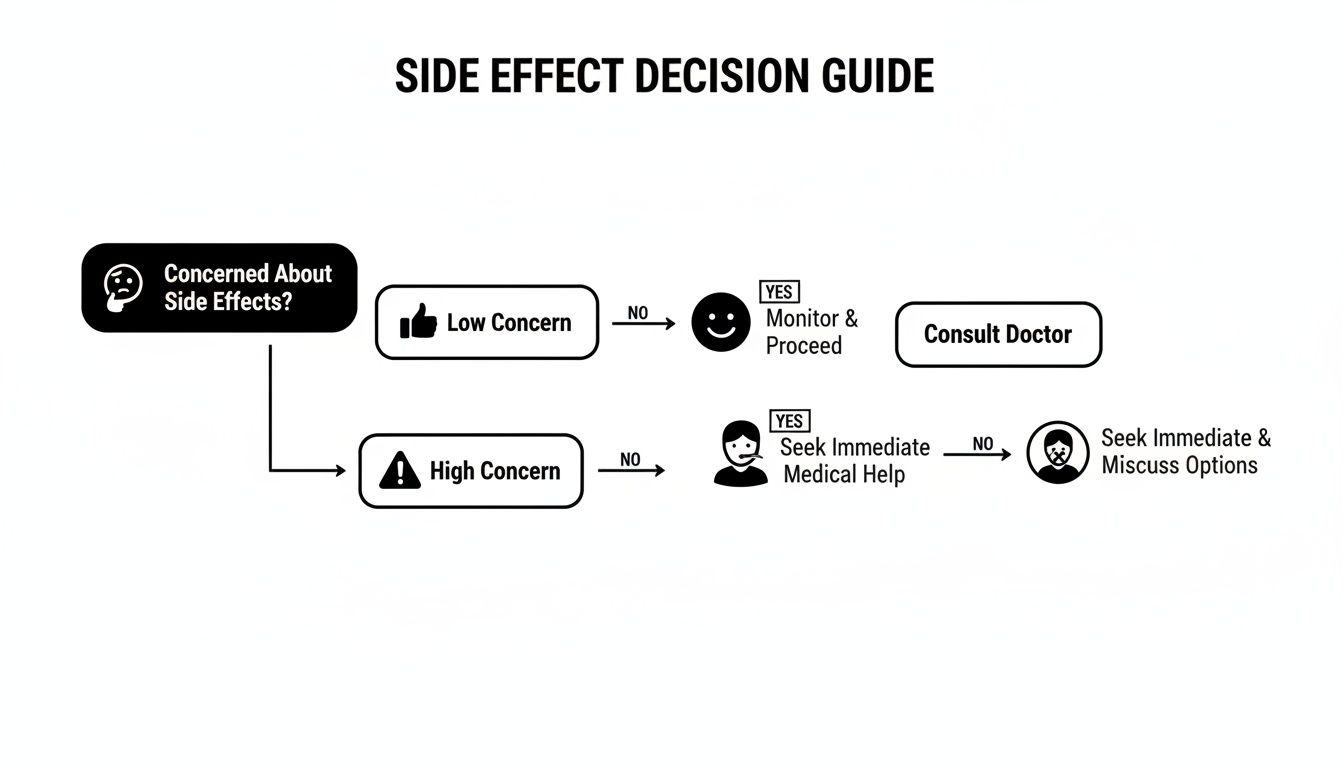
This kind of framework shows how your personal risk tolerance can help you and your doctor decide whether to stick with the standard approach or explore a more aggressive one.
Building a Comprehensive Hair Restoration Strategy
It’s crucial to remember that these medications don't have to work in a vacuum. In fact, they are most often the foundation of a broader, multi-pronged attack on hair loss, working in tandem with other therapies to get the best possible results.
A really solid, comprehensive plan might also include:
- Minoxidil: Whether you use the topical solution or the oral pill, minoxidil works on a completely different pathway. It's thought to improve blood flow and extend the hair’s growth phase. Combining an oral DHT blocker with minoxidil is one of the most powerful non-surgical combos out there.
- Platelet-Rich Plasma (PRP) Therapy: This procedure uses a concentration of your own blood platelets, injected into the scalp, to kickstart follicular activity. It can be a fantastic booster for a medication-based routine.
- Low-Level Laser Therapy (LLLT): Laser caps and combs use red light to stimulate cellular energy within the hair follicles, which can help encourage growth.
The best hair restoration plans attack the problem from multiple angles. A DHT blocker like finasteride or dutasteride addresses the root hormonal cause, while treatments like minoxidil or PRP work to actively stimulate and support the hair follicles.
Ultimately, the dutasteride vs. finasteride debate isn't about finding a single "best" drug. It's about finding the best drug for you. Finasteride is the reliable starting player, and dutasteride is the heavy-hitter you call on when you need more power. With this knowledge, you’re ready to have a truly productive talk with your doctor and build a plan that works.
Answering Your Key Questions
When you're weighing dutasteride against finasteride, a lot of practical questions pop up. Let's tackle some of the most common ones head-on to give you the clarity you need.
Can I Switch from Finasteride to Dutasteride?
Absolutely. Making the switch is a well-trodden path for many men, especially for those who feel finasteride isn't quite getting the job done or their results have hit a wall. Think of it as the next logical step up in treatment, given dutasteride's more comprehensive DHT-blocking power.
The transition itself is usually seamless. Because finasteride clears out of your system relatively quickly, your doctor will likely just have you stop one and start the other the very next day. This keeps DHT suppression consistent and avoids any gaps in your treatment.
Is It Safe to Use Both Medications Together?
Taking both oral finasteride and oral dutasteride at the same time is generally not recommended. They both target the same 5-alpha-reductase enzyme, so combining them is redundant and can unnecessarily elevate the risk of side effects without any real upside.
That said, some more aggressive treatment plans might pair oral dutasteride with a topical finasteride solution. This is an advanced strategy and definitely not a DIY situation—it must be done under the careful guidance of a hair loss specialist who can track your response.
Will I Experience Shedding When I Switch?
The fear of a big shed is a common concern when changing treatments, but it's highly unlikely when moving directly from finasteride to dutasteride. The initial shedding phase many people experience happens when they first start a DHT blocker, as follicles cycle out old, miniaturized hairs to grow stronger ones.
Since you’re just swapping one DHT blocker for a more potent version, you’re not interrupting that protective mechanism. Your follicles are already accustomed to reduced DHT, so a significant shed isn't something we typically expect to see.
The Bottom Line: Moving from finasteride to dutasteride is usually a smooth transition aimed at boosting your results. A major shed isn't a typical part of this specific switch.
Is Dutasteride FDA-Approved for Hair Loss?
Here’s a crucial distinction: No, dutasteride is not officially FDA-approved specifically for treating male pattern hair loss. The FDA has approved it for treating an enlarged prostate, also known as benign prostatic hyperplasia (BPH).
However, its powerful effect on DHT and hair growth has been proven time and again in clinical research. This is why physicians often prescribe it "off-label" for hair loss, especially when a man needs something stronger than finasteride to get the results he's after.
At PRP For HairLoss, our goal is to arm you with clear, evidence-based knowledge for your hair restoration journey. To see how these treatments fit into a broader strategy, feel free to explore our resources at https://prpforhairloss.com.
 PRP For Hairloss
Leave a comment