Let's cut to the chase: Do DHT blockers work?
The answer is a resounding yes, and this conclusion is strongly backed by extensive scientific evidence for treating androgenetic alopecia, or pattern hair loss. Think of DHT's effect on your hair follicles like a dimmer switch slowly turning down the light; these treatments stop that switch from dimming, protecting your hair.
The Verdict on DHT Blockers: A Quick Answer
DHT blockers are engineered to combat hair loss by targeting its primary hormonal culprit right at the source. They work by significantly reducing your body's levels of Dihydrotestosterone (DHT), the potent hormone responsible for shrinking hair follicles in genetically susceptible individuals.
This damaging process, known as miniaturization, gradually shortens the hair's growth phase. Over time, this results in progressively thinner strands and eventual baldness. DHT blockers intervene directly in this destructive cycle, giving your follicles a crucial protective shield. It’s not about eliminating testosterone but managing its conversion into follicle-damaging DHT.
Evidence Backing Their Effectiveness
The support for DHT blockers isn't merely anecdotal; it's rooted in hard clinical data. For instance, a significant meta-analysis that reviewed over 20 clinical trials directly compared their efficacy. It found that oral DHT blockers like dutasteride and finasteride consistently outperformed non-DHT blocking treatments. After just 24 weeks, they proved more effective than both oral and topical minoxidil regimens. You can discover more insights about DHT blockers and their performance on Xyon Health.
By lowering DHT levels in the scalp, these treatments effectively shield hair follicles from the miniaturization process that leads to thinning and baldness. This protective action is the core reason they are a cornerstone of modern hair loss therapy.
However, it's crucial to set realistic expectations. Their success isn't instantaneous, and overall effectiveness depends on a few key factors:
- The Specific Blocker Used: Different types, from prescription medications to natural supplements, have varying levels of potency.
- Consistency of Use: These treatments demand a long-term, daily commitment to maintain results, as stopping will cause hair loss to resume.
- Your Individual Biology: Your unique genetic sensitivity to DHT and stage of hair loss play a significant role in the final outcome.
Ultimately, while the science confirms DHT blockers do work, understanding these nuances helps you begin your treatment journey with improved clarity and confidence.
Understanding DHT's Role in Hair Loss
Before we can see why DHT blockers are so effective, we first have to get to the root of the problem itself. The culprit here is Dihydrotestosterone, or DHT, but it’s not some foreign invader. It’s actually a powerful hormone your own body makes from testosterone, and it's essential for developing male characteristics during puberty.
So, if it's natural, why is it responsible for hair loss? The real issue isn't DHT itself, but a genetic sensitivity to it. That's the key difference between someone who maintains a full head of hair and someone who experiences pattern baldness. It all comes down to how your hair follicles are genetically wired to respond to this hormone.
The Lock and Key That Triggers Hair Loss
I find the best way to explain this is with a simple "lock and key" analogy. Imagine each of your hair follicles has a tiny, specific lock on it called an androgen receptor. In this scenario, DHT is the perfectly shaped key.
As DHT travels through your bloodstream and makes its way to your scalp, it finds these receptors and "unlocks" them. This connection, however, isn't a good thing. It sends a signal to the hair follicle to start a destructive process known as miniaturization.
Miniaturization is the gradual shrinking of the hair follicle. Every time the DHT key turns the lock, it messes with the hair's natural growth cycle. The growth phase gets shorter and the follicle itself weakens, producing a hair that's thinner, shorter, and lighter in color with each new cycle.
This isn't an overnight disaster; it's a slow, progressive weakening that can take years. Over time, the follicle shrinks so much that it eventually just gives up and can no longer produce a visible hair. That's what leads to the baldness we see.
Where Does This Problem Start? The 5-Alpha Reductase Enzyme
So where is all this trouble-making DHT coming from? It's created from testosterone by an enzyme called 5-alpha reductase. Think of this enzyme as a little factory in your body. Its one job is to take testosterone and convert it into the much more potent DHT.
For men who are susceptible to pattern hair loss, this conversion process is the main event. The more active the 5-alpha reductase "factory" is, the more DHT it pumps out, which in turn speeds up the miniaturization of those sensitive hair follicles.
This is precisely why a treatment strategy that focuses on inhibiting 5-alpha reductase works so well. By slowing down this factory, you dramatically reduce the amount of the DHT "key" being produced, which means fewer keys are around to damage the "locks" on your hair follicles.
Once you understand this chain of events—testosterone gets converted by 5-alpha reductase, DHT binds to follicles, and follicles start shrinking—it becomes clear why the answer to "do DHT blockers work?" is a firm, scientifically-backed "yes." They are engineered to step in and break this exact biological sequence, giving your follicles a fighting chance.
How DHT Blockers Work to Stop Hair Loss
So, how do these DHT blockers actually stop hair from falling out? To get a clear picture, we need to look at the science behind it. Think of the enzyme 5-alpha reductase as a tiny biological factory in your body. Its main job is to convert testosterone into dihydrotestosterone, or DHT.
DHT blockers don't just bulldoze this factory. That would cause all sorts of unwanted problems. Instead, they act more like a precise manager, specifically slowing down the assembly line that produces DHT—the hormone that’s so damaging to hair follicles. It's this targeted approach that makes them effective, giving your follicles a fighting chance to recover and grow without being constantly under assault.
Targeting the Enzyme at the Source
It turns out there isn't just one type of 5-alpha reductase enzyme. There are two main forms, Type I and Type II, and they hang out in different parts of the body. For anyone dealing with male pattern baldness, the Type II enzyme is the one that really matters, as it's highly concentrated in and around the hair follicles on your scalp.
This is where prescription medications like finasteride and dutasteride come in. They are designed to very specifically inhibit these enzymes. They essentially bind to the 5-alpha reductase enzyme, physically blocking it from doing its job of turning testosterone into DHT. Your testosterone levels aren't the problem; it's the conversion to the much more potent, hair-thinning DHT that needs to be managed.
The mechanism is quite direct: by inhibiting the 5-alpha reductase enzyme, these blockers cause a significant drop in DHT levels in the scalp. This action interrupts the process of hair follicle miniaturization, allowing the hair to return to a normal, healthy growth cycle.
The results are pretty dramatic. Dutasteride, for instance, blocks both Type I and Type II enzymes, which can lower DHT in the bloodstream by about 98%. Finasteride, which mainly goes after the Type II enzyme, reduces blood DHT by around 71%. This effect is also seen right where it counts—on the scalp. Here, dutasteride can lower DHT levels by 51%, and finasteride by 41%. You can read a more detailed breakdown of these DHT blocker findings on Xyon Health.
This simple infographic lays out the chain of events quite nicely.
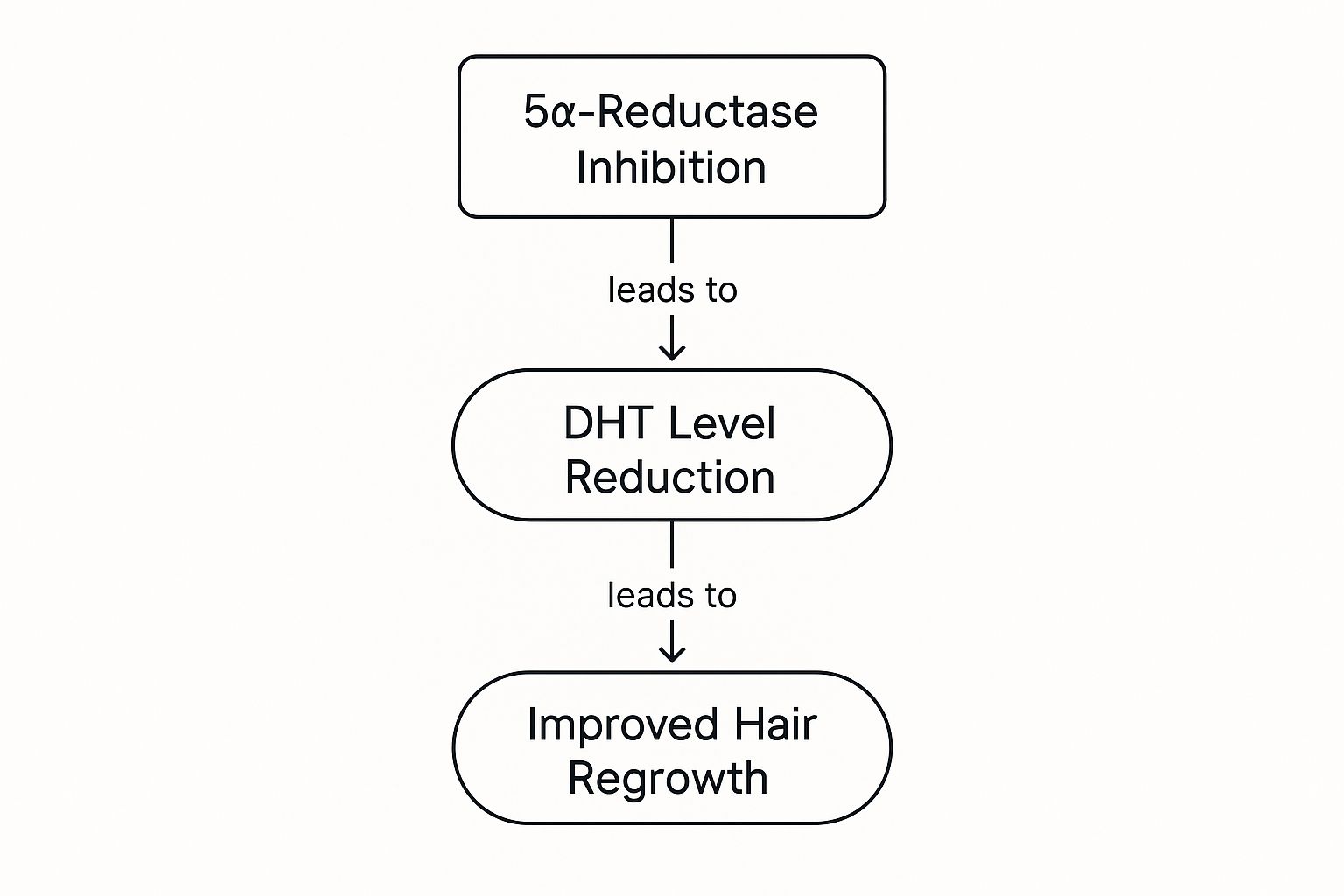
As you can see, blocking the enzyme leads directly to less DHT. Less DHT means a healthier environment for your hair to grow. It's this clear, cause-and-effect science that explains why these treatments have become a cornerstone for successfully managing hair loss for so many people.
What to Realistically Expect from Your Treatment Timeline

When you start taking DHT blockers, your two best friends will be patience and consistency. This isn't an overnight fix; it's a long-term strategy for your hair's future. Knowing what the journey looks like is the key to staying motivated and spotting the small but crucial signs that your treatment is on the right track.
One of the first things you might notice is a bit of extra shedding. I know, that sounds counterintuitive and can be alarming, but it's actually a good sign. Think of it as your hair follicles doing a bit of house-cleaning—they're pushing out old, weaker hairs to make way for new, stronger ones. This initial shed often means your hair growth cycles are getting a healthy reset.
The Typical Journey Map
Everyone's body responds differently, but there's a fairly predictable path most people follow. To answer the question "do DHT blockers work for me?" you'll need to look for progress over months, not days. The results from clinical studies give us a pretty good roadmap of what to expect if you stick with it.
Let's take a common prescription like finasteride. A daily 1mg pill is known to block about 70% of DHT and has an impressive 83% success rate in stopping further hair loss. The visible proof of that action, however, takes time to show up. You can learn more about what to expect from DHT blocker treatments here.
Key Takeaway: The benefits of DHT blockers are cumulative. If you stop the treatment, your DHT levels will return to normal, and any hair you’ve maintained or regrown will likely be lost within a year.
Here’s a more detailed breakdown of what your first year might look like:
- Months 1-3: Don't be surprised if you see some initial shedding. It’s normal. Your main job here is to get into the habit of taking your treatment every single day.
- Months 3-6: Shedding should slow down or stop altogether. You might start noticing the first subtle signs of progress, like fine, vellus "peach fuzz" hairs appearing or your hair just feeling a little thicker.
- Months 6-12: This is when the magic really starts to happen. You'll likely see more obvious results, such as better density, improved coverage, and less scalp showing through. This is the period when most people feel confident the treatment is working.
- After 1 Year: By now, you should be seeing the full effect of the treatment. The goal shifts from regrowth to maintenance—continuing the treatment to keep protecting your hair from DHT for the long haul.
Of course. Here is the rewritten section, designed to sound natural and expert-driven, following all your specified requirements.
What About the Potential Side Effects?
No honest discussion about DHT blockers would be complete without talking about side effects. Let's face it, the idea of messing with your hormones, even a little bit, can be unsettling. It’s important to cut through the noise and look at the actual data so you can make a decision that's right for you.
When people talk about side effects, they're almost always referring to prescription medications like finasteride. Since these drugs work on a hormone that comes from testosterone, the main concerns usually center around sexual health. But it's really important to know that these issues don't happen to everyone—not by a long shot.
So, What Are the Real Risks?
For the vast majority of men, these medications are completely fine. The clinical trials back this up, showing that serious side effects are rare. Even when they do pop up, they often fade away as the body gets used to the medication over time.
The side effects that are reported most often include:
- A drop in libido (feeling less interested in sex)
- Erectile dysfunction (ED)
- Less ejaculate volume
Think of it this way: you're weighing a small statistical risk against the very real and proven benefit of stopping your hair loss. For most guys, that's a trade-off that makes sense.
Let's Put the Numbers in Perspective
One study, for instance, found that up to 15.8% of men experienced at least one of these side effects. That number might sound a little scary at first, but it helps to know that for many, the issues went away on their own. You can dive deeper into the research on these findings over at Hair Science if you want the full breakdown.
Now, there is a very small group of men who have reported that these symptoms stuck around even after they stopped taking the medication. This is sometimes called post-finasteride syndrome (PFS). It's a real phenomenon discussed in medical circles, but experts are still researching how common it is and exactly what causes it.
Ultimately, the decision to use a DHT blocker is a personal one. It comes down to weighing the proven benefits against the potential risks for your own body and lifestyle. The best first step is always an open conversation with your doctor. They can help you understand your personal health profile and figure out the best path forward for keeping your hair.
Exploring Natural and Topical Alternatives

If you're hesitant to jump into systemic medications or worried about potential side effects, you're not out of options. The world of hair loss treatment has expanded, with several natural and topical pathways gaining a lot of traction. Many people find these alternatives to be a much more approachable starting point.
These alternatives often operate on a similar wavelength as their prescription cousins—they aim to disrupt DHT's destructive influence on hair follicles. The main difference? They tend to do it in a milder, less potent way, which is a big part of their appeal.
The Rise of Natural DHT Blockers
You've probably seen them mentioned online or on product labels. Certain plant-based extracts have been investigated for their ability to act as natural DHT blockers. While they might not pack the same punch as finasteride, they offer a compelling route for anyone looking for a less aggressive strategy.
Two of the most popular natural players are:
- Saw Palmetto: This herbal remedy is thought to inhibit the 5-alpha reductase enzyme, much like prescription drugs do, just to a lesser degree. It's a common ingredient in hair supplements and shampoos.
- Pumpkin Seed Oil: This oil is loaded with beneficial compounds. Some research suggests that regular use of pumpkin seed oil might help block DHT and encourage healthier hair growth.
It's important to set realistic expectations here. While these natural ingredients show promise and generally have fewer side effects, their effectiveness isn't as extensively proven as that of FDA-approved medications.
The real beauty of topical treatments is their precision. By applying the medication directly to the scalp, you're hitting the hair follicles exactly where they need support. This approach is specifically designed to minimize the amount of the drug that enters your bloodstream.
A Targeted Topical Approach
Another major step forward has been the creation of topical DHT blockers. These are often the same medications, like finasteride, but they’re reformulated into a serum or spray that you apply right to your scalp. The goal is to deliver the active ingredient where it's needed most, which could lower the risk of the systemic side effects sometimes linked to oral pills.
These alternatives really broaden the toolkit for fighting hair loss. If you're looking to explore even more solutions, this detailed science-backed guide on whether PRP works for hair loss offers excellent insights into other advanced treatments.
Frequently Asked Questions About DHT Blockers
When you start digging into hair loss treatments, it's natural for a ton of questions to pop up. And when you're considering something like DHT blockers, you need straight answers to feel confident about your next steps. Let's tackle some of the most common and practical questions people have.
Think of this as your personal cheat sheet, designed to clear up any lingering confusion about how these treatments work and what you can realistically expect.
Can DHT Blockers Regrow Hair on a Completely Bald Spot?
This is a big one, and it's where we need to be realistic. DHT blockers are fantastic at two things: stopping hair loss in its tracks and thickening up the thinning, miniaturized hairs you still have. Their main job is to preserve what you've got and give thinning areas a second wind.
But what about a spot that's been smooth and bald for years? It's highly unlikely. Once a hair follicle goes dormant and scars over, it's pretty much retired from the job of producing hair. This is precisely why early intervention is so crucial—it gives the treatment a fighting chance to work with active follicles.
Key Insight: Think of a DHT blocker as your hair's best line of defense. It protects the follicles you have from DHT's damaging influence. While some regrowth is a fantastic bonus, its true power is in stopping the progression of hair loss.
Are DHT Blockers Safe for Women to Use?
This is a really important question, and the answer is complex. Using DHT blockers for women absolutely requires a doctor's guidance. Prescription medications like finasteride and dutasteride are strictly forbidden for any woman who is pregnant or might become pregnant because they can cause severe birth defects in a male fetus.
That said, a dermatologist might prescribe these medications "off-label" for some post-menopausal women or those who are certain they won't become pregnant. Only a qualified doctor can evaluate your specific situation and determine if this is a safe and appropriate path for treating female pattern hair loss.
What Happens If I Miss a Dose?
Don't sweat it. Missing a single dose isn't going to undo your progress. The real magic of DHT blockers comes from keeping your DHT levels consistently low over the long haul, not from flawless daily perfection.
If you miss a dose, just take your next pill at the usual time. Do not take a double dose to make up for it. That just increases your risk of side effects without providing any extra benefit. What truly matters is consistency over months and years.
Do I Have to Take DHT Blockers Forever?
In a word, yes—as long as you want to keep the results. Pattern hair loss isn't a temporary problem; it's a chronic condition hardwired by your genetics and fueled by DHT. If you stop taking the blocker, your DHT levels will creep back up to their normal, pre-treatment baseline.
When that happens, any hair you managed to save or regrow will likely be lost over the next year. It's best to think of DHT blockers as a long-term commitment, similar to how you would manage any other ongoing health condition.
At PRP For HairLoss, we're committed to giving you clear, science-backed information to guide you on your hair restoration journey. We specialize in treatments like Platelet-Rich Plasma (PRP) and explaining how they fit into a complete strategy for tackling male pattern baldness. To explore all your options, learn more at the PRP For Hairloss website.

 PRP For Hairloss
Leave a comment