Ever found yourself wondering what’s really going on up there when you see more hair in the shower drain? For most people dealing with common hair loss, the story points to one main character: a hormone called Dihydrotestosterone (DHT).
Think of it like this: for some of us, DHT is like a key that perfectly fits a lock on our hair follicles. When that key turns, it sends a signal for those follicles to gradually shrink and, eventually, shut down.
The Hidden Culprit Behind Your Thinning Hair
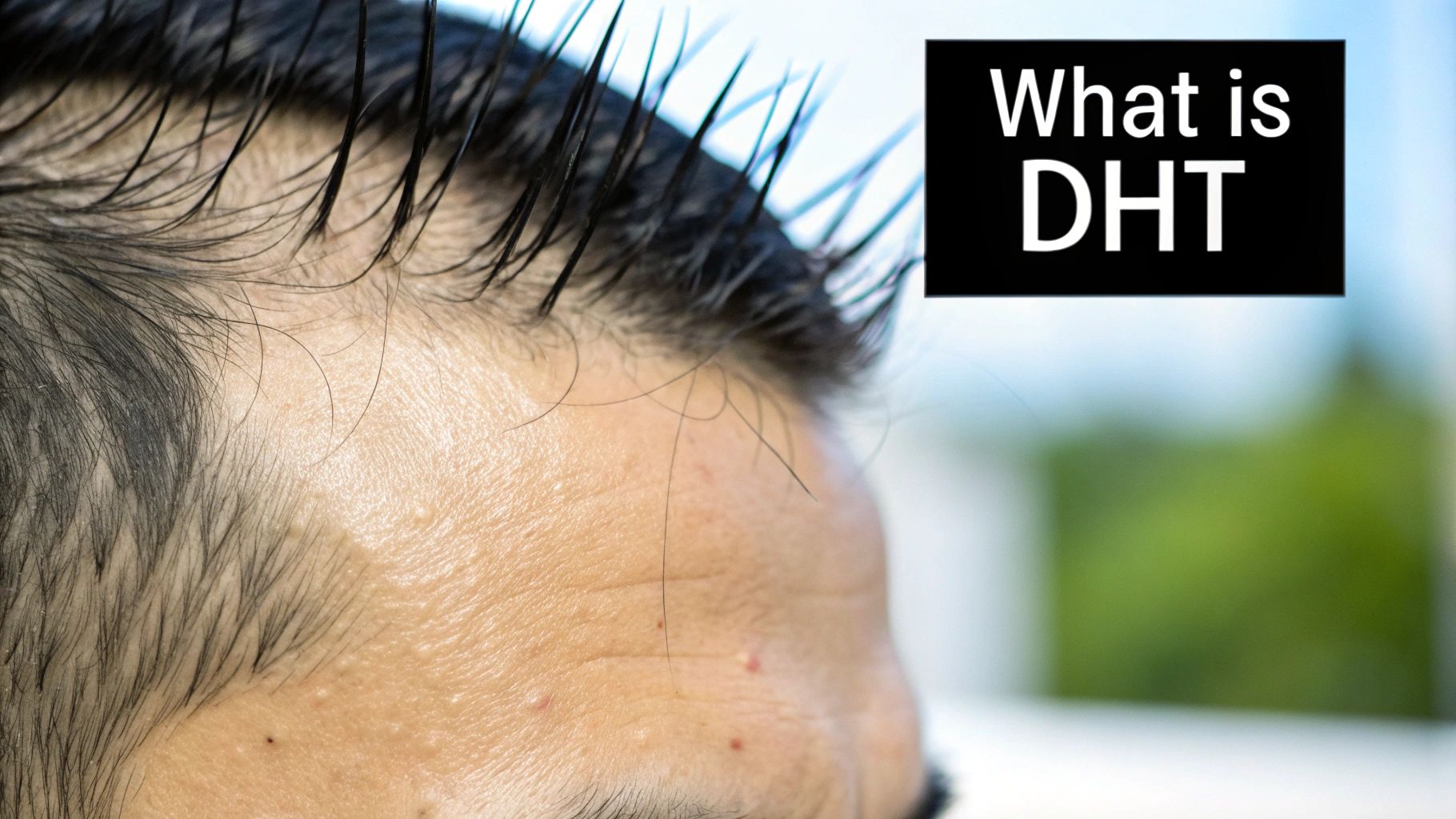
While a few different things can cause hair to thin, the story of male and female pattern baldness almost always circles back to DHT. This powerful hormone isn't some strange invader; it's a natural byproduct of testosterone that your body makes every day.
It gets created when an enzyme called 5-alpha reductase gets its hands on some of your testosterone and converts it. In fact, about 10% of testosterone is turned into DHT every single day.
During puberty, DHT is a superhero, responsible for developing male characteristics like a deeper voice, facial hair, and body hair. The trouble is, once you're past adolescence, its presence can become a real problem for anyone with a genetic sensitivity to hair loss.
How DHT Actually Triggers Hair Loss
This whole process has a scientific name: androgenetic alopecia. At its heart, it’s all about how sensitive your hair follicles are to DHT.
When DHT latches onto special androgen receptors in these genetically susceptible follicles, it kicks off a process called follicular miniaturization. It's a fancy way of saying the follicles start to shrink.
This shrinking action also shortens the hair's active growth phase (known as the anagen phase), which for a healthy hair, typically lasts for two to six years. You can dive deeper into the various factors in our guide on what causes hair loss.
With each new growth cycle, the hair that pops out is thinner, weaker, and shorter. Eventually, the poor follicle just gives up and stops producing hair altogether. This isn't some rare condition—it affects up to 50% of men by the time they reach age 50.
Interestingly, not all hair follicles get the same memo. The hair on the back and sides of the head is usually resistant to DHT's shrinking effects. This is exactly why those areas are the go-to donor sites for hair transplant procedures—their resilience is practically built-in.
Quick Overview: DHT vs Testosterone
To get the full picture, it helps to see them side-by-side. While they're related, their impact on your hair couldn't be more different.
| Hormone | Role in Hair Loss | Potency | Formation |
|---|---|---|---|
| Testosterone | Indirectly involved; it's the raw material for DHT. | Less androgenic than DHT. | Produced primarily in the testes and ovaries. |
| DHT | Directly binds to follicles, causing them to shrink (miniaturize). | 2-3 times more potent than testosterone. | Converted from testosterone by 5-alpha reductase. |
As you can see, DHT is the more powerful, specialized hormone when it comes to influencing hair follicles.
What Does This Mean For Treatment?
Knowing that DHT is the main villain in this story opens the door to effective treatments. The goal of many modern therapies, from medications to natural supplements, is to either lower the amount of DHT in the scalp or block its ability to attach to the hair follicles.
This is also where treatments like Platelet-Rich Plasma (PRP) come into the picture. PRP therapy doesn't try to block DHT directly. Instead, it works to counteract the damage DHT causes by delivering a concentrated dose of your body's own growth factors right to the scalp.
These growth factors help stimulate the weakened follicles, encouraging them to stay in the growth phase longer and produce thicker, healthier hair. It's a strategy that focuses on revitalizing the follicles rather than just fighting the hormone.
How DHT Gradually Shrinks Your Hair Follicles
So, what’s actually happening on your scalp when DHT gets involved? It’s not like your hair just decides to fall out one day. Instead, it’s a slow-motion process called follicular miniaturization—a gradual weakening that takes place over many hair growth cycles.
Picture a healthy hair follicle as a big, bustling factory that produces thick, strong hair strands. Now, imagine DHT as a saboteur that slowly cuts off the factory's power and supply lines. Production doesn't stop overnight, but each new product that comes off the line is a little smaller and weaker than the last.
This image breaks down how the hormone conversion leads to this progressive thinning.
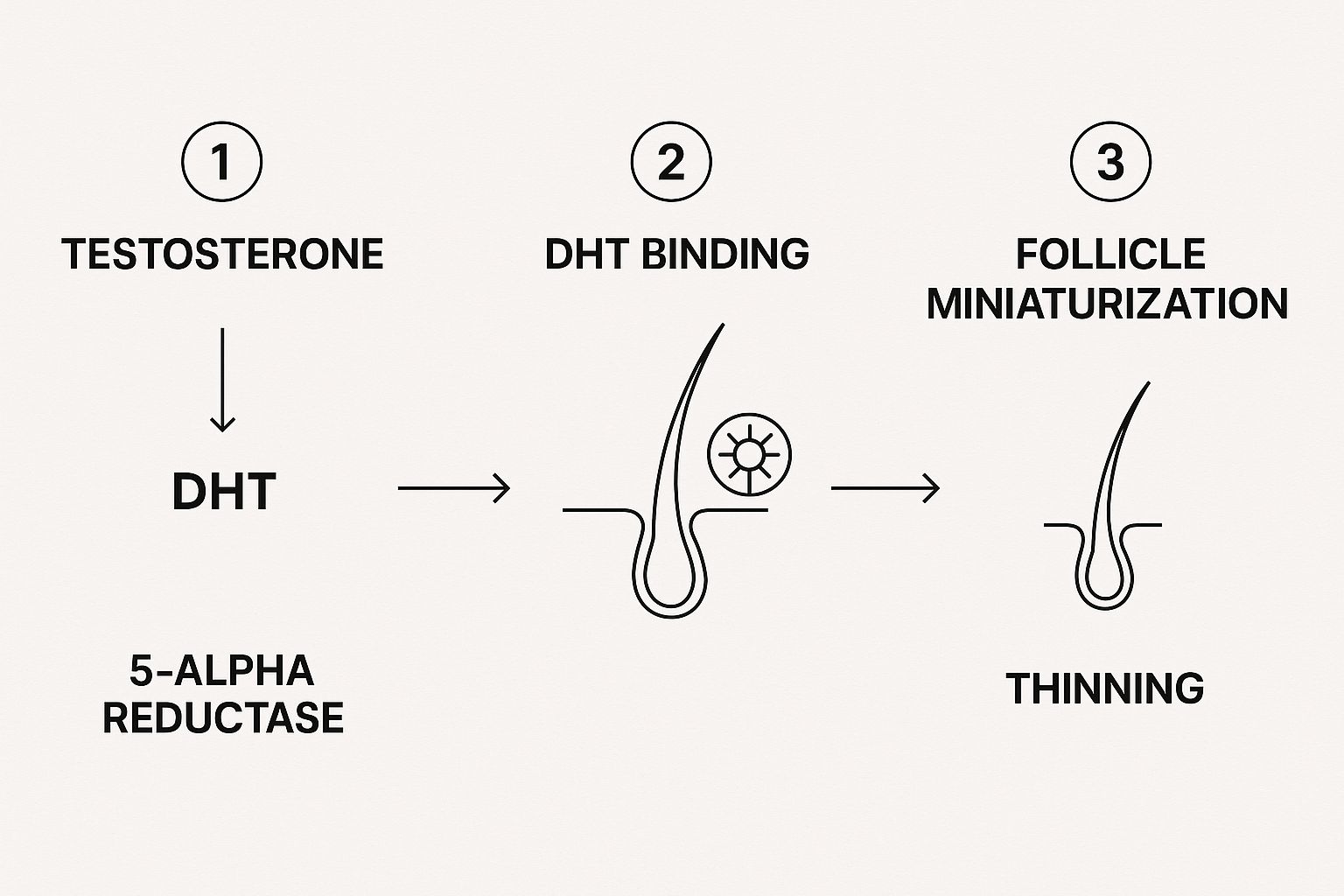
As you can see, DHT doesn't just attack the hair itself; it latches onto the follicle and systematically dismantles its ability to grow healthy hair.
The Hair Growth Cycle Under Attack
Every single hair on your head goes through a natural cycle. The most important phase is the anagen phase—this is when the hair is actively growing. For a healthy scalp, this growth period can last anywhere from 2 to 6 years.
Here’s where DHT causes trouble. For those of us with a genetic sensitivity, DHT cuts this anagen phase short. At the same time, it forces the hair into the telogen phase (the resting stage) for longer periods.
The result is a double-whammy: your hair spends much less time growing and far more time just sitting there, waiting to shed. You can get a deeper look at the mechanics in our guide to hair follicle miniaturization.
This creates a destructive feedback loop. Each new hair that grows back is shorter, finer, and more fragile than the one before it. Eventually, the follicle shrinks so much that it can no longer produce any visible hair at all.
Why Each New Hair Is Weaker
This progressive weakening is the hallmark of pattern baldness. With every new growth cycle, the miniaturized follicle struggles to produce a hair that’s just a ghost of its former self. That bustling factory is now barely running, churning out a tiny, flimsy product.
Eventually, the follicle just gives up. It doesn't die, but it becomes dormant—alive, but no longer producing hair. This is precisely why catching hair loss early is so crucial. It's far easier to help a struggling follicle recover than it is to coax a dormant one back to life.
Why Your Genes Determine DHT's Impact
If you think of DHT as the bullet, your genetics are what load the gun. It’s a common myth that guys with baldness simply have more DHT floating around. That’s rarely the case. The real culprit is a genetically inherited sensitivity to completely normal levels of the hormone.
This sensitivity is controlled by something called the androgen receptor (AR) gene. You can think of this gene as the volume dial for DHT’s signal. In some people, genetics crank that dial way up, meaning even a small amount of DHT sends a powerful, destructive message to the hair follicles, triggering miniaturization.
This is exactly why male pattern baldness runs so strongly in families. You don't inherit high levels of DHT; you inherit hair follicles that are hardwired to overreact to it. If your dad or grandpa went bald, there’s a good chance your follicles carry that same genetic blueprint. We dive deeper into how these traits are passed down in our overview of male pattern baldness genetics.
How Genes Influence Hair Loss Patterns
This genetic link also explains the classic patterns of hair loss we see. For the 50 million men and women in the U.S. dealing with this, their genes dictate where the thinning happens.
Men usually see the classic receding hairline and a thinning spot at the crown. Women, on the other hand, tend to experience more of a diffuse, all-over thinning, which often becomes more noticeable after menopause when hormonal changes kick in.
The bottom line is this: Your body's response to DHT is written in your DNA. It explains why two men can have identical DHT levels, yet one has a full head of hair while the other is significantly thinning. Often, the best crystal ball for your own hair's future is your family photo album.
Proven Strategies for Managing DHT Hair Loss
https://www.youtube.com/embed/PXiZjh7-cxU
So, we've established that DHT is the primary trigger for male pattern baldness. The natural next question is, what can you actually do about it? Thankfully, this isn't a new problem, and there are a couple of solid, well-researched ways to tackle it.
The main strategies come down to a two-pronged approach: you can either reduce the amount of DHT your body produces, or you can work on stimulating the hair follicles to help them stand up to DHT's effects. It’s less about a magic cure and more about smart, effective management.
Lowering DHT Production
The most direct way to fight DHT hair loss is to go straight to the source: the enzyme 5-alpha reductase. If you can slow this enzyme down, you can significantly drop the DHT levels in your scalp. This gives your embattled hair follicles a much-needed break and a chance to recover.
This is exactly how medications like finasteride work. They are designed to inhibit that enzyme, reducing the conversion of testosterone into DHT throughout the body. For many men, this is enough to slow, stop, or in some cases, even reverse the hair thinning process.
The scale of this issue is massive. We're talking about a global market for hair loss treatments valued at USD 52.37 billion in 2022, with over 650,000 hair transplant procedures performed annually. Finasteride is the most common medical treatment, prescribed to roughly 66.4% of patients, which shows just how crucial DHT management is. You can dig into more hair loss treatment market statistics to see the full picture.
Stimulating Hair Follicle Growth
The other major strategy takes a completely different path. Instead of blocking DHT, this approach focuses on fortifying the hair follicles themselves. The idea is to create a healthier scalp environment, making the follicles more robust and resilient to DHT’s destructive influence.
Minoxidil is the best-known example of this. It's a topical treatment that works by increasing blood flow to the scalp and helping to keep the hair in its anagen (growth) phase for longer. Think of it like giving a struggling plant better soil and more water—you're not removing the bad weather, but you're helping the plant become strong enough to withstand it. We cover this concept more in our guide on whether DHT blockers really work.
Key Takeaway: You can either fight DHT head-on by reducing its levels, or you can support your hair follicles so they are better able to resist its miniaturizing effects. The most successful treatment plans often combine both of these tactics.
Exploring PRP Therapy: A Modern Approach

While fighting DHT with blockers is a proven strategy, there's another powerful tool in the arsenal that takes a completely different path: Platelet-Rich Plasma (PRP) therapy. Instead of targeting hormones, this treatment taps into your body's own incredible healing power to wake up struggling hair follicles.
Think of it like this: your blood contains platelets, which are little powerhouses packed with growth factors designed to heal injuries. PRP therapy isolates these platelets, concentrates them, and delivers that healing cocktail right where it's needed most—your scalp.
The process is pretty straightforward. A small sample of your own blood is drawn (just like a routine blood test) and spun in a centrifuge. This separates the platelets and plasma from other blood cells, creating a golden, nutrient-rich serum. This PRP is then meticulously injected into the areas of thinning hair.
How PRP Fights Back Against DHT Damage
So, how does this actually help with hair loss? The whole point of PRP is to reverse that miniaturization process that DHT kicks off. The concentrated growth factors in the plasma essentially sound the alarm for dormant follicles, telling them to get back to work.
They do this in a few key ways:
- They boost blood flow to the scalp, which is like opening up a superhighway for oxygen and nutrients to reach the hair roots.
- They kickstart cell regeneration, helping to repair the very follicles that DHT has been trying to shrink.
- They extend the anagen (growth) phase of the hair cycle, giving each strand more time to grow longer and stronger.
In short, while DHT is busy trying to put your hair follicles to sleep, PRP therapy swoops in with a potent biological boost, helping them to not only resist but return to a healthy growth cycle.
Who Is a Good Candidate for PRP?
PRP tends to deliver the best results for people in the earlier stages of male pattern baldness. This is when the follicles are weakened and shrinking but haven't shut down completely. It’s a fantastic option on its own, but it can also be combined with treatments like finasteride or minoxidil to create a multi-pronged attack against hair loss.
Of course, the only way to know for sure if it’s the right move for you is to chat with a specialist who can assess your specific situation. To get a deeper understanding of the procedure, check out our complete guide to platelet-rich plasma therapy for hair. It's a compelling, science-backed option that's giving many men a new way to manage their hair loss.
Answering Your Top Questions About DHT and Hair Loss
When you start digging into hair loss, it's easy to get lost in a sea of conflicting information. Let's cut through the noise and tackle some of the most common questions people have about DHT, so you can get the straight facts.
Think of this as your practical guide to understanding how DHT works and what you can actually do about it. Getting clear on these points is the best way to make smart decisions for your hair.
Can I Just Stop My Body From Making DHT?
It's a logical question—if DHT is the problem, why not just get rid of it? But it’s not that simple. Trying to completely eliminate DHT isn't a good idea, and frankly, it's not the goal of effective treatment.
DHT is important for other functions in the male body. The real aim is to dial back its effects on your hair follicles, not to shut it down entirely. Think of treatments like finasteride, which block the 5-alpha reductase enzyme that creates DHT. They dramatically lower the hormone's levels where it counts—in your scalp—without completely removing it from your system. It's about finding a balance.
Does My Lifestyle Really Impact DHT Hair Loss?
Absolutely. While your genetics are the root cause, your lifestyle can either help or hurt the situation. Think of your genetic predisposition as a smoldering fire; things like chronic stress, a nutrient-poor diet, and not getting enough sleep are like pouring gasoline on it.
These stressors don't cause male pattern baldness, but they can definitely disrupt your hormones and accelerate the thinning process.
On the flip side, a healthy lifestyle creates the best possible environment for your hair to fight back. Eating well, exercising, and getting enough rest helps support your follicles and can slow down the negative impact of DHT.
It helps to think of your body as an ecosystem. You can't change your genetic blueprint, but you have a lot of control over the environment. A healthier lifestyle gives your hair follicles a fighting chance, even if they're sensitive to DHT.
Are DHT-Blocking Shampoos Enough to Stop Hair Loss?
DHT-blocking shampoos are a great addition to your toolkit, but they usually aren't powerful enough to be your only solution. Ingredients like ketoconazole or saw palmetto can help reduce inflammation on the scalp and offer some mild, topical DHT-blocking effects.
But let's be realistic: their impact is much weaker than FDA-approved medical treatments. They work best as a supporting player in a bigger strategy that includes more powerful therapies, not as your first and only line of defense.
At PRP For HairLoss, our goal is to give you clear, honest information so you can feel confident on your hair restoration journey. If you're looking for a modern, science-backed way to address the effects of DHT, it's worth exploring what PRP therapy can do. To learn more, visit us at https://prpforhairloss.com.


Leave a Reply