When you're looking into dutasteride for hair loss, the most common and clinically supported dosage is pretty straightforward: a 0.5 mg capsule taken once a day. Studies have shown this specific amount hits the sweet spot for effectively fighting male pattern baldness.
The whole point of this daily dose is to consistently lower the levels of the hormone that's actively damaging your hair follicles, giving them a real chance to bounce back and grow stronger.
How Dutasteride Protects Your Hair Follicles
Before diving into dosing schedules, let's get a quick handle on what dutasteride is actually doing. The main villain in the story of male pattern baldness is a hormone called Dihydrotestosterone, or DHT. If you want to go deeper, you can check out our guide on what DHT is and how it causes hair loss.
Over time, DHT attacks sensitive hair follicles, causing them to shrink in a process known as miniaturization. This is why you see hairs growing back thinner, shorter, and weaker, until eventually, the follicle just gives up. Dutasteride's job is to step in and put a stop to this.
The Science of Follicle Defense
Think of dutasteride as a bodyguard for your hair follicles. Its primary mission is to block the enzymes—called 5-alpha-reductase—that convert your regular testosterone into the much more aggressive DHT.
By getting in the way of this process, dutasteride drastically cuts down the amount of DHT circulating in your body and, most importantly, in your scalp. This takes the pressure off your hair follicles, giving them the space they need to recover from the damage and start growing thicker, healthier hair again.
What makes dutasteride so potent is that it blocks two different types of the 5-alpha-reductase enzyme (type I and type II). This dual-action approach results in a much more dramatic reduction in DHT than other, similar treatments.
This powerful DHT suppression is exactly why it's considered such an effective option. Studies have consistently shown that dutasteride's ability to slash DHT levels provides a robust defense against further hair loss.
It's important to remember that dutasteride isn't creating new hair follicles from scratch. Instead, it's reviving the ones you already have. That’s why sticking to the right dosage consistently is so important—it’s all about protecting the hair you have and helping it return to its former glory.
The Standard Dutasteride Dosage For Hair Loss

When you're trying to figure out the right way to tackle hair loss, you just want straight answers. For men looking into dutasteride, the good news is that the starting point is incredibly consistent and backed by years of clinical research.
The universally accepted dosage is a single 0.5 mg capsule, taken once a day. This isn't just a random suggestion; it's the specific dose that has been rigorously tested in clinical trials to find the ideal balance between stopping hair loss and maintaining a strong safety profile.
This daily 0.5 mg dose is proven to be a heavy hitter against DHT, the primary hormone driving male pattern baldness. It's the standard because it consistently helps increase hair count and improve thickness. Many guys land on this option after exploring different DHT blockers for hair loss with their doctor.
Why 0.5 mg Is The Gold Standard
You can think of this dosage as the "sweet spot." It’s powerful enough to make a real difference without being overkill. Studies have shown that a 0.5 mg daily dose of dutasteride can suppress DHT levels in the scalp by more than 90%.
That massive reduction is exactly what your struggling hair follicles need. It gives them a chance to recover from DHT's relentless attack and start growing healthier, more robust hair again.
The whole point of the 0.5 mg daily dose is to keep a stable, consistent level of the drug in your system. This creates a constant shield for your hair follicles, protecting them from DHT's damaging influence around the clock.
Interestingly, research hasn't found that taking a higher dose leads to significantly better hair growth. What it does do is raise the risk of potential side effects. This makes the standard 0.5 mg daily capsule the most sensible and effective protocol for treating androgenetic alopecia.
For a quick reference, here’s a simple breakdown of the standard protocol.
Standard Dutasteride Dosage At A Glance
| Aspect | Standard Recommendation | Important Note |
|---|---|---|
| Dosage Amount | 0.5 mg | This is the clinically established dose for androgenetic alopecia. |
| Frequency | Once per day | Consistency is crucial for maintaining stable DHT suppression. |
| Administration | Taken orally with a glass of water. Can be taken with or without food. | Do not chew or break the capsule, as it can irritate the mouth and throat. |
| Best Time of Day | Any time, but the same time each day is recommended. | Helps create a routine and ensures consistent levels of the medication. |
Ultimately, the 0.5 mg dose gives you the best shot at success with a safety profile that is well-understood and documented, offering a clear and reliable path forward.
How Dutasteride Stacks Up Against Finasteride

If you've spent any time looking into hair loss treatments, you've undoubtedly come across finasteride, often sold under the brand name Propecia. It's the go-to DHT blocker for many guys. So, the natural question is, where does dutasteride fit into the picture?
Both drugs do the same basic job: they block the 5-alpha-reductase enzyme that converts testosterone into the hair-killing hormone DHT. But there's a key difference in how they do it.
Think of finasteride as a specialist. It primarily targets the type II version of the enzyme. Dutasteride, on the other hand, is more of a heavyweight, blocking both the type I and type II versions.
Because of this dual action, dutasteride simply knocks down more DHT. While finasteride reduces DHT in the bloodstream by about 70%, a standard 0.5 mg dutasteride hair loss dosage can lower it by over 90%. This more aggressive approach is exactly why many see it as a more potent weapon in the fight to save your hair.
For a deeper dive, check out our complete comparison of finasteride vs. dutasteride for hair loss.
The Difference In Clinical Results
So, what does that extra DHT-blocking power mean in the real world? It often translates into better results when you look at the clinical studies. After all, the goal isn't just to halt hair loss but to actually see some regrowth.
When you put them head-to-head, the data suggests dutasteride's more thorough DHT suppression can lead to greater improvements in hair density over time.
One major analysis that pulled together multiple studies found a clear edge for dutasteride. After 24 weeks, men taking 0.5 mg of dutasteride daily grew an average of 7.1 more hairs per square centimeter compared to those on the standard finasteride dose. That's a noticeable difference.
Now, this doesn't automatically mean dutasteride is the "best" choice for everyone. But it's a critical piece of the puzzle to discuss with your doctor when figuring out which treatment makes the most sense for your specific situation and what you're hoping to achieve.
Exploring Alternative Dosing Strategies
While taking 0.5 mg of dutasteride every day is the standard, well-researched protocol, it’s not the only way to approach treatment. Some doctors and patients are exploring different strategies, usually with the goal of minimizing potential side effects without sacrificing the hair-saving benefits.
These aren't the standard "by-the-book" methods; think of them as "off-label" approaches that have become part of the broader conversation around hair loss treatment. The real aim is to find a long-term plan you can stick with, and for some people, that means adjusting how often they take the medication.
Let's look at some of the common dutasteride dosing strategies that people discuss with their doctors.
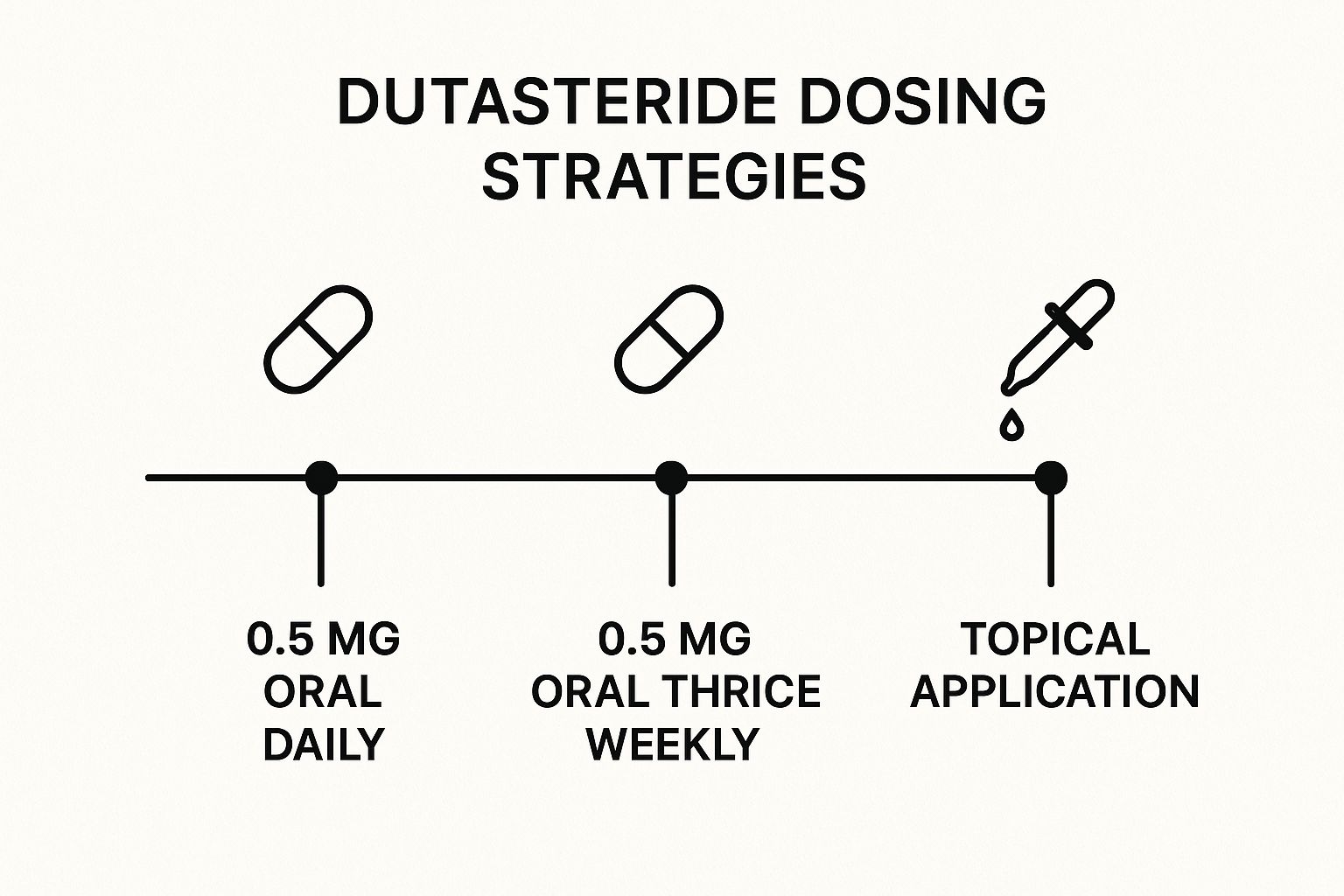
As you can see, the options range from the standard daily pill to less frequent schedules and even topical formulas applied directly to the scalp.
Less Frequent Oral Dosing
Here’s an interesting fact about dutasteride: it has a very long half-life. This means it stays active in your system for weeks, not days. Because of this, some people theorize that you don’t need a daily dose to keep DHT levels suppressed.
Taking it just three times a week, for example, is one such approach. This is often considered for guys who are particularly sensitive to the medication or are stacking it with other treatments. It’s all about finding that sweet spot between maximum DHT blockade and minimal systemic exposure. Understanding the potential for oral minoxidil side effects gives you a good idea of why managing risk is always a priority.
A quick but important warning: Never change your prescribed dosage on your own. This is a decision that has to be made with a healthcare professional who can track your results and make sure everything is going smoothly.
Topical Dutasteride Formulas
Another exciting frontier is topical dutasteride. The logic is pretty simple: why not apply the DHT-blocker directly where you need it—on the scalp—instead of sending it through your entire body?
This targeted approach hopes to deliver the best of both worlds: powerful protection for your hair follicles with a much lower chance of the drug being absorbed into your bloodstream. Studies have even shown promise with doses lower than the standard oral amount. In fact, a landmark 2004 study found that just 0.2 mg of dutasteride daily still led to significant hair growth compared to a placebo. You can read the full research about these findings to dive deeper into the science.
A Realistic Timeline For Seeing Results
When you start a new hair loss treatment, it’s completely normal to be impatient. You want to see results yesterday! But with dutasteride, patience really is your most important tool. Think of it as a marathon, not a sprint—that mindset will help you stick with it for the long haul.
To avoid getting discouraged, it helps to know what to expect. Believe it or not, one of the first signs that the medication is working can be a little unnerving: an initial shedding phase. This is actually a good thing. It means the dutasteride is kicking dormant follicles back into gear, pushing out old, weak hairs to make room for new, healthier ones.
The First Signs Of Progress
For the first few months, most of the action is happening under the surface as your DHT levels drop. You probably won't see a huge difference in the mirror just yet.
- Months 1-3: This is when you might experience some temporary shedding. It’s a normal part of the process and a sign that your hair cycle is resetting for the better.
- Months 3-6: Around this time, the first subtle signs of progress usually start to show up. You may notice less hair in the shower drain or on your brush. Some fine, new "vellus" hairs might even begin to sprout along your hairline.
The key takeaway here is consistency. Sticking with your prescribed dutasteride hair loss dosage day in and day out is what builds the foundation for the significant improvements that come later.
Reaching Peak Results
As you stay on the treatment, the results start to become much more obvious. This is where your commitment truly begins to pay off.
The sweet spot for seeing noticeable improvements in hair density and thickness is often between 6 and 12 months. This kind of timeline is pretty standard for most hair growth treatments; you can read about how soon Rogaine works and see similar patterns.
But the journey doesn't stop there. Peak results can take even longer to fully develop, sometimes up to two years. Your hair will continue to improve as more and more follicles are protected from DHT's damaging effects and re-enter a healthy, active growth phase.
Your Dutasteride Dosage Questions, Answered
Starting any new treatment comes with questions. When it comes to something as specific as dutasteride dosing for hair loss, getting clear, straightforward answers is key to feeling confident in your plan. Let's walk through some of the most common questions guys have.
Is It Okay To Take More Than 0.5 mg For Better Results?
It’s a logical thought: more medicine, more hair, right? In this case, not really. Sticking to the standard 0.5 mg daily dose is the proven path for treating hair loss.
Clinical research hasn't shown that taking a higher dose leads to significantly better hair regrowth. What it does show is an increased risk of side effects. The 0.5 mg dose is considered the sweet spot—it delivers a powerful blow to DHT while maintaining a well-understood safety profile. Always follow the exact dosage your doctor prescribes.
What Should I Do If I Miss A Dose?
First off, don't worry. If you miss a single pill, just take your next one at the usual time. Whatever you do, don't double up to try and make up for it.
Dutasteride has a very long half-life, meaning it stays active in your body for about five weeks. Because of this, a single missed dose isn't going to derail your progress or impact your long-term results.
Consistency over months and years is what matters, not perfect adherence every single day. Just get back on your normal schedule with the next dose.
Does The Time Of Day Matter? Morning vs. Night?
Nope. Whether you’re a morning person or a night owl, dutasteride works just the same. Taking it with breakfast or right before you go to sleep makes no difference to its effectiveness. You can also take it with or without food—your choice.
The real key is finding a time that fits your routine and helps you remember to take it every day. The best strategy is to "anchor" it to another daily habit you already have, like brushing your teeth. That’s how you build the consistency that gets results.
Are There Side Effects I Need To Be Aware Of?
Like any prescription medication, dutasteride has potential side effects, but it's important to know that most men don't experience any. The ones you hear about most are sexual in nature, like a dip in libido or erectile dysfunction, which affect a small percentage of users.
It's also worth noting that these side effects are often temporary and can sometimes resolve on their own, even if you keep taking the medication. If they don't, they typically go away after stopping the treatment. Before you start, have an open conversation with your doctor to weigh all the potential risks and benefits.
At PRP For HairLoss, we're committed to giving you the clear, accurate information you need to tackle hair loss head-on. For more expert insights and to explore advanced treatment options, visit us at https://prpforhairloss.com.



Leave a Reply