So, does insurance actually cover hair loss treatments?
The short answer is usually no, but it's not that simple. Most insurance companies view common hair loss, like male pattern baldness, as a cosmetic issue rather than a medical necessity. What that means for you is they typically won't foot the bill for treatments designed to restore your hair.
However, there's a big exception to this rule. If your hair loss is a direct symptom of an underlying medical condition or a side effect of a necessary treatment (like chemotherapy), then getting coverage becomes a very real possibility.
Why Your Insurance Policy Matters for Hair Loss
Navigating insurance for hair loss treatment can feel like trying to play a game where the rules keep changing. It all comes down to how your insurance provider defines what is "medically necessary."
Insurers tend to draw a pretty firm line in the sand. On one side, you have treatments that address a diagnosed health problem. On the other, you have procedures that are purely to improve appearance. For the vast majority of men dealing with androgenetic alopecia (the clinical term for pattern baldness), insurance companies place it squarely in the cosmetic camp.
This is exactly why so many people end up paying out-of-pocket, fueling a massive industry. The global hair loss treatment market is expected to balloon past USD 88 billion by 2030. That's not really surprising when you think about the fact that 85% of men will experience some noticeable hair thinning. Even though it's incredibly common, it's not seen as life-threatening, so the cost usually falls on the patient.
The Key Takeaway
When you're talking to your insurance provider, the question they're really asking is: "Are we treating a disease, or are we just treating the appearance of hair loss?" If the treatment is for a covered medical condition—think an autoimmune disorder or a serious scalp infection—you've got a solid argument for coverage. If it's just for the hair itself, it's almost always a no-go.
This is a critical point to understand, especially when you start looking into specific treatments like Platelet-Rich Plasma therapy. While it can be effective, figuring out if PRP is covered by insurance circles right back to this medical vs. cosmetic distinction. We'll dig into this and other options to help you get a clear picture of the financial side of your hair restoration journey.
Hair Loss Treatment Coverage at a Glance
To make this a bit easier to visualize, here’s a quick breakdown of how insurance companies typically look at different types of hair loss.
| Type of Hair Loss | Typical Insurance View | Likelihood of Coverage |
|---|---|---|
| Androgenetic Alopecia (Pattern Baldness) | Cosmetic | Very Low |
| Alopecia Areata (Autoimmune) | Medical Condition | Moderate to High |
| Chemotherapy-Induced Hair Loss | Side Effect of Medical Treatment | Often Covered (wigs/cranial prostheses) |
| Traction Alopecia (Styling-Related) | Cosmetic/Preventable | Very Low |
| Telogen Effluvium (Stress-Related) | Symptom of Underlying Cause | Low to Moderate (depends on cause) |
This table should give you a starting point for understanding where your situation might fall. Just remember, every policy is different, so think of this as a general guide, not a guarantee.
Understanding the Cosmetic vs. Medically Necessary Divide
When you're trying to figure out if insurance will cover hair loss treatment, everything really boils down to two key phrases: cosmetic and medically necessary. Insurance companies draw a hard line in the sand between these two, and understanding where your situation falls is the first, most critical step. This distinction is the bedrock of their entire decision-making process.
Think of it like car insurance. If you get into an accident, your policy covers the repairs needed to get your car safely back on the road. But if you just want to add a spoiler and a fancy new paint job? That's coming out of your own pocket. The accident repair is necessary; the spoiler is purely for looks.
For the most part, insurers see common types of hair loss, like male or female pattern baldness, as that spoiler and paint job. In their view, it’s an aesthetic issue, not a functional one that threatens your physical health.
What Does Your Policy Actually Say?
If you dig into the fine print of your insurance documents, you'll eventually find a section titled "Exclusions." This is the laundry list of everything your plan won't pay for. I can almost guarantee you'll find phrases like "cosmetic procedures," "services for aesthetic purposes," or treatments "not deemed medically necessary."
This language is kept intentionally broad, giving the insurer a lot of room to deny claims. It's helpful to understand the key differences between plastic and cosmetic surgery, because insurers apply that same logic to all sorts of treatments, including those for hair loss.
From their perspective, a medically necessary treatment is one that directly addresses a diagnosed illness, injury, or disease. When it comes to hair loss, this means you often have to prove that the hair loss itself is just a symptom of a bigger, underlying medical problem.
The core question your insurer is asking isn't "Is your hair loss distressing?" but rather, "Is your hair loss a sign of a separate, covered medical condition?" If the answer is no, the treatment is automatically labeled cosmetic.
The Hurdle of Proving Medical Necessity
This is where things get tricky, and where most people hit a wall. To get a treatment classified as medically necessary, your doctor has to establish a clear, documented link between your hair loss and an underlying health condition.
For instance, if your hair loss stems from an autoimmune disorder like alopecia areata or is the result of a serious scalp infection, the conversation changes. The treatment is no longer just about growing hair; it's about managing the disease causing the hair loss. The same goes for conditions that cause permanent scarring on the scalp. Our guide on what is scarring alopecia explains how these specific diagnoses can open the door for potential coverage. This is the gray area where you might just find some success with your claim.
When Hair Loss Becomes a Medical Condition
Most insurance providers are quick to dismiss common hair loss as a cosmetic issue, plain and simple. But that story changes completely when thinning hair is actually a symptom of a larger, underlying medical problem.
This is the key distinction that can open the door to coverage. In these cases, your doctor isn't just treating hair loss—they're managing a diagnosed disease. Hair regrowth becomes a welcome side effect of treating the real culprit.
It's all about reframing the problem from "cosmetic" to "medical." Think of it this way: a cough from a cold is just an annoyance. But a cough caused by pneumonia? That’s a serious condition requiring treatment that insurance will absolutely cover. The same logic applies to your hair.
Conditions That May Qualify for Coverage
A number of well-known medical conditions count hair loss among their primary symptoms. When your doctor officially diagnoses one of these, you suddenly have a solid foundation for an insurance claim.
Here are a few of the most common examples:
- Alopecia Areata: This is an autoimmune disorder where the body gets its signals crossed and attacks its own hair follicles, causing anything from small patches of hair loss to complete baldness.
- Thyroid Disorders: Conditions like an underactive or overactive thyroid throw your hormones out of whack, which can seriously disrupt the natural hair growth cycle and lead to widespread thinning.
- Lupus: As another autoimmune disease, lupus causes inflammation throughout the body. This inflammation often affects the skin and scalp, leading to hair loss that can sometimes be permanent.
- Severe Scalp Infections: Fungal infections like tinea capitis (better known as scalp ringworm) are a direct assault on the scalp and follicles. They need medical intervention to clear up and allow hair to regrow.
To get to the bottom of things, a dermatologist might run a few tests. Getting a definitive diagnosis is your best ammunition, and learning more about why a scalp biopsy for hair loss is often necessary can help you understand the process.
Cranial Prosthetics for Medically-Induced Hair Loss
There’s another major exception where insurance often provides support: for patients who lose their hair as a side effect of medical treatment. The most common example, of course, is chemotherapy. Here, the hair loss isn't the problem—it's an unavoidable consequence of life-saving care.
In situations like this, many insurance plans will cover a cranial prosthetic. It sounds technical, but it’s just the official medical term for a high-quality, custom-fitted wig.
To get a cranial prosthetic covered, you’ll need a prescription from your oncologist or doctor. The prescription makes it clear that the wig isn't just a cosmetic choice but a necessary piece of medical equipment, much like any other prosthetic.
Even with these clear exceptions, getting coverage for hair loss treatments is still an uphill battle. Across the U.S., most common medications like topical minoxidil, finasteride, and spironolactone are rarely covered. Insurers just don't classify them as dermatological agents for hair loss under standard plans. This is a tough reality, especially since hair loss affects so many people and requires consistent, long-term treatment to see and maintain results. For a deeper dive, you can find more insights about insurance designations for hair loss drugs from the Journal of Drugs in Dermatology.
A Practical Guide to Common Treatments and Their Coverage
When you start exploring hair loss solutions, you quickly realize it's not just about what works—it's about what you can realistically afford. Let's break down the most common treatments and see where they usually stand with insurance providers. Getting a handle on this now will save you a ton of headaches and help you set a practical budget.
Here’s the hard truth: most insurers see popular hair loss treatments as purely cosmetic. That single classification is the biggest hurdle you'll need to clear.
Prescription Medications and Their Coverage Quirks
Let's start with prescription drugs, which can be a bit of a gray area. Finasteride (you probably know it as Propecia) is one of the heavy hitters for treating male pattern baldness. But when it comes to insurance, things get complicated.
You see, Finasteride is also used in a higher dose to treat an enlarged prostate, which is considered a medically necessary condition that insurance often covers. When a doctor prescribes the lower dose specifically for hair loss, insurers almost always flag it as cosmetic and deny the claim. In their eyes, you're treating your appearance, not a covered medical condition. This is a perfect example of how the reason for the prescription matters more than the drug itself.
The picture gets even tougher with public insurance. Plans like Medicare and Medicaid are known for their extremely low coverage rates for these drugs. In fact, research shows that nearly 90% of Medicare beneficiaries have no coverage for generic finasteride. This leaves many people paying the full price out-of-pocket for one of the most proven treatments on the market. You can discover more insights about hair loss drug coverage on GoodRx.
Procedures Seen as Strictly Cosmetic
When we shift from pills to in-office procedures, that "cosmetic" label gets applied even more firmly. You can pretty much expect to pay for treatments like Platelet-Rich Plasma (PRP) therapy and hair transplant surgery on your own.
- PRP Therapy: This procedure uses your own concentrated blood platelets, which are injected into the scalp to wake up hair follicles. While many find it effective, insurers often dismiss it as "experimental" or "investigational"—another common reason for denial.
- Hair Transplant Surgery: This is the big one. Since it’s a surgical procedure designed to physically move hair from one part of your scalp to another, it's the textbook definition of cosmetic surgery to an insurer.
If you're weighing your options, our guide on hair loss treatment options provides a great overview of their effectiveness and typical costs.
Insurance Coverage by Hair Loss Treatment Type
To give you a clearer picture, I've put together a simple table that shows how insurance companies typically classify common hair loss treatments.
| Treatment | Primary Use | Typical Insurance Classification | Coverage Likelihood |
|---|---|---|---|
| Finasteride (Propecia) | Androgenetic Alopecia | Cosmetic | Very Low |
| Topical Minoxidil (Rogaine) | Androgenetic Alopecia | Cosmetic (Often OTC) | None |
| PRP Therapy | Hair Follicle Stimulation | Experimental / Cosmetic | Very Low / None |
| Hair Transplant Surgery | Surgical Hair Restoration | Cosmetic Surgery | None |
| Corticosteroid Injections | Alopecia Areata | Medically Necessary | Often Covered |
As you can see, the reason behind your hair loss makes all the difference. Treatments for conditions like alopecia areata are often covered, while those for pattern baldness almost never are.
Building Your Case for Insurance Coverage
So, you and your doctor agree that your hair loss treatment is a medical necessity. What now? You can't just cross your fingers and hope your insurance company agrees. You need a solid, organized game plan to build the strongest possible claim. Think of it less like asking for permission and more like preparing a case—every piece of evidence counts.
Simply having a condition that should qualify isn't enough. You have to prove it, and that means creating a crystal-clear paper trail that justifies the treatment you need.
Start with a Formal Diagnosis
First things first: get a formal diagnosis from a specialist, usually a dermatologist. This is more than just figuring out what's wrong; it's about getting the correct diagnostic codes (known as ICD-10 codes) into your medical record. This is the language insurance companies understand and respond to.
A vague note from your doctor saying "hair loss" won't do the trick. The diagnosis must specifically link your hair loss to a covered medical condition, like alopecia areata or a severe scalp infection. This formal diagnosis is the bedrock of your entire claim.
Secure a Letter of Medical Necessity
With a diagnosis in hand, your next step is to ask your doctor for a Letter of Medical Necessity. This is probably the single most persuasive document you can have. This letter needs to spell out, in no uncertain terms, why the treatment you're seeking is not for looks but is essential for your health.
Think of this letter as the bridge connecting your diagnosis to the recommended treatment. It needs to state that the treatment is necessary to control, manage, or cure the medical problem causing your hair to fall out.
This can't be a generic, one-size-fits-all note. It has to be detailed, referencing your specific medical history and those all-important diagnostic codes. The more thorough it is, the harder it is for an insurer to push back.
The infographic below really gets to the heart of the matter, showing the simple question every insurance provider asks.
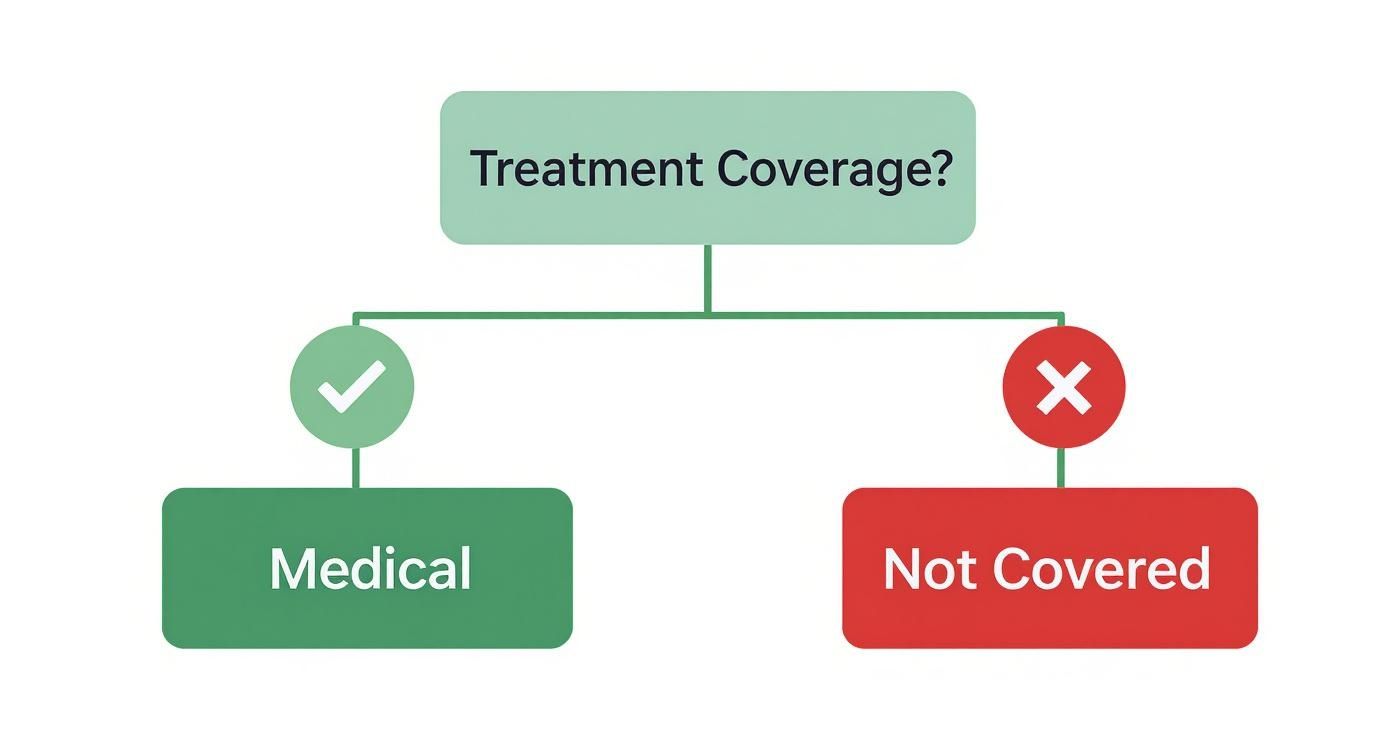
As you can see, your entire path to getting coverage hinges on that one distinction: is it medical or cosmetic?
Document Absolutely Everything
From this moment on, you need to become your own best advocate and a meticulous record-keeper. Keep track of every single interaction, test, and piece of paperwork related to your claim. This creates a complete file you can turn to anytime, which is an absolute lifesaver if your initial claim gets denied.
Here’s what your file should include:
- Photographic Evidence: Take clear photos of your hair loss from different angles. Make sure they are well-lit and dated so you can show how the condition is progressing.
- Communication Log: Keep a running log of every call with your insurance provider. Jot down the date, time, who you spoke with, and a quick summary of what was discussed.
- Copies of All Paperwork: Never send an original. Keep copies of everything you submit, from the claim form itself to the Letter of Medical Necessity and any receipts.
When you back up your claim with objective data, like professional hair density measurements, you strengthen your position significantly. You can learn more about how a hair density test can provide the kind of hard numbers that support your case. Taking these steps turns you from a patient hoping for the best into a prepared advocate who is ready to fight for the care you need.
What to Do When Your Claim Is Denied
Getting a claim denial for your hair loss treatment can feel like hitting a brick wall. It’s a deeply frustrating moment, but it's important to know that a denial is often just the start of a conversation, not the final word.
You have every right to challenge the decision. The key is knowing how to approach it effectively. So, the first step is to take a deep breath and resist the urge to accept that initial "no." Insurance companies work with complex systems, and a claim can be denied for something as simple as a clerical error or a missing document. Your job is to stay calm, get organized, and prepare to advocate for yourself.
The Appeals Process Step by Step
Think of your denial letter as your roadmap. By law, it has to explain exactly why the claim was rejected. Once you pinpoint their reasoning, you can start building a formal appeal. This is your chance to re-present your case, but this time with more detail and stronger evidence.
The appeal process typically unfolds in two stages:
-
1. Internal Appeal: Your first move is to appeal directly to your insurance company. This means sending a formal letter, along with your doctor's Letter of Medical Necessity and all the other supporting documents you’ve gathered.
-
2. External Review: If the insurance company denies your internal appeal, you can escalate the case to an independent, third-party reviewer. This neutral expert will look at the facts from both sides—yours and the insurer's—and make a final, impartial decision.
It’s always a good idea to get a handle on why claims get rejected in the first place. You can learn more by understanding common reasons for claim denials and the next steps you can take.
Your appeal needs to be built on solid medical facts, not emotion. Keep the focus on reinforcing the argument that your treatment is medically necessary. Use the specific language and diagnostic codes your doctor provided to make your case as strong as possible.
Remember, you don't have to go through this alone. Patient advocacy groups can be a fantastic resource, offering guidance and support. They're experts at navigating the maze of insurance appeals and can give you the confidence you need to fight for the coverage you deserve.
Common Questions About Hair Loss and Insurance
Wrestling with insurance policies for hair loss can be confusing, to say the least. To clear up any lingering doubts, let's go over a few of the most common questions people ask. These quick answers should help solidify what we've covered.
Will My Insurance Pay for a Wig if I'm Undergoing Chemo?
In most situations, yes. When hair loss is a side effect of chemotherapy, insurers often cover what's officially termed a cranial prosthetic. The key is getting a formal prescription from your doctor—that's the first and most important step.
Just be sure to double-check the fine print of your specific plan. Many policies put a cap on how much they'll pay or restrict you to certain suppliers. It's always best to call and confirm the details before you make a purchase.
Is There Any Chance Insurance Will Cover PRP Therapy?
It’s extremely unlikely. Insurers almost universally label Platelet-Rich Plasma (PRP) therapy as experimental, investigational, or cosmetic. With that classification, getting a claim approved is a real uphill battle.
Realistically, you should plan on paying for PRP treatments out of your own pocket. Think of it as an investment in yourself, because it's not one your insurance company is likely to fund.
Can I Get Coverage by Citing the Mental Toll of Hair Loss?
Unfortunately, this isn't a path to coverage. While the emotional and psychological distress from hair loss is undeniable and deeply felt, insurance claims are built on physical diagnoses, not the mental health consequences.
To even have a shot at getting a treatment covered, your claim has to be linked directly to an underlying medical condition that is physically causing the hair to fall out. The argument must be based on a medical necessity, not the emotional hardship it creates.
At PRP For HairLoss, we know that good information is your best tool for finding the right solution. To learn more about how you can take charge of your hair restoration journey, explore our resources at https://prpforhairloss.com.

 PRP For Hairloss
Leave a comment