Let’s cut right to the chase: if you're thinking about Platelet-Rich Plasma (PRP) therapy for hair loss, it’s best to plan on paying out-of-pocket. For the vast majority of health insurance companies, PRP is still considered an experimental or investigational treatment, which, unfortunately, means it’s not typically covered.
The Bottom Line on PRP Insurance Coverage

When you're looking into a promising solution for hair loss like PRP, one of the first questions that pops into your head is probably, "Will my insurance cover this?" It’s a totally fair question, but the answer is almost always a frustrating "no."
This isn't a knock on how well PRP works. It's really about how insurance carriers see the world. They need to see years of huge, standardized clinical trials before they'll officially stamp a procedure as "medically necessary." In their eyes, PRP just isn't there yet.
Why the "Investigational" Label Matters
That "investigational" label is the real roadblock here. Think of your insurance provider as a very cautious investor. They want to back sure things—treatments with a long, proven track record across thousands of cases. While PRP shows incredible promise and has helped a lot of people, it hasn't produced the massive mountain of data that insurers need to get on board.
For anyone just starting their research, getting a good feel for what PRP for hair loss is can shed more light on why it's still seen this way by the medical establishment. It's a nuanced procedure that is still being perfected.
In simple terms, insurance companies are in the business of managing risk. Until a procedure has a long, documented history of predictable results across thousands of patients, they see it as a financial risk they aren't ready to cover.
We put this guide together to give you a clear, honest look at the situation. We'll break down exactly why insurers take this stance, what it means for your wallet, and look at the rare exceptions where you might find a bit of coverage. Starting with realistic expectations is the best way to plan your next steps.
Why Your Insurance Plan Likely Says No to PRP
It’s a frustrating moment that a lot of people go through. You learn about a promising treatment like PRP, you get your hopes up, and then you run smack into the wall of an insurance denial. To get past that frustration, it helps to understand the "why" behind their decision—to see things from their point of view.
The reason almost always boils down to one powerful word: investigational. When an insurance company slaps this label on a procedure, they're not necessarily saying it doesn't work. It just means the treatment hasn't cleared their incredibly high bar for large-scale, standardized clinical proof. It’s like a new medication that's showing great results in early trials but hasn't finished the massive, years-long studies needed for full FDA approval. Insurers are waiting for that mountain of undeniable data.
The Problem with Standardization
Another big hurdle is the simple fact that there’s no single, universally accepted recipe for PRP. The way the treatment is prepared and given can be dramatically different from one clinic to the next.
Just think about all the variables:
- How much blood is drawn?
- What kind of machine is used to spin it?
- What’s the final concentration of platelets in the shot?
This lack of consistency is a major headache for insurers. How can they set a fair, predictable coverage policy for a procedure that changes depending on who’s doing it? Without a universal standard, they can't accurately forecast outcomes or costs, which makes them very hesitant to foot the bill. For them, it's like trying to insure a car model where every vehicle rolls off the assembly line with a totally different engine. You can dig deeper into why PRP effectiveness can vary to see why this matters so much.
At its core, an insurance company's "no" is a risk-management decision. The lack of standardized protocols and the absence of massive, multi-year clinical trials mean that, in their view, PRP is still an unproven variable rather than a predictable medical certainty.
A Unified Stance From Major Insurers
This cautious approach isn't just a quirk of smaller insurance companies; it's the industry standard. Even with PRP's growing popularity for all sorts of medical uses, you’ll find that the biggest names in the insurance world are holding a firm line. This isn't a fluke—it's a deliberate policy based on their current risk models.
A quick look around the industry shows a consistent pattern. Top providers like Blue Cross Blue Shield, Cigna, Aetna, and United Healthcare all classify PRP therapy as investigational or experimental. They all point to the same reason: what they see as a lack of sufficient clinical evidence. This uniform stance is why patients almost always have to plan on paying for the treatment themselves. You can get more insight into why providers don't cover PRP on ShapiroMedical.com.
Knowing this upfront can feel a bit discouraging, but it's crucial for setting realistic financial expectations. Their decision isn't personal; it's purely procedural. Until the body of scientific evidence grows to a point where it satisfies their strict criteria, the answer to "is PRP covered by insurance?" will, for most people, remain a firm "no."
Decoding the Medical Codes Behind Denials

When your insurance company denies a claim, it can feel like you've hit a bureaucratic brick wall. But there’s usually a specific, logical reason for the rejection buried in the jargon of medical billing. If you can learn to speak a little of that language, you'll be much better equipped to talk with your doctor's office and the insurer.
The entire system runs on CPT (Current Procedural Terminology) codes. Think of these as a universal shorthand that doctors use to tell insurance companies exactly what they did. For PRP injections, the most important code to know is 0232T.
That little "T" at the end is everything. It’s the single character that tells an insurer almost everything they need to know to deny the claim.
What Is a Category III Code?
In the coding world, a Category III code is basically a "work in progress" tag. It's reserved for new and emerging technologies or procedures that haven't been around long enough to be considered a standard, proven treatment.
This "T" code signals to the insurance company that the medical community is still figuring out how effective and safe the procedure is. As soon as they see it, they automatically flag the service as experimental.
This is the technical reason why claims for PRP covered by insurance are almost always denied for hair loss. The code itself is designed to trigger a denial. Learning about the coding process is a big part of understanding common insurance claim denial reasons and seeing the bigger picture.
The CPT code 0232T is the specific mechanism behind most PRP denials. Its 'Category III' status officially labels the procedure as an emerging technology, giving insurance carriers a clear and documented reason to classify it as investigational and withhold coverage.
Why This Knowledge Is Your Advantage
Knowing about code 0232T transforms you from a confused patient into an empowered one. You're no longer just being told "it's not covered." You now understand the exact billing reason why.
This puts you in a much stronger position when talking to your provider's billing department. You can ask pointed questions like, "Have you ever had success getting a Category III code like 0232T approved under specific circumstances?"
You can also brush up on essential hair loss terminology to feel even more confident in these conversations. While knowing the code won't magically get your treatment paid for, it helps you navigate the system with clarity and ensures you get straight answers about why you're paying out-of-pocket.
Are There Any Rare Exceptions for PRP Coverage?
While the standard answer to "is PRP covered by insurance?" is almost always a hard "no," it's not entirely black and white. In the tangled world of medical billing, a few very specific, narrow pathways for coverage can sometimes appear. These are definitely the exception, not the rule, but it’s worth knowing they exist just in case your situation happens to fit.
It's a bit like trying to find a hidden clause in a massive contract. For most people, the main text is what matters. But for a select few, a tiny footnote might just change everything.
When Medicare Might Step In
One of the most talked-about exceptions involves Medicare, but the conditions are incredibly strict. You’re not going to get coverage for hair loss, arthritis, or a sports injury. Instead, Medicare’s focus is on something completely different and far more serious: chronic wounds that just won't heal.
The Centers for Medicare & Medicaid Services (CMS) has some very rigid policies. They will only consider covering autologous PRP treatments for chronic non-healing diabetic, pressure, or venous wounds. And even then, there's a huge catch: it has to be part of an approved clinical trial. You can dig into the details of these specific CMS guidelines on PubMed Central. This tiny window of approval really shows the gap between how PRP is being used in clinics and what official policies are willing to pay for.
So, while it's technically possible to get a "yes," it comes with a long list of asterisks:
- The Condition: The problem must be a chronic, non-healing ulcer caused by diabetes, pressure, or venous issues.
- The Setting: Treatment has to take place within a formal clinical research study that Medicare has given the green light to.
- The Purpose: It’s all about studying the treatment's effectiveness, not just providing routine patient care.
Worker's Compensation and Personal Injury Claims
Another potential route for coverage exists completely outside of your regular health insurance plan. In cases involving worker's compensation or personal injury claims, the game changes. Here, the primary goal is often to get an injured person back to their job or their pre-injury life as quickly and effectively as possible.
Because of this different priority, PRP might get the nod if it's considered a reasonable way to speed up healing and prevent long-term disability.
For instance, imagine a construction worker suffers a severe tendon tear on the job. If physical therapy and other standard treatments aren't working, their worker's comp case manager might approve PRP. The thinking is that the $1,000 cost of a PRP injection is a much better deal than paying for months of lost wages or the high cost of surgery later on.
In these situations, the decision isn’t about whether PRP is "experimental." It’s about whether it’s a smart, cost-effective tool for a faster recovery. Getting this approved requires solid proof from your doctor showing that PRP could be the ticket to a quicker and better outcome. It's never a sure thing, but it’s one of the few scenarios where PRP covered by insurance becomes a real possibility.
How to Confirm Your Benefits with Confidence
When it comes to insurance, the golden rule is simple: never assume. The only way to know for sure what your policy covers is to get the facts straight from the source. A quick call to your provider can save you from surprise bills down the road and give you the clarity you need to plan your finances.
Before you dial, get your ducks in a row. Have your insurance card handy and, most importantly, the specific medical code for PRP therapy for hair loss. That code is 0232T. Walking into the conversation with the CPT code shows you're prepared and helps the representative find the exact information you need, not just give you a generic answer.
Your mission on this call is to get a clear "yes" or "no" and understand the why behind their decision. That knowledge is your most powerful tool.
The Right Questions to Ask
Vague questions get vague answers. To get the real story, you need to be direct and armed with specifics.
Here’s a simple script you can follow when you get a representative on the line:
- Lead with the Code: "Hi, I'm calling to check my benefits for a specific procedure. The CPT code is 0232T. Can you tell me if this is a covered service on my current plan?"
- Understand the 'Why': "How does my policy classify services under code 0232T? Is it considered cosmetic, experimental, or simply non-covered?"
- Dig for Loopholes: "Are there any specific medical diagnoses or circumstances where my plan would cover PRP therapy?"
- Check for Red Tape: "In the rare event it could be covered, would this procedure require pre-authorization?"
As you can imagine, exceptions are few and far between. Most standard health plans just won't budge. However, there are some niche situations, often involving work-related injuries or specific Medicare rules, where the rules can change.
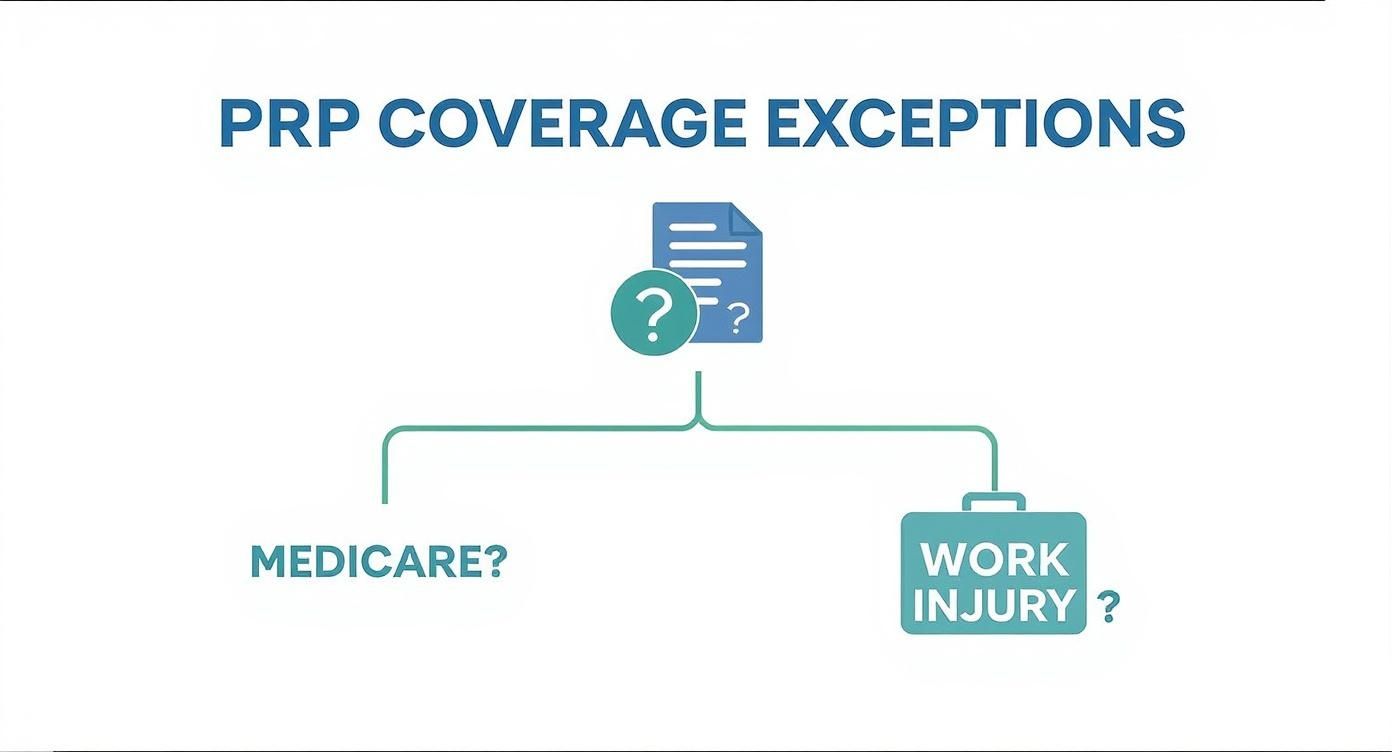
This decision tree gives you a visual of how those rare exceptions work. Essentially, who pays the bill—your regular insurer versus a worker's comp carrier, for example—can sometimes change the outcome.
Crucial Tip: Before you hang up, get the representative's name and a call reference number. Then, ask them to send you the coverage details in writing. A verbal confirmation is great, but a written document is proof.
Doing this homework is the only way to find out if PRP covered by insurance is a real possibility for you. Even if you find out it's not covered, you're now in the driver's seat. You can confidently discuss payment plans with one of the qualified hair loss specialists near you and decide on your next steps without any lingering uncertainty.
Smart Ways to Finance Your PRP Treatment
https://www.youtube.com/embed/Yz7JBPr32Z8
So, you've looked into it and discovered that getting PRP covered by insurance probably isn't going to happen. It's easy to feel a little defeated at that point, but don't let an insurance denial stop you. It just means it's time to get a little creative and look at other smart ways to pay for your treatment.
One of the most effective and popular strategies is to use your pre-tax dollars. If you have a Health Savings Account (HSA) or a Flexible Spending Account (FSA), these are perfect for covering medical expenses like PRP. Think about it—you're paying with money that hasn't been taxed yet. This simple move can slash the real cost of your treatment by 20-30% or even more, all depending on your personal tax bracket.
Exploring Payment and Financing Options
Beyond using your own savings accounts, don't forget that your clinic is a great resource. They deal with the financial side of things every single day and often have systems in place to help patients manage the cost.
It never hurts to ask the clinic's administrative staff about what they offer. Many of the best providers have helpful solutions, such as:
- In-House Payment Plans: These let you break up the total cost into a series of smaller, much more manageable monthly payments. Instead of one big hit, you can spread it out over a few months.
- Third-Party Medical Financing: Many clinics partner with companies like CareCredit, which is basically a credit card designed just for healthcare expenses. They often have special financing deals, like interest-free periods, as long as you pay off the balance within the agreed-upon time.
These options can make the upfront cost feel a lot less intimidating. If you're trying to figure out a budget, you can get a better sense of the numbers by reading up on the typical PRP hair treatment cost in our other guide.
Paying for PRP out-of-pocket can feel daunting, but using pre-tax HSA/FSA funds or clinic-offered financing plans can make the investment far more achievable for your budget.
If your credit history is a concern and you're worried about getting approved for financing, there are still paths forward. You might find valuable information in resources that explain how to find easy approval for personal loans for bad credit.
When insurance isn't an option, it's helpful to see all your payment choices side-by-side.
PRP Payment Options Comparison
| Payment Method | How It Works | Key Benefit |
|---|---|---|
| HSA/FSA | Use pre-tax funds from a dedicated health account. | Reduces your effective cost by your tax rate (e.g., 20-30%). |
| In-House Plan | The clinic splits your total bill into monthly installments. | Avoids interest and third-party credit checks. |
| Medical Financing | Use a specialized credit card like CareCredit. | Often includes 0% interest promotional periods. |
| Personal Loan | Borrow a lump sum from a bank or online lender. | Provides immediate funds; can be a good option with a low rate. |
| Credit Card | Pay with a standard credit card. | Quick and easy, especially if you can earn rewards points. |
By taking the time to explore all these avenues, you can build a financial strategy that puts your hair restoration goals well within reach.
So, is the "no coverage" answer from insurers set in stone? It can certainly feel that way, but if you look closely, the ground is slowly shifting. There are a few powerful forces at play that could completely reshape how insurance companies see PRP therapy over the next few years.
The biggest factor is simple momentum. The global PRP market is exploding, projected to grow from around $489 million in 2025 to a staggering $1.28 billion by 2035. This isn't just a niche trend; it's a massive economic wave.
As PRP becomes more common worldwide and health systems in other countries (like the UK's NHS) start figuring out coverage, the pressure on U.S. insurers will mount. It becomes much harder to deny a treatment that's gaining acceptance everywhere else. You can dig into the specifics of this growth on Future Market Insights.
The Power of Clinical Research
At the end of the day, one thing will unlock widespread insurance coverage: solid, large-scale research. When an insurer slaps the "investigational" label on a treatment, it's their way of saying, "Show me the proof." Right now, they feel there isn't enough conclusive evidence to justify paying for it.
Think of it like building a legal case. Every new high-quality, peer-reviewed study demonstrating PRP's effectiveness for specific conditions—like certain types of arthritis or chronic tendon injuries—is another piece of evidence. Once the pile of evidence becomes too big to ignore, insurers will have no choice but to reconsider their stance.
The ultimate goal of all this ongoing research is to get PRP upgraded from "investigational" to a "standard of care" for certain conditions. That official change in medical consensus is the key that truly opens the door to insurance reimbursement.
Advocacy and Physician Influence
Finally, never underestimate the power of a unified voice. As more and more patients see real results from PRP, advocacy groups will likely pop up to lobby insurers directly.
At the same time, the doctors who perform these treatments and see the benefits firsthand are constantly pushing for their patients. This combined pressure from both the people getting the treatment and the professionals giving it can create a real tipping point. Change won't happen overnight, but the future of whether PRP is covered by insurance is definitely looking brighter than its present.
At PRP For HairLoss, we're committed to giving you the most up-to-date and realistic information on your hair restoration journey. Explore our resources to learn more about your options. https://prpforhairloss.com


Leave a Reply