If you're starting to see more hair in the brush or noticing a thinning spot in the mirror, you've probably gone down the rabbit hole of hair loss treatments. One option that keeps popping up is Platelet Rich Plasma (PRP) therapy. So, what is it, really?
Let's cut through the medical jargon. PRP therapy for hair is a non-surgical treatment that cleverly uses your body's own natural healing abilities to give your hair growth a much-needed kickstart. The process is pretty straightforward: we draw a small amount of your blood, spin it in a centrifuge to concentrate the platelets, and then inject this powerful, nutrient-rich serum—what some people call "liquid gold"—back into your scalp. The goal is simple: wake up tired hair follicles and promote thicker, healthier hair.
What Is PRP Therapy for Hair Loss?
At its heart, PRP therapy isn't some complex, foreign procedure. It’s all about harnessing and focusing the healing power that's already inside you.
Think of your blood as a construction crew. You have red blood cells, white blood cells, and then you have platelets. Platelets are the emergency response team—the first ones on the scene when you get a cut or an injury. They carry incredibly powerful proteins called growth factors, which are essentially the biological blueprints for repair and regeneration. PRP therapy simply isolates this elite team, concentrates their power, and puts them to work right where you need them most: your scalp.
The Basic Idea Behind the Treatment
The whole concept is beautifully simple: we give your scalp a highly concentrated dose of its own natural healing ingredients. When you get injured, your body automatically rushes platelets to the site to begin repairs. PRP just gives this natural process a turbo-boost. By creating a solution that has 5 to 10 times more platelets than your regular blood, we're delivering a supercharged cocktail of growth factors directly to your struggling hair follicles.
This targeted approach is designed to:
- Wake Up Sleeping Follicles: Many hair follicles aren't gone for good—they're just dormant. The growth factors in PRP can act like a strong cup of coffee, waking them up to start producing hair again.
- Boost Blood Flow: The treatment encourages the growth of new, tiny blood vessels around the follicles. This is critical because it means more oxygen and nutrients can get to the hair root, feeding it what it needs to thrive.
- Thicken Existing Hair: By nourishing the follicles from within, PRP can help your existing hairs grow back thicker and stronger, leading to better overall density and volume.
Is This a Proven Method?
Naturally, the biggest question on your mind is: does it actually work? For men in the earlier stages of male pattern baldness (androgenetic alopecia), the evidence is very encouraging. Clinical studies consistently show that a solid 70-80% of patients see real, noticeable improvements in both hair thickness and the rate of new growth after a series of PRP treatments.
Its success really comes down to the direct-action approach. We're not just masking the problem; we're improving the fundamental health of the scalp to support a healthier hair growth cycle. If you'd like to dive into the clinical data, you can learn more about the success rates of PRP treatments.
The power of PRP lies in its personalized nature. Because the treatment uses a concentrate derived from your own blood, the risk of allergic reactions or adverse side effects is extremely low, making it a safe option for many.
To give you a quick snapshot, here’s a table that breaks down the key aspects of PRP therapy.
PRP Therapy at a Glance
| Aspect | Description |
|---|---|
| Treatment Type | Non-surgical, minimally invasive injectable treatment. |
| Source Material | Your own blood, specifically the platelet-rich plasma. |
| Primary Goal | To stimulate dormant hair follicles and promote new, thicker hair growth. |
| Procedure Time | Typically 60-90 minutes per session, including blood draw and injections. |
| Typical Candidates | Individuals with early to moderate hair thinning or androgenetic alopecia. |
| Safety Profile | Very high, with a minimal risk of side effects since it uses your own biological material. |
| Recovery | Minimal to no downtime; you can usually return to normal activities right away. |
This table provides a high-level overview, but understanding these points can help you feel more confident about what the treatment involves from start to finish.
How PRP Wakes Up Your Hair Follicles
To really get what’s happening with Platelet-Rich Plasma therapy, I like to use an analogy I share with my clients: think of your scalp as a garden. Over time, the soil (your scalp) can become depleted, and the seeds (your hair follicles) just don't have the nutrients they need to sprout and grow strong.
PRP isn't about adding anything foreign to your system. Instead, we’re enriching that soil with a potent, all-natural fertilizer made from your very own blood.
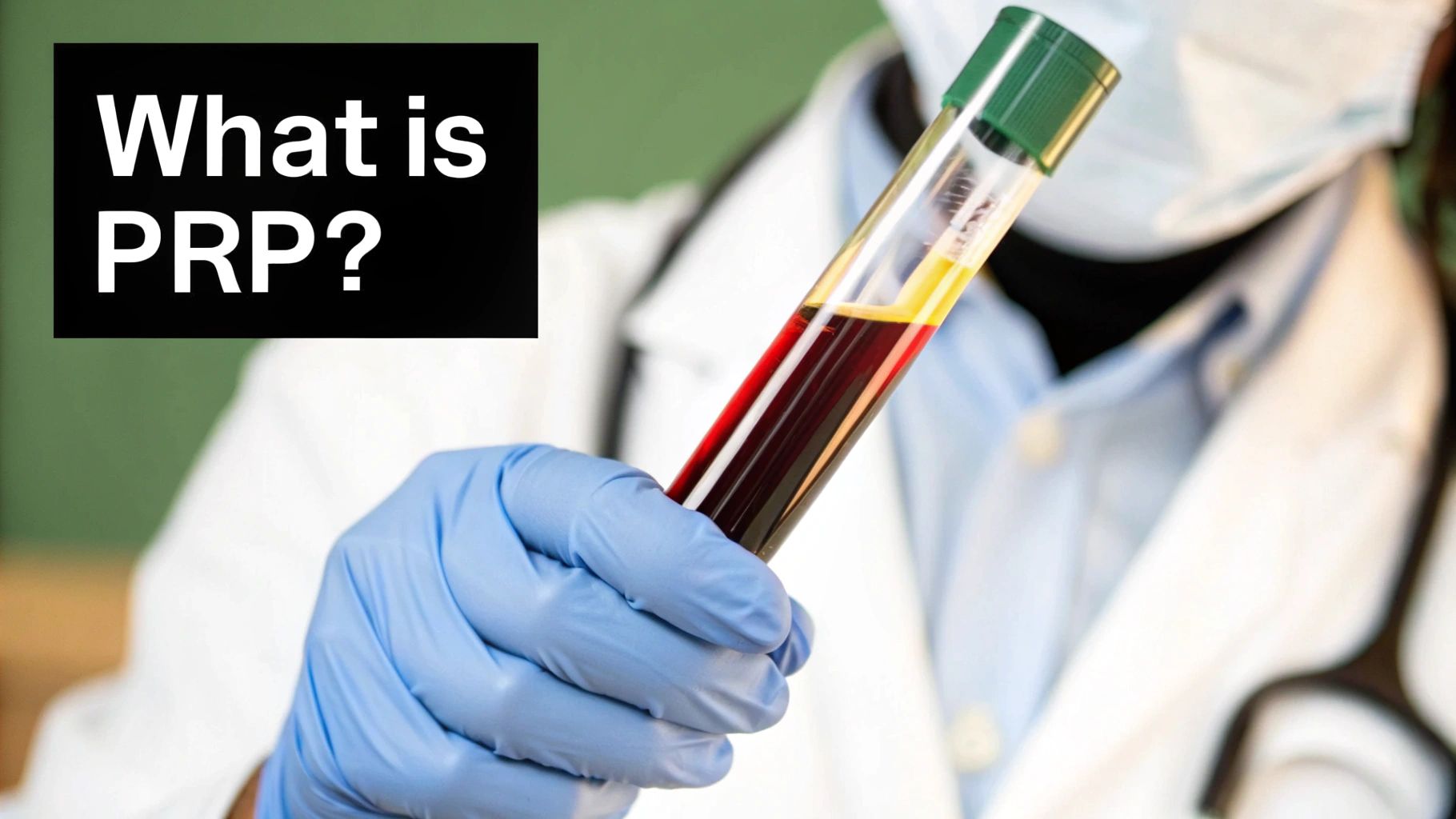
This “fertilizer” is the platelet-rich plasma, a golden liquid separated from your blood that’s absolutely packed with platelets. These platelets are your body’s emergency response team. When you get a cut, they don't just stop the bleeding; they release a cascade of powerful proteins called growth factors. These are the biological signals that tell your body to repair and regenerate tissue.
With PRP therapy, we isolate and concentrate these growth factors, then deliver them right where they’re needed most—your hair follicles. It’s this targeted approach that helps jolt dormant follicles awake and get them back to the business of growing hair.
The Growth Factor Power Players
Not all growth factors do the same thing. It helps to think of them as a highly specialized construction crew, where each member has a specific role in rebuilding and revitalizing your hair follicles.
Here’s a quick look at the key players in your PRP serum:
- Platelet-Derived Growth Factor (PDGF): This is the crew's foreman. It’s one of the first on the scene, signaling other cells to get to work, which kicks off the whole rejuvenation process.
- Vascular Endothelial Growth Factor (VEGF): Think of this one as the plumber. VEGF’s main job is to help form new blood vessels. Better blood flow means more oxygen and nutrients can reach the follicle, which is absolutely critical for healthy growth.
- Epidermal Growth Factor (EGF): This is like the architect. It stimulates cell growth and division, helping to fortify the follicle itself so it can produce a stronger, thicker hair shaft.
- Fibroblast Growth Factor (FGF): This worker builds the foundational structures that support everything else. It’s crucial for tissue repair and keeping the cells healthy and functional.
By injecting this super-concentrated team of proteins directly into the scalp, we’re essentially giving your follicles a five-star meal of everything they need to thrive.
The concept is surprisingly simple but powerful: PRP creates an incredibly nutrient-rich environment that nudges dormant hair follicles to re-enter their active growth phase. The result is visibly thicker hair and better scalp coverage.
Extending Your Hair's Growth Phase
To understand why this is so effective, you need a basic grasp of the hair growth cycle. Every single hair on your head cycles through a growth phase (anagen), a transitional phase (catagen), and a resting phase (telogen), after which it sheds.
A lot of common hair loss happens when this cycle gets disrupted—the growth phase shortens while the resting phase gets longer. This means more of your hair is "sleeping" at any given time, which is what leads to that look of thinning.
The growth factors in PRP directly combat this. They send signals that encourage follicles to extend the anagen (growth) phase and shorten the telogen (resting) phase.
What this means for you is that more of your follicles are actively growing hair for longer stretches of time. This naturally leads to better density and a fuller head of hair. It's not just about creating new hair; it’s about keeping the hair you already have growing for as long as possible.
What to Expect During Your PRP Appointment
The thought of any medical procedure, even one as straightforward as platelet-rich plasma therapy for hair, can be a bit daunting. Knowing what’s going to happen from start to finish can really help ease any nerves. So, let's walk through a typical appointment, step by step. You'll see it’s a lot less intimidating than it sounds.
The entire process is surprisingly efficient, usually wrapping up in about 60 to 90 minutes. It breaks down into three simple stages: drawing your blood, spinning it down to get the good stuff, and then injecting it back into your scalp. Think of it less like a major medical event and more like a highly targeted, natural therapy session.
Step 1: The Blood Draw
Your appointment kicks off with a familiar first step: a simple blood draw. A clinician will take a small sample of blood from your arm, usually just one or two vials. If you've ever had blood taken for a routine physical, you know exactly what to expect. It's quick, and the pinch is over in a second.
This small sample is all that's needed to create your personalized treatment. It’s the source of the powerful platelets and growth factors that we’ll concentrate to kickstart your hair follicles.
Step 2: Creating the "Liquid Gold"
Now for the cool part. This is where the real magic happens, but the science behind it is surprisingly straightforward. Your blood sample is placed into a machine called a centrifuge. This device spins the blood at extremely high speeds, which causes it to separate into layers based on weight and density.
It's a bit like when you let a vinaigrette dressing sit, and the oil and vinegar separate out. The centrifuge does the same thing to your blood, but with incredible precision. It isolates three distinct layers:
- Red blood cells, the heaviest part, settle at the bottom.
- Platelet-poor plasma, the lightest liquid, floats to the top.
- In between, a concentrated, golden-hued layer of platelet-rich plasma (PRP) forms.
This middle layer is the "liquid gold" we're after. It’s packed with a concentration of platelets that's 5 to 10 times greater than what’s normally circulating in your bloodstream. This potent serum is what gets injected into the scalp. The whole separation process is quick, usually taking just 10 to 15 minutes.
This infographic gives you a great visual breakdown of how the whole PRP therapy process works.
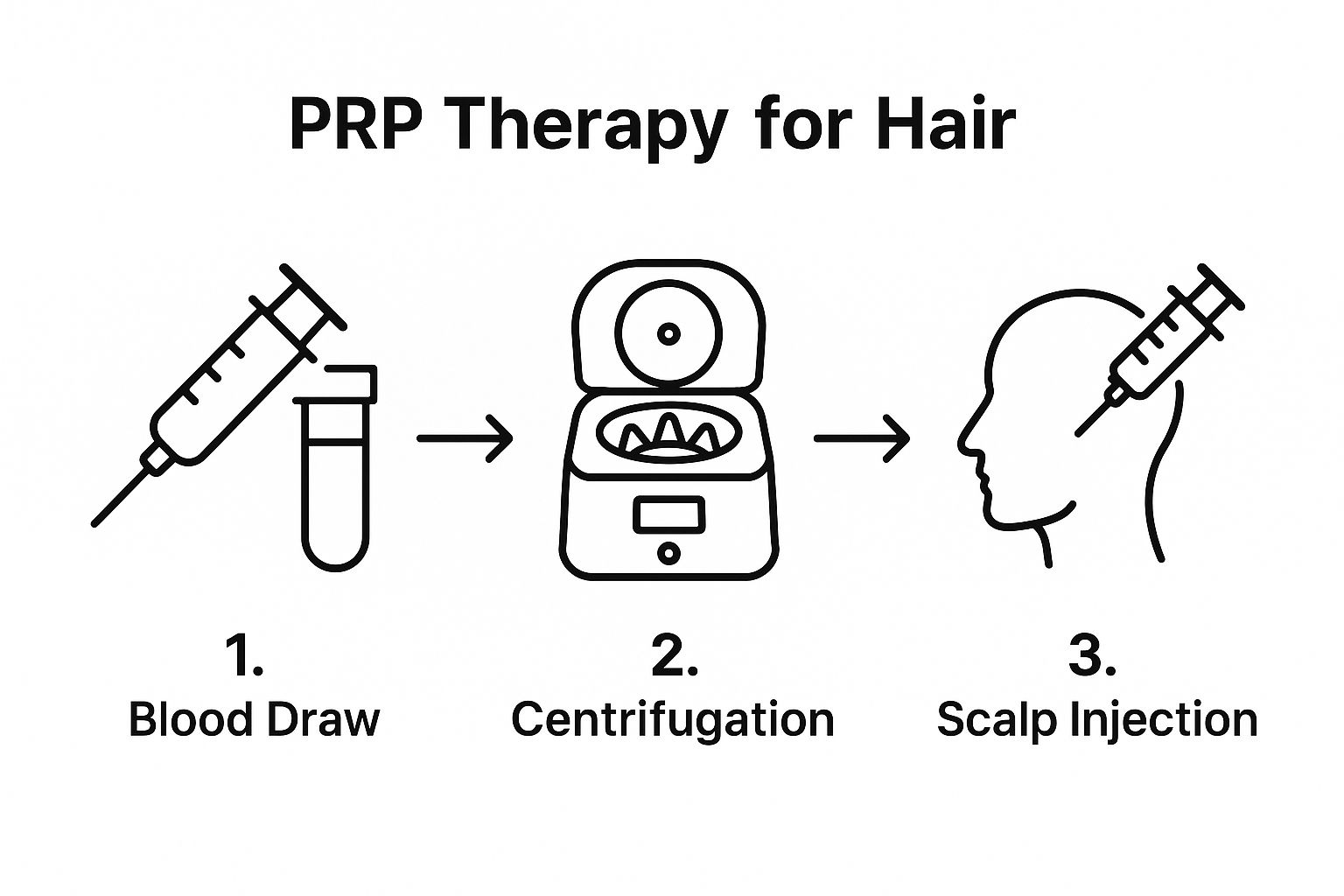
As you can see, it's a closed-loop system. The treatment is created from your own body, making it an incredibly safe and natural approach to hair restoration.
Step 3: The Injections
Once the PRP is ready, it's carefully drawn into a syringe for the final step. This is the part that most people are curious—and maybe a little apprehensive—about. Let's be real, nobody enjoys the idea of needles.
Your comfort is the top priority. To make sure the process is as painless as possible, most practitioners will apply a topical numbing cream, use a local anesthetic, or even a cooling device to numb the scalp before they begin.
Your practitioner will then meticulously inject the PRP into the specific areas of your scalp where you're experiencing thinning. Using a very fine needle, they'll make a series of small injections, delivering those powerful growth factors right where they're needed most—at the base of the hair follicles.
Most guys describe the sensation as a mild pinch or a feeling of light pressure, but the numbing agents do their job well, making it very manageable. The injection phase itself is usually over in less than 30 minutes. After that, you're all finished. There's no real downtime, and you can typically get right back to your day.
Is PRP Hair Therapy the Right Choice for You?
While the science behind platelet-rich plasma therapy for hair is exciting, it's not a magic bullet for every single person dealing with hair loss. The best way to think about it is as a highly specialized tool—it’s brilliant for the right job but isn't a one-size-fits-all solution. Figuring out if you're a good candidate is the most critical first step toward getting results you'll be happy with.
At its core, PRP works by energizing hair follicles that are still active, even if they're weak or sputtering out. For the therapy to have any effect, it needs something to work with. It's designed to wake up and nourish struggling follicles, not to create brand-new ones on a completely smooth scalp. This is a crucial distinction.
The Ideal Candidate Profile
So, who are the people who walk away with the best results? Generally speaking, the perfect candidate is someone who has started to notice thinning hair or is in the early chapters of their hair loss story. When it comes to PRP, being proactive pays off in a big way.
The strongest candidates usually fit this description:
- Early-Stage Hair Loss: People who've recently noticed their part widening or their hairline creeping back, but who still have decent hair coverage, are in the sweet spot. Their follicles are often just dormant, not gone for good, and can be kickstarted by PRP’s growth factors.
- Androgenetic Alopecia: This is the clinical name for male and female pattern baldness, the most common reason people lose their hair. PRP has a great track record for slowing this process down and boosting hair density for these individuals.
- Overall Good Health: Since PRP uses your own blood, your general health matters. A healthy body produces higher-quality platelets, giving the treatment better raw materials to work with.
The single biggest predictor of success is the presence of viable hair follicles. If an area of your scalp has been completely bald for many years, the follicles have likely atrophied beyond repair. In that case, PRP probably won't be able to bring them back.
This is exactly why a one-on-one consultation is non-negotiable. A specialist can get a magnified look at your scalp to see if your follicles are still in the game.
When PRP Might Not Be the Best Option
Just as it’s important to know who PRP is for, it’s equally important to know when it’s not the right fit. A frank and honest assessment saves you from potential disappointment and ensures you put your time and money toward a treatment that actually makes sense for you.
Certain health factors or conditions, known as contraindications, can make PRP less effective or even risky.
Here are a few scenarios where another path might be better:
- Underlying Medical Conditions: If you have active infections, certain skin diseases like lupus that affect the scalp, or chronic liver disease, PRP may not be a suitable option.
- Blood-Related Disorders: Since the whole treatment is centered around platelets, conditions like clotting disorders, thrombocytopenia (a low platelet count), or being on blood-thinning medication can interfere with both the safety and the results.
- History of Certain Cancers: A past diagnosis of cancer, especially skin cancer on the scalp, is a major contraindication.
- Unrealistic Expectations: If someone hopes to go from a completely bald scalp to a full, thick head of hair, PRP is not the right procedure. It’s a treatment to improve what you have and slow down loss—not for total regeneration.
To make it easier to see where you might stand, this quick checklist can help you self-assess before a consultation.
PRP Candidacy Checklist
| Factor | Ideal Candidate Indicator | Potential Contraindication |
|---|---|---|
| Stage of Hair Loss | Early thinning; still have follicles | Completely bald areas for years |
| Type of Hair Loss | Androgenetic Alopecia (pattern baldness) | Hair loss from active medical issues |
| General Health | Good overall health | Chronic liver or skin diseases, active infections |
| Blood Health | Normal platelet count, no clotting issues | Blood disorders, on blood-thinning medication |
| Medical History | No history of scalp-related cancers | History of skin cancer on the treatment area |
| Expectations | Aims to thicken existing hair, slow loss | Expecting to regrow hair on a bald scalp |
This table is a great starting point, but it's not a substitute for professional medical advice. An experienced provider can give you a definitive answer based on a thorough evaluation of your specific situation.
Understanding the Cost of PRP Hair Treatments
So, let's talk about the bottom line. When you're looking into any kind of hair restoration, the cost is always a major factor. It’s important to be upfront about the financial side of PRP therapy. Think of it less like a one-off expense and more as an ongoing investment in your hair and, frankly, your confidence.
The price for PRP sessions can swing pretty widely, and for good reason. You’re not just paying for a vial of plasma; you're paying for the skill, precision, and technology that make the treatment effective.
What Influences the Price Per Session
Several things can move the needle on the cost of a single PRP treatment. Knowing what they are helps explain why you'll see different prices as you shop around.
- Geographic Location: It’s a simple fact of life—operating a clinic in a major city costs more than in a smaller town. That overhead, from rent to salaries, naturally gets factored into the treatment price.
- Clinic and Provider Expertise: This is a big one. You're paying for experience. A seasoned practitioner with years of successful PRP treatments under their belt will likely command a higher fee than someone just starting out.
- Technology Used: Not all PRP equipment is the same. The quality of the centrifuge and the preparation kits directly affects the concentration of platelets in your final injection. Better tech often means a better result, and that can influence the cost.
On average, you can expect a single PRP session to set you back anywhere from $500 to $1,500. This range really highlights why it pays to research your options and choose a provider you trust.
The Full Treatment Plan Investment
One session is just the beginning. To get the kind of results most people are looking for, you need to commit to an initial series of treatments. It’s like getting a new lawn to grow; you can't just sprinkle seeds once and walk away. It needs consistent care to get established.
A standard treatment plan usually starts with a "loading phase" of 3 to 4 sessions, typically spaced about a month apart. After that, you'll shift to maintenance sessions every 6 to 12 months to keep your hair healthy and growing.
Because of this structure, the total up-front investment is more than just the cost of one appointment. But the therapy's rising popularity shows that many people find the value to be there. The U.S. market for regenerative hair loss treatments like PRP was valued at $255.2 million in 2024 and is projected to grow. This trend is fueled by people wanting effective, minimally invasive options that deliver real benefits, like quicker regrowth. You can read more about the market growth for PRP hair treatments to see how it fits into the broader picture of hair restoration today.
Insurance and Financing Options
Let’s be direct about insurance: platelet rich plasma therapy for hair is almost always classified as a cosmetic procedure. That means you should expect it to be an out-of-pocket expense, as health insurance plans typically won't cover it.
The good news is that many clinics get it. They understand this is a significant financial commitment. To help make it more accessible, they often offer in-house financing plans or work with medical credit companies. Don't be shy about asking what payment options are available during your consultation; you can often find a solution that works with your budget.
What to Expect After Your PRP Treatment: Recovery and Results
Once your PRP session is over, you can pretty much walk right out of the clinic and get back to your day. The recovery is incredibly straightforward, but what you do in the hours, days, and months that follow really does impact your final results. The whole game is about being patient and giving your body the right conditions to work its magic.
The great news is that the aftercare instructions are simple. There's no complex routine or list of medications to worry about. Right after the treatment, your scalp might feel a little tender, look a bit red, or even have some minor swelling. Don't worry—this is completely normal. In fact, it's a good sign that your body's natural healing process has been kicked into high gear. These initial effects usually settle down within a few hours to a couple of days.
The First 48 Hours: Immediate Aftercare
For the first day or two, your main job is to simply let your scalp rest and recover. Think of it as giving those freshly delivered growth factors some quiet time to settle in and start their work without being disturbed.
Here are a few simple things to keep in mind:
- Take it Easy: For the first 24 to 48 hours, hold off on any intense exercise or heavy lifting. Getting your heart rate way up increases blood flow everywhere, including your scalp, which could make any temporary swelling a bit more noticeable.
- Be Gentle with Your Hair: Try to avoid washing your hair for at least 24 hours. When you do shampoo, use something mild and sulfate-free, and be gentle. It’s also wise to avoid harsh chemical treatments like hair dye or intense heat styling for about a week.
- Shield Your Scalp: If you're going to be outside for a while, protect your scalp from direct sun. A hat is your best friend for the first few days.
It's so important to remember that hair growth is a marathon, not a sprint. A huge part of this process is managing your expectations and being patient. The real work is happening deep at the follicle level, long before you can see it in the mirror.
The Long Game: When Will I Actually See Results?
This is the question on everyone's mind, and for good reason. When will you actually see a difference? Because PRP works with your body's natural hair growth cycle, the results appear gradually. It's not an overnight fix, so having a realistic timeline helps a lot.
Here’s a general idea of how things typically progress:
- Months 1-2: Honestly, you probably won’t see much visible change yet. Underneath the skin, though, the growth factors are busy improving blood flow and waking up those sleepy hair follicles. Some people do report noticing less hair shedding during this initial phase.
- Months 3-4: This is usually when the first exciting signs of progress start to show up. You might begin to spot new, fine "baby hairs" sprouting in the treated areas. Your existing hair might also start to feel a little thicker and look healthier.
- Months 5-6: By this point, the results should be much more apparent. Hair density often improves, giving you better scalp coverage and a fuller look overall. Your initial series of treatments is usually finished, so this is a great time to properly evaluate your progress with your practitioner.
- Beyond 6 Months: The improvements don't just stop; they'll continue as your hair keeps growing. To keep these fantastic results, your specialist will likely suggest a maintenance plan, which usually involves a follow-up session every 6 to 12 months.
Common Questions About PRP for Hair Loss
It's natural to have questions, even after getting familiar with the science and the process. Investing in your hair is a big decision, and you should feel completely confident before you move forward. Let's tackle some of the most frequent questions we hear about platelet-rich plasma therapy for hair.
Our goal here is to provide clear, direct answers to help you put the final pieces of the puzzle together. Clearing up any lingering doubts is key to making an informed choice about your hair restoration journey.
Is PRP Therapy a Painful Procedure?
This is usually the first thing people ask, and it's a perfectly valid concern. I'll be straight with you: since it involves injections into the scalp, it's not going to be completely sensation-free. However, "painful" isn't the word most guys would use to describe it.
Your comfort is always the top priority. Before starting, your practitioner will apply a topical numbing cream, a local anesthetic, or use a cooling device to make the whole thing much more manageable. Most men describe the feeling as a slight pinch or a bit of pressure, but nothing they can't handle.
How Long Will My Results From PRP Last?
It’s important to understand that PRP is not a one-and-done cure for hair loss—it's more of a powerful management tool. The results are definitely long-lasting, but they do require a little upkeep.
After your initial round of treatments (typically 3-4 sessions), you can enjoy thicker, denser hair for quite a while. But because the underlying cause of hair loss doesn't just disappear, you'll need to keep those follicles stimulated over the long term.
Think of it like a regular tune-up for your scalp. To maintain your results and keep your hair looking its best, most specialists recommend a follow-up maintenance session every 6 to 12 months.
Is PRP Hair Treatment Safe?
Absolutely. Because PRP therapy uses your body's own resources, it’s an incredibly safe procedure. The "treatment" is just a concentrated dose of your own platelets, which nearly eliminates the risk of allergic reactions or your body rejecting it.
The most common side effects are very minor and temporary, stemming directly from the injections themselves:
- Slight redness or swelling where the injections were made
- A feeling of tightness or tenderness on your scalp for a day or so
- Minor bruising is possible, but not very common
These issues almost always clear up on their own within 24 to 48 hours. The entire procedure is done in a sterile clinic, which keeps the risk of infection extremely low. When you compare it to surgery or daily medications, PRP’s safety is one of its biggest advantages.
At PRP For HairLoss, we're committed to giving you clear, honest information about male pattern baldness and effective treatments like platelet-rich plasma therapy. If you're ready to learn more, explore our resources at https://prpforhairloss.com.


Leave a comment