When you're dealing with male pattern hair loss, you want a treatment that gets right to the source of the problem. That’s the thinking behind topical dutasteride. It's a powerful medication you apply directly to your scalp, delivering its DHT-blocking punch exactly where your hair follicles are under siege.
This targeted approach is precisely why it's gaining so much traction. The goal is straightforward: get the best possible results—stimulating hair growth and halting thinning—while dialing down the risk of systemic side effects that can come with taking a pill.
Why Topical Dutasteride Is Gaining Attention
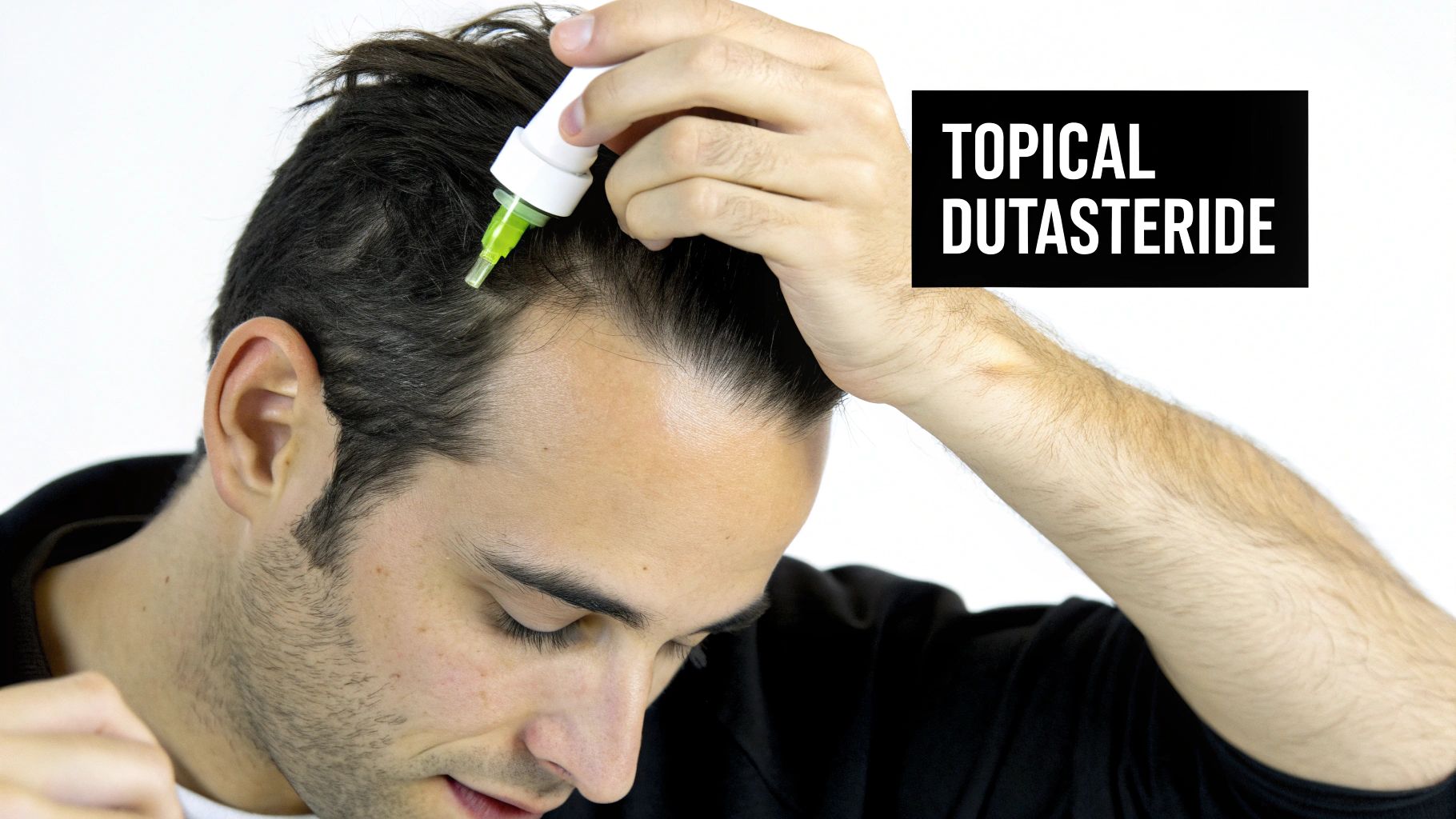
For a long time, the conversation around hair loss was dominated by a few well-known treatments. But lately, topical dutasteride has been making some serious waves, and for good reason. It represents a strategic shift in thinking—instead of treating the entire body for an issue on the scalp, it goes straight to the root of the problem.
At its core, dutasteride works by blocking an enzyme called 5-alpha reductase. Think of this enzyme as a tiny factory in your body that converts testosterone into dihydrotestosterone (DHT)—the hormone primarily responsible for shrinking hair follicles in male pattern baldness.
By shutting down this DHT factory, dutasteride triggers a significant drop in DHT levels, giving your follicles a fighting chance to bounce back and grow healthier hair. While the drug itself isn't new, delivering it directly to the scalp is a game-changer.
The Power of Localized Treatment
The logic behind applying dutasteride topically is simple: put the medicine exactly where you need it. This method aims to concentrate the drug's DHT-blocking action right in the hair follicles while limiting how much gets absorbed into your bloodstream.
This localized strategy is the main appeal for a lot of guys. It opens the door to potentially powerful hair growth results, all while trying to sidestep the systemic side effects that are a common worry with oral medications.
The buzz isn't just hype. Dutasteride has proven to be a powerhouse for treating male pattern baldness, a condition affecting up to 50% of men over 50. Although it was first approved for other health issues, its off-label use for hair loss has soared. The global dutasteride market was valued at USD 1.1 billion in 2023 and is projected to reach USD 1.8 billion by 2032, which says a lot about its growing role in hair restoration.
To give you a clear, quick overview, here’s a summary of what topical dutasteride offers.
Topical Dutasteride at a Glance
| Attribute | Description |
|---|---|
| Primary Use | Treatment for male pattern hair loss (androgenetic alopecia). |
| Mechanism | Blocks the 5-alpha reductase enzyme, significantly reducing DHT levels in the scalp. |
| Application | Applied directly to the scalp, typically as a solution, gel, or spray. |
| Key Advantage | Targeted action aims to maximize effects at the hair follicle while minimizing systemic absorption and side effects. |
| Potency | Considered a more powerful DHT inhibitor than finasteride. |
| Availability | Usually available through compounding pharmacies with a prescription. |
This table captures the essence of topical dutasteride—it’s a potent, targeted treatment designed for maximum local impact.
What Makes It Different From Other Options?
With other treatments out there, you might be wondering why topical dutasteride is worth considering. It all boils down to its unique blend of power and precision.
- Targeted Action: Unlike a pill that travels through your entire system, a topical solution focuses its efforts directly on the scalp's hair follicles.
- High Potency: Dutasteride is known for being a stronger DHT inhibitor than finasteride, another popular hair loss drug. If you want to dig deeper, you can explore our detailed comparison of finasteride vs. dutasteride for hair loss.
- Reduced Systemic Exposure: By keeping the medication localized, the hope is to lower the risk of side effects that could pop up elsewhere in the body.
This guide will walk you through everything you need to know about topical dutasteride, from the science behind it to the practical details of using it effectively.
How Topical Dutasteride Protects Hair Follicles
To really get how topical dutasteride for hair loss works, you can think of your scalp as a garden. For hair to thrive, the "soil"—your hair follicles—needs to be protected from anything that might harm it. In male pattern baldness, the number one culprit is a hormone called dihydrotestosterone, or DHT.
DHT is a potent byproduct of testosterone, created with the help of an enzyme called 5-alpha reductase (5AR). You can picture this enzyme as a tiny factory in your body that's always converting testosterone into DHT. For most of your body, this is completely normal. But on the scalp, it's a different story.
DHT is incredibly aggressive toward hair follicles. It latches onto them and starts to shrink them over time, a process called miniaturization. As the follicles get weaker and smaller, they can no longer produce strong, healthy hairs. This is what you see in the mirror as thinning and, eventually, bald spots.
The Double-Blockade Strategy
This is where dutasteride steps in, acting like an elite security guard for your hair follicles. Its job is to shut down that DHT factory by inhibiting the 5-alpha reductase enzyme. What makes dutasteride so uniquely effective, though, is that it's a dual inhibitor.
It turns out there are two main types of the 5AR enzyme in the body, Type 1 and Type 2. The other well-known hair loss drug, finasteride, mostly targets the Type 2 enzyme. Dutasteride, on the other hand, blocks both.
- Type 1 Enzyme: Found mainly in the scalp and oil glands.
- Type 2 Enzyme: Found in hair follicles and the prostate.
By targeting both pathways, dutasteride puts the brakes on DHT production far more effectively. In fact, studies have shown it can slash scalp DHT levels by over 90%—a much greater reduction than finasteride typically achieves. This comprehensive blockade is exactly why it’s considered such a heavy-hitter in the fight against hair loss.
By neutralizing both enzyme types, dutasteride provides a more robust defense for your hair follicles. It dramatically lowers the amount of DHT available to cause damage, creating a much healthier environment for hair growth.
This near-total shutdown of DHT is the secret to its power. For a deeper dive into managing this hormone, our guide on how to lower DHT levels naturally and with medication is a great resource.
Why the Topical Approach Matters
So, we've established that dutasteride is a powerhouse DHT blocker. But why is applying it directly to the scalp such a game-changer? It really comes down to one simple idea: targeted action with fewer side effects.
When you swallow a pill, the medication enters your bloodstream and gets distributed throughout your entire body. This is known as systemic exposure. While it gets the job done, it also means the drug reaches tissues and organs that have nothing to do with your hair, which is where unwanted side effects can arise.
The whole point of a topical dutasteride for hair loss formula is to avoid that systemic journey.
Delivering Power Where It's Needed Most
By applying dutasteride as a liquid or gel directly to your scalp, you’re putting the active ingredient exactly where the problem lies: the hair follicles. The goal is simple—achieve a high concentration of the drug in the scalp tissue while keeping the amount that makes its way into your bloodstream as low as possible.
It’s like watering a single struggling plant in your garden. Instead of using a giant sprinkler that soaks everything (systemic), you use a watering can to deliver water straight to the roots of the plant that needs it (topical). This localized method gives you two major benefits:
- Maximized Scalp Concentration: It ensures your hair follicles get a potent, direct dose of the DHT-blocking medicine.
- Minimized Systemic Absorption: It dramatically reduces the amount of dutasteride circulating through your body, which is key to lowering the risk of potential side effects.
This precision is what makes the topical route so appealing. It lets you use the full, powerful DHT-blocking ability of dutasteride in a much more focused way, directly shielding your hair from the damaging effects of miniaturization.
What the Clinical Evidence Actually Shows
Okay, let's move beyond theory and get to the part that really counts: does topical dutasteride actually work? The science behind blocking DHT is sound, but the big question is whether rubbing a solution on your scalp translates into more hair on your head.
The good news is that a growing body of clinical evidence says yes, and the results are pretty encouraging.
Researchers have been tracking key metrics like hair count, hair thickness, and overall scalp coverage. The findings consistently point to real, measurable improvements—not just slowing the shed, but actively reversing some of the damage.
What this means is that topical dutasteride appears to help turn the tide on follicle miniaturization. You start to see a significant increase in what are called terminal hairs (the thick, healthy, pigmented ones) and a decrease in those thin, wispy vellus hairs that are a tell-tale sign of advancing hair loss.
Turning Study Data into Real-World Gains
Scientific papers love to talk about percentages and p-values, but what does a "statistically significant increase in terminal hair count" mean for the average guy looking in the mirror?
It means seeing less scalp peeking through your hair. It means your hairline looks a little fuller. It means feeling more density when you run your fingers through your hair. These are the results that actually matter.
The core mechanism driving these outcomes is pretty straightforward, as the infographic below illustrates.
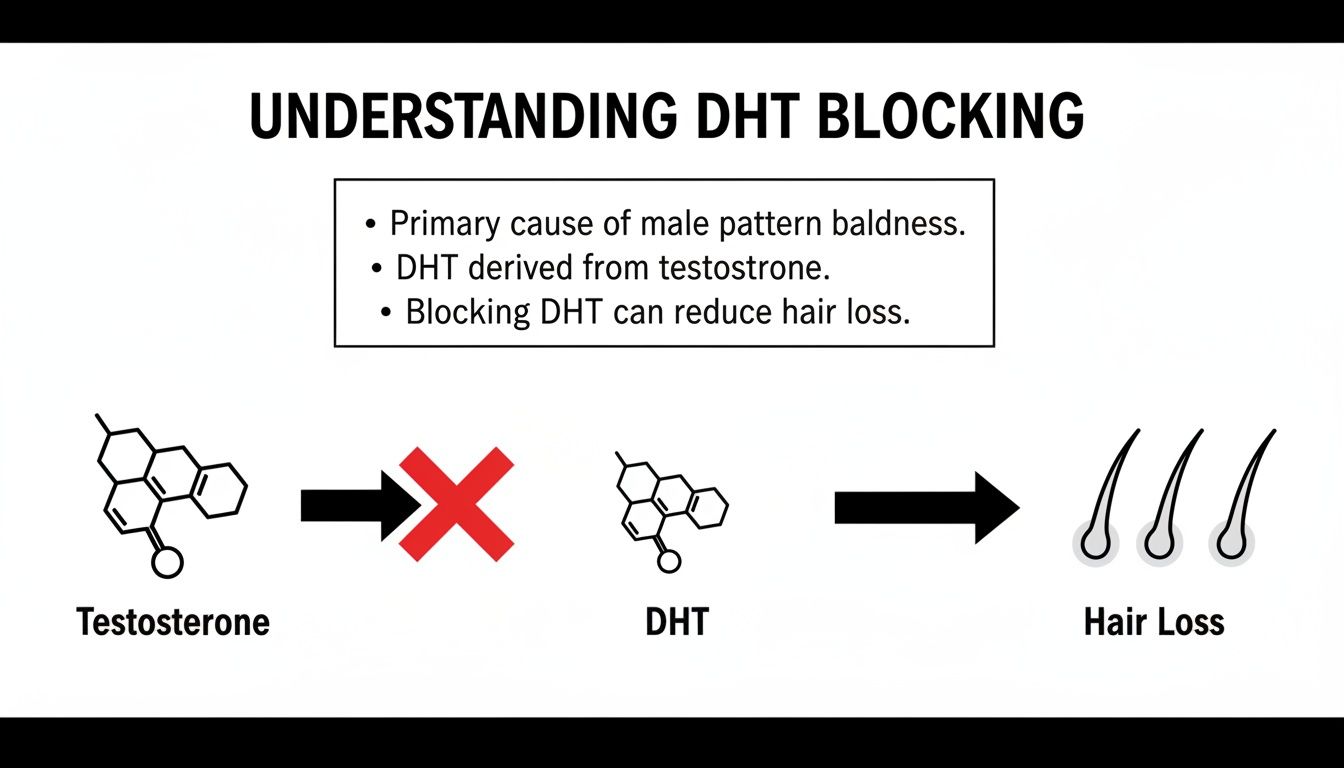
By stopping testosterone from converting into the follicle-killing DHT right at the source, dutasteride gives your hair follicles a real chance to recover and get back to producing healthy hair.
The numbers from the research are compelling. A major 2024 meta-analysis, which pooled the results of 12 different studies with over 1,500 men, found that topical dutasteride boosted hair density by an impressive 18-27% after just six months.
To put that in perspective, that performance easily beats the typical 12-15% increase seen with topical minoxidil in the crown area over the same timeframe. This data really cements its place as a powerful primary treatment. We cover the specifics of how DHT blockers work to achieve these results in another guide.
Comparing Key Hair Loss Treatments
When you're exploring your options, it's useful to see how they stack up against each other. Here’s a quick head-to-head comparison of the big three to help clarify the key differences.
Topical Dutasteride vs Finasteride vs Minoxidil
| Feature | Topical Dutasteride | Oral Finasteride | Topical Minoxidil |
|---|---|---|---|
| Primary Action | Blocks Type 1 & 2 5-AR enzymes to drastically reduce scalp DHT. | Blocks primarily Type 2 5-AR enzyme to reduce systemic DHT. | Stimulates blood flow to hair follicles and extends the growth phase. |
| Delivery Method | Applied directly to the scalp. | Taken as a daily pill. | Applied directly to the scalp. |
| Main Goal | Prevent hair follicle miniaturization by blocking DHT at the source. | Prevent hair follicle miniaturization through systemic DHT reduction. | Revitalize dormant follicles and promote growth, but doesn't block DHT. |
| Side Effect Profile | Lower risk of systemic side effects; potential for local scalp irritation. | Higher risk of systemic side effects, including sexual dysfunction. | Low risk of systemic side effects; mainly scalp irritation or unwanted hair. |
This table makes the unique advantage of topical dutasteride crystal clear. It packs the powerful DHT-blocking punch of an oral medication but delivers it with the targeted, safety-focused approach of a topical treatment.
For many men, this represents the ideal balance: aggressive action against the root cause of hair loss with a much lower risk of the side effects associated with pills.
The market is taking notice, too. Demand for dutasteride is projected to climb at a 13% compound annual growth rate through 2032, outpacing the broader hair loss market. In the United States—where pharmaceutical treatments make up 58.3% of the USD 3 billion hair loss industry—sales of DHT blockers like dutasteride saw a 7-9% jump in 2023 alone.
When you look at all the evidence, a very promising picture emerges. Topical dutasteride is positioning itself as a legitimate, powerful tool for not only stopping hair loss but actively improving hair density and thickness, making it a top-tier contender in any modern hair restoration plan.
Navigating the Safety and Potential Side Effects
When looking into any hair loss treatment, what it doesn't do is just as important as what it does. The big appeal of topical dutasteride for hair loss is its targeted approach. It puts the powerful DHT-blocking medicine right where the hair loss is happening—on your scalp—while drastically reducing how much gets into the rest of your body.
Think of it as a precision strike versus a carpet bomb. By keeping the treatment localized to the scalp, we aim to avoid the main worry that comes with oral DHT blockers: side effects that can affect your whole system.
Systemic Side Effects: A Minimized Concern
Let's be real, the elephant in the room with oral finasteride and dutasteride is the risk of sexual side effects like low libido or erectile dysfunction. It's a valid concern, and for many men, it's a dealbreaker. The story with topical dutasteride, however, is refreshingly different.
Because so little of the drug actually enters your bloodstream, the odds of running into these systemic issues plummet. This is a huge sigh of relief for anyone who wants the horsepower of dutasteride without the anxiety that can come with the pill.
The core advantage of a topical formulation is its precision. By targeting the hair follicles directly, it aims to protect your hair without affecting the rest of your body, offering a much more favorable risk-to-reward balance.
The numbers really highlight this point. While oral versions can report sexual side effects in the 5-10% range, the data for topical application is far more encouraging. In recent 2023 studies involving over 300 men across the US and Europe, these issues were reported by less than 2% of participants.
Understanding Local Side Effects
While the risk of body-wide side effects is reassuringly low, you are putting something directly on your skin. So, it's possible to have a bit of a local reaction, though these are usually minor and don't last long.
Here's what some guys occasionally report:
- Scalp Itching: A mild, temporary itch where you applied the solution.
- Redness or Irritation: A little bit of inflammation at the application site.
- Dryness or Flaking: This can look a bit like dandruff as your scalp adjusts to the new routine.
Most of the time, these minor annoyances fade away on their own as your skin gets used to it. If you're curious how these compare to a similar treatment, our guide on topical finasteride side effects offers some great context. Of course, if any irritation sticks around, your best move is always to check in with your doctor.
Product Purity and Quality
One crucial thing to remember is that topical dutasteride is almost always custom-made by compounding pharmacies. This means the quality of the final product is everything. A poorly made formula might not just fail to work, but it could also cause more skin irritation.
That's why it's so important to use a reputable source. For peace of mind, it’s worth understanding comprehensive lab testing practices that verify the purity and strength of the ingredients. This ensures the product you’re using is clean, potent, and exactly what your doctor ordered.
How to Use Topical Dutasteride for Best Results
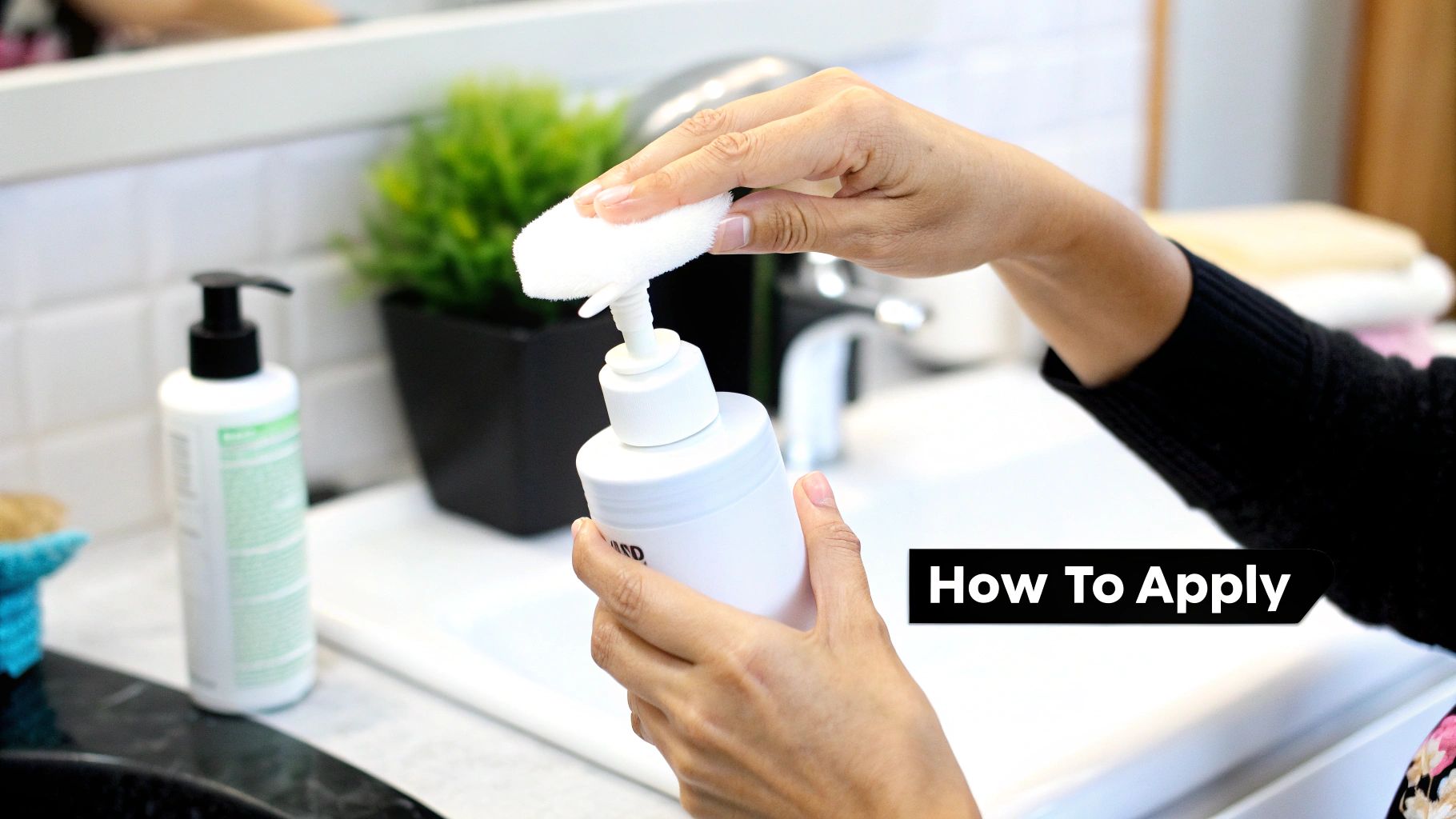
Alright, let's get into the practical side of things. Before you can start using topical dutasteride, it’s important to know that you can’t just grab this off the shelf at your local pharmacy.
Topical dutasteride is almost always a compounded medication. This simply means it's custom-mixed by a specialized pharmacy once they receive a prescription from your doctor. This custom approach allows your doctor to dial in the exact strength and formula that’s right for your situation.
Understanding Concentrations and Formulations
Your doctor will decide on the best starting dose, but the most common concentration you'll see prescribed is 0.05%. This is generally a good starting point—it's effective for many, but also conservative enough to see how your body responds.
Depending on your progress and tolerance, your doctor might adjust that concentration over time. The medication itself usually comes in a couple of different forms:
- Solutions or Lotions: These are thin, watery liquids that you apply directly to the scalp, often with a dropper. They're great for precise application.
- Foams: A lot of people prefer foams because they're less likely to run down your forehead or neck, making for a much cleaner, less messy application.
Ultimately, the goal is to find a formulation that works for you and is easy enough to stick with every single day. Consistency is king.
Your Step-by-Step Application Guide
Applying it correctly is key to getting the active ingredient where it needs to go: your hair follicles. Think of this less like applying shampoo and more like a targeted scalp treatment.
- Start with a Dry Scalp: Always apply the medication to a clean, completely dry scalp. Putting it on wet hair will just dilute the formula and make it less effective.
- Part Your Hair: Grab a comb and part your hair in the areas where you're thinning. This creates a clear path to the skin, so the medication doesn't just get wasted on your hair.
- Apply the Recommended Dose: Use the applicator provided (usually a dropper) to apply the prescribed amount, which is typically 1 milliliter (1mL). Dab it directly onto the scalp along the parts you've made.
- Gently Massage It In: Use just your fingertips to gently rub the solution into your scalp for about a minute. This helps spread it evenly and encourages absorption.
- Wash Your Hands Thoroughly: Once you’re done, wash your hands with soap and water to get rid of any residue.
After that, just let it air dry. Try to avoid using a hairdryer directly on the treated areas, as the heat can sometimes break down the medication.
What to Expect in the First Few Months
Here’s where you need to practice some patience. Hair growth operates on its own slow timeline, and you won’t see changes overnight.
One of the first signs that topical dutasteride is working can be a temporary increase in shedding. It sounds weird, I know, but this initial shed is often a great sign. It means dormant follicles are pushing out the old, weak hairs to make room for new, healthy ones to grow in.
This shedding phase, if it happens, usually shows up within the first couple of months and then settles down. As for real, visible gains in hair density and thickness, you'll likely start noticing those after six to twelve months of consistent daily use.
The market for dutasteride is growing fast—it hit USD 1,325.70 million in 2024 and is expected to climb to USD 2,450.90 million by 2032. This spike is largely driven by more people seeking out proven hair loss treatments. You can learn more about these market trends and insights on futuremarketreport.com.
Creating a Powerful Hair Restoration Stack
Trying to fix hair loss with just one product is like trying to build a house with only a hammer. You might make some progress, but you’re leaving a lot of potential on the table. A far better strategy is to create a "stack"—a combination of treatments that work together for a much bigger impact.
In this kind of multi-pronged attack, topical dutasteride for hair loss often serves as the cornerstone. By blocking DHT production right at the scalp, it creates the perfect environment for other growth-focused therapies to work their magic. It’s not just about stopping the damage; it’s about setting the stage for real regrowth.
Unlocking Synergy with PRP and Minoxidil
One of the most powerful pairings is topical dutasteride with Platelet-Rich Plasma (PRP) therapy. Think of dutasteride as the shield that defends your hair follicles from DHT's constant assault. With that shield in place, PRP can act like a specialized repair crew, delivering a high concentration of growth factors to stimulate and rejuvenate those newly protected follicles.
This duo is a perfect example of synergy. Studies show that combining treatments like these can lead to 35% better hair density than using just one method alone. This isn't just about the numbers, either. It’s about regaining confidence, which is a huge motivator—so much so that by 2025, 52.6% of men are expected to seek treatment due to social pressures related to their appearance.
Minoxidil is another natural partner for dutasteride. While dutasteride tackles the hormonal root of the problem, minoxidil works on a completely different pathway by improving blood flow to the follicles and extending the hair's growth phase. When you use them together, you’re hitting hair loss from two distinct and highly effective angles.
By combining a powerful DHT blocker like dutasteride with a growth stimulant like minoxidil or PRP, you create a comprehensive strategy that both defends existing hair and actively promotes new growth.
Expanding Your Treatment Stack
Beyond PRP and minoxidil, you can layer other treatments into your routine for even better results. Microneedling and low-level laser therapy (LLLT) are two common additions that pair nicely with topical dutasteride.
- Microneedling: This technique uses a device with tiny needles to create micro-injuries on the scalp. This process stimulates the release of natural growth factors and has the added benefit of boosting the absorption of topicals like dutasteride and minoxidil.
- Low-Level Laser Therapy (LLLT): Available as caps, combs, or headbands, LLLT devices use red light to energize the cells inside your hair follicles. This can improve their function and help kickstart new growth.
When putting together any combination of treatments, it helps to understand the basics of creating a powerful supplement stack to make sure everything works together effectively. You can also dive deeper into how these treatments function in our guide on DHT blockers for hair loss. Building a smart stack is all about making each part of your regimen work harder for you.
Frequently Asked Questions
It’s completely normal to have a lot of questions when looking into a new hair loss treatment like topical dutasteride. To help cut through the noise, here are some straightforward answers to the questions we hear most often.
How Long Until I See Results from Topical Dutasteride?
With any hair loss treatment that actually works, patience is key. You might notice less shedding within the first two or three months, which is always encouraging, but visible regrowth takes a bit longer.
Most of the clinical data suggests you'll start seeing noticeable improvements in hair density and thickness somewhere between 6 and 12 months of daily, consistent use. Keep in mind, it's common to go through a temporary shed at the beginning. Don't panic—this is usually a good sign that weaker hairs are making way for stronger, healthier ones. To give it a fair shot, you really need to stick with it for at least a year.
Is the Topical Form Really Safer Than the Pill?
This is probably the biggest reason why men are drawn to the topical version. By applying dutasteride directly to your scalp, you’re putting the medicine exactly where it needs to be—at the hair follicle—with minimal absorption into the rest of your body.
This targeted delivery dramatically reduces the risk of systemic side effects, especially the sexual side effects that are sometimes linked to the oral pill. While a very small percentage of users might get some minor scalp irritation, the overall safety profile is much better for guys concerned about a full-body effect. Of course, the best first step is always to talk it over with your doctor.
The core benefit of topical dutasteride is precision. It delivers a powerful DHT-blocking effect directly to the follicles, offering a strong defense against hair loss while minimizing the potential for body-wide side effects.
What Happens If I Stop Using Topical Dutasteride?
It's best to think of male pattern baldness as a chronic condition that needs ongoing management. Topical dutasteride isn't a cure; it's a treatment that works by constantly protecting your follicles from the harmful effects of DHT.
If you stop using it, that protective shield disappears. DHT will resume its attack on the follicles, and over the next several months, you'll likely lose any hair you maintained or regrew. To keep your results, you have to view this as a long-term commitment.
Do I Need a Prescription to Get It?
Yes, you absolutely need a prescription. Dutasteride is a potent medication and isn't sold over the counter. The process starts with a consultation with a doctor or dermatologist who can properly diagnose your hair loss and review your medical history.
If they determine you're a good candidate, they’ll write you a prescription. Because there isn’t a mass-produced, commercial topical dutasteride, that prescription will almost always go to a compounding pharmacy. These are specialized pharmacies that can create high-quality, custom formulas just for you.
At PRP For HairLoss, our mission is to provide you with clear, evidence-based information on the most effective hair loss treatments available. Explore our resources to build a powerful and informed strategy for hair restoration. Learn more at https://prpforhairloss.com.


Leave a Reply