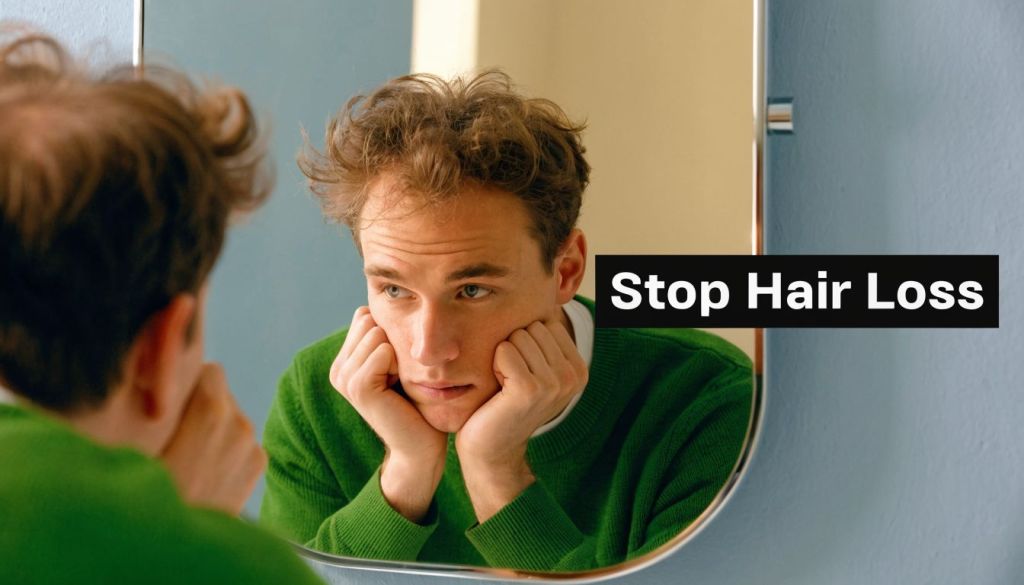
You run your hand through your hair in the bathroom and pause. There are more strands than usual on your fingers. A week later, the shower drain looks a little too full. Then one morning the mirror catches an angle you hadn’t noticed before. The temples look weaker. The crown looks thinner under bright light. Your stomach drops.
If that’s where you are, the first thing to know is simple. You’re not overreacting, and you’re not some rare exception. Hair changes can hit hard when you’re young because they don’t feel like a normal part of your life yet. They feel early, unfair, and weirdly personal.
They also feel isolating. Most guys don’t talk about it until it’s advanced, so you end up assuming everyone else is fine while you’re the one studying old photos and checking your hairline every morning.
That silence is part of what makes this harder than it needs to be. The good news is that young guys with thinning hair usually have more options than they think, especially when they act early and stick to evidence instead of panic-buying random products. This guide is here to help you think clearly, understand what may be happening, and choose your next step with less guesswork.
That Sinking Feeling and Why You Are Not Alone
A lot of guys remember the exact moment it clicked. Not because the hair loss was severe, but because it suddenly felt real. Maybe your barber asked if you wanted to “keep a little more length up front.” Maybe a friend tagged you in a photo and your hairline looked different than it does in your head. Maybe you noticed that wet hair now shows more scalp than it used to.
That moment can mess with you fast. You can feel embarrassed, angry, even a little obsessive. You start checking mirrors, phone cameras, harsh lighting, all of it. That reaction is common. It doesn’t mean you’re vain. It means something tied to your identity changed and your brain noticed.
The part many young men don’t know is that this starts earlier than is generally thought. A landmark study found that 16% of men aged 18 to 29 already have moderate to extensive hair loss, which means about 1 in 6 young guys are dealing with it too, according to the 1998 Journal of Dermatologic Surgery study on male pattern hair loss prevalence.
You don’t need to wait until it looks “bad enough” to take it seriously.
That matters because panic pushes people toward bad decisions. They either ignore it for too long or throw money at miracle products with no real plan. A calmer move is better. Notice the pattern. Get informed. Compare options. Act early if the signs keep showing up.
If you’re around your mid-20s and trying to figure out whether what you’re seeing is typical or a real warning sign, this piece on balding at 25 is a useful next read.
Hair loss can absolutely affect confidence, dating, mood, and the way you carry yourself. But it doesn’t need to become the thing that runs your life. The more clearly you understand it, the less power the uncertainty has over you.
Why Your Hair Might Be Thinning Sooner Than You Thought
Hair thinning in your 20s usually starts with biology, not grooming mistakes. The most common reason is male pattern baldness, also called androgenetic alopecia. It is largely driven by inherited sensitivity in your hair follicles.

The simple version of DHT
Your hair follicles work like tiny factories with a built-in lifespan. In men with male pattern baldness, certain follicles are unusually sensitive to DHT, a hormone your body makes from testosterone. DHT binds to those follicles over time and gradually shrinks them.
That shrinking process is called miniaturization. It sounds technical, but the pattern is simple. Each growth cycle can produce a hair that comes back finer, shorter, and less visible than before. After enough cycles, some follicles produce only very thin hairs, or stop producing visible hair at all.
This confuses a lot of guys. Male pattern baldness usually does not mean you have unusually high testosterone. It means your follicles respond to DHT in a way that makes them wear down faster. If you want a straightforward outside explainer, XO Medical covers what causes male pattern baldness in clear everyday language.
Why it can show up earlier than expected
Genes set the baseline, but timing can vary a lot. Some men do not notice meaningful change until later adulthood. Others see recession or crown thinning much earlier because their follicles are more sensitive from the start.
Researchers have documented that male pattern hair loss can begin in early adulthood, not just middle age. A review in StatPearls notes that androgenetic alopecia can start during the late teens and becomes more common with age, which helps explain why some men notice changes well before they expected to. See the StatPearls overview of androgenetic alopecia.
That early timing matters for more than appearance. If you are already stressed, dating, starting a career, or trying to feel settled in your own skin, unexpected hair loss can hit confidence hard. The biology may be gradual. The mental effect often is not.
Genetics are the main driver, but they are not always the whole story
Male pattern baldness is the foundation in many cases, but other issues can make thinning look worse or seem to speed up. Stress-related shedding, poor nutrition, illness, scalp inflammation, and harsh grooming habits can all add noise to the picture. That is one reason self-diagnosis gets messy fast.
A useful way to frame it is this. Genetics decide how vulnerable your follicles are. Daily life can influence how healthy the rest of your hair looks while that process is happening.
For example:
- Chronic stress can push more hairs into a resting and shedding phase.
- Nutritional gaps can reduce the support hair needs to grow well.
- Poor sleep and burnout can make shedding feel more noticeable and harder to ignore.
- Smoking and environmental exposure may add extra strain to scalp and hair health.
Some young men are dealing with one clear cause. Others have male pattern baldness plus a second issue layered on top. That is why pattern, timing, and context matter more than guessing based on one bad week in the mirror.
If you want a fuller explanation of the mechanics, triggers, and overlapping causes, this guide to male pattern baldness causes can help you sort out what may be happening before you choose a treatment path.
How to Recognize the Early Signs of Hair Loss
You catch your reflection under bright bathroom light and pause for half a second longer than usual. The front corners look a little wider. Your crown seems easier to see after a shower. Nothing looks dramatic, which is exactly why early thinning is so easy to talk yourself out of.

Early hair loss usually works like a slow leak, not a snapped cable. You rarely wake up one morning with an obvious bald spot. What changes first is often the pattern, the way your hair sits, or how much scalp shows in lighting that never used to bother you.
The patterns that matter
Male pattern baldness usually shows up in predictable zones.
One common starting point is the temples. The front corners begin to creep back, and the hairline can shift from straight or rounded to more of an M shape. The other common starting point is the crown, where hair may look flatter, thinner, or more see-through from above.
Some young men notice one area first. Others see both.
Doctors often use the Norwood scale to describe these patterns. You do not need to study it like an exam chart. Its value is simple. It helps separate a true pattern of thinning from random bad hair days, breakage, or a harsh haircut.
Normal shedding versus a real warning sign
Hair sheds every day. That part is normal. The American Academy of Dermatology says it is common to lose 50 to 100 hairs a day as part of the normal hair cycle, according to its guidance on how much hair shedding is normal.
That number helps with perspective, but counting hairs in the sink usually makes people more anxious, not more informed. A better question is whether your hair looks and behaves differently over time.
Watch for signs like these:
- Your hairline looks different in photos taken a month or two apart
- Your crown shows more scalp under overhead light
- Your usual hairstyle stops covering the same areas
- Your hair feels less dense when you wash or style it
- Your barber or stylist notices thinning before you clearly do
Pattern matters more than one rough week.
The reason this hits hard at a young age is not just cosmetic. Hair is tied to identity, dating confidence, social ease, and the way many guys feel in group settings or on camera. The International Society of Hair Restoration Surgery describes early hair loss in young men as emotionally disruptive, and that tracks with what many guys already feel before they ever say it out loud, according to the ISHRS discussion of young male hair loss.
That emotional reaction deserves to be taken seriously. Catching changes early is not about vanity. It can also protect your mental bandwidth, give you more treatment options, and stop the cycle where every mirror, photo, and windy day turns into a stress test.
A short visual explainer can help if you’re trying to compare what you see in the mirror to common thinning patterns:
When to stop self-diagnosing
If the same change keeps showing up across photos, haircuts, and lighting conditions, get it checked instead of guessing. A proper assessment can sort out male pattern baldness from temporary shedding, scalp inflammation, or a mix of issues.
If you want a clearer checklist first, this guide to the early signs of male pattern baldness can help you compare what you are seeing before you book an appointment.
An Honest Guide to Evidence-Backed Treatments
When guys get worried, they usually run into two bad extremes. One side says, “Just shave it, nothing works.” The other side says, “Buy this serum, this roller, this shampoo, this supplement stack.” Neither is useful.
The stronger approach is boring in the best way. Stick with options that have real medical logic behind them. For most men, the conversation centers on minoxidil, finasteride, and PRP. Some routines also include microneedling as a supportive tool.

What each treatment is trying to do
Minoxidil is a topical treatment. You apply it to the scalp. Its role is to support the growth phase of hair and help follicles keep producing stronger strands.
Finasteride is an oral medication. It targets DHT, which is the main hormone involved in male pattern baldness. In plain language, it works upstream by reducing the hormonal pressure on sensitive follicles.
PRP, or platelet-rich plasma, is an in-office treatment that uses a concentrated portion of your own blood to deliver growth factors to the scalp.
Microneedling isn’t usually a stand-alone answer for pattern baldness, but some men use it as part of a broader plan to support scalp response and product absorption.
Comparing the Top Hair Loss Treatments for Young Men
| Treatment | How It Works | Best For | Prescription Needed? | Commitment Level |
|---|---|---|---|---|
| Finasteride | Lowers DHT activity involved in male pattern baldness | Guys with ongoing recession or crown thinning tied to androgenetic alopecia | Yes | Daily, long-term |
| Minoxidil | Topical treatment that supports active growth and helps maintain density | Men who want a non-pill option or a combination plan | No | Regular ongoing use |
| PRP | Uses concentrated growth factors from your own blood to stimulate miniaturizing follicles | Younger men with early-stage thinning who still have active follicles | No, but requires a clinician | Series of sessions plus maintenance |
| Microneedling | Creates controlled micro-injury in the scalp to support regeneration | Men using a broader routine rather than relying on one tool | No for at-home tools, though guidance helps | Repeated sessions, technique matters |
How to think about them without getting lost
Each option solves a slightly different problem.
- If your main issue is DHT-driven miniaturization, finasteride is often part of the conversation because it addresses the mechanism.
- If you want to directly support weak follicles, minoxidil can help.
- If you’re in earlier-stage thinning and want an in-office option, PRP may fit well.
- If you like the idea of combination therapy, microneedling is often discussed as a supporting piece, not a miracle fix.
Expensive doesn’t automatically mean effective, and cheap doesn’t automatically mean useless. Match the treatment to the cause.
A lot of confusion also comes from shampoos. Hair loss shampoos may help scalp comfort, oil control, or cosmetic fullness, but they usually aren’t the core answer for true male pattern baldness. Guys often mistake a better-looking wash day for actual treatment progress.
If you want a primer on the main regulated medical options, this explainer on FDA approved hair loss treatment is worth reading.
What commitment really looks like
This is the part many people skip. Hair loss treatment usually isn’t one dramatic fix. It’s maintenance. You’re trying to slow a process, preserve vulnerable follicles, and improve what can still respond.
That means patience matters. Consistency matters more than hype. And the sooner a proven treatment starts, the more hair there often is to work with.
A Deep Dive Into PRP for Hair Restoration
A lot of young guys hear "PRP" after a stressful few months of checking mirrors, comparing photos, and wondering whether they are overreacting. That matters more than people admit. If your hair is changing in your late teens or twenties, the goal is not only to improve your scalp. It is also to reduce the constant mental noise that comes from feeling like your appearance is slipping out of your control.
PRP stands for platelet-rich plasma. A clinician draws a small amount of your blood, spins it in a centrifuge to separate the platelet-rich portion, and injects that concentrated plasma into areas where hair is thinning. Platelets contain growth factors involved in tissue repair, so the idea is to give stressed follicles a better local environment. PRP works more like support for struggling follicles than replacement for follicles that are already gone.

What happens at the appointment
The process is pretty straightforward. First comes an evaluation. The clinician checks your pattern of loss, scalp health, family history, and whether you still have miniaturizing hairs that could respond.
Then comes the blood draw and centrifuge step. After the platelet-rich portion is prepared, the clinician injects it into the areas that need treatment. It is a targeted procedure, not a blanket treatment across the whole scalp.
That last point is easy to miss. PRP usually works best where follicles are weakened, not absent.
Who tends to do best with PRP
PRP usually makes the most sense for younger men in earlier stages of thinning, especially when there is still visible hair in the area. A simple way to picture it is this: PRP is more like helping a struggling plant recover than trying to regrow one from dry soil. If the follicle is still active, even if it is weaker and producing finer hair, there is more to work with.
That is why better candidates often include:
- Young men with early recession or crown thinning
- Guys who still have miniaturizing hairs in the area
- Patients willing to follow a treatment series instead of judging PRP after one visit
- Anyone with realistic expectations about maintenance
If you want a general patient-friendly overview of the process, this article on PRP treatment for hair loss explains the basics clearly.
What PRP can and cannot do
PRP may improve hair caliber, support density, and help preserve thinning hair. Some studies and reviews suggest it can be a useful option for androgenetic alopecia, especially in earlier-stage cases, as described in a 2021 review in the Journal of Cosmetic Dermatology on platelet-rich plasma for androgenetic alopecia: https://pubmed.ncbi.nlm.nih.gov/33724574/.
The limit is just as important as the promise. PRP does not permanently switch off male pattern hair loss, and it usually does not restore dense coverage in areas that have been bald for a long time. A lot of frustration starts right there. The treatment may be reasonable, but the expectation was set at transplant-level results.
That distinction matters for mental well-being too. If you view PRP as one tool for preserving options early, it can feel proactive. If you expect it to reverse years of advanced loss, it can feel defeating.
The usual timeline
PRP requires patience. Clinics often recommend an initial series of treatments, followed by periodic maintenance, rather than a single session. Protocols vary by practice, which is one reason cost and results can feel confusing when you compare one clinic's marketing to another's.
You also should not judge the outcome too fast. Hair growth moves on a slow cycle, and response depends on factors like your stage of loss, scalp inflammation, and whether PRP is being used by itself or alongside other treatments. If you want a more detailed breakdown of candidacy, timelines, and response factors, this guide on how effective PRP is for hair loss is a useful next read.
Side effects and practical expectations
Because PRP uses your own blood, the risk profile is generally favorable when the procedure is done correctly in a medical setting. Reported side effects are usually short-term things like scalp soreness, pinpoint bleeding, tenderness, or mild swelling. Sterile technique and proper patient selection still matter.
Cost matters too, especially for younger guys paying out of pocket. PRP is often sold as a package, not a one-time fix, so the main question is not "Can I afford one session?" It is "Can I afford the full plan and maintain it if it helps?" That is a smarter way to think about it.
For a lot of young men, that honest framing lowers anxiety. You are not choosing between panic and denial. You are choosing whether PRP fits your stage of loss, your budget, and your broader plan to protect both your hair and your confidence early.
Lifestyle and Styling Changes You Can Make Today
Medical treatment matters, but it’s not the only lever you can pull. A lot of young guys with thinning hair feel better once they stop treating every morning like a battle and start making a few practical changes. The goal isn’t to “hack” your genetics. It’s to reduce extra stress on your hair and make what you have look better right now.
Hair care that doesn’t work against you
You don’t need a twenty-step routine. You do need to stop being rough with your hair.
Try this:
- Wash your scalp gently: Scrubbing aggressively doesn’t make your hair healthier.
- Use products that don’t leave hair heavy: Thick, greasy formulas can flatten thin hair and make scalp show more.
- Go easier on heat: Frequent high heat can make fragile hair look worse through breakage and dryness.
- Dry with less friction: Patting or gently squeezing water out is better than attacking it with a towel.
If your hair is thinning, the mission changes. You’re no longer styling for maximum drama. You’re styling for control, texture, and coverage.
Diet can quietly matter more than you think
Genetics may be the main driver of male pattern baldness, but nutrition can still shape how well your hair holds up. Emerging analysis, including a 2023 review from Baylor College of Medicine, found that severely reduced intake of protein, zinc, and vitamin D can negatively affect hair growth cycles and may worsen thinning in young men, including in some cases associated with vegan or vegetarian diets, as covered in this Healthline summary on why millennials may be losing hair earlier.
That doesn’t mean a plant-based diet automatically causes hair loss. It means any restrictive diet can become a problem if it leaves you short on basics your hair depends on.
A smarter checklist looks like this:
- Protein first: Hair is heavily protein-based. If your intake is low, your hair may show it.
- Watch zinc and vitamin D: If your diet is limited, these are worth discussing with a clinician.
- Don’t crash diet: Big nutritional swings can hit hair hard.
- Eat consistently: Hair tends to like stability more than extremes.
If your eating pattern has changed a lot in the same period your hair started thinning, bring that up at your appointment. It matters.
Haircuts and styling that help immediately
Some cuts make thinning less obvious. Others expose it.
Usually, men do better with:
- Shorter sides: This reduces contrast and makes the top look fuller.
- Texture on top: A slightly messy finish often hides thinning better than flat, neat styles.
- Matte products: Matte paste, clay, or texture powder usually look denser than shiny gels.
- Regular trims: A shape that’s slightly off can make thinning stand out more than the thinning itself.
What usually hurts:
- Long slick-backs
- Wet-look gels
- Trying to force a comb-over from too far away
- Growing it out in the hope that more length equals more coverage
A good barber can make a bigger difference than many guys expect. Tell them directly that density is your concern. A skilled cut won’t solve the root issue, but it can make your hair easier to live with while you figure out the bigger plan.
Common Questions Young Guys Ask About Hair Loss
Does wearing a hat make hair loss worse
Usually, no. A normal hat or beanie doesn’t cause male pattern baldness. The bigger issue is the genetic and hormonal process covered earlier. If something is extremely tight and constantly pulling on hair, that’s a different problem, but everyday hat use isn’t the main reason young guys with thinning hair lose ground.
Are expensive hair loss shampoos a scam
Some are oversold. That’s the honest answer.
A shampoo can help with scalp comfort, cleanliness, oil, and the way hair feels. It may make hair seem a bit fuller for a few hours. But shampoo is wash-on, wash-off. If you have true male pattern baldness, shampoo usually isn’t the core treatment. Be skeptical of any bottle that sounds like it can replace proven options.
If I start thinning now, will I definitely go completely bald
No. Early thinning does not guarantee one final outcome for every person. Hair loss patterns vary, and progression varies. What matters most is how early you identify the pattern and whether you respond with a real plan instead of denial or random spending.
Should I start treatment as soon as I notice changes
If the changes are consistent and clearly patterned, getting evaluated early makes sense. Most evidence-backed approaches work better when follicles are still active. Waiting until an area is far more advanced usually reduces your options.
Is hair loss really that big of a deal mentally
For a lot of guys, yes. It can affect self-image, dating confidence, social comfort, photos, and concentration. That reaction isn’t shallow. It’s human. What helps is replacing doom-scrolling and mirror-checking with a practical plan.
Can I combine treatments
Often, yes. Many men don’t rely on a single tool. They use a plan that matches the cause, the stage of loss, and what they can realistically maintain. The strongest move is to talk with a qualified clinician about fit, not to copy a stranger’s routine online.
What if I’m not ready for medical treatment yet
That’s fine. Start with observation, good photos in consistent lighting, better hair care, better nutrition, and a haircut that works with your density instead of against it. Doing something sensible beats spiraling.
If you want clear, no-hype education on PRP, male pattern baldness, and realistic treatment options, PRP For HairLoss is a solid place to keep learning. It’s built for men who want straightforward information, practical guidance, and a better understanding of what helps when hair starts changing early.


Leave a Reply