Decoding the Early Clues of Hair Loss
For many men, watching their hair gradually thin is a discouraging experience. Male pattern baldness (androgenetic alopecia) affects a large percentage of men, often starting with subtle changes that become more noticeable over time. While we've known about the genetic factors behind hair loss for centuries, our understanding of the biological mechanisms and treatment options has dramatically improved in recent years. From traditional remedies to modern medical approaches, the journey to address hair loss has shaped how we tackle this common concern today.
Recognizing the early signs of male pattern baldness isn't about giving up—it's about taking control. Early detection is key to managing hair loss effectively. When you spot the initial changes, you can make informed choices about your hair care routine, explore preventive strategies, and consider various treatment options ranging from topical solutions and prescription medications to surgical interventions. What determines whether an approach works? It depends on scientific evidence, how well it addresses your specific situation, and maintaining reasonable expectations about results.
In this article, we'll help you identify the subtle, often missed early warning signs of male pattern baldness. Understanding these indicators will equip you to better manage your hair health journey and take appropriate action. We won't promise miracle solutions, but we will provide clear, factual information about what's happening to your hair and the steps you can take to address it.
1. Receding Hairline
The receding hairline typically appears as the first visible indicator of male pattern baldness (androgenetic alopecia). This common condition affects millions of men worldwide and is characterized by the hairline gradually retreating, usually beginning at the temples and forming what many describe as an M, U, or V shape.

This hairline recession happens because of hair follicle miniaturization. Dihydrotestosterone (DHT), a hormone derived from testosterone, attaches to receptors in these follicles, causing them to shrink over time. Eventually, these diminished follicles become too small to produce visible hair. The process generally occurs gradually and often asymmetrically, with one temple receding more quickly than the other. It commonly starts between ages 17 and 29, with the most noticeable thinning occurring at the front hairline.
Features:
- Gradual and often asymmetrical recession at the temples
- Formation of an M, U, or V-shaped hairline
- Often begins between ages 17-29
- Hair thinning is most noticeable at the frontal hairline
Pros:
- Early detection allows for prompt intervention with treatments
- Often progresses slowly, giving time to adapt or seek treatment
- Can sometimes stabilize and not progress further for years
Cons:
- Often continues to progress without treatment
- Can significantly impact self-image and confidence
- May be difficult to disguise with styling as it worsens
Examples and Case Studies:
A "widow's peak" formation represents a classic example of a receding hairline in its early stages. The Norwood-Hamilton scale, a widely used classification system for male pattern baldness, categorizes a receding hairline as Stage 2 or 3, depending on severity. Public figures like Prince William and Jude Law have experienced noticeable hairline recession, bringing greater awareness to this condition. Prince William's progressive recession began in his 20s, while Jude Law showed significant temple recession in his early 30s. Their visibility helps normalize the experience and encourages open discussion about hair loss.
Practical Tips:
- Track Progression: Take photographs of your hairline every few months to monitor changes and assess treatment effectiveness.
- Consult a Dermatologist: A dermatologist can diagnose the cause of your hair loss and recommend appropriate treatments. Common prescriptions include finasteride (which blocks DHT production) and minoxidil (which promotes hair growth).
- Consider Hairstyles: Certain haircuts can help de-emphasize a receding hairline. Consult a stylist for advice on cuts and styling techniques that create a fuller appearance.
- Avoid Tight Hairstyles: Tight styles that pull on the hair can worsen hair loss (traction alopecia). Choose looser styles to reduce tension on hair follicles.
By understanding the characteristics of a receding hairline and taking proactive steps, men can effectively manage this common sign of male pattern baldness and explore the various treatment options available to them.
2. Thinning Crown (Vertex Baldness)
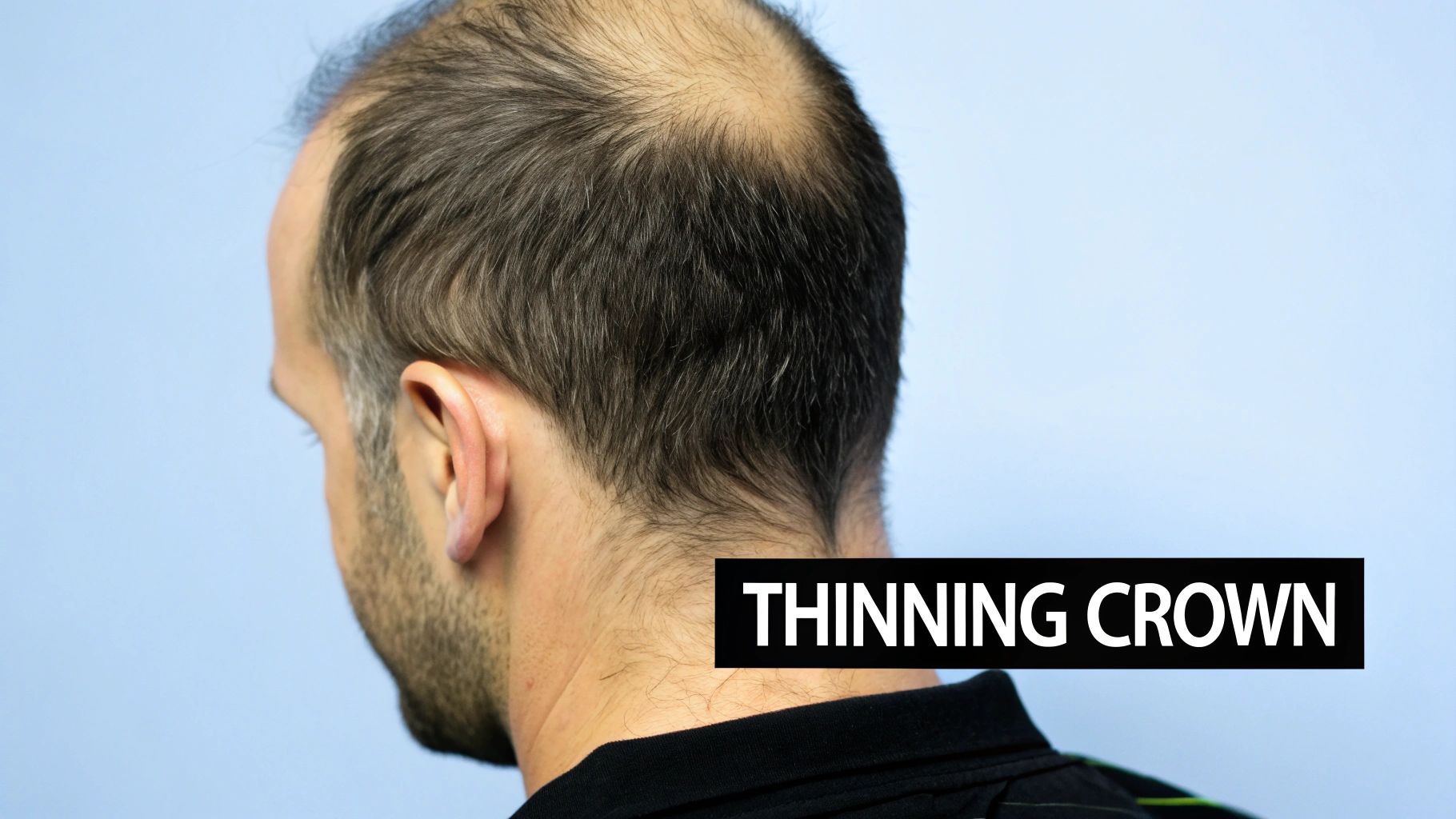
Thinning at the crown, or vertex baldness, is a key sign of male pattern baldness. Unlike receding hairlines which men often notice early, crown thinning develops gradually and frequently goes undetected until significant hair has been lost. This makes early awareness particularly important.
Crown thinning typically begins as a small circular area at the top-back of the head. The hair in this area progressively becomes finer and less dense, making the scalp more visible underneath. Over time, this thinning spot expands into a larger bald patch. Crown thinning can occur independently of a receding hairline, sometimes being the only visible sign of baldness for years. In other cases, it develops alongside a receding hairline, eventually connecting to create a more extensive bald area.
Features of Crown Thinning:
- Develops as a circular thinning area at the top of the head
- Hair density decreases with more scalp visibility
- Often goes unnoticed until significant progression occurs
- May develop after or alongside a receding hairline
Pros of Early Detection:
- Typically responds well to treatments like minoxidil, especially when caught early
- Easier to conceal with styling techniques than frontal hair loss
- Often progresses slowly, providing time for intervention
Cons of Neglecting Crown Thinning:
- Difficult to spot without someone pointing it out or using multiple mirrors
- Can eventually merge with a receding hairline, creating extensive baldness
- Becomes more challenging to treat once the area is completely bald
Real-World Examples:
The Norwood-Hamilton scale, which doctors use to classify male pattern baldness, categorizes crown thinning from stages 3 Vertex through 5. Public figures like Jason Alexander and Prince William show different degrees of crown thinning. Even Elton John experienced significant crown thinning before getting hair restoration treatments. Joe Biden's hair transplants, reportedly focused on his crown area, have helped bring attention to this common type of hair loss.
Practical Tips for Addressing Crown Thinning:
- Regular Monitoring: Use a handheld mirror with a bathroom mirror to check your crown monthly. Taking dated photos helps track changes over time.
- Topical Treatments: Apply minoxidil directly to the thinning area for best results. Speak with a dermatologist for personalized recommendations.
- Strategic Styling: Consider slightly longer hairstyles that can be styled to cover the thinning area.
- Product Awareness: Limit heavy styling products that can make thinning more noticeable by clumping hair together.
By understanding crown thinning characteristics, recognizing potential progression patterns, and actively using these tips, men can take control of their hair loss journey and explore effective options for maintaining fuller-looking hair.
3. Increased Hair Shedding

Increased hair shedding often serves as one of the earliest and most noticeable warning signs of male pattern baldness. While it's normal to lose between 50 and 100 hair strands daily, a significant increase beyond this baseline may indicate the beginning of androgenetic alopecia. This happens because hair follicles sensitive to dihydrotestosterone (DHT) begin to miniaturize, producing progressively thinner, shorter hairs before eventually stopping growth altogether.
What makes this sign particularly valuable is that it typically precedes visible thinning or receding hairlines. This provides a crucial window for early intervention when treatments like minoxidil or finasteride tend to be most effective.
Features of Increased Shedding Related to Male Pattern Baldness:
- More than 100 hairs shed daily: Though exact counting is difficult, noticing a clear increase from your normal rate is the key indicator
- Hair accumulation in visible places: You may find more hair on your pillow, in shower drains, on clothing, or in your hairbrush
- Diffuse thinning: Your hair might appear thinner overall without distinct bald patches developing yet
- Cyclical shedding patterns: The increased loss might occur in waves, with periods of heavier shedding followed by relatively normal phases
Pros of Recognizing Increased Shedding:
- Early detection: Allows for prompt intervention before significant visible hair loss occurs
- Potential for reversal: Early treatment may slow or even reverse the miniaturization process
- Investigation of alternative causes: Increased shedding could stem from treatable conditions like nutritional deficiencies or thyroid issues
Cons of Relying on Shedding as a Sole Indicator:
- Difficulty measuring: Quantifying hair loss accurately without specialized tools can be challenging
- Psychological impact: Focusing on hair shedding may create anxiety that potentially worsens stress-related hair loss
- Risk of dismissal: Many men disregard increased shedding as normal until significant thinning becomes apparent
Real-World Examples:
- The Shower Drain Test: A man notices his shower drain clogging much more frequently with hair, prompting him to investigate possible causes
- The Pillowcase Check: Finding noticeably more hair on the pillowcase each morning becomes a consistent pattern
- The Hairbrush Accumulation: Observing a marked increase in hair trapped in a brush after regular grooming sessions
Practical Tips for Monitoring and Addressing Increased Shedding:
- Establish a baseline: Count hairs lost during typical showers for a week to understand your normal shedding rate
- Document visually: Photograph your hairbrush after regular use to track changes in shedding over time
- Eliminate other causes: Visit a dermatologist to rule out other potential triggers like nutritional deficiencies, thyroid conditions, or stress
- Consider supportive supplements: Discuss with your doctor whether supplements like biotin or saw palmetto might benefit your hair health
By paying attention to changes in your shedding patterns and taking proactive steps, you gain valuable insight into your hair health and can potentially address male pattern baldness early. While discovering increased shedding might cause concern, it also empowers you to take control and explore the best options for maintaining your hair.
4. Hair Miniaturization: The Invisible Thief of Your Hair
Hair miniaturization is the hidden process driving male pattern baldness (MPB), operating undetected long before visible hair loss becomes evident. Recognizing this process early is essential for anyone concerned about their hair health, as prompt intervention can significantly improve your chances of maintaining your hair.
At its core, miniaturization transforms thick, pigmented terminal hairs into fine, short, and lighter vellus hairs. This occurs when dihydrotestosterone (DHT), a testosterone derivative, binds to androgen receptors in hair follicles, causing them to shrink. Each successive growth cycle produces increasingly finer and shorter hairs until eventually, the follicle stops producing visible hair altogether. This gradual replacement creates the appearance of thinning.
What does this look like in everyday life? Think of a lush lawn slowly giving way to patchy, thin grass. At first, the change is subtle, but over time, the density noticeably decreases. With hair miniaturization, you might notice:
- Overall thinning: Your hair appears less dense, particularly in MPB-prone areas like the temples and crown.
- Finer, weaker hairs: Individual strands become thinner, more brittle, and break more easily.
- Loss of pigmentation: Your hair may appear lighter or more transparent, especially when compared to unaffected areas.
The Science and History: Our understanding of hair miniaturization has evolved substantially through the work of pioneers like Dr. James Hamilton and Dr. O'Tar Norwood. Dr. Hamilton created the first classification system for MPB, identifying the pattern of receding hairline and thinning crown. Dr. Norwood later refined this into the widely used Norwood-Hamilton scale, which categorizes MPB stages based on the extent of miniaturization and hair loss.
The Pros and Cons of Recognizing Miniaturization:
Pros:
- Early detection: Miniaturization can be identified before significant hair loss becomes visible, allowing for proactive treatment.
- Better treatment response: MPB treatments like finasteride typically work best when started during early miniaturization stages.
- Potential for halting progression: With appropriate interventions, the miniaturization process can be slowed or stopped, helping preserve your existing hair.
Cons:
- Hard to detect without tools: In early stages, miniaturization is often invisible to the naked eye.
- Gradual but persistent: Without treatment, miniaturization continues relentlessly, leading to progressive hair loss.
- Difficult to reverse when advanced: Once miniaturization has progressed significantly, reversing the process becomes challenging.
Practical Tips for Identifying and Addressing Miniaturization:
- Magnification: Use a handheld microscope or magnifying glass to examine your hair shafts for variations in thickness and color.
- Photographic tracking: Take close-up photos of your hair at regular intervals to monitor changes in thickness and density over time.
- Professional consultation: Visit a dermatologist or trichologist who can perform trichoscopy, a non-invasive examination using specialized microscopes to assess miniaturization and diagnose MPB.
- DHT-blocking treatments: Consider FDA-approved treatments like finasteride, which blocks the conversion of testosterone to DHT, potentially slowing or stopping miniaturization.
By understanding and identifying the signs of hair miniaturization early, you can take effective steps to manage MPB and potentially preserve your hair for years to come.
5. Taking Longer to Grow Hair
While hair shedding is the most obvious sign of male pattern baldness (MPB), a more subtle yet equally important early indicator is slowed hair growth. This often-overlooked change can serve as an early warning system, potentially allowing for treatment before visible thinning occurs. It's worth highlighting because recognizing this change could lead to earlier intervention when treatments tend to be most effective.
The main culprit behind this slowed growth is dihydrotestosterone (DHT), the hormone primarily responsible for MPB. DHT works by miniaturizing hair follicles and shortening the anagen phase – the active growth period in the hair cycle. Healthy hair typically grows about half an inch per month. However, in men experiencing early MPB, this rate can decrease significantly, even before noticeable thinning begins.
Features of Slower Hair Growth Related to MPB:
- Increased time needed to regrow hair after haircuts: What used to take a month to grow back might now take six weeks or longer.
- Hair seems to reach a shorter maximum length than previously: You might notice your hair never seems to get as long as it used to, even with less frequent trims.
- Growth appears stalled or plateaued compared to unaffected areas: The crown or temples, common areas affected by MPB, might show slower growth compared to the back and sides of the head.
- May precede visible thinning by months or years: This is why paying attention to growth rate is so crucial for early detection.
Pros of Recognizing This Sign:
- Subtle indicator that can provide early warning: Catching this subtle change can give you a head start in addressing potential hair loss.
- Non-cosmetic sign that doesn't immediately affect appearance: Since this happens before visible thinning, it allows for proactive measures.
- May lead to earlier intervention before visible hair loss: Earlier intervention often leads to better outcomes with treatments.
Cons of Relying on This Sign:
- Easily dismissed or overlooked: Changes in hair growth rate can be gradual and easily attributed to other factors.
- Difficult to measure precisely without deliberate tracking: Without careful monitoring, it's hard to definitively determine a slowdown.
- Can be confused with normal age-related changes in hair growth: It's important to distinguish between MPB-related slow growth and the natural slowing that occurs with age.
Real-World Examples:
- A man notices his usual monthly haircut now takes over six weeks to grow out to the same length.
- The hair on the crown of his head seems to plateau at a shorter length, while the hair on the sides continues to grow longer.
- He realizes he hasn't needed a haircut in as long as he used to, even though he prefers longer hair.
Tips for Tracking and Addressing Slow Hair Growth:
- Mark calendar dates of haircuts and take photos to track regrowth: This provides visual and documented evidence of growth patterns.
- Compare growth rates in different areas of the scalp: This can help pinpoint areas potentially affected by MPB.
- Consider treatments that stimulate the growth phase, like minoxidil: Discuss these options with a dermatologist.
- Consult with a dermatologist about prescription treatments like finasteride: A dermatologist can diagnose the cause of slow growth and recommend the best course of action.
Though slowed hair growth might seem like a minor change, recognizing it early can be a powerful advantage in managing MPB. By paying attention to this subtle sign, men can take proactive steps toward addressing hair loss before it becomes more noticeable, opening the door to more effective treatment options when they matter most.
6. Change in Hair Texture and Volume
One of the earliest warning signs of male pattern baldness often goes unnoticed: a distinct change in your hair's texture and volume. This subtle shift deserves your attention because it typically precedes visible thinning, giving you a valuable opportunity for early intervention that could potentially slow down hair loss progression.
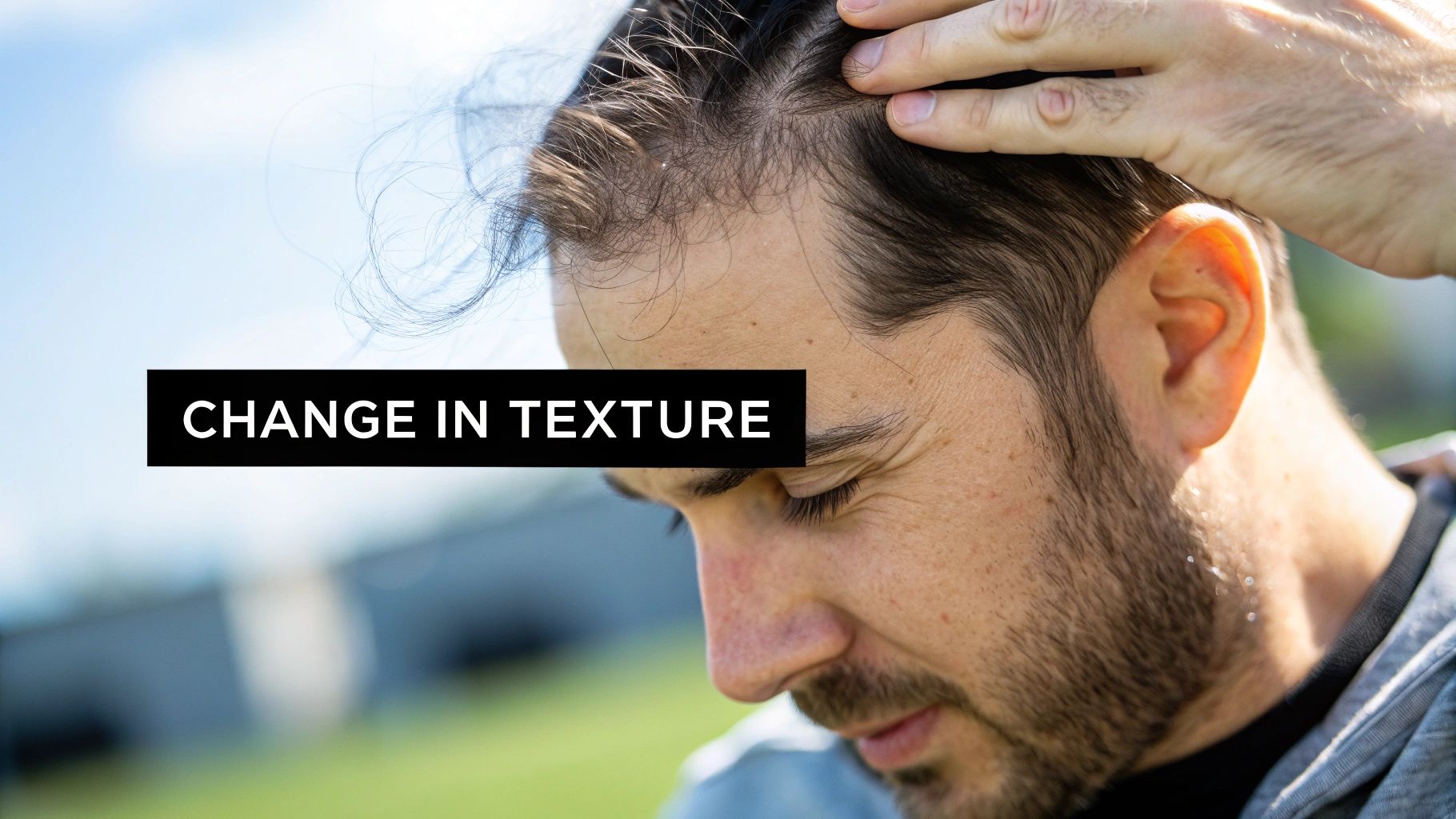
When DHT (dihydrotestosterone), the primary hormone responsible for male pattern baldness, begins affecting your hair follicles, it gradually miniaturizes them. This compromises their ability to produce robust, thick hair strands, resulting in several noticeable changes:
- Features:
- Hair feels thinner between your fingers when you run your hands through it
- Styling your hair with the same volume becomes increasingly difficult
- Hair texture becomes more wispy, brittle, or fragile
- You notice a loss of natural body and resilience in your hair
Think about it this way: Imagine a thick, healthy rope gradually being replaced by thinner, weaker twine. Even before significant portions disappear, the overall strength and volume decrease dramatically. This perfectly illustrates what happens to your hair during the early stages of male pattern baldness.
-
Real-world examples: You might find yourself using more styling product to achieve looks that once came easily. Hair that previously had natural volume now lies flat against your scalp, and hairstyles that once required minimal effort now demand considerable time and attention.
-
Pros of recognizing this change:
- You can detect it before significant visible thinning occurs, giving you a head start on treatment
- It can motivate positive lifestyle changes that benefit overall hair health, like improving diet and reducing stress
- The change can be temporarily masked with volumizing products while you explore treatment options
-
Cons:
- People often mistake this change for normal stress or aging effects, delaying proper diagnosis
- It creates styling challenges as hair becomes less responsive to products and techniques
- Without intervention, these texture and volume changes typically progress to visible thinning
The evolution of hairstyles adopted by celebrities like John Travolta over the decades clearly demonstrates this progression. Professional hairstylists like Sally Hershberger, known for creating effective styles for thinning hair, have highlighted how texture changes relate to hair loss. They've developed specific techniques and products to address these challenges, further emphasizing the importance of recognizing this early sign.
- Practical Tips:
- Use volumizing shampoos and lightweight conditioners to enhance thickness without weighing down hair
- Consider shorter hairstyles that require less volume to look good
- Try thickening fibers or sprays for temporary cosmetic improvement
- Include regular scalp massage in your routine to stimulate blood flow to hair follicles
By paying close attention to changes in your hair's texture and volume, you can gain valuable insights into its health and potentially address male pattern baldness before it advances to more noticeable stages.
7. Family History of Baldness
Family history stands as one of the strongest indicators of male pattern baldness (MPB), even though you won't see it directly in your mirror. Understanding your genetic predisposition can help you take control of your hair loss journey. MPB is primarily determined by inherited genes that affect how your hair follicles respond to dihydrotestosterone (DHT), which gradually shrinks follicles over time.
Your risk increases significantly if you have a strong family history of baldness, particularly on your mother's side. This connection exists because the main baldness gene is located on the X chromosome, which comes from your mother. However, genes from both sides of your family contribute to your hair loss risk. Pay special attention to your maternal grandfather's hair pattern—it often provides valuable clues about your own future hairline. Study the baldness patterns of your male relatives: do they share similar recession at the temples or crown thinning? Did they start losing hair in their 20s or later? These patterns can help predict your own hair loss journey.
Features to Look For:
- Maternal side patterns: Your mother's father and brothers offer particularly relevant insights
- Age of onset: Early hair loss in relatives may signal your own timeline
- Progression similarities: Hair loss patterns tend to repeat within family lines
- Both sides contribute: While maternal genes carry more weight, paternal genetics also play a role
Pros of Knowing Your Family History:
- Proactive measures: You can begin treatments before visible hair loss appears
- Differential diagnosis: Helps distinguish hereditary MPB from other causes
- Realistic expectations: Enables more informed decisions about managing hair loss
Cons of Knowing Your Family History:
- Anxiety: Awareness of predisposition may cause unnecessary stress
- Not definitive: Not everyone with family history develops significant baldness
- Premature treatment: May lead to starting treatments earlier than necessary
Real-World Examples:
The British royal family provides a clear illustration of hereditary hair loss patterns. The progression from Prince Philip to Prince Charles and now Prince William demonstrates how MPB can be traced through generations. This high-profile example has increased public understanding of inherited baldness. Another interesting phenomenon is the "skipping a generation" pattern sometimes seen with X-linked inheritance, where a grandson may mirror his maternal grandfather's baldness pattern. Dr. Norman Orentreich's groundbreaking work on "donor dominance" in hair transplantation further highlighted genetic factors in MPB. He discovered that hair follicles from the back of the head maintain their DHT resistance even when moved to balding areas, confirming the genetic nature of pattern baldness.
Practical Tips:
- Photographic evidence: Examine old family photos to identify recurring patterns
- Genetic testing: Consider testing for androgen sensitivity markers
- Dermatologist consultation: Share your family history with specialists to customize treatment approaches
- Early intervention: If your family history suggests high risk, consider preventative treatments sooner
Family history deserves serious consideration because it gives you power. While it's not a perfect predictor, understanding your genetic predisposition allows you to make informed decisions about prevention and treatment options, potentially slowing or minimizing the effects of male pattern baldness.
7 Signs of Early Male Pattern Baldness Comparison
| Sign | 🔄 Complexity | ⚡ Progression Speed | 📊 Diagnostic Impact | 💡 Treatment Tips/Insights |
|---|---|---|---|---|
| Receding Hairline | Low – Easily noticeable | Slow to moderate | High – Early, visible predictor | Track with photos; consult a dermatologist; adjust hairstyles |
| Thinning Crown (Vertex Baldness) | Moderate – Requires careful observation with mirrors | Gradual | Moderate-to-high – Becomes more evident later | Monitor with photos; use topical treatments like minoxidil |
| Increased Hair Shedding | Low – Observed in daily routine | Variable/Cyclical | Moderate – Early sign but less definitive | Count shed hairs; check for nutritional factors; consider supplements |
| Hair Miniaturization | High – Needs magnification/dermoscopy | Gradual, stealthy | High – Strong indicator when observed | Use handheld microscope; consult for DHT-targeted treatments |
| Taking Longer to Grow Hair | Moderate – Requires time tracking | Slow indicator | Moderate – Subtle early warning | Document regrowth intervals; compare scalp areas; consider growth therapies |
| Change in Hair Texture and Volume | Low – Felt and seen through styling changes | Gradual | Moderate – Subjective but common change | Use volumizing products; adjust styling; maintain hair/scalp health |
| Family History of Baldness | N/A – Informational factor | N/A – Predictive factor | High – Strong genetic predictor | Review family patterns; consider early preventive measures; realistic expectations |
Taking Action Against Hair Loss
Spotting the early signs of male pattern baldness is the first step toward effectively managing it. These signs include a receding hairline, thinning at the crown, increased hair shedding, miniaturization of hair follicles, slower growth, changes in texture, or a family history of baldness. Recognizing these warning signals allows you to take proactive measures before significant hair loss occurs. Early intervention often leads to better outcomes in hair loss treatment.
Once you've identified potential signs, it's wise to confirm your observations with a professional. Consulting with a dermatologist or hair loss specialist provides an accurate diagnosis and personalized treatment recommendations based on your specific condition. Don't delay seeking professional advice if you notice concerning changes in your hair – the range of available treatment options typically narrows as hair loss progresses.
Hair loss management is rarely a one-size-fits-all solution. Each person responds differently to treatments, and your approach may need to change over time. Stay informed about emerging research and treatment methods by following reputable sources and medical journals. Adjust your strategy as needed, and remember that consistent application of your chosen treatments is essential for seeing results.
The field of hair restoration continues to advance with new scientific breakthroughs and therapeutic approaches. Keeping up with these developments helps you make well-informed choices about your treatment plan. Among the most promising recent innovations in hair loss therapy is Platelet-Rich Plasma (PRP) treatment, which has gained considerable attention from both researchers and patients.
Key Takeaways:
- Early detection of male pattern baldness is essential.
- Professional consultation is highly recommended.
- Consistent treatment and adaptation are crucial.
- Stay informed about the latest advancements in hair loss therapies.
Ready to take control of your hair loss journey and explore the potential of PRP therapy? Learn more about this innovative treatment and discover how it can help you combat hair loss and regain your confidence at PRP For HairLoss.


Leave a Reply