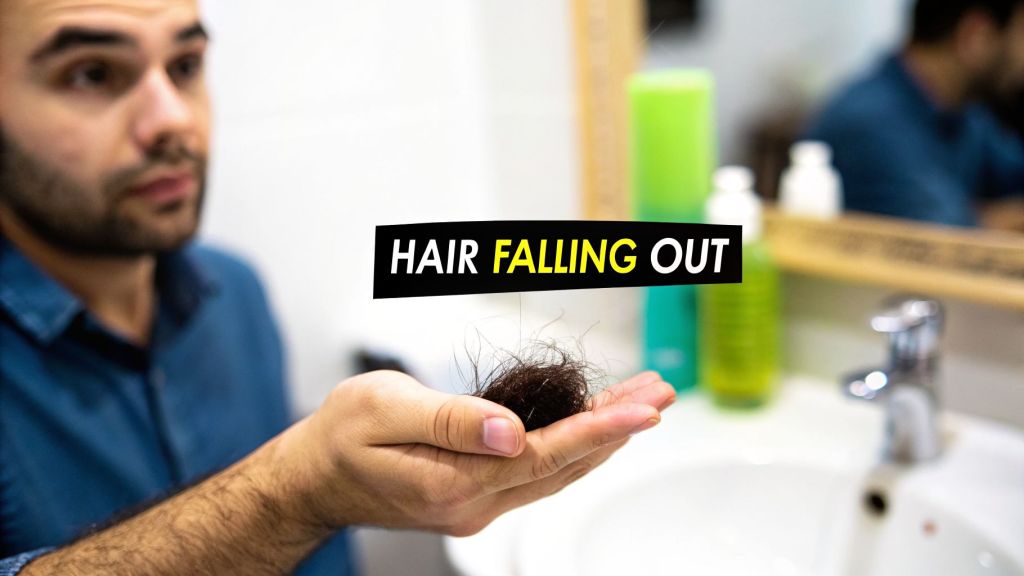
It’s a moment that can stop you in your tracks. You look down at the shower drain, your pillow, or your hairbrush and see a clump of hair that definitely wasn’t there before. For men, this kind of sudden shedding might feel like male pattern baldness has been kicked into overdrive, or it could be your body sounding an alarm after a period of intense stress.
The most important thing you can do right now is get to the bottom of what’s really going on so you can take back control.
The Moment of Panic When Your Hair Falls Out In Clumps

First things first, let's just acknowledge the shock and worry that comes with this. Finding your hair falling out in clumps isn't just some minor inconvenience; it’s a genuinely alarming experience that can make you feel completely isolated. But I promise you, you are not the only one going through this.
This exact scenario is a reality for millions of men. Male pattern baldness is one of the most common conditions guys face, affecting about 50 million men in the United States alone. In fact, by age 35, a staggering two-thirds of men will have some degree of noticeable hair loss. That number jumps to roughly 85% by age 50, making significant thinning an incredibly widespread issue.
From Alarm to Understanding
The sudden, visual evidence of hair loss can be jarring. It’s completely normal to feel a spike of panic, anxiety, or even fear about your health. The goal of this guide is to help you channel that initial alarm into a clear, empowered understanding of what's happening.
When you see clumps of hair falling out, it’s almost always a sign that your hair's natural growth cycle has been disrupted. This shock to the system can be triggered by genetics, major stress, or hormonal shifts. While it's normal to shed 50 to 100 hairs a day, finding large clusters means something specific is going on.
This isn't about random guessing. It’s about listening to what your body is telling you. There are very specific reasons this happens, and thankfully, there are clear paths forward. We'll help you connect the dots between your symptoms and what’s been going on in your life, which is the first and most critical step toward finding a solution that actually works.
What This Guide Will Cover
This guide is designed to give you direct, no-nonsense answers. We will walk through:
- The Root Causes: Uncovering the specific triggers that can cause sudden, heavy shedding.
- Immediate Actions: Practical things you can start doing right away to manage the situation.
- Professional Diagnosis: What to expect when you seek help from a specialist.
- Effective Treatments: An honest look at modern solutions that deliver real results.
If you’re struggling with the emotional impact of this, remember that help is available. The sudden shock of seeing hair fall out in clumps can trigger intense feelings of anxiety. To better navigate this, you might find it useful to consult A Practical Guide To Cbt For Health Anxiety.
Why Is My Hair Suddenly Falling Out In Clumps?

Finding a noticeable clump of hair in the shower drain or on your pillow can be genuinely alarming. It feels like something went wrong overnight, but the truth is, this kind of shedding is almost always a delayed reaction to something that happened weeks or even months ago.
Your hair grows in a predictable cycle. When a significant event—whether it's stress, a genetic trigger, or a health issue—disrupts that rhythm, the result is a sudden, concentrated shed. Getting to the root of that disruption is the key to figuring out what's going on and what to do next.
The Genetic Trigger: Androgenetic Alopecia
For most guys, the number one reason for hair loss is Androgenetic Alopecia, which is the clinical term for male pattern baldness. It’s important to know this isn't a disease; it’s a genetic trait you've inherited, just like your eye color. Think of it as a pre-written script for how your hair follicles will behave over time.
This script involves a sensitivity to a hormone called Dihydrotestosterone (DHT). As you get older, DHT gradually miniaturizes the hair follicles on your scalp. Each new hair that grows back is a little thinner and weaker than the one before it. Eventually, the follicle just gives up and stops producing hair. When a large number of follicles hit this point around the same time, you'll see a dramatic increase in shedding that looks like clumps.
If this is happening to you now, it likely means that this genetic process has simply hit a more advanced stage. It’s an incredibly common experience—about one in four men see signs by the time they’re 25. In fact, this sensitivity to DHT is behind 95% of all hair loss in men.
The System Shock: Telogen Effluvium
Another very common reason for finding clumps of hair is a condition called Telogen Effluvium (TE). This one has nothing to do with genetics and everything to do with a major shock to your system.
Think of your body's resources like a budget. When everything is running smoothly, there’s enough to go around. But if a major event occurs—like a serious illness, surgery, extreme stress, or even drastic weight loss—your body enters survival mode. It immediately diverts resources away from "non-essential" functions, and unfortunately, hair growth is high on that non-essential list.
This shock effectively shoves a huge number of your hair follicles—sometimes 30% or more—into the resting (telogen) phase all at once. Then, about two or three months later, all those hairs are shed at the same time, which is why you suddenly see so much hair falling out.
The good news? TE is almost always temporary. Once the stressor is gone and your body finds its balance again, your hair growth cycle should get back on track.
To help you quickly distinguish between these common causes and others, here's a quick-reference table.
Comparing Reasons for Sudden Hair Loss In Men
| Condition | Primary Cause | Pattern of Loss | Reversibility |
|---|---|---|---|
| Androgenetic Alopecia | Genetic sensitivity to the hormone DHT | Gradual thinning at the temples and crown | Manageable and can be slowed, but not naturally reversible |
| Telogen Effluvium | Physical or emotional shock to the body | Diffuse, all-over shedding | Typically reverses on its own within months once the stressor is gone |
| Alopecia Areata | Autoimmune response attacking hair follicles | Round, distinct bald patches or diffuse shedding | Unpredictable; can regrow on its own or with treatment |
| Nutritional Deficiency | Lack of key nutrients like iron or zinc | General, diffuse thinning and increased shedding | Reversible once nutritional levels are restored |
This table provides a starting point, but remember that a proper diagnosis is always the best path forward.
Other Potential Culprits
While genetics and stress are the two heavy hitters, a few other factors can absolutely cause your hair to shed in clumps. It’s worth keeping them on your radar.
- Nutritional Gaps: Your hair follicles are like tiny factories that need a steady supply of raw materials. If you’re deficient in key nutrients like iron, zinc, or certain B vitamins, you can stall the production line and trigger a shed.
- Autoimmune Responses: Sometimes, the body’s own immune system gets confused and attacks healthy hair follicles. A condition called Alopecia Areata is the most common example, usually causing round bald patches but sometimes appearing as more widespread, clumpy loss.
- Medical Conditions: Certain underlying health problems, especially thyroid disorders (both overactive and underactive), can throw your hormones out of whack and disrupt the hair growth cycle in a big way.
By taking stock of your health and recent life events, you can start connecting the dots. To get a more complete picture, you can learn more about the sudden hair loss causes in men in our comprehensive guide.
Your Immediate Action Plan For Sudden Hair Loss
Watching your hair fall out in clumps can be alarming, to say the least. While figuring out the root cause is the long-term goal, you need a plan for right now. That feeling of panic is real, but taking a few immediate, practical steps can help you regain some control and, more importantly, prevent the shedding from getting worse. This is all about damage control while you map out your next move.
Your first order of business is to reduce physical stress on your hair. Think of your follicles as being on high alert; any aggressive pulling or harsh treatment can easily tip more of them into the shedding phase. It's time to get gentle, starting today.
Adopt A Gentler Hair Care Routine
You'd be surprised how much of a difference small tweaks to your daily routine can make. The goal here is simple: treat your scalp and hair with the utmost care.
- Switch to a mild shampoo: Look for a sulfate-free formula. Harsher detergents can strip your scalp of its natural oils, causing irritation that you just don't need right now.
- Use lukewarm water: Super hot showers feel great, but they can be rough on your scalp and hair shafts, which might encourage more shedding.
- Wash gently: Don't scrub your scalp like you're trying to get a stain out. Use your fingertips—not your nails—to massage the shampoo in. Piling all your hair on top of your head is also a recipe for tangles and breakage, so avoid that.
- Pat, don't rub: Vigorously rubbing your wet hair with a towel is one of the worst things you can do. The friction can literally pull weakened hairs right out. Gently pat it with a soft towel or just let it air dry.
- Ditch the tight styles: That tight man bun or ponytail puts constant strain on your hair follicles, a condition known as traction alopecia. Give your hair a break and let it hang loose for a while.
Assess Your Diet And Lifestyle
What happens on the outside is often a reflection of what's going on inside. Your hair follicles are tiny, high-metabolism factories, and they need a constant supply of fuel to do their job. A sudden shock to your system—whether from diet or stress—can shut down production.
Take a moment to think back. Have you made any drastic dietary changes lately? Have you been under an unusual amount of stress? Deficiencies in key nutrients like iron, zinc, and protein are well-known triggers for hair loss. A balanced diet packed with lean proteins, leafy greens, and healthy fats gives your hair the raw materials it needs to grow.
When your body is under major stress, it pumps out the hormone cortisol. Elevated cortisol can throw your hair growth cycle out of whack, forcing a large number of hairs into the shedding phase all at once. Finding ways to manage that stress—whether it's hitting the gym, practicing mindfulness, or just getting a solid night's sleep—can have a direct, positive impact.
When To See A Professional Immediately
While being gentle and eating well are fantastic first steps, some signs are clear indicators that you need to see a doctor or dermatologist, and fast. These red flags suggest something more is going on than just temporary, stress-induced shedding.
If you're experiencing any of the following, it’s time to make that call:
- Extremely rapid and widespread loss: If the shedding is coming on strong and happening all over your head very quickly.
- Visible scarring or smooth patches: Any bald spots that are completely smooth, shiny, or look scarred are not typical and need a professional diagnosis.
- Scalp pain, itching, or burning: Discomfort, redness, or inflammation points to a possible infection or inflammatory condition that won't resolve on its own.
Knowing when to escalate the issue is key. For a more in-depth guide, learn more about when you should see a dermatologist for hair loss to help you decide. Acting quickly on these symptoms can dramatically improve your outcome.
Getting A Clear Diagnosis From A Hair Loss Specialist
Look, trying to figure this out on your own through late-night searches can only get you so far. It’s mostly just guesswork. If your hair is falling out in noticeable clumps, the only way to get a real answer—and a treatment plan that actually works—is to see a hair loss specialist like a dermatologist or a certified trichologist.
Going it alone often leads to a cabinet full of useless products and a lot of frustration. A specialist, on the other hand, knows exactly what to look for. They use a systematic approach to uncover the root cause of your shedding, which is critical because treating genetic thinning is a completely different ballgame than addressing stress-related hair fall.
What To Expect During Your Consultation
Walking into a specialist's office for the first time might seem daunting, but the process itself is very straightforward. It's all about gathering clues to understand your specific situation.
First, you'll just talk. The doctor will ask about your personal and family medical history, your diet, recent stress levels, and any medications or supplements you're taking. Be honest and thorough here—every detail helps.
Next, they'll conduct a physical exam of your hair and scalp. They're trained to spot things you can't, like specific patterns of thinning, scalp inflammation, or scarring that point to a particular diagnosis. This initial look sets the stage for any tests that might be needed.
This flowchart maps out a simple game plan for when you notice that sudden, clumpy shedding.

The main point is clear: seeing hair fall out in clumps is your cue to get a professional opinion. Milder, more diffuse shedding, on the other hand, can often be managed initially with some simple, gentle care at home.
Common Diagnostic Tests For Hair Loss
Based on your conversation and the initial scalp exam, the specialist might suggest a few tests to get a clearer picture of what's happening under the surface. Don't worry, these aren't invasive or scary; they're just diagnostic tools to solve the mystery.
Some of the most common methods include:
- The Hair Pull Test: This is a quick, simple test done right in the office. The doctor will gently tug on a small bunch of hair, maybe 40-60 strands, to see how many come loose. If more than a handful of hairs come out, it often signals an active shedding phase like telogen effluvium.
- Blood Tests: Very often, the problem isn't on your head but inside your body. A standard blood panel can check for common culprits like thyroid issues, anemia (low iron), or vitamin D deficiency. All of these are well-known triggers for significant hair loss.
- Scalp Biopsy: In cases where an autoimmune condition or a scarring form of alopecia is suspected, a scalp biopsy might be the next step. It sounds more intense than it is—it just involves taking a tiny skin sample from your scalp for analysis in a lab. You can get a better sense of what's involved by reading up on a scalp biopsy for hair loss and what to expect.
Getting a clear diagnosis is the single most important step you can take. It ensures that any treatment you begin is targeted, effective, and right for your specific condition, saving you time, money, and emotional energy.
Modern Hair Restoration Treatments That Actually Work

Once you’ve received a proper diagnosis from a specialist, the worry can finally take a backseat to action. This is the point where you get to move beyond drugstore foams and into the realm of real, effective solutions with proven track records.
It’s all about matching the right tool to the right job. If you’re dealing with temporary shedding from something like Telogen Effluvium, the best "treatment" is usually just patience while you fix the root cause. But for progressive, genetic thinning, you need to be much more proactive.
Platelet-Rich Plasma: A Closer Look
One of the treatments generating a lot of buzz is Platelet-Rich Plasma (PRP) therapy. It sounds high-tech, but the core idea is beautifully simple: using your body's own healing power to give your hair follicles a second wind.
Think about what happens when you get a papercut. Your body immediately sends platelets rushing to the scene to stop the bleeding and begin repairs. These platelets are loaded with powerful growth factors. PRP therapy simply harvests that same healing energy and focuses it on your scalp.
The process itself is surprisingly straightforward. First, a small amount of your blood is drawn, no different than a routine lab test. That sample is then spun in a centrifuge, a machine that separates the blood into its different parts. The "liquid gold" layer is isolated—the plasma that's now packed with a high concentration of platelets. Finally, this super-concentrated plasma is carefully injected directly into the thinning areas of your scalp.
By delivering this potent mix of growth factors right where they're needed, the therapy aims to wake up tired follicles, boost blood supply, and encourage them to produce thicker, stronger hair once again.
Is PRP The Right Move For You?
Now for the big questions: does it actually work for male pattern baldness, and are you a good candidate?
In my experience, PRP delivers the best results for men in the earlier stages of androgenetic alopecia. If your hair has just started thinning or you've noticed your part widening, PRP can be a fantastic way to pump the brakes and improve hair density. It's much less effective for guys with large, completely bald areas where the follicles have been dormant for many years.
Seeing hair fall out in clumps terrifies men because it often signals advancing male pattern baldness, which affects roughly 85% of men by the time they reach age 50. If you have a family history of baldness, seeing clumps is a sign that things are accelerating. This is where PRP can be a game-changer, using your plasma's platelets to boost follicle regeneration. Studies have reported 60-70% improvement in density for patients in the early stages, making it a far better option than waiting. The sessions are quick, involve drawing and injecting your own blood, and have no downtime, which is perfect for busy guys. Discover more about the prevalence and treatment of male hair loss on kopelmanhair.com.
Comparing Your Treatment Choices
While PRP is a great tool, it’s not the only one in the toolbox. It’s important to see how it stacks up against the two FDA-approved heavyweights in hair loss treatment: Minoxidil and Finasteride. Knowing the pros and cons helps you make a truly informed choice.
A Quick Comparison of Top Hair Loss Treatments
| Treatment | How It Works | Best For | Pros | Cons |
|---|---|---|---|---|
| PRP Therapy | Injects your own concentrated platelets into the scalp to stimulate follicles. | Early-stage genetic hair loss and boosting hair density. | Uses your body's own materials, minimally invasive, no daily commitment. | Requires multiple sessions, can be costly, results vary. |
| Minoxidil (Rogaine) | A topical foam or solution that increases blood flow to follicles and extends their growth phase. | General thinning and slowing down hair loss progression. | Readily available over-the-counter, easy to apply. | Must be used twice daily forever, can cause scalp irritation. |
| Finasteride (Propecia) | An oral prescription pill that blocks the conversion of testosterone to DHT, the hormone that shrinks follicles. | Halting the progression of male pattern baldness, especially at the crown. | Very effective at stopping hair loss and can regrow hair in some men. | Requires a prescription, potential for sexual side effects in a small percentage of users. |
Very often, the most powerful strategy is a combination approach. A specialist might recommend Finasteride to tackle the underlying hormonal cause of hair loss, while using PRP sessions to actively stimulate new growth and improve the health of existing hair. You can learn more about how different approaches can be combined by exploring other hair restoration treatment options available today. Ultimately, the best path forward will be tailored to your specific diagnosis, the extent of your hair loss, and what you hope to achieve.
Answering Your Questions About Clumpy Hair Loss
Losing your hair is personal, and when it starts coming out in clumps, it’s downright alarming. You’re left with a lot of questions and deserve clear, straightforward answers.
We’ve walked through the causes and treatments, but now let’s tackle the specific concerns that are probably on your mind.
Can Stress Really Make My Hair Fall Out In Clumps?
Absolutely. There's a direct link, and it’s a condition known as Telogen Effluvium. Think of a major physical or emotional shock—like a bad illness, a major surgery, or even intense personal distress—as your body hitting the emergency brake.
When your system goes into survival mode, it diverts resources away from anything it considers non-essential. Unfortunately, hair growth is at the top of that non-essential list. This forces a huge number of hair follicles to go into a resting phase all at once.
Then, about three months later, all of those resting hairs are shed simultaneously. That’s why you suddenly see those terrifying clumps in the shower drain. The good news? This is almost always temporary. Once the stressor is gone, your hair cycle typically resets and begins to grow back normally.
My Dad Is Bald. Does That Mean I Will Be Too?
Your dad’s genes are a big factor, but they aren't your destiny. The genes for male pattern baldness can come from either side of your family, so your mother’s father is just as important a clue.
That said, if baldness is common among your close male relatives, your genetic risk is certainly higher. You can think of it as having a built-in sensitivity to the hormone DHT. If you start noticing thinning or shedding in clumps, it could be a sign that this genetic switch has been flipped on.
But this is not a life sentence for your hair. The most important thing to know is that today's treatments work best when you catch things early. You have a real opportunity to intervene and change the outcome instead of just waiting for it to happen.
You can't change your genetic code, but you absolutely can change how you respond to it. Acting fast gives you the best odds of keeping the hair you have.
How Painful Are PRP Injections For Hair Loss?
This is a fair and very common question. The truth is, most guys find the procedure much more manageable than they expected. Your comfort is a huge priority, so clinics use strong numbing creams on the scalp or a special cooling device that distracts the nerves during the injections.
The needles used are incredibly fine—much thinner than what’s used for a flu shot. Patients usually describe the sensation as a few quick, light pricks or a feeling of pressure, but not sharp pain.
Any minor discomfort you might feel is over in a flash and subsides almost as soon as the session is done. Since it's a minimally invasive treatment, there's no downtime, letting you get right back to your day without missing a beat.
How Long Until I See Results From PRP?
Patience is everything when it comes to hair growth. It’s a marathon, not a sprint. You won't see a full head of new hair overnight because your follicles need time to wake up and get back to work.
Here’s a realistic timeline of what you can generally expect:
- First Sign of Change (2-3 Months): The very first thing you'll probably notice is that your hair is shedding less. This often happens after your second or third monthly session and is a fantastic sign that the treatment is taking hold.
- Visible New Growth (4-6 Months): This is when things get exciting. You might start to see fine, new "vellus" hairs sprouting, and your hair should begin to feel and look a bit thicker and denser overall.
- Optimal Results (Up to 1 Year): The most significant results typically appear after you've finished your initial series of treatments. Your hair can continue to improve in thickness and strength for up to a full year as the new hairs mature.
The journey to restoring your hair is a gradual one, and it's important to understand the biological timelines involved. To get a deeper look at what influences regrowth, check out our article on whether hair can grow back after loss. Sticking with your treatment plan is the single best thing you can do to get the results you're after.
At PRP For HairLoss, we believe that understanding your options is the first step toward taking control. If you're tired of worrying about your hair and ready to explore a solution that uses your body's own healing power to restore density, we're here to help guide you. Learn more at https://prpforhairloss.com.
 PRP For Hairloss
Leave a comment