Let's get right to the question on everyone's mind: can my hair actually grow back?
The short answer is yes, in many cases, it absolutely can. But whether or not it's possible for you comes down to one critical factor: the health of your hair follicles.
Think of a hair follicle like the root system of a plant. As long as the root is alive and healthy, you can coax a new shoot to grow. The real problem starts when that root is gone for good.
Yes, Your Hair Can Grow Back—Under the Right Conditions
This is probably the most common question I hear, and it’s surrounded by a lot of hope, but also a ton of misinformation. The deciding factor is surprisingly simple: is your hair follicle dormant, or is it permanently damaged?
A dormant follicle is like a hibernating bear—it’s just sleeping and can be woken up with the right encouragement. Permanent damage, on the other hand, means the follicle has scarred over and closed up shop. It simply can't produce hair anymore.
This distinction is everything. Many common causes of hair loss, like stress, hormonal shifts, or nutritional gaps, just push follicles into a temporary resting state. That’s great news, because it means regrowth is a very realistic goal.
The core concept is that if a follicle is dormant but not dead, the right interventions can reawaken it. The journey requires patience, but understanding the root cause is the first step toward recovery.
The Scale of Hair Loss and Regrowth
If you’re experiencing hair loss, you are far from alone. Androgenetic alopecia (the classic "pattern baldness") is the most widespread form, affecting around 85% of men and 33% of women worldwide.
Despite how common it is, people are finding real success. For example, a staggering 95.2% of patients who have hair transplant surgery report positive emotional benefits from the results. It's no wonder the global market for hair regrowth solutions shot past USD 52.37 billion in 2022—people are investing in these treatments because they often work. You can explore more comprehensive hair loss statistics to see just how prevalent these issues—and their solutions—have become.
Regrowth Potential for Common Hair Loss
To give you a clearer idea of what you might be dealing with, I’ve put together a quick breakdown of common hair loss conditions and their potential for regrowth.
The goal here is to help you move from a place of uncertainty to one of informed action. Once you have a better sense of the why, you can start exploring the how.
Hair Regrowth Potential by Cause of Loss
| Type of Hair Loss | Is the Follicle Damaged? | Can Hair Grow Back? | Common Triggers |
|---|---|---|---|
| Telogen Effluvium | No, just dormant | Yes, usually fully | Stress, illness, surgery, nutritional deficiencies |
| Androgenetic Alopecia | Miniaturized over time | Yes, with early treatment | Genetics and hormones (DHT) |
| Alopecia Areata | No, but attacked by immune system | Yes, often spontaneously or with treatment | Autoimmune response |
| Traction Alopecia | Yes, if prolonged | Yes, if caught early; may be permanent later | Tight hairstyles, pulling |
| Cicatricial (Scarring) Alopecia | Yes, permanently destroyed | No, follicle is replaced by scar tissue | Inflammation, autoimmune disorders |
As you can see, for many of the most common types of hair loss, the follicle isn't permanently gone—it's just waiting for the right signal to get back to work. The key is catching it early and identifying the trigger, which gives you the best possible chance of recovery.
Understanding Your Hair's Natural Growth Cycle
Before we can even begin to answer, "can hair grow back?" we have to look at how it grows in the first place. Every single strand of hair on your head follows a predictable, repeating cycle. When that cycle is working as it should, you have a healthy, full head of hair.
Think of each hair follicle as a tiny, independent engine. When it's running smoothly, it's producing hair. Understanding the different stages of this engine's cycle is the key to diagnosing why things might be sputtering out.
The Four Phases of Hair Production
The life of a single hair is a four-act play. Each act has a specific role, and how long each one lasts determines the health and length of your hair.
-
Anagen (The Growth Phase): This is the main event, the active growing period. Cells in the follicle are dividing and pushing the hair shaft longer. For most people, this phase lasts anywhere from 2 to 7 years, and it dictates the maximum length your hair can ever reach.
-
Catagen (The Transition Phase): A very brief intermission. The follicle shrinks, cuts itself off from the blood supply, and stops growing. This is the shortest phase, lasting only about 2 to 3 weeks.
-
Telogen (The Resting Phase): The hair is no longer growing, but it's not ready to leave just yet. It sits dormant in the follicle for about 3 months while, underneath it, a brand new hair starts to form.
-
Exogen (The Shedding Phase): The final act. The old, resting hair is finally pushed out by the new one growing in its place. It's completely normal and healthy to shed between 50 and 100 of these hairs every single day.
When everything is in balance, the number of hairs being shed is easily replaced by new hairs entering the growth phase. You never notice a difference.
How The Cycle Gets Disrupted
Hair loss is what happens when this carefully choreographed cycle gets thrown off-kilter. Something interferes, pushing too many hairs into the resting and shedding phases at once or shortening the growth phase itself. The end result is a net loss of hair.
For instance, a significant physical or emotional stressor can shock a large percentage of your hair follicles, forcing them to jump from the anagen (growth) phase directly into the telogen (resting) phase. Then, about three months later, all of those hairs enter the exogen phase simultaneously, leading to a sudden, noticeable period of shedding. This common condition is called telogen effluvium.
This infographic breaks down some of the most common culprits that can knock your hair's growth cycle out of whack.
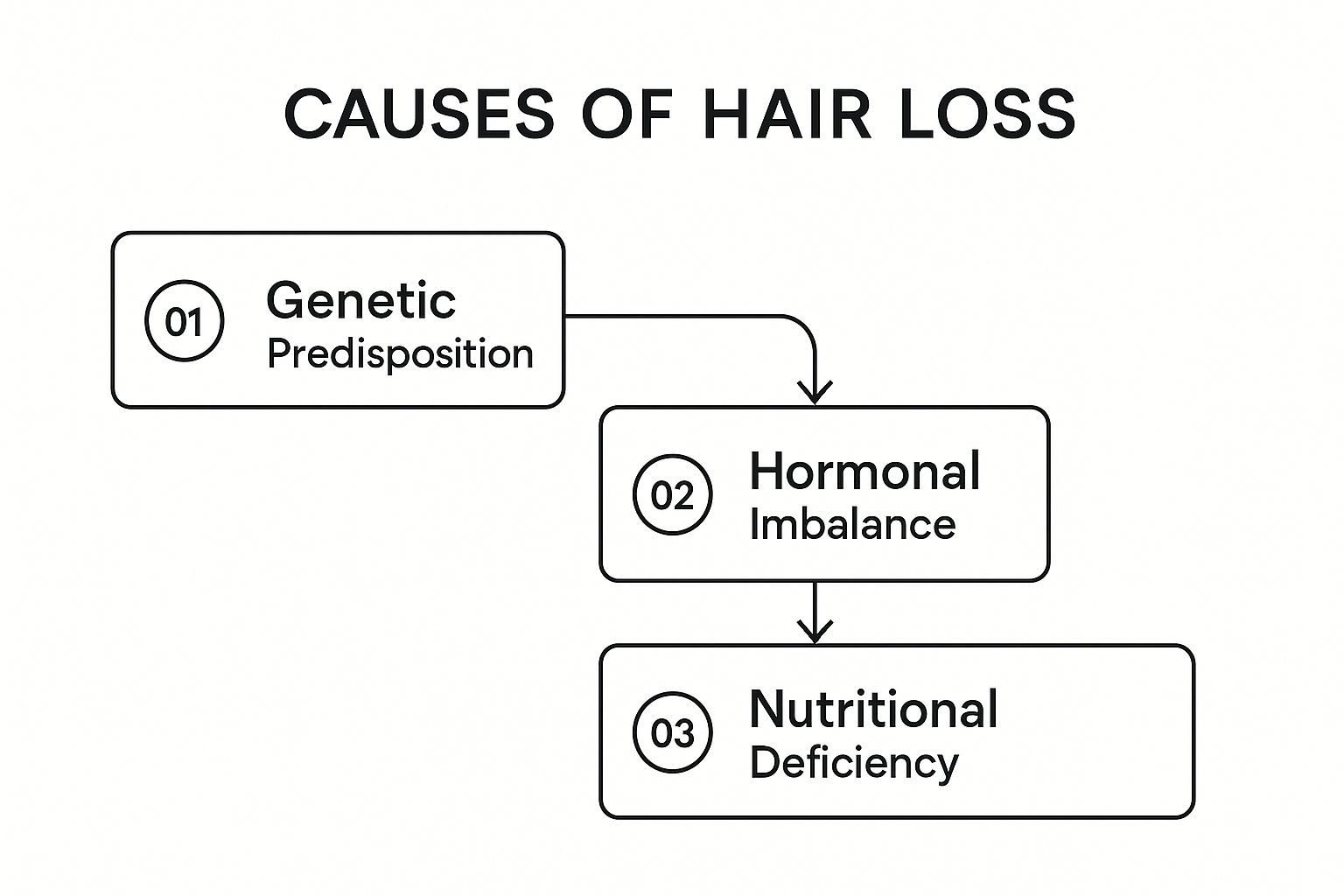
As you can see, these factors are often interconnected. A genetic tendency for hair loss can make you more vulnerable to hormonal shifts, which in turn can be made worse by a poor diet.
The key takeaway is this: Hair loss isn't just about hair falling out. It's often about the growth cycle being disrupted—either the growing phase is cut short, or the resting phase is prolonged.
This is exactly what effective hair regrowth treatments target. They aim to get the cycle back on track, whether by extending the anagen phase, stimulating dormant follicles out of the telogen phase, or blocking the internal signals causing the problem. This is also why patience is so crucial—it takes time to gently coax these tiny engines back to life.
Identifying Why Your Hair Stops Growing

Hair loss rarely just happens out of the blue. Think of it as a signal—a red flag from your body telling you that something is disrupting its natural rhythms. Figuring out that "something" is the most critical first step you can take on the road to regrowth. The answer to "can my hair grow back?" really begins with understanding why it stopped in the first place.
It's a bit like playing detective with your own health. You have to follow the clues to unmask the true culprit. Luckily, most cases of hair loss fall into a few key categories, each with its own unique way of impacting your hair follicles.
H3: The Genetic Blueprint: Androgenetic Alopecia
For the vast majority of men dealing with hair loss, the story begins and ends with their genes. This is Androgenetic Alopecia, but you probably know it better as male pattern baldness. It’s not an illness; it's a hereditary trait, and it accounts for a staggering 95% of hair loss cases in men.
The main character in this genetic drama is a hormone called dihydrotestosterone (DHT). DHT is a natural byproduct of testosterone, but for men with a specific genetic sensitivity, it becomes the enemy of a full head of hair.
Here’s the simple breakdown of what happens:
- DHT latches onto receptors in the hair follicles on your scalp.
- This connection triggers a process called follicle miniaturization.
- With each new hair growth cycle, the follicle shrinks a little more, producing a hair that’s shorter, finer, and weaker than the last.
- Eventually, the follicle becomes so tiny that it can no longer push a visible hair through the skin, resulting in baldness.
This process is a slow burn, not an overnight disaster. It’s a gradual weakening of your hair’s production line, which is exactly why acting early makes such a huge difference. The sooner you intervene, the better your odds of saving those follicles before they shrink into retirement.
Key Insight: Male pattern baldness isn't really about hair falling out. It's about hair growing back weaker with each cycle until it eventually stops. The follicle is still there, just dormant and suppressed.
H3: The Stress Response: Telogen Effluvium
Ever gone through a period of extreme stress, a serious illness, or a major life event, only to find your shower drain clogged with hair a few months later? That’s a classic case of Telogen Effluvium.
This type of shedding is a direct reaction to a major shock to your system. Your body, sensing a crisis, wisely decides to redirect its energy away from non-essential tasks—like growing hair—to focus on survival. This sudden change shoves a huge number of hair follicles from the anagen (growth) phase straight into the telogen (resting) phase.
About three months later, all those resting hairs are shed at once, leading to a sudden and frankly alarming amount of hair loss. But here's the good news: Telogen Effluvium is almost always temporary. Once the stressor is gone and your body finds its balance again, the follicles wake up and get back to work. You can typically expect to see regrowth begin within 3 to 6 months.
H3: Hormonal Shifts and Health Conditions
Beyond genetics and acute stress, a whole host of other factors can throw your hair growth cycle off track. Hormonal imbalances are a big one. For example, problems with your thyroid gland—whether it's overactive (hyperthyroidism) or underactive (hypothyroidism)—can lead to diffuse thinning all over the scalp.
Certain medications and treatments can also play a role. Anabolic steroids, for instance, can flood the body with DHT, dramatically accelerating male pattern baldness in anyone with a genetic predisposition. In some cases, stopping the steroid use can reverse the hair loss, but only if the follicles haven't been permanently miniaturized.
H3: Nutritional Gaps and Deficiencies
Your hair follicles are like tiny, high-energy factories, and they need a constant supply of raw materials to keep production humming. If your diet is lacking in key vitamins and minerals, your hair will be one of the first things to suffer.
Think of your body's nutritional resources like a tight budget. Critical, life-sustaining functions get funded first. Hair growth, being a lower priority in the grand scheme of things, only gets what's left over.
A deficiency in any of these key nutrients can stall the hair growth cycle:
- Iron: Crucial for producing hemoglobin, which transports oxygen for the growth and repair of all cells, including the ones that build hair.
- Zinc: This mineral is a powerhouse for hair tissue growth and repair. It also helps keep the oil glands around the follicles working properly.
- Protein: Hair is made almost entirely of a protein called keratin. Without enough protein in your diet, your body simply can't build strong, healthy hair.
- Vitamins: Key B-vitamins like Biotin, along with Vitamins D and E, are all essential for creating the healthy scalp environment your follicles need to thrive.
Before diving into treatments, it's worth taking a look at the common over-the-counter and prescription options to understand the landscape.
Comparing Hair Loss Treatments and Supplements
| Treatment/Supplement | How It Works | Best For | Potential Side Effects |
|---|---|---|---|
| Minoxidil (Rogaine) | A vasodilator that widens blood vessels, increasing blood flow to follicles and extending the growth phase. | General thinning and early-stage male pattern baldness. | Scalp irritation, unwanted facial hair growth, dizziness. |
| Finasteride (Propecia) | A DHT-blocker that prevents testosterone from converting to DHT, addressing the root cause of miniaturization. | Men with diagnosed Androgenetic Alopecia (male pattern baldness). | Sexual side effects (decreased libido, erectile dysfunction), dizziness. |
| Biotin Supplements | Supports keratin production, the protein that makes up hair. | Individuals with a confirmed biotin deficiency. | Generally safe, but can interfere with certain lab tests. |
| Saw Palmetto | A natural herb thought to work similarly to Finasteride by blocking DHT production. | Those looking for a natural alternative, but with less clinical evidence. | Mild digestive issues, headache. |
Understanding these options provides a great baseline, but the key is matching the treatment to the cause. By figuring out exactly why your hair has stopped growing, you can shift from a place of worry to one of empowered, targeted action. This knowledge is the foundation for choosing a path that gives you the best possible chance of getting your hair back.
Exploring The Science Behind Hair Regrowth
Now that we’ve untangled the why behind hair loss, let's get to the question everyone really wants answered: can we actually make hair grow back? The answer is a resounding yes, thanks to proven, science-backed treatments that get right to work on the hair growth cycle itself.
These aren't just old wives' tales or wishful thinking. They are real medical strategies designed to push back against the very biological processes causing your hair to thin. Getting a handle on how they work is the first real step you can take toward making a confident, informed decision for your own journey.
The FDA-Approved Frontline Fighters
When it comes to clinically proven options, two names always come up first: Minoxidil and Finasteride. These are the heavy hitters in the hair loss world, approved by the FDA because they’ve shown time and again in rigorous studies that they actually work.
-
Minoxidil (Rogaine): You can think of Minoxidil as a personal trainer for your hair follicles. It's what's known as a vasodilator, meaning it helps widen blood vessels. This simple action boosts the flow of oxygen-rich blood and crucial nutrients straight to your follicles, essentially re-energizing them. It also helps stretch out the anagen (growth) phase, encouraging hair to grow longer and stronger before it eventually sheds.
-
Finasteride (Propecia): While Minoxidil works on improving the environment for growth, Finasteride goes after the root hormonal cause of male pattern baldness. It works by blocking the enzyme that turns testosterone into dihydrotestosterone (DHT)—the hormone notorious for shrinking follicles. By dramatically lowering DHT levels in the scalp, it can stop that shrinking process in its tracks and, in many cases, allow follicles to recover and start producing healthy hair again.
The development of these treatments marks a huge step forward in how we manage hair loss. The proof is in the numbers: the global market for hair growth treatments was valued at about USD 8.24 billion and is expected to nearly double. This reflects a powerful, widespread belief that with the right approach, hair really can grow back. You can explore the full market analysis on Precedence Research to see just how big this trend has become.
Stepping Up to Advanced Clinical Procedures
Beyond daily medications, we have more intensive clinical procedures that can kickstart regrowth. These treatments use sophisticated technology and, quite beautifully, your body's own natural healing powers to wake up dormant follicles.
Two of the most effective and popular options are Low-Level Laser Therapy (LLLT) and Platelet-Rich Plasma (PRP) therapy.
Key Insight: Advanced treatments like LLLT and PRP don't work by adding foreign substances to magically create hair. Instead, they stimulate your body's own biological machinery to repair and reactivate the hair follicles you already have.
LLLT and PRP: What Are They Really Doing?
These treatments might sound complicated, but the ideas behind them are surprisingly straightforward and grounded in solid biological science.
Low-Level Laser Therapy (LLLT)
This is a completely non-invasive treatment that uses medical-grade lasers to deliver safe, low-level light energy right to your scalp. This light gets absorbed by the cells inside your follicles, which jumpstarts their metabolism. It's a bit like photosynthesis for your scalp; the light energy sparks cellular activity, improves blood flow, and nudges follicles out of the resting (telogen) phase and back into the active growth (anagen) phase.
Platelet-Rich Plasma (PRP) Therapy
PRP is a brilliant regenerative treatment that taps into the healing power of your own blood. We start by drawing a small amount of your blood, which is then spun in a centrifuge to separate and concentrate the platelets—tiny cell fragments packed with powerful growth factors. This "liquid gold" plasma is then carefully injected into the areas of your scalp where hair is thinning. These growth factors act like a powerful wake-up call, signaling dormant follicles to heal, reboot, and start producing hair again.
Both LLLT and PRP offer powerful, targeted ways to fight hair loss right at the follicular level. They represent a fundamental shift in our approach—moving beyond just slowing down hair loss to actively promoting new growth, providing real, evidence-based hope for anyone wondering if their hair can truly grow back.
The Role of Nutrition and Lifestyle in Regrowth

Medical treatments are powerful, there's no doubt about it. But they don't operate in a vacuum. To give yourself the best possible shot at regrowth, you have to create a supportive internal environment.
Think of it this way: your body is the soil, and your hair follicles are the seeds. Even the most promising seed won’t sprout in poor-quality soil. This is where nutrition and lifestyle become your most powerful allies. By giving your body the right building blocks and taming internal stressors, you create the ideal conditions for your hair follicles to heal, wake up, and thrive.
Feeding Your Follicles From Within
Your hair follicles are tiny, high-energy factories that are always on the job. To work correctly, they need a steady supply of specific nutrients. When those nutrients are missing, hair production is one of the first things your body pauses to save resources for more essential functions.
To encourage robust hair growth, focus on getting these nutritional powerhouses into your diet:
- Protein: Hair is almost entirely made of a protein called keratin. If you’re not eating enough protein from sources like lean meats, eggs, fish, and legumes, your body can't build strong, healthy strands.
- Iron: This mineral is crucial for making hemoglobin, the part of your red blood cells that carries oxygen. Your hair-building cells need that oxygen to grow and repair themselves. It’s no surprise that low iron is a well-known cause of hair shedding.
- Zinc: Zinc is a key player in hair tissue growth and repair. It also helps the oil glands around the follicles work properly, keeping your scalp healthy.
A well-balanced diet rich in these key nutrients is fundamental. It ensures your body has the raw materials needed to construct strong, healthy hair and support the demanding energy needs of the anagen (growth) phase.
As you explore how diet impacts hair, understanding the role of essential fatty acids is also important; for example, you can look into the benefits of Omega 3 and 6 in hemp seed.
The Surging Popularity of Hair Supplements
Since the link between nutrition and hair is so clear, many people are turning to supplements to fill any gaps in their diet. This trend shows a major shift toward using nutraceuticals as a supportive strategy for hair health.
In fact, the global market for hair growth supplements was valued at USD 830.6 million and is projected to hit USD 1.94 billion by 2030. That’s an impressive growth rate of 15.5% every year. This boom highlights a growing global awareness that being proactive with nutrition can make a real difference.
Managing Stress and Prioritizing Rest
Your daily lifestyle has a direct and profound impact on your hair. Chronic stress is one of the biggest enemies of hair growth because it floods your body with the hormone cortisol. When cortisol levels are high, they can push a large number of hair follicles into the resting (telogen) phase all at once, leading to noticeable shedding a few months later.
This is why incorporating stress-reduction techniques isn't just a "nice to have"—it's essential for your hair.
- Mindfulness and Meditation: Just 10-15 minutes a day can help lower those cortisol levels.
- Regular Exercise: Physical activity is a proven stress-buster that also boosts blood flow to your scalp.
- Quality Sleep: Your body does most of its repair work—including hair follicle regeneration—while you're asleep. Aim for 7-9 hours of quality rest each night.
By managing stress and prioritizing sleep, you help calm the systemic inflammation that can harm follicles and give your body the restorative time it needs. When you combine these foundational habits with targeted medical treatments, you create a powerful, comprehensive strategy for achieving the best regrowth possible.
Setting Realistic Timelines For Your Hair Journey
The journey back to a fuller head of hair is a marathon, not a sprint. This is probably the most important thing to understand, because grounding your expectations in reality is what will keep you going when you don't see changes overnight. The honest answer to "can my hair grow back?" is almost always yes, but it will definitely take time.
There are no instant fixes in hair restoration. The hair growth cycle itself is the built-in speed limit. A new hair has to sprout, grow, and mature for months before it’s even long enough to make a difference visually. Patience isn't just a virtue here; it's a requirement.
What A Typical Timeline Looks Like
So, what does this actually look like in practice? Let's walk through a common scenario. Imagine a man named Mark starts using a proven treatment like Minoxidil for the first signs of pattern baldness. His first year is a great example of why you can't just check the mirror after a week and expect a miracle.
-
Months 1-2: The Shedding Phase. To his surprise, Mark might actually notice more hair falling out. While alarming, this is often a fantastic sign. The treatment is effectively kicking out the old, weak hairs that were just resting in the follicle, making way for new, healthier ones to grow. Think of it as clearing out the old tenants to make room for the new.
-
Months 3-6: The First Signs of Growth. This is when the first real glimmers of hope appear. Mark might start to see some very fine, soft, baby-like hairs (we call these vellus hairs) in the thinning spots. They aren't the final product, but they are the first tangible proof that dormant follicles are waking up. Sticking with the plan now is absolutely crucial.
-
Months 6-12: Visible Improvement. The real payoff begins. Those new hairs start to mature, becoming thicker, darker, and longer—more like the rest of his hair. The overall density begins to improve, and the results finally become obvious to Mark and to other people.
Mark's journey shows that real, meaningful change takes the better part of a year. Whether you're recovering from a bout of stress-related shedding or starting a DHT-blocking regimen, your body simply needs time to respond, heal, and reset its own natural growth cycles.
The single most important takeaway is this: Consistency over time is what delivers results. A smart, sustained approach that pairs the right treatment with a healthy lifestyle is the only proven path to noticeable improvement.
Your Path to Success
Ultimately, success isn't about finding a magic pill. It's about committing to a process. Every single month you stick with your plan—be it medication, PRP therapy, or key lifestyle adjustments—you are making a direct investment in the long-term health of your hair follicles.
You're giving them the support they need to wake up, re-enter the growth phase, and produce the healthy hair you’re working towards. The journey demands patience, but when you know what to expect, you can move forward with confidence, knowing that real, lasting results are absolutely within your reach.
At PRP For HairLoss, we believe in empowering you with honest, accurate information about treatments like Platelet-Rich Plasma. To learn more about how this innovative therapy can fit into your hair restoration journey, explore our website.


Leave a comment