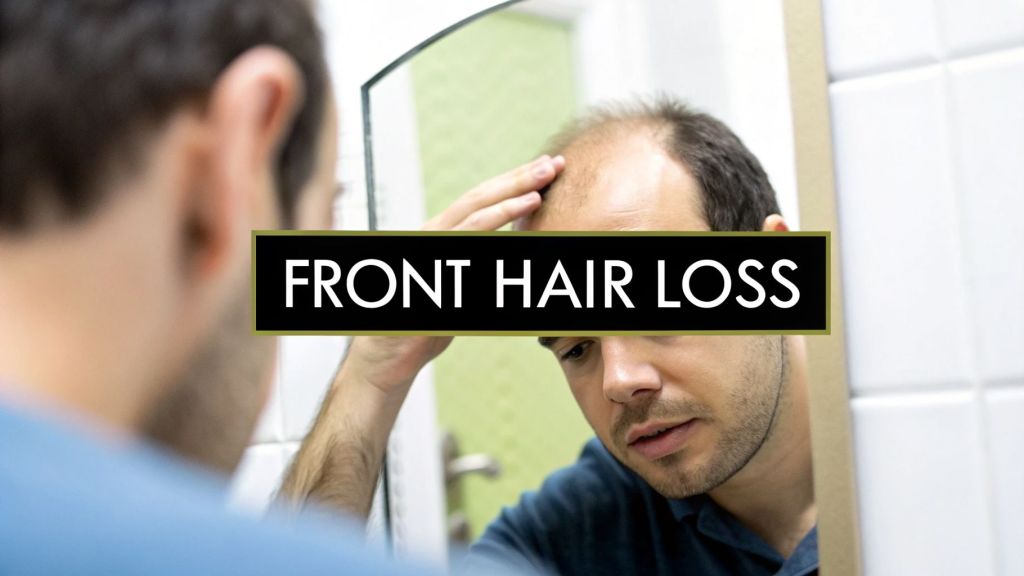
It’s a moment millions of guys go through. That quiet, personal reckoning in front of the bathroom mirror when you realize your hairline isn't quite where it used to be. Seeing your hair thinning at the front is often the first real sign of male pattern baldness, but it's not a reason to panic. In fact, noticing it early is the best thing that can happen—it gives you the power to get ahead of it.
The Moment You First Notice Your Hairline Changing

It usually starts small. Maybe you notice your forehead looks a bit bigger in a photo, or you see more scalp than you're used to under bright lights. That initial shock can be unsettling, but it’s a completely normal part of the aging process for many men, not some kind of personal failure.
The scientific name for this is androgenetic alopecia, but most of us just call it Male Pattern Baldness (MPB). The reason it so often starts at the front hairline comes down to a one-two punch of genetics and a specific hormone.
The Key Players: Genetics and DHT
Think of it this way: your DNA is the instruction manual for your entire body, including your hair follicles. For a lot of men, that manual includes a specific instruction that makes the follicles along the hairline and crown sensitive to a hormone called dihydrotestosterone (DHT).
DHT is an androgen, a hormone derived from testosterone. While it’s important for other functions in your body, it can be the primary antagonist for the hair on your head.
Imagine DHT as a key that’s been specifically cut to fit the locks on your frontal hair follicles. If your genetics gave you those locks, DHT can slip in, turn the key, and tell the follicle to start shrinking.
This shrinking, known as "miniaturization," is a gradual process. Each time an affected follicle enters a new growth cycle, the hair it produces comes back a little thinner, shorter, and weaker. Over many cycles, it can shrink so much that it stops producing a visible hair altogether. This is why you notice a slow thinning rather than a sudden bald patch.
You Are Far From Alone
If you're noticing these changes, it’s incredibly easy to feel like you're the only one. The reality is, you're in very good company. Globally, about 42% of men experience some form of hair loss. In the United States, that figure is 42.68%, which adds up to an estimated 50 million men. You can explore more global statistics about male hair loss on worldpopulationreview.com.
Seeing these numbers isn't just about trivia; it’s about gaining perspective. Realizing your hair is thinning at the front isn’t the end of a story—it's the beginning of a proactive journey. For more on this, you might want to read our detailed guide on how to tell if your hair is thinning.
Once you understand what’s actually happening, you can move past that initial shock and start exploring the real, effective solutions available today.
Why Frontal Hair Thinning Is a Progressive Journey
Frontal hair thinning doesn't just show up one morning. It’s a slow-burn process that unfolds over years, often starting so subtly you might brush it off as a "maturing hairline." But what you see in your twenties as a slight recession at the temples often becomes more noticeable thinning by your thirties.
This happens because the hair follicles at the front of your scalp have a genetic sensitivity to a hormone called DHT. This sensitivity doesn't fade away; in fact, its effect accumulates over time. Think of it as a dimmer switch being slowly turned down on your hair follicles, year after year. This predictable progression is exactly why catching it early gives you a massive advantage.
The Accelerating Timeline of Hair Loss
Male pattern baldness is a numbers game, and the odds increase with age. The chances of seeing significant thinning aren't static—they climb with every birthday, which is why awareness is your best defense.
The statistics are pretty eye-opening. By age 35, a staggering 66% of men will have some degree of hair loss. This number shows just how common it is for that minor recession in your 20s to become something much more apparent a decade later. The risk climbs steadily over time: roughly a 20% chance in your 20s, 30% in your 30s, 40% in your 40s, and so on. Gitnux.org has even more data on these age-related trends if you're curious.
Knowing this timeline isn't about causing stress. It's about giving you a clear-eyed look at what's happening, so you can see that there's a definite window of opportunity to step in and make a real difference.
Understanding how this works is simple. The follicles at your hairline and temples are usually the first to be impacted by DHT. With each growth cycle, they shrink or "miniaturize," producing hair that's finer, shorter, and weaker, until eventually, they stop producing hair at all. This is the whole reason why early action is so critical—it's far easier to save a struggling follicle than to try and revive one that's already gone dormant.
Your Window of Opportunity
Once you recognize that frontal hair loss is a progressive issue, you can start thinking strategically. If you intervene when you first notice changes, you're working with a higher number of viable follicles. This dramatically boosts the odds of any treatment being successful.
Here’s how to think about it:
- Early Stages: At this point, the goal is defense. Treatments focus on shielding the hair you still have and re-energizing those weakened follicles so they can produce thicker, healthier hair again.
- Later Stages: Once a significant number of follicles have become dormant, the game changes. It's much harder to get substantial regrowth, and the focus often shifts from reversal to simply maintaining what’s left.
This is why understanding the progression of male pattern baldness is so empowering. It allows you to get ahead of the curve and take control before the changes become much more difficult to manage.
Creating Your Personal Hair Restoration Action Plan
That moment you notice your hairline isn't quite what it used to be can be a jolt. But instead of letting worry take over, the best thing you can do is get proactive. Seeing a hair thinning at front male pattern is one thing; knowing what to do about it is everything.
Let's build a concrete action plan, starting with figuring out exactly what's going on. This will turn that feeling of uncertainty into a clear, manageable path forward.
How To Perform A Self-Assessment
The first step is to get honest with what you see in the mirror. Vague feelings won't help you track progress, so we need to create a baseline. You don't need any special tools—just good, consistent lighting and your phone's camera.
The goal here is to create a visual record you can refer back to.
- Front-on: Pull your hair back so your entire hairline is visible.
- Side views: Snap a picture from each side to see the corners and temples clearly.
- Top-down view: Have someone help you get a shot looking directly down at the top of your head.
Do this once a month, in the same room and with the same lighting. This visual diary makes it easy to tell if you're seeing real, progressive thinning or just the normal day-to-day changes in how your hair sits. You’re looking for a pattern, not a single bad hair day.
Early vs. Advanced Frontal Thinning: What To Look For
As you track your hair, it helps to know what signs point to early thinning versus more advanced stages. This table breaks down the key differences to help you gauge where you are.
| Symptom | What It Looks Like (Early Stage) | What It Looks Like (Advanced Stage) |
|---|---|---|
| Hairline Shape | A slight "M" shape begins to form; the corners recede a bit. Often called a "mature hairline." | The "M" or "V" shape is deep and obvious. The central part of the hairline may start to recede. |
| Hair Density | The hair just behind the hairline feels a little less dense or "fluffy" compared to the back. | You can clearly see more scalp through the hair at the front. The density difference is significant. |
| Individual Hairs | You might notice some finer, shorter, "wispy" hairs along the receding hairline. | Many hairs at the hairline are thin, short, and almost colorless (miniaturized). |
| Styling Difficulty | It's getting harder to style the front the way you used to; it doesn't have the same volume. | Styling becomes a challenge; you might be relying on a "comb-over" or longer hair to hide thinning spots. |
This isn't a formal diagnosis, but it’s an incredibly useful tool for self-awareness. It helps you understand the situation and communicate it clearly if you decide to see a professional.
Using The Norwood Scale As Your Map
Once you start documenting, it helps to have a common frame of reference. The Norwood Scale is the standard system doctors use to classify the stages of male pattern baldness. Don't think of it as some scary medical chart—it's just a map that helps you pinpoint where you are on the journey.
The Norwood Scale isn't a diagnosis; it's a communication tool. It gives everyone—you, your doctor, researchers—a shared language to describe hair loss patterns accurately.
For frontal thinning, the first few stages are the most relevant:
- Stage 1: No real hair loss to speak of. This is your baseline, adolescent hairline.
- Stage 2: A minor recession at the temples. This is very common and often just considered a "mature hairline."
- Stage 3: This is where clinically significant balding begins. The recession at the temples becomes much more defined, creating a clear M, U, or V shape.
Knowing your approximate stage gives you a better idea of what treatments might be on the table and how urgently you might want to act.
When To See A Specialist
Self-monitoring is a great first step, but it can’t replace a professional diagnosis. Guessing can lead to you wasting time and money on treatments that aren't right for your situation. If you've been tracking your hair and notice consistent thinning over a 3-6 month period, it's time to book an appointment.
A dermatologist or a dedicated hair loss specialist will give you the clarity you need. Here's what a professional evaluation usually involves:
- Discussing your family history: Genetics is the biggest player in male pattern baldness, so they'll want to know what to expect.
- Examining your scalp: They'll use a handheld microscope (a dermatoscope) to look for hair follicle miniaturization—the tell-tale sign of DHT's effect on your hair.
- Reviewing your lifestyle: Factors like high stress, poor diet, or certain medications can sometimes accelerate hair loss.
- Ruling out other causes: While most hair thinning at front male cases are genetic, a specialist can confirm it's not something else, like a thyroid issue, alopecia areata, or a nutritional deficiency.
Getting an expert opinion is crucial. It puts an end to the guesswork and allows you to build a treatment plan based on facts, not fear. An early, accurate diagnosis is your best bet for successfully managing hair loss and keeping your hairline where you want it.
How PRP Therapy Can Revitalize Your Hairline
When you’re grappling with thinning hair at the front, you need a treatment that brings reinforcements directly to the frontline. This is exactly where Platelet-Rich Plasma (PRP) therapy steps in. We're not talking about questionable supplements or magic potions; this is a medical treatment that taps into your body's own healing power to wake up tired hair follicles.
Think of it this way: your blood is full of platelets, which are like your body’s emergency first-responders. The moment you get a cut, platelets flood the area to stop the bleeding and begin the repair process. They are absolutely loaded with potent growth factors—proteins that essentially tell your cells to regenerate and grow.
PRP therapy concentrates this elite repair crew and deploys it precisely where it’s needed most: your thinning hairline. It’s a targeted, biological boost for the follicles struggling against DHT.
What The PRP Process Actually Looks Like
The idea of using your own blood might sound a bit intense, but the procedure itself is surprisingly simple and happens right in a doctor's office. It all boils down to three key steps.
-
The Blood Draw: It all starts just like a routine blood test. A small vial of blood is drawn from your arm—quick and easy.
-
The Concentration: That blood sample goes into a centrifuge, a machine that spins it at an incredibly high speed. This spinning action separates the blood into its different parts. The heavier red blood cells drop to the bottom, while the lighter plasma and platelets rise. This platelet-rich layer is carefully collected, creating the "liquid gold" packed with growth factors.
-
The Application: Finally, this concentrated PRP solution is injected into your scalp, targeting the areas where thinning is worst. For guys with frontal hair loss, this means focusing on the temples and the receding hairline to deliver those growth factors right to the weakened follicles.
The entire appointment typically takes under an hour. And because it uses your own biological material, the risk of an allergic reaction is practically nonexistent.
Who Is The Best Candidate For PRP
PRP is a fantastic tool, but it's not a one-size-fits-all solution. It works by stimulating hair follicles that are dormant or weakened but are still alive. It can’t bring back follicles that have been gone for years.
This means the best candidates for PRP are:
- Men in the early stages of hair loss: If you’ve just started noticing your hairline thinning or your temples receding, PRP can be especially effective. The follicles are still receptive to stimulation.
- Individuals with thinning hair, not complete baldness: PRP is designed to thicken existing hair and encourage dormant follicles to produce stronger strands. It's not meant to grow new hair on a completely smooth, bald scalp.
- Those looking for a non-surgical option: For men who aren't ready for a hair transplant or prefer to avoid daily medications, PRP is a compelling alternative.
Before jumping into treatment, getting a professional evaluation to understand your specific stage of hair loss is absolutely essential.
This visual guide breaks down the simple path to understanding your hair's current situation.

As the infographic shows, it’s a clear progression from self-assessment to professional diagnosis. This is the exact journey you should follow before committing to a treatment like PRP.
Realistic Expectations And Timelines
Managing your expectations around the timeline is key to a positive experience. PRP isn't an overnight miracle; it’s a biological process that unfolds over several months.
Think of it like planting a garden. The initial treatments are like watering and fertilizing the soil. You won’t see sprouts the next day, but you are creating the perfect conditions for future growth.
Here’s a general timeline of what most people experience:
| Timeframe | What You Can Expect |
|---|---|
| Initial Sessions (First 3 Months) | The first phase typically involves a series of 3-4 treatments, each spaced about a month apart. You probably won't see much visible change yet, but the growth factors are getting to work under the surface. |
| Noticeable Changes (3-6 Months) | This is when you’ll likely start to see the first signs of improvement. It usually starts with less hair shedding, followed by early new growth that looks like fine "baby" hairs. |
| Peak Results (6-12 Months) | Your hair should continue to improve in appearance. Existing hairs become thicker and healthier, which creates better overall density and coverage at the front. |
| Maintenance (Ongoing) | To keep the results going, most specialists recommend follow-up treatments every 6-12 months. |
PRP therapy truly excels at tackling that stubborn hair thinning at front male pattern. The treatment takes your own blood, concentrates the platelets and growth factors, and injects them right where you need them—the temples and hairline. It’s a powerful way to boost follicle health with minimal downtime, making it perfect for men noticing the first signs of recession.
With 42% of men experiencing hair loss worldwide, millions are looking for non-surgical solutions. In high-prevalence countries like the US (42.68%), demand for PRP is on the rise as an effective way to address early frontal loss.
To learn more about the science of how Platelet-Rich Plasma (PRP) therapy helps rejuvenate tissue, you can read this great explanation of its benefits. And if you’re curious about its specific track record on the hairline, check out our article discussing if PRP works for frontal hair loss.
Exploring A Full Range Of Proven Treatment Options
While PRP is an excellent and highly effective treatment, it's just one tool in the toolbox. To truly get a handle on frontal hair thinning, you need to understand the full playbook. Think of it this way: PRP might be your go-to play, but having other options ready gives you a complete strategy for success.
When you walk into a specialist's office armed with this knowledge, you can have a much more productive conversation and co-create a plan that’s right for you. Some treatments block the hormone that causes hair loss in the first place, while others work by directly waking up dormant follicles. Each has its own job to do.
FDA-Approved Medications
When it comes to non-surgical treatments backed by decades of science, two names stand out from the rest: Minoxidil and Finasteride. For millions of men, these are the cornerstones of any serious plan to fight hair loss.
-
Minoxidil (Rogaine): This is a topical foam or solution you apply right to your scalp. The best way to think of Minoxidil is as a growth stimulant for your hair follicles. It works by opening up the blood vessels in your scalp, which brings a fresh rush of blood, oxygen, and nutrients to the hair roots. It’s available over-the-counter and is often the first thing men try, especially for diffuse thinning.
-
Finasteride (Propecia): This is a once-a-day pill that requires a prescription, and it gets right to the hormonal root of the problem. Finasteride’s job is to block the specific enzyme that turns testosterone into DHT—the hormone that chokes out and shrinks hair follicles. By drastically lowering DHT levels in your scalp, it can stop hair loss in its tracks and even help regrow hair you thought was gone for good.
The easiest way to remember the difference is to think of it as offense versus defense. Finasteride plays defense by blocking the DHT hormonal attack, while Minoxidil plays offense by stimulating the follicles to grow stronger. This is precisely why they are so effective when used together.
Advanced Therapeutic Options
Beyond daily medications, a couple of other powerful options can either work on their own or boost the results you get from treatments like PRP.
Low-Level Laser Therapy (LLLT)
You’ve probably seen these as futuristic-looking caps, helmets, or combs. LLLT devices use calibrated red light to gently energize the cells inside your hair follicles. This light is absorbed by the cells, which helps kick their metabolism into a higher gear, encouraging them to shift out of a resting phase and back into an active growth phase.
It’s a completely non-invasive approach you can do right at home. While it’s not typically as powerful as medication or PRP on its own, many people find it’s a great addition to their daily hair maintenance routine. You can explore a variety of other hair loss treatment options to see how something like LLLT might fit into your overall plan.
Hair Transplantation
For guys with more significant thinning or a receded hairline, a hair transplant is the most direct and permanent fix. This is a minor surgical procedure where a doctor carefully moves healthy, DHT-resistant hair follicles from the back and sides of your head (the "donor area") to the thinning areas up front.
You aren't creating new hair—you're just strategically relocating the healthy hair you already have to where you need it most. Since these transplanted follicles are genetically programmed to resist DHT, the results are permanent. This is often the ultimate solution when the primary goal is to rebuild a strong, dense hairline.
Daily Habits To Defend Your Frontal Hairline

While advanced treatments like PRP are powerful tools for fighting hair loss, what you do every day is just as important. Think of it this way: your daily hair care routine is the supportive groundwork that allows those treatments to deliver the best possible results.
You can’t expect to see major improvements if your daily habits are accidentally causing more stress and damage. Getting your routine right protects your vulnerable hairline and creates a healthy environment where hair can actually thrive.
Gentle Scalp Care And Product Choices
The first place to make a change is in the shower. When you're dealing with hair thinning at front male patterns, a gentle approach is everything. This means swapping out rough techniques and harsh products that can easily break or weaken already fragile hair.
Always use lukewarm water, as steaming hot showers strip the essential natural oils from your scalp, leaving it dry and irritated. When you apply shampoo, use the soft pads of your fingertips—never your nails—to massage your scalp. This simple motion boosts blood flow to the follicles without causing unnecessary breakage.
The products you use can either help or hurt your cause.
-
Avoid: Shampoos containing harsh sulfates, like sodium lauryl sulfate, are incredibly drying and should be avoided. You should also stay away from thick, greasy pomades and gels. They can weigh down fine hair, making your scalp more noticeable, and may even clog up your follicles.
-
Embrace: Instead, reach for gentle, sulfate-free shampoos and lightweight conditioners. A great starting point is a product specifically formulated to promote a healthier scalp, like the Avalon Organics Thickening Biotin B Complex Shampoo.
If you want to build a truly solid foundation, our complete guide to scalp care for men is the perfect next step.
Smart Styling For A Fuller Appearance
The right haircut and styling choices can make a world of difference in how you feel about your hair. The idea isn't to create some elaborate comb-over, but to adopt a style that looks intentional, clean, and confident. A bad haircut can accentuate thinning, but a smart one can make it a complete non-issue.
A great haircut doesn't hide hair loss; it makes it irrelevant. By creating a strong shape and texture, it draws the eye away from thinning areas and toward the overall style.
Here are a few of the most effective strategies to discuss with your barber:
-
Go shorter. Long, thinning hair tends to look stringy and draws more attention to sparse areas. Shorter styles, such as a classic crew cut, a buzz cut, or a modern textured crop, create an instant illusion of density.
-
Add texture. Ask your barber to add some choppy layers or texture. This breaks up the hair and creates movement and volume, making it appear much fuller than it is.
-
Pick the right product. Forget about those shiny, wet-look gels that can make your scalp reflect light. Your best friends are now lightweight matte clays, putties, or styling powders. They add grit and lift without weighing hair down, giving you a fuller look with a natural finish. Just work a small amount into dry hair to build subtle volume.
Common Questions About Frontal Hair Thinning In Men
When you start noticing your hairline changing, a flood of questions and myths usually follows. It's easy to get lost in conflicting advice. Let's cut through the noise and answer some of the most common questions I hear from men dealing with frontal thinning.
Can Stress Alone Cause My Hair To Thin At The Front?
This is a big one. While a major shock to your system—like intense stress, an illness, or surgery—can cause a type of hair loss called telogen effluvium, it looks very different from what you're likely seeing. Telogen effluvium is a diffuse, all-over shedding, not a focused retreat at your temples and hairline.
That classic frontal thinning pattern is almost always the signature of male pattern baldness (MPB), which is driven by your genetics and hormones. Think of it this way: stress isn't the primary cause, but it can absolutely be an accelerant. If you're already genetically predisposed to MPB, a period of high stress can pour gasoline on the fire, making the thinning happen faster or seem more dramatic. It's rarely the sole culprit, though.
Will Wearing Hats Make My Frontal Hair Loss Worse?
Let's bust this persistent myth for good. Wearing a normal, clean hat will not cause hair loss or speed up male pattern baldness. Your hair follicles get their oxygen and nutrients from the blood flowing in your scalp, not from the air. A hat doesn't suffocate them.
The only time headwear can cause hair loss is in cases of traction alopecia, which is caused by constant, aggressive pulling on the hair shafts. We're talking about a hat that is so painfully tight it's literally yanking on your hair roots all day, every day. It's an extremely unlikely scenario. For the average guy, a hat is just a great way to protect your scalp from the sun.
Is It Ever Too Late To Start Treatment?
This is a crucial question, and the answer isn't about your age—it's about the state of your hair follicles.
The key is whether the follicles are dormant (asleep) or have permanently shut down (dead).
Treatments like Minoxidil and PRP work by reawakening follicles that are weakened, shrinking, or resting but are still alive. If an area of your scalp has been completely smooth and bald for many years, it's very likely those follicles have atrophied and are gone for good. You can't revive a follicle that no longer exists.
This is exactly why experts always stress that acting early is crucial. The sooner you start a treatment plan after you notice thinning, the more viable, salvageable follicles you have to work with. This dramatically increases your chances of seeing significant, satisfying results.
At PRP For HairLoss, we believe the first step is always clear, accurate information. To start building your own plan for tackling hair loss, you can find more resources and insights at https://prpforhairloss.com.
 PRP For Hairloss
Leave a comment