Male pattern baldness, known in the medical world as androgenetic alopecia, isn't something that happens overnight. It’s a slow-moving, predictable process that can unfold over years, sometimes even decades. Think of it less like a sudden event and more like a gradual journey dictated by your genetics and hormones. Because this path is so well-trodden, we have a pretty clear map of what to expect.
What's Really Happening on My Head?
If you’re seeing a few more hairs in the shower drain or noticing your hairline isn't quite what it used to be, you're in good company. This is an incredibly common experience for men all over the world. It’s not an illness or a sign that you're doing something wrong; it's simply a genetic trait, like your eye color or how tall you are.
The progression is so common, in fact, that it follows a fairly predictable timeline as men age.
Male Pattern Baldness Progression by Age
The numbers show just how widespread this experience is. Here’s a quick look at the likelihood of noticeable hair loss at different stages of a man's life, based on population studies.
| Age Group | Approximate Percentage of Men Affected |
|---|---|
| 20s | 20% |
| 30s | 30% |
| 50s | 50% |
These statistics, which you can explore further with resources from the International Society of Hair Restoration Surgery, underscore that hair loss is a natural, age-related process for a huge portion of the male population. It’s not an outlier; it’s a standard part of aging for many.
The Path is Predictable
The most important thing to grasp is that this journey usually follows a set pattern. Experts have been studying it for a long time and have a clear understanding of the stages, which means you can often anticipate what's coming next. My goal here is to give you a roadmap of that progression so you can understand:
- The science behind why it's happening.
- The specific stages of hair loss you might encounter.
- What you can do about it at each phase.
Having this knowledge can take a lot of the fear and uncertainty out of the equation. Once you understand the "what" and the "why," you're in a much better position to make smart decisions about how you want to handle it. The whole process feels a lot less like a scary mystery and more like a manageable part of life.
At its core, androgenetic alopecia is about sensitive hair follicles reacting to hormones over time. This sensitivity is hereditary, passed down through your family's genes. It is not caused by wearing hats, washing your hair too often, or using certain styling products.
Ultimately, this guide is about replacing confusion with clarity. We'll break down the science into easy-to-understand concepts, walk through each stage of the progression, and show you how treatments like PRP can make a difference. By the end, you'll have the foundational knowledge you need to navigate male pattern baldness with confidence.
The Science Behind Your Hair Loss
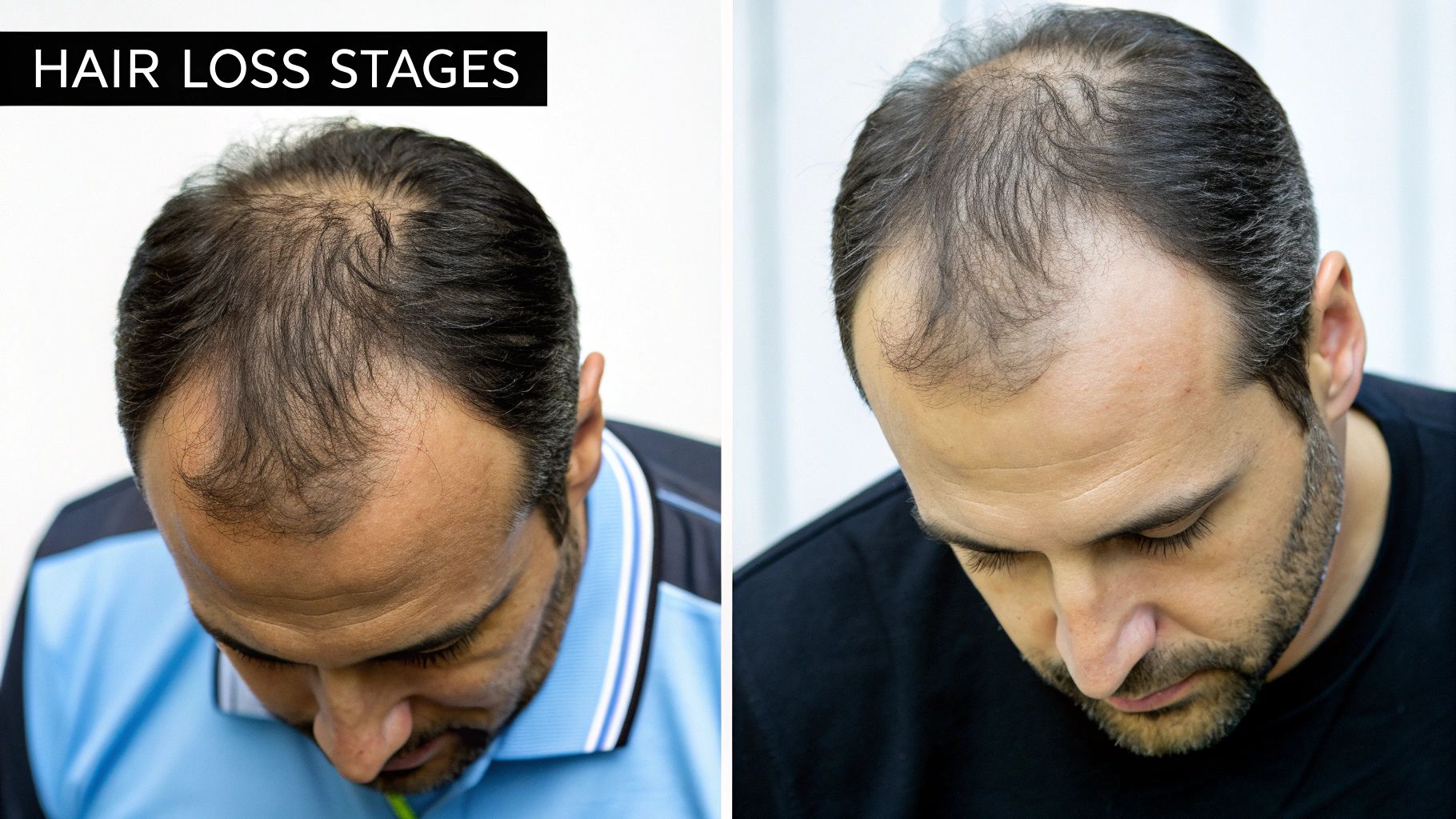
To really get a handle on how male pattern baldness progresses, we have to look under the hood at what’s driving it. At its core, this isn't about something you're doing wrong. It's a powerful combination of your genetics and a specific hormone that's been part of your biology all along.
Think of your hair follicles as having tiny, unique "locks" on their surface. The shape of these locks is predetermined, written into the genetic blueprint you inherited from your parents. For years, these locks might not do much of anything—until the right "key" shows up.
That key is a hormone called dihydrotestosterone (DHT). DHT is a natural, potent byproduct of testosterone, formed when an enzyme called 5-alpha reductase interacts with it. For men who are genetically prone to hair loss, DHT is the key that fits perfectly into the locks on their scalp's hair follicles.
The DHT Key and the Genetic Lock
When DHT binds to these genetically sensitive follicles, it's like turning the key and sending a damaging signal. This process, known as miniaturization, is the fundamental mechanism behind androgenetic alopecia. It's not a sudden event, but a slow, gradual weakening of the hair follicle that plays out over many years and many hair growth cycles.
Picture a healthy hair follicle as a big, robust tree that produces a thick, strong trunk (the hair). When DHT "unlocks" its harmful signal, it’s like slowly poisoning the soil around that tree. With each passing season, the tree struggles to get enough nutrients and starts to wither.
This is exactly what happens to your hair. Each new strand that grows from a miniaturized follicle comes in thinner, shorter, and lighter in color than the one before it. Eventually, the follicle shrinks so much that it can no longer produce a visible hair at all, which is what creates the appearance of baldness.
Here's the most important thing to understand: Male pattern baldness isn't caused by having too much testosterone. It's caused by having hair follicles that are genetically over-sensitive to completely normal levels of DHT.
This simple fact explains why some guys with sky-high testosterone have a full head of hair for life, while others with lower levels go bald. It all comes down to the sensitivity of the follicles, not the amount of testosterone in your system.
Debunking a Common Genetic Myth
You’ve probably heard the old wives' tale: if you want to know about your hair's future, look at your mom's dad. While there's a tiny grain of truth to it, it’s a massive oversimplification. The main gene for hair loss sensitivity is indeed on the X chromosome, which men get from their mothers, making the maternal grandfather a decent clue.
But we now know it's a lot more complicated than that. Scientists have found over 200 different genes that influence male pattern baldness. You inherit these genes from both of your parents, making your hair’s future a true genetic lottery.
- Your Dad's Side: You can absolutely inherit the hair loss trait from your father's family.
- Your Mom's Side: The genes from your mother's side are also critical players.
- The Combined Effect: It’s the unique cocktail of all these inherited genes that sets the final level of your follicles' sensitivity to DHT.
So, to get a better guess at your own risk, you really need to look at the whole family tree—parents, uncles, and grandfathers on both sides. In the end, how your baldness progresses is a story written in your unique DNA, waiting for the hormonal key of DHT to turn the page.
Where Do You Fall on the Norwood Scale?
The journey of male pattern baldness isn’t random; it follows a surprisingly predictable path. For decades, experts have used a specific roadmap to chart this progression: the Norwood Scale (sometimes called the Norwood-Hamilton Scale). Think of it as the universal language for classifying hair loss, helping you pinpoint exactly where you are and what might come next.
Instead of a stiff, clinical description, let's walk through these stages from a real-world perspective. My goal is to help you see where you might fit on this scale so you can make smarter decisions about your hair.
The image below breaks down the key forces at play—genetics, hormones, and age—and how they team up to cause hair loss over time.
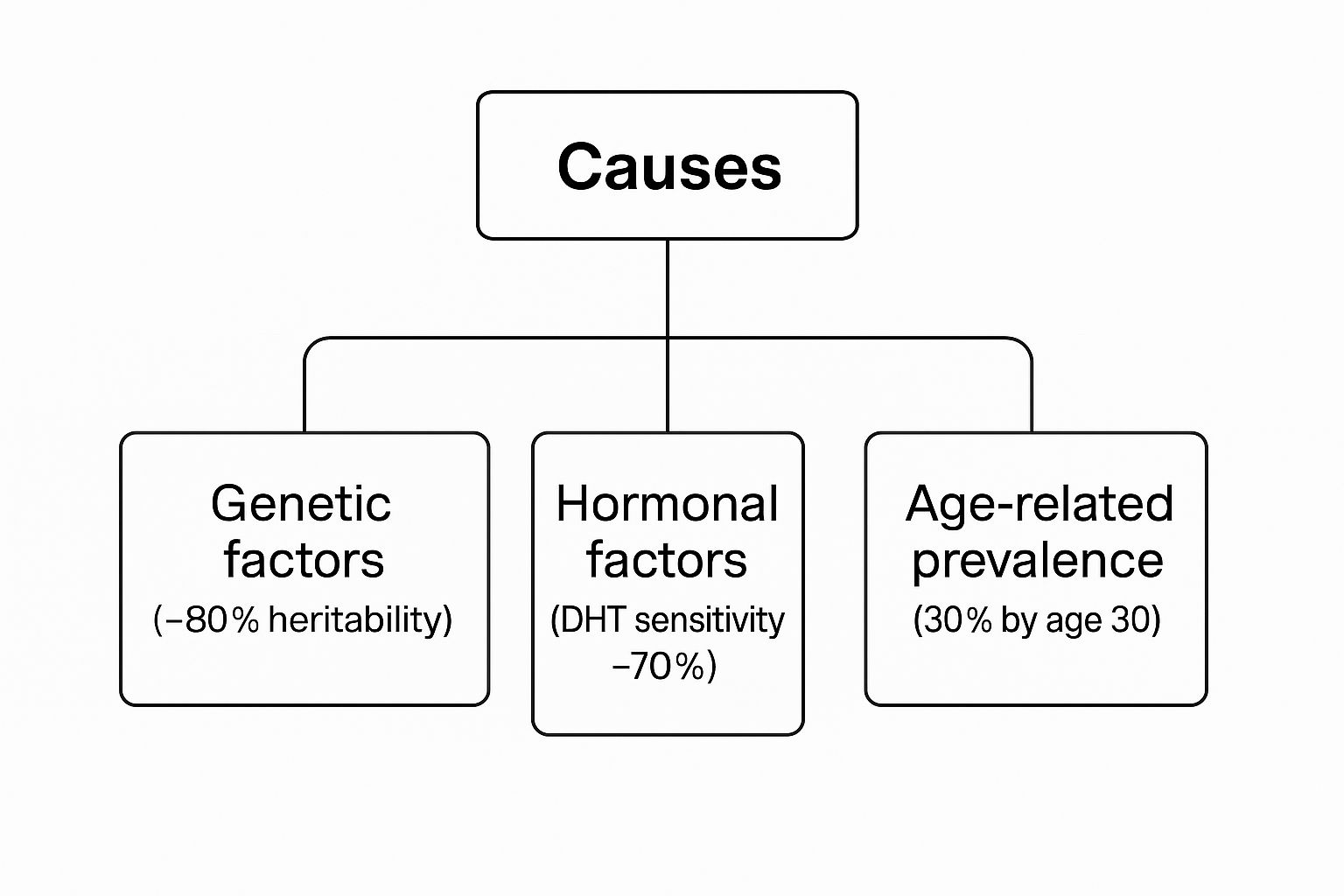
As you can see, your genes are the main driver. They determine just how sensitive your hair follicles are to the hormonal shifts that happen as you get older.
The Early Stages: Your Best Window for Action
The first hints of hair loss are often easy to miss, but this is the most crucial time to act. Stepping in early gives you the best possible chance to hold on to the hair you still have.
-
Stage 1: The Baseline
At this stage, there’s no real hair loss to speak of. Your hairline is full, just as it’s always been. It’s the starting point before male pattern baldness officially kicks in. A lot of men stay here their whole lives. -
Stage 2: The First Signs
This is where you might notice the first subtle changes. A slight recession starts to appear at the temples, usually in a symmetrical pattern. Many guys chalk this up to a “maturing hairline,” but on the Norwood Scale, it’s the official start of the journey. The change is minor, but it's the beginning of the classic "M" shape. -
Stage 3: The Clinical Tipping Point
By Stage 3, the hair loss is undeniable and considered clinically significant. The recession at the temples has deepened, creating a much more obvious M, V, or U shape. There's also a key variation here, Stage 3 Vertex, where a second front opens up—a small but noticeable bald spot on the crown (the vertex). This is the stage where most men start seriously looking for solutions.
The Intermediate Stages: When Thinning Picks Up Speed
During this phase, the two areas of loss—the receding hairline and the thinning crown—really start to expand. The strip of hair between them begins to feel threatened.
Key Insight: From Stage 3 onward, the story is all about the shrinking gap between your hairline and crown. That bridge of hair becomes the main visual cue for how far the hair loss has progressed.
-
Stage 4: Significant Loss
Now, the hair loss is obvious to anyone. The bald spot on your crown is bigger, and the frontal recession has pushed back further. There's still a solid band of hair separating the two zones, but it's getting narrower. -
Stage 5: The Bridge Is Closing
At this point, that band of hair separating the front and the crown is looking much thinner and more sparse. The two bald areas are still separate, but they’re getting much, much closer. The classic horseshoe pattern of hair around the sides and back of your head becomes more defined.
The progression of male pattern baldness is overwhelmingly tied to your genetics and DHT, the primary hormone responsible. The numbers tell the story: starting as early as age 25, about one in four men begins to see some hair loss. That figure jumps to approximately 50% of men showing signs of baldness by age 50. In some places, like Mexico, statistics show about 50% of men aged 20 to 30 already have this condition, with the rate climbing to a staggering 80% in older men. You can dig into more global hair loss statistics to see how it impacts different demographics.
The Advanced Stages of Hair Loss
In these final stages, significant hair loss covers most of the scalp. The focus of treatment often shifts from preserving what's left to restoring what's been lost.
-
Stage 6: The Two Areas Merge
This stage is defined by one major event: the bridge of hair is gone. The balding at the front and the crown have now completely joined, creating one large area of hair loss. The hair on the sides of your head is still there, forming a prominent horseshoe shape. -
Stage 7: The Final Pattern
This is the most advanced stage on the Norwood Scale. All that’s left is a wreath-like band of hair running around the sides and back of the head. The top of the scalp is completely smooth and bald. The hair that remains is often finer and less dense than it used to be.
Knowing where you stand on this scale is the first step toward taking back control. It helps you set realistic goals and explore the right strategies for your unique situation.
It's easy to feel like you're the only one going through it, but the truth is, your hair loss journey is part of a massive global story. Male pattern baldness is a shared experience for men everywhere, though how it plays out often comes down to genetics and where your ancestors are from. When you take a step back and look at the bigger picture, some fascinating patterns emerge in how hair loss shows up around the world.
The main reason for these global differences is pure genetics. You can think of it as a genetic lottery—over millennia, some populations were simply dealt more of the genes that predispose them to hair loss. This heritage is why significant baldness is much more common in certain parts of the world than in others.
A Look at Global Hair Loss Hotspots
Statistically speaking, men of Caucasian descent, especially those with Northern European roots, tend to have the highest genetic predisposition to androgenetic alopecia. This reality is reflected in the higher rates of noticeable hair loss seen across Western countries.
On the other hand, some ethnic groups generally see lower rates. Men of East Asian heritage, for example, often have the lowest prevalence. Men of African, Native American, and South Asian descent typically land somewhere in the middle, with different patterns and ages of onset.
This doesn't mean men in these groups are immune—not at all. It just means that, on average, their hair follicles aren't as genetically sensitive to the effects of DHT as those of Caucasian men.
Let's look at the numbers. The data paints a very clear picture of this genetic influence.
Top Countries by Male Hair Loss Prevalence
This table offers a snapshot of countries with the highest reported rates of male pattern baldness, highlighting the global distribution of this condition.
| Country | Percentage of Men with Hair Loss |
|---|---|
| Spain | 44.5% |
| Italy | 44.37% |
| France | 44.25% |
| United States | 42.68% |
| Croatia | 41.32% |
| Germany | 41.51% |
| Canada | 40.94% |
As you can see, Western nations consistently top the charts. This isn't a coincidence; it's a direct reflection of the genetic predispositions discussed. You can explore a more comprehensive breakdown of these global hair loss percentages to get the full scope.
Why This Global View Matters
Realizing your hair loss is part of a well-documented human experience can be surprisingly comforting. It reframes the situation from a personal failing to a simple biological reality shared by tens of millions of men. This worldwide context helps take the sting out of the male pattern baldness progression.
Here’s why seeing the bigger picture is so helpful:
- It Clears Up the Cause: It reinforces the fact that hair loss is tied to your DNA, not a result of something you did or didn't do.
- It Builds a Sense of Community: Knowing that men across the globe are dealing with the exact same thing helps you feel less isolated.
- It Gives You Context: The data shows that if you come from a certain genetic background, experiencing hair loss isn't just common—it's statistically likely.
This global perspective isn't about creating a competition. It's about providing context. Understanding just how widespread androgenetic alopecia is can empower you to look at your own situation more objectively and move forward with clarity, knowing you are in very good company.
Lifestyle Factors That Can Influence Hair Loss

While your genes and sensitivity to DHT are the main architects of male pattern baldness, they don't tell the whole story. Think of your genetic predisposition as the car you've been given. Your lifestyle, on the other hand, is how you drive it and the conditions of the road you're on. A bumpy road and reckless driving can speed up a journey you'd rather slow down.
Certain habits and health issues can absolutely act as accelerators, influencing just how fast and how severely you lose your hair. They don't typically cause androgenetic alopecia on their own, but they can pour gasoline on an already smoldering fire. The good news? Understanding these factors gives you back a degree of control.
By addressing these lifestyle elements, you're creating a healthier internal environment for your hair follicles. This can potentially slow the noticeable male pattern baldness progression, giving you a better chance to fight back against the genetic hand you were dealt.
The Impact of Chronic Stress
One of the biggest culprits here is chronic stress. When you're constantly on edge, your body is flooded with the stress hormone cortisol. This hormonal surge can seriously disrupt your natural hair growth cycle, prematurely pushing a large number of follicles from their active growing phase (anagen) straight into the resting and shedding phase (telogen).
This stress-induced shedding is a condition known as telogen effluvium, and it results in a diffuse, all-over thinning. If you already have genetic thinning underway, a bout of telogen effluvium can make your hair loss look far more dramatic and sudden. It essentially unmasks the underlying problem, making it impossible to ignore.
Think of it like this: Genetic hair loss is a slow, steady leak in a tire. Chronic stress is like hitting a massive pothole—it doesn't create the leak, but it can cause a sudden, rapid loss of air that makes the problem immediately obvious.
Nutritional Deficiencies and Your Hair
Your hair follicles are tiny, high-energy factories, and they need a constant, reliable supply of vitamins and minerals to keep production running smoothly. A poor diet that’s lacking in key nutrients can weaken these factories, making them far more vulnerable to the damaging effects of DHT.
Without the right building blocks, your follicles simply can't produce strong, healthy hair. This not only leads to weaker strands that break easily but can also stall the entire growth cycle, making your hair look thinner, faster.
Here are some of the most critical nutrients your hair is counting on:
- Iron: This is non-negotiable. Iron helps produce hemoglobin, which is responsible for carrying oxygen to your cells for growth and repair—and that includes the cells in your hair follicles. An iron deficiency is a very common and well-known cause of hair shedding.
- Zinc: Zinc is a key player in hair tissue growth and repair. It also helps the oil glands around the follicles function correctly. A deficiency has been strongly linked to hair loss.
- Vitamin D: We're still learning about its exact role, but low vitamin D levels have been associated with alopecia. It's believed to help in the creation of new follicles, which are the tiny pores where new hair grows.
- Protein: This one is simple: your hair is made almost entirely of protein. If you don't get enough in your diet, your body will start rationing it, and non-essential functions like hair growth are first on the chopping block.
Making sure your diet is rich in these nutrients gives your follicles the support they desperately need to stay as robust as possible.
Broader Health and Medical Influences
Beyond just stress and diet, other health issues can throw a wrench in the works. Certain illnesses, especially those affecting the thyroid or autoimmune conditions, can directly impact your hair's growth and shedding cycles.
On top of that, some medications list hair loss as a known side effect. This can include certain blood thinners, antidepressants, and blood pressure medications. If you notice a sudden change in your hair right after starting a new prescription, it’s absolutely worth a conversation with your doctor. They might be able to suggest an alternative with fewer side effects. It’s all about controlling what you can to give your hair the best possible environment to thrive.
What You Can Actually Do About It: Actionable Steps for Managing Hair Loss
Knowing where you are on the Norwood scale is one thing, but turning that knowledge into a concrete plan is what really counts. Once you’ve pinpointed your stage, you can start looking at strategies that actually work. The whole point is to match your approach to the reality of your hair loss, giving you the best shot at slowing things down, holding onto the hair you still have, and maybe even encouraging some regrowth.
Let's be clear: this isn't about chasing some mythical cure. It's about using proven, science-backed solutions to get back in the driver's seat. Thankfully, modern medicine gives us a pretty solid toolkit to work with, ranging from simple topical treatments to more advanced clinical therapies.
The First Line of Defense: FDA-Approved Treatments
For most guys, especially those in the earlier stages of hair loss, the journey starts with two powerhouse treatments approved by the FDA. They get right to the biological root of the problem by fighting back against DHT's damaging effects.
-
Minoxidil (Rogaine): You’ve probably seen this one. It’s a topical foam or liquid you apply directly to your scalp. The science isn't 100% settled, but we know it acts as a vasodilator, which is just a fancy way of saying it widens your blood vessels. This boosts blood flow to your hair follicles, nudging them into their growth phase and helping to reverse that dreaded miniaturization process.
-
Finasteride (Propecia): This is a daily pill that tackles the problem from the inside out. Finasteride works by blocking the 5-alpha reductase enzyme—the culprit responsible for converting testosterone into DHT. By dramatically lowering DHT levels in your scalp, it effectively silences the hormonal signal telling your follicles to shrink and give up.
Many experts find these two work best as a team. Think of Finasteride as your defense, protecting follicles from DHT, while Minoxidil is your offense, actively stimulating new growth.
The most important thing to remember? You have to be consistent. These aren't quick fixes; they require daily, long-term commitment to see and maintain results. If you stop, your hair loss will eventually catch up to where it would have been without treatment.
Stepping Up Your Game: Advanced and Procedural Options
When you need something more direct or find yourself in the more advanced stages, it’s time to look at other therapies. These are typically in-office procedures that offer a more hands-on approach to reviving follicles and restoring hair. As you consider what to do next, you'll naturally want to explore haircare solutions that fit your specific needs.
Here are some of the leading options available today:
-
Platelet-Rich Plasma (PRP) Therapy: This is a fascinating treatment where a small amount of your own blood is drawn and spun in a centrifuge. This process separates the platelet-rich plasma, a kind of "liquid gold" packed with natural growth factors. This plasma is then injected directly into your scalp, where it can awaken dormant hair follicles, boost blood supply, and thicken existing hair shafts. PRP is a great tool for adding density and slowing down hair loss in the intermediate stages.
-
Low-Level Laser Therapy (LLLT): This is a non-invasive option you can often do from home. It involves using devices like hats, caps, or combs that emit a specific wavelength of red light. The theory is that this light energy gets absorbed by the cells in your follicles, kickstarting their metabolism and encouraging them to grow.
-
Hair Transplant Surgery: For guys in the more advanced stages (Norwood 4 and up), surgery is often the most reliable way to restore a natural hairline. Modern techniques like FUE (Follicular Unit Extraction) are incredibly sophisticated, allowing a surgeon to harvest individual, DHT-resistant follicles from the back and sides of your head and meticulously implant them in the balding areas up top.
Ultimately, there's no single "best" path—only the best path for you. The smartest move you can make is to sit down with a doctor or a hair loss specialist. They can give you an accurate diagnosis, help you understand your stage, and work with you to build a realistic treatment plan that aligns with your goals.
Common Questions About Hair Loss Progression

When you start to notice thinning hair, a flood of questions—and a lot of myths—usually follows. Let's cut through the noise and get straight to the facts, answering some of the most common things men wonder about when facing pattern baldness.
Can I Stop Male Pattern Baldness Completely?
The honest answer is that there's no permanent cure that can completely switch off your genetic predisposition to hair loss. At its heart, it's a process written into your DNA.
But that absolutely does not mean you're powerless. Several proven treatments are incredibly effective at slowing the whole process down, stopping it in its tracks, and in many cases, even helping to regrow hair. The real secret is early intervention. The sooner you act, the more of your original hair you can preserve.
Does Wearing a Hat Make Hair Loss Worse?
This is one of the most stubborn myths out there, and it's simply not true. Your favorite baseball cap has nothing to do with causing or speeding up genetic hair loss.
The real culprit is how your hair follicles react to the hormone DHT. Unless your hat is so excruciatingly tight that it's physically yanking hair from your scalp (which is a separate condition called traction alopecia), it won't affect your natural hair growth cycle. So, go ahead and wear that hat with confidence.
The Bottom Line: Your genetic programming dictates your hair's future, not your headwear. The male pattern baldness progression is an internal process driven by hormones and DNA.
At What Age Does Male Pattern Baldness Usually Start?
There’s no magic number here; it really varies from one guy to the next. Some men might spot the first signs of a receding hairline or a thinning crown in their late teens or early 20s. For others, noticeable changes might not show up until they hit their 40s or 50s.
What's important to understand is that it's a chronic and progressive process. It continues throughout your life, although the speed of hair loss can sometimes slow down as you get older. A key takeaway is that an earlier start often signals more significant loss down the road, making timely action even more critical.
At PRP For HairLoss, we believe that understanding your journey is the first step toward taking control. To learn more about advanced, non-surgical options that work with your body’s own healing mechanisms to combat hair loss, explore our treatments.


Leave a Reply