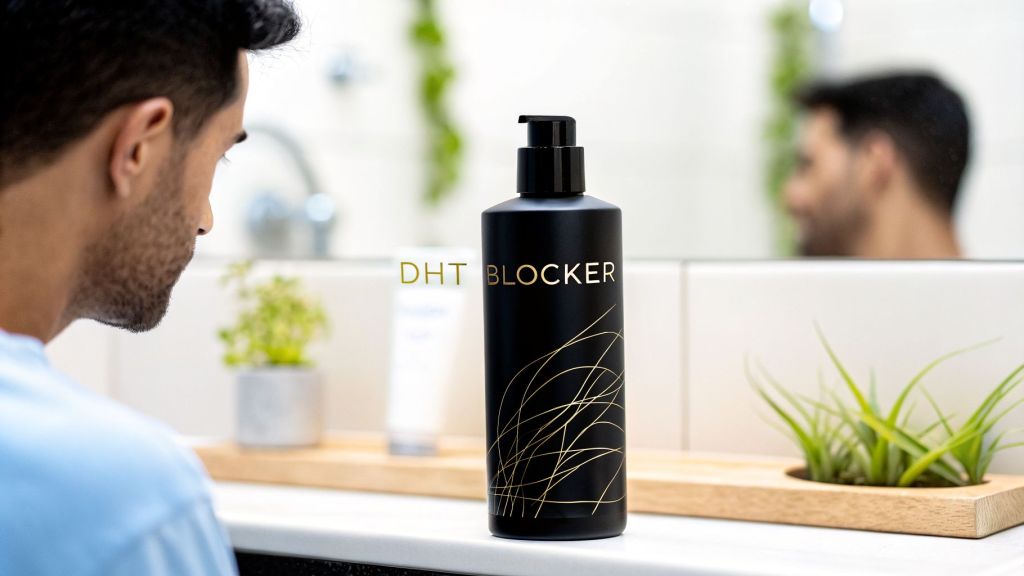
That moment you catch a glimpse of your reflection and see a little more scalp than you'd like can be unsettling. For many guys, grabbing a DHT blocker shampoo is the very first, and most accessible, step they take to fight back against thinning hair—right from their own shower. It's a proactive way to get ahead of male pattern baldness.
Your First Step in the Fight Against Thinning Hair

Whether it’s a widening part, a hairline that’s starting to creep back, or a new spot on your crown, that realization is a common one for millions of men. This is often the first sign of male pattern baldness, a genetic condition primarily fueled by a potent hormone called Dihydrotestosterone, or DHT.
Think of DHT like an overzealous bouncer at the club that is your hair follicle. If you've got the genetic sensitivity, this bouncer starts telling certain follicles that their time is up. It slowly shrinks them down until they eventually stop producing hair altogether. This process is called miniaturization, and it’s the direct cause of what we know as androgenetic alopecia.
Taking Control at the Scalp Level
This is exactly where a good dht blocker shampoo for men enters the picture. It’s your first line of defense, working directly on the scalp where the problem starts. Unlike your standard shampoo that just gets your hair clean, these are specifically formulated with active ingredients that aim to get in the way of DHT and its damaging effects.
The goal here isn't just to wash your hair; it's to intervene. By making a DHT-blocking shampoo part of your daily routine, you're taking a logical and practical step toward managing the hair loss process. It gives you a sense of control when it might feel like you have none.
The concept is pretty straightforward: reduce the amount of DHT on the scalp to help protect your follicles from shrinking. This can slow down thinning and create a healthier environment for the hair you still have.
What to Realistically Expect
Now, it’s crucial to set some realistic expectations. A DHT-blocking shampoo is a key player, but it’s just one part of your overall strategy. Think of it as the foundation of your hair care regimen, designed to support scalp health and protect your hair.
Here’s what you can realistically hope for:
- Slowing the rate of thinning: For most guys, the main win is simply holding on to their current hair for longer.
- Improving the look of existing hair: By creating a healthier scalp, these shampoos can help your hair appear fuller and thicker.
- An easy place to start: It’s a simple change to your daily routine that doesn't require a prescription or a trip to the doctor's office.
This approach gives you an immediate, actionable step. It's a smart first move that can also work alongside other treatments down the road. To build out your plan, check out our full guide on the best shampoo for thinning hair. It will help you better understand the science and how these products can fit into your routine.
The Science of DHT and Male Pattern Hair Loss
Before you can tackle hair loss, you have to know your enemy. Let’s get into the science of what’s actually happening on your scalp, without the confusing jargon. It all comes down to a hormone called Dihydrotestosterone, or DHT.
Every guy has DHT. It’s made from testosterone by an enzyme known as 5-alpha reductase. In your younger years, DHT is a hero—it helps deepen your voice and gives you body hair. But later on, for a lot of men, it becomes the primary villain behind thinning hair.
The Lock and Key Problem
Here’s the thing: male pattern baldness isn't about having "too much" testosterone or even an excessive amount of DHT. The real issue is a genetic lottery—it’s all about how sensitive your hair follicles are to it.
Imagine your hair follicles have tiny receptors, which are like locks. DHT is the key.
For men with the genetic trait for hair loss, that DHT key fits perfectly into the locks on their scalp follicles. When the key turns, it triggers a destructive process called miniaturization.
Follicle Miniaturization: This is the slow, gradual shrinking of the hair follicle. With each new growth cycle, the hair that emerges is thinner, weaker, and shorter. Eventually, the follicle just gives up and stops producing hair entirely.
This process doesn't happen overnight. It’s a slow burn, which is why you might notice your ponytail feels thinner or your part looks wider long before you see any actual bald spots. Understanding this is crucial to seeing how a dht blocker shampoo for men is supposed to work.
Hormones and Hair Health
It’s also important to remember the connection between testosterone and DHT. Because DHT comes directly from testosterone, anything that impacts your testosterone levels can also affect your DHT levels. This is why treatments like testosterone replacement therapy can have an influence on hair health, a conversation you should definitely have with a doctor if you're considering it.
You're not alone in this, either. Hair loss is a massive issue, and the market for solutions is booming. The global hair thinning market is expected to jump from USD 2.5 billion in 2026 to a staggering USD 6.33 billion by 2035. Shampoos are one of the first lines of defense, and a 2022 survey in China found that 69% of 3,000 young people were already buying formulas to fight thinning hair. You can read more about these trends in the full report on the hair thinning market from Novaone Advisor.
With this science in your back pocket, you can see exactly what DHT blocker shampoos are trying to do. They’re designed to get in the way of that miniaturization process, right at the scalp, giving you a fighting chance to manage your hair’s future. For a more detailed look at the hormone itself, feel free to read our guide on what DHT is and its connection to hair loss.
Decoding the Label: What’s Really Inside a DHT-Blocking Shampoo?
Walking down the hair care aisle can feel overwhelming. You’re staring at a wall of bottles, all making bold promises about fighting hair loss. How do you cut through the noise and figure out what actually works?
Think of this as your personal guide to reading the fine print. We're going to break down the key ingredients you'll find in DHT-blocking shampoos for men so you can choose a product with real confidence, not just marketing hype.
At their core, the active ingredients that tackle hair loss fall into two main categories: clinical compounds and natural botanicals. Both are designed to disrupt DHT's damaging effects on your hair follicles, but they take different routes to get there.

This diagram shows the simple chain reaction we're trying to interrupt. When testosterone converts to DHT, it latches onto your hair follicles, causing them to shrink and your hair to thin. The ingredients below aim to throw a wrench in that process.
The Clinical Side of Things
Some of the most effective ingredients in this fight come from a clinical background. These are compounds that were often developed for other medical reasons but were later discovered to have a beneficial side effect on hair.
Ketoconazole is a perfect example. It was originally created as a potent antifungal to treat conditions like severe dandruff and skin infections. But researchers noticed it had another welcome effect: it seems to disrupt the DHT pathway right on the scalp.
So, not only does it create a healthier, fungus-free environment for hair to grow, but it also directly interferes with local DHT activity. It’s a powerful one-two punch. You can find shampoos with 1% ketoconazole over the counter, while a stronger 2% formula usually requires a doctor's prescription. For a deeper dive, our guide on how ketoconazole shampoo works for hair loss has all the details.
The Bottom Line: Clinical ingredients like ketoconazole often have more robust scientific research behind them. While hair loss might not have been their original purpose, their proven effects on scalp health and DHT make them a cornerstone of many effective shampoos.
The Power of Natural Ingredients
On the other side of the aisle, you'll find a growing number of natural, plant-based compounds. These ingredients have become incredibly popular because they're seen as a gentler, more holistic approach to hair care.
This demand for natural solutions has fueled incredible growth in the market. The global market for hair growth products was valued at USD 9.2 billion in 2025 and is on track to hit USD 12.3 billion by 2034. This boom is largely driven by new products featuring natural DHT-blocking ingredients.
To help you sort through them, the table below gives a quick overview of the most common players, how they work, and what the science says.
A Quick Guide to Common DHT Blocker Ingredients
| Ingredient | Type (Clinical/Natural) | Proposed Mechanism of Action | Level of Supporting Evidence |
|---|---|---|---|
| Ketoconazole | Clinical | Antifungal; may disrupt the DHT pathway on the scalp. | Strong |
| Saw Palmetto | Natural | Believed to inhibit the 5-alpha reductase enzyme, reducing DHT production. | Moderate |
| Pumpkin Seed Oil | Natural | May have a mild 5-alpha reductase inhibitory effect. | Emerging |
| Rosemary Oil | Natural | Thought to improve scalp circulation, delivering more nutrients to follicles. | Emerging |
| Caffeine | Natural | Helps counteract DHT's effects on the hair follicle and may prolong the growth phase. | Moderate |
As you can see, each ingredient offers a slightly different approach. Let's dig a bit deeper into what these natural powerhouses do.
-
Saw Palmetto: Extracted from the berries of a small palm tree, this is probably the most famous natural DHT blocker out there. It's thought to work by inhibiting 5-alpha reductase—the very enzyme that turns testosterone into DHT. Less enzyme means less DHT.
-
Pumpkin Seed Oil: This nutrient-rich oil is another ingredient that’s been studied for hair growth. Similar to saw palmetto, some research points to it having a mild effect on that same 5-alpha reductase enzyme.
-
Rosemary Oil: This isn't just for the kitchen. When applied to the scalp, rosemary oil is believed to boost circulation. Better blood flow means your follicles get more of the oxygen and nutrients they need to thrive, helping them stand up to DHT’s assault.
-
Caffeine: Your morning coffee isn't the only way to get a jolt. Topically applied caffeine is absorbed easily by the scalp and is thought to directly counter the follicle-miniaturizing effect of DHT. Studies suggest it can help stimulate the hair shaft itself and encourage it to stay in its growth phase longer.
Once you understand what these ingredients are meant to do, you're no longer just guessing in the store. You can flip over a bottle, scan the ingredient list, and know exactly what that formula is designed to accomplish. This is how you find the best DHT-blocking shampoo for your hair.
How to Use DHT Blocker Shampoo for Maximum Effect

Alright, so you’ve picked up a dht blocker shampoo for men that seems to have all the right stuff. That's a great first step, but simply swapping bottles in your shower isn't going to move the needle. Your technique matters far more than you’d think.
A quick lather-and-rinse won't cut it. We're not just washing away dirt and oil; we're applying a targeted scalp treatment. To give those active ingredients a real shot, you need consistency, proper contact time, and a healthy dose of patience.
Consistency Is King
The first rule? Make this shampoo a non-negotiable part of your hair care routine. Think of it like going to the gym—you won't see results after just one session. The active compounds need to be applied regularly to build up and maintain their presence on your scalp.
Always follow the instructions on the bottle, but most will recommend using the shampoo 3 to 5 times per week. Using it sporadically is the fastest way to get zero results. You're trying to establish a constant defensive line against DHT's influence on your follicles.
The Key Takeaway: Your hair follicles are under constant attack from DHT. To push back effectively, your defense needs to be just as constant.
The 3 to 5 Minute Rule: Let It Work
This is, without a doubt, the most critical step—and the one most guys skip. After lathering up, don't immediately rinse it out. You must let that shampoo sit on your scalp for at least 3 to 5 minutes.
It’s simple, really. If you just splash a plant with water for two seconds, the water runs right off without ever reaching the roots. The same goes for your shampoo. Ingredients like ketoconazole or saw palmetto need time to actually penetrate the skin and get down to the follicles where all the action happens.
Here’s a simple routine to lock in the habit:
- Apply and Lather: As soon as you get in the shower, apply the shampoo and work it into a rich lather.
- Gentle Scalp Massage: Use your fingertips (never your nails!) to massage your entire scalp for about a minute. This isn't just for relaxation; it helps boost circulation to the follicles.
- Wait It Out: Now, just let it sit. Leave the lather on your head for the full 3-5 minutes while you wash up, brush your teeth, or mentally prepare for your day.
- Rinse Completely: After the time is up, rinse your hair and scalp thoroughly with lukewarm water.
Managing Your Timeline: A Marathon, Not a Sprint
Now for the hardest part: managing your expectations. A dht blocker shampoo for men is a long-term play, not a miracle cure. You will not see a change overnight, and you won't see one in a few weeks, either.
If the product is going to help, the very first signs will be subtle. You might start noticing less hair in the shower drain or on your brush after about 3 to 6 months of consistent use. Any real improvements in thickness or density will take even longer, as your hair needs to cycle through its natural growth phases.
The primary goal here is to slow the rate of hair loss. This strategy also brings up questions about washing frequency, and you can learn more about how often you should be washing thinning hair in our detailed guide. If you stick with this routine, you're giving your chosen shampoo the absolute best chance to deliver on its promises.
Realistic Expectations for Shampoo-Based Hair Treatments
Alright, let's have the talk we need to have before you go investing your time, money, and hope into a new hair care routine. We have to set some realistic expectations for what a dht blocker shampoo for men can—and just as importantly, can't—do for your hair.
Think of these shampoos as a key player on your defensive line, not the star quarterback who wins the game single-handedly. For most guys, a DHT-blocking shampoo works best as part of a larger strategy or as a preventative measure. It's all about playing the long game.
What Shampoos Can Realistically Do
So, where do these shampoos really shine? On defense. Their main job is to help slow down the rate of thinning while creating a healthier scalp, which can make the hair you still have look and feel fuller and more resilient.
The goal is to throw a wrench in that miniaturization process we talked about earlier. By reducing the amount of DHT hanging around on your scalp, you’re giving your hair follicles a fighting chance to resist shrinking. This is a quiet but crucial victory in the battle against male pattern baldness.
Think of it this way: You're not trying to build a new wall where one has crumbled. You're reinforcing the wall you already have, shoring it up to keep it strong for as long as possible. The real win here is preservation.
The Hard Truth About Regrowth
Now, for a dose of reality. No shampoo is a miracle worker. It's incredibly unlikely that a shampoo alone will regrow a significant amount of hair, especially on parts of your scalp that are already smooth and bald. Once a follicle goes completely dormant, a topical shampoo just doesn't have the horsepower to bring it back.
This is a crowded market, and it’s easy to get lost in the noise. The demand for solutions has created a massive industry—hair-loss treatments are the fastest-growing part of the U.S. hair care market, set to grow at a 6.11% CAGR through 2031. With over 300 new products hitting shelves each year, it's no wonder guys are skeptical. You can get a better sense of how brands are navigating this competitive space in this in-depth market analysis.
Factors That Influence Your Results
It's also critical to remember that your mileage will vary. The results you get from a dht blocker shampoo for men depend heavily on a few personal factors:
- Genetics: This is the big one. Your individual genetic sensitivity to DHT will have the biggest impact on your results. If your hair is highly sensitive, a shampoo might only provide modest backup.
- Stage of Hair Loss: Timing is everything. If you start using a DHT-blocking shampoo at the very first sign of thinning, you have a much better shot at seeing a positive effect than if you wait until your hair loss is advanced.
- Consistency: Like we mentioned before, spotty use won't cut it. It’s like trying to put out a forest fire with a spray bottle. You have to use the product regularly and as directed, no exceptions.
Ultimately, you should see these shampoos as one valuable tool in a much bigger hair wellness toolkit. When you understand their role and their limits, you can sidestep the disappointment and make smarter, more effective choices for your hair.
When to Consider Stronger Treatments Like PRP Therapy
A good DHT-blocking shampoo is an excellent starting point, but it's not a magic bullet. If you've been using one for several months and still notice your hair thinning or your hairline receding, it’s probably time to think about adding more firepower to your routine. This isn't about giving up on the shampoo; it's about building a stronger defense on the foundation you've already laid.
Think of your dht blocker shampoo for men as your first line of defense, guarding your follicles from the outside. To really halt significant hair loss, you often need to bring in treatments that work more deeply or systemically.
Stepping Up to Medical Treatments
When you're ready to escalate your fight against hair loss, there are two FDA-approved workhorses that doctors have relied on for decades. They are backed by an enormous amount of clinical evidence and are considered the gold standard for a reason.
-
Minoxidil (Topical): You probably know it as Rogaine®. Minoxidil is a vasodilator, which is a technical way of saying it widens blood vessels in your scalp. This boosts blood flow, delivering a rush of oxygen and nutrients to your hair follicles, encouraging them to wake up and start growing again. It doesn’t block DHT, which makes it a perfect partner for your shampoo.
-
Finasteride (Oral): This is a heavy-hitter available only by prescription. As a 5-alpha reductase inhibitor, it tackles hair loss at the source by dramatically lowering DHT levels throughout your body. Clinical studies show it can slash DHT by up to 70%, making it one of the most effective tools for stopping male pattern baldness in its tracks.
The real power comes from combining these approaches. Using a DHT-blocking shampoo, Minoxidil, and Finasteride together creates a comprehensive strategy: the shampoo protects the scalp, Minoxidil stimulates the follicles, and Finasteride cuts off the internal DHT supply.
The Next Frontier: Platelet-Rich Plasma Therapy
For guys who want to be even more aggressive in their approach—or for those who aren't seeing the results they want from medications alone—an advanced procedure like Platelet-Rich Plasma (PRP) therapy is another powerful option. This is a form of regenerative medicine that taps into your body’s own healing mechanisms to give hair follicles a serious boost.
The process itself is surprisingly simple. A small sample of your own blood is drawn (just like a normal blood test) and placed in a centrifuge, which spins it at high speed to separate the platelets. This creates a concentrated, golden liquid—the platelet-rich plasma—that is packed with powerful growth factors.
This "liquid gold" is then meticulously injected back into the areas of your scalp where the hair is thinning. You're essentially delivering a super-dose of your body's own repair signals directly to dormant or weakened follicles, telling them to get back to the business of growing hair. For anyone serious about reversing their hair loss, learning more about how PRP for male pattern baldness works is a crucial next step. It’s a fantastic option when you're ready to move beyond daily routines and get more proactive.
Common Questions About DHT Blocker Shampoos
When you start looking into hair loss treatments, it's easy to get bogged down by marketing hype and confusing claims. Let's cut through the noise and tackle the real questions you probably have about dht blocker shampoo for men. Here are the straightforward answers I give my own clients.
Can Shampoo Really Regrow Lost Hair?
Let's get the most important question out of the way first: almost certainly no. A shampoo isn't going to bring back hair on a fully bald spot. That’s not what it’s designed for. Its real power is in prevention and preservation.
Think of it as playing defense for your hairline. The goal is to slow down the thinning process, protect the follicles you still have, and help your existing hair stay healthier for longer. It's a fantastic first move if you're just starting to notice thinning and want to get ahead of the curve.
How Quickly Will I See Results?
This is a long game, so you have to be patient. You won't see any difference after a week or two—your hair simply doesn't grow that fast. The active ingredients need time to build up on the scalp and influence your hair's natural growth cycle.
If the shampoo is going to have an effect, you might start noticing the first subtle changes after 3 to 6 months of consistent, regular use. This usually looks like less hair in the shower drain or on your brush. Any visible improvements in thickness or density will take even longer, so hang in there.
Remember, this is a marathon, not a sprint. Consistency over many months is the only real way to know if it's working for you.
Are There Any Side Effects to Worry About?
For the vast majority of guys, dht blocker shampoo men products are extremely safe. Because the product is topical and gets rinsed off, the ingredients don't really get absorbed into your system. This means systemic side effects are incredibly rare.
If you do experience any issues, they'll almost always be localized to your scalp. This can include things like:
- Mild irritation or a bit of redness
- Dryness of the scalp or hair shafts
- Itchiness
These are typically temporary and often go away on their own. You can try using the shampoo less frequently or adding a high-quality conditioner to your routine. If the irritation doesn't clear up, it's best to stop using the product and check in with a dermatologist.
Can I Just Use a DHT Blocker Shampoo on Its Own?
You absolutely can. If you're just beginning to see some thinning and want a simple, non-invasive first step, using a DHT-blocking shampoo by itself is a perfectly reasonable strategy.
For men with more significant or advanced hair loss, however, these shampoos work best as part of a team. Think of the shampoo as a supporting player that enhances the effectiveness of heavy-hitting, clinically-proven treatments like topical Minoxidil or oral Finasteride. Combining them creates a much stronger, multi-front attack against hair loss.
Are you ready to build a comprehensive strategy to fight hair loss and explore advanced treatments like PRP? At PRP For HairLoss, we provide the evidence-based information you need. Visit us at https://prpforhairloss.com to learn about all your options.
 PRP For Hairloss
Leave a comment