It's a question every guy thinks about at some point, whether it's whispered in the locker room or frantically typed into a search bar: Does testosterone cause hair loss?
The short answer is no, not directly. The real story is a bit more complicated, and it turns out testosterone itself isn't the villain behind that receding hairline; a much more powerful byproduct is.
The Testosterone and Hair Loss Connection Explained
If you've been worried that the very hormone that makes you a man is also destined to make you bald, you can relax a little. Having high—or even just normal—levels of testosterone doesn't automatically mean you'll lose your hair. It really comes down to how your body processes it.
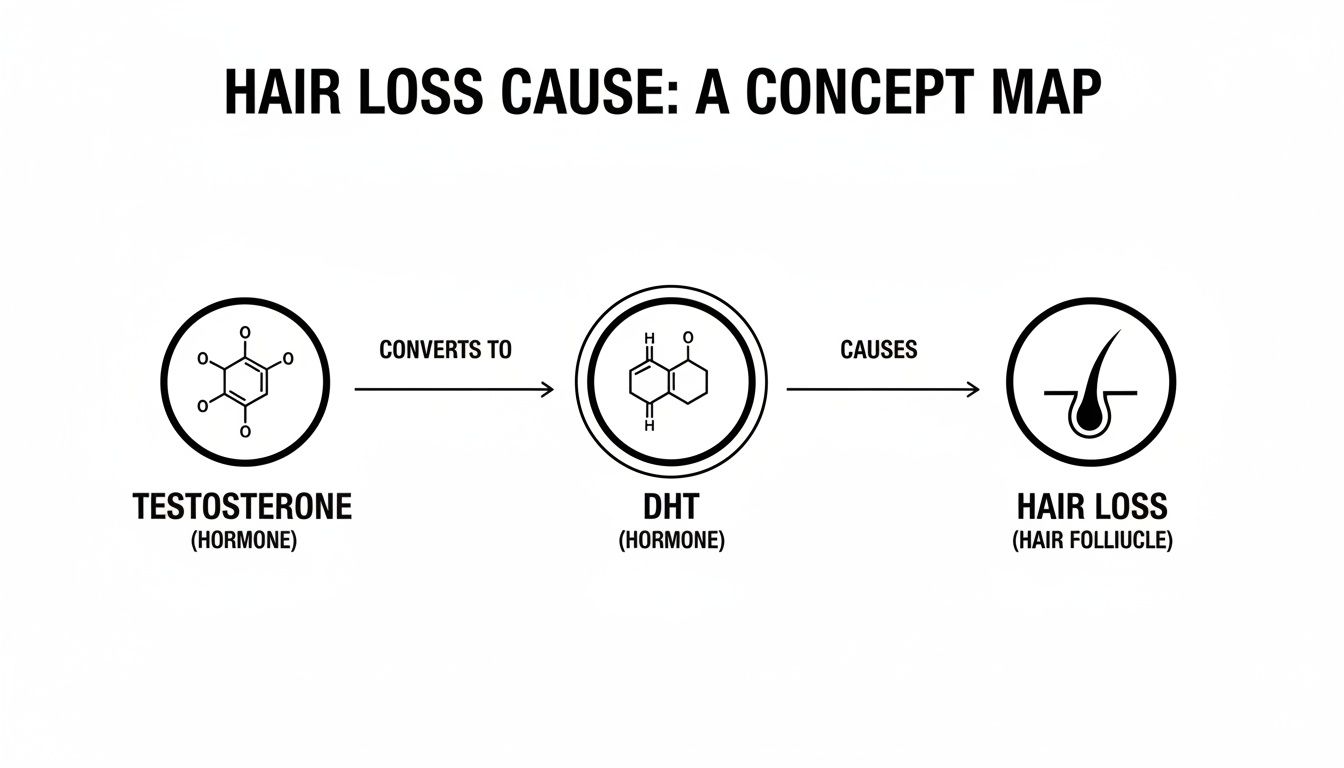
Think of testosterone as the raw material. It’s absolutely vital for everything from building muscle and keeping bones strong to regulating your mood. But in certain tissues, like your scalp, an enzyme called 5-alpha reductase gets to work on it.
This enzyme converts testosterone into a far more potent androgen: Dihydrotestosterone (DHT).
DHT is the key player in male pattern baldness. It’s like a super-charged version of testosterone, and for some men, it's the primary trigger for hair loss.
This conversion from testosterone to DHT is where the trouble starts. The amount of testosterone floating around in your system is actually less important than two other, more critical factors:
- How much 5-alpha reductase your body produces. More of this enzyme means more testosterone gets converted into the follicle-damaging DHT.
- Your hair follicles' genetic sensitivity to DHT. This is the big one. It's the genetic lottery that determines whether your follicles will shrink in the presence of DHT.
For men who've inherited this genetic sensitivity, DHT latches onto receptors in their scalp's hair follicles. Once attached, it kicks off a destructive process called miniaturization. This process gradually shrinks the follicle, causing it to produce finer, weaker hairs with each growth cycle. Eventually, the follicle just gives up and stops producing hair altogether.
To help clear up any confusion, let's break down the key differences between these two hormones.
Testosterone vs DHT at a Glance
This table provides a quick comparison of testosterone and its potent derivative, DHT, to clarify their distinct roles in male pattern hair loss.
| Hormone | Primary Role in the Body | Impact on Genetically Prone Hair Follicles |
|---|---|---|
| Testosterone | Essential for muscle mass, bone density, libido, and overall male characteristics. | Serves as the precursor to DHT but has minimal direct impact on causing hair loss. |
| DHT | Crucial for sexual development before birth and during puberty. | Binds to sensitive follicles, causing them to shrink (miniaturize) and eventually stop growing hair. |
Ultimately, it isn’t about having "too much" testosterone. It all comes down to whether you have the genetic blueprint for DHT-sensitive hair follicles.
Want to go deeper? You can learn more about this process by exploring our detailed guide on what DHT is and how it relates to hair loss.
Understanding DHT: The Real Culprit Behind Male Pattern Baldness
So if testosterone isn't the bad guy, what is? The blame actually falls on its far more potent offspring: Dihydrotestosterone (DHT).
Think of it like this: testosterone is the crude oil circulating through your system. It’s useful, but not in its raw form. An enzyme called 5-alpha reductase acts as a refinery, converting that testosterone into a much more powerful, high-octane fuel—DHT. This "refinery" is located in various tissues, including the oil glands right in your hair follicles. This localized conversion process is what kicks off male pattern baldness.
It's All in Your Genes
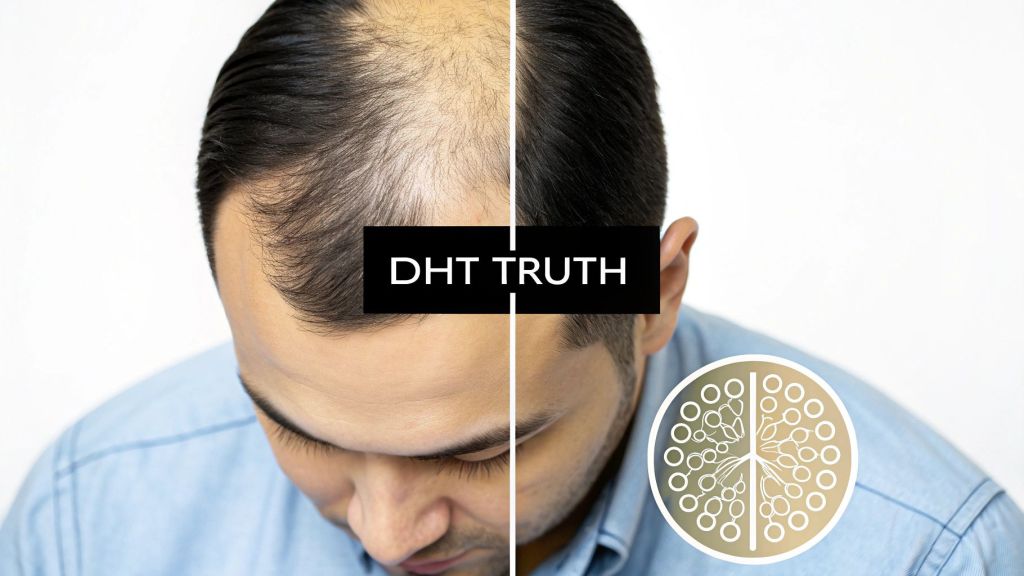
Now, just having DHT doesn't automatically mean you'll lose your hair. The real decider is genetics. The problem isn’t the DHT itself, but how sensitive your hair follicles are to its presence—a trait you inherit from your family.
Men who are genetically predisposed to hair loss have follicles with more androgen receptors. You can picture these receptors as tiny docking stations perfectly sized for DHT molecules. When DHT locks in, it sends a signal that begins a destructive process called follicular miniaturization.
This is the central mechanism behind hair loss. Essentially, the follicle starts to shrink.
With each new hair growth cycle, the follicle gets progressively smaller and weaker. This has two major effects:
- The hair's growth phase (anagen) gets shorter, meaning it can't grow as long.
- The hair shaft becomes thinner, finer, and less pigmented.
This cycle repeats over and over until the follicle is so tiny it can no longer produce a visible hair. That’s what creates the classic receding hairline and thinning crown we all recognize.
The key takeaway is that testosterone is just the precursor. DHT is the active hormone that flips the switch on genetically vulnerable follicles, causing them to shrink into oblivion.
How Common Is This, Really?
If you're seeing more hair in the drain, you are definitely not alone. This genetic sensitivity to DHT is incredibly widespread. In fact, male pattern baldness (or androgenetic alopecia) is so common that for many men, it's just a normal part of the aging process.
The statistics are pretty staggering. While testosterone itself is off the hook, its conversion to DHT affects a huge number of guys. Male pattern baldness impacts up to 50% of men by the time they hit their 50s. The prevalence jumps from around 16% in men aged 18-29 to 50% by age 49.
It all comes down to your individual genetic blueprint. Two men can have the exact same level of testosterone, but their hairlines will tell completely different stories if one has a high sensitivity to DHT and the other doesn't.
This is a critical distinction because it means we can stop blaming testosterone and focus on what really matters: managing DHT. Modern treatments work by either blocking its creation or shielding the follicle from its effects. If you're looking to be proactive, our guide on how to lower DHT levels is a great place to start.
How TRT and Steroids Can Accelerate Hair Loss
This is where the conversation gets personal for a lot of guys. The link between testosterone and hair loss often becomes a major concern when Testosterone Replacement Therapy (TRT) or anabolic steroids enter the picture. If your natural testosterone levels aren't the direct culprit, does artificially cranking them up change the game?
Absolutely—but with a huge catch. It only matters if you're already genetically wired for male pattern baldness.
Imagine your genetic predisposition for hair loss is like a dormant volcano. Your natural testosterone levels might just be a gentle rumble, not nearly enough to cause an eruption. But starting TRT or steroids? That’s like pumping a massive volume of fresh magma straight into the chamber. The pressure builds fast, making a future eruption not just more likely, but potentially far more explosive.
What’s happening on a biological level is that you’re flooding your system with the raw materials for DHT production. The 5-alpha reductase enzyme, your body's "DHT factory," suddenly gets an overwhelming supply of testosterone to convert. It goes into overdrive, and the resulting surge of DHT aggressively targets your hair follicles, fast-tracking the miniaturization process.
A Clear Cause and Effect
While your baseline testosterone doesn't really predict hair loss, deliberately adding more to your system creates a very direct cause-and-effect relationship for those with sensitive follicles. The formula is brutally simple: more fuel (the extra testosterone) creates more of the harmful byproduct (DHT).
This is exactly why so many men report that their hair started thinning, sometimes alarmingly quickly, right after starting TRT or a steroid cycle. They haven't spontaneously developed a new problem. They've just hit the fast-forward button on a genetic timeline that might have otherwise taken decades to unfold.
For a man with the genetic trait for male pattern baldness, starting TRT or steroids can be like pouring gasoline on a smoldering fire. The accelerated DHT production can turn slow, gradual thinning into aggressive, widespread hair loss in just a few months.
The Evidence From High-Dose Users
This isn't just anecdotal, either. We see clear clinical evidence linking supraphysiological (higher than normal) doses of testosterone to accelerated hair loss. Bodybuilders and athletes using high-dose anabolic steroids are a prime example, often reporting a dramatic increase in shedding.
One review noted that the incidence of alopecia among users jumped from 2% to 12% in just 3.5 months—a stark demonstration of how quickly excess testosterone gets converted into follicle-killing DHT.
Consider this: male pattern baldness already affects about 53% of men aged 40-49. If you're in that group and introduce external hormones, you’re supercharging an existing vulnerability. Your body typically converts about 5-10% of testosterone into DHT, but on a steroid cycle, that conversion process can explode, putting immense pressure on any follicles that are sensitive to it. If you want to dive deeper into how high T-levels can affect your hairline, you can discover more insights on the topic at KSL Clinic.
This doesn't mean every man on TRT is destined to go bald. A man with zero genetic sensitivity to DHT could theoretically take high doses of testosterone and see no change in his hair. But for the millions who do carry that genetic switch, artificially boosting testosterone is a major gamble. It's also why understanding different hormonal treatments is key; for example, you might be curious about corticosteroids and their potential links to hair loss, which we cover in another article.
Identifying the Early Signs of Male Pattern Baldness
Alright, we’ve covered the biology behind hair loss, but let's talk about what that actually looks like in the mirror. Knowing the first signs of male pattern baldness is your best defense. Why? Because virtually every treatment works better the sooner you start. Catching it early gives you a massive head start.
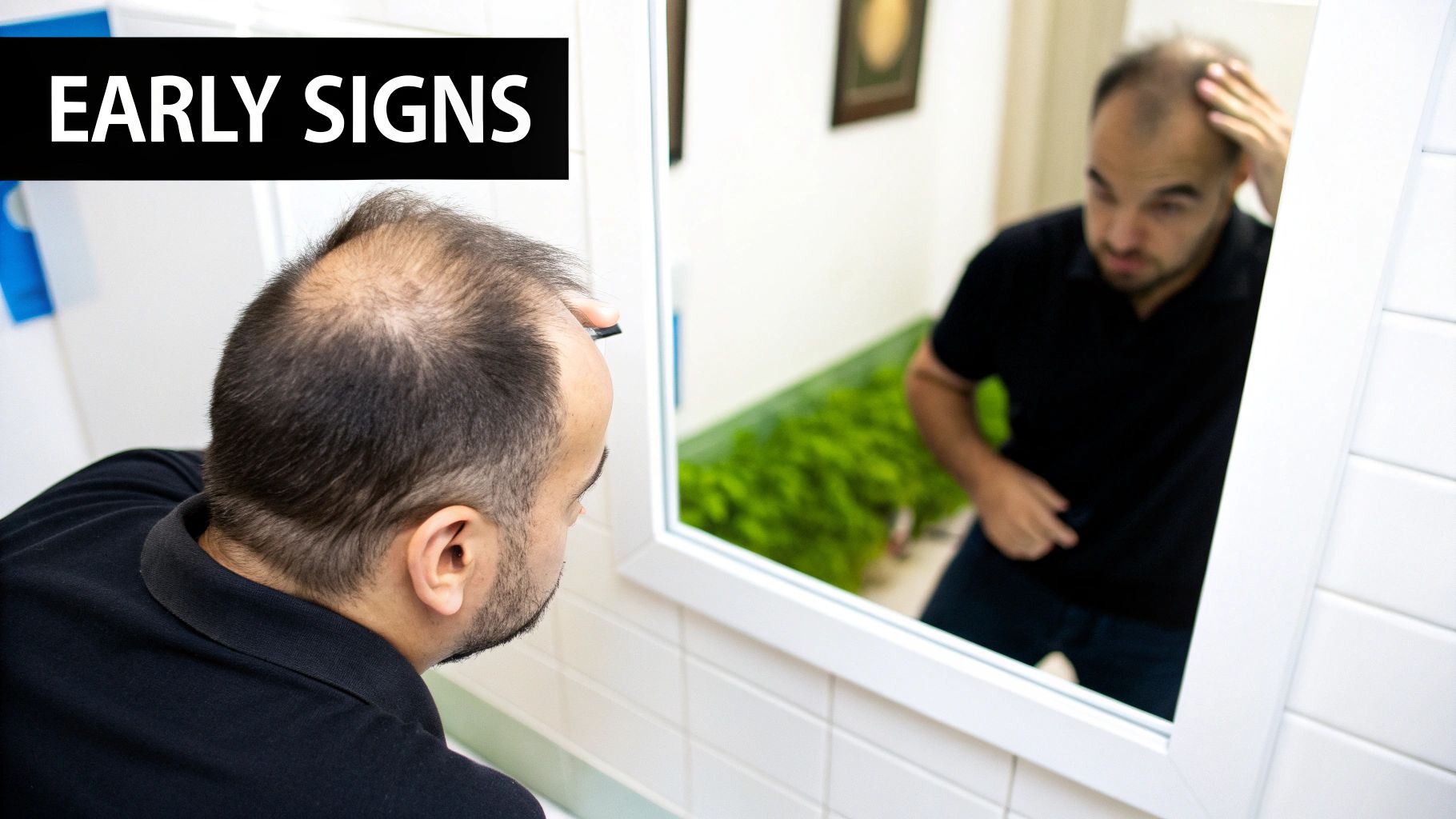
The whole process is usually a slow burn, not a sudden event. It’s a gradual retreat that tends to follow a couple of classic patterns. For most guys, the first hint isn’t a glaring bald spot, but a much more subtle shift in the hairline.
The Two Most Common Starting Points
Male pattern baldness—the clinical term is androgenetic alopecia—almost always kicks off in one of two places, and sometimes both at the same time. Learning to spot these is the first step.
The most common starting point is a receding hairline. You might notice the corners at your temples creeping back, slowly carving out a more defined "M" or "V" shape. This is often the very first clue that DHT is starting to affect those follicles.
The other classic sign is thinning at the crown, which is the vertex or the top-back of your head. This one can be tricky to spot on your own. Often, the first time you notice it is in a photo, or maybe your barber or a friend mentions it. Over time, that thinning patch can expand into the classic bald spot.
Here's a key detail many people miss: The hair doesn't just fall out. First, it gets replaced by thinner, weaker, less pigmented hairs. This process is called miniaturization, and it means you might notice your hair feels less dense or looks a bit "see-through" in bright light long before you see a lot of scalp.
Using the Norwood Scale to Track Progression
To keep everyone on the same page, hair loss specialists use a classification system called the Norwood Scale. Think of it as a roadmap that shows the seven typical stages of male pattern baldness.
- Stage 1: No noticeable hair loss. A full head of hair.
- Stage 2: A slight recession at the temples. It's often called a "mature hairline" and can be subtle.
- Stage 3: This is the point where hair loss becomes clinically significant. The recession at the temples is much deeper, or a bald spot has appeared on the crown.
- Stages 4-7: These later stages involve more extensive hair loss, eventually connecting the receding hairline and the crown, leaving only that classic "horseshoe" of hair around the sides and back.
Getting familiar with the Norwood Scale helps you turn a vague worry into a concrete observation. It gives you a way to objectively gauge where you are and monitor changes over time.
The Power of Your Family Tree
Finally, one of the best predictors of your own hair's future might be sitting across from you at Thanksgiving dinner. Since androgenetic alopecia is genetic, your family history offers some serious clues. Take a look at the men on both sides of your family.
Did your dad or his brothers start thinning early? What about your grandfather on your mom's side? The old myth that you only inherit it from your mother’s father is just that—a myth. The genes can come from either parent.
However, a strong family history of baldness is a major risk factor. If most of the men in your family have it, you've likely inherited that same genetic sensitivity to DHT. Knowing this helps you stay proactive, and you can read more about recognizing the first signs of baldness and hair loss to be fully prepared.
Your Action Plan of Proven Hair Loss Treatments
Alright, now that we've covered the science behind why testosterone and DHT can lead to hair loss, let's get to the most important part: what you can actually do about it. If you're noticing thinning and want to fight back, you have several powerful, scientifically-backed treatments on your side. This isn't about miracle cures; it's about proven strategies that can halt hair loss and even kickstart regrowth.

The world of hair loss treatment has come a long way. Today, the most effective game plans tackle the problem from different angles, from blocking the DHT that's causing the damage to directly stimulating the follicles themselves. Let's break down the top-tier options you should be discussing with a specialist.
FDA-Approved Medications: The First Line of Defense
When it comes to treating male pattern baldness, two medications consistently rise to the top. They're considered the gold standard because they're approved by the FDA, backed by decades of data, and have strong safety profiles.
Finasteride: The DHT Blocker
Finasteride goes straight for the root cause of genetic hair loss. It works by inhibiting the 5-alpha reductase enzyme—that's the "factory" that converts your testosterone into follicle-damaging DHT. By dramatically lowering DHT levels right at the scalp, it stops the miniaturization process in its tracks.
Think of it as cutting off the fuel supply to the fire. With less DHT attacking your follicles, they get a chance to recover, and your hair's growth cycle can start to normalize. For many guys, this not only stops further loss but can lead to visible regrowth of thicker, healthier hair.
Minoxidil: The Growth Stimulant
Minoxidil has a funny origin story. It started as a blood pressure medication, but doctors noticed a surprising side effect: patients were growing hair. It's now a topical solution or foam that you apply directly to your scalp. While the exact science is still being pinpointed, we know it acts as a vasodilator, meaning it widens blood vessels.
This boosts blood flow to your follicles, delivering more oxygen and nutrients. It essentially "wakes up" dormant follicles and helps keep them in the anagen (growth) phase longer. Minoxidil doesn't block DHT, which is why it's so often paired with Finasteride for a powerful, two-pronged attack.
And the numbers don't lie. By age 35, a staggering 40% of men are already dealing with noticeable hair loss. That number climbs to an 85% lifetime prevalence, all driven by that genetic sensitivity to DHT. Studies show Finasteride can drop scalp DHT by 69%, leading to regrowth in 48% of men versus just 7% in a placebo group. Similarly, 5% Minoxidil halts loss for 62% of users and promotes new growth in 35%.
Platelet-Rich Plasma (PRP): A Non-Hormonal Approach
For guys looking for an alternative to daily meds or a way to boost their current routine, Platelet-Rich Plasma (PRP) therapy is a compelling option. The best part? It's a non-hormonal treatment that uses your body's own natural healing power to rejuvenate hair follicles.
The process is pretty straightforward:
- A small sample of your blood is drawn, just like a standard blood test.
- The blood is spun in a centrifuge to separate and concentrate the platelets, creating a plasma rich in growth factors.
- This "liquid gold" is then carefully injected into the areas of your scalp where you're seeing thinning.
PRP therapy works by delivering a super-concentrated dose of growth factors directly to the hair follicle. These powerful proteins signal the follicles to get back into the growth phase, improve blood supply, and can even increase the thickness of the hair shaft.
Because PRP uses your own biological material, it's an incredibly safe option with no risk of systemic side effects. It's an excellent choice for men who are on TRT and want to combat hair loss without messing with their hormone levels, or for anyone who just prefers a more natural approach.
Beyond PRP, other emerging treatments are also gaining traction, such as red light therapy for hair growth. Ultimately, the best strategy often involves a combination of therapies tailored to you. The crucial next step is talking to a hair loss specialist to build a personalized plan that gives you the best shot at success.
For men on Testosterone Replacement Therapy (TRT) who are concerned about their hair, or really for anyone who just doesn't want to take a daily pill, finding a solution that won't mess with hormones is a huge deal. DHT blockers like Finasteride work, there's no doubt about it, but they aren't the answer for everybody. This is exactly where Platelet-Rich Plasma (PRP) therapy comes in as a fantastic, non-hormonal alternative.
PRP is a game-changer because its mechanism is completely different. Instead of blocking or altering your testosterone and DHT, it taps into your body's own healing power to wake up hair follicles right at the scalp. This makes it a perfect strategy for guys who need to stay on their TRT protocol but are determined to keep their hair.
The real beauty of PRP is that it works locally. We're delivering a super-concentrated dose of your own natural growth factors directly to the scalp, kickstarting follicles without touching your systemic hormone levels. Your testosterone and DHT are left completely alone.
This approach is about as natural as it gets. You're not putting a foreign substance into your body. You're simply taking your body's own regenerative toolkit, concentrating it, and putting it to work right where you need it most.
How the PRP Process Works
The whole procedure is surprisingly straightforward and leverages the healing systems you were born with. It’s a simple three-step process that’s usually done in less than an hour.
- A Simple Blood Draw: It all begins just like a routine physical. We take a small sample of blood from your arm.
- Concentrating the Platelets: That blood sample goes into a centrifuge, which is a device that spins it at an incredibly high speed. This separates the blood into its different parts, allowing us to isolate the plasma rich in platelets—the stuff packed with powerful growth factors.
- Targeted Injections: Finally, this concentrated "liquid gold" is meticulously injected into the areas of your scalp where the hair is thinning. Those growth factors immediately get to work, signaling follicles to shift back into a more active growth phase.
This direct delivery helps awaken dormant follicles, boosts blood flow to the scalp, and can even thicken the shaft of your existing hairs. The goal isn't just to stop shedding but to actively improve hair density for a fuller, healthier look. If you're wondering about success rates, we have a complete breakdown on whether PRP is effective for hair loss in our dedicated guide.
The Benefits of a Hormone-Free Approach
Opting for a non-hormonal treatment like PRP comes with some major advantages, especially when testosterone’s role in hair loss is the main concern. First off, the safety profile is incredibly high. Since we're using your own biological material, the risk of allergic reactions or systemic side effects is practically zero.
This makes PRP an excellent standalone treatment, but it also pairs beautifully with other options like topical Minoxidil to get even better results. It offers a proactive way to strengthen your hair follicles against DHT's influence, all without ever altering your body's sensitive hormonal balance.
Common Questions About Testosterone and Hair Loss
When you start digging into the connection between hormones and hair, a lot of specific questions pop up. To help clear the air, here are some of the most common ones we hear, with straightforward answers to lock in what you've learned.
If I Have Low Testosterone, Will I Stop Losing My Hair?
It's a logical question, but the answer is usually no. While having almost no testosterone might stop male pattern baldness in its tracks, a T level that's just "low-normal" won't stop the process. Why? Because the real culprit is your follicles' genetic sensitivity to DHT.
Even a modest amount of testosterone gives your body enough fuel to produce the DHT that triggers hair loss if you're genetically prone to it. The root of the problem isn't the total volume of testosterone, but how your hair follicles are programmed to react to its byproduct, DHT.
Will Stopping TRT Reverse My Hair Loss?
Stopping a TRT or steroid cycle will definitely take your foot off the gas pedal. By cutting off that extra supply of testosterone, you can dramatically slow down, or maybe even stop, any further thinning. However, it's unlikely to reverse the damage—the miniaturization—that has already happened to your follicles.
Think of it this way: you're removing the accelerator, but the car has already traveled a certain distance. To get any of that lost ground back and revive those shrunken follicles, you'd need to actively start a targeted treatment plan.
Can Lifestyle Changes Prevent This Type of Hair Loss?
A healthy lifestyle is fantastic for your overall well-being and can absolutely support the health of the hair you have. Good nutrition, regular exercise, and managing stress are always great ideas. But they can't change your DNA.
No amount of clean eating or gym time is going to rewrite your hair follicles' built-in sensitivity to DHT. Healthy habits are great for optimizing what you've got, but they aren't a preventative measure or a cure for androgenetic alopecia.
Is PRP Treatment Painful?
Most people handle PRP treatments just fine. They usually describe the feeling as a series of quick, mild pinches. To make things as comfortable as possible, a numbing cream is applied to the scalp beforehand. It's important to remember, though, that the results aren't permanent because the underlying genetic condition is still there. To keep your hair looking thicker and fuller, you'll likely need a follow-up session every 6 to 12 months.
If you're ready to explore a powerful, non-hormonal treatment to fight hair loss, the experts at PRP For HairLoss are here to help. Discover how our specialized approach can rejuvenate your hair follicles and restore your confidence. Learn more about PRP therapy on our website.
 PRP For Hairloss
Leave a comment