It might sound like a contradiction, but the relationship between corticosteroids and hair loss is a real head-scratcher. These potent anti-inflammatory medications can, believe it or not, both cause and cure certain kinds of hair loss. This paradox leads to a lot of confusion, so let's clear things up.
The Steroid Paradox: Friend or Foe?
First, let's get back to basics. At their core, corticosteroids are designed to pump the brakes on an overactive immune system. Picture your immune system as a hyper-vigilant security guard that starts seeing threats everywhere, even in friendly faces. That's essentially what's happening in autoimmune diseases—the body's defenses start attacking its own healthy cells.
When Steroids Are the Solution
For certain autoimmune conditions that cause hair loss, this calming effect is exactly what the doctor ordered.
- Alopecia Areata: This is the classic example. The immune system gets confused and attacks the hair follicles. This assault forces them to shut down production, resulting in those tell-tale smooth, bald patches.
- Calling a Truce: Corticosteroids step in like a mediator, effectively telling the rogue immune cells to stand down. This "cease-fire" reduces the inflammation around the follicles, giving them the breathing room they need to recover and get back to the business of growing hair.
So, by stopping the friendly fire, corticosteroids tackle the problem at its source, making them a go-to treatment for this type of hair loss.
For autoimmune conditions like alopecia areata, corticosteroids are not the cause of hair loss—they are the solution. They work by halting the immune response that is damaging the hair follicles in the first place.
When Steroids Are the Trigger
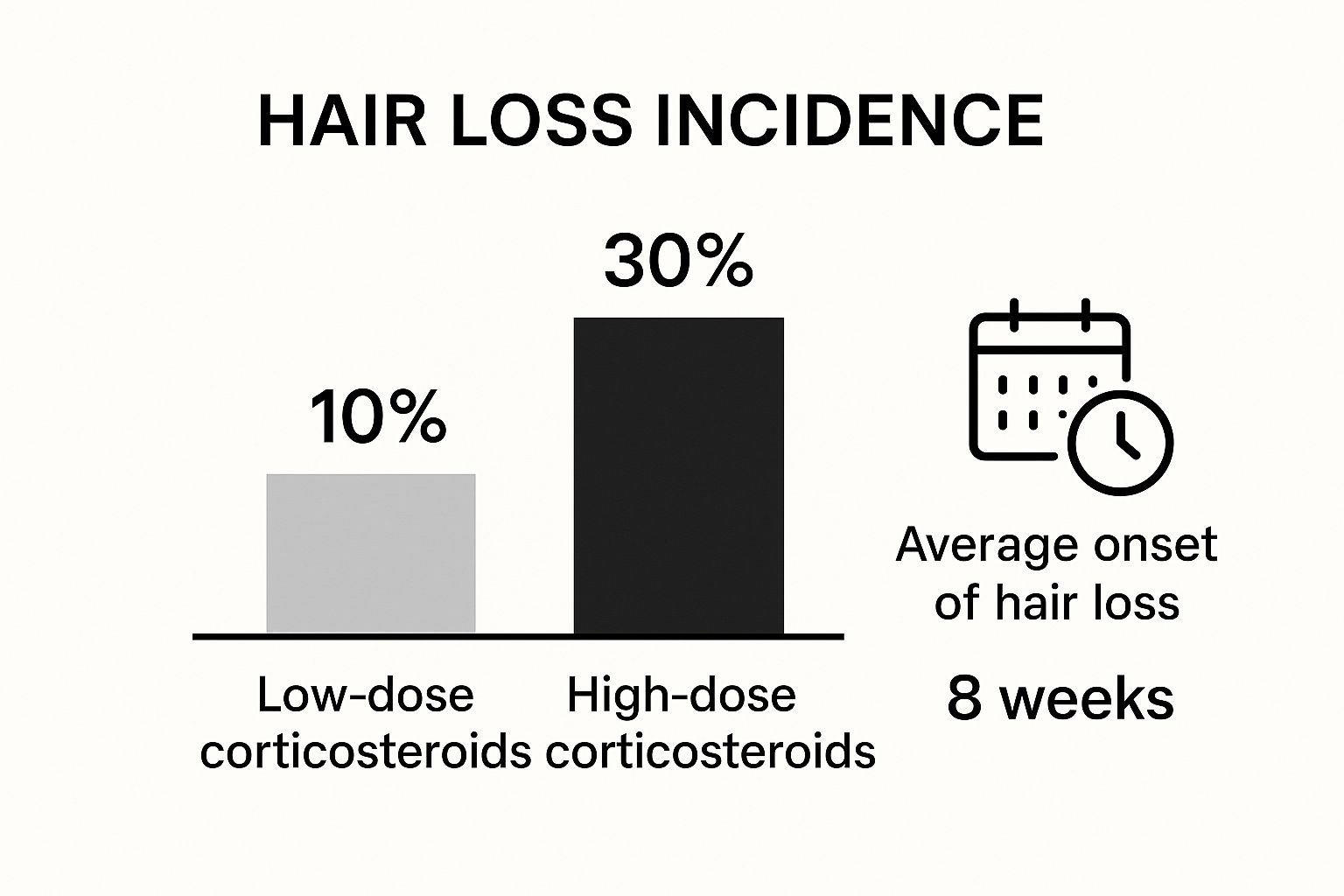
On the flip side, taking corticosteroids—especially the systemic kind that are swallowed or injected and affect your whole body—can sometimes kickstart a completely different type of hair loss. This isn't an autoimmune issue at all. Instead, it's about the intense physiological stress these powerful drugs can put on your system.
This stress can shock a significant number of your hair follicles, pushing them all into the resting (telogen) phase of the hair growth cycle at the same time. A few months later, all those resting hairs are shed, resulting in a condition called telogen effluvium. This isn't patchy; it's a diffuse, all-over thinning that can be quite alarming.
Getting your head around this dual nature—hero in one scenario, villain in another—is the first crucial step to understanding your treatment options.
Here is the rewritten section, crafted to sound more natural and human-written.
What Is Alopecia Areata and Why Do Steroids Help?
Before we dive into how corticosteroids work, we need a clear picture of what they're up against: alopecia areata.
Imagine your body’s immune system is like a highly-trained security force. Its mission is simple: find and take down real threats, like viruses or bacteria. But in someone with alopecia areata, that security team gets some bad intel. It starts misidentifying your healthy hair follicles—the tiny structures that grow your hair—as dangerous invaders and launches an all-out attack.
This is what we mean when we call alopecia areata an autoimmune condition. The body’s own defense system has turned on itself. This friendly fire causes inflammation around the hair follicles, which messes up the normal hair growth cycle and forces them to go dormant. The most visible sign of this is the smooth, round patches of hair loss you see on the scalp or other parts of the body.
The Immune System's Mistake
Losing your hair is about so much more than just appearance. The unpredictable nature of alopecia areata can be deeply distressing, creating real emotional and psychological hurdles for those who live with it.
Alopecia areata is a chronic, T-cell mediated autoimmune condition that doesn't just cause patchy hair loss; it is also linked to an increased risk for depression and anxiety, highlighting the need for effective treatments.
And it’s more widespread than most people think. In the United States, alopecia areata accounted for 2.4 million office visits in just ten years. On a global scale, the lifetime risk of developing it is about 2.1%, which makes it a surprisingly common autoimmune disorder. If you'd like to dig deeper into the numbers, you can find detailed epidemiological insights from this study.
Why Corticosteroids Are the Answer
Once you see alopecia areata as an overactive immune response, the role of corticosteroids and hair loss treatment clicks into place. Steroids are potent immunosuppressants, which means they are incredibly effective at dialing back an overzealous immune system.
Think of it this way: a doctor using corticosteroids is like a general telling the confused security team to stand down. By administering steroids, they're essentially calling a ceasefire on the immune cells that are attacking the hair follicles.
This approach accomplishes two critical things at once:
- It shuts down inflammation: First and foremost, it stops the inflammatory assault that's causing the follicles to shut down in the first place.
- It gives follicles a chance to recover: With the attack paused, the hair follicles finally have the breathing room they need to heal, recover, and hopefully get back to their normal growth phase.
Corticosteroids don't just put a band-aid on the problem. They tackle the root autoimmune issue, creating the right environment for hair to start growing again. That’s why they’ve long been a cornerstone treatment for alopecia areata.
How Steroids Signal Your Hair Follicles to Regrow

So, how do steroids actually coax hair follicles back to life? It all starts with inflammation. When you have a condition like alopecia areata, your immune system gets its signals crossed and mistakenly attacks your own hair follicles. Imagine a constant, low-level siege happening right at the root of your hair.
Corticosteroids act like a diplomatic envoy, sent in to call a truce. They work on a cellular level to dial down this aggressive immune response. By getting inside the overactive immune cells, steroids effectively shut down the production of the very chemicals causing the inflammation.
Once the attack stops, the beleaguered hair follicles can finally breathe. This peaceful environment gives them a chance to heal from the damage and, with any luck, shift back into the anagen phase—the active growing stage of the hair cycle.
Matching the Treatment to the Need
The way a corticosteroid is delivered is just as crucial as the medicine itself. A dermatologist's choice isn't random; it's a strategic decision based on how much hair loss you have and where it's located.
There are three main delivery methods for alopecia areata:
- Topical Steroids (Creams/Foams): Think of these as the first responders. Applied right onto the skin, they're perfect for smaller, more isolated patches. They offer a gentle way to calm inflammation locally without involving the rest of your system.
- Intralesional Injections: When you're dealing with more stubborn or clearly defined patches, your doctor might inject the steroid directly into the scalp. This method delivers a concentrated dose right where it's needed most, which is why many people see results more quickly.
- Oral Steroids (Pills): These are typically reserved for more severe or rapidly spreading cases of hair loss. Because they're taken by mouth, they have a systemic effect, meaning they work throughout the entire body. They are powerful but come with a higher risk of side effects, requiring close monitoring by your doctor.
The central idea behind using corticosteroids and hair loss treatment is simple: calm the inflammation so the follicle can get back to work. The delivery method is just about finding the right tool for the job.
Ultimately, the type of steroid treatment you receive is a calculated choice. Understanding how these medications work and why one method might be chosen over another gives you a clearer picture of your own treatment plan and helps set realistic expectations for your hair regrowth journey.
When a doctor brings up using corticosteroids for hair loss, they aren't talking about a single, one-size-fits-all solution. The type of treatment they recommend will depend entirely on how severe your hair loss is and where it’s happening. It’s like a mechanic choosing the right tool for the job—you wouldn't use a sledgehammer to fix a tiny dent.
For many, the treatment journey starts with the gentlest option first.
Comparing Steroid Treatment Options for Alopecia Areata
To help you understand how these treatments differ, here’s a quick breakdown of the three main ways corticosteroids are used for alopecia areata. Each method is chosen based on the patient's specific situation.
| Treatment Type | Best For | How It Works |
|---|---|---|
| Topical Steroids | Milder, early-stage alopecia with smaller patches. A good starting point. | Creams or foams are applied directly to the scalp to calm inflammation at the surface. |
| Intralesional Injections | More stubborn or concentrated patches of hair loss that don't respond to topicals. | A tiny needle delivers the steroid directly into the bald spots for a targeted, potent effect. |
| Oral Steroids | Severe, widespread, or rapidly progressing hair loss. Reserved for more serious cases. | Pills are taken by mouth to suppress the immune system throughout the entire body. |
As you can see, the goal is always to use the most direct and least invasive method that will get the job done, minimizing side effects along the way.
Topical Steroids: The First Line of Defense
If you have a few small patches or are just starting to experience alopecia areata, your dermatologist will almost always begin with topical steroids. These come in creams, foams, or lotions that you apply right onto the affected skin. The biggest advantage here is that they work locally, targeting inflammation right at the source without sending the medication through your entire system.
Of course, not all topical steroids are created equal. Their strength, or potency, is a critical factor. For instance, a 2014 study highlighted that a high-potency steroid was much more effective for children with alopecia areata. An incredible 85% of children using the stronger formula saw at least a 50% improvement, while only 33.3% of those using a low-potency version saw similar results.
Intralesional Injections: A More Targeted Strike
What if creams and foams just aren't cutting it? When hair loss is more stubborn, the next step is often intralesional injections.
This sounds more intense than it is. A very fine needle is used to inject a small amount of corticosteroid directly into the skin of the bald patches. This delivers a concentrated dose of the anti-inflammatory medicine exactly where it’s needed—right around the hair follicles under attack. It’s a highly effective way to get powerful results in a specific area, often sparking regrowth in four to eight weeks.
Oral Steroids: The System-Wide Approach
For cases that are widespread, progressing quickly, or particularly severe, your doctor might consider oral corticosteroids like prednisone. Because you take these as pills, they work systemically, meaning they dial down the immune response throughout your whole body.
This is a powerful move, but it comes with a higher risk of side effects, which is why it’s reserved for more serious situations. Anyone taking oral steroids needs to be monitored closely by their doctor to track progress and manage any potential issues.
It's also worth noting that the world of hair restoration is always evolving. Beyond corticosteroids, innovative approaches like Platelet-Rich Plasma (PRP) therapy are also showing real promise. Understanding all your options is the first step toward having a productive conversation with your doctor and finding the right path for you.
Navigating the Potential Side Effects of Steroids
Any good treatment plan comes with a frank discussion about both the upsides and the potential downsides. When we talk about corticosteroids and hair loss, it’s absolutely essential to have a clear-eyed view of the possible side effects. The good news? The risks you face really depend on how you're using the steroid.
For instance, local treatments like scalp injections or topical creams are designed to work right where you apply them. This keeps the medication contained, meaning any side effects are usually minor and stick to that specific area.
Localized vs. Systemic Side Effects
If your treatment involves intralesional injections or topical steroids, the side effects are almost always confined to the spot being treated. You might notice a few things:
- Skin Thinning (Atrophy): This is the most common issue. You might see the skin become a bit thinner where the steroid is applied or injected.
- Minor Irritation: Some temporary redness, a bit of itching, or mild discomfort isn't unusual right after application.
- Pigmentation Changes: The skin in the treated spots could get slightly lighter or darker.
This is exactly why your doctor will keep a close eye on your progress and carefully plan your treatment schedule. On the other hand, oral steroids are a different ballgame. Since they affect your entire system, they carry a wider range of potential side effects and require much closer medical supervision.
The risk profile for corticosteroids is not one-size-fits-all. A localized treatment like scalp injections carries very different considerations than a systemic treatment like oral prednisone.
Systemic steroids, taken by mouth, are incredibly powerful, but their influence is body-wide. This is why doctors usually reserve them for more severe or widespread cases of hair loss. Because they impact your whole body, they can lead to things like weight gain, mood swings, increased appetite, or even changes in blood sugar and blood pressure.
Balancing Efficacy with Caution
Deciding to use oral corticosteroids always comes down to a careful calculation: does the potential for significant hair regrowth outweigh these risks? For conditions like severe alopecia areata, research shows they can work wonders. One study, for instance, combined prednisone with another drug and saw at least 50% hair regrowth in most patients within just three to six months.
But there's always a trade-off. In studies, common side effects like weight gain and acne showed up in 55% of patients taking oral prednisolone, compared to only 13% in placebo groups. We also have to consider that hair loss can sometimes return after the treatment stops. You can explore the full study findings on oral corticosteroid treatment for alopecia areata to see the data for yourself.
Ultimately, the goal here isn't to scare you away from treatment. It’s to give you a complete, balanced picture. Armed with this knowledge, you can have a truly productive and honest conversation with your doctor to decide if the benefits of a particular steroid treatment are worth the risks in your specific case.
Frequently Asked Questions About Steroids and Hair
https://www.youtube.com/embed/I9yfbhsw5vU
When you're dealing with hair loss and considering corticosteroids, a lot of questions pop up. It’s only natural. Let’s walk through some of the most common concerns to give you a clearer picture of what to expect during and after treatment.
How Quickly Can I Expect Hair Regrowth?
This is probably the first question on everyone's mind, but the honest answer is: it varies. Everyone's body responds differently, and how fast you see results depends on the severity of your alopecia, the specific steroid treatment you're using, and your unique physiology.
For more direct treatments like intralesional injections or oral steroids, some people start noticing fine, new "peach fuzz" within 4 to 8 weeks. With topical creams and foams, the journey is usually a bit slower; it might take several months before the changes are obvious. Patience is key here, as hair growth is naturally a slow, gradual process.
Is Hair Regrowth from Corticosteroids Permanent?
This is a really important question. The truth is, alopecia areata is notoriously unpredictable. While corticosteroids do an excellent job of calming down the immune system and kickstarting new growth, they are a treatment, not a permanent cure.
Alopecia areata can relapse. The goal of corticosteroid therapy is to manage the active hair loss by controlling the immune response. For many, this means ongoing management rather than a one-time fix.
It's entirely possible for hair loss to return once the medication is stopped. Your dermatologist will be your partner in this, helping you create a long-term strategy to manage the condition effectively.
Can Steroids for Other Conditions Cause Hair Loss?
Yes, they absolutely can, and this is a common point of confusion. When doctors prescribe systemic steroids like prednisone for conditions completely unrelated to hair loss—think asthma, arthritis, or severe allergies—the medication can put your entire body under a lot of stress.
This physiological stress can trigger a completely different kind of hair loss called telogen effluvium. This isn't your immune system attacking the follicles; it's a diffuse shedding caused by a shock to your system. The good news? This type of hair loss is almost always temporary and resolves on its own a few months after you stop the steroid.
At PRP For HairLoss, we believe that understanding all your options is the first step toward regaining control. If you're exploring treatments beyond corticosteroids, you can learn more about innovative solutions like Platelet-Rich Plasma therapy on our website. Find out more at prpforhairloss.com.


Leave a Reply