Yes, heavy drinking can absolutely mess with your hair growth, often leaving it weaker and more prone to falling out. If you're a guy already watching your hairline, you should know that excessive alcohol can sabotage the very nutrients and processes your hair needs to stay healthy.
Simply put, it can accelerate hair loss. Think of it as an inside job, quietly undermining your efforts to keep a full, healthy head of hair.
The Uncomfortable Truth About Alcohol and Your Hair
Let's get straight to it. You're probably here because you're wondering if your weekend beers are thinning out your hair, and you want a direct answer. The truth is, yes, heavy drinking can definitely be a contributing factor.
For any guy who's already keeping a sharp eye on his hairline, it can feel like you're just pouring fuel on a fire, speeding up a process you’re desperately trying to put the brakes on.
This isn’t about scaring you; it’s just biology. When you drink heavily, your body has to work overtime to process all that alcohol. That metabolic emergency pushes everything else to the back of the line, including absorbing the vital nutrients your hair depends on.
Imagine your hair follicles as tiny construction sites. They need a steady stream of raw materials—zinc, iron, protein—to build strong, healthy hair. Alcohol basically hijacks the delivery trucks, leaving your follicles starved for the very resources they need to get the job done.
How Alcohol Sabotages Hair Health
Over time, this nutritional deficit leads to a predictable outcome. Your hair gets weaker, more brittle, and is more likely to be pushed into its shedding phase way too early. It’s the reason you might notice more hair on your pillow or circling the shower drain after a period of heavy drinking.
The impact isn't just a theory. Research from hair specialists shows that heavy alcohol use messes with nutrient absorption and blood flow to the follicles, potentially accelerating hair loss by up to 40%. For men, this can make a visible difference over time.
This internal chaos sets the stage for bigger problems. Some studies even suggest that men who drink more than 14 units of alcohol a week might hit the more advanced stages of baldness about seven years earlier than guys who don't.
The link between lifestyle and hair health is undeniable. Much like the effects of smoking on hair loss, what you put into your body has a direct impact on what grows on your head. Recognizing that connection is the first real step toward protecting your hair for the long haul.
2. The Biological Battle Inside Your Hair Follicles
To really get how alcohol messes with your hair, you have to think of your hair follicles as tiny, highly-specialized factories. Like any factory, they need a steady supply of specific raw materials to produce their product—strong, healthy hair. Alcohol comes in and systematically disrupts that entire supply chain.
This internal conflict plays out on three main fronts: it robs your body of nutrients, it dehydrates you from the inside out, and it sparks inflammation. Each of these creates a hostile environment on your scalp, making it incredibly difficult for your follicles to function, which often leads to weaker strands and more shedding over time.
The Nutritional Gap
First off, alcohol is a master of nutritional sabotage. It directly interferes with how your body absorbs and uses the very nutrients that are the literal building blocks of hair. Imagine trying to build a sturdy brick wall but someone keeps stealing half your bricks and watering down your mortar. The end result is going to be weak and unstable.
This isn't just theory. People who drink heavily often have significant deficiencies in crucial minerals and proteins. A massive systematic review that looked at over 61,000 patients found a clear, direct link: the more alcohol people drank, the more hair loss they experienced. Deficiencies in zinc, iron, and protein are especially bad news for hair, leading directly to weakened follicles and increased shedding.
Here’s a simple visual breakdown of how alcohol disrupts this process, ultimately leading to weaker hair.
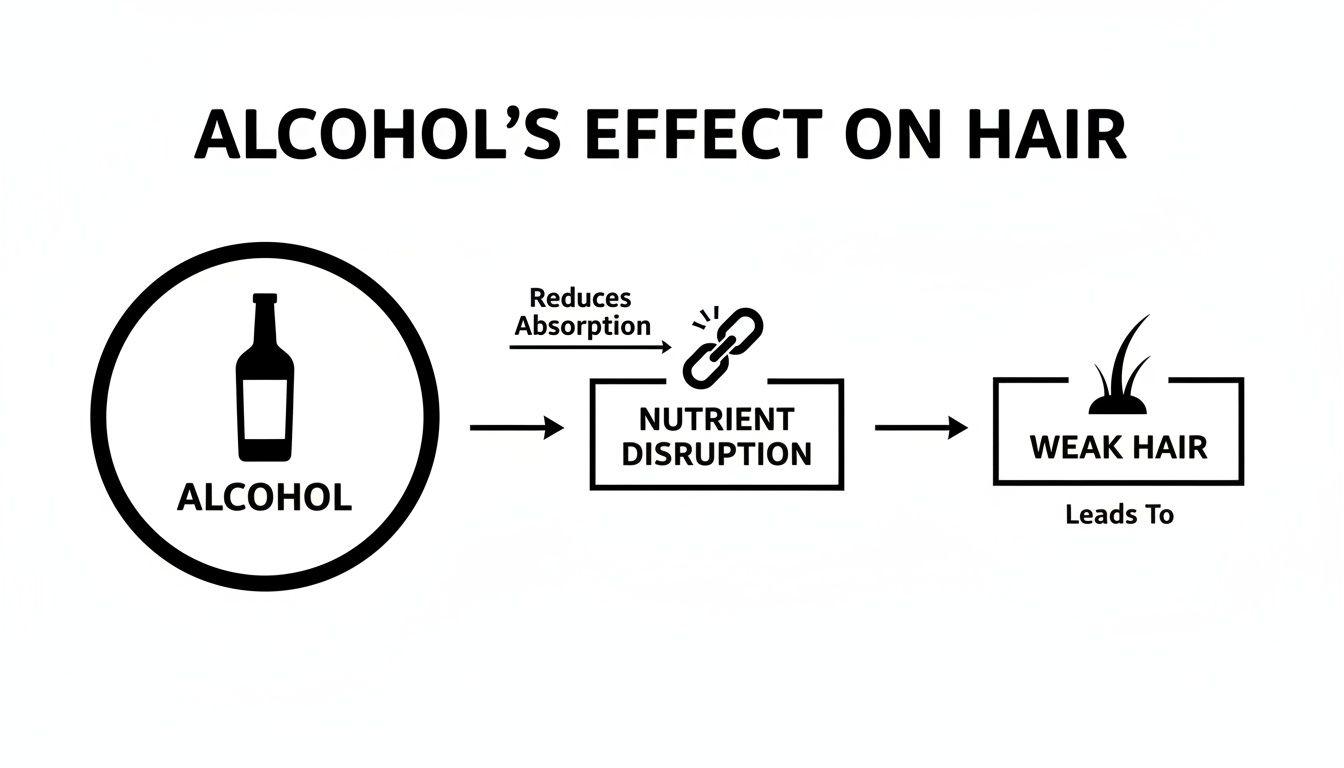
As the flowchart shows, the path from a drink to nutrient disruption is surprisingly direct, with a clear negative impact on your hair's strength.
The Dehydration Drain
Next up is hydration. Alcohol is a well-known diuretic, which is a technical way of saying it makes your body flush out water. This does more than just make you thirsty the next day; it impacts your entire system, right down to your scalp and hair.
A dehydrated scalp is a stressed scalp. It can become dry, flaky, and lose its elasticity—a terrible foundation for growing healthy hair. Your hair strands themselves are made of roughly 25% water. When that moisture gets stripped away, they become brittle, lose their shine, and are far more likely to snap and break. The link between https://prpforhairloss.com/dehydration-and-hair-loss is well-established, highlighting just how vital water is for keeping your hair on your head.
Inflammation and Oxidative Stress
Finally, alcohol triggers a low-grade inflammatory response throughout your body. You can think of this as a constant, simmering state of alert that puts your cells under a ton of stress.
This low-level, persistent inflammation leads to what’s called oxidative stress. It’s a state where an army of damaging molecules, known as free radicals, runs rampant, attacking your hair follicles at the cellular level. This is like forcing your follicles to age prematurely, which can shorten their growth phase and make them less and less effective at producing hair.
It's not just one thing. Understanding chronic inflammation and its causes helps paint the full picture of how alcohol, a known inflammatory agent, affects your whole body—including the delicate ecosystem of your scalp. This three-pronged attack of starvation, dehydration, and inflammation is exactly how a few drinks can escalate into a real problem for your hairline.
How Alcohol Disrupts Hormones and Accelerates Balding
If you’re already genetically prone to male pattern baldness, keeping your hormones in check is a top priority. We've talked about how alcohol can strip your body of essential nutrients, but its impact on your hormones might be even more direct and damaging. It can create the perfect internal storm for hereditary hair loss to take hold and speed up.
Think of your liver as the body's master chemical processing plant. One of its countless jobs is to manage and regulate hormones, including testosterone. When you drink heavily, you’re essentially forcing that plant to shut down its other assembly lines to focus on one emergency task: processing alcohol. This diversion means its hormone-regulating duties get put on the back burner.
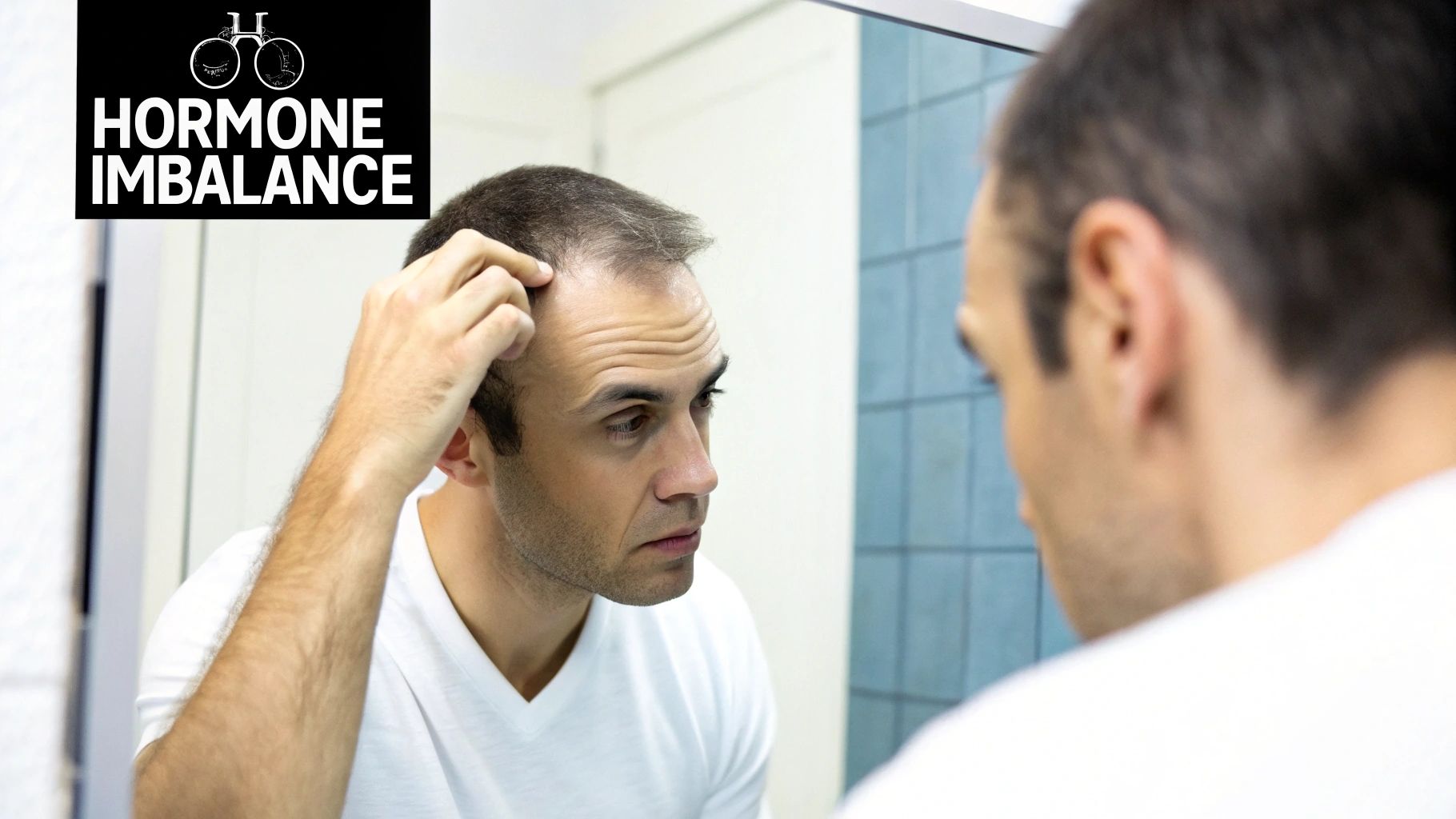
When the liver can't keep up, it creates a hormonal traffic jam. This can lead to an increased conversion of testosterone into dihydrotestosterone (DHT)—the very hormone that’s the primary trigger for male pattern baldness. For anyone with that genetic sensitivity, it’s a worst-case scenario.
The DHT Connection to Hair Loss
DHT is the main villain in the story of hereditary hair loss. It binds to receptors on your hair follicles and tells them to shrink, a process known as miniaturization. As the follicles get smaller, their growth phase gets shorter. Eventually, they become so tiny they can't produce a visible hair, which is what causes a receding hairline and thinning at the crown.
It helps to think of your hair follicles like tiny, thriving plants in a garden. DHT is like a targeted weed killer that gets into the soil, slowly choking the life out of the plant until it withers away. The more DHT you have circulating in your system, the more "poison" is available to attack those vulnerable follicles.
This is precisely why the link between alcohol and hair health is so critical. By impairing your liver's ability to do its job, heavy drinking can indirectly crank up the production of the one hormone responsible for destroying your hair.
The Role of Stress and Cortisol
But the hormonal disruption doesn't end with DHT. Drinking, especially in excess, also triggers a sharp increase in cortisol, the body’s primary stress hormone. When cortisol levels are chronically high, it’s bad news for your entire system—and your hair is no exception.
High cortisol can prematurely shove a large number of hair follicles out of their growth phase and into the shedding (telogen) phase. This sudden, widespread hair fall is a condition called telogen effluvium, and it can make existing male pattern baldness appear much more severe, almost overnight.
So, in essence, alcohol can launch a two-pronged hormonal assault on your hair:
- It can increase DHT, the long-term follicle shrinker.
- It can spike cortisol, the short-term mass shedder.
For any man trying to preserve his hair, this combination is especially brutal. It doesn't just accelerate the underlying genetic timeline for baldness; it layers on a whole separate type of stress-induced hair loss. Understanding how a hair loss hormonal imbalance operates is fundamental to grasping your own situation. It makes it clear how a lifestyle choice like drinking can directly pour fuel on a fire you were already genetically wired to fight.
Protecting Your Investment in Hair Loss Treatments
If you’re using treatments like PRP, Finasteride, or Minoxidil, you've made a real investment in your hair's future. It’s not just a financial one; it’s an investment of time, hope, and commitment. The absolute last thing you want is for a lifestyle choice—like having a few drinks over the weekend—to quietly sabotage all that effort.
It's crucial to understand how alcohol can get in the way. Think of your treatment as hitting the gas pedal for hair growth. Heavy drinking, on the other hand, is like slamming on the emergency brake. Pushing both at once just leads to wasted energy and stalled progress.
How Alcohol Interferes With PRP Treatments
Platelet-Rich Plasma (PRP) therapy is pretty amazing—it uses your body's own concentrated healing factors (platelets) and injects them right into your scalp to wake up sleeping hair follicles. For it to work, your body needs to be in a prime state for regeneration, with inflammation kept to a minimum.
Alcohol does the exact opposite. It's an inflammatory substance that also thins your blood.
Drinking before a PRP session can mean more bleeding and bruising at the injection sites. But more importantly, the inflammation it creates throughout your body actively fights against the healing signals your PRP treatment is trying to send. It's like trying to put out a fire while someone else is trickling gasoline onto the embers. To really see how effective PRP for hair loss can be, getting your internal environment right is non-negotiable.
Finasteride and Minoxidil: The Liver and Circulation Problem
For those of you on medications like Finasteride or Minoxidil, alcohol can interfere in ways that are less obvious but just as damaging.
- Finasteride: This is an oral medication, which means your liver has to process it. When you drink alcohol, your liver drops everything to metabolize the booze first. This can slow down its ability to process Finasteride, potentially making it less effective at blocking DHT over the long haul.
- Minoxidil: This topical treatment is all about boosting blood flow to the hair follicles, getting them the oxygen and nutrients they need to thrive. Alcohol messes with your circulation and dehydrates you, which can directly counteract the very thing that makes Minoxidil work.
The bottom line is simple: for these treatments to do their job, your body needs to be able to properly absorb, process, and deliver the medicine where it needs to go. Heavy alcohol use throws a wrench into all of these fundamental processes.
Making sure you get the best return on your investment means aligning your lifestyle with your treatment goals. This isn't about becoming a teetotaler, but it does mean being smart about your consumption.
Here’s a clear breakdown of how alcohol can impact each of these popular treatments and what you can do about it.
How Alcohol Can Interfere With Common Hair Loss Treatments
| Treatment | How Alcohol Can Interfere | Best Practice Recommendation |
|---|---|---|
| PRP Therapy | Increases inflammation and thins the blood, directly working against the regenerative goals of the treatment. | Avoid alcohol for at least 72 hours before and after your session to maximize healing and results. |
| Finasteride | Puts extra strain on the liver, which is responsible for metabolizing the medication. This can potentially hinder its efficacy. | Keep alcohol intake moderate to avoid overburdening your liver, allowing it to process the medication efficiently. |
| Minoxidil | Impairs circulation and causes dehydration, counteracting the treatment’s primary function of boosting blood flow to follicles. | Stay well-hydrated and limit alcohol to support healthy circulation, giving Minoxidil the best chance to work. |
A little bit of mindfulness goes a long way in ensuring that your efforts—and your money—are working for you, not against you.
A Realistic Guide to Drinking and Healthy Hair
Figuring out how alcohol impacts your hair is the easy part. The real trick is applying that knowledge in the real world without having to turn down every social invitation. Let's be clear: the goal isn't to become a hermit. It's about being strategic with your choices so you can have a drink without sabotaging your hair care efforts.
This all boils down to a smart approach built on moderation, better choices at the bar, and careful timing. It's about finding a sustainable rhythm that supports your hair health goals while letting you live your life. You really don't have to pick between a healthy head of hair and a night out with friends.
What Does "Moderation" Actually Look Like?
When experts talk about "moderation," what do they mean? For men, a solid rule of thumb is sticking to no more than two standard drinks per day. Even better, try to have several alcohol-free days each week. This gives your liver a much-needed break and allows your body to get back on track with absorbing nutrients and rehydrating properly.
Think of it like a weekly budget. If you know you have a wedding or a big game coming up on the weekend, you can be more mindful in the days leading up to it. It’s not about being perfect; it’s about finding a healthy balance over the long haul.
Making Smarter Choices at the Bar
Not all alcoholic drinks are created equal, especially when it comes to their effect on your hair. Some are far more problematic than others.
Here are a few simple swaps that can make a huge difference:
- Ditch the Sugary Cocktails: Drinks packed with sugar—think margaritas, daiquiris, or rum and cokes—deliver a nasty one-two punch of inflammation and dehydration. That intense sugar spike can be just as rough on your hair follicles as the alcohol itself.
- Opt for Clearer Spirits: A vodka or gin with soda water and a squeeze of lime is a much cleaner choice. You still get to have a drink in your hand, but you skip the extra sugar and inflammatory junk often found in dark liquors and sugary mixers.
- Alternate with Water: This one is non-negotiable. For every alcoholic drink you have, down a full glass of water. This simple habit directly counteracts the dehydration that is one of alcohol's most immediate and damaging effects on your hair.
If you remember just one thing, make it hydration. Actively replacing water as you drink gives your scalp and hair follicles a fighting chance against alcohol’s drying effects.

Timing Is Everything, Especially Around Treatments
If you're investing your hard-earned money in treatments like PRP, timing becomes absolutely critical. As we've discussed, alcohol's blood-thinning and inflammatory properties are the sworn enemies of a successful PRP session. Most specialists will be very clear: avoid alcohol for at least 72 hours before and after your appointment.
Think of this period as a protected window to let your investment do its job. For anyone serious about minimizing alcohol's impact on their hair and health, understanding the quitting alcohol timeline can offer some powerful motivation by showing how quickly the body begins to recover. Following these pre- and post-treatment guidelines gives your body the ideal environment to heal and respond, making sure you get the results you paid for.
Common Questions About Alcohol and Hair Health
Navigating the connection between lifestyle and hair health brings up a lot of specific questions. You've got the big picture, but what about the day-to-day details? Let's tackle some of the most common things men ask about alcohol's role in their hair growth journey.
How Soon Can I See Hair Improvement After Cutting Back?
Patience is key here, but the rewards are real. Everyone's body responds differently, of course, but many guys notice a significant reduction in shedding and an improvement in hair texture within 3 to 6 months of cutting back on alcohol.
True regrowth is a longer game. Those initial improvements happen because your body is finally getting the nutrients it needs and scalp inflammation is calming down. This creates a much healthier foundation for new, stronger hair to eventually grow.
Is One Type of Alcohol Better or Worse for My Hair?
While no alcohol is actively good for your hair, some choices are definitely less damaging than others. The biggest culprits tend to be sugary cocktails and dark liquors, which often pack a double punch of inflammation and dehydration.
If you are going to have a drink, a glass of red wine in moderation is often considered a better option because it contains some antioxidants. But in the end, the quantity and frequency of your drinking have a much bigger impact than the specific type of alcohol you choose.
The most important takeaway is that how much you drink matters more than what you drink. Consistency in moderation is the goal for protecting your follicles from the negative effects of alcohol.
Do I Need to Stop Drinking Completely for PRP to Work?
This is a critical point for anyone investing in hair treatments. Most hair restoration specialists will strongly advise you to avoid alcohol for at least 72 hours before and after a PRP session.
There are two main reasons for this. First, alcohol thins the blood, which increases the risk of bruising at the injection sites. Second, its inflammatory nature works directly against the regenerative goals of PRP. To get the best long-term results from your investment, keeping your consumption moderate is non-negotiable.
Can Drinking More Water with Alcohol Prevent Hair Damage?
Staying hydrated is always a smart move. Drinking a glass of water for every alcoholic beverage is an excellent habit that can definitely help offset the dehydrating effects on your scalp and hair.
But it's not a complete fix. Water alone can't stop the other negative impacts like nutrient depletion, hormonal disruption, or inflammation. It's a helpful piece of the puzzle, but it doesn't cancel out the broader damage. Many factors contribute to hair health, and understanding if vitamin deficiency can cause hair loss shows just how important a well-rounded nutritional approach really is.
At PRP For HairLoss, we're dedicated to giving you the clear, science-backed information you need to make the best decisions for your hair. Explore our resources to learn more about effective treatment options and lifestyle adjustments that deliver real results. Learn more at https://prpforhairloss.com.

 PRP For Hairloss
Leave a comment