Yes, hair loss is frequently a direct result of a hormonal imbalance. Your body's hormones act as powerful chemical messengers, directing countless processes—and your hair is no exception. When these hormones get out of balance, they can throw the natural hair growth cycle into disarray, leading to noticeable shedding and thinning. Getting to the root of this connection is the first real step toward finding a lasting solution.
The Connection Between Hormones and Hair Health
I like to think of the relationship between hormones and hair follicles like a conductor leading an orchestra. When the conductor is in command, keeping perfect time, the result is beautiful, harmonious music—or in this case, thick, healthy hair growth.
But what happens when the conductor loses their rhythm? When the signals become chaotic and confusing, the orchestra falls apart. The music becomes a jumbled mess. This is exactly what happens with hair loss hormonal imbalance. Your hair follicles get conflicting messages, causing them to shrink, enter a prolonged resting state, or stop producing hair altogether. It's not a random fluke; it's a specific biological process that has gone off track.
How Hormones Dictate Your Hair Growth Cycle
Every single strand of hair on your head follows a precise life cycle. It's hormones that give the orders, telling each follicle when it's time to grow, when to rest, and eventually when to shed. As long as these hormonal signals are balanced, the entire system runs like a well-oiled machine.
The image below gives a great visual breakdown of how hormonal disruptions can directly trigger hair loss.
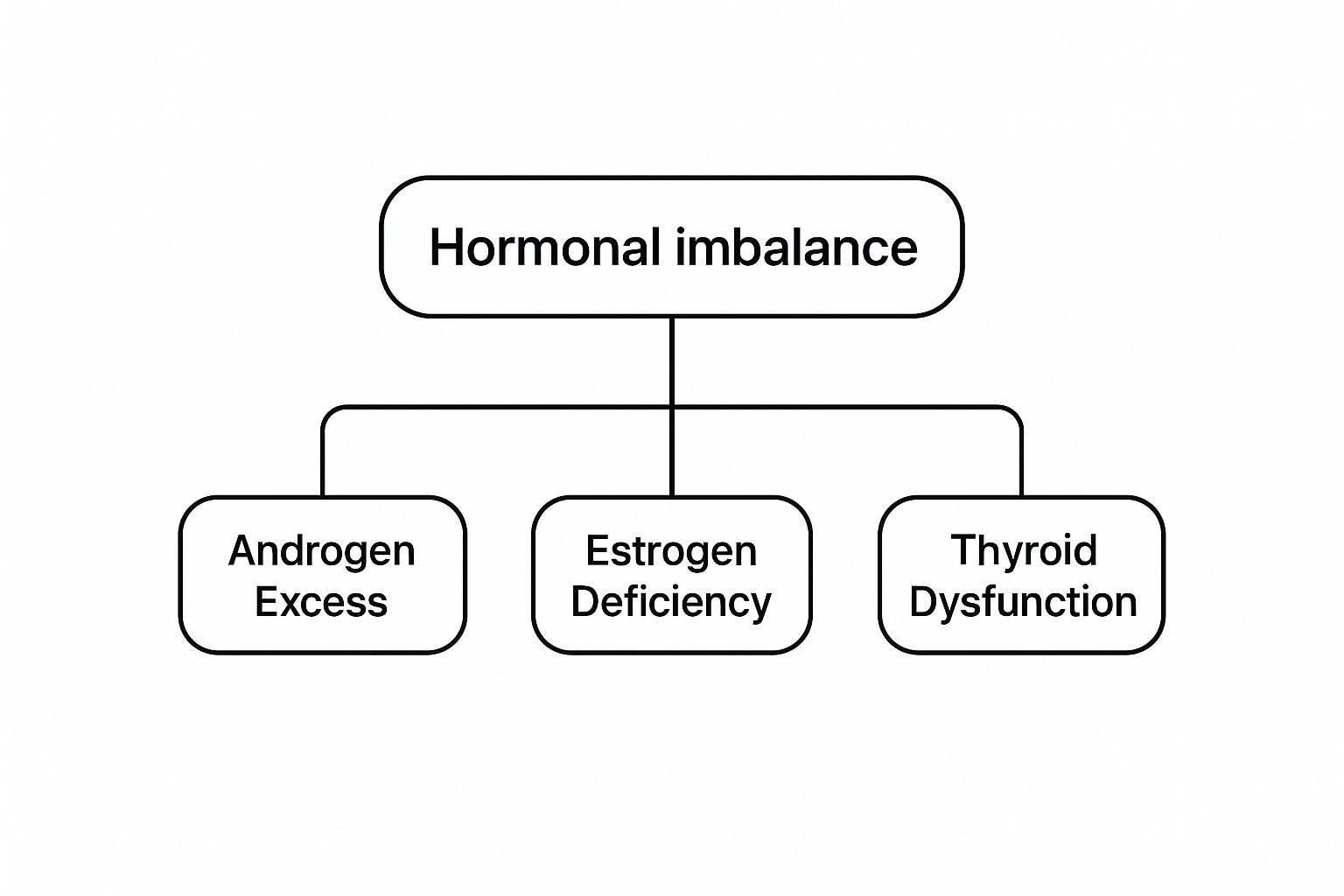
As you can see, major culprits like excess androgens, a drop in estrogen, or thyroid problems can throw a wrench directly into your hair's natural growth pattern.
This disruption does more than just cause a bit of extra shedding; it fundamentally changes the math of your hair growth. On a healthy scalp, the ratio of growing hairs (anagen phase) to resting hairs (telogen phase) is typically high, somewhere around 12:1 to 14:1. A hormonal imbalance can cause this ratio to plummet. For example, in androgenetic alopecia (pattern hair loss), it can drop to as low as 5:1, meaning far more of your hair is resting than it should be. You can find more information about how hormonal imbalances impact hair growth cycles on our blog.
Key Hormonal Players in Hair Loss
While dozens of hormones keep your body running, a few have a particularly powerful influence on your hair. Knowing who these key players are can help you understand exactly why you might be seeing more hair in your brush.
Here’s a quick summary of the main hormones involved and what they do.
Key Hormones and Their Impact on Hair
| Hormone | Role in Hair Growth | Effect of Imbalance |
|---|---|---|
| Androgens (DHT) | Regulate secondary sex characteristics. | High levels shrink hair follicles, shortening the growth phase (common in pattern baldness). |
| Estrogen | Promotes hair growth by extending the anagen (growth) phase. | Low levels shorten the growth phase, leading to thinner hair and increased shedding. |
| Thyroid Hormones | Regulate the body's metabolism and energy use. | Both too much (hyper-) or too little (hypo-) can disrupt the hair cycle, causing diffuse shedding. |
| Cortisol | The body's primary stress hormone. | Chronically high levels can force many follicles into the resting (telogen) phase, causing sudden shedding. |
Understanding these roles makes it clear that hormonal hair loss isn't just about one "bad" hormone. It’s about the intricate system falling out of sync.
Let's take a closer look at each one.
- Androgens (like DHT): Often called “male hormones,” androgens are present in everyone. They are the main culprits behind genetic pattern baldness. One potent androgen, Dihydrotestosterone (DHT), is particularly problematic. It can attach to receptors in your hair follicles, causing them to miniaturize and eventually stop producing hair.
- Estrogen: This “female hormone” is great for your hair. It helps keep hair in the growth phase longer, promoting thickness and length. When estrogen levels decline—like during menopause or postpartum—this protective benefit is lost, and the negative effects of androgens can become much more obvious.
- Thyroid Hormones: Your thyroid gland is the master of your metabolism, and its hormones are crucial for the energy supply to your hair follicles. If your thyroid is underactive (hypothyroidism) or overactive (hyperthyroidism), it can disrupt the entire hair cycle and lead to diffuse thinning all over your scalp.
- Cortisol: Known as the "stress hormone," cortisol can do a number on your hair. Chronic stress keeps cortisol levels high, which can shock a large number of hair follicles into the resting phase all at once. This triggers a sudden, dramatic shedding event known as telogen effluvium.
Identifying the Key Hormonal Causes of Hair Thinning
Before you can tackle any problem, you have to know what you’re up against. When it comes to hair loss hormonal imbalance, a few key chemical messengers are almost always the ones causing the trouble. Getting a handle on what they do is the first real step toward understanding your own hair loss and finding a solution that works.
I like to think of these hormones as musicians in your body’s orchestra. When one starts playing way too loud, too soft, or just plain out of tune, the whole performance—in this case, your hair growth—gets thrown into chaos. Let’s meet the main culprits behind this follicular drama.
DHT: The Architect of Androgenetic Alopecia
Dihydrotestosterone, or DHT, is the prime suspect behind what we call male pattern baldness (androgenetic alopecia). It’s a powerful hormone derived from testosterone. While it has an important job in male development, it can become a real problem for hair follicles if you’re genetically predisposed.
Here’s the process in a nutshell:
- The Conversion: An enzyme named 5-alpha reductase takes a portion of your testosterone and converts it into DHT.
- The Attack: DHT then latches onto special receptors in your hair follicles, zeroing in on those at the hairline and crown.
- The Miniaturization: This connection signals the follicles to shrink. With every new hair cycle, the follicle gets smaller, and the hair it produces becomes shorter, finer, and weaker.
Eventually, the follicle becomes so small it can’t produce a visible hair anymore. This leads to that classic receding hairline and thinning spot on the crown. It’s a slow, methodical takeover orchestrated by DHT.
DHT doesn't just make hair fall out; it methodically dismantles the hair-producing factory itself, replacing strong, healthy hair with progressively weaker strands until production stops completely.
Estrogen: The Protective Hormone
Most people think of estrogen as a "female hormone," but men have it too, and it actually plays a protective role for our hair. Estrogen helps keep hair in its anagen (growth) phase for longer, which contributes to a fuller, thicker head of hair.
When a hair loss hormonal imbalance throws things off—like when estrogen levels drop relative to androgens—that protective shield is weakened. The hair's growth phase gets cut short, and the damaging effects of DHT can hit even harder. This is why a healthy hormonal balance is so important for everyone, regardless of gender.
Thinking about how diet affects hormones like testosterone can also offer clues. For example, knowing which foods that naturally boost testosterone levels can give you some insight into managing your body's internal chemistry through what you eat.
Thyroid Hormones: The Metabolic Regulators
Your thyroid, that little butterfly-shaped gland in your neck, is basically the master controller of your body's metabolism. It churns out hormones that manage how every cell uses energy, and that absolutely includes the cells inside your hair follicles. A healthy hair cycle is completely dependent on this steady energy supply.
If the thyroid starts acting up, it can trigger diffuse hair thinning all over your scalp. There are two main ways this happens:
- Hypothyroidism (Underactive Thyroid): Your body doesn't produce enough thyroid hormone, so everything slows down. Hair growth can stall out, and the hair that remains can become dry, brittle, and shed like crazy.
- Hyperthyroidism (Overactive Thyroid): Your body produces too much thyroid hormone, sending all your systems into overdrive. This can also disrupt the hair cycle, speeding up shedding and leaving hair noticeably thinner.
Cortisol: The Stress Instigator
Chronic stress isn't just in your head; it has very real, physical effects on your body. When you're constantly under pressure, your system floods itself with the stress hormone cortisol.
In short, controlled bursts, cortisol is useful. But when it's always high, it can literally shock a huge number of your hair follicles—we’re talking as many as 30% or more—out of the growing phase and straight into the resting (telogen) phase. A few months down the line, you experience a sudden and dramatic shedding event known as telogen effluvium. While this is often temporary, relentless stress keeps cortisol levels high, preventing your hair from ever getting back to its normal growth pattern.
How to Recognize the Signs of Hormonal Hair Loss

Trying to connect your hair loss to a specific cause can feel a bit like detective work. You know you’re shedding more, but is it just a phase, maybe stress-related, or is there a deeper hair loss hormonal imbalance going on? Learning to spot the specific patterns and other symptoms is the key to cracking the case and having a much more informed conversation with your doctor.
The way hair thins because of hormones often follows a predictable script, but that script looks very different for men and women. For men, the signs tend to be more localized and distinct, usually starting at the temples or the top of the head. For women, the thinning is often more spread out and subtle, something you might only notice over a longer period.
Distinct Patterns in Men
When men experience hormonal hair loss—what we call androgenetic alopecia—the signs are classic and progressive. This isn't just about finding a few extra hairs on your pillow. It's about seeing a real, noticeable change in your hairline’s geography.
You'll probably see:
- A Receding Hairline: This is the classic starting point. The hair at the temples starts to thin and pull back, slowly creating that well-known "M" shape.
- Thinning at the Crown: A bald spot might begin to appear on the vertex (the very top of your head) and slowly grow larger.
- Overall Thinning: Eventually, these two thinning areas can meet, leading to significant baldness across the top of the head, while the hair on the sides and back stays relatively thick.
This specific pattern is a direct result of how DHT attacks the follicles in these genetically sensitive spots.
Widespread Thinning in Women
For women, hormonal hair loss rarely causes the same M-shaped recession or distinct bald spots. Instead, the thinning is typically more diffuse, meaning it’s spread evenly across the whole scalp. This can actually make it harder to spot in the early stages.
The most common signs include:
- A Widening Part: This is the hallmark sign for women. You might look in the mirror one day and realize your part line looks wider than it used to, with more of your scalp showing through.
- A Skimpier Ponytail: A ponytail that once felt thick and full might now feel noticeably thinner and less substantial when you gather it.
- General Thinning on Top: While the hair thins all over, it’s often most obvious on the top of the head—similar to men, but without a clear bald patch forming.
Hormonal hair loss is incredibly common, but how it shows up varies. Globally, about 85% of men and 33% of women will experience some form of hair loss. Androgenetic alopecia, the main hormonal type, accounts for 95% of cases in men, while female pattern hair loss affects about 25% of women by age 50. You can read more about the global impact of hair loss statistics on the NCOA website.
Beyond the Hairline: Look for These Other Clues
A hair loss hormonal imbalance rarely happens in a vacuum. Because hormones are in charge of so many bodily functions, you’ll often notice other changes happening at the same time. These are powerful clues that your hair loss might be part of a bigger systemic issue.
Keep an eye out for these accompanying signs:
- Stubborn Acne: Especially deep, cystic acne along the jawline, which can be a sign of excess androgens.
- Unexplained Weight Changes: Gaining or losing weight without any changes to your diet or exercise routine could point to a thyroid or cortisol problem.
- Chronic Fatigue: That feeling of being constantly drained, even when you’re getting enough sleep, is a classic symptom of thyroid issues or adrenal fatigue.
- Mood Shifts: If you’re experiencing more irritability, anxiety, or feelings of depression, it can be linked to shifts in estrogen, cortisol, or thyroid hormones.
Noticing these other symptoms alongside your hair loss gives you a much fuller picture. It empowers you to walk into your doctor’s office with the confidence and information needed to find the right answers.
Getting to the Root of It: The Medical Diagnosis Process for Hair Loss
Walking into a doctor's office about hair loss can feel daunting, but it's absolutely the most important step you can take. A solid diagnosis is the bedrock of any successful treatment. Without it, you're just guessing, and that can lead to a lot of frustration and wasted effort.
Think of your doctor as a detective trying to solve a mystery. They need to figure out why your hair is thinning to recommend a solution that actually works. The goal is to pinpoint the cause, especially to see if a hair loss hormonal imbalance is the culprit. This process is about looking at the big picture of your health, not just what's happening on your scalp.
Your First Visit: The Consultation and Physical Exam
It all starts with a conversation. Be prepared to talk about your full medical history, whether hair loss runs in your family, your daily diet, recent stress levels, and any medications you're on. Every detail helps your doctor connect the dots.
After the chat, your doctor will perform a physical exam, taking a close look at your hair and scalp. They're not just scanning for bald patches; they're looking for specific patterns of loss, checking the health of your scalp skin, and examining the hair strands themselves. They might even pull out a dermatoscope—a handheld magnifying scope—to get an up-close view of your hair follicles.
One of the simplest yet most revealing in-office tests is the hair pull test. It's straightforward but gives a real-time snapshot of your shedding.
- Your doctor will take a small bundle of hair, usually around 40-60 strands.
- They'll give it a gentle but firm tug, from the scalp to the ends.
- The number of hairs that come out is what matters.
If more than a handful of hairs come loose, it's a strong sign of active shedding, like what happens with telogen effluvium—a condition often kicked off by major stress or hormonal fluctuations.
Blood Tests: Finding the Evidence Within
If the initial exam hints that something internal is going on, blood tests are the next step. This is where we really start digging for evidence of a hair loss hormonal imbalance. These tests provide hard data, turning hunches into confirmed facts.
An accurate diagnosis isn't just a formality; it's the most powerful tool you have. It distinguishes between genetic predispositions, nutritional deficiencies, and treatable hormonal issues, ensuring you invest time and resources into a solution that actually addresses the root cause of your hair loss.
Your doctor will order a series of tests to check for common hair loss triggers. You can generally expect them to look at:
- Thyroid Panel (TSH, T3, T4): An overactive or underactive thyroid is a classic cause of widespread hair thinning.
- Hormone Levels: This test checks key players like testosterone and DHT—the androgens that can directly attack hair follicles.
- Complete Blood Count (CBC): This can spot conditions like anemia, where low iron means your follicles aren't getting the oxygen they need to thrive.
- Ferritin (Iron Stores): You don't have to be anemic to have a problem. Low stored iron (ferritin) is a well-known contributor to shedding.
- Vitamin D: This vitamin helps kickstart new hair growth, so a deficiency can stall the entire process.
By combining your personal story, the physical exam findings, and the concrete data from these labs, your doctor can finally put a name to the problem. This clarity eliminates the guesswork and sets you on a clear path toward a treatment that is designed for you.
Modern Treatments for Hormonal Hair Loss

Finally getting a diagnosis for your hair loss is a huge relief. It’s the moment you stop guessing and start doing something about it. Once you know that a hair loss hormonal imbalance is the culprit, you can start exploring effective, modern treatments with real confidence. The road ahead isn't about finding a single magic bullet; it's about combining medical, procedural, and lifestyle strategies that work together to restore your hair.
And there are more options now than ever before. This field has exploded, with the global hair loss treatment market valued at around $52.37 billion in 2022 and on track to hit over $88 billion by 2030. This isn't just hype—it's driven by the success of proven treatments. For instance, finasteride is used by about 66.4% of men with androgenetic alopecia, showing a clear demand for solutions that actually work. You can dig deeper into these hair loss market trends and statistics on medihair.com.
Proven Medical Interventions
For most men facing hormonal hair loss, medication is the first line of defense. These aren't just temporary cosmetic fixes; they are scientifically proven to get to the root of the problem, targeting the hormonal pathways that are shrinking your hair follicles.
Two medications have really become the gold standard:
-
Minoxidil (Rogaine): This is a topical foam or solution you apply right to your scalp. Think of it as a personal trainer for your hair follicles. It’s a vasodilator, which means it boosts blood flow, delivering a rush of oxygen and nutrients. This can jolt dormant follicles back into their growth phase and help your existing hairs grow back thicker and healthier.
-
Finasteride (Propecia): This is a daily pill that works from the inside out. It directly blocks the enzyme 5-alpha reductase, which is the troublemaker that converts testosterone into the follicle-killing hormone DHT. By slashing the DHT levels in your scalp, Finasteride can stop the miniaturization process in its tracks, preventing more loss and often leading to some impressive regrowth.
Just remember, these treatments are a marathon, not a sprint. You have to be consistent. It typically takes 3-6 months to see real changes, and you’ll need to stick with it to keep your results.
Advanced Procedural Treatments
Beyond daily meds, there are powerful in-office procedures that can give you an extra edge. These treatments use your body's own healing mechanisms or advanced technology to bring struggling hair follicles back to life.
Procedural treatments like PRP and LLLT represent a major shift in thinking. We're moving beyond just slowing hair loss to actively sparking new growth. They create a healthier scalp, giving your hair the best possible chance to thrive.
Let's break down two of the most popular options:
-
Platelet-Rich Plasma (PRP) Therapy: This is a fascinating treatment that uses your own biology to heal itself. We draw a small amount of your blood, spin it in a centrifuge to concentrate the platelets, and then inject this "liquid gold" back into the thinning areas of your scalp. This plasma is packed with powerful growth factors that act like a wake-up call for sleepy follicles, encouraging them to get back to the business of growing hair.
-
Low-Level Laser Therapy (LLLT): This is a completely non-invasive approach that uses medical-grade lasers to gently energize your scalp. The light is absorbed by your cells, which can kickstart metabolic activity within the follicles. The aim is to extend the hair's growth phase and encourage the production of thicker, stronger hair shafts. You can get LLLT treatments in a clinic or even use FDA-cleared devices at home.
Foundational Lifestyle Adjustments
While powerful treatments are key, they work best when you build them on a solid foundation of healthy habits. Your daily choices directly influence your hormones and the overall health of your hair follicles.
Here are the lifestyle changes that can make the biggest difference:
-
Master Your Stress: When you're constantly stressed, your body pumps out cortisol, a hormone that can shove your hair straight into the shedding phase. Finding ways to unwind—whether it's through exercise, meditation, or just making time for a hobby—can lower those cortisol levels and create a much friendlier environment for hair growth.
-
Targeted Nutritional Support: Your hair is literally made of protein and needs a steady stream of vitamins and minerals to grow. Make sure your diet is loaded with lean protein, iron (think spinach and lean red meat), and zinc (found in nuts and seeds). A balanced diet gives your follicles the raw materials they need to do their job.
-
Gentle Hair Care: Be kind to the hair you have. That means avoiding tight ponytails or hats that pull at the roots, backing off from high-heat styling tools, and being gentle when you wash and towel-dry. While this won't reverse hormonal hair loss, it will prevent unnecessary breakage that makes thinning look even more pronounced.
Your Hormonal Hair Loss Questions, Answered
Alright, we've covered a lot of ground on what causes hormonal hair loss and how to treat it. But I know you probably still have some specific questions rolling around in your head. Let's tackle some of the most common ones I hear from my patients to clear things up and help you figure out your next move.
Can Hormonal Hair Loss Be Reversed?
Yes, it often can be. The real question is to what degree, and that hinges entirely on the root cause and how early you start treatment.
For situations where your hormones are temporarily out of whack—think postpartum shedding or a majorly stressful period that triggers telogen effluvium—your hair's growth cycle usually sorts itself out. You just have to give your body a few months to get back to its baseline.
Now, for progressive, genetic conditions like androgenetic alopecia (male or female pattern baldness), the game changes a bit. The goal shifts from a complete reversal to stabilization and meaningful regrowth. Is it realistic to expect the full, thick head of hair you had at 17? Probably not. But what is realistic with today's treatments is:
- Stopping further thinning in its tracks by addressing the hormonal triggers.
- Waking up dormant follicles that have gone quiet but aren't dead yet.
- Encouraging thicker, healthier strands to grow from your existing follicles.
With a consistent, medically supervised plan, stopping the retreat and seeing noticeable improvement is a very achievable outcome.
What Lifestyle Changes Actually Help With Hair Health?
While medical treatments are the heavy hitters, your daily habits are the bedrock they're built on. Think of it this way: treatments are the construction crew, but your lifestyle choices supply the quality building materials. Without good materials, the crew can't do its best work.
I always tell my patients to zero in on three key areas:
-
Get a Handle on Stress: Chronic stress is a nightmare for your hair. It keeps your body swimming in cortisol, a hormone notorious for pushing hair follicles into the shedding phase. You need to find a way to bring those levels down. That could mean meditation, hitting the gym, practicing yoga, or even just carving out non-negotiable time for a hobby you love.
-
Fuel Your Follicles: Your hair is literally made from the food you eat. A diet rich in protein (the building block), iron (think lean red meat and spinach), and zinc (nuts and seeds are great) is non-negotiable. Crash diets and poor nutrition essentially starve your follicles, and you can't expect them to perform well under those conditions.
-
Be Kind to Your Hair: This one is about minimizing physical damage. Ease up on tight hairstyles like ponytails or braids that constantly pull at the roots. Go easy on harsh chemical treatments and try to reduce how often you blast your hair with high-heat styling tools. This won’t stop hormonal loss on its own, but it will prevent extra breakage that makes thinning look much worse.
The single most important ingredient here is patience. Hair growth is a slow process. Being consistent with your treatment plan is far more critical than which specific treatment you choose.
How Long Does It Really Take to See Results?
This is the big one, and the answer is always "longer than you want." Progress is tied to the natural, slow-and-steady cycle of hair growth. It’s a marathon, not a sprint.
Here’s a realistic timeline you can set your watch to:
- Medical Treatments (Minoxidil or Finasteride): With daily use, you’ll likely start seeing the first hints of progress—less shedding, maybe some soft "peach fuzz"—within 3 to 6 months. For more substantial, visible changes in thickness and density, you really need to give it 12 to 18 months of consistent application.
- Procedural Treatments (PRP Therapy): For in-office treatments like Platelet-Rich Plasma, you’ll typically start with a series of sessions (often three, spaced a month apart). The first thing you might notice is reduced shedding. More obvious improvements in hair density and thickness tend to show up around the 4 to 6-month mark after your first session.
The takeaway? You have to stick with it. Stopping and starting will only set you back to square one.
At PRP For HairLoss, our entire focus is on providing men with the most accurate, up-to-date information on real-world hair loss solutions. If you're exploring advanced treatments that use your body's own natural healing abilities to encourage regrowth, we invite you to learn more about how PRP therapy can help you.


Leave a Reply