Traction alopecia in men is a specific type of hair loss that's all about physics, not genetics or hormones. It’s caused by prolonged physical tension on the hair follicles. In plain English, tight hairstyles like braids, man buns, or even heavy dreadlocks can literally pull the hair out from the root over time, leading to noticeable thinning and even bald patches.
Unpacking Traction Alopecia in Men
Unlike male pattern baldness, which is largely hereditary, traction alopecia is both preventable and, in many cases, reversible. Picture your hair follicles as tiny anchors holding your hair in the scalp. A little pull now and then is no big deal. But constant, forceful tension day after day weakens those anchors until they can no longer hold on.
That’s exactly what happens with traction alopecia in men. The relentless pulling from certain hairstyles causes chronic inflammation and damages the follicles. We're not talking about wearing a tight hat for an afternoon; this is the result of months, or even years, of sustained stress on your scalp. The best part? Since it's caused by an external force, you're in the driver's seat. Taking the tension off your hair is the most important first step to stopping the hair loss and giving it a chance to grow back.
How Damage Occurs at the Follicle Level
The damage starts when a hairstyle pulls the hair so tightly that it puts a constant strain on the base of the follicle. This can kick off an inflammatory response, which you might notice as small bumps, redness, or even tenderness along your hairline.
If you ignore these warning signs and keep up the tension, the follicle can get so damaged that it just gives up and goes dormant. In the worst-case scenario, it’s replaced entirely by scar tissue.
At this advanced stage, the hair loss becomes irreversible because the follicle itself is gone. This is known as scarring alopecia, a condition where the potential for natural regrowth is lost. You can learn more about how scar tissue can permanently affect hair follicles by reading our guide on what is scarring alopecia.
Why This Isn't Just Male Pattern Baldness
It’s easy to see hair loss and immediately think of male pattern baldness (androgenetic alopecia), but they are two completely different beasts. Knowing the difference is critical for getting the right help.
- The Cause: Traction alopecia is mechanical—it comes from physical pulling. Male pattern baldness is a mix of genetics and hormones.
- The Location: Traction alopecia usually shows up right where the tension is highest, like along the temples and forehead from tight buns or cornrows. Male pattern baldness typically starts with a receding M-shaped hairline or a bald spot on the crown.
- The Symptoms: The early stages of traction alopecia can feel uncomfortable, with pain, itching, and folliculitis (pimple-like bumps) being common signs. You don't usually get those with genetic hair loss.
Understanding these key differences is the first step toward getting the right diagnosis and treatment. While traction alopecia is just one possibility, it's helpful to know the broader context of what can cause hair loss. You can explore the various reasons for hair loss to see where it fits in. Once you connect your hair loss to your styling habits, you can take immediate action to save your hairline.
Hairstyles and Habits That Put Your Hairline at Risk
We often see hairstyles as a temporary way to switch up our look, but some can have surprisingly permanent consequences for your hair. Traction alopecia isn't the result of one bad hair day; it’s caused by a constant, long-term pull that literally wears out your hair follicles. Getting a handle on what’s actually happening at the scalp level is the first step in keeping your hair right where it belongs.
Imagine each hair follicle is like a tiny plant anchored in soil. A gentle breeze is harmless, but a relentless tug, day in and day out, will eventually uproot it. That's a perfect analogy for what high-tension hairstyles do. They create a non-stop pulling force that inflames the follicle, weakens its grip, and eventually shuts down its ability to grow hair.
The Most Common Culprits
While any hairstyle that pulls on the scalp can be problematic, a few are notorious for causing damage. It’s important to remember that it's not the style itself that’s bad—it’s the tension.
- Tight Cornrows and Braids: When braided very tightly against the scalp, these styles put immense strain along the part lines and especially the hairline, which is the most fragile area.
- Heavy Dreadlocks: The sheer weight of long, heavy locs creates a constant downward pull. This 24/7 gravitational force can cause significant thinning over time, particularly at the front and crown.
- High-Tension Man Buns: A loose, casual bun is usually fine. The problem starts when you pull your hair back severely and tie it down for hours at a time, which puts a ton of stress on the frontal hairline and temples.
This constant tension creates a vicious cycle of inflammation, follicle damage, and ultimately, hair loss.
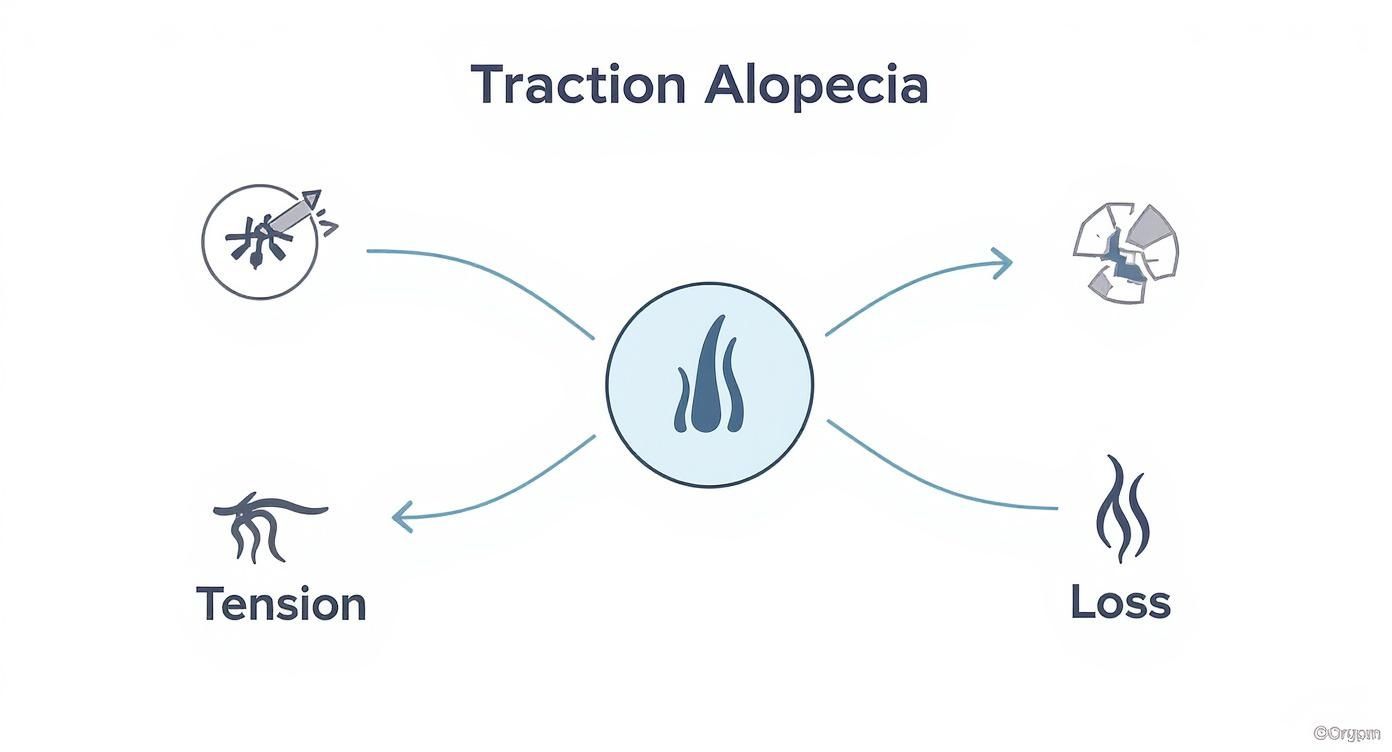
As you can see, it's a straightforward but damaging process. The pull leads to follicle trauma, and if that stress isn't relieved, the hair loss can become permanent.
Beyond the Hairstyle Itself
It’s not always just the hairstyle. Sometimes, it’s the other things we do to our hair that make it more vulnerable to this kind of damage. Certain practices can weaken the hair shaft itself, making it less able to withstand any pulling force.
Hair extensions, for example, are a major factor. The added weight and the bonding methods used can place a huge amount of stress on the roots of your natural hair. Asking the question, "Do hair extensions damage hair?" is critical, because the answer is often yes, especially if they are heavy or improperly applied.
The bottom line is this: The real danger comes from the combination of tension and time. A tight style worn for a few hours for a special occasion is one thing. But wearing that same style day and night for months on end is what leads to irreversible follicle damage.
Chemical treatments are another big piece of the puzzle. Relaxers, bleaches, and harsh dyes break down the structural integrity of the hair strand, leaving it brittle. When you take chemically weakened hair and then pull it into a tight style, you’re basically setting it up for disaster.
If you’re already noticing some thinning, it's a good idea to lean into gentler options. Our guide on the best haircuts for thinning hair has some great ideas for styles that look sharp without stressing your follicles. Learning to spot the difference between a cool look and a dangerously tight one is the key to protecting your hair for years to come.
How to Spot the Early Warning Signs
When it comes to traction alopecia, catching it early is everything. Think of your hair follicles like an elastic band—you can stretch it repeatedly, but eventually, it loses its ability to snap back. If you wait too long, that damage becomes permanent.
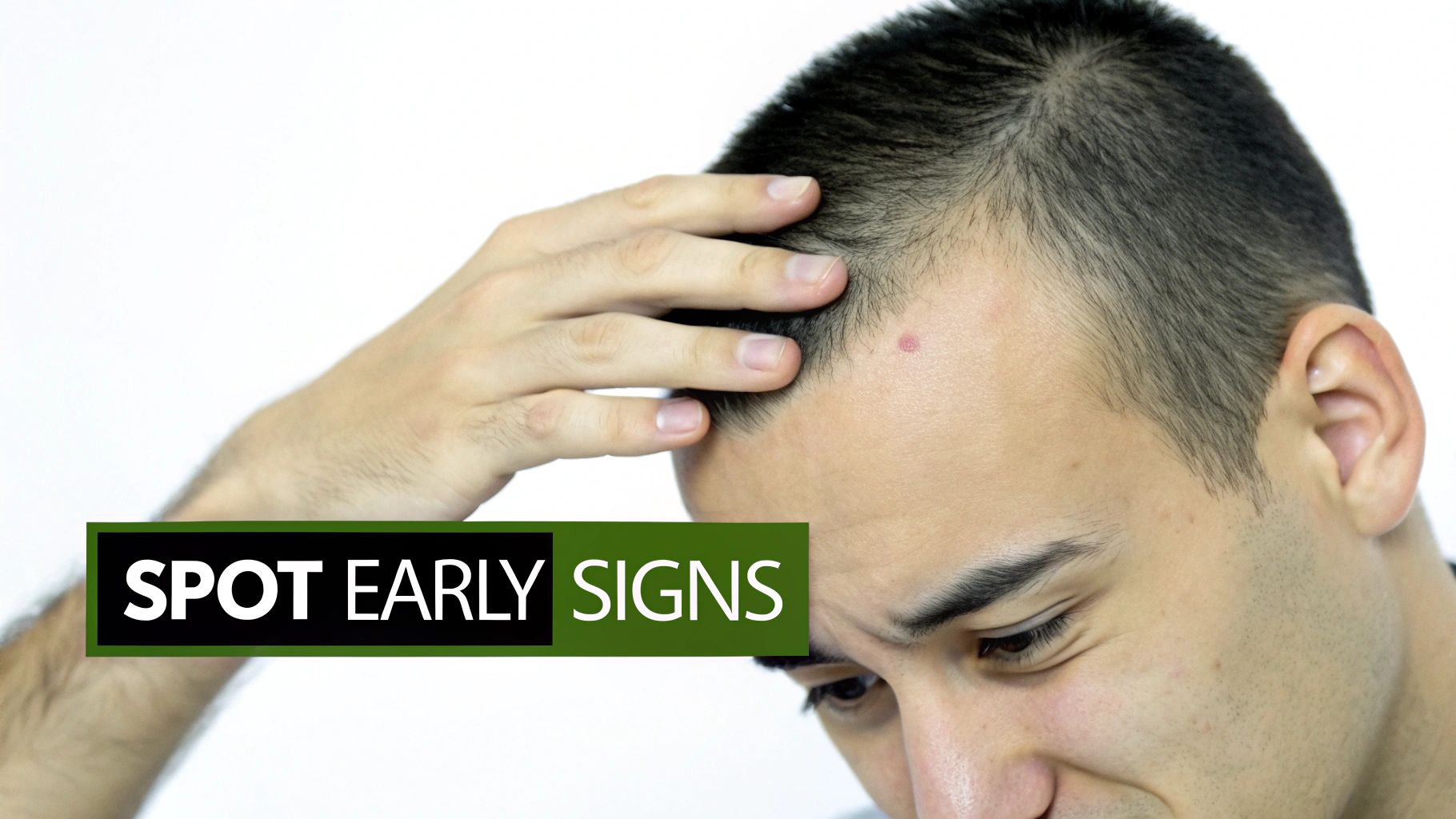
The good news is that your scalp gives you plenty of warning signs. The key is learning to listen to what it’s telling you, especially right after you’ve worn a tight hairstyle. Many guys brush off a bit of soreness or a few bumps as no big deal, but these are often the first signals that your follicles are in trouble.
A Practical Symptom Checklist
Get in the habit of checking your scalp and hairline. If you notice any of the following, it’s a clear sign you need to change up your hairstyle immediately.
- A Unique Receding Hairline: This isn't the classic "M" shape you see with genetic balding. Instead, the thinning directly follows the line of tension from your hairstyle, often hitting the forehead and temples first. It might look like a fuzzy, weakened fringe right where the pulling is most intense.
- Scalp Tenderness and Pain: Does your scalp feel sore or ache after you let your hair down? That lingering, tight sensation is a dead giveaway that your follicles have been under serious stress all day.
- Small, Pimple-Like Bumps: If you see little red bumps, almost like acne, around your hairline, that’s likely folliculitis. This is a direct sign of inflammation caused by the constant tugging on the hair follicles.
- Redness and Itching: An inflamed scalp is an unhappy one. If the areas under the most tension are consistently red, irritated, or itchy, your body is sounding the alarm.
- Short, Broken Hairs: Take a close look at your hairline. If you see a lot of short, snapped-off hairs, it means the physical strain is so great that the hair is breaking before it has a chance to grow out.
Distinguishing It from Male Pattern Baldness
One of the most common mistakes is chalking these symptoms up to male pattern baldness. It's an easy assumption to make, but it leads to the wrong conclusion—that nothing can be done. In reality, the two conditions couldn't be more different.
Key Insight: Traction alopecia is a diagnosis of location and sensation. The hair loss happens exactly where the hairstyle pulls, and you can often feel it as pain or soreness. Male pattern baldness, on the other hand, is usually painless and follows a predictable genetic pattern.
To help you tell them apart, let's compare the signs side-by-side.
Comparing Symptoms: Traction Alopecia vs. Male Pattern Baldness
This table breaks down the core differences, helping you get a clearer picture of what you might be dealing with.
| Symptom | Traction Alopecia | Male Pattern Baldness (Androgenetic Alopecia) |
|---|---|---|
| Location of Thinning | Follows the hairstyle's tension lines (e.g., temples, forehead). | Typically starts at the crown or creates an M-shaped receding hairline. |
| Associated Sensations | Often includes pain, soreness, itching, or a pulling feeling. | Generally painless with no physical discomfort. |
| Visible Scalp Signs | May show redness, scaling, or small bumps (folliculitis). | The scalp usually appears healthy, just with less hair. |
| Type of Hair Loss | Can include noticeable hair breakage and short, snapped hairs. | Involves hair miniaturization, where hairs become progressively finer. |
Recognizing this distinction is absolutely critical. Why? Because the "cures" are worlds apart. You can't treat traction alopecia with the same medications used for genetic balding. The first, and most effective, step is simply to stop the hairstyle that's causing the damage.
It’s also worth noting that hair structure can play a role. For example, the curved follicles of African hair can make it more vulnerable to the mechanical stress from styles like tight braids. While men are generally affected less than women, the incidence of traction alopecia in men who favor these styles is much higher. You can explore the research on hair characteristics and traction alopecia to learn more. By understanding these signs and your personal risk factors, you empower yourself to act before the damage becomes irreversible.
Getting a Professional Diagnosis: What to Expect
https://www.youtube.com/embed/AhByhSDw6sU
If you're worried you might have traction alopecia, the best thing you can do is see a professional. It might feel a bit daunting to book an appointment with a dermatologist or a hair loss specialist (a trichologist), but the process of getting a diagnosis is usually pretty simple. Knowing what’s coming can make the whole experience much less stressful.
Your visit will almost always start with a simple conversation. The doctor will want to know about your hairstyling routines, when you first noticed any thinning, and if you're dealing with symptoms like scalp tenderness or itching. Your personal history is a massive clue when it comes to identifying traction alopecia in men.
The Physical Examination
After getting the backstory, the doctor will take a close look at your scalp and hairline. This isn't just a quick peek—they're hunting for specific, tell-tale signs of traction alopecia.
They’ll likely use a dermatoscope, which is basically a powerful handheld magnifying glass for your skin. This tool lets them see your hair follicles in high definition, checking for redness, inflammation, tiny bumps around the follicles (folliculitis), and short, broken hairs near the scalp. It's this up-close view that really helps separate traction alopecia from other hair loss culprits.
Another common technique is the "hair pull test." It’s exactly what it sounds like: the doctor will gently tug on a small bunch of hairs in the thinning area. How many hairs come out gives them a good idea of how weak the follicles are and how active the shedding is.
A definitive diagnosis is the first concrete step toward recovery. It moves you from a place of worry and uncertainty into a position of action, equipped with a clear understanding of the problem and a tailored plan to fix it.
When a Deeper Look Is Needed
More often than not, your hairstyle history combined with the physical exam gives the doctor all they need to confirm traction alopecia. But sometimes, the picture isn't 100% clear. If they suspect another condition could be at play—like alopecia areata or a scarring alopecia—they might suggest a scalp biopsy.
Don't let the word "biopsy" scare you. It's a quick, minor procedure done right in the office using a bit of local anesthetic. The doctor takes a tiny sample of scalp tissue, usually just a few millimeters wide, and sends it off to a lab for analysis under a microscope.
The biopsy provides the final word on what’s happening at the follicular level. It can reveal inflammation, follicle damage, or, in more advanced stages, the scar tissue that indicates the hair loss is permanent. While it sounds intense, a biopsy offers crucial information for building the most effective treatment plan. To get a better idea of what's involved, check out our guide on the scalp biopsy for hair loss. Taking this step ensures you're tackling the right issue from the very beginning, which is key to getting your hair back.
Your Action Plan for Treatment and Regrowth

Once you get a diagnosis, it's time to shift from defense to offense. The best thing about traction alopecia? You have the power to stop it in its tracks. A solid recovery plan is built on one simple, foundational rule: get rid of the tension. Everything else you do is secondary to just giving your hair follicles a break.
This means the very first move you make is also the most important one. You have to change your hairstyle. That's not a suggestion—it's the non-negotiable starting point for any real success. If you eliminate the source of the pulling, you finally give your scalp a chance to heal and your hair an opportunity to grow back.
The First Step: Loosen Up and Let Go
Before even thinking about medical options, focus on these immediate changes. They're free, incredibly effective, and completely within your control. Making these adjustments is often all it takes to reverse early-stage damage, no other intervention needed.
- Switch to Looser Styles: Immediately stop wearing the tight braids, cornrows, or man buns that are causing the problem. Choose styles that put zero tension on your hairline.
- Give Your Hair a Break: If you can't imagine parting with a specific look, at least give your hair frequent "off days." Critically, avoid sleeping in tight styles, which prolongs the stress on your follicles all night long.
- Ease Up on Chemicals: Harsh chemical relaxers and dyes weaken the hair shaft, making it far more likely to break under tension. Putting those treatments on pause gives your hair a much better fighting chance.
While traction alopecia in men is less common than in women, certain cultural or long-term styling practices definitely raise the risk. One study highlighted that while the condition's prevalence in men in South Africa was just 2.3% (compared to a staggering 31.7% in women), it popped up more often in specific groups. Cases have been documented among young Sikh men who wear tight knots under their turbans and men who maintain cornrows or dreadlocks for years. You can read more about these gender and cultural disparities in hair loss on ncbi.nlm.nih.gov. The data is clear: while it happens less often in men, the cause is almost always tied to specific, sustained hairstyling habits.
Medical and Professional Treatments
If you've caught the issue early but want to give the regrowth process a boost, several medical treatments can help awaken follicles that are dormant but not dead. These options are most effective when the follicle hasn't been permanently scarred over.
Topical Minoxidil
This is a very common over-the-counter treatment that stimulates blood flow to your follicles and helps extend their growth phase. Think of it as a gentle wake-up call for follicles that have been stressed into taking a nap. You apply it directly to the scalp, and it can help speed up recovery once the tension is gone.
Corticosteroid Injections
If your scalp is showing clear signs of inflammation—like redness, bumps, or it just feels tender all the time—a dermatologist might suggest corticosteroid injections. These shots are administered right into the affected areas to calm the inflammation at its source. Bringing down that inflammation is a key step in creating a healthy environment for hair to grow again.
Important Takeaway: Medical treatments are supporters, not saviors. They can't work if the root cause—the physical tension—is still there. You have to change your hairstyle first for any of these to have a real impact.
Platelet-Rich Plasma (PRP) Therapy
PRP is a more advanced approach that taps into your body's own healing powers. A small amount of your blood is drawn and spun in a centrifuge to concentrate the platelets, which are packed with natural growth factors. This "liquid gold" is then injected back into your scalp. The growth factors can help kickstart tissue repair and encourage weakened follicles to start producing hair again. It's a really promising option for anyone looking to supercharge the natural healing process.
When Follicles Are Permanently Damaged
In advanced cases, years of non-stop pulling can completely destroy the hair follicles, replacing them with scar tissue. Once that happens, the hair loss is permanent, and the options above simply won't work. The only way to restore hair to these scarred areas is through surgery.
Hair Transplantation
For men dealing with irreversible traction alopecia, a hair transplant is a very effective solution. The procedure involves harvesting healthy, tension-resistant hair follicles from a donor area (usually the back of your head) and then surgically implanting them into the bald patches. This can completely rebuild a natural-looking hairline. Just remember, you'll have to commit to loose hairstyles for life to protect your new investment. A good grasp of follicle health is vital here; you can learn more about how to repair damaged hair follicles in our detailed guide.
Common Questions About Traction Alopecia in Men
Dealing with hair loss brings up a ton of questions. To wrap things up, let’s go through some of the most common things men ask about traction alopecia. My goal is to give you clear, straightforward answers so you can figure out your next steps.
Can Hair Actually Grow Back After Traction Alopecia?
Yes, it absolutely can—but there's a catch. The key is to act quickly. If you spot traction alopecia early and, most importantly, stop the hairstyle that's causing all that tension, your hair follicles have a great chance of making a full recovery. Think of it like a sprained ankle; once you stop putting pressure on it, it can heal.
The problem comes when that pulling continues for months or even years. Over time, the constant stress can lead to permanent scarring of the follicle. Once that scar tissue forms, it's like concrete has been poured over the follicle—it can no longer produce hair. This is why timing is everything. Our guide exploring if hair can grow back after damage gives you a deeper look into this process.
How Long Does It Realistically Take to See Regrowth?
You're going to have to be patient with this one. Once you've stopped the damaging hairstyle, don't expect a miraculous recovery overnight. Hair growth happens in cycles, and it often takes a solid 3 to 6 months before you start seeing any noticeable new hairs sprouting from the healed follicles.
It's like planting a garden—the seeds need time to germinate and push through the soil. If you're using treatments like minoxidil to support the process, you might see some fine, new hairs pop up within that window. The big takeaway here is consistency. Be gentle with your hair and scalp, and understand that healing is a gradual journey.
Are Some Hair Types More at Risk for This?
While any hair type can suffer from enough pulling, the real villain here is the mechanical stress, not your hair's texture. That being said, some studies suggest that the natural structure of tightly coiled hair might make it a bit more susceptible to damage from tension.
But let's be clear: a guy with fine, straight hair who wears an extremely tight man bun every day is just as much at risk as a man with coily hair in tight braids.
The most critical factor is the styling practice, not just the hair type. Focus on how you wear your hair, not just what kind of hair you have.
When Is It Time to See a Doctor About Hair Loss?
The moment you think something is wrong. Don't wait around hoping it will just go away.
If you notice any of the signs below, it’s time to book an appointment with a dermatologist or a hair loss specialist for a professional opinion:
- A receding hairline that seems to perfectly match where your hairstyle pulls the tightest.
- Scalp pain, tenderness, or itching that doesn't go away, even after you let your hair down.
- Small bumps that look like pimples or persistent redness along your hairline.
Getting an early, accurate diagnosis is the best thing you can do to prevent permanent hair loss. A doctor can confirm if it's traction alopecia in men, make sure it isn't another condition, and help you map out a solid plan for recovery.
At PRP For HairLoss, we believe that understanding the root cause of your hair loss is the first step toward finding the right solution. For more in-depth information on treatments and recovery, visit us at https://prpforhairloss.com.

 PRP For Hairloss
Leave a comment