If you're dealing with hair loss, you've probably asked yourself, "Are my hair follicles dead?" The answer is often written right on your scalp. Take a close look in the mirror: if an area is completely smooth and shiny, almost like a billiard ball, without any visible pores, those follicles are likely gone for good. But if you can still make out tiny, vellus-like "peach fuzz" or see the openings where hairs used to be, there's a good chance those follicles are just sleeping.
Dormant vs. Dead Follicles: What You Need to Know First

When you first notice your hair thinning or your part widening, it's natural to jump to the worst conclusion. But here’s a bit of reassuring news: not all hair loss means the follicle is permanently out of commission. The single most important thing to get your head around is the difference between a dormant follicle and a truly dead one.
Think of a dormant hair follicle like a hibernating bear. It’s not dead—it's just in a deep sleep, conserving energy. It's still very much alive and has every potential to wake up and get back to work when the conditions are right.
A dead follicle, on the other hand, is more like a fossil. The structure that once supported life is gone, often replaced by scar tissue. No amount of prodding, wishing, or nourishing will bring it back.
For a quick reference, here’s how the two states compare.
Dormant vs. Dead Follicles at a Glance
| Characteristic | Dormant Follicle (Recoverable) | Dead Follicle (Irreversible) |
|---|---|---|
| Scalp Appearance | Might have tiny, "peach fuzz" hairs or visible pores. | Smooth, shiny, and may not have any visible pores. |
| Potential for Regrowth | High. Can often be reactivated with the right treatments. | None. The follicle is permanently non-functional. |
| Underlying Cause | Usually due to hormonal shifts, stress, or early-stage pattern baldness. | Caused by severe inflammation, physical trauma, or late-stage pattern baldness. |
| Cellular State | The follicle's structure and stem cells are still intact. | The follicle has been destroyed and replaced by scar tissue. |
Knowing which camp your follicles fall into is the foundation for any successful treatment plan. It's the difference between trying to wake the bear and trying to revive a fossil.
The Lifecycle of a Hair Follicle
Every single hair on your head operates on a schedule, cycling through phases of growth, rest, and shedding. This is a totally normal, ongoing process. You can dive deeper into the specifics of the hair growth cycle to really understand what's happening on your scalp day-to-day.
The trouble begins when something throws that cycle off balance. Genetics (hello, male and female pattern baldness), major hormonal shifts, or inflammation can cause follicles to shrink over time in a process called miniaturization. This shrinking forces them into a longer and longer resting—or dormant—state, which is often a precursor to them dying off completely.
The key takeaway: Dormancy is a warning sign, not a death sentence. It’s a reversible state that's telling you something is wrong. True follicle death is usually the final stop on the line, typically caused by that prolonged miniaturization or direct physical damage.
What Actually Kills a Hair Follicle?
So, what’s the tipping point that pushes a follicle from a temporary slumber into a permanent, irreversible state? It almost always comes down to damage that the body simply can't repair.
The main culprits are:
- Scarring Alopecias: These are inflammatory autoimmune conditions where the body’s own defense system mistakenly attacks the hair follicles. This assault destroys them, leaving behind scar tissue where a follicle used to be.
- Physical Trauma: Think severe burns, deep wounds, or other major injuries to the scalp. If the damage goes deep enough to destroy the follicular structure, it's not coming back.
- Advanced Pattern Baldness: In the very late stages of androgenetic alopecia, the miniaturization process can drag on for so long that the follicles shrink into oblivion and are eventually replaced by fibrous tissue.
Understanding whether you're dealing with dormant or dead follicles is everything when it comes to treatment. Stimulating treatments are designed to "wake up" existing, viable follicles. For example, the principles behind how treatments like Latisse and eyebrow hair growth work are based on targeting follicles that are still functional. This fundamental knowledge helps you set realistic expectations and choose a path forward that actually makes sense for your scalp.
The Journey From a Healthy Follicle to a Damaged One
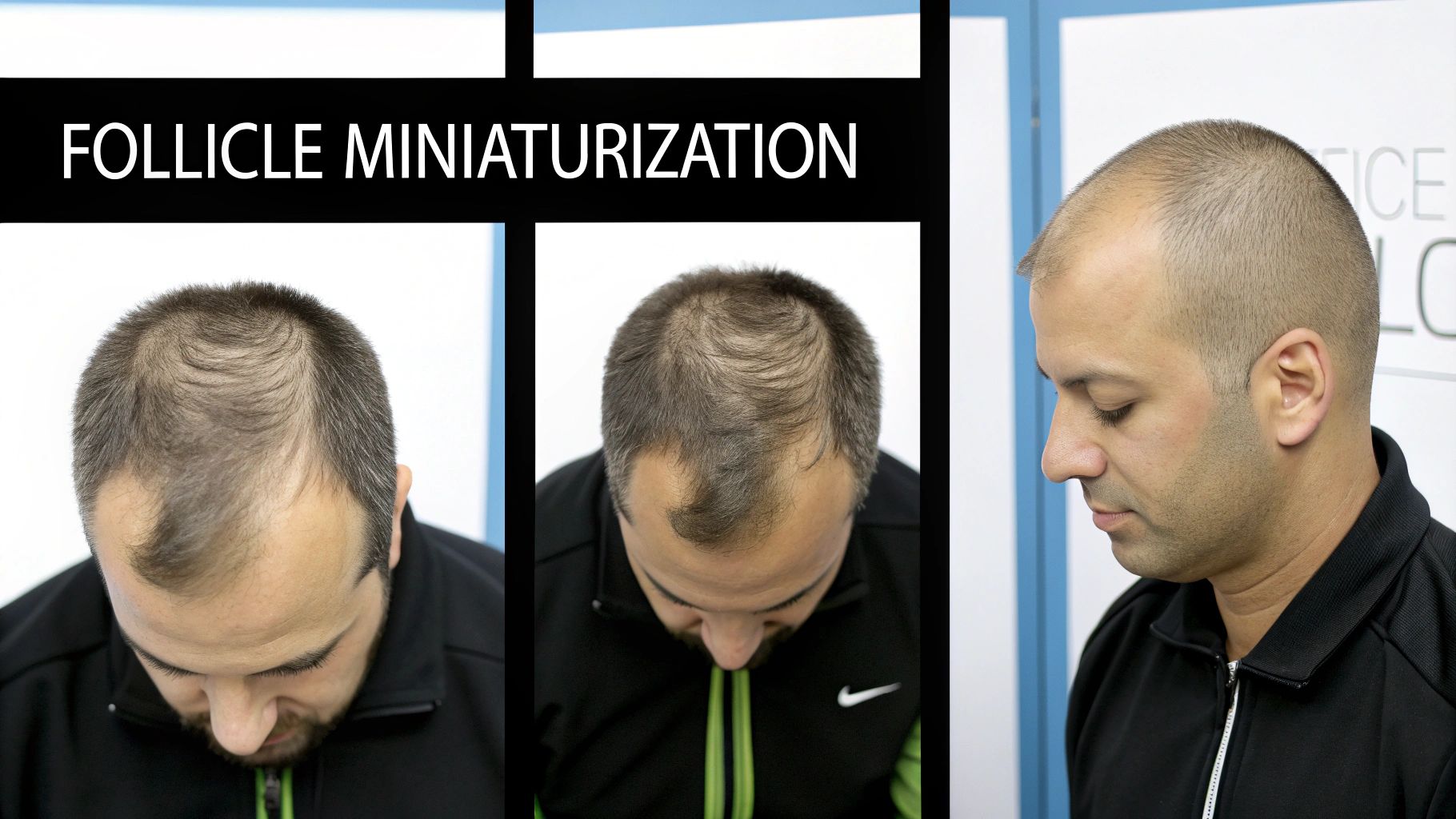
To really get a handle on whether a hair follicle is gone for good, you first have to understand its life story. Each follicle is a tiny engine under your skin, chugging along through a cycle of growing, resting, and shedding hair. This process is supposed to repeat itself over and over again, keeping your hair full and healthy.
But sometimes, that finely-tuned system gets thrown out of whack. For most men dealing with hair loss, the main culprit is a process called miniaturization. It’s a sneaky, gradual weakening of the hair follicle that you often don't even notice at first.
Think of it like this: a healthy follicle is a big, strong tree that grows a thick, sturdy branch (your hair). With miniaturization, that tree starts to shrink. Each time a new growth cycle begins, it produces a slightly smaller, weaker twig. This continues until all it can muster is a tiny, almost invisible fuzz.
This slow-motion shrinking is why thinning is the first sign of trouble, long before any bald spots appear. Your hair doesn't just vanish overnight; it gets progressively finer, shorter, and weaker first.
What’s Causing This Shrinking? The Role of DHT
So, what's driving this process? In male pattern baldness, the primary villain is a hormone called dihydrotestosterone, better known as DHT. It’s a byproduct of testosterone, and for follicles that are genetically susceptible, it’s bad news.
When DHT latches onto receptors in these follicles, it sends a signal to shorten the hair's growth phase and shrink the follicle itself. Over time, this forces the follicle to produce wispy, vellus-like hairs instead of the strong, pigmented hairs you're used to seeing.
Here's the key: for a very long time, the follicle isn’t actually dead. It's just dormant and producing a much weaker, thinner hair. This gives you a crucial window of opportunity to step in and do something about it.
If you're interested in a deeper dive, there's a great guide that really breaks down hair follicle miniaturization and its effects. Understanding this is fundamental to figuring out what's happening on your scalp.
The Point of No Return: From Dormant to Dead
If miniaturization is left to run its course for years, the follicle gets so small and weak that it eventually just gives up and goes dormant. It's still alive under the skin—just inactive, waiting for a signal to wake up and get back to work. This is the stage where many hair loss treatments have the biggest impact, as they're designed to reverse the shrinking and kickstart these sleeping follicles.
So, when does a follicle officially cross the line from dormant to dead? True, irreversible follicle death happens in one of two ways:
-
Advanced Miniaturization: After years of being suppressed by DHT, a dormant follicle can simply waste away. The cellular machinery that builds hair gets dismantled, and the body eventually absorbs what's left. It's gone.
-
Scarring and Inflammation: In less common conditions called scarring alopecias, the body's own immune system mistakenly attacks the hair follicles. The resulting inflammation destroys the follicle and replaces it with a tiny plug of scar tissue, permanently sealing off any chance of regrowth.
It's this final stage—the appearance of scar tissue—that is the most definitive answer to how to know if hair follicles are dead. Where there’s a scar, no hair can grow. This is why a scalp that looks smooth and shiny is often a sign of permanent hair loss. The absence of visible pores is a tell-tale sign that the growth structures underneath are gone for good, not just taking a nap.
Scarring vs. Non-Scarring Hair Loss: What's Happening on Your Scalp?
When a dermatologist looks at hair loss, their first question isn't just "how much hair is falling out?" but "what's happening to the follicles?" This is the crucial starting point, because nearly all hair loss conditions fall into two major camps: non-scarring and scarring alopecia.
Figuring out which one you have is the single biggest clue to what's possible for your hair.
Think of non-scarring alopecia—the kind that includes common pattern baldness—as a factory that's temporarily shut down. The equipment (your hair follicle) is still there, it's just been put into a deep sleep by hormones or other signals. Because the fundamental structure is intact, there's a solid chance of restarting production and regrowing hair.
Then there's scarring alopecia. This is a completely different beast. It's more like the factory has been hit by a wrecking ball. An aggressive inflammatory process attacks and permanently destroys the hair follicle, leaving a small patch of scar tissue in its place. Once that happens, the follicle is gone for good.
What to Look For: Visual Clues on Your Scalp
You can often spot the early signs just by taking a close look at your scalp. While it’s not a substitute for a professional diagnosis, the visual clues can tell you a lot about what’s going on under the surface.
In non-scarring hair loss, you’ll see thinning, but the scalp skin itself usually looks healthy. You can still see the tiny pores where hairs used to grow (follicular ostia), even if the hairs coming out are thin and wispy or non-existent.
A scalp affected by scarring alopecia, however, often tells a much different story.
- A Smooth, Shiny Surface: The area might look unusually smooth and tight. This sheen is often caused by the fibrous scar tissue that has replaced the normal skin architecture.
- Missing Pores: The most telling sign is the complete absence of those tiny follicular openings. A lack of pores is a strong hint that the follicles underneath have been destroyed.
- Signs of a Fight: You might also see active redness, scaling, or irritation around the edges of the hair loss, which are signs of the inflammation that’s causing the damage.
You can learn more about these aggressive conditions and why they demand immediate medical attention by reading this guide on what is scarring alopecia.
Why Does This Difference Matter So Much?
Knowing whether your follicles are being scarred is everything. It fundamentally changes the treatment goals, the potential outcomes, and the urgency of the situation. With non-scarring alopecia, the goal is revival—waking up those sleeping follicles. But with scarring alopecia, the game completely changes.
With scarring alopecia, the primary objective isn't regrowth in the bald patches; it's preservation. It becomes a defensive battle to halt the inflammatory attack and save the hair follicles you still have.
Comparing Scarring and Non-Scarring Hair Loss
To make it clearer, here’s a breakdown of the key differences between these two categories. This table outlines the typical signs, causes, and follicle outcomes for each.
| Feature | Non-Scarring Alopecia (Follicles Likely Dormant) | Scarring Alopecia (Follicles Likely Dead) |
|---|---|---|
| Scalp Appearance | Skin looks relatively normal; pores are visible. | Skin may be smooth, shiny, red, or scaly; pores are often absent. |
| Key Symptom | Gradual or diffuse thinning of hair. | Patches of hair loss, often with itching, burning, or pain. |
| Follicle Status | Follicles are miniaturized or dormant but still present. | Follicles are permanently destroyed and replaced by scar tissue. |
| Potential for Regrowth | Good, as the follicle structure is intact. | Very low to none in scarred areas; focus is on preventing spread. |
| Common Causes | Androgenetic alopecia, telogen effluvium, alopecia areata. | Lichen planopilaris, frontal fibrosing alopecia, CCCA. |
Understanding these distinctions is the first step toward getting the right help.
Thankfully, dermatologists now have incredible tools like trichoscopy (a special scalp microscope) and scalp biopsies to get a definitive diagnosis. It’s important to act, because some conditions, like alopecia areata, can be unpredictable. Globally, around 160 million people suffer from this autoimmune condition. While many recover, the most severe forms—affecting fewer than 200,000 people in the U.S.—can sometimes lead to permanent, scarring-like follicle loss. In those rare, extreme cases, studies show the chance of natural follicle recovery is less than 10%. You can discover more insights about alopecia areata on pfizer.com.
This is exactly why a professional diagnosis is non-negotiable. An at-home check can give you clues, but only a specialist can put a name to what's happening and build a plan to protect your hair.
How to Assess Your Scalp Health at Home
While a dermatologist’s office is where you'll get the final verdict, you can absolutely play detective at home first. Doing a little recon work on your own scalp can give you a much clearer picture of what's going on, making your conversation with a specialist far more productive.
Think of it as gathering initial clues. These simple checks can help you figure out if you're likely dealing with dormant follicles that can be revived, or if you're seeing signs that point to permanent loss.
This visual guide breaks down the core difference between the two main types of hair loss—scarring and non-scarring—and what each looks like up close.
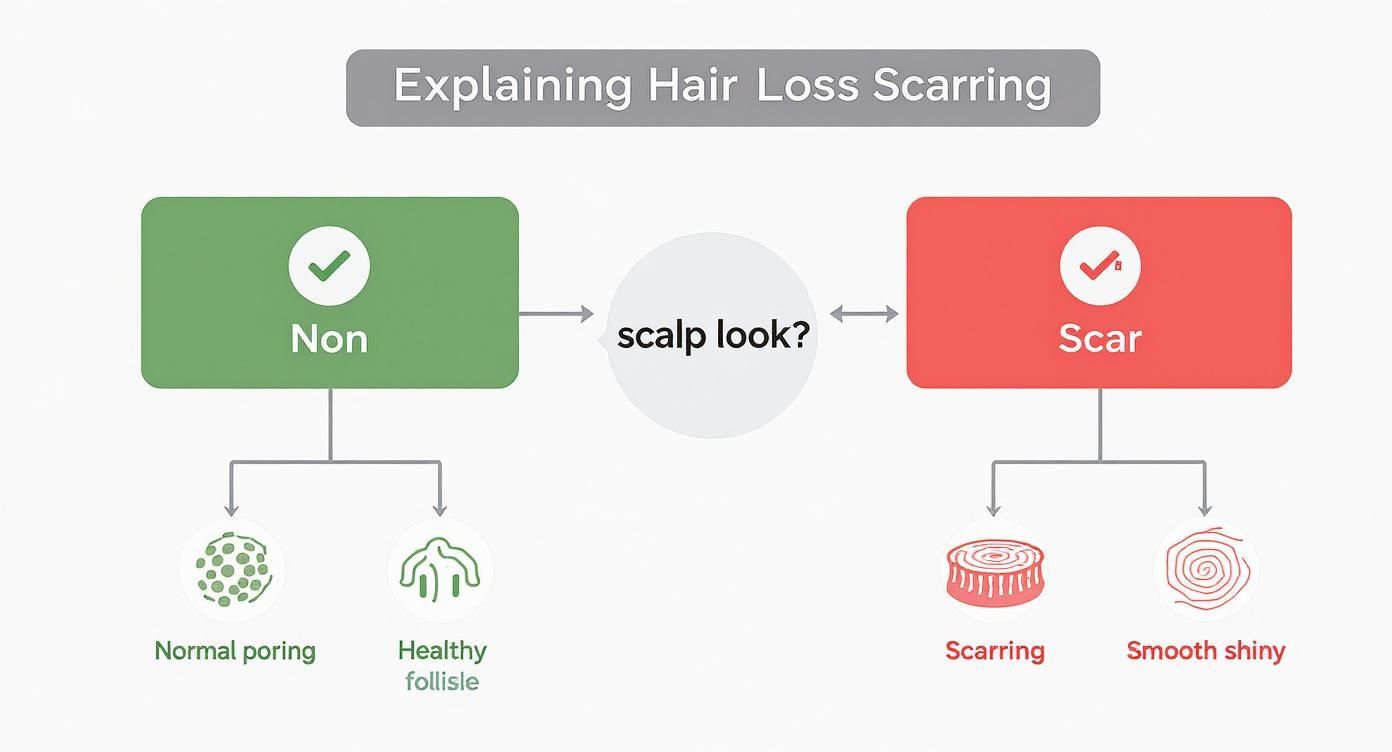
The takeaway here is pretty straightforward: if you can still see the tiny pores where hairs should be, you’re likely in non-scarring territory. But if the scalp looks smooth and shiny, it's a strong hint that scarring might be the culprit.
The Shiny Scalp Test and Pore Check
This is the easiest visual check you can do. Just get under a bright light, grab a mirror (or your phone's camera), and take a close look at the areas where your hair feels thinnest.
- What to Look For: Do you see a smooth, almost reflective sheen? Does the skin look tight and completely lack the tiny openings, or follicular ostia, that dot the rest of your scalp?
- What it Means: A completely smooth and shiny scalp is a classic sign of scarring alopecia. That slick appearance happens because the follicular structures have been replaced by scar tissue, basically paving over the spots where hair used to grow. On the other hand, if you can still see pores, that’s fantastic news. It means the "machinery" is still there, even if it’s switched off for now. Our guide on how to measure hair density can give you a better sense of what a healthy scalp with visible pores looks like.
The Gentle Pull Test
This old-school test is a great way to get a rough idea of your current shedding rate. It won’t tell you if follicles are dead, but it does give you a snapshot of how much hair you’re actively losing right now.
- Start with clean, dry hair. It’s best to wait at least a full day after washing.
- Gently pinch a small section of hair—around 50-60 strands is a good amount—between your thumb and forefinger, close to the root.
- Slide your fingers firmly but gently along the hair shaft, all the way to the ends.
- Count how many hairs came out.
General Guideline: If you pull out more than 5-6 hairs in a single go, it could suggest you're experiencing active shedding that’s a bit more than the normal daily cycle. It's not a definitive diagnostic tool, but it's valuable information to bring to your doctor.
Consider the Timeline of Your Hair Loss
How long has your hair been thinning? This is a crucial piece of the puzzle. Follicles rarely just die overnight; it's almost always a gradual decline, especially with something like common pattern baldness.
Research has given us some pretty solid benchmarks here. While a follicle can sit dormant for years and still be viable, the odds of permanent loss go up dramatically after about 5-7 years of continuous hairlessness in a specific area.
In fact, studies on men with advanced pattern baldness have shown that after a decade, only about 10-15% of follicles in the balding zones might still be active. So, if you've had a completely bald spot for more than five years with zero signs of life, the probability that those follicles are gone for good is unfortunately quite high.
Why a Professional Diagnosis Is Your Best Next Step
https://www.youtube.com/embed/lERVb0U5LUI
Those at-home checks we talked about? They're a great starting point, giving you some initial clues about what's going on up there. But they’re just that—clues. To get a real, definitive answer on whether your follicles are truly gone for good, you need an expert to connect the dots.
Think of it this way: trying to treat hair loss without a proper diagnosis is like navigating a new city without a map. You might wander around, try a few different routes, and waste a lot of time and money, only to end up more lost than when you started. A dermatologist or trichologist provides that map, taking all the guesswork out of the process.
Peering Beneath the Surface: The Power of Trichoscopy
One of the first and most powerful tools a specialist will reach for is a trichoscope. Don't let the name intimidate you; it's basically a high-powered, handheld microscope designed specifically for your scalp. It uses polarized light to look past the surface and reveal an incredible amount of detail that’s completely invisible to the naked eye.
During a trichoscopy exam, your doctor is looking for tell-tale signs that point to the true state of your follicles. They can spot things like:
- Empty Follicular Openings: Are the pores truly empty, or do they contain tiny, almost invisible "peach fuzz" hairs? Those nearly microscopic hairs are a classic sign of miniaturization, not permanent follicle death.
- Signs of Inflammation: Redness, flaking, or scaling around the follicle can signal an active inflammatory attack, which is common in many types of scarring alopecia.
- Fibrosis or Scarring: The definitive sign of a dead follicle is the presence of white, smooth, structureless patches where follicular openings should be. This confirms that scar tissue has replaced the follicles.
This quick, completely painless exam gives your doctor a massive amount of information, often enough to make a confident diagnosis right there on the spot.
A professional diagnosis is the only way to get a clear answer. Without it, you are navigating in the dark, and your efforts to restore your hair may be completely misdirected.
The Final Verdict: The Scalp Biopsy
Sometimes, especially if a scarring alopecia is suspected, even a trichoscopy isn't enough to get the full story. When the evidence is complex or unclear, a dermatologist might recommend a scalp biopsy for the most conclusive answer possible.
It sounds a bit intense, but it's actually a very minor and quick procedure. After numbing a small spot with local anesthetic, the doctor takes a tiny sample of scalp tissue—usually only 4 millimeters wide. That sample is then sent to a lab to be examined under a microscope.
A biopsy delivers the ultimate proof. It reveals not just if the follicles are destroyed but why. It can identify the specific types of inflammatory cells causing the damage, leading to a precise diagnosis of the exact condition you're up against. This level of detail is absolutely essential for aggressive conditions where every day counts, and the main goal is to stop the damage in its tracks.
Getting this kind of expert insight is crucial. Consulting with an online dermatologist is a convenient way to get a comprehensive evaluation and expert guidance on your scalp health without the stress of an in-person visit.
What Dead Follicles Mean for Your Treatment Options
Getting a diagnosis can feel overwhelming, but clarity is the first step toward a real solution. Knowing the true state of your hair follicles isn't the end of the road; it's the starting line for creating a treatment plan that actually works. Everything that comes next hinges on whether your follicles are just sleeping, damaged, or permanently gone.
If a biopsy shows that follicles in a certain area are truly dead and have been replaced by scar tissue, your treatment strategy has to change. You can't bring back something that no longer exists. While that might be tough to hear, it's crucial information that prevents you from wasting time, hope, and money on treatments that are destined to fail.
When Revival Therapies Are Off the Table
Treatments aimed at waking up dormant follicles, like minoxidil or even Platelet-Rich Plasma (PRP), need a viable follicle to work on. Think of them like premium fertilizer for a garden. If a seed is still in the soil, the fertilizer can give it a powerful boost to grow. But if the ground has been paved over with concrete, no amount of fertilizer will ever make a flower sprout.
This is the key takeaway: if a follicle is scarred and gone, rejuvenation treatments won't work in that spot. The goal then shifts from regrowth to preservation.
This is especially critical for scarring alopecias. The primary mission becomes stopping the inflammation in its tracks to save the healthy follicles you still have. Your focus moves from reversing the damage to preventing it from spreading. You can dive deeper into this topic in our guide on whether dead follicles can be revived.
The Only Proven Solution for Permanent Loss
So, what can be done for areas where the follicles are lost for good? When the scalp is smooth and shiny because of scarring, there is only one proven, long-term solution to get hair back: hair transplantation.
A hair transplant is essentially a relocation process. A surgeon takes healthy, active follicles from a donor area on your scalp—usually the back and sides, where hair is genetically programmed to keep growing—and carefully implants them into the balding areas.
It’s a brilliant strategy because it uses your own natural hair to repopulate the spots where follicles have died. These transplanted follicles will continue to grow just as they did before, offering a permanent fix for areas with irreversible hair loss.
It's also worth noting that lifestyle choices can speed up follicle damage. Research highlights a dramatic link between smoking and hair loss, showing that 85% of smokers experience hair loss compared to only 40% of non-smokers. This is often tied to poor blood flow and oxidative stress on the scalp. You can read the full study about the effects of environmental pollutants and lifestyle factors.
Ultimately, getting an accurate diagnosis is the most powerful step you can take. It lets you move forward with confidence, whether your path involves protecting the hair you have or exploring the incredible potential of a hair transplant.
A Few Final Questions About Follicle Health
We've gone deep into the science, covering everything from dormant vs. dead follicles to the tools a specialist uses to diagnose them. To tie it all together, let's go through some of the most common questions people ask. This should help lock in the key ideas and clear up any last bits of confusion.
Can Minoxidil Revive a Dead Hair Follicle?
Simply put, no. Minoxidil is fantastic at what it does, but it can't bring a dead follicle back to life. Its job is to improve blood flow and essentially nudge sleeping follicles back into their active growth phase. For it to work, it needs a living, even if miniaturized, follicle to stimulate.
Think of it as a strong cup of coffee for a sleepy follicle, not a resurrection for a dead one. If the follicle has been destroyed and replaced with scar tissue, there’s nothing left for the Minoxidil to act on.
How Long Does a Follicle Stay Dormant Before It Dies?
This is the million-dollar question, and there's no single, set-in-stone answer. The clock is definitely ticking, though. In conditions like pattern baldness (androgenetic alopecia), a follicle can hang out in its dormant state for a few years and still be viable. But the longer it stays inactive and shrunken, the more likely it is to eventually give up for good.
As a rule of thumb, if a patch of scalp has been completely smooth and bald for 5-7 years—with no fine, fuzzy vellus hairs in sight—the odds are high that those follicles are permanently gone. This is why acting early is always the best game plan.
Is My Hair Follicle Dead if the Hair That Falls Out Has a White Bulb?
Not at all! Seeing that little white bulb on the end of a shed hair is perfectly normal and is actually a good sign. It does not mean the follicle is dead.
That bulb is just the root portion of the hair shaft that was anchored in the follicle. Its presence means the hair completed its natural life cycle and was shed during the resting phase. A healthy, living follicle will get to work growing a brand-new hair to take its place.
Can a Dead Follicle Still Get Clogged or Infected?
Once a follicle is truly dead and the area has been replaced by scar tissue, the structure that gets clogged—the pore and the oil gland attached to it—is usually gone as well. The skin in that spot typically becomes smooth and sealed over.
However, the conditions that lead to follicle death, like some scarring alopecias, are often driven by intense inflammation. During this active destructive phase, you might see pimple-like bumps or infections as part of the disease process that's killing the follicle.
If a Follicle Is Dead Can It Still Grow a Hair?
No. Once a hair follicle is gone, its hair-producing days are permanently over. The complex cellular "factory" needed to construct a hair shaft has been completely dismantled.
This is why solutions for restoring hair to a scarred, bald area don't involve reviving old follicles. Instead, they rely on bringing in new, healthy ones from another part of the scalp, which is exactly what a hair transplant does.
Getting a clear picture of your scalp's health is the critical first step toward finding a real solution. For more expert-led information on hair loss treatments, including Platelet-Rich Plasma, PRP For HairLoss is an excellent resource to help you navigate your options. You can explore everything we offer at https://prpforhairloss.com.

 PRP For Hairloss
Leave a comment