Curious about your hair's fullness? You can get a solid idea of your hair density just by checking how visible your scalp is, counting strands in a small marked-off section, or even measuring your ponytail's circumference. While these at-home checks give you a great sense of whether you have low, medium, or high density, more advanced clinical methods like trichoscopy offer a precise, scientific count of hairs per square inch.
Why Your Hair Density Is Worth Tracking
Before we jump into the how, let’s chat about the why. Hair density—which is just the number of individual hair strands on your scalp per square inch—is a super important sign of your hair's overall health. It's easy to get it mixed up with hair thickness (the width of each strand), but they tell two completely different stories.
Imagine a forest. You could have a dense forest packed with very thin trees—that's high density. Or, you could have a forest with thick, sturdy trees spaced far apart—that's low density. The same concept applies to your hair, and knowing where you fall on that spectrum is more than just a fun fact.
A Baseline for Your Hair Health
Figuring out your current hair density gives you a crucial baseline. This isn't just a number to tuck away; it's a personal wellness tool that helps you make much smarter decisions about your hair care.
Once you know your density, you can:
- Choose better products: Hair with lower density often gets weighed down easily, so it loves lightweight, volumizing products. High-density hair, on the other hand, might need more powerful moisturizers just to get through all those strands.
- Style your hair more effectively: Let's be honest, certain cuts and styles just vibe better with different densities. A stylist who understands your hair density can create a look that really maximizes fullness and makes your life a whole lot easier.
- Notice changes early: This is probably the biggest reason to pay attention. Tracking your density helps you spot the very first signs of thinning long before it becomes obvious to anyone else.
Spotting Changes Over Time
Catching a subtle change, like a slightly wider part or a ponytail that feels a bit less hefty, can be the first clue that something is impacting your https://prpforhairloss.com/hair-growth-cycle. This cycle is the engine dictating how and when your hairs grow, rest, and eventually shed.
Ultimately, keeping an eye on this metric turns a simple observation into proactive health management. It’s all about taking control and listening to what your body is telling you.
A healthy scalp is the foundation for healthy hair density. Specialized treatments, like professional Japanese Head Spa services, can be incredibly beneficial for creating the best possible environment for hair to grow.
Simple Ways to Check Hair Density at Home
You don't need a fancy lab or expensive gear to get a good sense of your hair density. While a professional analysis will always be more precise, a few simple at-home checks can give you a pretty solid idea of whether you're working with low, medium, or high density. Think of these as a way to establish your personal baseline.
The Scalp Visibility Test
One of the quickest ways to start is with what I call the Scalp Visibility Test. It's exactly as straightforward as it sounds.
Just stand in front of a mirror with some good, bright lighting and let your hair fall into its natural part. Now, take a close look at that part line. If you can easily see a good amount of your scalp without having to move your hair around, you likely have lower-density hair.
On the flip side, if you can barely see your scalp through the strands at the part, that’s a classic sign of high density. Medium density is that happy middle ground where you might see some scalp, but your hair still provides pretty full coverage.
A lot of people mix up hair density with hair thickness, but they're two totally different things. The infographic below does a great job of breaking down the difference.
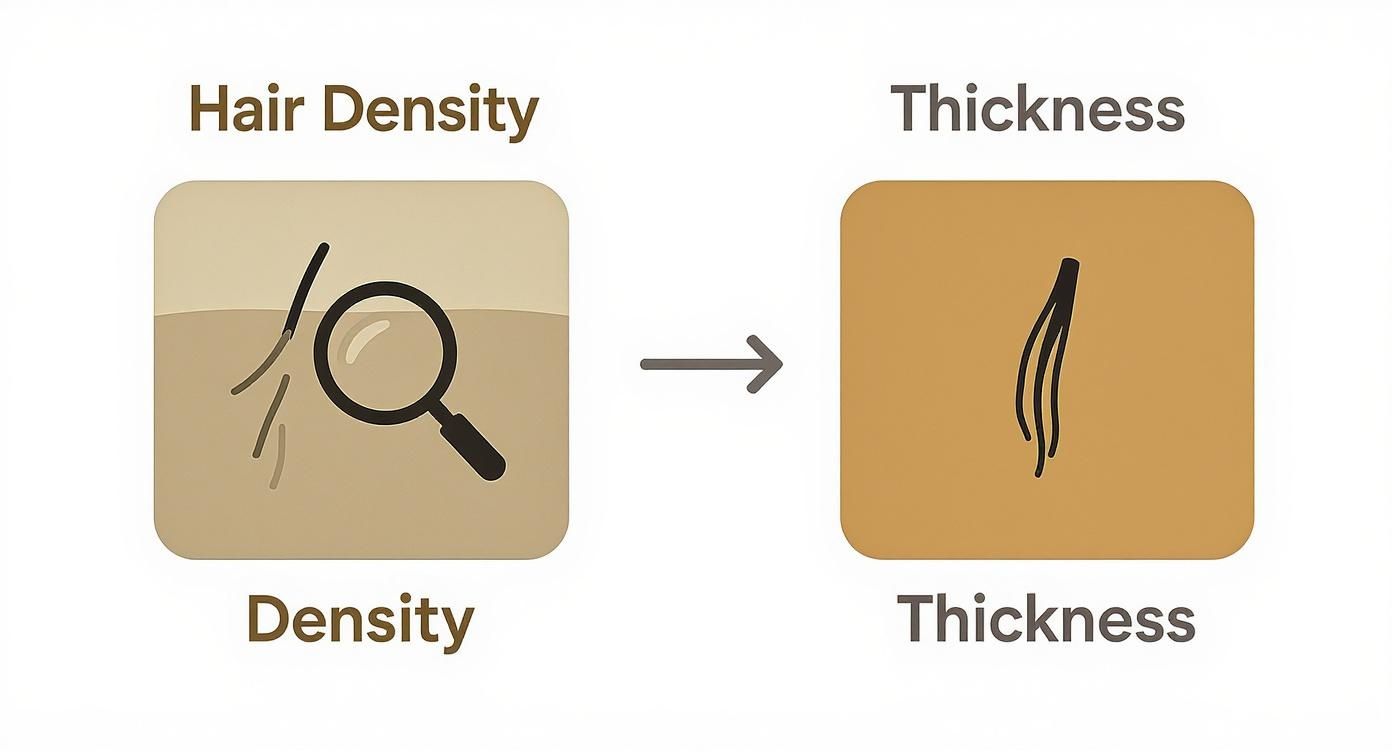
As you can see, density is all about the number of hairs you have, while thickness refers to the width of each individual strand. Both play a huge role in how full your hair looks and feels.
The Ponytail Test for a Quick Gauge
If your hair is long enough to tie back, the Ponytail Test is another surprisingly useful trick. This one uses the circumference of your ponytail as a rough estimate of your hair's overall volume.
First, gather all of your hair into a smooth ponytail and secure it with a hair tie. Then, grab a flexible measuring tape and wrap it around the base of the ponytail, right against the hair tie.
Here’s a general guide to what the measurement means:
- Low Density: A circumference of less than 2 inches.
- Medium Density: A circumference between 2 and 3 inches.
- High Density: A circumference of more than 4 inches.
Now, this isn't a perfect science—if you have very coarse, thick strands, it might inflate the measurement a bit. Still, it’s a fantastic real-world gauge. If you notice your ponytail circumference is shrinking over time, that could be a subtle clue that your density is changing. Of course, for men or anyone with short hair, this test isn't practical, making the scalp visibility check a better starting point.
Don't panic if your results suggest low density. For many people, it's simply a natural, genetic trait and not a sign that something is wrong. The real key is to watch for significant changes from your personal baseline over time.
A Quick Look at At-Home Density Tests
To help you decide which method works best for you, here’s a simple breakdown of these at-home tests. They're all about giving you a practical starting point, not a clinical diagnosis.
| Method | What It Measures | Pros | Cons |
|---|---|---|---|
| Scalp Visibility Test | How much scalp is visible through the hair part. | Very quick and easy; works for all hair lengths. | Highly subjective and dependent on lighting. |
| Ponytail Test | The circumference of a ponytail, estimating hair volume. | Provides a quantifiable number to track over time. | Only works for long hair; can be skewed by strand thickness. |
| Photograph Comparison | Visual changes in hair fullness and scalp visibility. | Excellent for tracking long-term changes objectively. | Requires consistency and patience over months. |
Each of these methods offers a different piece of the puzzle. Using them together can give you a much more complete picture of your hair's density and how it might be evolving.
Using Photos to Track Changes Over Time
For a more long-term and objective approach, nothing beats the Photograph Comparison Method. This is about creating a visual diary of your hair so you can spot subtle shifts that are nearly impossible to notice day-to-day.
To make this work, consistency is everything. Here’s how to do it right:
- Find a spot with consistent lighting. Bright, indirect natural light is your best friend here. Avoid harsh overhead lights, which can create shadows that make your scalp look more visible than it is.
- Use the same angles every single time. The most important shots are usually from the top of your head (looking down at your part), the crown, and your hairline.
- Keep your styling and device the same. Always take the photos when your hair is dry and parted as you normally wear it. Using the same phone or camera helps, too.
- Repeat the process every month or two. This gives enough time for changes to become noticeable.
This simple habit turns a vague feeling into hard evidence. After a few months, you'll have a clear visual record that can either put your mind at ease or confirm that your density is, in fact, changing. If you've been asking yourself, "is my hair thinning?", having a photo log like this will give you a much more concrete answer.
How Professionals Measure Hair Density
When the at-home methods just aren't cutting it and you need a truly accurate picture, it’s time to see what the pros use. While the scalp visibility test is a decent starting point, professional tools give you objective, measurable data. Knowing what these clinical methods involve can make the idea of seeking expert advice feel a lot less intimidating.
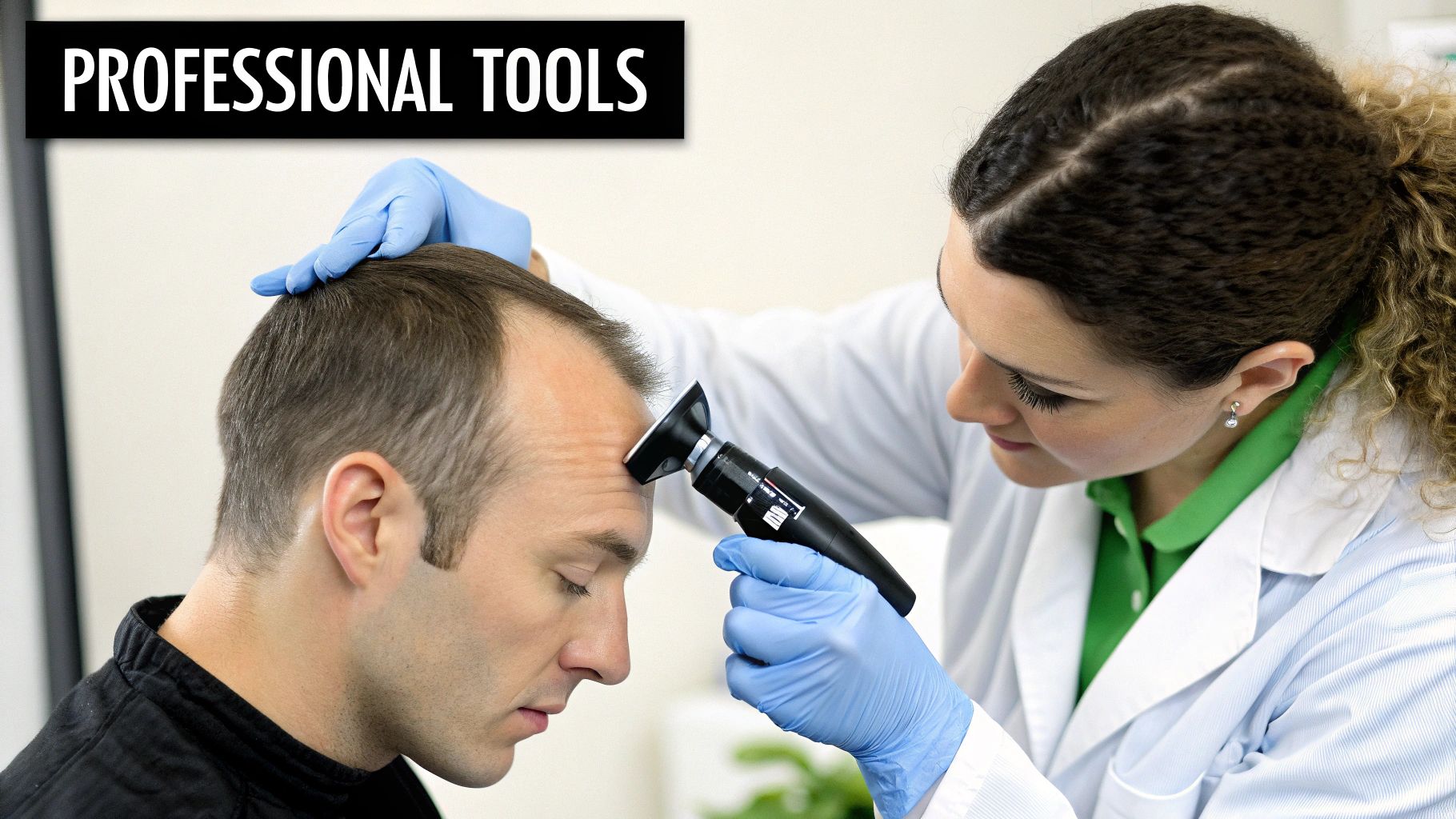
These diagnostic tools are the gold standard for pinpointing the cause of hair loss and tracking how well a treatment is actually working. They take all the guesswork out of the equation.
The Rise of Digital Imaging
Believe me, the methods for measuring hair density have come a long way. The move from manual, often uncomfortable hair counts to modern digital imaging has been a game-changer for both patients and doctors. In the past, researchers sometimes used a "unit-area trichogram"—a pretty unpleasant process that involved plucking hairs from a marked spot on the scalp to count them under a microscope. Ouch.
Thankfully, starting in the 1990s, the phototrichogram came into the picture. This technique uses magnified scalp photos to count hairs digitally, offering a much gentler, non-invasive alternative. More recently, automated systems have taken over. Tools like TrichoScan combine powerful imaging with smart software to rapidly analyze not just density, but also growth rates and even the distribution of hair diameters.
For reference, a healthy adult scalp typically has a density ranging from roughly 150 to just over 200 hairs per square centimeter.
Automated Systems Like TrichoScan
Walk into a modern clinic, and you'll likely see advanced systems that provide a much deeper analysis than a simple headcount. TrichoScan is a perfect example of this leap forward.
Here’s a quick rundown of what these impressive systems can do:
- Calculate Hair Density: You get an exact number of hairs per square centimeter, which is the foundational metric.
- Measure Anagen/Telogen Ratio: This analysis reveals the percentage of hairs in the active growing phase (anagen) versus the resting phase (telogen)—a crucial indicator of scalp health.
- Assess Hair Shaft Diameter: The software can measure the thickness of individual strands, which is fantastic for spotting miniaturization, a classic sign of androgenetic alopecia.
This level of detail gives a dermatologist a complete picture of what's happening on your scalp, far beyond what you could ever see with the naked eye.
A professional assessment isn't just about getting a number; it's about understanding the why behind your hair density. It helps differentiate between genetic traits, temporary shedding, and progressive hair loss conditions.
What to Expect During an Assessment
If you do decide to see a professional, the process is usually quick and completely painless. The specialist will use a handheld device that looks like a pen with a camera on the end, connected to a computer.
They'll press it gently against different parts of your scalp to capture highly magnified images. The software then does its magic, analyzing these images right there on the spot.
For more complex cases, a doctor might suggest a different path. It's helpful to learn what a scalp biopsy for hair loss involves to understand the full range of diagnostic tools they have. And remember, beyond just measurement, professionals can offer advanced solutions like professional PRP treatments to actively boost growth and improve your overall hair density.
Comparing Trichoscopy and Biopsy for Hair Analysis
When you’ve exhausted at-home methods and need a professional diagnosis, your doctor will likely bring up two powerful clinical techniques: quantitative trichoscopy and the punch biopsy. Both are designed to get a highly accurate hair density count, but they approach the task from completely different angles. Knowing the difference is key to understanding your diagnosis.
Trichoscopy is a modern, non-invasive method. Think of it as an ultra-high-powered camera for your scalp. A specialist uses a special device called a dermatoscope to take incredibly detailed digital pictures. The whole process is quick, totally painless, and gives you instant results. This makes it the perfect tool for tracking changes over time without any discomfort.
A scalp punch biopsy, on the other hand, is a more direct, invasive procedure. A dermatologist numbs a small spot on your scalp and uses a tiny tool to remove a piece of skin, usually about 4 millimeters wide. This skin sample is then sent off to a lab where it's put under a microscope for a detailed analysis.
The Trade-Off Between Accuracy and Comfort
So, which one is better? It’s not that simple.
If we're talking about pure, unadulterated accuracy, the biopsy wins. The lab technician can physically examine the tissue and count every single follicle—even the tiny, dormant ones hiding just under the skin's surface. A camera, no matter how powerful, can sometimes miss those.
This difference shows up in the numbers. One comparative study revealed that hair density measured by a 4-mm punch biopsy was significantly higher, clocking in at an average of around 215 hairs/cm². The same scalps measured with quantitative trichoscopy showed an average of 163 hairs/cm². The biopsy simply provides a more complete count of all follicles, while surface imaging can naturally undercount the deeper or miniaturized ones. You can dig into the full scientific study on the National Center for Biotechnology Information website.
While a biopsy provides the most accurate "gold standard" count, its invasive nature makes it less practical for routine monitoring. For most clinical situations, trichoscopy offers the ideal balance of accuracy, patient comfort, and repeatability.
Why Trichoscopy Is Often the Go-To Choice
Despite the biopsy's raw precision, trichoscopy is what dermatologists turn to most often for diagnosing and managing common hair loss conditions. Why? Because it’s practical.
The ability to quickly and painlessly scan multiple areas of the scalp gives your doctor a fantastic big-picture view of what’s going on. It’s especially good at spotting tell-tale signs of conditions like androgenetic alopecia, where hair follicle miniaturization is the main culprit.
Ultimately, the choice comes down to your specific situation. If you're tracking how well a treatment is working or need a solid initial diagnosis, trichoscopy is an excellent, patient-friendly tool. A biopsy is usually reserved for more puzzling cases where the cause of hair loss isn't obvious, and a deeper look at the scalp tissue itself is necessary to get to the bottom of it.
The Future of Accessible Hair Density Testing
For a long time, checking your hair density meant choosing between a quick, not-so-accurate glance in the mirror at home or a costly, involved trip to a specialist's office. That gap is finally starting to close. We're seeing some exciting developments that put accurate, meaningful hair density data right into your hands, no fancy lab equipment required.
The whole point of this new wave of innovation is to move beyond complex, clunky machinery. Instead, the focus is on smarter, simpler methods that empower you to track your hair health with a precision that used to be reserved for dermatology clinics.
The Rise of Simplified Scoring Systems
One of the most promising tools to emerge from this shift is the Scalp Coverage Scoring (SCS) system. It was designed from the ground up to be a straightforward, calibrated way to estimate hair density without needing any expensive digital imaging gear. Think of it as taking a scientific, evidence-based approach and making it practical for real-world use.
So, how does it work? The SCS method breaks the scalp down into specific zones. Then, using a standardized visual guide, you score the percentage of hair coverage you see in each area. This structured process gives you a consistent and repeatable way to measure density over time. It's simple enough for you to use for routine check-ins but also reliable enough to be used in formal clinical trials—that’s how you know it’s solid.
The real beauty of this system is just how accessible it is. A 2023 study dug into the SCS method and found it to be incredibly reliable, even when used by people with zero medical training. After a very short tutorial, these observers produced scores that were statistically identical to those from an expert with 20 years of experience. That's a game-changer. You can read the full study to learn more about the SCS method and its clinical applications.
Bridging the Gap Between Home and Clinic
Tools like the SCS method are creating a much-needed middle ground for hair analysis. For years, your choices were stark: a rough guess at home or a highly technical, sometimes invasive, clinical assessment. There wasn't much in between.
These new methods are filling that void by offering the best of both worlds:
- Clinical Relevance: The data you get is actually meaningful. It helps you track real changes in your hair health, not just guess.
- Ease of Use: They are designed to be intuitive. You don't need a PhD to get reliable results, often just a little bit of training.
- Cost-Effectiveness: By cutting out the need for specialized hardware, these approaches become affordable and available to almost anyone.
This is about democratizing hair analysis. It gives both individuals and researchers powerful tools that are scientifically sound but also incredibly practical for everyday use.
Ultimately, the future of measuring hair density is about putting more control back in your hands. As these tools become more widespread, you'll be able to get a much clearer, more accurate picture of your hair's health, all on your own terms. This shift helps you make smarter decisions about your hair care routine and know exactly when it might be time to bring in a professional.
Common Questions About Hair Density
As you get more familiar with measuring your hair's fullness, you're bound to have some questions. It's only natural. Getting straight answers is the best way to understand what your results mean and figure out what to do next. Let's dig into a few of the questions I hear most often.
Can I Really Measure My Hair Density at Home?
You absolutely can get a solid ballpark figure at home. Simple techniques like checking your scalp's visibility or doing the ponytail test are perfect for getting a sense of whether your hair is on the low, medium, or high side of the density scale. Think of it as establishing your personal baseline.
Just keep in mind that these methods won't give you a precise, scientific number. For an exact count of hairs per square inch—the kind of data needed to diagnose a condition or track a treatment's progress—you’ll need to see a professional.
What’s a Normal Hair Density Count?
The truth is, "normal" covers a pretty wide spectrum. What's normal for you is shaped by your genetics, ethnicity, and even your age. That said, most research points to a density of about 150 to over 200 hairs per square centimeter for a healthy scalp.
But that number doesn't tell the whole story. Someone could have fewer but thicker strands of hair and actually look like they have more volume than a person with lots of very fine hair. It’s the combination of density and strand thickness that creates the overall look.
What really matters isn't hitting some magic number. It's about knowing your normal and noticing any big changes. A sudden drop in density is a much bigger red flag than where you started.
When Should I See a Doctor About My Hair Density?
If you notice a sudden, rapid change in your hair's fullness, that's your cue to book an appointment with a doctor or a trichologist. While our hair naturally gets a bit thinner over the years, a quick drop can be a sign of an underlying health issue that needs to be addressed.
Be on the lookout for these key indicators:
- Your part line is looking noticeably wider than it used to.
- Your ponytail feels a lot thinner when you tie it up.
- You can see more of your scalp than before, even in regular lighting.
A professional can pinpoint the cause and guide you toward the right solution. If you're ready to take action, learning how to increase hair density with effective strategies is a great place to start. Getting ahead of the problem usually gives you the best shot at success.
At PRP For HairLoss, we're committed to giving men the clear, expert information they need to tackle hair loss and explore powerful treatments like PRP. For more resources and real solutions, visit us at https://prpforhairloss.com.


Leave a Reply