Hair follicle miniaturization is the sneaky culprit behind most cases of thinning hair and pattern baldness. It’s not just that your hair is falling out—it's that the follicles themselves are shrinking, producing finer, shorter, and weaker strands over time.
What is Hair Follicle Miniaturization?
If you've noticed your hair seems less dense or your part looks a bit wider, you're seeing the results of miniaturization. This isn't something that happens overnight; it’s a gradual weakening of the very structures that grow your hair.
Think of a healthy hair follicle as a deep, robust root system that grows a thick, strong tree. Miniaturization is what happens when that root system slowly withers. With each new growth cycle, the follicle gets smaller and more shallow, capable of producing only a thin, wispy sapling instead of a mighty oak. Eventually, this leads to a visible loss of hair volume and coverage.
The Slow Shift from Thick to Thin Hair
This transformation from thick, healthy hair to thin, wispy strands is the hallmark of androgenetic alopecia (better known as male and female pattern baldness). Researchers really started to get a handle on this back in the mid-20th century. A groundbreaking 1969 study was one of the first to document how the hair shaft diameter and follicle size progressively shrink in balding areas. This process fundamentally changes not just how your hair looks, but its entire growth potential.
At its core, miniaturization throws your hair's natural growth cycle out of whack. It shortens the growth (anagen) phase and lengthens the resting (telogen) phase. This means hair simply doesn't get the time it needs to grow long and strong before it's shed.
To really get this, it helps to understand the basics of the normal hair growth cycle and see how miniaturization disrupts it. The contrast is pretty stark:
- Healthy Follicles produce thick, pigmented terminal hairs that can grow for 2 to 6 years.
- Miniaturized Follicles produce thin, nearly colorless vellus-like hairs that are fragile and might only last a few months.
To make this crystal clear, let's break down the key differences side-by-side.
Healthy vs. Miniaturized Hair Follicle at a Glance
The table below highlights the dramatic changes a hair follicle undergoes as it shrinks.
| Characteristic | Healthy (Terminal) Hair Follicle | Miniaturized (Vellus-like) Hair Follicle |
|---|---|---|
| Size & Depth | Large, extends deep into the scalp's dermal layer | Small, sits shallowly in the upper dermis |
| Hair Shaft | Thick, strong, and pigmented | Thin, weak, and often colorless or very light |
| Growth Phase | Long (anagen phase lasts 2-6 years) | Short (anagen phase lasts only a few months) |
| Resting Phase | Short (telogen phase is brief) | Long (telogen phase is extended) |
| Blood Supply | Robust and well-nourished | Reduced and compromised |
As you can see, this isn't just a cosmetic issue—it's a deep-seated biological shift.
This gradual transition from terminal to vellus-like hair is precisely what creates the appearance of thinning. The good news? Catching this process early gives you the best shot at intervening and potentially reversing the damage before the follicles shut down for good.
Why Hair Follicles Begin to Shrink
To get to the root of why a once-healthy hair follicle starts producing weaker, thinner hair, we need to talk about hormones. The main culprit behind miniaturization is a powerful androgen called Dihydrotestosterone (DHT). And while hormonal science can get complicated, the role DHT plays in pattern hair loss is surprisingly straightforward.
Think of it like this: certain hair follicles on your scalp, especially around the temples and crown, have a genetic tendency to be sensitive to DHT. When DHT floats through your bloodstream, it latches onto androgen receptors in these follicles. This connection acts like a switch, flipping on a signal that tells the follicle to start shrinking.
This isn't an overnight process. It's a slow, methodical decline that happens cycle after cycle.
The Role of DHT in the Hair Growth Cycle
The big problem with DHT is how it messes with your hair's growth phase, known as the anagen phase. On a healthy scalp, this phase lasts anywhere from two to eight years, giving each hair plenty of time to grow long and strong.
But when DHT gets involved, it throws that whole timeline off. With every new growth cycle, the anagen phase gets shorter and shorter. A phase that once lasted years might dwindle to just a few months, or even weeks. This means the hair simply doesn't have enough time to mature before it's shed. The new hair that comes in is noticeably thinner, shorter, and often lighter in color.
This systematic shortening of the growth phase is the core mechanism behind androgenetic alopecia, the clinical term for male and female pattern baldness. It's not that hair stops growing entirely—it's that the growth cycle becomes too short to produce a meaningful, visible hair strand.
To really grasp how this hormone impacts your scalp, you can dive deeper into our guide on what DHT is and its connection to hair loss. Understanding this relationship is the first step toward finding a real solution.
The image below gives a great visual of how a follicle goes from healthy and robust to weak and miniaturized.
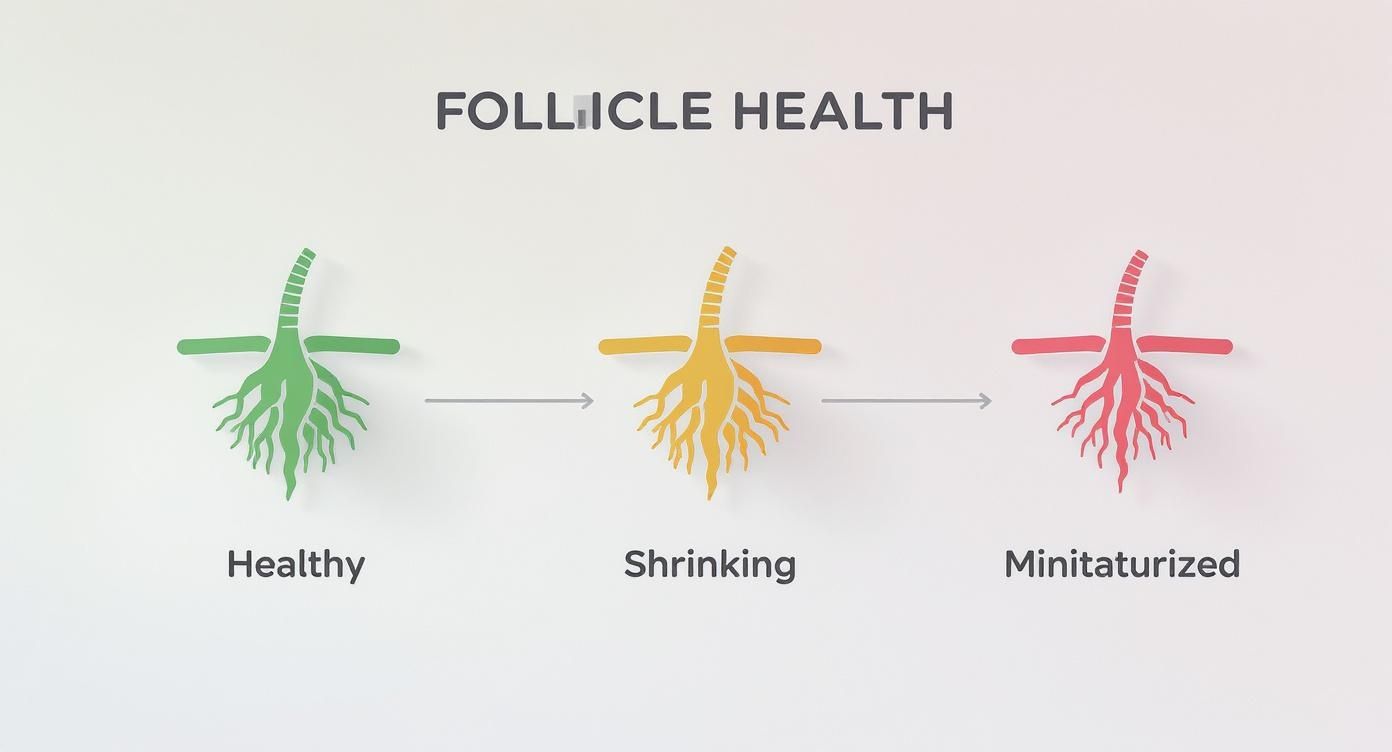
As you can see, the root of the follicle gets shallower and the hair shaft itself thins out at each stage. It perfectly illustrates the gradual but damaging effect of miniaturization.
Genetic Sensitivity: The Real Determining Factor
It’s crucial to understand that DHT itself isn't the bad guy—it’s a normal male hormone. The real issue is the inherited sensitivity of your hair follicles. This explains why one person can have high DHT levels and a full head of hair, while someone else starts thinning with completely normal levels.
It all comes down to the genetic lottery. This is a globally significant reality, as hair follicle miniaturization is the main biological process behind androgenetic alopecia. This condition affects an estimated 50% of men by age 50 and up to 40% of women by age 70. That constant hormonal signaling systematically weakens the follicles, turning a once-powerful growth engine into a shadow of its former self.
Other Contributing Factors to Follicle Health
While genetics and hormones are the primary drivers, other factors can absolutely influence your scalp's health and even speed up the thinning process. A healthy follicle is a hungry one—it needs a constant supply of nutrients and oxygen to do its job well.
Certain stressors can weaken follicles, making them even more vulnerable to DHT's effects:
- Poor Blood Flow: Reduced circulation to the scalp can starve follicles of the oxygen and nutrients they need to thrive. Think of it like trying to grow a plant in poor soil.
- Chronic Inflammation: Scalp conditions like dermatitis or psoriasis create an inflammatory environment that can easily disrupt the hair growth cycle.
- Lifestyle Habits: Things like chronic stress, smoking, and not getting enough quality sleep can throw your hormones out of whack and impact the health of all your cells, including your hair follicles.
On top of that, things like nutritional deficiencies impacting hair health can also play a major role in why follicles shrink. By addressing these underlying issues, you create a much better environment for your hair to grow, which can support any treatments you're using to fight miniaturization.
How to Spot the Signs of Miniaturization
Knowing the science behind miniaturization is one thing, but catching it early is what truly gives you the upper hand. The whole process can be incredibly subtle at first, making it easy to brush off. You might just feel like your hair isn't as full as it used to be, or maybe you notice a bit more scalp showing through under the bathroom lights.
These aren't just vague feelings; they are the very first signs of miniaturized hair follicles. Learning to spot them is the key to shifting from simply worrying about hair loss to taking decisive, informed action. It's about becoming an active participant in your own hair health journey.
Looking Beyond the Obvious Clues
When most people think of balding, they picture a receding hairline or a thinning spot on the crown. And while those are definitely classic patterns, miniaturization often sends out more subtle signals long before those areas become obvious.
One of the most telling early signs is a noticeable change in hair texture. The strands in thinning areas might start to feel softer, weaker, or more fragile than the hair on the sides and back of your head. You might also notice that these hairs just don't grow as long as they once did—a direct result of that shrinking anagen (growth) phase we talked about earlier.
A key indicator that professionals look for is hair caliber variation. In simple terms, this means that within one small patch of your scalp, you have a mix of thick, healthy hairs sitting right next to thin, wispy, miniaturized ones. This inconsistency is a dead giveaway that DHT is at work, shrinking some follicles while their neighbors are still holding strong.
What to Look For at Home
You can absolutely be your own first line of defense just by paying close attention to a few specific changes. Think of these as the early warning system for follicle miniaturization.
- Increased Scalp Visibility: Is it suddenly easier to see your scalp, especially under bright lights or when your hair is wet? This often points to a loss of density as individual hairs become finer.
- A Widening Part: If you wear your hair longer, a part line that seems to get wider over time is a classic sign of thinning across the top of the scalp.
- Changes in Hair Quality: Take a look at the hairs on your brush or in the shower drain. Are you seeing more short, fine, almost colorless hairs? Those are likely miniaturized hairs that have been shed.
- Lack of Volume: Does your hair feel flat and limp, refusing to hold any style or body? This often happens when the diameter of each individual hair strand has decreased.
Keeping an eye on these details gives you a much better handle on what's going on. If you want to get more methodical, you can even learn more about how to measure hair density to track any changes with more precision.
The Professional Diagnosis: Trichoscopy
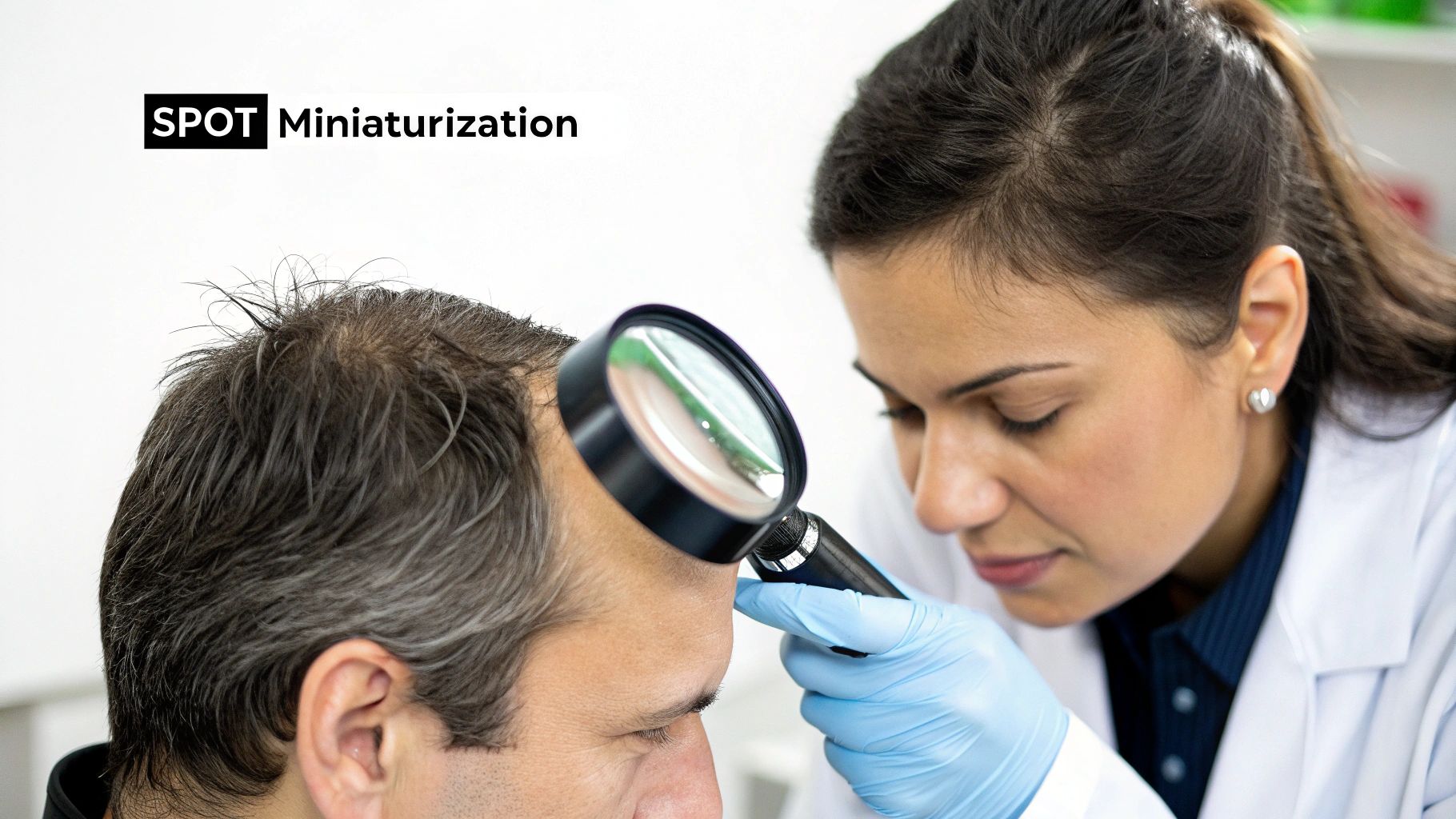
While observing your hair at home is a great start, a dermatologist can give you a definitive diagnosis using a tool called a trichoscope. You can think of it as a high-powered, specialized magnifying glass designed specifically for looking at the scalp and hair.
This simple, non-invasive exam lets a clinician see exactly what's happening at the follicular level in incredible detail. A trichoscopy can clearly reveal:
- Significant variation in hair shaft diameter, which is the clinical confirmation of miniaturized hair follicles.
- Reduced follicular units, meaning fewer hairs are growing out of each pore than there should be.
- "Yellow dots," which are essentially empty follicular openings clogged with sebum, marking spots where hair has already stopped growing.
This kind of professional analysis takes all the guesswork out of the equation. It provides a clear, evidence-based snapshot of your scalp's condition, confirming not only if miniaturization is happening, but also how advanced it is. From here, you can build a truly effective treatment plan.
Can Miniaturized Follicles Actually Be Revived?
This is the question on everyone’s mind when they start noticing their hair thinning: can we turn back the clock? Is it really possible to bring those shrunken, weakened follicles back from the brink? The answer, thankfully, is a hopeful "yes"—but there’s a major catch.
Success all comes down to timing. Think of it like a plant that's starting to wilt. If you catch it early and give it a good watering, it will perk right back up, good as new. But if you wait weeks until the stem is brown and brittle, no amount of water is going to save it.
Hair follicles work in much the same way. In the early stages of miniaturization, the follicle is struggling but it's still alive and kicking. It has a blood supply, and it's still capable of producing hair, even if it's a fine, wispy one. Intervene at this stage, and your odds of success are excellent.
The Point of No Return
The real problem starts when a follicle has been miniaturized for a long, long time. After years of being hammered by DHT, a follicle can shrink so much that it simply goes dormant. Worse still, the tissue around it can start to change.
If left alone for too long, the follicle can get trapped in fibrotic tissue, essentially walling it off from the blood and nutrients it needs to grow. At that point, the follicle is effectively lost for good, and reviving it with non-surgical treatments becomes next to impossible.
This is exactly why "act now" isn't just a catchy phrase—it's the single most important rule in fighting hair loss. Waiting until your thinning is obvious means you’re working with a much smaller pool of salvageable follicles.
The key principle is simple: A follicle that’s still producing even a tiny, vellus-like hair is a follicle you can save. But a follicle that has gone completely dormant and scarred over is likely gone forever.
What the Science Says About Follicle Permanence
The idea that some hair loss can become permanent isn't just a modern theory. In fact, research going back decades has shown the deep structural changes that happen during miniaturization. This isn't just about a follicle getting smaller; it's a biological cascade that can permanently alter the scalp at a cellular level.
A landmark observation from way back in 1942 found that even when androgens were blocked, the miniaturized follicles in men with long-term baldness didn't recover. This suggested the damage was set in stone. More recently, scientists have identified tough, dense deposits of elastic fibers (called Arao-Perkins bodies) under these dormant follicles, which might physically block them from ever growing again. You can read more about these fascinating historical insights on the persistent nature of miniaturized follicles.
It all points to the same conclusion: the sooner you intervene, the better. The longer a follicle is exposed to DHT's damaging influence, the greater the risk of these permanent, structural changes taking hold.
Setting Realistic Goals for Treatment
Keeping this biological timeline in mind is absolutely essential for setting realistic expectations for any treatment you start. The strategy is really twofold:
- Protect What You Have: The absolute first priority is to stop healthy follicles from starting the miniaturization process in the first place.
- Revive What You Can: The second goal is to reverse the damage in those follicles that have started to shrink but haven't been lost completely.
Effective treatments work by blocking DHT, improving blood flow, and giving those weakened follicles the support they need to get back to their prime. Success isn't an overnight miracle. It's a slow, steady process of turning things around, where you'll see those thin, weak hairs gradually become thicker, darker, and stronger over the course of many months.
Proven Treatments to Reverse Miniaturization
Knowing that shrunken hair follicles aren't necessarily a lost cause is the first piece of good news. The next logical question is, "Okay, so what actually works?" Thankfully, we've come a long way from the snake oil and miracle tonics of the past. Today's most effective strategies are rooted in science, designed to tackle miniaturization at its source to protect the hair you have and coax weakened follicles back to health.
The goal of any legitimate treatment is to tip the scales back in favor of growth. This means either running interference on DHT's destructive signals or giving follicles a direct boost of energy, blood flow, and vital nutrients. By addressing the problem from different angles, you can build a powerful defense and give yourself the best shot at seeing real, noticeable improvement.
FDA-Approved DHT Blockers and Growth Stimulants
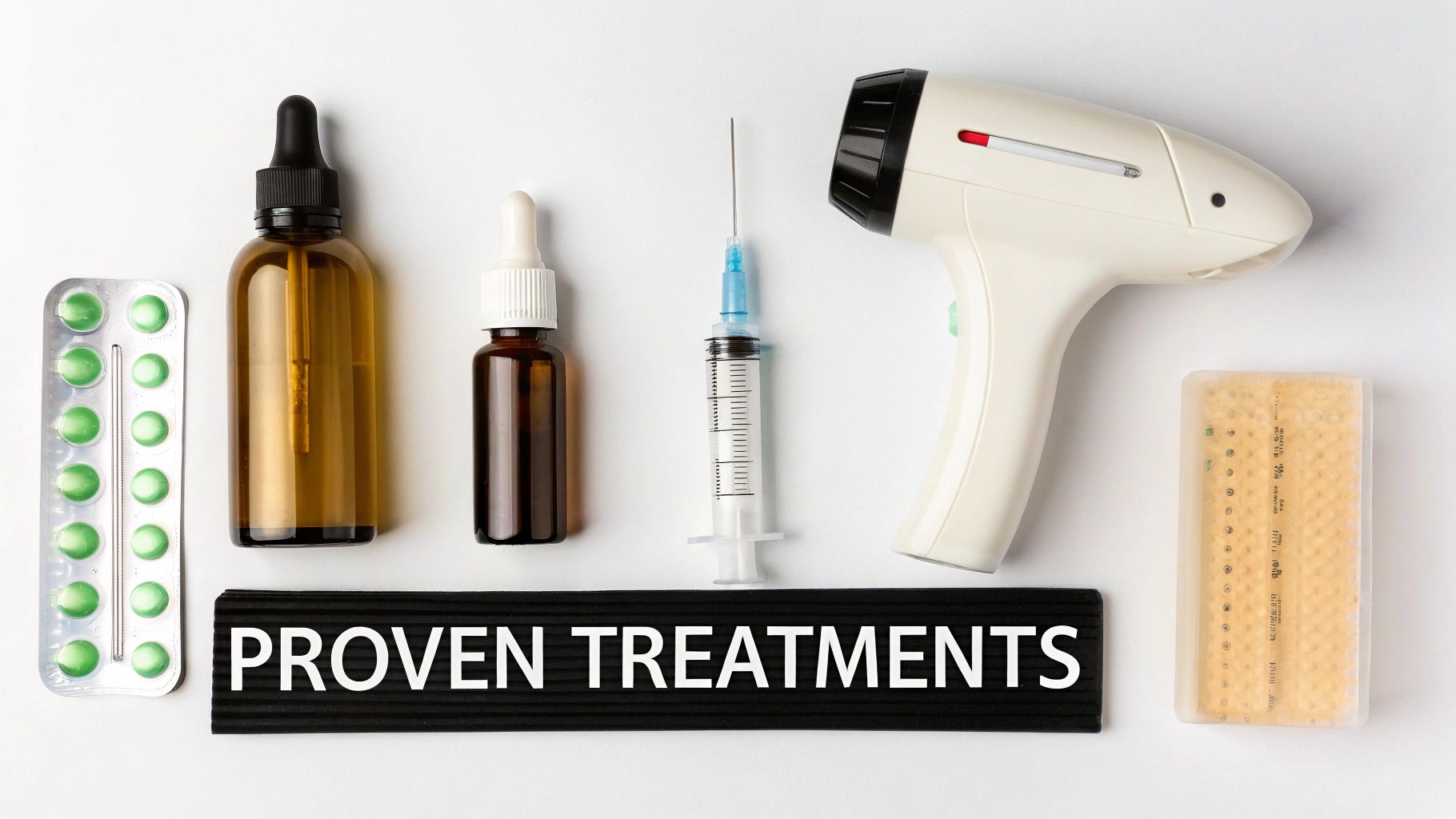
When you start researching medical treatments for hair loss, two names will pop up again and again: Finasteride and Minoxidil. They are the cornerstones of modern hair loss therapy for a simple reason—they're backed by decades of clinical data and have helped millions of men.
First up is Finasteride. Think of this as your frontline defense against DHT. It’s an oral pill that works systemically to block the 5-alpha reductase enzyme, the culprit that converts testosterone into the much more potent DHT. By dramatically reducing DHT levels in the scalp, Finasteride essentially takes away the "shrink" command, giving your follicles a fighting chance to survive and thrive.
Then there's Minoxidil. You might have heard it was first a blood pressure drug, and its ability to grow hair was a fortunate side effect. Minoxidil is usually a topical foam or liquid that acts as a vasodilator. In plain English, it widens the tiny blood vessels in your scalp, allowing more oxygen, blood, and nutrients to reach the follicles. It also helps kick-start and prolong the anagen (growth) phase, encouraging those wispy, miniaturized hairs to grow back thicker and stronger.
A simple analogy: Finasteride is the bodyguard that stops the bully (DHT) from getting to your follicles. Minoxidil is the medic that rushes in with supplies to help the weakened follicles recover and rebuild.
A Deeper Dive: Platelet-Rich Plasma (PRP) Therapy
Moving beyond daily pills and topicals, Platelet-Rich Plasma (PRP) therapy has become a game-changer. It’s a compelling option that uses your body's own healing power to directly rejuvenate miniaturized follicles, making it ideal for those seeking a more natural approach or a powerful addition to their current routine.
The procedure itself is quite elegant.
- Simple Blood Draw: A small vial of your blood is drawn, no different than a routine lab test.
- Concentrating the Good Stuff: That blood is spun in a centrifuge, a machine that separates it into layers. This process isolates the platelets and plasma, creating a super-concentrated, golden-colored serum.
- Targeted Injections: This "liquid gold," packed with growth factors, is then meticulously injected back into the areas of your scalp where thinning is most visible.
So, why does this work? The platelets in PRP are biological powerhouses, loaded with growth factors that essentially shout a wake-up call to sluggish follicles. They promote cell repair, boost circulation, and can nudge miniaturized follicles out of their dormant state and back into a healthy growth cycle. Study after study has shown PRP can measurably increase hair density and thickness, confirming its place as a key player in reversing miniaturization.
Other Effective Therapeutic Options
While Finasteride, Minoxidil, and PRP form the "big three" for many, they aren't the only tools in the shed. Often, the best results come from a strategic combination of treatments that work in different ways. Our guide on the best hair thickening treatments explores how to build a comprehensive plan.
A popular and easy-to-use option is Low-Level Laser Therapy (LLLT). This technology uses caps or combs that emit a specific wavelength of red light. This light energy is thought to be absorbed by your follicular cells, revving up their metabolism and improving their function. It's a painless, non-invasive treatment you can do right from your couch.
Of course, for more significant hair loss where follicles have unfortunately died off completely, a hair transplant is still the gold standard. This surgical procedure doesn't revive dead follicles; instead, it moves healthy, DHT-resistant follicles from the back and sides of your head to the thinning areas. The result is a permanent, natural-looking restoration of density.
Comparing Popular Treatments for Hair Miniaturization
With several proven paths, figuring out where to start can be tricky. The right choice depends on your stage of hair loss, lifestyle, budget, and personal preferences.
To make things a bit clearer, here’s a quick comparison of the top treatments for miniaturized hair follicles.
| Treatment | Mechanism of Action | Average Cost Range | Best For | Time to See Results |
|---|---|---|---|---|
| Finasteride | Blocks DHT production to stop follicle shrinkage. | $30 – $90 / month | Early to moderate pattern baldness. | 3-6 months to slow loss, 6-12 months for regrowth. |
| Minoxidil | Increases blood flow and extends the growth phase. | $20 – $50 / month | General thinning, especially at the crown. | 4-6 months. |
| PRP Therapy | Injects growth factors to stimulate follicle repair. | $500 – $1500 / session | Diffuse thinning with active follicles. | 3-6 months (after 2-3 sessions). |
| LLLT | Uses red light to boost cellular energy in follicles. | $500 – $3000 (device) | Slowing early-stage loss and supporting other treatments. | 6+ months. |
| Hair Transplant | Surgically relocates DHT-resistant follicles. | $4,000 – $15,000+ | Advanced hair loss with stable donor areas. | 6-12 months for final result. |
Ultimately, the best strategy is a personalized one. Consulting with a dermatologist or a hair loss specialist is the most important step you can take. They can properly diagnose the extent of your miniaturization and help you build a realistic and effective plan to get you back on track to a fuller, healthier head of hair.
Your Realistic Hair Regrowth Timeline
If there's one thing you need when trying to bring miniaturized hair follicles back to life, it's patience. Seeing real, lasting results from any effective treatment is a marathon, not a sprint. The best thing you can do for yourself is to set realistic expectations right from the start—it's what will keep you motivated and consistent.
The first victory you'll probably celebrate isn't a sudden explosion of new hair. It's actually a significant reduction in shedding, which usually happens within the first 3 to 6 months of consistent treatment. Think of it as the first clear sign that you're successfully putting the brakes on miniaturization and stabilizing your follicles.
The First Signs of Progress
Once your hair loss has stabilized, the real work of regrowth begins. Your follicles need time to reset their cycle and start producing healthier, stronger hair. Generally, you can expect to see the first visible signs of regrowth and increased thickness somewhere between 6 to 12 months.
These new hairs will look and feel different—they'll be stronger and more pigmented, a stark contrast to the weak, wispy hairs they're replacing. Understanding how long different treatments, like PRP, take to work can give you a better benchmark for what to expect and how to track your progress accurately.
One of the most confusing (but positive!) signs you might see is an initial shedding phase, especially with treatments like Minoxidil. Don't panic. This is actually a fantastic sign that the treatment is pushing out old, weak hairs to make room for new, healthy ones to grow in.
This temporary shedding shows that your follicles are actively resetting their growth cycles. It’s a short-term phase that comes right before you start seeing those stronger, more resilient strands emerge.
Staying Consistent for Long-Term Success
Keep in mind, the damage from follicle miniaturization happened over many years, so it's going to take many months to see a meaningful reversal. The absolute key is unwavering consistency. Skipping treatments or missing doses can halt the recovery process and send you back to square one.
Here’s a simplified timeline to help you stay on track:
- Months 1-3: You might see some initial shedding. This is totally normal.
- Months 3-6: Hair loss should slow down noticeably. This is your first win!
- Months 6-12: Real, visible thickening and new growth starts to appear.
- Months 12+: You'll see continued improvement and focus on maintaining your results.
By understanding this timeline, you can celebrate the small victories along the way and stay committed to the long-term goal.
Got Questions? Let's Talk About Miniaturization
Even when you get the science, real-world questions always pop up. Let's dig into some of the most frequent things people ask when they first learn about this process.
Does Stress Actually Make Follicles Shrink?
This is a big one. While intense stress can cause a different kind of hair loss called telogen effluvium (where you suddenly shed a lot of hair at once), it doesn't directly cause the slow, progressive shrinking of follicle miniaturization.
That said, think of chronic stress as gasoline on a fire. If you already have a genetic tendency for hair loss, ongoing stress can absolutely make things worse and potentially speed up the process.
Can a Shrunken Follicle Ever Grow a Normal Hair Again?
Absolutely, but there's a catch: you have to act before it's too late. This is precisely what treatments like Minoxidil, Finasteride, and PRP are designed to do—they work to reverse that shrinking process.
The goal is to give the follicle the support it needs to get back to producing a healthy, thick, pigmented hair. The sooner you intervene, the better your chances are of seeing that happen.
What About All Those Hair Growth Shampoos and Supplements?
Most of the shampoos and supplements you see on the shelf are best thought of as part of the supporting cast. They can definitely help by improving the overall health of your scalp and making sure your body has the right nutrients for hair production.
They create a better environment for growth, but they typically aren't strong enough on their own to stop or reverse the powerful hormonal effects of DHT. Consider them a helpful addition to proven medical treatments, not a substitute.
To get a clearer picture of your own health and treatment options, well-sourced information is key. Using effective patient education resources can make a significant difference in understanding and managing your condition.
At PRP For HairLoss, we believe that understanding the "why" is the first step toward finding the right solution. Dive into our guides to learn more about your options and take back control of your hair's future. Visit us at https://prpforhairloss.com.
 PRP For Hairloss
Leave a comment