When people ask me how long PRP takes to work, I always stress the importance of having realistic expectations. This isn't some magic overnight fix. While you might notice some subtle changes sooner, you'll generally start seeing the results you're looking for within 3 to 6 months.
The Honest Answer About Your PRP Timeline
Platelet-Rich Plasma (PRP) therapy taps into your body's own biology, which means it works on a natural schedule. Think of it less like flipping a switch and more like planting a garden. We're giving your body the "seeds"—its own powerful growth factors—and it simply needs time for those seeds to sprout and flourish.
Unlike treatments that just put a band-aid on the symptoms, like a steroid injection, PRP is designed to kickstart genuine, long-term healing from the inside out. This slow-and-steady approach is actually what makes it so powerful. Your body is meticulously rebuilding tissue, whether that's waking up dormant hair follicles or repairing a worn-out joint. That natural pace is a good sign that real, lasting repair is happening.
For those combining treatments, understanding the microneedling recovery timeline can also be helpful, as it gives you a fuller picture of the entire healing journey.
PRP therapy leverages your body's innate healing abilities, which means the timeline is dictated by natural cell regeneration cycles. Patience isn't just a virtue here; it's a necessary part of the process.
This infographic helps visualize how PRP results build over time, from the initial cellular activity to the mature, visible improvements you're hoping for.
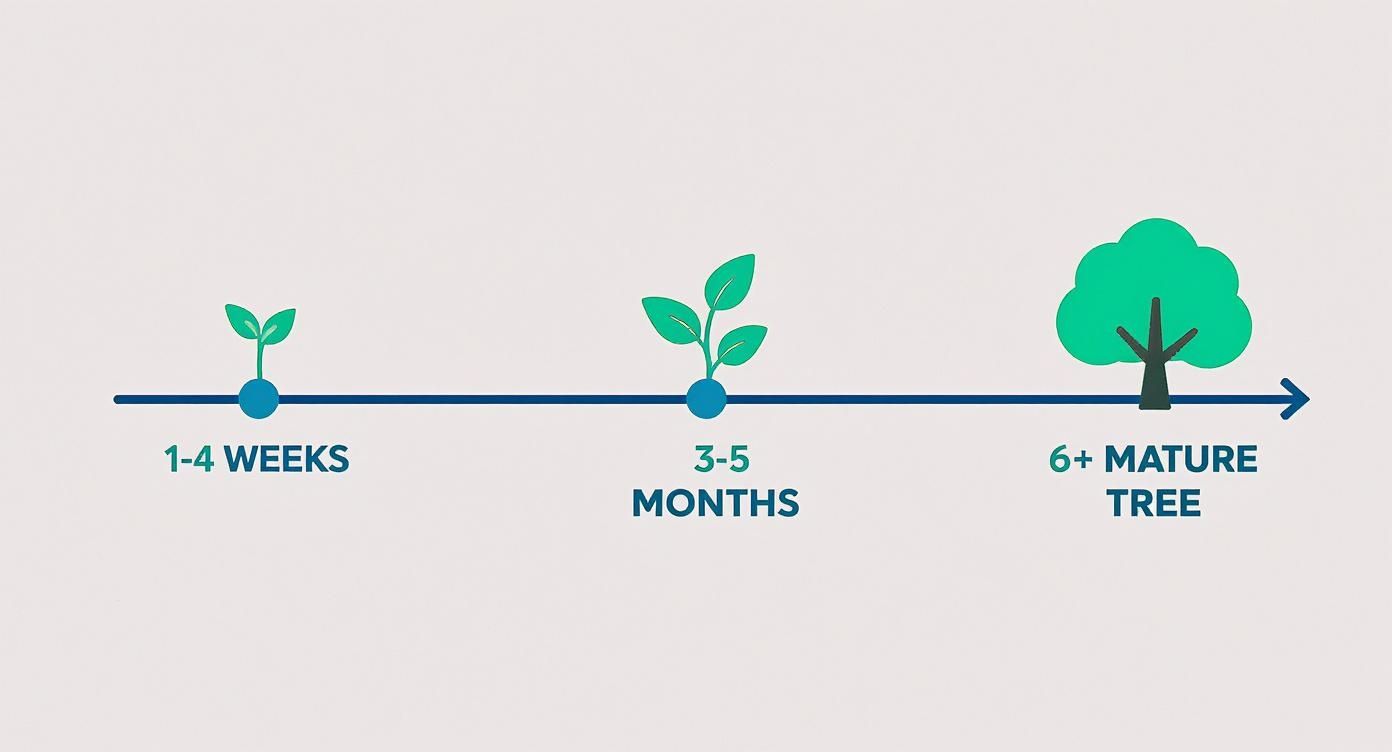
As you can see, the journey kicks off with foundational repairs in the first month. From there, it builds into more substantial growth and healing over the next several months.
PRP Results Snapshot by Treatment Area
While everyone’s body is a unique case, it helps to have a general idea of what to expect for specific treatments. This table gives a quick look at typical timelines for some of the most common PRP applications.
| PRP Application | First Noticeable Changes | Peak Results Expected |
|---|---|---|
| Hair Restoration | 3-4 months | 6-12 months |
| Skin Rejuvenation (Face) | 3-4 weeks | 3-6 months |
| Joint Pain Relief | 4-6 weeks | 6-9 months |
| Tendon/Ligament Injury | 6-8 weeks | 4-6 months |
Just remember, these are averages. Your personal results will depend on your health, the specific area being treated, and how many sessions you have. It's all about giving the body what it needs to rebuild and then giving it the time to do its work.
How Your Body Puts PRP to Work
To really wrap your head around why PRP results don't pop up overnight, you have to look at what’s happening on a cellular level. Picture PRP as a team of highly-skilled first responders arriving at the scene of an injury. The platelets are the team captains, loaded with powerful growth factors that act like a detailed repair manual for your cells.
Once injected, these platelets release a flood of these growth factors, sending out powerful signals that kickstart the healing process. This isn't a quick fix or a temporary patch. It's a fundamental renovation project that your body manages from the inside out.
This is exactly why PRP is considered a regenerative therapy. It's not about hiding symptoms; it’s about giving your body a super-concentrated dose of the natural resources it needs to genuinely heal itself.
The Three Phases of Healing with PRP
The healing journey that PRP sets in motion happens in three distinct stages. Each phase has its own job and its own timeline, which explains why the final results take a while to become visible. It's a beautifully complex biological sequence.
-
Phase 1: Inflammation (First Few Days)
Right away, the growth factors trigger a controlled inflammatory response. This is your body's "911 call," signaling that a repair process needs to begin and summoning other healing cells to the site. -
Phase 2: Proliferation (Weeks 1-6)
This is the rebuilding stage. Your body gets busy producing new cells, forming new blood vessels, and laying down a fresh matrix of collagen and other tissues. The real foundational repairs are happening here. -
Phase 3: Remodeling (3+ Months)
Now it's time for strengthening and refining. The new tissue that was just built starts to mature, organize itself, and become stronger and more integrated with the surrounding area. This is where you’ll start to see the most noticeable, lasting results.
The PRP timeline is a direct reflection of your body's own natural healing process. The wait is actually a good sign—it means that true, deep-seated repair is happening at the cellular level, leading to results that are built to last.
Understanding what platelet-rich plasma is and how it works is the first step to setting realistic expectations for your treatment. To complement this process, you can also look into broader strategies for faster healing and recovery that can support your body's efforts.
Your Timeline for Joint Pain Relief with PRP
If you're thinking about PRP for a nagging knee or a stiff shoulder, you're probably asking one big question: "When will I feel better?" It's a fair question, but it’s important to remember that PRP isn't a quick fix like a painkiller. It’s a regenerative treatment that works with your body, and that takes time.
The first few weeks after the injection might feel… well, pretty quiet. This is the crucial "behind-the-scenes" phase. The platelets we’ve introduced are hard at work, sending out signals to your body’s repair crews to get started on rebuilding damaged tissue. Don't mistake this initial stillness for a sign that it isn't working.
Most people start to notice the first real glimmers of hope around the four to six-week mark. You might find that morning stiffness isn't quite so bad or that a familiar ache has started to fade. This is the first tangible proof that the foundational repair work is paying off.
The Path to Significant Improvement
The most dramatic and lasting improvements usually show up between three to six months post-treatment. This is when the newly generated tissue really begins to mature and strengthen, leading to much better joint function and a significant drop in pain. Think of it less like flipping a switch and more like a sunrise—the improvement is gradual, steady, and brightening over time.
The goal of PRP isn't just to temporarily mask symptoms; it's to repair the underlying damage for long-term relief. This deeper, structural healing process is why patience is so essential.
This timeline isn't just anecdotal; it's backed by research. A major meta-analysis looking at knee osteoarthritis found that while patients saw clear benefits at six months, the positive effects often became even more pronounced at the 12-month mark.
Ultimately, understanding this timeline is key. The platelet-rich plasma results will always be unique to the individual and the specific joint being treated. But for joint pain, the entire process is geared toward fostering durable, meaningful healing that helps you reclaim your active life.
When to Expect New Growth from PRP for Hair Loss
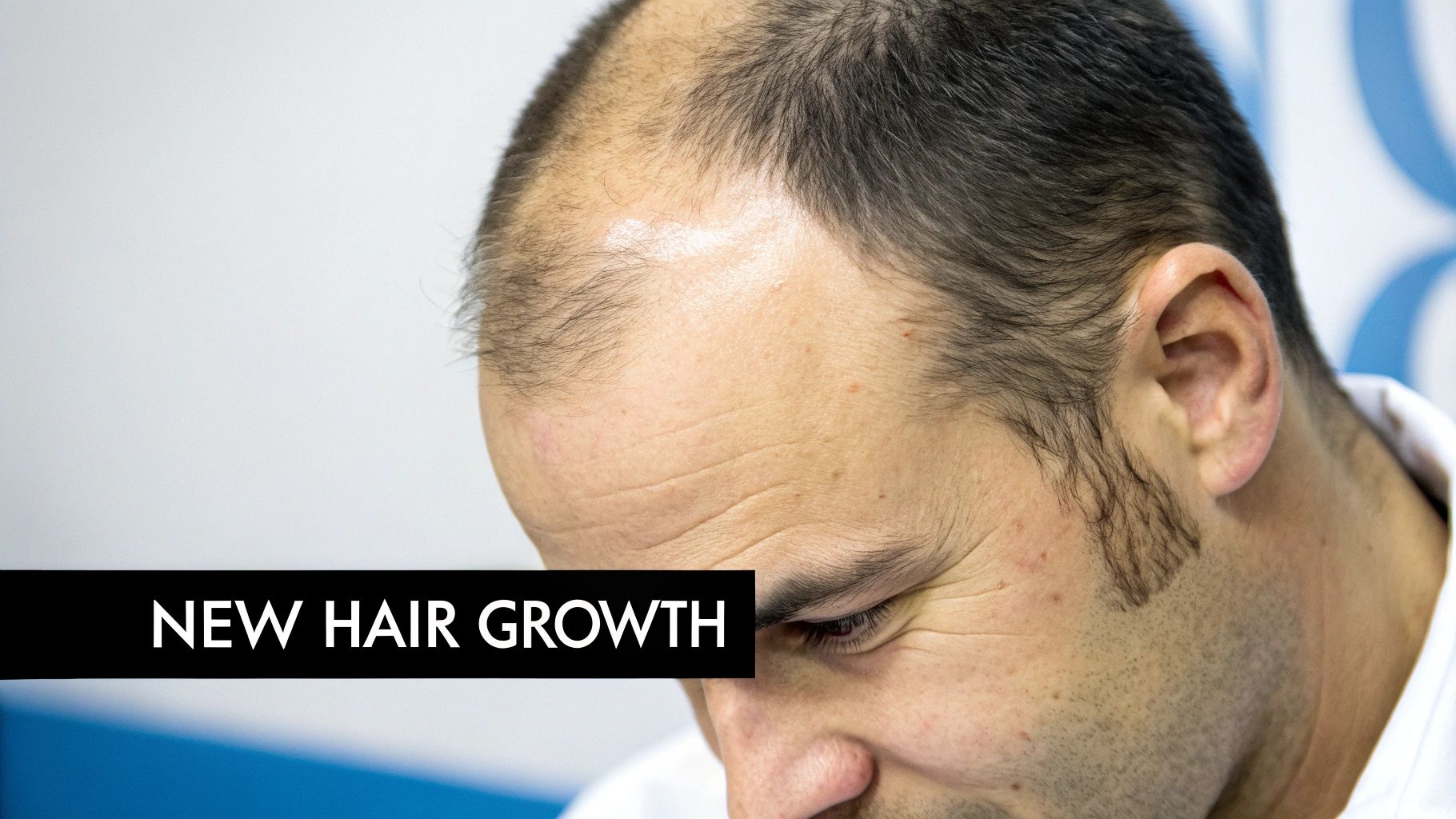
When you’re dealing with thinning hair, the one thing you want is fast results. But with PRP, patience is absolutely part of the process. The timeline for seeing new growth is tied to your body’s natural hair growth cycle, a biological rhythm that just can't be fast-forwarded. Your body needs time to respond to the growth factors we’ve just introduced.
One of the very first signs that things are working isn't a sudden explosion of new hair. In fact, many people tell me they notice a significant reduction in hair shedding within the first month or two. This is a fantastic early signal that the PRP is fortifying your existing hair follicles.
This initial phase is crucial. By slowing down hair fall, you’re holding onto the hair you have, giving the treatment the time it needs to wake up dormant follicles under the scalp.
Spotting the First Signs of New Hair
The results most people are waiting for usually start to show up around the three to six-month mark. This is when you might begin to see very fine, soft, new hairs—what we call "vellus" hairs—sprouting in the areas we treated. It’s the first real evidence that dormant follicles are kicking back into gear.
Think of it like planting a new lawn. You don't get a thick carpet of grass overnight. First, you see those tiny green shoots pushing through the soil. That's what this stage is like—it’s undeniable proof that growth is happening.
As the months go by, these new hairs should mature. They'll get thicker, darker, and longer, gradually adding to your overall hair density. If you want a more detailed breakdown of what to expect, check out our PRP hair treatment timeline.
This whole journey is why we almost always recommend an initial series of treatments, typically three sessions spaced about a month apart. It’s all about building momentum to get you the best possible outcome.
What Really Influences Your PRP Results?
https://www.youtube.com/embed/4s3BsfbfSI8
Ever wonder why one person sees amazing results from PRP in a couple of months, while another’s progress feels slower? It’s because the timeline isn't set in stone. Several key factors can either put your results on the fast track or slow things down, making everyone's journey a little different.
Your personal timeline is a blend of your own biology and the specific treatment plan your provider puts together. Just like a personal fitness plan, the details matter—a lot.
The real answer to "how long does PRP take to work" has less to do with a universal clock and more to do with your personal health profile and the strategy behind your treatment. Once you get a handle on these variables, you’ll have a much clearer picture of what to expect.
Your Body and Your Treatment Plan
Think of your body as the soil and PRP as a high-quality fertilizer. The "richness" of the soil—your overall health—plays a huge role in how well that fertilizer works. Things like your age, the specific condition you're treating, and your body's own natural healing ability all come into play.
The treatment protocol itself is just as critical. For example, a dose-response study on knee pain found that the benefits really stacked up with each session, hitting their peak after the fourth and fifth injections. Pain scores improved from -7.7 after the first shot to a much more impressive -25.26 after the fifth. This shows that while more isn't always better, finding the right number of sessions is absolutely key. You can read more about these PRP treatment findings to see just how much a structured plan impacts results.
The specific technique used also makes a difference, which is why understanding the basics of platelet-rich plasma preparation can be so helpful. A few of the most critical variables include:
- Age and Health: It's no surprise that younger, healthier people often have a more powerful healing response.
- Condition Severity: Treating the first signs of hair thinning will likely have a different timeline than tackling advanced joint degeneration.
- Following Aftercare: How well you stick to post-treatment instructions, like avoiding certain medications, is crucial for success.
- Number of Sessions: Most conditions need a series of treatments to really build momentum and get the best, most lasting results.
Why the Quality of Your PRP Matters
It’s a common misconception, but not all PRP treatments are the same. In fact, the quality of the PRP itself can dramatically influence how quickly you see results and how effective they are.
Think of it like brewing coffee. You can use the same beans, but a weak, watery brew won't give you the same kick as a rich, concentrated espresso shot. The same principle applies here: a more potent, concentrated dose of platelets will always deliver a stronger regenerative punch.
A high-quality PRP treatment is packed with a dense concentration of platelets, which means your body gets a powerful dose of the growth factors needed for healing and regrowth. A low-quality or diluted preparation, on the other hand, might not have enough horsepower to kickstart a significant response, often leading to underwhelming results.
Getting the Best Possible Outcome
So, how can you make sure you’re getting a top-tier treatment? Don't be shy about asking your provider a few key questions before committing. A good place to start is to ask about their preparation methods and the specific platelet concentration levels they aim for in their final product.
The absolute number of platelets in the final PRP injection is one of the most critical factors for achieving strong, lasting effects. A higher concentration doesn't just work better—it often works for longer, too.
Research consistently backs this up. One clinical trial, for example, discovered that a PRP formula with a total platelet count of over 10 billion had a protective effect on knee cartilage that lasted for up to a year. You can read the full research on PRP concentration here.
This really drives home why the quality of your PRP is just as important as the treatment itself. To get a better sense of what this means for your specific goals, check out our deep dive into the PRP injection success rate.
Frequently Asked Questions About the PRP Timeline
When you're thinking about starting PRP, a lot of practical questions naturally come to mind. Getting a handle on the details can make you feel more confident and help you set realistic expectations for what's to come. Let's tackle some of the most common questions we hear about how long PRP takes to work.
Knowing the answers helps clarify the timeline by focusing on the factors you can actually influence.
Can I Do Anything to Make PRP Work Faster?
While you can't exactly speed up your body's natural healing clock, you can definitely create the perfect environment for it to do its job well. The most critical thing you can do is follow your doctor's aftercare instructions to the letter.
This advice usually boils down to a few key things:
- Steer clear of anti-inflammatory drugs like ibuprofen. These can actually block the very healing signals that PRP is designed to kickstart.
- Rest the treated area just as your doctor recommends. This gives the repair process a chance to get going without any interruptions.
- Fuel your body with a nutrient-rich diet. Your body needs the right raw materials to build new, healthy tissue.
- Stay hydrated. Every single process in your body, including healing, depends on water.
Think of it this way: you're giving your body's repair team the best tools and a quiet, supportive worksite to get the job done right.
Will I Need More Than One Treatment?
For the vast majority of people, yes. It's much better to think of PRP as a therapeutic program rather than a single, quick fix. For hair restoration, a typical plan starts with an initial series of three treatments, each spaced about a month apart.
After that first round, we usually recommend maintenance sessions once or twice a year. This helps keep your results going strong and continues to support the regenerative process long-term.
For joint pain or injuries, the protocol might involve two or three injections to methodically build up the healing response. Staging the treatments like this provides a sustained release of growth factors, which is often what it takes to get a more significant and durable result.
How Will I Know If It Is Not Working?
Patience is key. You have to give the process enough time and, just as importantly, complete the full treatment plan your doctor laid out. It’s almost always too early to make a final call before the six-month mark, since that's when the most substantial results really start to show.
Your provider will schedule follow-up appointments to monitor your progress. If you’ve completed the entire series of injections and still haven't seen any real improvement after six to nine months, that's the point to have an honest talk with your doctor. You can then discuss whether PRP is truly the best path for you or explore other options.
At PRP For HairLoss, we believe in giving you clear, straightforward information about hair restoration. Dive into our resources to see how PRP might help you reach your goals. Find out more at prpforhairloss.com.


Leave a Reply