When you start digging into PRP for hair loss, one of the first things on your mind is probably the price tag. Let's cut to the chase: the PRP hair restoration cost can swing anywhere from $400 to over $1,500 for a single session. For the complete, initial round of treatments, you're usually looking at an investment between $2,000 and $6,000.
Decoding the Price of PRP Hair Restoration
Figuring out the cost of Platelet-Rich Plasma (PRP) therapy isn't like looking up a price in a catalog. It's much more like pricing a custom-built service, where the final number really depends on a few key factors that we'll break down right here.
What you're being quoted for is a sophisticated medical treatment that harnesses your body's own healing abilities to wake up hair follicles. The whole thing involves drawing a little bit of your blood, spinning it down in a centrifuge to concentrate the powerful platelets, and then carefully injecting this "liquid gold" back into your scalp right where you need it most.
If you're brand new to all this, you can learn more about what PRP for hair loss is all about in our detailed guide.
To give you a clearer picture, here’s a quick rundown of what you can generally expect to pay.
PRP Hair Treatment Cost At a Glance
This table offers a snapshot of the typical costs you'll see with PRP hair restoration, covering everything from single sessions to the full initial treatment plan.
| Cost Component | Typical Price Range (USD) | Notes |
|---|---|---|
| Single PRP Session | $400 – $1,500 | Varies widely by location, clinic reputation, and the technology they use. |
| Initial Treatment Course | $2,000 – $6,000 | Usually includes 3-6 sessions. Buying a package often lowers the per-session rate. |
| Maintenance Sessions | $400 – $1,500 (per session) | Typically needed once or twice a year after you finish the initial course. |
Keep in mind, these are just ballpark figures. The only way to get a solid number is to schedule a consultation and get a quote tailored to you.
What Is the Average Cost Per Session?
A single PRP session is the basic building block of your entire treatment plan. Across the United States, you'll find that one treatment generally lands somewhere between $400 and $1,500.
Of course, your location plays a massive role. You might see prices pushing $2,500 in major hubs like Los Angeles or New York, where the cost of running a clinic is just naturally higher. On the flip side, clinics in smaller towns could offer the same excellent service closer to the $400 to $600 range.
The Initial Treatment Package
PRP isn't a one-and-done deal. Think of it like starting a new fitness routine; you need that initial consistency to really get things moving. To truly kickstart the hair follicles, clinics almost always suggest an initial series of treatments.
This usually means a course of three to six sessions, with each one spaced about a month apart.
A full course of PRP therapy is an investment in your hair's future. The initial series of treatments is designed to saturate the scalp with growth factors, creating the optimal environment for dormant follicles to reactivate.
From a purely financial perspective, buying a package is almost always the smarter way to go. While the total for a full course might land between $2,000 and $6,000, the price you pay per session usually gets a nice discount. This structure not only saves you some cash but also encourages you to follow through with the entire protocol—which is absolutely key for getting the results you're hoping for.
What Your PRP Investment Actually Covers
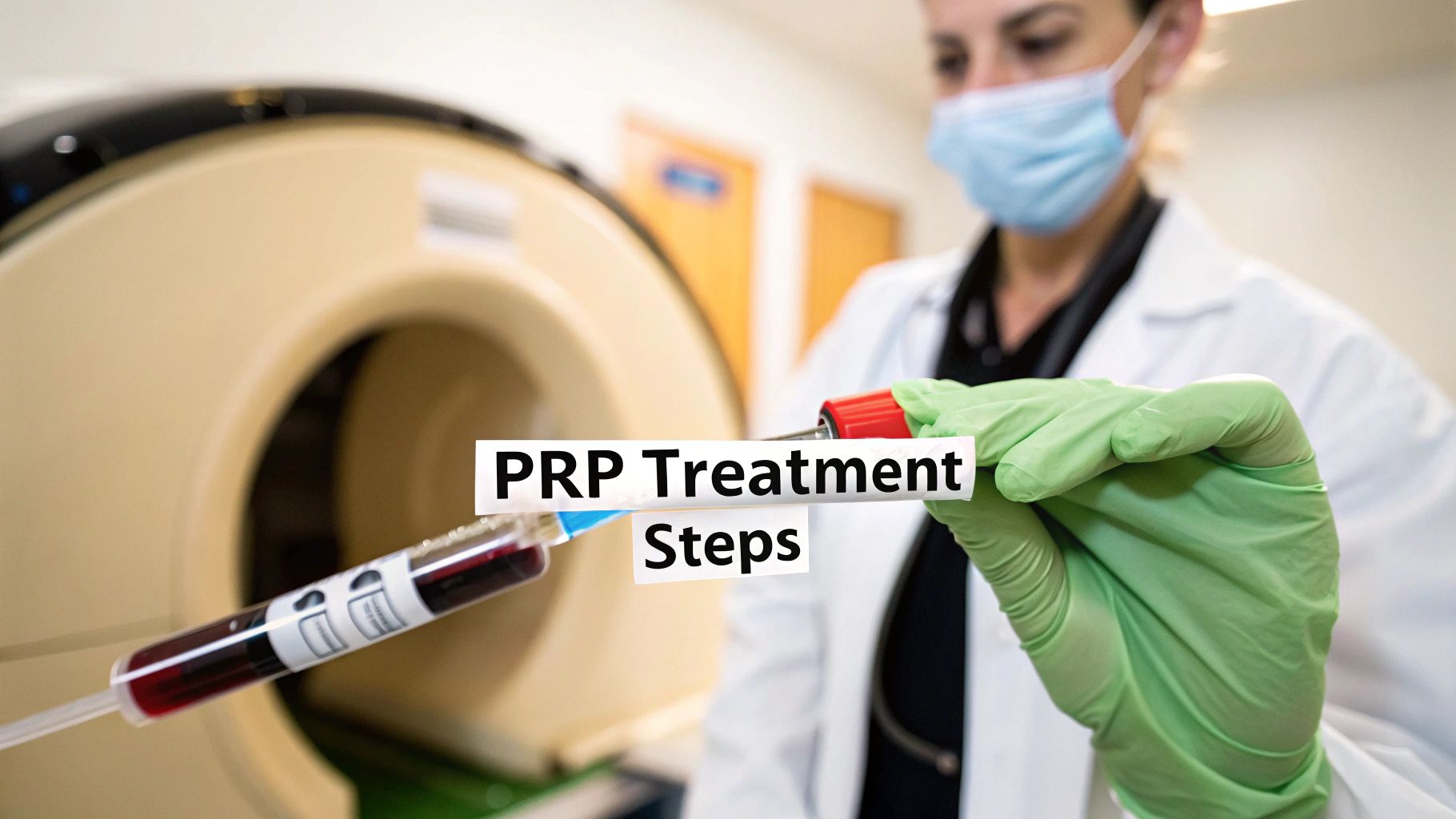
When you see that price quote for PRP hair restoration, it's totally fair to ask, "So, what am I actually paying for?" It's definitely not just for a quick shot. You're investing in a refined medical service that requires clinical expertise, specialized equipment, and a careful, step-by-step process.
Think of it less like a simple purchase and more like hiring a skilled craftsman to restore a piece of antique furniture. You're not just paying for the wood and varnish; you're paying for the skill, the specialized tools, and the steady hand of an expert who knows precisely how to bring it back to life.
The Blood Draw and Preparation
The process always starts with a simple blood draw, pretty much the same as what you’d have at a regular doctor's visit. A trained professional collects a small vial of your blood in a completely sterile setting. It’s a quick step, but it’s the foundation for the entire personalized treatment that follows.
This sample is the raw ingredient for creating your body's very own hair growth formula. Getting this first part right is crucial for the safety and success of everything else.
The High-Tech Separation: Using a Centrifuge
This is where the real science kicks in. That vial of blood is placed into a machine called a centrifuge. This device spins at an incredibly high speed, using powerful G-forces to separate your blood into its different layers.
It's sort of like a high-tech salad spinner, but for blood. The intense spinning forces the heavier red blood cells down to the bottom, leaving the lighter, golden-colored plasma at the top. Most importantly, it concentrates the platelets into this plasma layer, creating the Platelet-Rich Plasma (PRP) that is the powerhouse of the entire treatment.
This separation process is far more than a simple, one-size-fits-all spin. The quality of the centrifuge and the specific protocols—how fast it spins and for how long—directly influence how concentrated the platelets become. Top-tier clinics invest in advanced systems to get a more potent PRP, which is a big factor in the overall PRP hair restoration cost.
The resulting liquid is often called "liquid gold," partly for its amber color, but mostly because it's packed with an incredible concentration of natural growth factors. These are the biological messengers that tell your sleeping hair follicles it's time to wake up and get back to work.
Precision Injections: Where Skill Matters Most
The final, and most hands-on, part of the procedure is delivering that PRP back to your scalp. The practitioner carefully injects the prepared PRP into the specific areas where your hair is thinning. This isn't random; it requires a deep understanding of scalp anatomy and hair follicle depth.
An experienced practitioner’s technique is what really makes or breaks the treatment.
- Proper Depth: They have to inject the PRP at just the right level, right at the base of the hair follicles where it can do the most good.
- Even Distribution: The injections need to be spread out methodically across the treatment area to encourage uniform growth.
- Patient Comfort: A skilled hand can get the job done with minimal discomfort.
This is where the expertise you're paying for truly comes into play. You're not just buying a vial of PRP; you're investing in a professional's years of training and experience to put it exactly where it needs to be. To get a better feel for the whole journey, you can see a breakdown of the complete PRP procedure for hair.
What Goes Into the Final Price Tag?
Have you ever seen two clinics offering what seems like the same treatment but with wildly different prices and wondered what gives? The cost of PRP for hair loss isn't just some number pulled out of a hat. It’s a reflection of several key things that can really shift the final bill.
It's a bit like the real estate market—a condo in downtown Manhattan will cost a whole lot more than a similar-sized one in a quiet suburb. The same logic applies here. Once you understand what drives the price, you can make a much smarter choice about where to get your treatment. Let’s break down the big things that influence what you'll pay.
Your Zip Code Plays a Big Role
The single biggest factor shaping the price of your PRP treatment is, simply, where the clinic is. A practice in a high-rent district of a big city like New York or Los Angeles has huge overhead—steep rent, higher staff salaries, and pricier utilities. Naturally, those costs are passed on to patients.
This difference can be really significant. For example, while the average cost for one PRP session in the U.S. is around $600, it's not unusual for top-tier dermatology offices in prime locations to charge up to $3,500 for a single treatment. To give you a real-world example, a highly-regarded practice like Krauss Dermatology in Massachusetts lists their standard price at $800 per session, often with package deals. You can discover more insights on PRP cost variations at KraussDermatology.com to see how this plays out.
Since most people need three to six initial treatments, the total investment can easily range from $1,800 to $9,000 before you even start thinking about maintenance. Don't be surprised to see a 20-50% price jump for the exact same procedure just by crossing state lines, or even county lines.
The Experience of Your Provider
When it comes to a medical procedure, you're not just buying a product; you're paying for expertise and a steady, skilled hand. The credentials of the person doing your treatment are a huge piece of the cost puzzle.
- A board-certified dermatologist or plastic surgeon who specializes in hair restoration has spent years in highly specific training. They will, and should, charge more than a general practitioner or a technician at a medspa.
- Experience means better results. A seasoned pro has done this hundreds, maybe thousands, of times. They’ve perfected their injection technique to get the PRP exactly where it needs to go for the best effect with the least discomfort.
- Reputation matters. An expert known for getting fantastic, consistent results for their patients will be in high demand, and their pricing will reflect that.
It's like hiring a master carpenter versus a handyman. Both can build a cabinet, but you pay a premium for the master's precision, skill, and the guarantee of a flawless result. With PRP, you're investing in the likelihood of a great outcome.
The Quality of the Technology and Equipment
Here’s a little secret many people don't realize: not all PRP is created equal. The quality of the equipment used to spin your blood and isolate the platelets directly affects how potent the final serum is. This, in turn, has a big impact on your results and the price.
The real magic is in the platelet concentration. High-end centrifuges and specialized kits can create a PRP that is 5 to 10 times richer in platelets than your normal blood. Cheaper, less advanced systems might only manage a concentration of 2 to 3 times.
Top-tier clinics invest heavily in medical-grade equipment and sterile, single-use preparation kits. This technology ensures they get the highest possible platelet count and that the procedure is perfectly safe. These systems are expensive, and that cost is built into the treatment price. A clinic using a basic, low-yield centrifuge will likely charge less, but you might just be getting what you pay for in terms of results. To really get why this matters, you can learn more about the platelet-rich plasma preparation process and see why the gear makes all the difference.
How Many Sessions You'll Need
Finally, the biggest piece of your personal cost puzzle is the number of treatments it will take to get the job done. This isn’t a one-size-fits-all situation; it’s completely customized for you.
A man in his late 20s who's just starting to notice some thinning might only need an initial round of three sessions to stop the shed and kickstart some regrowth. On the other hand, someone with more significant, long-standing hair loss might be looking at six initial sessions, followed by a more rigorous maintenance schedule.
During your consultation, your provider will take a close look at the extent of your hair loss, your age, and what you're hoping to achieve. From there, they’ll create a personalized treatment plan that spells out the number of sessions, which is what ultimately determines your total financial commitment.
Comparing the Cost of PRP to Other Treatments
To really understand the cost of PRP, it helps to see how it stacks up against other popular options for fighting hair loss. The prp hair restoration cost isn’t just about the upfront price; it’s about the long-term value you get. Putting it side-by-side with other treatments paints a much clearer picture.
Think of it like this: a hair transplant is like buying a car outright. It’s a huge initial expense, but it’s a permanent solution. Daily medications are more like leasing—smaller, ongoing payments you have to keep making forever. PRP sits somewhere in the middle. It’s a series of targeted tune-ups to keep your own engine running smoothly.
PRP vs. Surgical Hair Transplants
The biggest difference between PRP and a hair transplant boils down to the price tag and the procedure itself. A hair transplant is a one-and-done surgery with a serious upfront cost. PRP, on the other hand, is a non-surgical approach that involves a series of treatments over time.
While a transplant is often seen as the permanent fix, it definitely comes at a premium. When you look at the two, you can see why different people lean one way or the other. If you're weighing your options, our guide comparing PRP vs. hair transplants breaks down the pros and cons to help you figure out what fits your goals and wallet.
This infographic gives a great visual of what drives the final price of PRP, showing how things like your location, the clinic you choose, and how many sessions you need all play a part.

The key thing to remember is that your total investment is a mix of these factors, not just one single number.
Comparing Long-Term Costs of Different Methods
When you zoom out and look at the financial commitment over several years, the real value of each treatment starts to become clear. For instance, an initial round of PRP might cost around $3,000, with maintenance sessions adding to that over time.
A hair transplant? You're often looking at $10,000 to $20,000 right out of the gate in the U.S., not to mention the permanent scarring. On the other end of the spectrum, you have medications like minoxidil or finasteride, which could add up to $3,000 to $5,000 over a decade—and that's without considering potential side effects or the fact that they can become less effective.
To make this crystal clear, let's look at how the numbers might play out over five years. This table gives you a ballpark idea of the total financial commitment for each option, which really helps put the recurring prp hair restoration cost into perspective.
Hair Loss Treatment Cost Comparison Over 5 Years
| Treatment | Initial Cost | Annual Maintenance Cost | Estimated 5-Year Total Cost |
|---|---|---|---|
| PRP Therapy | $2,000 – $4,500 | $800 – $2,000 | $5,200 – $12,500 |
| Hair Transplant | $10,000 – $20,000 | $0 (Generally) | $10,000 – $20,000 |
| Topical Minoxidil | $240 – $480 (Year 1) | $240 – $480 | $1,200 – $2,400 |
| Oral Finasteride | $600 – $1,200 (Year 1) | $600 – $1,200 | $3,000 – $6,000 |
| Hair Systems/Wigs | $2,000 – $5,000 (Initial) | $1,000 – $3,000 | $6,000 – $17,000 |
This table shows the trade-offs pretty clearly. Medications seem cheap at first, but those costs never stop, and you have to use them every single day for them to work. Hair systems also demand constant upkeep and replacements.
PRP really offers a compelling middle ground. It’s a more direct investment in your own hair growth than daily pills, but you get to avoid the massive upfront cost, scarring, and surgical risks that come with a transplant. For many guys, the biggest benefit is that it helps your own body do the work naturally.
In the end, the "best" choice is completely up to you—your goals, your budget, and how you want to approach your hair loss journey. By understanding the full financial picture, you can make a confident decision that feels right.
Planning for the Ongoing Cost of Maintenance

Finishing your initial series of PRP treatments is a big win, and you should definitely feel great about it. But it's important to see this not as the finish line, but as a major milestone on a much longer journey. The growth factors you’ve kickstarted are doing their job, but the underlying causes of hair loss—like your genetics—are still in play.
This is why having a long-term game plan is so critical. To protect your results and the investment you've made, you need to think about maintenance. It’s what keeps your hard-won progress from slowly fading away.
Why Maintenance Isn't Really Optional
Think of it like this: your first few PRP sessions are like tilling, fertilizing, and seeding a new lawn. You put in a ton of work to create the perfect environment for thick, healthy grass to grow. But what happens if you just stop watering it? Eventually, weeds will pop up, and the lawn will start to thin out.
PRP maintenance works on the same principle. Your hair follicles need that periodic boost of growth factors to stay in their active, hair-producing phase. Without follow-up treatments, they can gradually slip back into dormancy, and the thinning you worked so hard to reverse can start to return.
Maintenance isn't about starting over from square one. It's about keeping the momentum going. These sessions are what protect your investment and ensure your hair stays healthy for the long haul.
Understanding this from the get-go helps you set realistic expectations and avoids any unwelcome financial surprises down the road. It's all about being proactive.
Budgeting for Your Follow-Up Sessions
So, what does this ongoing care look like in terms of cost? After you've completed the initial set of treatments, your provider will lay out a maintenance schedule designed to keep your results looking great.
The good news? These follow-up sessions are much less frequent. A typical maintenance plan usually involves a single PRP treatment every six to twelve months. The exact timing really depends on your specific situation:
- How you responded: Some people get a fantastic response and can go longer between sessions.
- The speed of your hair loss: If your hair loss was aggressive before, you might need more frequent touch-ups.
- Your personal goals: Are you happy maintaining where you're at, or are you aiming for even more improvement?
The cost for one of these maintenance treatments is typically the same as a single session from your initial package, which usually falls somewhere between $400 and $1,500.
When you do the math, this means you should plan for an annual prp hair restoration cost of about $800 to $3,000 to keep your hair looking its best, depending on if you need one or two sessions a year.
Building this ongoing expense into your budget from day one is the smartest way to approach PRP. It ensures you can comfortably afford to protect the fantastic results you’ve already achieved.
How to Make PRP Treatment More Affordable
That initial price tag for a full course of PRP can be a bit of a shock, but don't let it scare you off. There are a handful of smart ways to tackle the prp hair restoration cost that can make this investment in your confidence feel a lot more doable.
First, let's get one thing straight. Because PRP is considered a cosmetic treatment, it’s almost never covered by insurance, meaning you’ll be paying out-of-pocket. We break down the reasons for this in our article on why PRP is not typically covered by insurance policies. Knowing this from the start helps you plan effectively, so let's look at some real-world options to bring the price within reach.
Look Into Payment and Financing Plans
Most clinics get it—not everyone has a few thousand dollars just sitting around to pay all at once. That's why they often have systems in place to help you spread out the cost.
- In-Clinic Payment Plans: It never hurts to ask your provider directly if they offer a payment plan. Many will let you break the total cost into smaller monthly payments, sometimes even interest-free, which can make a world of difference.
- Third-Party Financing: Companies like CareCredit are made for this exact situation. They work like a credit card but are designed specifically for medical and health expenses. You can often find flexible plans, including short-term, interest-free periods, which takes a lot of the financial pressure off.
These options are a huge help, letting you move forward with your hair restoration without needing to pay the entire bill before you even start.
The most effective way to lower the overall investment is often by committing to a full treatment plan from the start. Clinics reward this commitment with significant per-session savings.
Ask About Package Deals for a Better Rate
One of the smartest moves you can make is to buy your treatments as a package. PRP isn't a one-and-done deal; you need a series of sessions to really see significant, lasting results. Clinics know this and almost always offer a discount when you commit to a full series upfront.
For example, if one session is $1,000, a package of three might be offered for $2,500. Just like that, you’ve saved $500. This strategy not only brings down your per-session cost but also helps you stay on track with the recommended treatment schedule. Always, always ask your clinic about their package deals—it's easily the most direct way to get more for your money.
Common Questions About PRP Costs
Even after a full breakdown, you probably still have a few questions rattling around about the prp hair restoration cost. Let's tackle some of the most common ones head-on so you can feel completely confident in your decision.
Is the Cost of PRP Worth the Results
This is the big one, isn't it? The truth is, "worth it" is a deeply personal thing. For someone who sees fantastic regrowth and gets a huge confidence boost, the price tag can feel like a bargain. But it's important to go in knowing that results aren't guaranteed and can vary a lot from one person to the next.
Think of it as an investment in yourself and your well-being. The best thing you can do is have a completely honest conversation with your provider. Ask them what a realistic outcome looks like for your specific situation and level of hair loss before you make a commitment.
How Many PRP Sessions Will I Need
Getting started with PRP usually involves a series of treatments to really get the ball rolling. Most people begin with an initial round of three to six sessions, typically spaced about four to six weeks apart.
The final number really depends on a few factors:
- Your starting point: Someone just beginning to notice thinning will likely need fewer sessions than someone with more advanced loss.
- Your goals: Are you trying to maintain what you have, or are you shooting for noticeable thickening?
- Your body's response: Everybody is different. Your specialist will keep an eye on your progress and adjust the plan as needed.
Once you finish this initial set of treatments, you'll probably switch to a maintenance plan to protect your investment and keep those results going strong.
The initial series is all about building momentum. Scheduling sessions a month apart allows the growth factors from one treatment to build on the effects of the last, waking up your hair follicles with a stronger, more consistent signal.
Are There Any Hidden Costs I Should Know About
A good clinic will always be upfront about their pricing, but it never hurts to be your own best advocate. Always ask for a detailed cost breakdown so you know exactly what you’re paying for. No surprises.
Here are a few potential extras to ask about specifically:
- Consultation Fees: Is the initial chat free, or is there a charge for the assessment?
- Post-Treatment Products: Your provider might suggest special shampoos or topical treatments to boost your results. Are these included in the price?
- Taxes and Fees: Make sure you ask if the price you've been quoted is the final, all-in number.
Clarifying these points right from the start means the only thing you’ll have to focus on is your results, not an unexpected bill.
At PRP For HairLoss, we believe that feeling informed is the first step toward reclaiming your confidence. Our goal is to provide clear, straightforward information to help you navigate your hair loss journey. You can explore all of your options by visiting us at https://prpforhairloss.com.
 PRP For Hairloss
Leave a comment