When people bring up "hair plugs vs. hair transplant," they're often comparing the past with the present without even realizing it. The difference isn't just a simple tweak in technique; it’s a total evolution. Hair plugs are an outdated method from a bygone era, while modern hair transplants are sophisticated, artistic procedures that deliver results so natural they’re practically invisible.
It’s really less about picking between two different options and more about understanding the journey from a deeply flawed early attempt to the refined, effective solution we have today.
The End of Hair Plugs and Rise of Modern Transplants
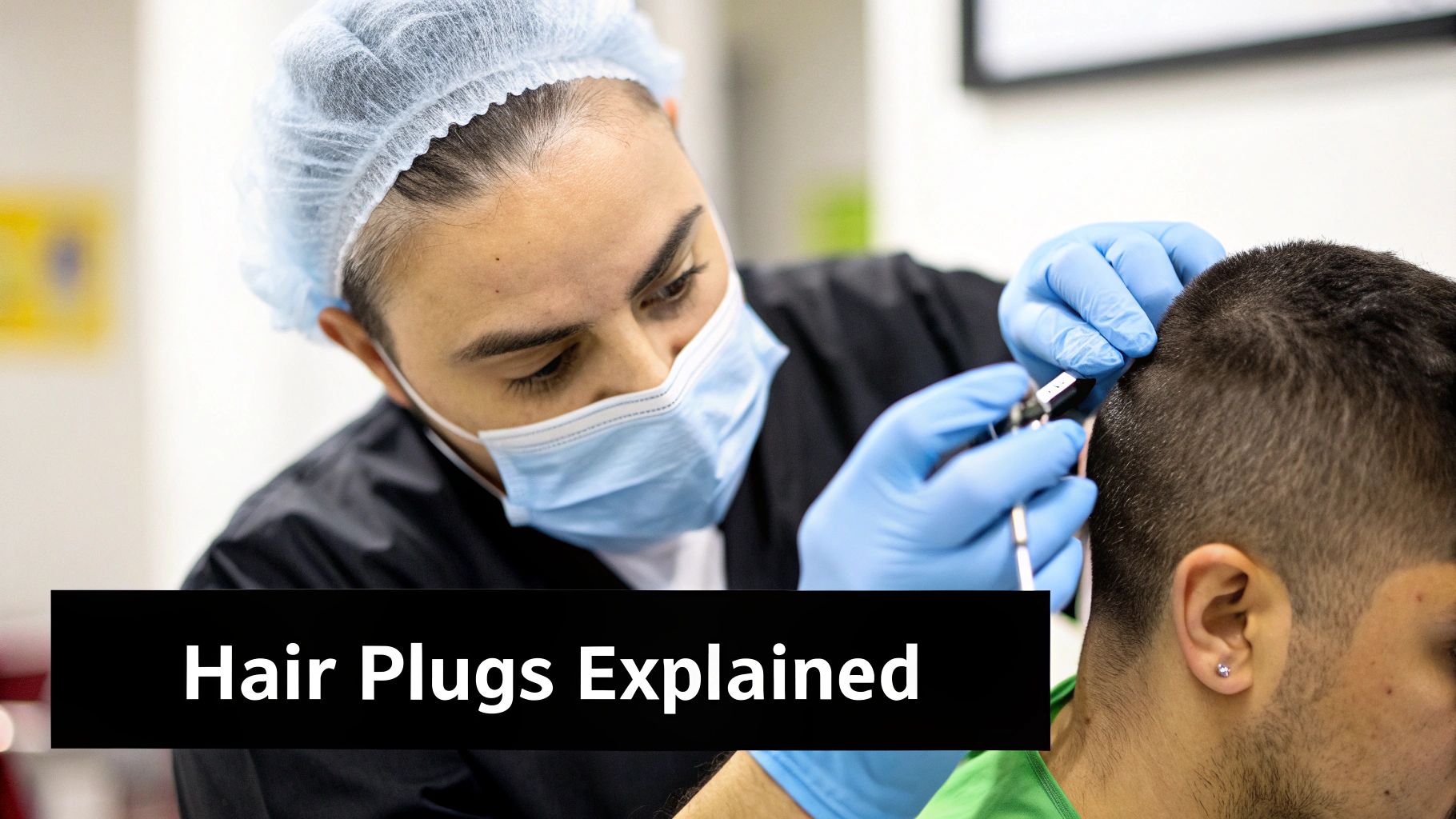
If you're looking into getting your hair back, the term "hair plugs" really belongs in the history books. It describes a method from decades ago where a surgeon would use a tool that looked like a cookie-cutter to remove big, circular grafts of skin with hair. These plugs often contained 15-20 follicles each and were then jammed into the balding spots.
The results were almost always jarring and unnatural. This approach created a look that people called "doll's hair" or a "cornrow" effect because the large, clumpy grafts couldn't possibly mimic the soft, random pattern of how hair naturally grows. The wide spacing and pluggy look pretty much screamed, "I've had a procedure," instead of subtly bringing back a hairline.
From Plugs to Precision
Modern hair transplant surgery is playing in a completely different league. Today's top methods, Follicular Unit Transplantation (FUT) and Follicular Unit Extraction (FUE), are all about transplanting individual follicular units—which is how hair actually grows, in tiny, natural clusters of one to four hairs.
The crucial shift was moving from transplanting clumps of scalp to transplanting individual follicular units. This micro-level precision is what gives surgeons the ability to recreate a soft, natural, and dense hairline that is virtually undetectable.
This evolution completely changed the patient experience, too. The old hair plug process was a true marathon, sometimes taking as long as 16 weeks to finish over multiple appointments. On the flip side, a modern FUE or FUT transplant is almost always done in a single day. You can explore the details of these different hair restoration treatment options to see just how far things have come.
Here’s a simple breakdown to help you visualize just how massive that leap was:
| Feature | Hair Plugs (Obsolete) | Modern Hair Transplants (FUE/FUT) |
|---|---|---|
| Graft Size | Large, circular punches (15-20+ hairs) | Small, individual follicular units (1-4 hairs) |
| Appearance | Unnatural, "doll's hair," visible gaps | Natural, dense, and undetectable |
| Scarring | Noticeable circular scars at donor/recipient sites | Minimal dot scars (FUE) or a fine linear scar (FUT) |
| Procedure Time | Multiple sessions over many weeks | Typically completed in one 4-8 hour session |
Comparing Surgical Techniques and Approaches
To really get why hair plugs and modern hair transplants look so vastly different, you have to look at the surgery itself. The difference isn't just about the size of the grafts; it's a complete shift in the philosophy, artistry, and technology used to move hair. Put simply, the old plug method was a blunt instrument, while today's transplants are a delicate, precise art form.
Think of it like a gardener trying to patch a lawn. The hair plug technique was like using a post-hole digger to move large, round clumps of grass into bare spots. Sure, it moves the grass, but it leaves behind obvious circular patterns and a patchwork look that isn't fooling anyone.
That’s pretty much how hair plugs worked. Surgeons used a steel punch, typically 4 millimeters in diameter, to yank out a big circular graft from the back of the head. That same tool was then used to punch a hole in the balding area, where the plug was jammed in. The entire process was mechanical, with very little finesse.
The Modern Approach: Follicular Unit Precision
Modern hair restoration essentially traded that shovel for a pair of tweezers. The two main techniques today—Follicular Unit Transplantation (FUT) and Follicular Unit Extraction (FUE)—are built around transplanting individual follicular units. These are the tiny, natural groupings of one to four hairs as they actually grow on your scalp.
This move from big plugs to tiny follicular units is the single biggest leap forward in the history of hair restoration. It gives the surgeon total control over the final result.
The core difference is the unit of transplantation. Hair plugs moved chunks of scalp. Modern transplants move individual, naturally occurring hair groupings, giving the surgeon complete artistic control over angle, density, and direction for a truly natural outcome.
This micro-level approach means surgeons can mimic nature with stunning accuracy. They can build a soft, feathered hairline using single-hair grafts and then create density behind it with multi-hair units, just like real hair grows. Understanding this precision helps explain the high hair transplant success rate patients see today.
A Breakdown of Techniques
Let's break down the main methods to see exactly how they stack up against the old plug technique:
- Hair Plugs (Outdated): A large punch tool mechanically removes and inserts round grafts with 15-20+ hairs. It’s an imprecise method that causes significant scarring and leaves an unnatural, doll-like pattern.
- Follicular Unit Transplantation (FUT): A surgeon removes a thin strip of hair-bearing skin from the donor area. Technicians then meticulously dissect this strip under high-powered microscopes to isolate individual follicular units. This "strip method" is great for getting a large number of grafts in one go.
- Follicular Unit Extraction (FUE): A surgeon uses a tiny micro-punch tool (less than 1 millimeter wide) to extract individual follicular units directly from the scalp, one by one. This technique is much less invasive and avoids the linear scar of FUT, leaving only tiny, dot-like scars that are easily hidden.
This comparison table puts the key differences in black and white, showing just how far we've come.
Hair Restoration Methods At a Glance
| Attribute | Hair Plugs (Outdated) | Modern Hair Transplants (FUE/FUT) |
|---|---|---|
| Graft Size | Large, round clumps of 15-20+ hairs | Tiny, natural follicular units of 1-4 hairs |
| Appearance | Unnatural "doll's hair" or "cornrow" look | Natural-looking, feathered hairline and density |
| Donor Scarring | Multiple circular scars, often visible ("moth-eaten") | FUT: A single, fine linear scar; FUE: Tiny, dot-like scars |
| Precision | Very low; no control over angle or direction | Extremely high; surgeons control placement and angle |
| Recovery | Longer and more painful, with noticeable scabbing | Faster, with minimal discomfort and less visible healing |
As you can see, the evolution from plugs to modern FUE/FUT represents a fundamental change in both the technique and the final aesthetic goal—moving from just "covering a bald spot" to truly recreating a natural head of hair.
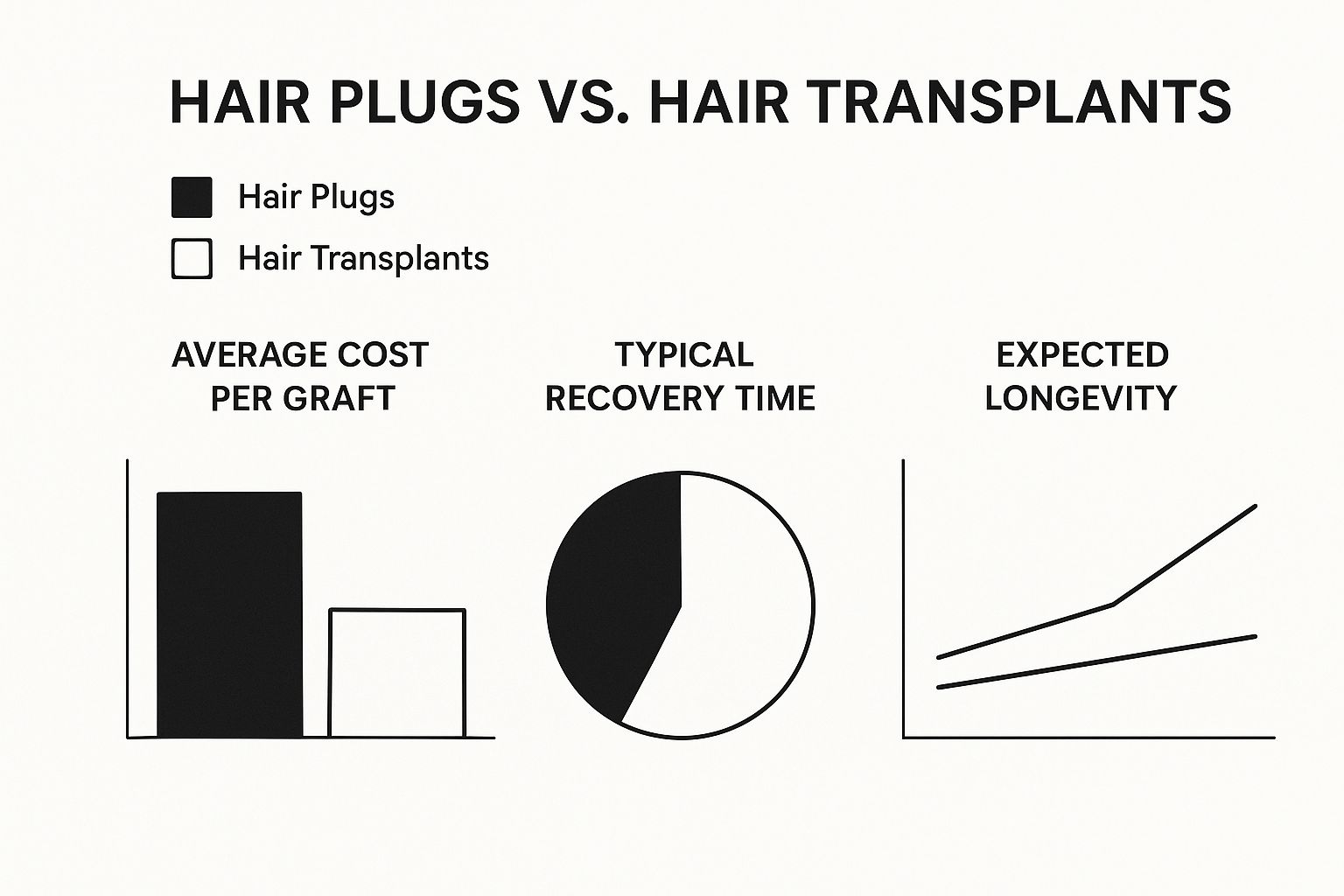
The data here drives the point home. While modern transplants may look like a bigger investment upfront, they deliver a permanent, natural-looking solution with a much smoother and faster recovery.
How Natural Do They Actually Look?
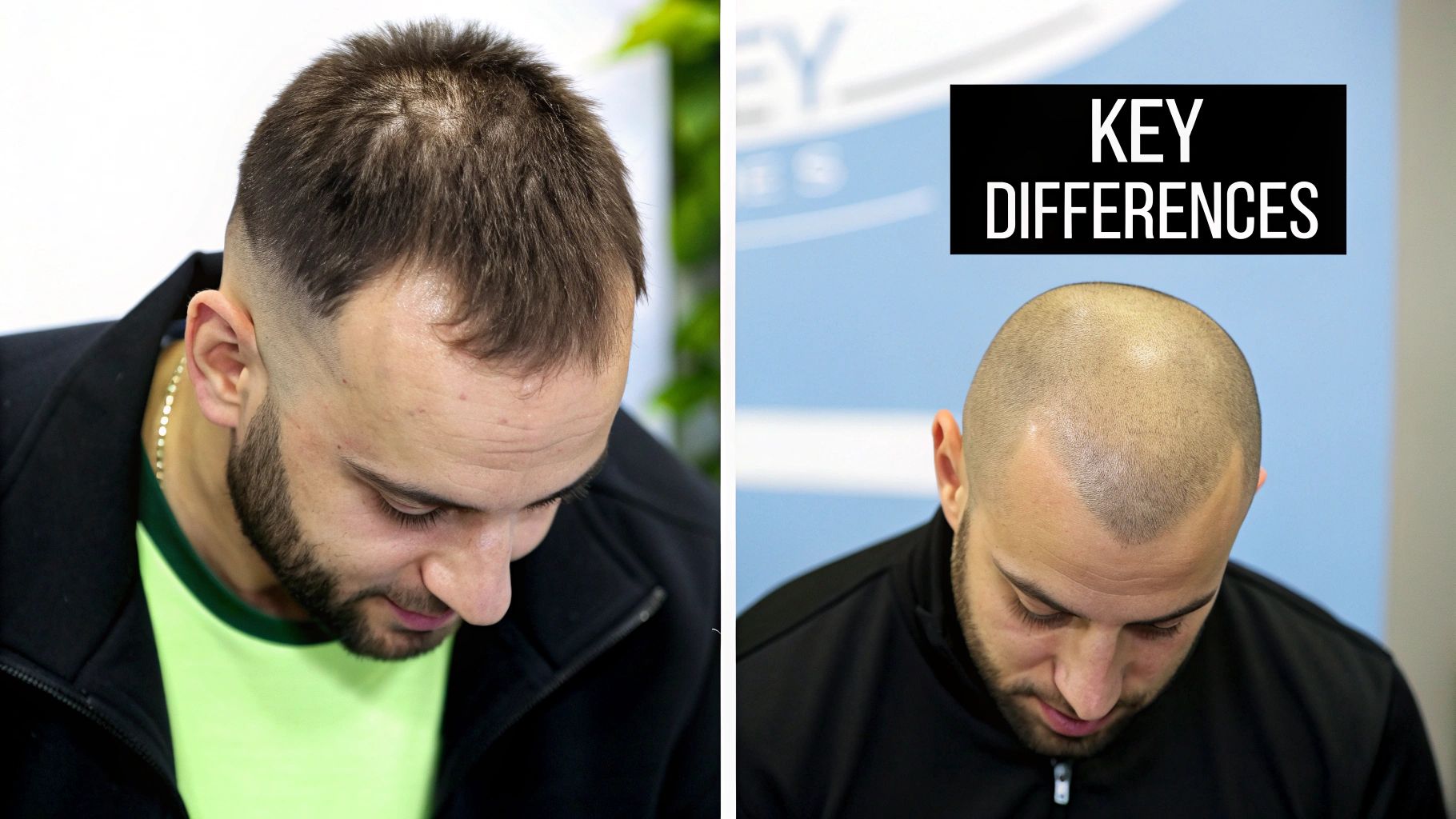
At the end of the day, what really matters is whether a hair restoration procedure looks and feels completely natural. This is precisely where old-school hair plugs failed so badly and where modern hair transplants truly shine. The difference isn't just a minor improvement; it's the gap between an obvious, crude patch job and a genuinely artistic restoration.
The most notorious giveaway of hair plugs was the "doll's hair" or "cornrow" look. This happened as a direct result of the technique, which involved implanting big, circular grafts containing 15-20 hairs each. These created dense clumps of hair that were like little islands in a sea of bald scalp, making a seamless blend impossible.
The outcome was a harsh, artificial hairline that anyone could spot from a mile away. To make matters worse, surgeons had very little control over the angle and direction of the hair, often leading to follicles sprouting in some pretty strange ways.
The Art and Science of Modern Hair Transplants
Modern FUE and FUT procedures, on the other hand, are a world apart. They allow a surgeon to be both a medical professional and an artist. The game-changer is working with individual follicular units—those tiny, naturally occurring groups of one to four hairs. This grants complete control over the final look and is the fundamental difference between a pluggy result and a natural hairline.
The biggest breakthrough in hair restoration wasn't just a medical advancement; it was an artistic one. Modern techniques give surgeons the power to control the angle, direction, and density of every single graft. They can finally mimic nature's intricate design instead of just filling empty space.
This level of precision is what makes a soft, feathered hairline possible. Surgeons meticulously place single-hair grafts at the very front to create that natural, delicate edge. Just behind that line, they strategically place grafts with multiple hairs to build up density and volume. To get a better sense of how your own hair density plays a role, you can learn how to conduct a proper hair density test and see what surgeons are working with.
Creating a Genuinely Undetectable Hairline
The entire goal of a modern transplant is to be so natural that it's undetectable, even to a discerning eye. Here’s how skilled surgeons pull it off:
- Mimicking Nature's Groupings: By transplanting follicular units exactly as they grow naturally, the final look never appears clumpy or artificial.
- Controlling Hair Direction: Each individual graft is placed at a precise angle to match the flow and whorls of your existing hair.
- Creating an Irregular Hairline: A perfectly straight hairline is a dead giveaway. Surgeons create subtle imperfections and "soft zones" so the hairline looks completely natural.
- Graduating the Density: Just like a real head of hair, the density is carefully transitioned from finer, single hairs at the front to thicker groupings farther back.
This meticulous, detail-oriented approach ensures the new hair integrates flawlessly with your native hair. It delivers a permanent, natural-looking solution that was simply unimaginable with the primitive methods of the hair plug era.
The Patient Recovery Journey and Potential Risks

What happens after you walk out of the clinic is just as important as the procedure itself. When you compare the patient experience of hair plugs versus a modern hair transplant, the recovery process reveals one of the biggest differences. The aftermath of a hair plug procedure was notoriously tough, defined by significant pain, a long healing period, and a much higher chance of things going wrong.
The large, circular wounds left by the 4mm punch grafts often led to major swelling, crusting, and discomfort that could drag on for weeks. It wasn't uncommon for patients to deal with noticeable bleeding and a serious risk of infection. Once healed, the donor area was often left with a "moth-eaten" look from all the circular scars—a dead giveaway that was almost impossible to hide.
Modern Recovery: A World of Difference
Recovering from a modern hair transplant couldn't be more different. Today's procedures are designed to get you back to your normal life as quickly and comfortably as possible. The contrast in downtime and scarring is night and day.
Refined techniques have dramatically cut down on post-op pain and healing time. Your specific recovery will depend on whether you get FUE or FUT, but both are lightyears ahead of the old plug method.
- FUE Recovery: With Follicular Unit Extraction, the comeback is incredibly fast. Each follicular unit is taken with a micro-punch smaller than 1mm, leaving tiny, dot-like scabs in the donor area that usually heal up within 7-10 days. Pain is minimal, and the scarring is so faint you can confidently wear your hair short.
- FUT Recovery: Follicular Unit Transplantation uses a linear incision closed with sutures. This means the donor area needs a bit more time to heal, but the result is a single, fine-line scar that’s easily hidden by the surrounding hair.
The guiding principle behind modern recovery is simple: minimize tissue trauma. Smaller incisions mean faster healing, less pain, and a drastically lower risk of infection or bad scarring. It makes the entire experience far more manageable for the patient.
Managing Risks and Supporting Healing
While modern transplants are incredibly safe, it's still a surgical procedure. That means there are potential risks, like minor swelling, temporary numbness, or "shock loss"—a phase where some existing hair sheds before it starts regrowing. To help manage common post-surgery issues like swelling, some people explore supportive treatments like a lymphatic drainage massage for post-operative treatment.
Following post-operative care instructions to the letter is crucial for getting the best results and keeping these risks low. Patients get a detailed guide on how to care for their scalp, which is a key part of a successful outcome. To get a better sense of what this involves, you can look into PRP hair treatment post care, as many of the aftercare principles overlap. At the end of the day, the smooth, predictable recovery is just another reason why modern transplants have made the old plug technique obsolete.
Understanding Costs and Long-Term Value
When we talk about the cost of hair plugs versus a modern hair transplant, we're not really comparing two valid options. Hair plugs are a thing of the past, so the conversation today is really about the investment required for a high-quality, contemporary hair restoration procedure.
The financial side of a modern FUE or FUT transplant is a big deal, and there’s no single price tag. A patient's final cost depends on several factors that directly influence the quality and scope of the procedure.
What Determines the Price of a Modern Transplant
A few key variables will shape the final quote you receive. Understanding these helps explain why pricing can look so different from one clinic to the next.
- Number of Grafts: This is the biggest factor driving the cost. Someone who just needs to touch up their hairline will pay a lot less than a patient looking for full coverage on their crown.
- Technique Used (FUE vs. FUT): FUE procedures usually have a higher price per graft. That's because extracting each follicular unit one by one is a meticulous, time-consuming process for the surgeon and their team.
- Surgeon's Expertise and Reputation: You're paying for artistry and experience. A top surgeon with a stellar reputation and a portfolio of incredible results will naturally command a higher fee.
- Geographic Location: The cost of running a clinic can vary wildly depending on the city or country. You'll almost always find higher prices in major metropolitan hubs compared to smaller towns.
The real discussion isn't just about the upfront cost, but about long-term value. Investing in a modern hair transplant is a permanent solution, while the "hidden cost" of an outdated procedure often involves years of dissatisfaction or additional expenses for corrective surgery.
The leap from old-school plugs to today's techniques has completely changed patient outcomes, making the investment far more worthwhile. A modern hair transplant can range anywhere from $1,500 to $15,000, a price that reflects the advanced skill and technology needed to create truly natural-looking results.
These advanced methods also mean a faster, more comfortable recovery and results that mimic natural hair growth patterns with stunning accuracy.
Ultimately, the goal is a permanent, natural result that brings back your confidence. When you look at the big picture, most people find that asking "is a hair transplant worth it" leads to a resounding "yes." Paying for a top-tier procedure one time is a much smarter investment than facing the emotional and financial burden of a bad one.
Choosing the Right Path for Your Hair Restoration
When you start looking into hair restoration, it can feel like a lot to take in. But the first step is actually pretty straightforward: you can immediately cross "hair plugs" off your list. Let’s be clear—no reputable surgeon today would ever suggest or perform a hair plug procedure. They are a relic of the past.
The real decision you'll be making is between the two advanced techniques that dominate the field: Follicular Unit Extraction (FUE) and Follicular Unit Transplantation (FUT). The conversation isn't about plugs versus transplants; it's about figuring out which of these modern methods is the right fit for you. Your specific pattern of hair loss, your lifestyle, and what you hope to achieve will all steer the decision.
FUE vs. FUT: When to Choose Which
Having an open, honest talk with a qualified specialist is the most crucial step you can take. To get you ready for that conversation, here are a few common situations where one method might have an edge over the other.
-
If you like to wear your hair short: FUE is almost always the better choice. Because it involves extracting individual follicular units, it avoids the linear scar that comes with FUT. Instead, you're left with tiny, dot-like scars that are practically invisible, even if you buzz the back and sides of your head.
-
If you need a large number of grafts: For those with more significant hair loss, FUT can be more efficient. The strip harvesting method allows a surgeon to access a large number of high-quality grafts in a single session. This often makes it the go-to for achieving maximum density in one go.
Ultimately, the decision between FUE and FUT often comes down to a trade-off. FUE gives you minimal scarring and more freedom with your hairstyle, while FUT can deliver a higher graft yield per session, making it a powerful option for more advanced hair loss.
The popularity of FUE speaks for itself. By 2021, it was already being used in about 75.4% of all hair transplant procedures for men, largely due to its less invasive nature. FUT, on the other hand, accounted for around 21.3% of procedures, which shows it's still a highly relevant and necessary option for the right candidates. You can dig deeper into how these trends have evolved over time. Learn more about these hair transplant statistics to get a better sense of the current landscape.
At the end of the day, the best choice is a personal one. Think about your long-term goals and how the recovery and results of each method will fit into your life.
Your Hair Restoration Questions, Answered
If you're looking into hair restoration, you probably have a lot of questions. Let's tackle some of the most common ones that come up when people weigh their options, especially when comparing old-school hair plugs to today's advanced hair transplants.
Is a Hair Transplant Painful?
Most people are pleasantly surprised by how comfortable the process is. The whole procedure is done under local anesthesia, so while you might feel a small pinch from the initial injections, your scalp will be completely numb during the surgery itself.
Afterward, any discomfort is usually quite mild. Think of it as a manageable soreness that can be easily handled with standard over-the-counter pain medication. Many find that FUE recovery is a bit easier than FUT since there's no long incision or stitches involved.
How Long Until I See the Final Results?
This is where you’ll need some patience. It's a journey, not a sprint. In the first few weeks, the transplanted hairs will fall out. Don't panic—this is a normal and expected part of the process called "shock loss" as the follicles settle into their new home.
- You'll start seeing the first signs of new growth around the 3 to 4-month mark.
- The real, noticeable difference in density and coverage typically shows up between 6 and 12 months.
- The final, fully matured results can sometimes take up to 18 months to appear, particularly for work done on the crown.
Can a Bad Hair Plug Procedure Be Fixed?
Yes, thankfully, many of the unnatural-looking results from old hair plug surgeries can be fixed. It’s a delicate process, but a skilled surgeon has a few ways to approach it.
They might remove or reduce the large plugs by carefully extracting the old grafts to break up that doll-like appearance. Another common technique is to camouflage the plugs by transplanting new, tiny follicular units around them. This softens the hairline and creates a much more natural blend. It's important to find a surgeon who specializes in this kind of complex repair work.
Ready to explore modern, effective solutions for hair loss? PRP For HairLoss provides in-depth guides and resources on the latest treatments. Learn more about your options at https://prpforhairloss.com.

 PRP For Hairloss
Leave a comment