For a lot of people, getting a hair transplant is absolutely worth it. It’s a permanent fix that can do wonders not just for your hairline, but for your self-confidence, too. That said, it’s a surgical procedure with a hefty price tag, so it’s a decision that needs some serious thought.
Decoding the Value of a Hair Transplant
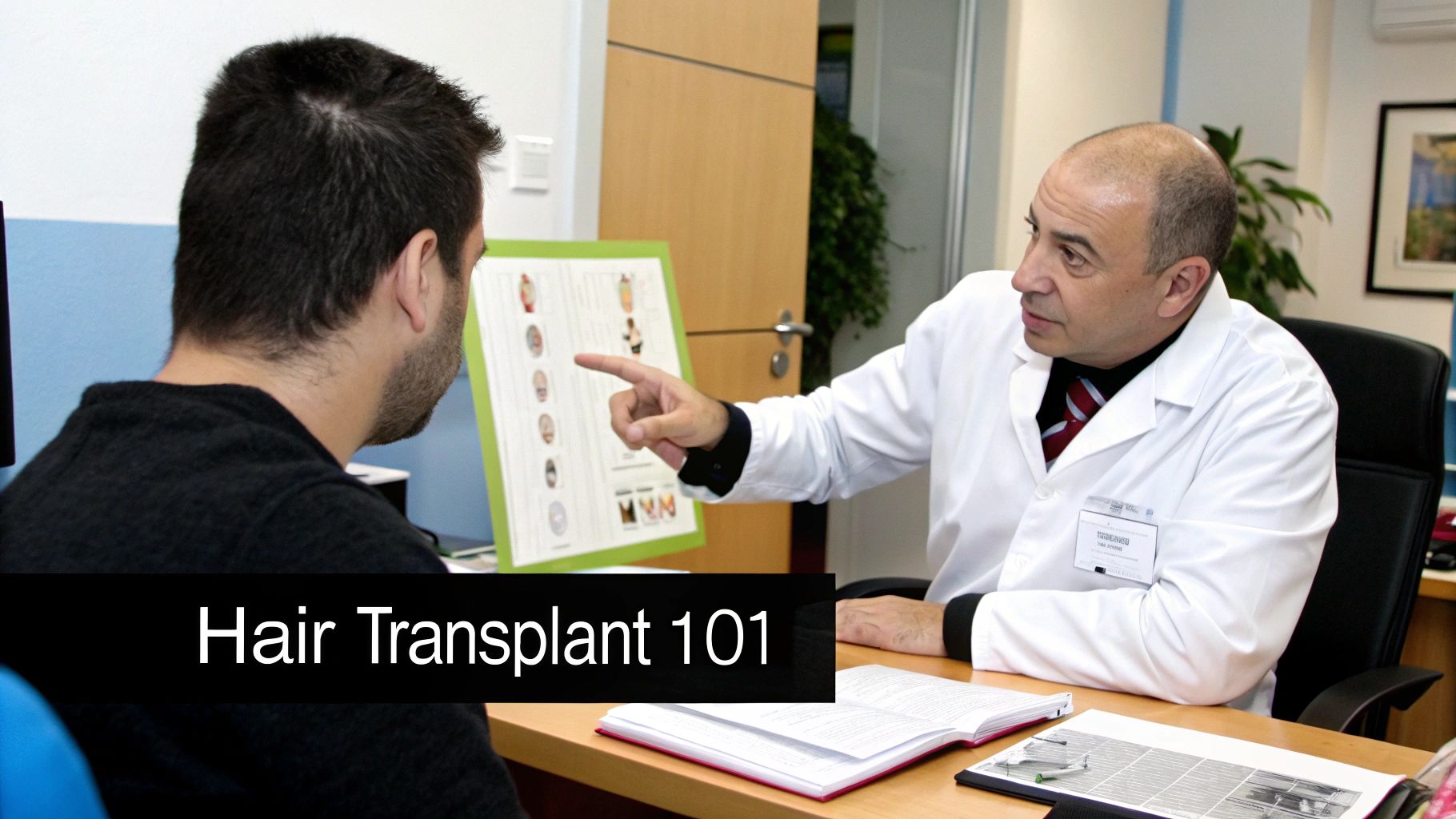
Deciding to get a hair transplant is a big deal. We're not just talking about a cosmetic tweak; it's a real investment in yourself, both financially and emotionally. For many, the final result brings a profound boost to their self-image, making the whole process more than worthwhile. For others, it might not be the right path.
The biggest draw? It's permanent. Unlike topical treatments or medications that you have to keep using forever, a hair transplant physically moves your own healthy, loss-resistant hair follicles to the areas that are thinning.
Think of it like transplanting robust shrubs from a dense part of your garden to a bare patch where nothing seems to grow. Once those follicles take root in their new home, they're there for good.
Weighing the Pros and Cons Early
Before we get into the nitty-gritty, it helps to understand the basic trade-offs. The main benefit is a full, natural-looking head of hair that lasts a lifetime. The biggest drawback is the significant one-time cost, which can definitely be a barrier for many.
This guide is here to give you a clear, honest look at the whole picture. I'll walk you through everything from the procedure itself to the recovery and costs, giving you the information you need to make a choice that feels right for you.
A hair transplant isn't just about restoring hair; it's about reclaiming a part of your identity and facing the world with renewed confidence. The decision balances a one-time investment against a lifetime of results.
Understanding the Success and Statistics
Modern hair transplant techniques have come a long, long way, making the procedure incredibly effective for the right person. The number one reason people get this surgery is for androgenetic alopecia—what most of us just call male or female pattern baldness.
Statistics show this condition affects about 81.1% of patients, and it's something most men will deal with eventually. With men making up around 87% of all hair transplant patients, the demand is clear. The average success rate for today's methods is between 85% and 95%, which reflects high graft survival and really happy patients.
So, when you ask "is a hair transplant worth it?", the answer is a personal one. A few key factors really determine whether you'll get a great outcome:
- Your Degree of Hair Loss: Are you just starting to thin, or is the loss more advanced?
- The Quality of Your Donor Hair: You need a good supply of healthy follicles on the back and sides of your head to move.
- Your Age and Health: Stable hair loss patterns and good overall health generally lead to better, more predictable results.
- Your Realistic Expectations: It’s crucial to understand the timeline and what the final outcome will look like.
To give you a better snapshot, here's a quick rundown of the key things to think about.
Hair Transplant At a Glance: Is It Right for You?
This table breaks down the essential factors to help you weigh whether a hair transplant is a smart investment for your specific situation.
| Factor to Consider | Why It Matters for Your Decision |
|---|---|
| Permanence | This is a one-and-done solution. Unlike medications you have to take for life, the results are permanent. |
| Cost | The upfront investment is significant, typically ranging from $4,000 to $15,000. It's a major financial decision. |
| Natural Results | Modern techniques use your own hair, so the final look is completely natural in color and texture. |
| Recovery Time | You'll need about a week of downtime for initial healing, with some minor scabbing and redness. |
| Timeline for Results | This isn't an overnight fix. You'll see noticeable growth in 3-4 months, with full results taking 12-18 months. |
| Donor Hair Supply | Your success depends on having enough healthy hair on the back and sides of your head to transplant. |
| Surgeon's Skill | The surgeon's experience and artistry are critical for achieving a natural-looking hairline. |
Ultimately, a successful hair transplant is about matching the right procedure with the right candidate.
By exploring these elements, you can get a much clearer picture of what makes this procedure successful. For a more detailed breakdown, take a look at our guide on the factors that influence the hair transplant success rate. Our goal here is to give you all the knowledge you need to decide if this investment aligns with your personal and financial goals.
Your Hair Transplant Journey From Start To Finish
Thinking about a hair transplant can feel like a huge step, but the process is more straightforward than you might imagine. It’s a well-defined journey with clear stages, and knowing what to expect is the first step in deciding if it's the right move for you.
It all starts long before you ever step into a clinic. It begins with a conversation.
The All-Important First Consultation
Your first real step is the initial consultation, and this meeting really sets the stage for everything that follows. Think of it as an interview—you're getting a feel for the surgeon and the clinic, and they're getting to know you and your hair.
A good surgeon doesn't just jump into selling you a procedure. They'll take the time to properly assess your hair loss.
They'll look at a few key things:
- Your Hair Loss Pattern: How much hair have you lost, and has the loss stabilized? This is critical for planning.
- Your Donor Area: The surgeon needs to see how much healthy hair you have on the back and sides of your head. This is the "supply" for your transplant.
- Your Hair Characteristics: The color, thickness, and texture of your hair all influence the final look.
- Your Goals and Expectations: This is a two-way street. A great consultation involves a frank discussion about what’s realistically possible.
This is your time to ask the tough questions. Don't hold back. Ask about their experience, look at plenty of before-and-after photos, and make sure you understand exactly which technique they recommend and why. Finding the right fit is crucial, and our guide on locating top hair loss specialists near you is a great resource to get you started.
The goal of a great consultation is clarity. You should walk away with a personalized plan, a clear understanding of the costs, and a realistic vision of your potential results.
Picking The Right Tool For The Job: FUE vs. FUT
Once you've decided to move forward, the next big decision is the surgical technique. Today, it almost always comes down to two main methods: Follicular Unit Extraction (FUE) and Follicular Unit Transplantation (FUT). Both get the job done—moving healthy hair follicles to where you need them—but they get there in very different ways.
Think of it like this:
- FUE is like precision gardening. The surgeon carefully plucks individual hair follicles, one by one, right from the donor area. This leaves behind tiny, dot-like scars that are almost impossible to see, making it perfect if you like to keep your hair short.
- FUT is more like transplanting a patch of grass. The surgeon removes a thin strip of scalp from the back of your head. This strip is then meticulously divided into individual follicular units under a microscope before being placed. It allows for a high number of grafts in one go but does leave a fine, linear scar that’s easily hidden by the surrounding hair.
The image below breaks down the three main phases of any hair transplant, from the initial game plan to placing the new hair.
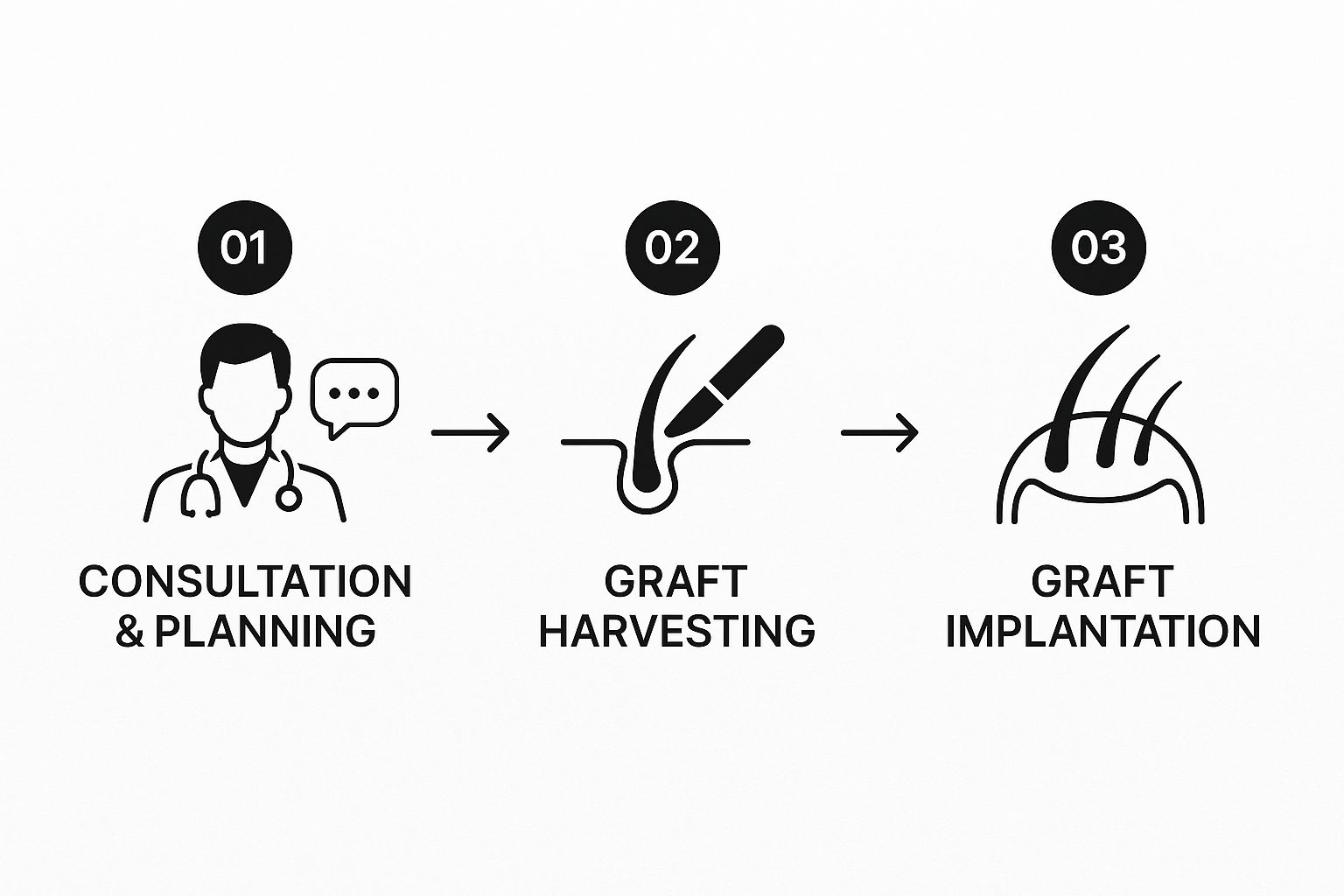
As you can see, whether you choose FUE or FUT, the core process of planning, harvesting the grafts, and implanting them is fundamentally the same.
To make the choice clearer, let's break down the key differences between FUE and FUT side-by-side.
Comparing FUE vs. FUT Procedure Characteristics
| Feature | Follicular Unit Extraction (FUE) | Follicular Unit Transplantation (FUT) |
|---|---|---|
| Harvesting Method | Individual follicular units are extracted one by one directly from the scalp. | A linear strip of scalp is surgically removed from the donor area. |
| Scarring | Leaves tiny, dot-like scars scattered across the donor area, which are often unnoticeable. | Creates a single, fine linear scar at the back of the head. |
| Recovery Time | Typically quicker, with less discomfort and a faster return to normal activities. | Longer recovery period due to the incision; sutures usually need removal. |
| Best for Short Hair | Yes, ideal for patients who wear their hair very short as scarring is minimal. | No, the linear scar can be visible with very short hairstyles. |
| Cost | Generally more expensive per graft due to the meticulous, time-intensive nature of the procedure. | Often more cost-effective, especially for procedures requiring a large number of grafts. |
Ultimately, the best method for you depends on your specific needs, hairstyle preferences, and budget. An experienced surgeon will guide you toward the technique that aligns best with your goals.
What Happens On Procedure Day
The day of the transplant is a big one, but it's designed to be as comfortable as possible. The entire procedure is done under local anesthesia, so while you'll be awake, your scalp will be completely numb. Many patients just relax—watching movies, listening to podcasts, or even taking a nap.
The process itself is incredibly detailed. First, the surgical team harvests the donor grafts using your chosen method (FUE or FUT). Next, the surgeon creates tiny recipient sites in the thinning areas, paying close attention to the natural angle and direction of your hair growth. This artistry is what makes the final result look so natural. Finally, each graft is carefully placed into its new home.
It's a long day, for sure. A typical procedure can last anywhere from four to eight hours, depending entirely on how many grafts are being moved. But knowing what the day entails helps turn any anxiety into confident anticipation.
Understanding the True Cost of a Hair Transplant

Let's talk about the elephant in the room: money. For most people considering a hair transplant, the cost is the biggest hurdle. To figure out if it's truly worth it for you, we need to go beyond a simple price tag and look at what really goes into the final bill.
Seeing this as a long-term investment rather than just a one-time expense is the right mindset. It’s all about understanding what you’re paying for and why. The final cost isn't just a random number; it's a calculation based on several key factors that are unique to you.
Breaking Down the Main Cost Factors
So, what are these factors? The price of a hair transplant is built on a few core components, and each one plays a big part in your final quote.
- Number of Grafts: This is the big one. It's the primary driver of the total cost. A smaller procedure to reinforce a receding hairline might only need 500 to 1,500 grafts. But if you're looking for more significant coverage across the crown, you could easily be looking at 2,500 grafts or more. The more hair you need to move, the more it will cost.
- Surgical Technique: As we’ve covered, the FUE method is almost always more expensive per graft than FUT. Why? Because it’s a much more painstaking and time-consuming process for the surgeon to individually extract each follicular unit.
- Surgeon's Expertise: You're not just paying for the procedure; you're paying for the skill and artistry of the person performing it. A top-tier surgeon with years of experience and a portfolio of natural-looking results will justifiably charge more. Think of it as paying for a lower risk of complications and a better aesthetic outcome.
- Geographic Location: Where the clinic is located matters. A clinic in a major city with a high cost of living will naturally have higher overhead and, therefore, higher prices than one in a smaller town.
These elements all come together to create your personalized quote, which is why you’ll never find a single, universal price online.
Realistic Price Ranges to Expect
Okay, so what does this look like in actual dollars? While it varies, a good ballpark figure is anywhere from $4 to $10 per graft.
Let's translate that into a couple of real-world scenarios:
- For a smaller touch-up (around 1,000 grafts), you might expect a price range of $4,000 to $10,000.
- For a more extensive session (around 2,500 grafts), the cost could be anywhere from $10,000 to $20,000, and sometimes more.
Any reputable clinic will be completely transparent about this. A proper consultation should end with a detailed quote that clearly states the number of grafts and the total cost, leaving no room for surprise bills later on.
A helpful way to frame this is to see a hair transplant not as a cost, but as a one-time investment in a permanent fix. When you stack it up against the endless, recurring expense of temporary treatments, the long-term value really starts to shine through.
A Long-Term Investment vs. Recurring Expenses
Think for a moment about the money spent on other hair loss solutions. Medicated shampoos, topical foams like minoxidil, or prescription pills like finasteride all work on a subscription model. They only work for as long as you keep buying them. The costs just keep adding up, month after month, year after year.
If you're spending, say, $50 to $100 a month on these temporary fixes, that adds up to $6,000 to $12,000 over a decade. And at the end of that, you've only managed your hair loss, not restored it.
A hair transplant is different. It’s a single, upfront investment for a result that lasts a lifetime. While other professional treatments like PRP therapy offer their own set of benefits, it's crucial to compare their financial models. For a deeper dive, check out our detailed guide comparing hair transplant vs. PRP treatments.
Ultimately, deciding if a hair transplant is "worth it" financially is a personal calculation. But by understanding what drives the price and weighing it against the cycle of temporary solutions, you can make a clear-headed decision about whether this permanent investment is the right path for you.
What to Expect After Your Hair Transplant
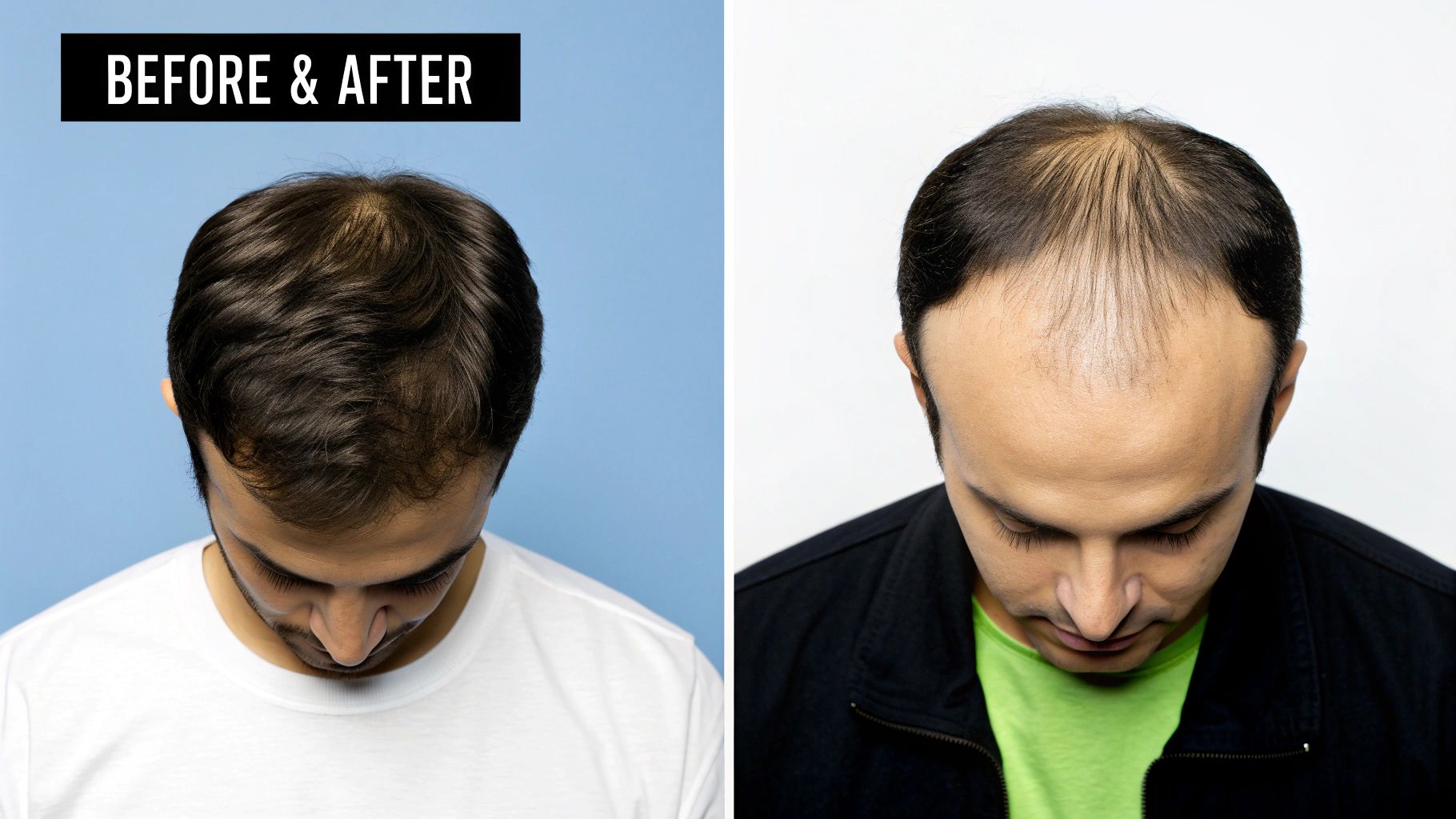
Knowing what’s around the corner is crucial for a smooth and stress-free recovery. A hair transplant is absolutely a marathon, not a sprint. Understanding the timeline helps you settle in and appreciate the process as it unfolds. This isn't an overnight fix; it's a gradual journey where patience truly is your best friend.
Think of your recovery less as a period of hardship and more like following a simple, clear roadmap. Once you know the milestones, you can relax and watch your final look take shape, one step at a time.
The First Week: The Crucial Healing Phase
The first few days are all about taking it easy and being gentle with your scalp. It’s going to be tender, and you can expect some mild swelling, especially around the forehead. This is completely normal and typically calms down within three to five days.
Your clinic will send you home with very specific aftercare instructions—follow them to the letter. This will cover everything from how to sleep (usually with your head propped up) to how to carefully wash the area without disturbing the newly implanted grafts. Any discomfort is usually minor and easily handled with the pain medication your surgeon provides.
Months One to Three: The Shedding Phase
About two to four weeks after the procedure, something happens that can catch people by surprise: the transplanted hairs start falling out. We call this the "shedding phase," and some people even refer to it as the "ugly duckling" stage. It might feel alarming, but it's a 100% normal and necessary part of the hair growth cycle.
It’s a bit like transplanting a plant. The original leaves might wilt and fall off, but the root system is busy establishing itself underground to push out new, stronger growth. The hair follicle is safe and sound beneath the skin, just getting ready to produce a brand new hair. You have to trust the process.
This shedding phase is the quiet before the growth. The follicles are simply entering a resting phase before they kick into their new growth cycle. Seeing the hair fall out is actually a good sign that the procedure was a success.
During this period, your scalp will probably look a lot like it did right before your surgery. The key here is to just hang in there. The real work is happening just below the surface, setting the stage for what’s to come.
Months Three to Six: The First Signs of Growth
Now for the exciting part. Around the three or four-month mark, you'll start to see the very first sprouts of new hair pushing through. At first, they'll be quite fine and thin, almost like baby hairs, and they'll likely come in sparsely.
Don't worry if the initial growth seems a bit patchy. Every follicle works on its own timeline. As the months roll on, these new hairs will gradually become thicker, stronger, and longer. By the time you hit month six, you should see a noticeable difference in your hair coverage, giving you a fantastic preview of the final outcome. It’s a huge confidence boost and a great sign that your patience is paying off.
Months Nine to Eighteen: The Final Result Unveiled
The journey from month nine forward is all about maturation and refinement. Your hair will continue to thicken, and the density will keep improving with each passing month. By the one-year mark, most people are looking at about 80-90% of their final result. The best part? This new hair can be cut, styled, and treated just like the rest of your natural hair.
It can sometimes take up to 18 months for the full, final result to become completely visible, particularly in the crown area where blood flow is different and the growth cycle can be slower. But by this point, the transformation is complete. Your hairline is restored, the density is there, and the result is a natural-looking head of hair that is 100% your own. This incredible long-term result is what ultimately answers the question of is hair transplant worth it.
Weighing the Pros and Cons of a Hair Transplant
So, is a hair transplant actually worth it? To get to the real answer, we need to look at this from all angles. Like any big decision, there are some incredible upsides and a few serious points to think about before you jump in. It's not just about a simple pros-and-cons list; it's about understanding the whole picture to see if it truly lines up with what you want.
Let's break down what you can realistically expect—the good, the bad, and everything in between.
The Clear Advantages of a Hair Transplant
The biggest draw for most people is that a hair transplant offers a permanent solution. This isn't a temporary patch or a clever cover-up. We're talking about using your own, naturally growing hair to permanently fill in the areas where it’s thinned or disappeared.
Once those transplanted follicles settle into their new home, they’re there for life, growing exactly like the rest of your hair. That brings us to the next huge plus: the results look completely natural. A talented surgeon doesn't just plug in hairs; they meticulously recreate your original hairline, paying close attention to the angle, density, and direction of growth.
But honestly, the most profound change is often the boost in self-confidence. Getting your hair back can feel like getting a piece of yourself back. Many patients say this psychological lift is, by far, the most rewarding part of the whole experience.
For many, the true value of a hair transplant isn't measured in the number of grafts, but in the renewed confidence they feel every time they look in the mirror. It's a return to form, personally and visually.
Understanding the Potential Downsides
Now for the other side of the coin. First and foremost, you have to consider the significant upfront cost. There's no sugarcoating it—this is a major financial investment. You need to be sure it fits comfortably within your budget without putting you under pressure.
It's also important to remember that this is a surgical procedure. While it's considered very safe and minimally invasive, any surgery comes with potential risks, like infection or small bumps in the healing process. Your best defense here is choosing a top-tier, reputable clinic and surgeon, which dramatically lowers these risks.
Then there’s the matter of scarring.
- FUE procedures leave behind tiny, dot-like scars that are almost impossible to spot, even if you wear your hair very short.
- FUT procedures create a thin, linear scar at the back of the head, but it’s easily hidden by the hair growing around it.
Modern techniques have made scarring a minor issue for most, but it’s still something to be aware of.
Long-Term Considerations and Global Trends
One last thing to keep in mind is that hair loss can be progressive. A transplant does a fantastic job of restoring density to a bald or thinning area, but it won’t stop future hair loss on other parts of your scalp. Because of this, some people find they might want a second procedure years later to touch up new areas.
The sheer popularity of this surgery says a lot. People around the world are increasingly turning to it. While the Middle East & Africa region saw a forecast decline for 2024, other areas are booming. Asia is on track for nearly 1 million transplants in 2024, a 12.09% increase from the previous year. North America and Europe aren't far behind, with projected numbers around 789,000 and 388,000 procedures. You can dive deeper into these global hair transplant statistics to get the full scope.
Ultimately, figuring out if a hair transplant is right for you is a personal journey. By understanding both the incredible benefits and the practical realities, you can make a decision you feel confident about.
Exploring Your Non-Surgical Hair Loss Options
Surgery isn't the only game in town. Before you go all-in on a hair transplant, it's worth taking a hard look at the non-surgical treatments on the table. For the right person, these alternatives can be incredibly effective, offering a completely different approach to tackling hair loss.
Most of these options aren't about moving hair around. Instead, they focus on either slowing down the shedding process or waking up dormant follicles. Think of them as your first line of defense against thinning hair.
Common Medical Treatments
You've probably heard of the most common non-surgical players: topical treatments and pills. Minoxidil, for instance, is the stuff you find in over-the-counter foams and liquids. It works by boosting blood flow to your hair follicles, which helps extend their growth phase. It’s like giving your hair a constant pep talk to hang in there a little longer.
Then there's Finasteride, a prescription pill that fights hair loss from the inside out. It's designed to block DHT, the hormone that’s the main villain in the story of male pattern baldness. It essentially puts up a defensive wall, shielding your follicles from the hormonal assault that makes them shrink.
Platelet-Rich Plasma (PRP) Therapy
Another option that's gained a lot of traction is Platelet-Rich Plasma (PRP) therapy. This is a pretty clever process that uses your body's own healing abilities to give your hair a boost. A small amount of your blood is taken and spun in a centrifuge to separate and concentrate the platelets—they're packed with powerful growth factors. This "liquid gold" is then carefully injected back into your scalp.
PRP acts like a high-octane fertilizer for your follicles, kickstarting cell repair and encouraging new growth. It’s a natural approach that taps into your own regenerative power. If this sounds interesting, our guide to non-surgical hair restoration goes into much more detail.
Beyond these, you'll also find other advanced treatments like Photobiomodulation (PBM) Therapy, which uses low-level light therapy to energize the cells within your hair follicles.
How They Compare to a Transplant
So, how do you choose? It really comes down to understanding the core difference between these treatments and a surgical procedure.
Non-surgical treatments are about maintenance and revitalization. A hair transplant is about restoration and relocation. One helps you keep and improve the hair you have, while the other rebuilds what's already gone.
Here’s a simple breakdown of how they stack up:
- Invasiveness: Foams and pills are completely non-invasive. PRP involves a series of simple injections. A transplant, while minor, is still a surgical procedure.
- Cost Structure: The non-surgical route means ongoing, recurring costs for as long as you want to see results. A transplant is a large, one-time investment that delivers a permanent change.
- Best Use Case: Medications and PRP are fantastic for people in the earlier stages of thinning who want to slow things down and add some density. A transplant is the definitive solution for filling in areas that are already noticeably thin or completely bald.
At the end of the day, these alternatives are powerful tools in their own right. The decision of whether a hair transplant is "worth it" often starts by figuring out if one of these less invasive options can get you where you want to be first.
Common Questions About Hair Transplants
Even after you've weighed the pros, cons, costs, and what recovery looks like, you probably still have a few questions rolling around in your head. That's completely normal. Let's tackle some of the most common things people ask when they're on the fence about getting a hair transplant.
How Painful Is a Hair Transplant Procedure?
This is, without a doubt, one of the biggest concerns for almost everyone, but the reality is much less scary than you might think. Most patients tell us they feel very little, if any, pain during the actual surgery. The whole thing is done under local anesthesia, which completely numbs your scalp.
You'll feel the initial numbing injections—a bit of a sting, similar to what you’d feel at the dentist's office. After that, it's smooth sailing. Post-procedure, you can expect some soreness and a feeling of tightness for a few days, but this is easily handled with the pain medication your clinic will give you. Honestly, most people are surprised by how manageable it all is.
Will My Transplanted Hair Look Natural?
Absolutely, but with one major condition: you have to choose the right surgeon. The difference between a fantastic result and a subpar one all comes down to the surgeon's artistry. A truly skilled professional doesn't just move follicles from point A to point B. They meticulously place each individual graft to perfectly mimic your natural hair growth, paying close attention to the angle, direction, and density.
This is what prevents that tell-tale "pluggy" or doll-hair look you might have seen from older, outdated techniques. The secret to a result that nobody can spot is doing your research and finding a reputable clinic with a proven track record. Your choice of surgeon is the single most important factor in getting a look you'll love.
A successful hair transplant shouldn’t look like you’ve had work done. It should just look like you have great hair, full stop. The goal is seamless, natural integration.
Am I a Good Candidate for a Hair Transplant?
A transplant isn't the right solution for everyone, and any good clinic will be upfront about that. The best candidates usually check a few key boxes:
- Stable Hair Loss: Your hair loss has slowed down and your pattern is mostly set. If it's still progressing rapidly, it's better to wait.
- Sufficient Donor Hair: You need a healthy, dense supply of hair on the back and sides of your head to source the grafts.
- Realistic Expectations: You need to understand what the procedure can achieve and what the timeline for seeing results looks like.
- Good Overall Health: Being in good health ensures you'll heal properly and have a smooth recovery.
The only way to know for certain is to have a proper consultation. A specialist can take a close look at your hair loss and your donor area to tell you if a transplant is the right move. For some, reviving dormant follicles might be another avenue to explore, which you can learn more about in our guide on whether dead follicles can be revived.
Making the right choice for your hair is a personal journey. At PRP For HairLoss, our goal is to give you the clear, honest information you need to choose the path that restores not just your hair, but your confidence, too.


Leave a Reply