Finding more hair than usual on your brush or circling the shower drain is a familiar and frustrating sight for many of us. Often, the culprit is a specific hormone that has a major impact on your hair's life cycle. The best DHT blocking supplements are designed to go after this hormone, Dihydrotestosterone (DHT), head-on. They typically use a blend of well-regarded natural ingredients like saw palmetto, pumpkin seed oil, and stinging nettle root to interrupt the chemical process that causes hair follicles to shrink.
The Hidden Cause of Thinning Hair
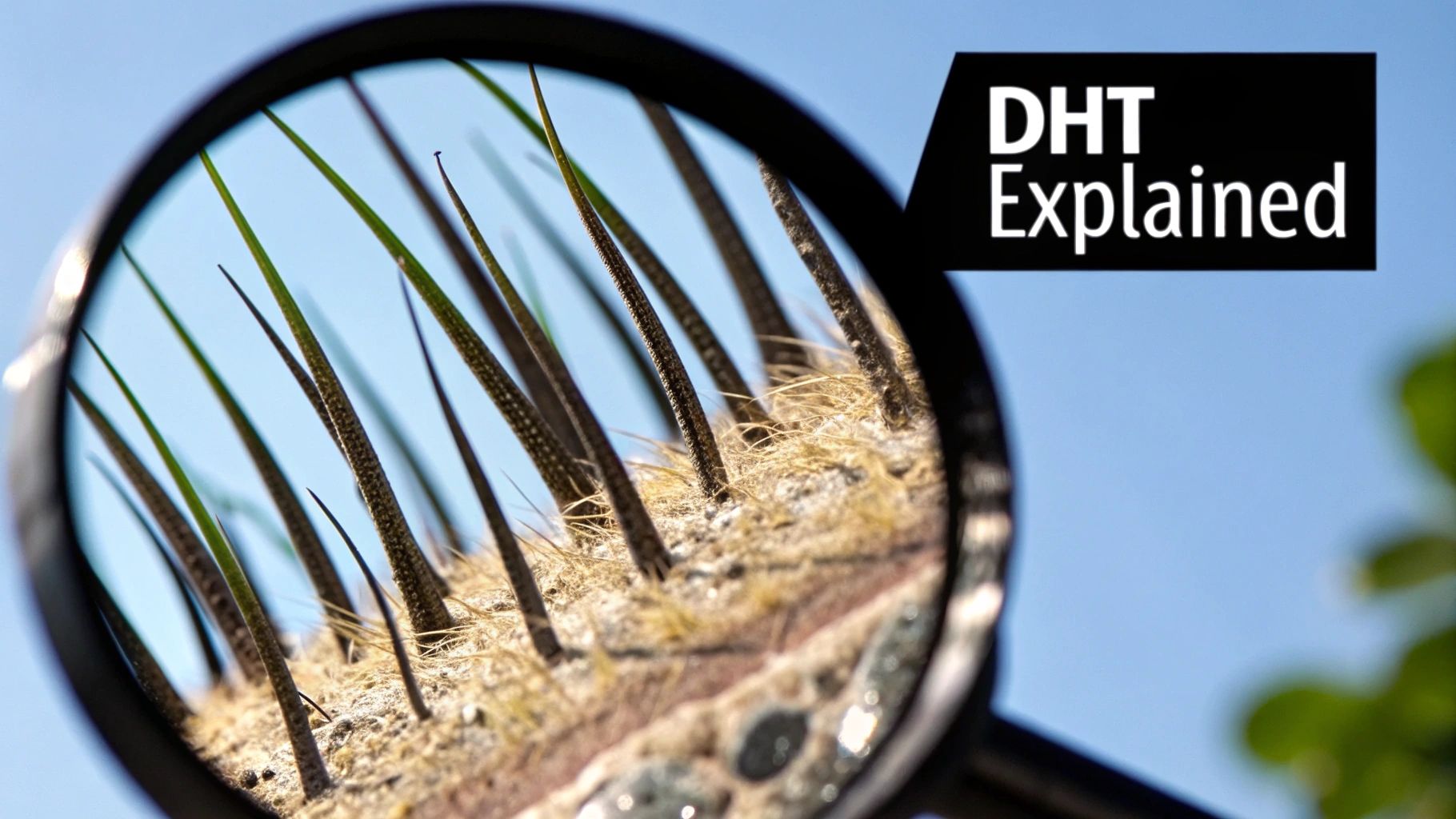
That sinking feeling you get when you see a growing clump of hair in the shower is a shared experience. For a huge number of people, the primary driver behind thinning hair is a surprisingly potent hormone known as Dihydrotestosterone, or DHT for short.
Think of DHT as a key that fits perfectly into a lock on your hair follicles. For those of us genetically prone to hair loss, when DHT "unlocks" these receptors, it sends a signal for the follicle to shrink and wither. This gradual process is called miniaturization, and it’s why new hairs grow back thinner, shorter, and weaker over time, until they eventually stop growing altogether. You can get a deeper look into the specifics of what DHT is and how it causes hair loss.
Why This Matters for Your Hair Health
This hormonal chain reaction is the root cause of androgenetic alopecia, far more commonly known as male or female pattern baldness. And it's incredibly widespread. This condition impacts roughly 85% of men and a large number of women at some point in their lives. Naturally, the market for solutions has exploded.
The global demand for hair growth supplements, which heavily features DHT blockers, was estimated at around USD 810 million in 2024. Projections show this market soaring, with forecasts suggesting it could hit nearly USD 2.9 billion by 2033.
This guide is here to help you navigate how to address this issue at its source. We'll be focusing on the best DHT blocking supplements as a key part of your toolkit for fighting back against hair loss.
We're going to break down:
- What’s actually happening inside your body when these supplements go to work.
- The important distinctions between natural supplements and prescription medications.
- How you can confidently choose the right approach for regaining healthier, fuller hair.
Think of this as your practical roadmap to understanding—and finally tackling—hair loss where it starts.
How DHT Affects Your Hair Follicles
To really get a handle on how DHT blocking supplements work, you first have to understand what they’re up against. It all comes down to a specific enzyme in your body called 5-alpha reductase. Think of this enzyme as a catalyst, whose one job is to convert testosterone into a much more potent hormone: DHT.
Now, testosterone is essential for plenty of functions, but an excess of DHT can be bad news for your hair. This powerful hormone has a strong attraction to the receptors in your hair follicles, particularly on your scalp. When DHT binds to those receptors, it kicks off a chain reaction that you definitely don't want.
The Miniaturization Process Explained
That chain reaction is what we call follicle miniaturization. In simple terms, DHT tells your hair follicles to shrink. As a follicle gets smaller and smaller, its growth phase shortens, and it struggles to produce the thick, healthy hair it once did. With each new growth cycle, the hair that emerges is thinner, shorter, and often lighter in color.
Imagine a healthy hair follicle is like a big, thriving oak tree. DHT is like a slow-acting poison that gets into the tree's root system. At first, the tree just looks a little less vibrant. But over years, the poison restricts the flow of nutrients, the leaves get smaller, the branches get thinner, and eventually, the mighty oak becomes a weak, little sapling. This is exactly what happens to your hair follicles. For a deeper dive into the science, you can read more about the process of hair follicle miniaturization and its effect on your hair's life cycle.
This gradual starvation of the follicle is why hair loss often starts with thinning rather than sudden bald patches. Each hair is just a little bit weaker than the one before it. Eventually, the follicle shrivels up to a point where it can’t produce a visible hair at all and simply goes dormant.
Key Takeaway: DHT doesn't just make your hair fall out. It systematically shrinks the follicle itself, strangling the hair at its source over many growth cycles until production stops completely.
The Role of Genetics in DHT Sensitivity
Here’s a crucial point: high DHT levels aren't the whole story. The real kicker is your genetics. Your DNA determines just how sensitive your hair follicles are to DHT’s effects.
This is why you can see two guys with the exact same level of DHT, where one is completely bald and the other has a full head of hair. It all comes down to their inherited sensitivity. If your family history has passed down highly sensitive follicle receptors, even normal amounts of DHT can trigger the miniaturization process. This genetic sensitivity is the true target for DHT blockers—they work by either lowering the amount of DHT in your system or stopping it from attaching to your follicles to begin with.
A Guide to Natural DHT Blocking Ingredients
When you start looking into DHT blocking supplements, you'll find a whole world of powerful, plant-based ingredients doing the real work. It's pretty amazing what nature has to offer for fighting hair loss right at the hormonal source. These ingredients don't use harsh chemicals; instead, they work in harmony with your body to either slow down the 5-alpha reductase enzyme or stop DHT from latching onto your hair follicles.
This visual guide gives you a quick look at some of the top-rated supplements out there, which almost always feature the key natural ingredients we're about to discuss.
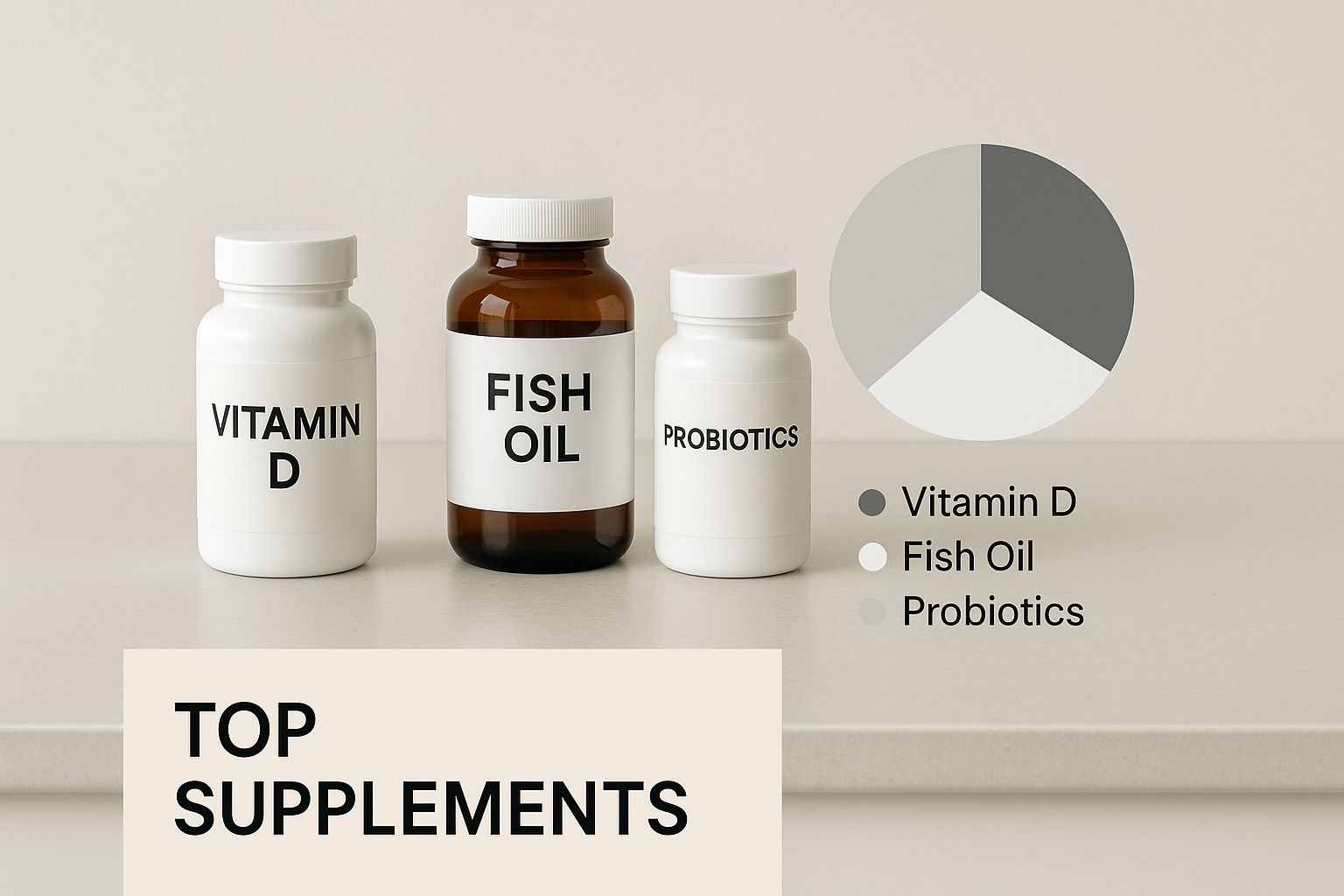
The way these products are presented often tells a story. Clean, science-backed formulas are usually front and center, highlighting purity and effectiveness. Now, let's dive into the most studied and effective natural ingredients you'll find in the best DHT blocking supplements.
Saw Palmetto: The Gold Standard
If you've heard of just one natural DHT blocker, it's probably saw palmetto. It's the most well-known and researched ingredient in this space, and for good reason. It comes from the berries of the Serenoa repens palm tree, and its main job is to inhibit the 5-alpha reductase enzyme. Think of it as putting a roadblock in the conversion factory that turns testosterone into the follicle-shrinking DHT.
By cutting down the amount of DHT your body produces, saw palmetto gives your hair follicles a fighting chance against miniaturization. Its effectiveness has even drawn comparisons to pharmaceutical drugs, solidifying its place as a cornerstone ingredient. For anyone trying to decide on a path, understanding the differences between finasteride vs. saw palmetto can really clarify the natural versus pharmaceutical approaches.
Pumpkin Seed Oil: The Nutrient-Rich Blocker
Pumpkin seed oil is another heavy hitter, and it brings more to the table than just blocking DHT. It’s loaded with a unique amino acid called cucurbitacin, along with a host of beneficial fatty acids and antioxidants. Research has shown that, much like saw palmetto, it can also inhibit the 5-alpha reductase enzyme.
But what really makes it special is its nutrient-dense profile. It doesn't just play defense against DHT; it also nourishes the scalp with vitamins and minerals that create a healthy environment for hair to grow. This one-two punch makes it an incredibly valuable part of any hair health routine.
Other Key Natural Ingredients
Beyond the big two, a few other plant-based extracts provide crucial support in a well-rounded supplement.
- Green Tea Extract: Packed with a compound called EGCG (epigallocatechin gallate), green tea is a fantastic antioxidant that helps shield follicles from oxidative stress. Some studies also suggest EGCG might help lower DHT levels, giving you another layer of defense.
- Stinging Nettle Root: This extract works a bit differently. It interferes with DHT's ability to bind to the receptors on your hair follicles. So, even if DHT is floating around, stinging nettle helps stop it from delivering its "shrink" command.
These ingredients often work best as a team. A formula combining a 5-alpha reductase inhibitor like saw palmetto with a binding blocker like stinging nettle creates a much more powerful and comprehensive defense against hair loss.
To help you see how these key players stack up, here’s a quick breakdown of the most popular natural ingredients you'll find in DHT blockers.
Comparing Popular Natural DHT Blocking Ingredients
This table highlights the main job of each ingredient, what the research says, and what kind of situation it's best suited for.
| Ingredient | How It Works | Key Research Highlight | Best For |
|---|---|---|---|
| Saw Palmetto | Inhibits the 5-alpha reductase enzyme to reduce DHT production. | Often compared to finasteride in its mechanism and effectiveness. | A foundational ingredient for directly lowering systemic DHT levels. |
| Pumpkin Seed Oil | Also inhibits 5-alpha reductase; rich in nutrients. | A 2014 study showed a 40% increase in mean hair count for men who took it. | Those wanting a dual-action approach: DHT blocking plus scalp nourishment. |
| Green Tea Extract | Contains EGCG, a potent antioxidant that may lower DHT. | Its antioxidant properties protect hair follicle cells from damage. | Adding a protective, anti-inflammatory layer to a core DHT-blocking routine. |
| Stinging Nettle Root | Prevents DHT from binding to androgen receptors on the follicle. | Works on a different pathway than enzyme inhibitors, offering a synergistic effect. | Combining with an enzyme inhibitor for a more comprehensive defense strategy. |
Ultimately, choosing a supplement that features these proven, natural ingredients is a solid first step toward tackling hair loss at its hormonal root.
Understanding Pharmaceutical DHT Blockers
While natural supplements are a fantastic first line of defense, it’s worth looking at the whole picture when it comes to fighting DHT. That brings us to pharmaceutical DHT blockers, which are a much more aggressive way to get to the root of hair loss.
These medications are known for being incredibly effective because they work systemically, meaning they drastically reduce the total amount of DHT your body produces. Think of them as the heavy machinery of hair loss treatment, built for powerful, undeniable results.
How Prescription Blockers Work
The main pharmaceutical options are oral medications, with the two big names being Finasteride and Dutasteride. Their job is to directly inhibit the 5-alpha reductase enzyme—the very thing that converts testosterone into hair-thinning DHT. By blocking a huge chunk of this conversion process, they dramatically lower DHT levels in your bloodstream and, most importantly, your scalp.
Finasteride is the one that's FDA-approved specifically for male pattern baldness. It's been clinically shown to shut down about 70% of DHT production. Even better, studies have found it stops hair loss for 83% of men taking a daily 1mg dose. Dutasteride is even stronger, capable of blocking up to 90% of DHT, though it's usually prescribed "off-label" for hair loss.
Effectiveness Versus Side Effects: The Big Trade-Off
The sheer power of these drugs is what makes them so appealing. For a lot of men, finasteride doesn't just halt thinning; it can actually lead to some noticeable regrowth over time. But there's a trade-off: a higher potential for side effects compared to natural supplements.
Because these medications work by altering your body's hormonal balance, a small percentage of users might experience side effects. This is the crucial point to consider, and it’s why talking to a doctor before starting treatment is absolutely non-negotiable.
Understanding both the pros and cons is everything. Pharmaceutical options are a powerful tool against hair loss, but they come with the responsibility of being fully aware of the risks. This is a conversation you have to have with your doctor.
Knowing this side of the story helps you have a much more informed discussion with a healthcare professional. For many, natural DHT-blocking supplements are the perfect place to start because of their stellar safety profile. For others, a prescription might be the necessary next step. If you want to dig deeper into what to expect, you can learn more about if DHT blockers really work in our detailed guide.
How to Choose a High-Quality DHT Blocker
Stepping into the supplement aisle can feel overwhelming. With so many bottles making bold promises, how do you know which one actually works? The trick is to ignore the flashy marketing and focus on what’s inside the bottle.
Instead of hunting for one "magic" ingredient, you'll get far better results from a formula that combines several proven compounds. Think of it like a one-two punch. A supplement that includes a 5-alpha reductase inhibitor (like saw palmetto) and a binding blocker (like stinging nettle) creates a much stronger defense. This powerful combination, known as ingredient synergy, is what truly sets the most effective DHT blockers apart.
Look for Quality and Transparency
Once you’ve found a promising formula, you need to verify its quality. This is where third-party testing is absolutely crucial. Keep an eye out for seals from independent organizations right on the product label.
These certifications are your assurance that the supplement has been rigorously tested for purity and potency. It's proof that what’s on the label is exactly what you're getting in the bottle.
- NSF International: This seal verifies that the product contains the ingredients listed and that there are no harmful contaminants.
- U.S. Pharmacopeia (USP): This one confirms the supplement meets exceptionally high standards for strength, quality, and purity.
Choosing a product with third-party certification is your best shield against a weak or, even worse, contaminated supplement. It’s a simple check that offers some serious peace of mind.
Decode the Supplement Label
Knowing what you’re looking at on the label is just as important. To make a smart choice, you have to be able to interpret the product information correctly. A great starting point is learning how to read supplement labels like a pro. Pay close attention to the dosages of each ingredient to make sure they match the amounts that have been shown to be effective in clinical studies.
Before you pull the trigger on a purchase, run through this quick mental checklist:
- Does it have a multi-ingredient, synergistic formula? A thoughtful blend is almost always going to be more effective than a single-ingredient product.
- Are the ingredient amounts clearly listed and effective? Be wary of "proprietary blends" that hide the exact dosages.
- Is it third-party tested? Look for those USP or NSF seals.
- Does it fit your routine and budget for the long haul? For hair growth, consistency is everything.
Answering these questions will help you cut through the marketing fluff and choose a high-quality supplement with confidence. For more specific recommendations, take a look at our roundup of the top hair growth supplements for men that tick all these boxes.
Your Questions About DHT Blockers, Answered
Alright, let's tackle some of the common questions that pop up when you're considering DHT blockers. It's totally normal to have a few "what ifs" before you start something new for your hair. My goal here is to give you straight, practical answers so you can move forward feeling confident.
How Long Until I See Results from DHT Blocking Supplements?
This is the big one, and the key words are patience and consistency. Hair growth happens on its own schedule, which is pretty slow. You're looking at a minimum of 3 to 6 months before you can expect to see real, noticeable changes.
The first thing you'll likely notice is less shedding, which can sometimes happen within the first couple of months. That’s a great early sign! But for the more visible improvements—thicker strands, maybe some new, fine hairs sprouting—you really need to stick with it daily for six months or more. Everyone's timeline is a bit different, but consistency is the one thing you can control.
Are Natural DHT Blockers Actually Safe?
For the most part, yes. One of the main reasons people turn to natural options like saw palmetto or pumpkin seed oil is their strong safety record. The vast majority of people use them without any issues at all.
If side effects do show up, they're usually very mild. Think minor stomach upset or a slight headache as your body adjusts. This is a far cry from the more serious potential side effects associated with pharmaceutical options.
My advice? Always start with a lower dose to test the waters and see how you feel. And, as with any new supplement, it's always a good idea to run it by your doctor, especially if you have other health conditions or are on medication.
Can Women Use DHT Blockers Too?
Absolutely. Many natural DHT blockers are a great fit for women experiencing hormonal hair thinning. Female pattern hair loss is also tied to DHT sensitivity, so ingredients like pumpkin seed oil and stinging nettle can be just as effective.
There's one crucial exception, though. If you are pregnant, breastfeeding, or planning on becoming pregnant, you must talk to your doctor before taking any supplement that affects your hormones. This is non-negotiable. It's also why pharmaceutical drugs like Finasteride are generally not prescribed to women of childbearing age.
At PRP For HairLoss, we know that understanding the why behind your hair loss is the first step toward finding a solution that works. We're committed to giving you the most current, reliable information on everything from supplements to PRP therapy. To learn more and continue your journey, come visit us at https://prpforhairloss.com.

 PRP For Hairloss
Leave a comment