Staring in the mirror, it’s easy to second-guess what you see. Is that tiny change in your hairline actually happening, or is your mind just playing tricks on you? The first whispers of a receding hairline often show up as subtle thinning at the temples or finding a few extra hairs on your pillow.
Catching these shifts early is the most important step. It’s what gives you the power to understand what’s going on and start thinking about your next move.
Is It a Mature Hairline or Early Hair Loss
It’s the question countless guys ask themselves: "Is my hairline just changing as I get older, or am I actually starting to lose my hair?" Telling the difference between a normal, maturing hairline and the first stages of male pattern baldness can be tricky, but there are some clear giveaways.
A mature hairline is a natural rite of passage for most men, usually showing up sometime between their late teens and late twenties. Think of it as your hairline settling into its adult position. It typically moves up just a bit—maybe an inch—from where it was when you were a kid, but the change is usually even and keeps a pretty solid shape.
A receding hairline, on the other hand, is a different beast. The changes are often more dramatic and uneven. You might start to notice a distinct 'M' shape forming as the corners of your hairline pull back faster than the middle. This isn't just about getting older; it's a process driven by your genetics and hormones.
The real tell-tale sign is the trajectory. A mature hairline finds its new spot and then pretty much stays there. A receding hairline, if you don't do anything about it, is likely going to keep on receding.
Key Indicators to Watch For
If you're trying to figure out what's going on with your own hair, keep an eye out for these specific signs:
- Thinning at the Temples: This is the classic starting point for so many. The hair at the corners of your forehead begins to look less dense than the hair right up front.
- More Hair Shedding: We all shed hair—losing 50-100 strands a day is totally normal. But if you suddenly notice way more hair in the shower drain, tangled in your brush, or on your pillow, that's a red flag.
- The Photo Test: Sometimes the best evidence is sitting right in your camera roll. Pull up some photos from a few years ago and compare them to a recent one. A picture doesn't lie, and it can show you exactly how much your hairline has shifted.
Mature vs. Receding Hairline: A Quick Comparison
Use this quick reference guide to understand the key differences between a normal maturing hairline and the early stages of hair loss.
| Characteristic | Mature Hairline (Normal Aging) | Receding Hairline (Early Hair Loss) |
|---|---|---|
| Timing | Typically late teens to late 20s | Can begin anytime after puberty |
| Shape | Moves back evenly, maintains a defined shape | Often uneven, creating an 'M' or 'V' shape |
| Progression | Moves up slightly (about an inch) then stabilizes | Continues to recede over time if unaddressed |
| Thinning | Minimal thinning, consistent density | Noticeable thinning, especially at the temples |
This table is a great starting point, but remember, everyone's situation is unique.
Knowing the difference between a normal part of getting older and the first signs of hair loss is empowering. If you want to get a better baseline for what's considered typical, our guide on the normal hairline for men can help you assess your own situation with a bit more clarity.
The Telltale Signs of a Receding Hairline
So, you think your hairline might be on the move. The key is to know what to look for—not to panic, but to pay attention to the subtle shifts that happen over time. Spotting these changes early gives you a major head start.
One of the most classic signs is the dreaded 'M' shape. This pattern appears when the hair at your temples starts to thin out faster than the hair in the middle. Slowly but surely, this creates two higher points on either side of your forehead, forming a shape that looks a lot like the letter M.
This infographic does a great job of showing the difference between a hairline that’s just maturing versus one that's actively receding.
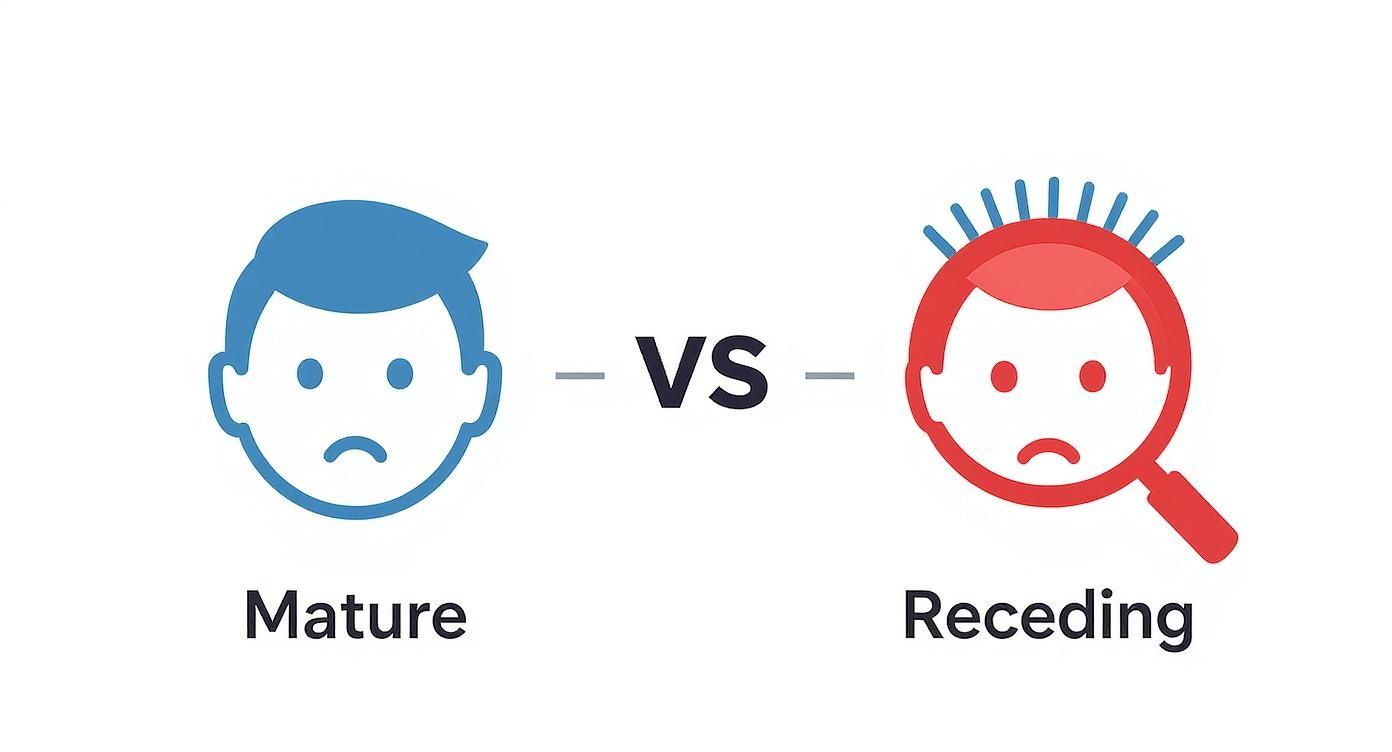
A mature hairline tends to move back evenly across the forehead and then stops. A receding one, on the other hand, keeps going, often leaving a more uneven and pronounced shape behind.
Miniaturization: The Unseen Clue
Beyond just the shape, there's a more subtle process at work called miniaturization. Imagine a healthy tree branch that, season after season, starts growing smaller and weaker leaves. That’s essentially what happens to your hair follicles.
Genetics and hormones can trigger certain follicles to shrink. As they get smaller, the hairs they produce become finer, shorter, and lighter in color. You might spot these wispy, almost see-through hairs right along your hairline. They're a clear signal that those follicles are struggling to produce healthy, strong hair.
Hair miniaturization is a gradual process where strong, thick terminal hairs are replaced by thinner, weaker vellus hairs. It's a hallmark of androgenetic alopecia and a sign that the follicle's growth cycle is being disrupted.
Is Your Shedding Normal or Excessive?
Losing some hair every day is completely normal. In fact, shedding between 50 and 100 strands is just part of your hair's natural growth cycle. But when you start noticing a lot more hair than usual, it’s time to take a closer look.
If your pillowcase, shower drain, or comb is suddenly covered in hair, it could be an early warning sign. While shedding alone isn’t a surefire sign of a receding hairline, when it’s paired with thinning at the temples, the picture becomes much clearer. For many guys, male pattern baldness (or androgenetic alopecia) kicks off in their twenties or thirties—in fact, about one in four men begin to see hair loss by age 25. You can learn more about these statistics and their implications on ncbi.nlm.nih.gov.
For a deeper dive into this, check out our guide on how to tell if your hair is thinning.
Understanding What Causes a Receding Hairline
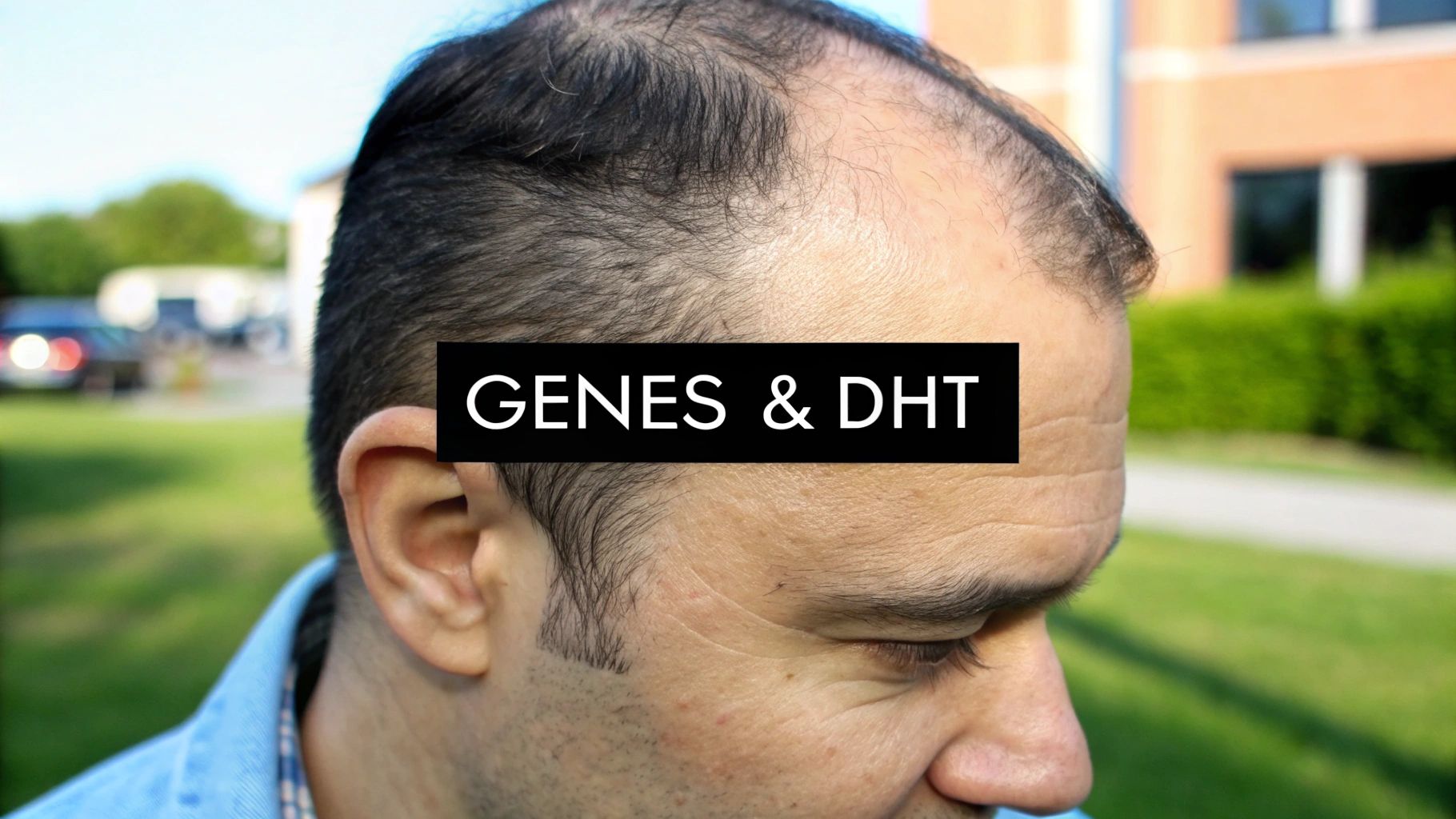
Spotting the signs of a receding hairline is the first step, but the real power comes from understanding why it's happening. This isn't just a random thing; it’s a biological process driven by two main forces: your genetics and your hormones. Knowing this helps you see it for what it is—a very common medical condition, not a personal failing.
Your genes basically hand you a roadmap for your hair's future. The most common culprit, androgenetic alopecia (or male pattern baldness), is a hereditary trait passed down through your family. If hair loss runs in your family, you're more likely to be on a similar path because that genetic roadmap dictates how sensitive your hair follicles will be to certain hormones.
The Role of Hormones and DHT
The key hormone in this story is dihydrotestosterone (DHT). It’s a byproduct of testosterone, and for guys with a genetic predisposition to hair loss, it's the main antagonist. DHT attaches itself to receptors in the hair follicles on your scalp, and over time, this causes them to shrink and weaken.
This shrinking process is what we call miniaturization. As the follicles get smaller, the hair they produce becomes finer and shorter, until they eventually just stop growing hair entirely. It’s this gradual shutdown that creates the thinning and recession you see in the mirror. Getting a handle on what DHT is and its connection to hair loss is crucial to understanding the science of it all.
Think of DHT like a key that only fits certain locks. If your genes gave your hair follicles those specific "locks," DHT can get in and start the miniaturization process. If you don't have that genetic sensitivity, DHT has a much less dramatic effect.
While genetics and DHT are the undisputed headliners, other factors can definitely throw gasoline on the fire.
- Chronic Stress: Major stress can seriously mess with your hair's natural growth cycle, sometimes pushing more hairs into the shedding phase.
- Poor Nutrition: Your hair needs fuel. Lacking essential vitamins and minerals can starve your follicles and weaken your hair.
- Lifestyle Choices: Things like smoking can constrict blood vessels, reducing vital blood flow to the scalp and potentially speeding up hair loss.
These factors usually won't cause male pattern baldness on their own, but if you’re already genetically wired for it, they can make things worse, faster.
Hair Loss Is More Common Than You Think
If you’ve started to notice the first signs of a receding hairline, it’s easy to feel like you’re on an island. But the truth is, what you're seeing in the mirror is one of the most common experiences men go through. You're not alone in this—not by a long shot.
Realizing this can be a game-changer. It helps shift your mindset from "Why me?" to understanding this is a widely shared part of the human journey. Millions of men all over the world are noticing the exact same changes.
A Look at the Numbers
Just how common is it? The data might surprise you. Male pattern hair loss, the primary driver behind a receding hairline, is a global phenomenon.
Take a look at Europe, for instance. In countries like Spain, Italy, and France, over 44% of adult men are dealing with significant hair loss. The United States isn't far behind at 42.68%, and countries like Germany, Canada, and Croatia are all over the 40% mark. If you're curious, you can explore more of these global hair loss statistics on voronoiapp.com.
These numbers tell a clear story: for a huge portion of the male population, experiencing some hair loss is more normal than not. It's a natural part of aging for many.
This perspective can be incredibly freeing. Your changing hairline doesn't make you an outlier; it actually puts you right in the middle of a very large peer group. Knowing you're in such good company can help you approach whatever you decide to do next with a sense of confidence, not anxiety.
When Is It Time for Professional Hair Loss Treatments?

Spotting the first signs of a receding hairline is one thing, but figuring out when to take action is a whole different ballgame. If you're tired of just watching it happen and are ready to be proactive, it might be time to bring in the pros. When it comes to hair loss, early intervention is almost always the secret to getting the best results.
Of course, many people first turn to topical solutions. Products like a botanical hair growth serum are a popular starting point, designed to give your follicles a little extra support. But when you’re ready for something more direct, that's where modern clinical treatments really shine.
One of the most talked-about options is Platelet-Rich Plasma (PRP) therapy. It’s a clever approach that taps into your body's own natural healing abilities to get the job done.
PRP therapy is a non-surgical treatment that uses a concentrated dose of your own blood platelets. These platelets are full of growth factors, and when they're injected back into your scalp, they can help wake up dormant follicles and encourage new, healthier hair growth.
Who Is a Good Candidate for PRP Therapy?
PRP tends to work best for people who are still in the earlier stages of hair loss. The whole idea is to stimulate hair follicles that are weakened but still active, so timing is everything.
You might be a great candidate for PRP if a few things line up:
- Recent Onset: You've noticed your hair thinning or receding within the last few years.
- Sufficient Follicles: You're seeing more scalp, but you don't have large patches that are completely smooth.
- Good Overall Health: A healthy body produces high-quality plasma, which is exactly what the treatment needs to be effective.
The procedure itself is surprisingly straightforward. A small sample of your blood is drawn—just like a regular blood test—and placed in a centrifuge to separate and concentrate the powerful platelets. This "liquid gold" is then carefully injected into the areas of your scalp that need it most. Most people find the process very tolerable.
The aim of PRP is to put the brakes on hair loss while thickening up the hair you still have. The results show up gradually, but many patients see a real difference in their hair's density and overall health. Wondering if it’s right for you? Your best bet is to find hair loss specialists near me and book a consultation to get a professional opinion.
Common Questions About Receding Hairlines
When you first notice your hairline changing, it’s natural to have a million questions. Getting straightforward answers is the first step toward figuring out what to do next.
A question I hear all the time is, "Will it stop on its own?" For most guys dealing with male pattern baldness, the answer is unfortunately no. This type of hair loss is a gradual process driven by your genetics and hormones, and it won't just hit the brakes without some kind of intervention.
Another common myth that needs busting: does wearing a hat make it worse? Simply put, no. Your favorite baseball cap isn't the culprit. Male pattern baldness is an internal, genetic process, and what you put on your head won't cause it.
Age and What You Can Realistically Expect
So, when does this all start? It really varies from person to person, but many men spot the first signs in their late teens or early 20s. In fact, studies show that about 25% of men with hereditary hair loss start seeing it before they even hit 21.
This brings us to the big one: can you reverse it? This is where acting early makes all the difference. While it's tough to bring back a hairline that's been gone for years, modern treatments can absolutely slow things down and, in many cases, even encourage some regrowth. You can dig deeper into whether lost hair can grow back to get a realistic picture of the possibilities.
The best game plan is to focus on keeping the hair you still have while waking up those dormant follicles. The sooner you get started, the better your odds of success.
Many people also look to nutrition to give their hair a fighting chance. Things like plant-based collagen supplements are popular for supporting hair health from the inside out. At the end of the day, understanding all your options is what gives you the power to take action.
At PRP For HairLoss, we believe that clear information empowers you to make the best choices for your hair. If you're ready to move beyond questions and explore effective, science-backed treatments, we're here to guide you. Learn more at https://prpforhairloss.com.


Leave a Reply