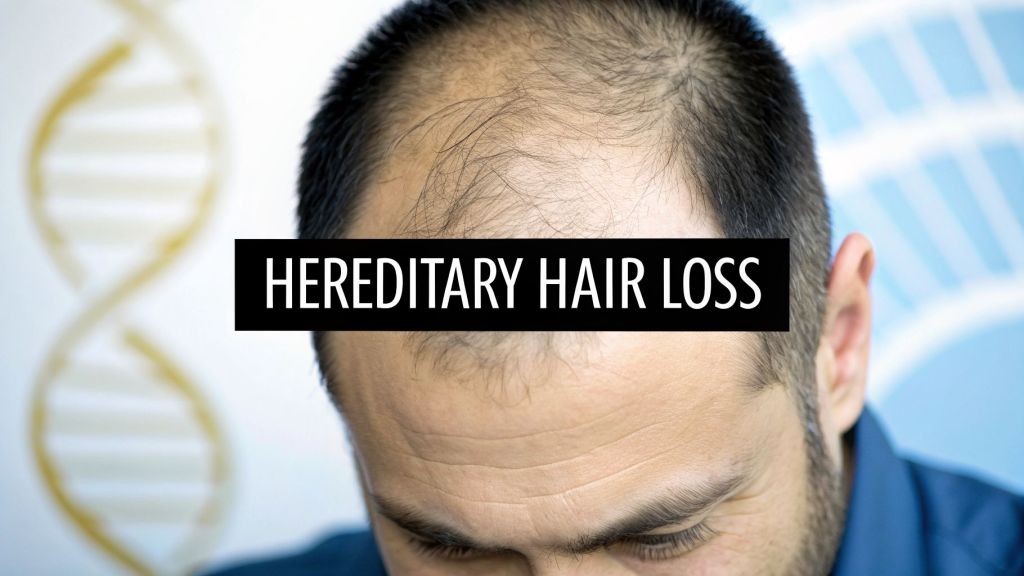
If you're a man who's been noticing more hair in the drain or a hairline that's starting to retreat, you've probably asked yourself, "Is this hereditary?" The short answer is, almost certainly, yes. For most guys, hair loss isn’t some random fluke—it’s a condition called androgenetic alopecia, and it's written right into your DNA.
The Genetic Blueprint Your Hairline Follows

We've all been there—that moment you catch a glimpse in the mirror and realize your hairline looks a little different than it used to. It's easy to blame stress or your diet, but the truth is, the script for hair loss was likely written long before you were born.
Think of it like a pre-programmed sensitivity. Your genes determine how your hair follicles will react to a powerful hormone called dihydrotestosterone (DHT), which your body naturally makes from testosterone. This isn't a defect or a sign that you're unhealthy; it's just a hereditary trait, like the color of your eyes. To get a better handle on this, the guide on What Causes Male Pattern Baldness? is a great resource.
How To Know If Your Hair Loss Is Hereditary
The pattern and timing of your hair loss are the biggest giveaways. Hereditary loss typically follows a predictable path—like a receding M-shaped hairline or thinning at the crown—while other types of hair loss can appear more sudden or patchy.
Here's a quick reference to help you spot the difference.
Quick Clues Your Hair Loss Is Hereditary
| Symptom | Hereditary Hair Loss (Androgenetic Alopecia) | Other Causes (Stress, Diet, etc.) |
|---|---|---|
| The Pattern | Follows a predictable pattern: receding hairline (at temples) or thinning on the crown. | Often diffuse (thinning all over), patchy, or in unusual spots. No clear pattern. |
| The Timing | Gradual and progressive over years. You might notice it slowly getting worse. | Can be sudden and rapid, often linked to a specific event or trigger. |
| Family History | Hair loss is common among male relatives on either side of your family. | No clear family link. May be the first in your family to experience it. |
| Other Symptoms | Usually none. The scalp is healthy, with no itching, scaling, or redness. | May be accompanied by scalp irritation, inflammation, or other health issues. |
Seeing your hair loss fit the "Hereditary" column is a strong sign that you're dealing with male pattern baldness.
Why Your Genes Are The Main Culprit
If you’re in your twenties and already seeing your hairline march backward, you’re not alone. For about one in four men, this is when male pattern baldness begins its slow, steady advance. By middle age, 30-50% of men will be dealing with it.
Why? It all comes down to a genetic hypersensitivity to DHT. In fact, research points to genetics being responsible for up to 80% of a man's predisposition to baldness. It’s the reason you see hair loss run in families. If your dad or grandad went thin on top, the odds are you're carrying the same genetic traits.
This inherited sensitivity explains everything. It’s why one guy starts losing his hair at 22 while his friend keeps a full head of it into his 50s. Your journey is entirely unique to your genetic makeup. The good news? Understanding that it’s genetic is the first real step toward doing something about it.
Key Takeaway: Hereditary hair loss isn't about having "bad genes." It’s simply an inherited trait that makes your hair follicles overreact to the hormone DHT, causing them to shrink over time.
While you can't rewrite your DNA, you absolutely can influence what happens next. Think of it this way: your genes might load the gun, but lifestyle and modern treatments can keep you from pulling the trigger. It’s all about understanding the blueprint you were given and taking smart, proactive steps. For those ready to explore this further, our guide on genetic hair loss testing is a great next step.
Who Do I Blame For My Hair Genes?
When your hair starts thinning, it's easy to go looking for a single person to blame. For decades, the go-to culprit was your mother's father. The old wives' tale was simple: if your maternal grandpa had a full head of hair, you were in the clear. If he was bald, well, bad luck.
There's a grain of truth to that, but it's only a small piece of a much bigger puzzle. The real story behind hereditary hair loss is far more complicated and interesting than just looking at one relative.
The primary gene linked to male pattern baldness, the Androgen Receptor (AR) gene, is in fact found on the X chromosome. Since men (XY) get their X chromosome from their mothers, there's a direct line back to her side of the family. This gene basically tells your hair follicles how strongly to react to DHT, the hormone that triggers hair loss.
But if you're only pointing the finger at your mom's side, you're letting your dad's family off the hook way too easily.
It Takes a Whole Genetic Team
Think about it this way: the AR gene is like the star quarterback of your "hair team." It's an incredibly important player and has a huge say in the final outcome. But no quarterback, no matter how good, wins a championship all by himself.
That's where the rest of the team comes in. Scientists have now identified dozens of other genes that play a role, and you inherit these from both of your parents. These are known as autosomal genes, and they act like the offensive line, the receivers, and the coaching staff.
These "teammate" genes help determine things like:
- When your hair loss starts: This is why one brother might see thinning at 25, while the other doesn't notice a thing until his 40s.
- The pattern it takes: Will it be a receding hairline, a thinning crown, or a more diffuse loss all over?
- How fast it progresses: Some guys experience rapid thinning, while for others, it's a slow burn over many years.
This is precisely why you can't just look at your dad or your uncle and predict your own future. Your hair's destiny is written in a unique genetic code, mixed and matched from both your mother's and father's family trees.
Your genetic blueprint for hair loss is a combination of signals from both sides of your family. The AR gene from your mother might set the stage, but the crowd of other genes you inherit from both parents will direct the performance.
Why Your Balding Pattern Is Unique
This "team of genes" concept is the key to understanding why your hair loss might look completely different from your father's or brother's. You might have inherited your dad’s genes for a slow, gradual thinning process but also got your mom’s high-sensitivity AR gene. The result is a pattern of hair loss that is entirely your own.
This complex genetic lottery is what makes predicting baldness so tricky. It isn't a simple case of inheriting one "baldness gene." It’s a polygenic trait, which is just a scientific way of saying many genes work together to create the final result.
Every person gets a different lineup of these genetic players. This leads to the huge variety of hair loss experiences we see, even within the same immediate family. So, instead of trying to find a single person to blame, it’s much more useful to understand that you've simply inherited a specific genetic profile that makes you susceptible.
How To Spot Hereditary Hair Loss Early

You know hair loss runs in the family, but spotting the first signs on your own head is a completely different ballgame. Catching it early is your single biggest advantage, because every treatment out there works best on the follicles you still have, not the ones you've already lost. But the initial clues are rarely as dramatic as finding a bald spot overnight.
For most guys, the first hint isn’t in the mirror—it’s on the pillowcase, in the shower drain, or tangled in a comb. An uptick in shedding is often the canary in the coal mine. It's perfectly normal to lose between 50 to 100 hairs a day, but if you start noticing consistently more than that, it could be a sign that your hair follicles are starting to succumb to DHT.
Think of that increased shedding as the first domino. It’s the subtle warning that precedes the more obvious, visual changes that we all recognize as male pattern baldness.
The Tell-Tale Patterns of Genetic Thinning
Hereditary hair loss follows a predictable playbook. For men, that playbook is known as the Norwood Scale, which is just a formal way of classifying the typical stages of balding. Learning these patterns helps you make sense of what’s happening on your own scalp.
You don’t need a medical degree to recognize the common starting points. The process almost always kicks off in one of two areas—or sometimes, both at once.
The Receding Hairline: This is the classic start. The thinning begins at your temples, gradually carving out a more defined "M" shape at your hairline. What was once a straight or rounded hairline starts to creep backward, leaving a prominent patch of hair in the middle.
The Thinning Crown: For many others, the first sign is a small, thinning circle right at the vertex—that spot on the top-back of your head. This area can slowly widen over months or years, often becoming most apparent under harsh lighting or right after a shower when your hair is wet.
Down the road, these two patterns often merge, leaving the familiar "wreath" of hair that runs around the sides and back of the head.
Key Insight: The giveaway isn’t just hair loss; it’s the pattern of the loss. When thinning progresses predictably from the temples or the crown, you're almost certainly looking at hereditary hair loss.
Zooming In on Hair Miniaturization
Here’s the most important concept to grasp: the real sign of androgenetic alopecia isn't just less hair, it's smaller hair. This process, called hair miniaturization, is the direct result of DHT’s assault on your follicles. Imagine a healthy tree that, season after season, gets a little less water and sunlight. It doesn’t just vanish; it slowly withers, producing smaller leaves and weaker branches.
That’s exactly what happens on your head. With each new growth cycle, the affected hairs come back a bit finer, shorter, and weaker than before. A thick, pigmented terminal hair is eventually replaced by a wispy, colorless "vellus" hair. This is why your hair can start to look thin and almost transparent long before you see significant scalp exposure.
So, how can you spot miniaturization yourself?
- Examine Your Hairline: Get close to a mirror and look at the hairs along your temples. Do they look as thick and dark as the hair on the back of your head? If you see a lot of fine, baby-like hairs where strong ones used to be, that’s miniaturization in action.
- Do a Touch Test: Run your fingers through the hair on top of your scalp. Now, do the same for the hair on the sides. If the hair on top feels noticeably softer, finer, or less dense, you’re feeling the texture change caused by miniaturization.
This is the most definitive clue you can find on your own. It’s what separates temporary shedding from the progressive thinning that signals hair loss hereditary in nature. Getting good at spotting these changes is crucial, and you can learn even more by reading about the early signs of male pattern baldness. Catching it early gives you the power to intervene when treatments are most effective.
Are Some Men More Prone To Baldness?
You've probably heard the jokes or noticed that men from certain parts of the world seem to go bald more often. As it turns out, there's a good deal of truth to that observation. When it comes to hair loss that’s hereditary, your ethnic background plays a much bigger role than you might think.
This isn't about stereotypes—it's about genetics. A massive body of research shows that men of Caucasian descent, especially from European backgrounds, have the highest rates of male pattern baldness on the planet. Their hair follicles simply carry a stronger genetic sensitivity to DHT, the hormone that shrinks them over time.
So, while any man can experience genetic hair loss, the deck isn't stacked evenly. A guy with a Northern European family tree is statistically far more likely to see thinning in his 30s than a man whose ancestors are from East Asia or Africa.
The Global Hotspots for Hair Loss
This genetic connection snaps into sharp focus when you look at baldness rates by country. The data reveals clear "hotspots" where the genes responsible for hair loss are just more common. This isn't a fluke; it's a direct result of genetic traits being passed down through generations in specific populations.
For instance, Spain currently has the highest rate of male pattern baldness in the world, with a staggering 44.5% of its male population affected. Other European nations aren't far behind. Italy comes in at 44.37%, France at 44.25%, and even the United States sits at 42.68%. You can see how other countries stack up in this fascinating baldness by country analysis.
The fact that these high rates are clustered across Europe and North America is no coincidence. It shows how certain versions of key genes, like the Androgen Receptor (AR) gene, have become more widespread in some populations than in others.
Key Insight: Think of your ethnicity as a general risk profile for hereditary hair loss. It doesn't seal your fate, but knowing your ancestry is linked to higher rates gives you a powerful reason to pay closer attention to the early signs.
What These Statistics Mean for You
Looking at these numbers shouldn't be a source of dread. Instead, see it as an advantage. Knowing your general risk level based on your ancestry helps put your own situation into perspective. If you’re of Caucasian descent and notice your hair thinning, you can be more confident that what you’re seeing is likely classic hereditary hair loss.
Having that context is incredibly helpful. It empowers you to:
- Be Vigilant: You know to keep an eye out for the very first signs, like a receding hairline or thinning at the crown.
- Act Sooner: Armed with this understanding, you can consult a specialist at the first sign of trouble, which is when treatments work best.
- Set Realistic Expectations: It helps you accept that you're dealing with a very common genetic trait, not some personal shortcoming.
At the end of the day, everyone has their own unique genetic hand to play. You can learn more about how these traits get passed on in our guide to male pattern baldness genetics. While your ancestry offers clues, your personal hair loss journey is your own—but being informed gives you a massive head start.
Can You Outsmart Your Genes? A Look at PRP Therapy
Once you realize your hair loss is written in your family's history, it’s easy to feel like you've been dealt a bad hand. The next thought is usually, "Can I do anything about my own DNA?" The answer is yes, you absolutely can. One of the most effective ways to intervene directly is with Platelet-Rich Plasma (PRP) therapy.
Instead of just surrendering to your genetic blueprint, PRP gives you a way to push back. It's not about rewriting your genes, but about fundamentally changing the environment on your scalp so your follicles can thrive despite them.
Waking Up Your Hair Follicles With Growth Factors
Imagine your scalp is a battleground. An androgen called DHT is methodically trying to shut down your hair follicles, causing them to shrink and weaken over time. PRP is like calling in a team of highly-trained medics to fortify your defenses and repair the damage.
The whole process cleverly uses your body's own natural healing power.
- A Simple Blood Draw: First, a small sample of your blood is drawn—no different than a routine lab test.
- Concentrating the Good Stuff: That blood is then spun in a centrifuge. This separates the components, isolating the platelet-rich plasma, which looks like a golden fluid packed with powerful proteins called growth factors.
- Targeted Injections: This liquid gold is then meticulously injected into the areas of your scalp where you're seeing thinning.
These growth factors are the real heroes here. They act like powerful messengers, essentially "waking up" those dormant or struggling follicles and signaling them to get back to the business of growing hair.
Countering DHT’s Genetic March
PRP works by directly challenging the miniaturization process that DHT triggers. While your genetics are telling follicles to get smaller and weaker, the growth factors in PRP are sending a competing message: grow stronger, healthier, and thicker. It’s a biological tug-of-war, and PRP gives your hair a much stronger rope to pull.
Make no mistake, genetics is a powerful force. Some studies suggest it dictates up to 80% of a man's predisposition to baldness, making hereditary hair loss a very common reality for the roughly 80 million people it affects in the U.S. alone.
This is precisely where PRP shines. By concentrating your body's own growth factors, it provides a natural way to thicken existing hair shafts and boost overall density. In fact, clinical trials focused on genetic hair loss have shown a 20-40% improvement in hair volume after just a few months, making it a powerful choice for guys who'd rather not commit to daily pills and their potential side effects.
This chart shows a typical timeline for how male pattern baldness unfolds, giving you a clear picture of the progression.

As you can see, thinning often starts as early as 25 for many men and can become much more noticeable by midlife. This really drives home the importance of taking action sooner rather than later.
Timing Your Intervention Is Everything
When it comes to hereditary hair loss, your timing is critical. PRP is incredibly effective at reviving and strengthening existing follicles that have been weakened but are still alive. It is not, however, designed to resurrect follicles in completely bald areas that have been dormant for years.
The table below breaks down how your current stage of hair loss, based on the common Norwood Scale, impacts how well PRP is likely to work for you.
PRP Suitability For Hereditary Hair Loss Stages
| Norwood Stage | Description | PRP Effectiveness and Goal |
|---|---|---|
| Stage 1-3 | Minimal to early thinning at the temples and crown. | High. The goal is to halt progression, reverse miniaturization, and significantly thicken existing hair. |
| Stage 4-5 | Noticeable bald spots on the crown and a more defined receding hairline. | Moderate to High. The goal is to thicken remaining hair and potentially restore some density in thinning zones. |
| Stage 6-7 | Extensive hair loss with only a band of hair remaining at the sides and back. | Low. PRP is less effective here as most follicles are permanently gone. The focus may shift to preserving the remaining hair. |
The key takeaway? Acting early gives you the best possible shot at preserving and restoring your hair.
Think of it like tending to a struggling lawn. It's much easier to bring yellowing, patchy grass back to life than it is to grow a lush new lawn from bare dirt. That's why acting at the first signs of thinning gives you the biggest advantage. You can get more details on the procedure in our complete guide to platelet-rich plasma therapy for hair.
What To Expect From a PRP Treatment Plan
A standard PRP plan kicks off with an initial series of sessions, typically scheduled about a month apart. Most specialists will recommend three to four treatments to start. This front-loads the scalp with growth factors to wake up the follicles and jumpstart a new growth phase.
After that initial round, you’ll likely need maintenance sessions every six to twelve months to maintain your results. Remember, you’re up against an ongoing genetic process. These follow-up treatments ensure your follicles continue to get the support they need to fend off DHT's influence over the long term.
While everyone's results will vary, many men report a noticeable decrease in shedding within the first couple of months. More visible improvements in thickness and density usually start to appear around the three-to-six-month mark, as the revitalized follicles begin producing healthier, more robust hair strands. For anyone wanting to understand the process from a patient’s point of view, this guide to PRP Treatment for Hair Loss offers an excellent overview.
Your Action Plan For Tackling Hair Loss
Okay, so you’ve connected the dots and realized your hair loss is likely hereditary. That’s a huge first step. It means you can stop guessing and start creating a real game plan.
Now comes the most important part: taking action. Knowing the cause is one thing, but what you do with that information is what truly matters. This isn't about just stopping hair loss; it's about getting back in the driver's seat. Here’s how you can move forward confidently and make informed decisions.
When To See A Professional
Knowing when to call in an expert is half the battle. Think of these signs as the "check engine" light for your hair—it's time to get a professional opinion. If any of this sounds familiar, book a consultation.
- Persistent Thinning: You've noticed your hair getting thinner for more than six months. This isn't a temporary shed; it’s a steady, downward trend.
- Visible Scalp: Your part seems wider, or you're seeing more of your scalp on the crown, especially under bright lights. That’s a classic sign that follicle density is decreasing.
- Increased Shedding: You’re consistently finding a lot more hair in the shower drain, on your pillow, or in your comb. This is a clear signal that follicles are weakening and entering the shedding phase more quickly.
Don't just wait and see. These are your cues that the genetic process is kicking in, and the sooner you intervene, the more options you'll have.
Questions To Ask Your Hair Loss Specialist
Walking into a specialist's office prepared is the best way to get real value from your appointment. You're not there to be lectured; you're there to collaborate on your health.
A great consultation is a conversation, not a sales pitch. Your mission is to understand exactly where you stand, what your options are, and what kind of results are actually possible for you.
Arm yourself with these essential questions:
- Based on my specific hair loss pattern and stage, am I a good candidate for PRP therapy? This cuts right to the chase and tells you if PRP is a viable path.
- What results can I realistically expect, and what’s the timeline? This is crucial for managing your expectations and knowing what success looks like.
- What’s the recommended treatment schedule for someone in my situation? You need to understand the full commitment, from the initial series of treatments to long-term maintenance.
- Should I combine PRP with any other treatments? A multi-pronged approach, like adding minoxidil, can often yield better, more durable results.
- What are the full costs, including the first few sessions and any future maintenance? Get a clear financial picture upfront so there are no surprises down the road.
Armed with these answers, you'll be ready to make a choice. If you want to dig deeper into all the possibilities, our guide on finding the best hair loss treatment is a great next read. Your journey forward starts with a single, well-informed decision.
Common Questions About Hereditary Hair Loss
Alright, we've covered a lot of ground. But let's be honest, you probably still have some specific 'what if' questions running through your mind. That's completely normal. Let's tackle the big ones head-on with some straight answers.
If My Dad Is Bald, Am I Guaranteed To Go Bald Too?
This is the classic question, and the answer is a solid 'maybe.' It definitely puts you on high alert, but it's not a done deal. Hereditary hair loss is a complex game of genetics, with cards dealt from both sides of your family.
While your dad's hair situation is a major clue, some of the most influential genes are actually passed down on the X chromosome—which you inherit from your mother. So, looking at your maternal grandfather can be just as telling. Ultimately, it’s a genetic lottery, and your specific combination is what matters.
Can I Stop Hereditary Hair Loss Completely?
Let's be real: you can't rewrite your DNA. There's no 'cure' for the genetic hand you were dealt. But you absolutely can step in and manage how the story unfolds. Think of treatments as a way to slow down that genetic clock.
The goal isn't to erase your genetics; it's to push back against them. Effective treatments like PRP therapy, minoxidil, and finasteride are all designed to interrupt the process, giving your hair follicles the support they need to resist thinning.
Does Lifestyle Affect Hereditary Hair Loss?
Yes, without a doubt. Your genes might load the gun, but lifestyle factors can definitely help pull the trigger. Things like chronic stress, poor sleep, and a nutrient-deficient diet create an environment that can accelerate the hair loss your genes have planned.
A healthy lifestyle won't stop hair loss hereditary in its tracks, but it makes your hair and follicles more resilient. On the flip side, a consistently unhealthy lifestyle can absolutely hit the fast-forward button on thinning.
Is PRP A Better Option Than Medication?
This really boils down to what you're looking for. PRP is a fantastic option for guys who want a natural approach, using their body's own powerful healing factors to strengthen hair from the inside out. It's proactive and avoids the potential side effects some men experience with daily medication.
However, it's not an either/or question for everyone. For some men, combining PRP with medication provides the most robust and lasting defense against hair loss. A specialist can help you map out a strategy that fits your specific hair situation, your personal preferences, and your ultimate goals.
Ready to move from worrying about your hair to doing something about it? The experts at PRP For HairLoss can help you understand your options and build a plan that works for you. Learn more about your hair loss solutions today.
 PRP For Hairloss
Leave a comment