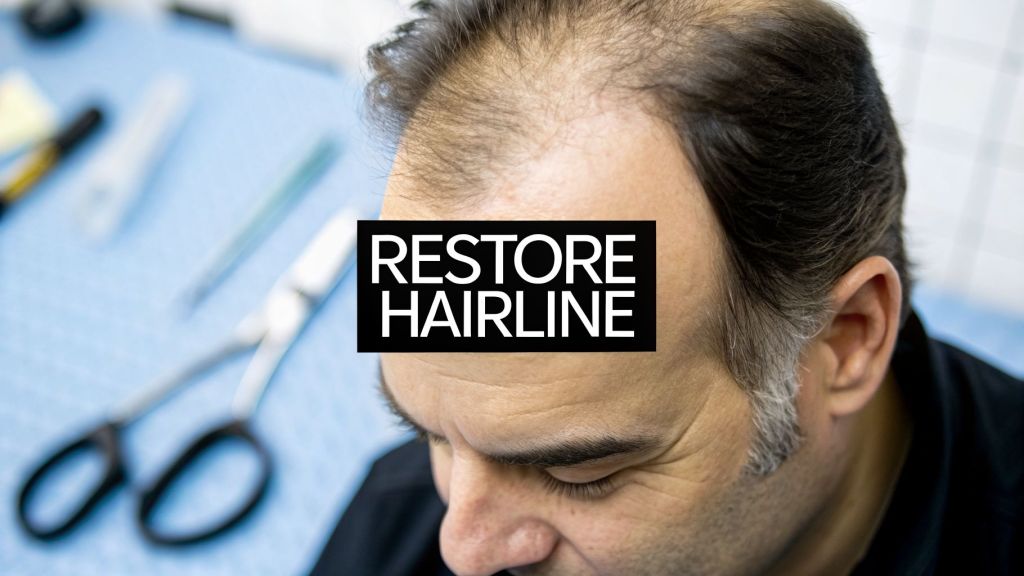
It’s a moment most guys dread. You catch your reflection, maybe under some harsh bathroom lighting or in a store window, and you notice something just looks… different. Your hairline seems a little higher at the temples, or the hair at the front just doesn’t have the same thickness it used to. This is the classic start to what’s often called front hair thinning, and it’s a tangible, often frustrating, sign of change.
The First Sign Something Has Changed

That initial realization can feel a bit isolating, but trust me, it’s an incredibly common experience. This isn't some personal failing or a sign you've messed something up. It’s usually just the first chapter in a story that millions of men share, a story called male pattern baldness (MPB). And this condition is driven almost entirely by genetics, not your lifestyle choices.
The reason a thinning hairline grabs your attention so quickly is simple: it frames your face. Unlike thinning on the crown, which can hide for a while, any change up front is immediately obvious—to you and probably to everyone else. It’s the leading edge, and when it starts to retreat, it can feel like a major shift in how you look and feel.
You Are Far From Alone
If you’re seeing this in the mirror, you really need to know just how widespread this is. Think about it: about one in four men start to see their hairline recede by the time they hit 25. Research confirms that roughly 25% of men have visible signs of frontal thinning by that age, which is the textbook sign of MPB.
In fact, this single genetic condition is responsible for a whopping 95% of all hair loss in men. It’s not some random fluke; for those of us with the right genes, it's a predictable biological process.
Here’s the key takeaway: Noticing front hair thinning isn't the end of the story. It's the beginning of taking action. Acknowledging the change is the most powerful first step you can take toward understanding your options and regaining a sense of control.
From Recognition to Action
Feeling concerned is completely normal, but the trick is to channel that energy into proactive steps. The path from spotting the first signs to finding a solution that works for you starts with getting informed. You can start by checking out our guide on how to tell if your hair is thinning to get a better handle on the early signs.
By reframing this experience—not as a loss, but as a signal—you can shift your entire mindset. You’ve identified the issue, which means you’re now in the perfect position to do something about it. The following sections will walk you through what causes it and, more importantly, the effective, modern treatments available to help restore your hairline and your confidence.
What’s Actually Causing Your Front Hair to Thin?
So, you’ve noticed your hairline isn’t quite what it used to be. What's really going on up there? For the vast majority of men, the answer is surprisingly straightforward: it’s a tag team of your genetics and a specific hormone. It’s not a disease or something you did wrong; think of it as a pre-programmed sensitivity in the hair follicles right at the front of your scalp.
The Main Culprit: DHT
The key player in this whole process is a hormone called Dihydrotestosterone (DHT). Every guy has it—it’s a natural byproduct of testosterone. The catch is, if you're genetically predisposed to hair loss, the follicles along your hairline and temples are extra sensitive to it.
Here’s a simple way to picture it: DHT acts like a slow-acting poison for these specific follicles. Over time, it latches onto them and begins to shrink them. This process, called miniaturization, doesn't happen overnight. With each new hair growth cycle, the follicle gets a little smaller, and the hair it produces becomes a bit thinner, shorter, and weaker. Eventually, the follicle just gives up and stops growing hair entirely.
Think of DHT as a shrink-ray aimed squarely at your frontal hair follicles. If you have the genetic sensitivity, this hormone slowly chokes the life out of those follicles, making it impossible for them to grow strong, healthy hair. This is the root cause of that classic receding hairline.
This is exactly why your hairline and temples are usually the first areas to show thinning. These follicles are genetically hardwired to be most vulnerable to DHT. At the same time, the hair on the back and sides of your head is naturally resistant, which is why even men with advanced baldness often keep that classic "horseshoe" pattern. If you want to get into the nitty-gritty, you can learn more about what DHT is and how it relates to hair loss in our detailed guide.
Your Genes Hold the Blueprint
Genetics are what hand DHT the keys to your hairline. If male pattern baldness runs in your family, you've probably inherited those hyper-sensitive follicles. This genetic blueprint dictates whether you’ll experience thinning, but it also influences when it starts and how fast it progresses.
This is why you can see two guys who are the exact same age with completely different hairlines. One might have follicles that can fend off DHT's signals for decades, while the other’s follicles start reacting in his early twenties. It all comes down to the genetic lottery.
When Other Factors Complicate Things
While 95% of front hair thinning in men is a clear-cut case of male pattern baldness, other issues can sometimes throw gasoline on the fire. These secondary culprits don't usually cause that M-shaped recession on their own, but they can definitely speed up the thinning process or cause a more widespread shedding that makes your hairline look even worse.
Knowing how to tell the difference is a big help.
Identifying Causes of Front Hair Thinning
Use this quick guide to help distinguish between Male Pattern Baldness (MPB) and other potential causes of thinning at the hairline.
| Symptom | Likely Cause Male Pattern Baldness (MPB) | Possible Other Causes (Stress, Diet, etc.) |
|---|---|---|
| Pattern of Loss | A predictable M-shaped receding hairline or thinning at the temples. | Diffuse thinning all over the scalp, not just at the front. |
| Speed of Onset | Gradual thinning over many years. | Sudden, rapid shedding that seems to happen all at once. |
| Scalp Condition | The scalp usually appears healthy and normal. | May be accompanied by scalp irritation, flaking, or inflammation. |
Being able to spot these differences is important. If your hair loss feels sudden and is happening all over, it might be triggered by something else, such as:
- Chronic Stress: Sky-high levels of cortisol (the stress hormone) can throw your hair’s growth cycle out of whack, forcing way more hairs into the shedding phase than normal.
- Nutritional Gaps: Not getting enough key nutrients like iron, zinc, or certain B vitamins can weaken your hair and put the brakes on healthy growth.
- Health Conditions: Sometimes, issues like a thyroid imbalance or other underlying medical problems can show up as hair shedding.
By understanding the primary driver—your genes and DHT—and keeping an eye out for these other accelerators, you get a much clearer picture of what you're up against. This knowledge is the absolute first step in finding a treatment plan that will actually work.
How PRP Therapy Can Reboot Your Hairline
When you're staring down front hair thinning, you want a solution that gets right to the root of the problem. That's where Platelet-Rich Plasma (PRP) therapy comes in. It's become a major player in hair restoration because it uses your body's own healing power to wake up struggling hair follicles.
Think of it this way: your blood is filled with platelets, which are like your body’s own emergency response team. When you get a cut, they rush in to start the repair process. PRP therapy isolates this elite team, concentrates it, and then deploys it directly to your scalp to kickstart regeneration where you need it most.
Your Body's Own Repair Kit
So, what’s it actually like to get this treatment? Forget complex surgery; this is a straightforward, in-office procedure that’s usually done in under an hour. It’s all about tapping into your own biology to fight back against hair loss.
The whole thing happens in three basic steps:
- Simple Blood Draw: It starts just like any other routine blood test—a small sample is drawn from your arm.
- The Spin Cycle: This is where the magic happens. The vial of your blood is placed into a centrifuge, a machine that spins at high speed to separate the blood into its different parts. This isolates the powerful, golden-colored platelet-rich plasma.
- Targeted Injections: That concentrated liquid gold, now packed with growth factors, is carefully injected into the areas of your scalp where thinning is most noticeable, like your hairline and temples.
This three-step process is typically repeated over a few sessions, with each treatment building on the last to steadily improve hair density and follicle health.
The flowchart below shows exactly what PRP is up against—the biological chain of events from genetics to the actual thinning of your hair.

It’s a clear visual of how genetics and hormones like DHT team up to shrink follicles, which is the direct cause of front hair thinning.
The Science Behind the Reboot
Once injected, those platelets don't waste any time. They release a flood of powerful growth factors that act like a wake-up call for sleepy or shrinking hair follicles, telling them it's time to get back to growing.
This targeted boost accomplishes a few key things:
- Boosts Blood Supply: It encourages new blood vessels to form around the follicles, delivering a fresh supply of oxygen and nutrients.
- Wakes Up Dormant Follicles: Many follicles aren't dead, just resting. PRP can nudge them back into the active growth phase.
- Thickens Existing Hairs: For follicles weakened by DHT, PRP can help increase the thickness of the hair shaft, making your hair look and feel fuller.
By nourishing the scalp's environment and stimulating cellular repair, PRP helps fortify the follicles against DHT's damaging effects. It's less about blocking the hormone and more about making your hair follicles too strong to be bothered by it.
For a deeper dive, check out A Guide to PRP Treatment for Hair Loss. It’s a great resource that walks you through the patient experience in more detail.
Setting Realistic Expectations for PRP
It's important to know that PRP is a process, not an overnight fix. Results show up gradually as your hair works through its natural growth cycles. Most treatment plans start with an initial series to get things going, followed by occasional maintenance.
- Initial Phase: Most guys begin with 3-4 treatments, spaced about a month apart. This is designed to load the scalp with growth factors and get a strong response from the follicles.
- Visible Results: The first signs of progress, like less shedding or hair feeling a bit thicker, usually appear within 3 to 6 months.
- Maintenance: To keep your results going strong, a follow-up session every 6 to 12 months is typically recommended.
Have a frank conversation with your specialist about what PRP can do for you. While many men see significant improvements, the results depend on how advanced your hair loss is and how your body responds. You can learn more about PRP’s effectiveness for frontal hair loss to get a better sense of what to expect.
Comfort, Cost, and Considerations
Naturally, everyone asks about the pain and side effects. The injections use very fine needles, and while you might feel some minor discomfort, it’s usually very manageable. Many clinics also offer a topical numbing cream to help.
The most common side effects are mild and clear up quickly right where the injections were done. These can include:
- Mild soreness or tenderness
- Slight swelling
- A little bruising
Because the treatment uses your own blood, the risk of an allergic reaction or infection is incredibly low. It’s considered a very safe procedure when done by a qualified professional. The cost varies, but many see it as a worthwhile investment in using their body's own power to restore their hairline.
Building a Powerful Hair Restoration Plan
While PRP therapy is a fantastic solo performer when it comes to stimulating hair growth, winning the fight against frontal thinning often requires assembling a full band. The most effective defense is a team strategy, combining different treatments that attack the problem from every possible angle. Think of it as creating a multi-front plan to not only regrow hair but also to fiercely protect what you still have.
Let's dive into the other proven medical options that work in harmony with PRP, giving you the most powerful hair restoration toolkit imaginable.
Minoxidil: The Growth Promoter
You probably know this one by its famous brand name, Rogaine. Minoxidil is an FDA-approved topical treatment you apply directly to your scalp, and it's a cornerstone of hair loss treatment for a very good reason—it works.
If PRP is the specialized repair crew sent in to rebuild follicles, think of Minoxidil as the fertilizer for your entire scalp. It works by widening blood vessels, which improves blood flow directly to the hair follicles. This rush of oxygen and nutrients helps jolt resting follicles back into their active growth phase and can even plump up miniaturized, wispy hairs.
- How It Helps: It creates a healthier, more nutrient-rich environment for hair to flourish.
- Best Combined with PRP: Using Minoxidil every day supports the regenerative work of your PRP sessions. It ensures your follicles have all the fuel they need to respond to those powerful growth factor signals.
Finasteride: The DHT Blocker
While Minoxidil is all about nourishing the scalp, Finasteride (often known as Propecia) goes straight to the root cause of male pattern baldness. It’s an oral medication that works internally to stop the hormonal damage from happening in the first place.
Consider Finasteride the personal bodyguard for your hair follicles. It actively blocks the enzyme that converts testosterone into dihydrotestosterone (DHT), the hormone that shrinks and ultimately kills follicles. By slashing DHT levels in your system by as much as 70%, it effectively disarms the main culprit behind your thinning hairline.
This is the crucial difference: Finasteride plays defense by stopping future damage, while Minoxidil and PRP play offense by stimulating new growth. Using them together is a powerful one-two punch against hair loss.
Because it tackles the hormonal root of the problem, Finasteride is widely considered the most effective long-term weapon for preventing further loss.
Low-Level Laser Therapy: The Cellular Energizer
Low-Level Laser Therapy (LLLT) uses medical-grade red light to kickstart cellular activity within the hair follicles. You can find it in various forms, from powerful in-office hoods to convenient at-home caps and combs that are easy to use.
Think of LLLT as a charging station for your hair follicles. The light energy gets absorbed by the cells, which helps ramp up their metabolism and encourages them to produce healthier, thicker hair shafts. It’s a non-invasive, completely pain-free option that can easily fit into your daily routine.
Studies show that LLLT can noticeably increase hair density and thickness over time. It’s especially effective when used alongside other treatments like PRP and Minoxidil, as it helps create an energized cellular environment that’s primed and ready to respond to growth signals. To learn more about the full spectrum of options, our guide on hair restoration treatment options offers a more detailed look.
Hair Transplantation: The Permanent Solution
For men dealing with more advanced frontal thinning, a hair transplant offers a permanent, surgical solution. This procedure is all about strategic relocation—moving your own DHT-resistant hair follicles from the back and sides of your head to the thinning areas up front.
A transplant is the ultimate move when you need to bring in fresh players to rebuild a depleted area. Here’s a quick breakdown of the two main techniques:
| Method | Follicular Unit Transplantation (FUT) | Follicular Unit Extraction (FUE) |
|---|---|---|
| Procedure | A strip of scalp is removed from the donor area, and individual follicular units are carefully dissected from it. | Individual follicular units are extracted one-by-one directly from the scalp using a tiny punch tool. |
| Scarring | Leaves a fine linear scar at the donor site, which is easily hidden by the surrounding hair. | Leaves tiny, dot-like scars that are practically invisible, even with very short hairstyles. |
A transplant is the only method that can truly restore hair to areas where the follicles have been lost for good. It's crucial to remember, though, that it doesn't stop the progression of hair loss in your non-transplanted, native hair. This is why specialists almost always recommend using Finasteride or Minoxidil after surgery to protect the rest of your hair.
By understanding how each of these treatments works, you can have a much more informed conversation with a specialist and build a plan that’s truly personalized and effective against front hair thinning.
7. Lifestyle and Styling: The Everyday Game-Changers
While medical treatments are busy working on a cellular level, the choices you make every day have an immediate and visible impact. From your diet to your haircut, these practical adjustments can drastically change how your hair looks and feels, giving you a real sense of control.
It’s not about hiding thinning hair—it's about learning how to work with what you've got. The right strategies can create the illusion of fullness, keep your existing hair healthy, and set the stage for new growth to thrive.

Fuel Your Follicles from Within
Think of your hair follicles as tiny factories. To produce strong, healthy hair, they need a steady supply of the right raw materials. If you're running low on key vitamins and minerals, those factories will slow down or even shut down production.
A well-rounded diet is the foundation of any good hair care plan. You simply can't grow strong hair from a poor diet.
Focus on getting these essentials on your plate:
- Biotin: The superstar vitamin for producing keratin, the protein that makes up over 90% of your hair. Find it in eggs, almonds, and whole grains.
- Iron: Low iron levels are a well-known cause of hair shedding. Load up on lean red meat, spinach, and lentils to keep your levels optimal.
- Zinc: This mineral is a workhorse, playing a key role in hair tissue growth and repair. Oysters, beef, and pumpkin seeds are packed with it.
- Protein: Since hair is literally made of protein, skimping on it can lead to weak, brittle strands. Make sure you get plenty from sources like chicken, fish, dairy, and beans.
Master the Art of Smart Styling
The right haircut can make all the difference. The goal is to create volume and texture without weighing the hair down, which can inadvertently reveal more of the scalp.
Your barber is your best friend here. A good one will know exactly how to cut your hair to flatter your hairline, not fight it.
A classic trick is to go shorter on the sides while leaving more length and texture on top. This technique naturally draws the eye upward, making the hair on top seem much fuller by comparison.
The products you use are just as important. Stay away from heavy gels and greasy pomades—they tend to clump hair together and make thinning more noticeable. Instead, reach for lightweight products that add lift and body.
- Volumizing Mousse: Apply a golf-ball-sized amount to damp hair before blow-drying to build volume right at the root.
- Texturizing Powder: A few shakes of this stuff on dry hair creates instant grit and fullness, making it look much thicker.
- Matte-Finish Clay: Provides a light, flexible hold without any shine. A matte finish absorbs light, helping hair appear denser.
For a deeper dive into techniques and product recommendations, check out our guide on how to style thinning hair.
It’s worth noting that hair loss is a global concern, though some populations are more affected than others. Male pattern baldness is most common in Western nations, with Spain seeing nearly 44.5% of its male population affected. Italy, France, and the US aren't far behind, which helps explain the high demand for effective solutions in these regions. You can find more data on hair loss prevalence by country on worldpopulationreview.com.
Answering Your Questions About Front Hair Thinning
When you start noticing changes in your hairline, it's natural to have a million questions. The problem is, the internet is a minefield of bad advice and miracle cures that don't work. Let's cut through that noise and get straight to the real answers for the most common questions men have about thinning at the front.
We're going to tackle the tough stuff head-on: how fast this can happen, if you can actually stop it, and what "permanent" really means for treatments. Getting clear, honest information is the first step to feeling in control of your hair's future.
How Quickly Can Frontal Hair Thinning Happen?
This is the big one, and the honest answer is: it really depends. For most guys, male pattern baldness is a slow burn. It can easily take 15 to 25 years to go from the first hint of a receding hairline to more significant, obvious baldness.
However, some men are just genetically more sensitive to the hormone DHT, and for them, the process can feel like it's stuck on fast-forward. In these more aggressive cases, major thinning can happen in as little as five years. The best clue you have is often in your family tree—looking at how hair loss progressed for your father or grandfathers can give you a rough idea.
Think of it this way: you can't predict the speed of hair loss with a stopwatch. While most men are on the scenic route, some are on the expressway. The key, no matter your timeline, is to get ahead of it early.
Can You Actually Stop a Receding Hairline for Good?
Let's be upfront: you can't "cure" the genetic trait that causes male pattern baldness. But can you stop it in its tracks? Absolutely. Think of it less like curing a cold and more like managing a chronic condition effectively.
Modern medicine gives us some powerful tools to build a defensive wall around your hairline:
- Finasteride: This is your frontline defender. It works by tackling the root cause—lowering the levels of follicle-killing DHT in your system.
- Minoxidil and PRP: These treatments are your offense. They work to wake up sleeping follicles and energize the ones you still have, making them more resilient to DHT's assault.
By combining these approaches, many men can effectively press pause on their receding hairline for years, holding onto what they have and often regaining some lost ground. The catch? Consistency is everything. These treatments work for as long as you stick with them.
Is PRP Therapy a Permanent Fix for Hair Loss?
PRP delivers fantastic, long-lasting results, but it’s not a one-and-done cure. It’s better to view it as a powerful, long-term management plan for your hair's health. PRP therapy gives your hair follicles a massive boost of regenerative growth factors, but it doesn't alter their underlying genetic sensitivity to DHT.
To keep the amazing results you get from your initial round of PRP, you’ll need to come in for maintenance. Most specialists find that a follow-up session every 6 to 12 months is perfect for keeping those follicles stimulated and healthy.
This isn't a sign that the treatment failed or "wore off." It's just proactive care, reinforcing your hair's defenses against the ongoing hormonal process of hair loss. Sticking to a maintenance schedule is the key to making your PRP results last for years.
If I Start Treatment, Will I Regrow Everything I Lost?
This really comes down to one thing: the current state of your hair follicles. If a follicle is just dormant—shrunken and weak but still technically alive—then treatments like PRP and Minoxidil have a great shot at waking it up and getting it to produce a healthy strand of hair again.
But if a follicle has been dormant for too long, it can die off completely. You'll recognize these areas as smooth, shiny patches of scalp. Unfortunately, no non-surgical treatment in the world can resurrect a dead follicle. At that point, the only solution to bring hair back to that area is a hair transplant, which physically moves healthy, DHT-resistant follicles from the back of your head to the front.
This is exactly why acting early is so critical. The sooner you intervene, the more living follicles you have to work with, which dramatically improves your chances of a fantastic, dense result. Don't wait until the battle is already lost to start fighting for your hair.
At PRP For HairLoss, our entire focus is on giving you clear, science-backed information so you can make confident decisions about your hair. To learn more about Platelet-Rich Plasma and how it fits into a complete restoration plan, explore our resources at https://prpforhairloss.com.
 PRP For Hairloss
Leave a comment