That moment you catch a glimpse of thinning hair at the back of your head can be a real shock, but you’re certainly not the first to go through it. The crown is, for many men, the classic starting point for male pattern baldness. Think of it as the first visible sign of a genetic and hormonal process that's been happening behind the scenes for a while.
Why the Crown Is a Common Hair Loss Hotspot
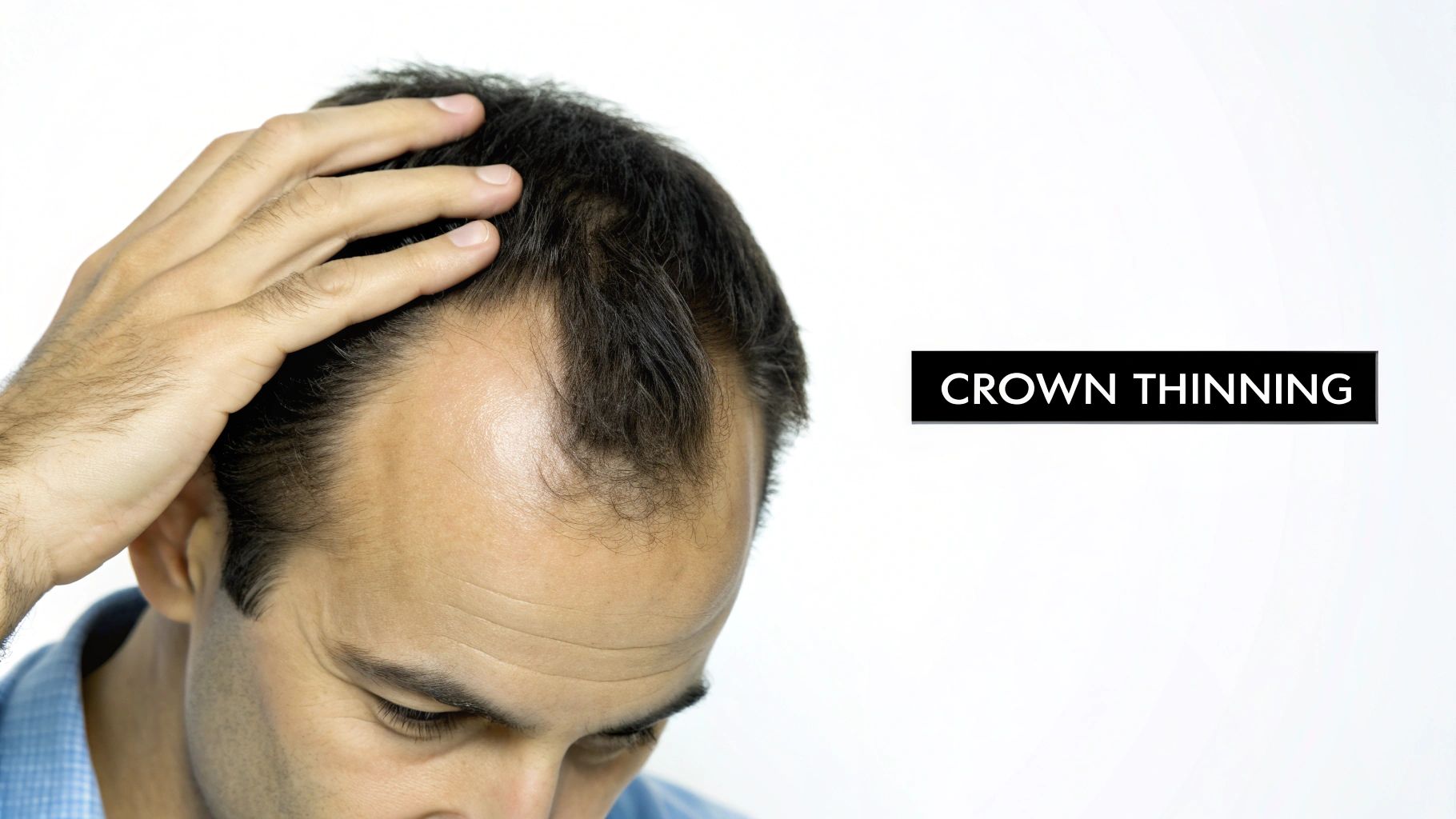
So, why there? Why does the crown seem to be ground zero for thinning? The answer is pretty much coded right into your DNA.
Imagine your scalp is like a plot of land. The soil at the back and sides is robust and fertile, but the soil at the crown and temples is genetically programmed to be extra sensitive to certain environmental changes—in this case, hormonal ones.
The main culprit is a hormone called dihydrotestosterone (DHT). For guys with a genetic predisposition to hair loss, the follicles at the crown have an unfortunate vulnerability to DHT. The hormone latches onto these follicles and, over time, causes them to shrink and weaken. This process, known as miniaturization, is a slow strangulation. It doesn't kill the follicle overnight, but it eventually chokes it to the point where it can no longer produce a healthy, thick strand of hair.
The Numbers Behind Male Pattern Baldness
This isn’t just a random occurrence; it's an incredibly common one. In fact, noticing a thinning crown before you hit 30 is far from unusual. Global studies show that about 25% of men will see the first signs of male pattern baldness by age 25. That number jumps to over 50% of men experiencing noticeable thinning by the time they reach 50.
This condition, clinically called androgenetic alopecia, accounts for roughly 95% of all hair loss in men. The crown is simply one of its favorite targets.
The good news is that this process usually follows a fairly predictable path. Understanding that path is the first step toward getting ahead of it.
A balding crown is one of the earliest and most recognizable signs of androgenetic alopecia. Early detection dramatically expands your treatment options and improves the likelihood of maintaining your existing hair.
Your Immediate Game Plan
Seeing that first hint of scalp through your hair can be unsettling, but your best defense is to act quickly and rationally. Don't fall into the trap of waiting to see if it gets worse. Instead, focus on a simple three-step strategy: assess what's happening, learn why, and then take action.
This table breaks down your starting point.
Crown Hair Loss At a Glance
| What to Look For | The Main Cause | Your First Move |
|---|---|---|
| Your part line looks wider than usual, or you can see your scalp easily under bright lights. The hair at your crown just feels finer. | Your hair follicles are genetically sensitive to the hormone DHT, which is causing them to shrink. | Start documenting. Take clear photos of your crown every month to track how quickly things are changing. |
| You're finding more hair on your pillow in the morning or seeing a lot more shed in the shower drain. | This is a direct result of follicle miniaturization, which makes the hair shaft weaker and more prone to falling out. | Begin researching evidence-based, FDA-approved treatments. Get familiar with names like minoxidil and finasteride. |
| A small, distinct bald spot is starting to form on the top-back of your head (also called the vertex). | This is a hallmark sign of androgenetic alopecia, which follows predictable patterns. | Schedule a consultation with a dermatologist or a hair loss specialist to get a real diagnosis and a personalized plan. |
Following these initial steps moves you from a place of worry to one of control. The goal is to stop focusing on the problem and start understanding the solutions. By learning more about male pattern baldness progression, you'll be much better equipped to anticipate what's coming and how to manage it effectively.
What's Really Going On Up There? The Science of a Thinning Crown

To really get a handle on crown thinning, you first have to understand what's happening at the microscopic level on your scalp. For most guys, the culprit behind crown of head hair loss is a condition called Androgenetic Alopecia, which is just the clinical term for male pattern baldness.
This isn't an illness or something you "caught." It’s a genetic trait you inherited, just like your eye color or how tall you are.
At the center of it all is a powerful hormone called dihydrotestosterone (DHT). While most people know about testosterone, it's this byproduct, DHT, that does the real damage in men who are genetically prone to hair loss. Think of your hair follicles as tiny locks and DHT as a key that doesn’t quite fit right.
For the follicles on the sides and back of your head, this key has no effect. But for the follicles at your crown and hairline, that "wrong" key gets stuck, and that’s when the trouble starts.
How DHT Shrinks Your Hair Follicles
When DHT latches onto these genetically sensitive hair follicles, it triggers a process known as miniaturization. This is the fundamental mechanism that drives male pattern baldness.
Imagine each of your hair follicles is a factory that produces a single strand of hair. DHT comes in and starts slowly shutting down the production line. With every new growth cycle, the factory gets smaller, and the hair it produces becomes progressively thinner, shorter, and less pigmented.
Eventually, the follicle shrinks so much that it can no longer push a visible hair through the scalp's surface, leaving behind that classic bald spot. You can get a much deeper look into this process in our guide to hair follicle miniaturization. The good news? The follicle isn't dead—it's just gone dormant, which is exactly why getting ahead of the problem is so critical.
Mapping Your Hair Loss: The Norwood Scale
One of the few silver linings with male pattern baldness is that it follows a very predictable path. This progression is laid out in a tool called the Norwood Scale, which is the gold standard for classifying the stages of hair loss in men. It gives us a common language, from Stage 1 (no real loss) all the way to Stage 7 (the most advanced stage).
Figuring out where you land on this scale is incredibly helpful. It stops the guesswork, tells you how far things have progressed, and gives you a realistic idea of which treatments will actually work for your situation.
The Norwood Scale isn't just a clinical chart; it's a roadmap. Knowing your stage allows you to build a smart strategy instead of just trying things and hoping for the best.
When we're talking specifically about hair loss on the crown, these are the key stages to look out for:
- Stage 3 Vertex: This is usually the first time a bald spot on the crown becomes obvious. You'll see a distinct thinning area on the vertex (the top-back of your head), even if your hairline recession is still pretty mild.
- Stage 4: By now, the bald spot on the crown has grown larger and is much more noticeable. The hairline is receding more aggressively, too, but a solid "bridge" of hair still separates the two thinning zones.
- Stage 5: That bridge of hair separating the front and the back starts to get much thinner and narrower. Both the hairline and crown balding areas are now significantly larger than they were in Stage 4.
- Stages 6 & 7: In these final stages, the bridge is gone. The hair loss at the front and the crown have merged into one large bald area, leaving only that classic horseshoe pattern of hair around the sides and back of the head.
By pinpointing your stage, you can shift from worrying about hair loss to building a concrete plan to fight it. And when it comes to keeping your hair, the earlier you act, the more you save.
Your Action Plan for Treating Crown Hair Loss
Knowing why your crown is thinning is half the battle. Now, it’s time to shift from understanding the problem to actually doing something about it. The good news is that you’re not powerless here—there's a solid lineup of evidence-based treatments that can make a real difference.
There’s no single magic bullet that works for every guy, but the right combination of proven options can help you slow down, stop, or even reverse hair loss at the crown. The trick is to find an approach that fits your specific stage of hair loss and, just as importantly, your lifestyle.
And if you're feeling isolated, don't. This is an incredibly common experience. Male pattern baldness is widespread, with over 40% of men in countries like Spain (44.5%), Italy (44.37%), and the US (42.68%) dealing with some degree of it. This hereditary condition is the culprit behind 95% of men's hair loss and often makes its first appearance as a thinning spot on the crown.
FDA-Approved Cornerstones of Treatment
When you're building a serious strategy, you start with the heavy hitters—the treatments with the most robust scientific backing and FDA approval. Two names will pop up again and again for a reason: Minoxidil and Finasteride. Think of these as the foundation of any effective hair retention plan.
Minoxidil, which most people know as Rogaine, is a topical solution you apply directly to your scalp. While scientists are still working out the exact mechanism, we know it acts as a vasodilator. Put simply, it widens the blood vessels. This boosts blood flow, delivering a fresh supply of oxygen and nutrients to your hair follicles, which can wake them up and push them back into their growth phase.
Finasteride (brand name Propecia) is a daily pill that tackles the problem from the inside out. It gets to the root hormonal cause of crown hair loss by blocking the enzyme that converts testosterone into the follicle-killer, DHT. By slashing DHT levels in your scalp, Finasteride basically puts up a protective shield around your vulnerable hair follicles, stopping them from shrinking away.
Both Minoxidil and Finasteride are highly effective, but they demand consistency. If you stop taking them, any hair you’ve maintained or regrown will likely be lost within a few months as your follicles return to their previous state.
It's also crucial to set the right expectations. These treatments excel at holding onto the hair you still have and can help regrow some of what you've lost, but they work best when you catch the thinning early. Finasteride, for instance, has been shown to stop the progression of hair loss in up to 90% of men, making it an incredibly powerful defensive tool.
Exploring Other Proven Therapies
Beyond those two mainstays, other technologies offer promising results, particularly when you pair them with a primary treatment like Minoxidil or Finasteride.
One of the most popular non-invasive options is Low-Level Laser Therapy (LLLT). This usually comes in the form of a cap, comb, or headband that emits red light at a very specific wavelength. The idea is that this light energy stimulates the mitochondria—the powerhouses—within your follicular cells, kicking them into a more active growth cycle. It’s a painless, at-home treatment that plays well with others.
Here's a quick breakdown of how these non-surgical approaches stack up.
| Treatment Approach | How It Works | Best For |
|---|---|---|
| Minoxidil (Topical) | Improves blood flow to follicles, extending the growth phase. | Directly stimulating growth at the crown and slowing shedding. |
| Finasteride (Oral) | Reduces scalp DHT levels to prevent follicle shrinkage. | Halting the progression of hair loss and preserving existing hair. |
| LLLT (Light Therapy) | Uses red light to energize cells in the follicles. | Supporting overall follicular health as part of a combined therapy plan. |
When Surgery Becomes an Option
For men with more advanced crown of head hair loss, where follicles have unfortunately gone dormant for good, surgery is the most direct path to restoration. A hair transplant isn’t about creating new hair out of thin air; it’s about strategically relocating healthy, DHT-resistant follicles from the back and sides of your head to the thinning area on top.
The two go-to techniques are Follicular Unit Transplantation (FUT) and Follicular Unit Extraction (FUE). While the methods for harvesting the donor hair are different, the end goal is the same: to move healthy follicles to the bald crown, where they'll take root and continue to grow naturally for the rest of your life. It’s the only truly permanent solution for restoring density to a bald spot.
Ready to figure out the right path for you? Dive into our complete guide on the best hair loss treatments for men to weigh all your options.
How PRP Uses Your Body's Power to Regrow Hair
While medications like Minoxidil and Finasteride are the bedrock of most hair loss treatment plans, many guys are looking for something more natural. An approach that works with the body's own healing systems, not against them. That’s exactly where Platelet-Rich Plasma (PRP) therapy comes into the picture. It’s a non-surgical treatment that uses a super-concentrated dose of your own blood platelets to essentially wake up sleeping hair follicles.
Think of it this way: if DHT is the signal telling your hair follicles to shrink and go dormant, PRP is the personalized wake-up call, delivered right to their doorstep. It doesn't use outside chemicals; it harnesses the powerful growth factors already inside you.
The Science Behind Platelet Power
So, how can a little bit of your own blood help with crown of head hair loss? The secret is in the platelets. These are tiny cell fragments floating around in your blood, famous for their role in clotting a cut. But that's just scratching the surface of what they can do.
When you get an injury, platelets swarm the area and release hundreds of proteins called growth factors. These proteins are like the foremen on a construction site—they signal other cells to start repairing tissue, building new blood vessels, and calming down inflammation. PRP therapy takes this natural healing process and dials it up to eleven. We just concentrate these powerful healing agents and deliver them precisely where they’re needed most: your scalp.
By injecting this "liquid gold" into the thinning areas of your crown, those growth factors get to work directly on your struggling hair follicles. They help kickstart the growth phase, boost blood flow to the area, and can even help fight back against the miniaturization caused by DHT.
The core idea behind PRP is brilliantly simple. We're taking the most potent healing components from your blood and using them as a high-octane fertilizer for your hair follicles, encouraging them to get back to the business of growing thicker, healthier hair.
What to Expect During a PRP Session
The actual process is surprisingly quick and straightforward, usually taking less than an hour from start to finish. It’s a simple three-step journey that feels more like a routine doctor's visit than some complex procedure.
- The Blood Draw: It all starts with a simple blood draw from your arm, just like you’d have for a standard lab test.
- The Centrifuge Process: This is where the real science happens. The vial of blood is spun in a special machine called a centrifuge at an incredibly high speed. This process separates your blood into three layers: red blood cells, platelet-poor plasma, and the star of the show—the highly concentrated platelet-rich plasma.
- The Injection: Your practitioner carefully collects the PRP and, using a very fine needle, injects it at multiple points across your scalp, zeroing in on thinning spots like the crown. Most guys say the discomfort is minimal, usually just a slight pinch or a feeling of pressure.
This targeted approach makes sure those precious growth factors are delivered right where your follicles need the most help.
Who Is a Good Candidate for PRP Therapy
While PRP shows a lot of promise, it isn't a silver bullet for everyone. The best results almost always come from guys who are in the earlier stages of hair loss. If your follicles have been completely dormant for years, PRP might not be enough to bring them back.
An ideal candidate for PRP therapy usually has:
- Active Thinning: You've noticed your hair getting thinner over the past few years, but you still have a fair amount of hair left.
- Healthy Follicles: The follicles might be producing finer, weaker hairs, but they're still alive and kicking—and able to respond to a little encouragement.
- Good Overall Health: Because the treatment depends on your body's own healing power, being in good general health without any blood-related disorders is key.
PRP also works exceptionally well as part of a team. Many experts find that combining it with other treatments like Minoxidil or Finasteride gives the best results, since you're hitting the problem from several different angles at once.
To help you see where this fits, the chart below shows a common multi-step approach to tackling hair loss, starting with topical treatments and moving toward more advanced options.
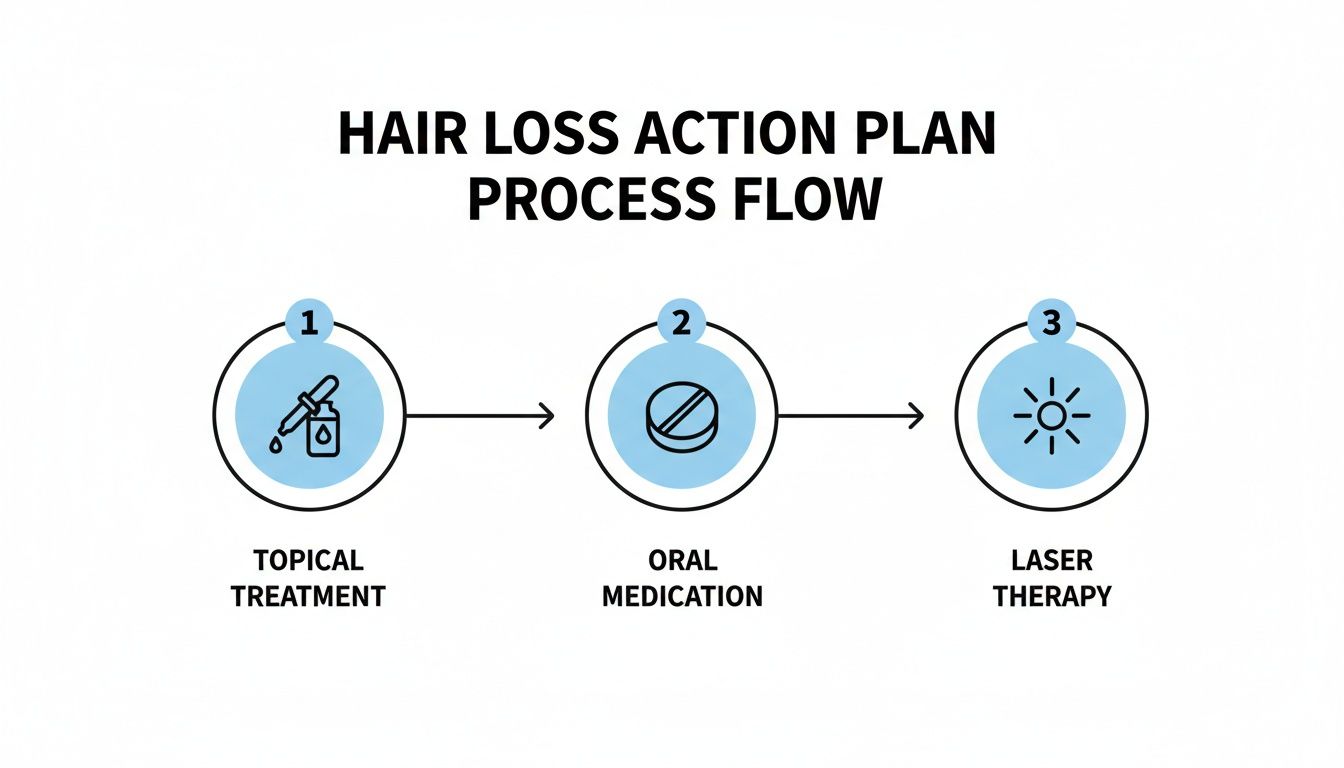
This illustrates how treatments can be layered, starting with the basics and adding more therapies as needed based on your specific situation.
Efficacy and Treatment Timeline
The big question everyone asks is, does it really work? The research is definitely encouraging. Multiple studies have shown that PRP can significantly bump up hair count and thickness. In fact, some clinical reviews point to success rates around 70%, where patients see a real, noticeable improvement in hair density.
But you have to be patient. PRP isn't a one-and-done miracle cure. It’s a process of gradually coaxing your follicles back to health. For a deeper dive into the science, you can check out this detailed explanation of how PRP works for hair loss.
A standard treatment plan starts with a series of initial sessions and then moves into a maintenance phase. To help you know what to expect, we’ve put together a general timeline.
PRP Treatment Timeline What to Expect
This table outlines what the journey typically looks like, from your first sessions to seeing real, tangible results. It's a marathon, not a sprint.
| Timeframe | What Happens | Expected Outcome |
|---|---|---|
| Months 1-3 | The initial "loading phase" usually involves one session per month for three months. | You might notice less shedding, but visible growth is rare at this stage. Think of this as preparing the soil. |
| Months 3-6 | Growth factors are now actively stimulating follicles and improving scalp circulation. | This is when most people start seeing the first real signs of new growth. Hairs may feel thicker, and the crown may look fuller. |
| Months 6-12 | Follicles continue to strengthen and produce healthier, more robust hair shafts. | Results should be much more obvious now. The goal is a clear improvement in density and coverage at the crown. |
| After 12 Months | Time for the maintenance phase. Most clinics recommend a follow-up treatment every 6-12 months to keep things going. | The gains you’ve made are sustained. Without maintenance, the effects will slowly fade as DHT gets back to work. |
The PRP journey requires commitment, no doubt about it. But for many men watching their crown thin out, it offers a powerful way to fight back using the most natural tool available: your body's own incredible ability to heal and regrow.
When to Talk to a Specialist About Your Crown
Deciding to see a specialist about your thinning crown can feel like a pretty big step. A lot of guys get caught in the "wait and see" trap, hoping it's just a phase or maybe not as bad as they think. But here’s the thing: when it comes to keeping your hair, time is not on your side. The sooner you get an expert opinion, the more tools you have in your toolbox.
So, when is it time to stop staring in the mirror and actually book a consultation? It's usually not one single moment, but a pattern you start to notice. The real trick is learning to tell the difference between normal shedding—we all lose somewhere between 50 to 100 hairs a day—and that focused, progressive thinning that screams male pattern baldness has arrived.
Key Triggers for Scheduling an Appointment
If you're on the fence, a few specific signs should be your cue to make the call. These are clear signals that something more than everyday hair fall is going on, and they really need a professional diagnosis. Waiting too long often means you're shifting from a game of defense (maintaining what you have) to a game of offense (trying to regrow it), and that's always a much tougher fight.
Think about booking an appointment if any of this sounds familiar:
- Sudden or Rapid Hair Loss: If it feels like your crown thinned out overnight or got noticeably worse in just a few months, that's a red flag. This can sometimes point to an underlying issue that needs a doctor's attention.
- Scalp Irritation: Is your hair loss coming with an itchy, red, flaky, or painful scalp? That’s not typical for simple male pattern baldness. Those symptoms could mean a scalp condition is pouring fuel on the fire.
- Frustration with OTC Products: You've been religiously using minoxidil or other over-the-counter treatments for six months or more, and… nothing. An expert can figure out why your efforts aren't paying off and point you toward something that will.
- It's Affecting Your Confidence: Don't brush off the mental side of this. If you’re constantly stressing about your crown of head hair loss or starting to dodge social events, getting a plan from a specialist can be incredibly empowering.
A consultation isn’t a commitment to treatment. It’s a commitment to getting real answers. The goal is to trade your anxiety and guesswork for a solid diagnosis and a clear path forward.
Demystifying the Consultation Process
Walking into a hair loss clinic for the first time can feel a little daunting, but it’s a lot less scary when you know what to expect. Think of your first visit as a fact-finding mission for both you and the doctor. They need to understand your story, and you need to understand your options. You can learn more about finding the right expert by exploring what doctor you see for hair loss.
The whole process usually follows a few simple steps. First, the specialist will go through your medical and family history. They'll ask about your diet, stress, lifestyle, and the big one: who else in your family has lost their hair.
Next up is the physical exam. Using a special handheld microscope called a dermatoscope, they'll get a super magnified view of your scalp and hair follicles. This lets them see exactly how much hair miniaturization is happening and check for other scalp problems. In some situations, they might even suggest a blood test to rule out things like thyroid issues or vitamin deficiencies. This thorough approach is all about getting you an accurate diagnosis, not just a hunch, so you can build a treatment plan that actually works.
Common Questions About Crown Hair Loss
As you start to figure out what's happening with your hair, you're bound to have a lot of questions. It's totally normal. Let's tackle some of the most common ones we hear from guys dealing with a thinning crown, so you can get clear, practical answers.
Does Stress Really Make Hair Loss Worse?
It absolutely can. While long-term stress isn't what causes male pattern baldness (that's down to genetics), it can definitely throw gasoline on the fire.
Here's how it works: major stress can trigger a condition called telogen effluvium. This basically shoves a ton of your hair follicles into the shedding phase all at once. For a guy whose crown follicles are already being weakened by DHT, a big stressful event can feel like a massive acceleration of his hair loss. It's like DHT is the slow leak, and stress is the sudden downpour. This is why managing stress is so important—not just for your mind, but for your hair, too.
Can Wearing a Hat Cause a Balding Crown?
This is probably one of the biggest myths out there, so let's clear it up: no, wearing a hat does not cause male pattern baldness. That process is all internal, driven by hormones and your DNA.
The only time a hat could cause hair loss is if it was so painfully tight that it was constantly pulling on your hair, a condition known as traction alopecia. But for your everyday, comfortably-fitting baseball cap? It’s not the villain. It’s just giving you some shade.
That old idea that hats "suffocate" your follicles? It's a complete myth. Your hair follicles get all the oxygen they need from your bloodstream, not from the air.
Is It Possible to Regrow Hair or Just Stop the Loss?
This is the million-dollar question, isn't it? The answer really boils down to how early you start treatment. For most guys, the primary goal of proven treatments like Finasteride and Minoxidil is to stop the loss from getting any worse. Honestly, just holding the line is a huge victory.
But yes, regrowth is definitely possible, especially where follicles have only recently stopped producing healthy hair.
- Stopping the Loss: This is the most realistic goal. For example, up to 90% of men who use Finasteride successfully halt or slow down their hair loss.
- Seeing Regrowth: Many guys do see some hair come back, and the crown is often a great area for this. It might start out as fine, light-colored hair before it matures.
- Reviving Follicles: The trick is to act while the follicles are still viable. Once a follicle has been dormant and scarred over for years, bringing it back with medication is a long shot. We get into the science of whether you can dead follicles be revived in another one of our guides.
How Much Shedding Is Considered Normal?
Everyone sheds hair every day. It's just part of the natural growth cycle. Losing somewhere between 50 and 100 hairs a day is considered perfectly normal. You’ll find them in the shower drain or on your brush, and it’s no cause for alarm.
When you should pay attention is if you notice a sudden, dramatic increase in shedding that doesn't let up. If you're seeing way more hair on your pillow or the thinning on your crown seems to happen overnight, that's your cue to figure out what’s going on.
At PRP For HairLoss, we believe that understanding the facts is the first step toward taking control. Armed with the right information, you can make confident decisions about your hair health. Explore our resources to build a strategy that works for you. https://prpforhairloss.com
 PRP For Hairloss
Leave a comment