That feeling when you notice more hair in the shower drain or catch a glimpse of your scalp in the mirror? It's a jolt, for sure. But it’s not a sign to give up—it’s a signal to take action. The reality is, turning things around with thinning hair requires a smart, multi-pronged attack. We're talking about combining dedicated at-home care, proven medical treatments, and a few key lifestyle tweaks.
The goal here is pretty simple: wake up those sleeping hair follicles and hang on to the healthy hair you've already got. Acting early is your biggest advantage, hands down.
Your Action Plan for Thicker Hair

If you're starting to see the signs, you're in good company. For most guys, this is the classic start of male pattern baldness, or what doctors call androgenetic alopecia. This one condition is the culprit behind more than 95% of hair loss in men.
The numbers don't lie. About two-thirds (66%) of American men will face some noticeable hair loss by the time they hit 35. For some, it starts much earlier—there's a 25% chance of seeing the first signs before you even turn 21. It’s incredibly common, as these male hair loss statistics from the American Hair Loss Association show.
Why an Early Start Is Your Best Bet
I can't stress this enough: timing is everything. When a hair follicle stops producing hair, it doesn't just vanish. It slowly shrinks and goes dormant. If you step in while it's still viable, you have a really good chance of bringing it back online. Waiting until an area is completely smooth and shiny makes revival a much steeper uphill battle.
Your mission is two-fold: stop the retreat and create an environment where your existing hair can get stronger and dormant follicles can be kickstarted back to life. This proactive approach is the core of any plan that actually gets results.
Building Your Comprehensive Toolkit
So, what does a realistic action plan look like? Forget searching for a single magic bullet. A truly effective strategy is all about layering several proven methods so they work together in harmony.
Here’s a quick overview of what we'll be diving into:
- Daily Habits and Nutrition: This is your baseline—the fundamental building blocks your body needs to produce healthy hair.
- Topical and Oral Treatments: Think of these as the heavy lifters. Clinically proven options like Minoxidil and Finasteride directly combat the biological causes of hair loss.
- Advanced Procedural Options: When you need to call in the big guns, treatments like Platelet-Rich Plasma (PRP) therapy can provide a powerful, targeted boost right at the scalp level.
To give you a clearer picture of what's on the table, here’s a quick comparison of the most common approaches.
Your Hair Regrowth Toolkit at a Glance
| Treatment Type | How It Works | Best For |
|---|---|---|
| Topical Minoxidil | A vasodilator that widens blood vessels to improve follicle health and prolongs the hair's growth phase. | Men in the early to moderate stages of hair thinning, especially at the crown. |
| Oral Finasteride | A DHT-blocker that prevents testosterone from converting to dihydrotestosterone (DHT), the hormone that shrinks follicles. | Men with classic male pattern baldness who want to stop further loss and potentially regrow hair. |
| PRP Therapy | Injects a concentration of your own blood platelets into the scalp to stimulate dormant follicles with powerful growth factors. | Individuals seeking a non-daily treatment to boost density and kickstart growth, often used with other therapies. |
This table is just a snapshot. The best plans often combine elements from each category for a synergistic effect.
Consider this guide your roadmap. We’ll break down each of these pillars with straightforward, no-nonsense advice. By understanding what it takes to genuinely improve your hair's health and thickness, you can build a routine that actually works for you. For a deeper dive into specific techniques, our guide on how to increase hair density is a great next step.
Building Your Foundation with At-Home Strategies

Before you even think about prescriptions or procedures, you've got to get your house in order. Think of your body as the soil your hair grows from. If that soil is nutrient-poor, constantly stressed out, or just not taken care of, you can't expect a healthy crop.
Making some smart, deliberate changes at home builds a powerful foundation for healthier hair. It sets the stage for any other treatments you might try, making them far more effective. After all, hair follicles are living parts of your body, and they need the right fuel and a calm environment to do their job. If you're running on empty, your body smartly diverts resources away from things it considers non-essential—like hair growth. This is where you can start to take back control.
Fueling Your Follicles from the Inside
Your diet is the most direct line of support you can give your hair. Every meal is an opportunity to send the right building blocks straight to your scalp. While there's no magic food that will give you a full head of hair overnight, consistently eating the right stuff can make a real, visible difference over time.
Get serious about adding these to your daily rotation:
- Biotin: Often called the "hair growth vitamin" for a reason. Biotin is essential for producing keratin, the protein that hair is literally made of. You’ll find it in eggs, almonds, walnuts, and sweet potatoes.
- Iron: This is all about oxygen delivery. Iron helps create hemoglobin, which carries oxygen to your cells—including the ones that power hair growth. Low iron is a classic, well-documented cause of shedding. Load up on spinach, lentils, and lean red meat.
- Zinc: Zinc is crucial for hair tissue growth and repair. It also helps the oil glands around the follicles work correctly, keeping your scalp in good shape. Good sources include oysters, beef, and pumpkin seeds.
- Protein: Your hair is almost entirely protein. Skimp on it, and your body will slam the brakes on hair production. Make sure you're getting high-quality protein from chicken, fish, beans, and lentils.
To really fortify this foundation, adding targeted supplements like collagen supplements can give your body an extra supply of the specific amino acids needed to build strong keratin.
Managing the Silent Follicle Killer: Stress
Let's be real: chronic stress is a certified enemy of healthy hair. It can literally shock your system and push a huge number of hair follicles into a "resting" phase all at once. A few months later, you see the result—a sudden and alarming amount of shedding. This condition, called telogen effluvium, is incredibly common.
The link between stress and hair loss isn't just an old wives' tale. High levels of the stress hormone cortisol throw the natural hair growth cycle out of whack. It can prematurely end the growth phase, leading to accelerated thinning.
Finding practical ways to manage stress is non-negotiable. This doesn't mean you need to become a Zen master overnight. It’s about building small, sustainable habits that fit your actual life.
- Take a 10-minute walk and leave your phone behind.
- Try 5 minutes of simple deep breathing exercises when you wake up or before bed.
- Schedule your workouts like you schedule meetings—physical activity is a proven stress-buster.
Adopting Smarter Hair Care Habits
What you do on the outside matters just as much as what you put inside. Being too rough with your hair or using harsh products can cause physical breakage, making the hair you do have look even thinner. It’s time for a smarter approach.
Gentle care is the name of the game.
- Rethink Your Shampoo: Switch to a sulfate-free formula. These cleanse your scalp without stripping away the natural oils that keep it balanced.
- Turn Down the Heat: High heat from blow dryers literally cooks the protein in your hair, making it brittle and weak. If you must use one, keep it on the lowest heat setting.
- Handle with Care When Wet: Hair is at its most fragile when it's soaked. Stop rubbing it aggressively with a towel. Instead, gently pat or squeeze it dry. And please, use a wide-tooth comb to detangle, not a brush.
Making these at-home adjustments is your first and most important line of defense. They create the best possible environment for your hair to thrive and might even be enough to slow down thinning on their own. For those looking to explore this further, you can find a whole host of other natural hair growth remedies that work well with these foundational strategies.
Time to Bring in the Big Guns: Medical Treatments That Actually Work
Let’s be honest. Sometimes diet, stress management, and gentle hair care just aren’t enough to move the needle. If you’ve built a solid foundation but are still losing ground, it's time to consider the clinically proven treatments that directly intervene in the hair loss process.
Think of it this way: your lifestyle changes create the best possible environment for your hair to grow. Medical treatments, on the other hand, are like the special forces team you send in to actively fight the biological factors causing your hair to thin. For most guys dealing with male pattern baldness, this means attacking the problem from two angles: waking up sleeping follicles and blocking the hormone that's putting them to sleep in the first place.
Minoxidil: The Topical Stimulator
You probably know this one. It’s most famously sold as Rogaine. Minoxidil is a foam or liquid you apply right to your scalp, and it's one of the most common starting points because you can grab it over the counter. It's been around for decades for a good reason.
So, what’s it actually doing? At its core, Minoxidil is a vasodilator. That’s just a fancy way of saying it widens blood vessels. By applying it to your scalp, you're boosting blood flow to your hair follicles, which is like opening up a superhighway for oxygen and nutrients. This extra nourishment can jolt dormant follicles back into action and keep your hair in its growth phase (the anagen phase) for longer.
But here’s the thing: it’s not magic. Consistency is everything.
- The Routine: You have to apply it twice a day, every single day. No days off. If you get lazy, your progress will screech to a halt.
- The Waiting Game: You won’t see much of anything for at least 3-6 months. In fact, some guys notice a bit of extra shedding at first. Don’t panic—that’s often a sign it’s working, pushing out weaker hairs to make room for stronger ones.
- Where It Works Best: Minoxidil is typically most effective for thinning on the crown (the vertex) and for guys who are in the earlier stages of hair loss.
Here's the key thing to remember about Minoxidil: it doesn't stop the root cause of male pattern baldness. It just works to counteract the effects. If you stop using it, the benefits go away, and your hair will likely revert to how it was before.
For anyone serious about starting medical interventions, a comprehensive understanding of hair loss causes, treatments, and effective solutions can provide a solid foundation for making informed decisions.
Finasteride: The DHT Blocker
While Minoxidil is working on the outside, Finasteride (brand name Propecia) goes to work on the inside. This is a prescription pill that gets right to the hormonal source of male pattern baldness: a powerful androgen called dihydrotestosterone (DHT).
Here's the science, simplified. In guys who are genetically prone to hair loss, an enzyme called 5-alpha reductase converts testosterone into DHT. DHT then attaches to your hair follicles and, over time, shrinks them. This process, known as miniaturization, is what causes your hair to grow back progressively thinner, shorter, and weaker until the follicle just gives up.
Finasteride’s job is to block that 5-alpha reductase enzyme. By doing so, it slashes the amount of DHT in your system by as much as 70%. This effectively hits the brakes on the miniaturization process, stopping further hair loss and, in many cases, allowing shrunken follicles to recover and start producing healthy hair again.
The results are hard to argue with. Studies consistently show that 80-90% of men who take it successfully stop their hair loss, and about two-thirds even see some regrowth.
Of course, because it messes with your hormones, there's a conversation to be had with your doctor about potential side effects. While they only affect a small percentage of users, they can include sexual side effects like a lower libido or erectile dysfunction. It's vital to have an open chat with a healthcare provider to weigh the powerful benefits against the potential risks. Learning more about all FDA-approved hair loss treatments before your appointment can help you ask the right questions.
Deciding between Minoxidil and Finasteride—or using them together, which many doctors recommend for a powerful one-two punch—is a major step. It’s a real commitment, but it’s also one of your best shots at truly taking control of your hair loss.
Diving Deeper: Is PRP Therapy the Right Move for You?
If you're ready for a more hands-on approach to fighting hair loss, it’s time to look at Platelet-Rich Plasma (PRP) therapy. This isn't just another cream or pill; it's a medical procedure that harnesses your body's own healing power to directly stimulate hair follicles.
The idea is elegantly simple: concentrate the most powerful growth factors already in your blood and put them to work right where you need them—your scalp. We're not introducing anything foreign here. It's all about giving your dormant follicles a highly concentrated dose of the biological signals they need to wake up and get back to growing.
What to Actually Expect During a PRP Session
The thought of scalp injections can sound a bit intense, but the reality is a pretty quick, well-managed procedure grounded in your own biology.
Here’s a play-by-play of what goes down:
- A Simple Blood Draw: The whole thing starts like a routine physical. A small amount of blood is drawn from your arm. No big deal.
- The Separation Process: This is where the magic happens. The vial of your blood goes into a centrifuge, a machine that spins incredibly fast to separate the blood into its different components. This isolates the platelet-rich plasma, a golden-colored liquid, from everything else.
- Targeted Injections: That concentrated plasma is then carefully injected into the areas of your scalp where you’re seeing the most thinning. These platelets are packed with growth factors that basically act as messengers, telling your follicles it’s time to get back on the job.
The entire process is usually wrapped up in under an hour. Most guys walk out and go right back to their day with little to no downtime. It’s a targeted, biological strike against thinning hair.
Why PRP is Gaining So Much Credibility
PRP has become a go-to treatment because it works with your body's natural systems. The platelets release powerful growth factors like Platelet-Derived Growth Factor (PDGF) and Vascular Endothelial Growth Factor (VEGF). These proteins are the superstars of cell repair, helping to ramp up blood supply to the follicles and kick the hair’s growth phase into a higher gear.
Think of it this way: If your hair follicles are like plants struggling in poor soil, PRP is like injecting a potent, organic fertilizer directly into the roots. It provides the exact biological kickstart needed to repair damage and fuel new, healthy growth.
The numbers don't lie. By age 50, over 50% of men have significant thinning, a figure that jumps to 85% with visibly thin hair in places like the US. PRP offers a scientifically sound solution. Clinical data shows men in their 40s and 50s can see a 25-40% improvement in hair count after completing a series of treatments, with the best results showing up around the 6-12 month mark.
Realistic Timelines and What to Expect
Let's be clear: PRP is a process, not an overnight fix. Knowing the timeline is key to sticking with it and judging your results fairly.
For anyone weighing this option, it's helpful to see where it fits into the bigger picture of medical hair loss treatments.
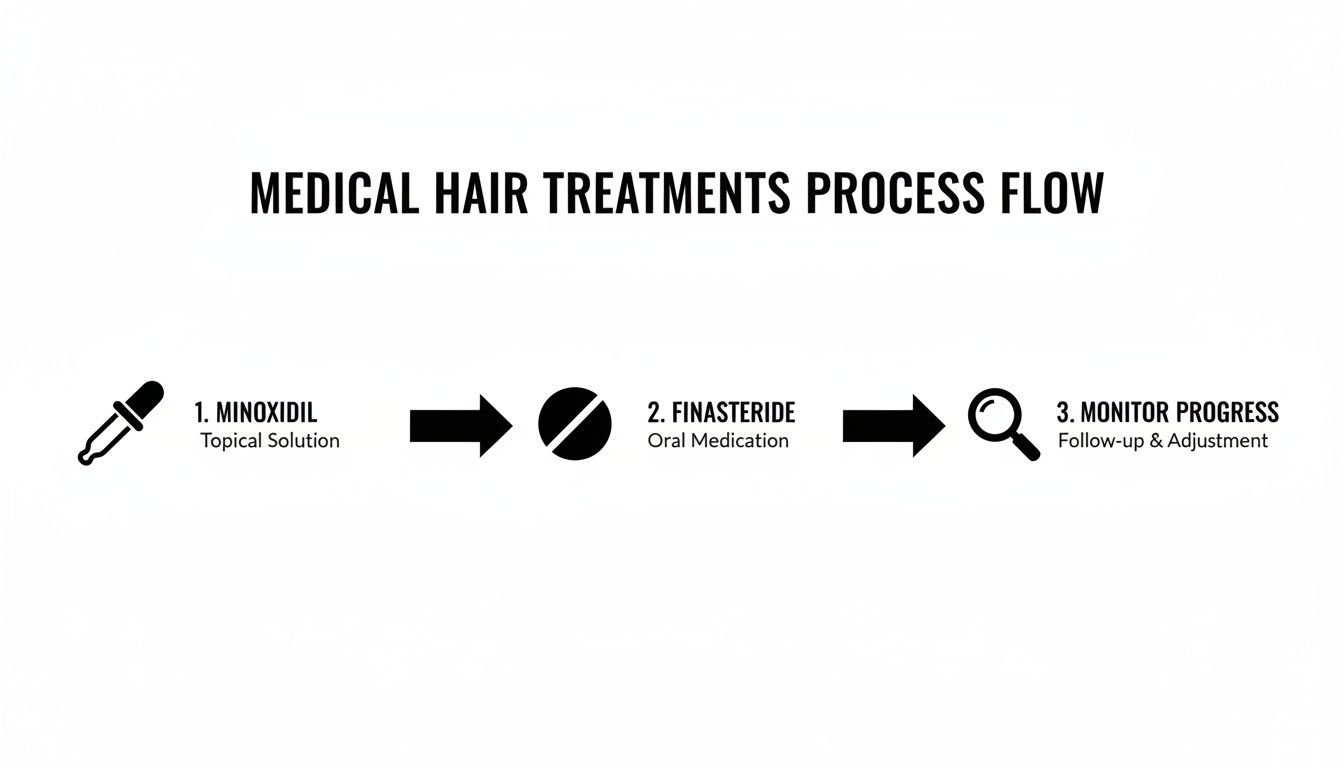
As you can see, foundational treatments like Minoxidil and Finasteride often build the base, with PRP acting as a powerful booster or alternative.
A typical PRP schedule starts with a loading phase.
- The Initial Series: Most specialists recommend 3-4 treatments, spaced about a month apart, to really get the regenerative process going.
- Ongoing Maintenance: After that, you'll likely need a follow-up session every 6-12 months to keep the results going strong.
You won't leave your first appointment with a thicker head of hair. The early signs of success, like less shedding, might show up after a couple of months. Real, noticeable improvements in hair density usually start becoming visible around the 4-6 month mark, once the newly activated follicles have had time to produce new hair.
Results vary from person to person, so it's crucial to have a realistic grasp of what the treatment can do. To get a better sense of what's possible, you can dive into our guide on how effective PRP is for different types of hair loss.
Ultimately, PRP has earned its place as a reliable and effective tool in the modern man's arsenal against thinning hair. It’s a science-backed method that works with your body, offering a path to natural-looking results without a daily medication regimen.
Designing Your Personal Hair Restoration Strategy
Information is one thing, but a real plan is what gets results. We’ve covered a ton of ground—from nutrition and stress to heavy-hitters like PRP—and it’s easy to feel overwhelmed. Now, let’s pull all those threads together into a strategy that actually makes sense for you, your lifestyle, and where you want to go.
Crafting a good plan isn't about throwing everything at the wall and hoping something sticks. It's about making smart, informed choices based on where you are right now. A guy just noticing a bit of thinning at the temples needs a completely different game plan than someone with a more noticeable bald spot on the crown. The key is to be realistic, strategic, and most importantly, consistent.
First Things First: Assess Your Current Situation
Before you can map out a route, you need to know exactly where you’re starting. The gold standard for this is the Norwood Scale. It’s a simple set of diagrams that visually maps out the common stages of male pattern baldness, from Stage 1 (no real loss) all the way to Stage 7 (the classic horseshoe pattern).
So, grab a mirror and be honest with yourself. Are you a Norwood 2, with some minor recession? Or are you maybe a 3 or 4, where the loss is more obvious? This isn't about being hard on yourself; it’s about collecting the facts.
Knowing your Norwood stage is a game-changer because it helps you:
- Pick the right tools: Early-stage thinning often responds great to foundational habits and Minoxidil. More advanced stages might mean it’s time to bring in Finasteride or PRP.
- Set realistic goals: Understanding your starting point helps you avoid disappointment down the line.
- Track your progress: You can't know if you're winning if you don't know the score when you start.
This early assessment is critical. The tough truth is that hair loss can start young; one in four men (25%) begin seeing signs of it by age 25, and that number jumps to 40% by age 35 in Western countries. Catching it in the earlier Norwood stages gives you a massive advantage because it’s much easier to save a hair follicle than it is to revive a dormant one. If you want to dive deeper into the stats, you can read the full research on global baldness rates.
Setting Goals That Make Sense
Okay, you know where you stand. So what’s the goal? "Get my hair back" is a nice thought, but we need to be more specific. A much better approach is to set clear, achievable milestones.
Your first goal shouldn't be regrowth. It should be stabilization—stopping any more hair from falling out. If you can just hold the line, you're already winning. Regrowth is the incredible bonus that comes next.
Think about it like this:
- Short-Term Goal (3-6 Months): Noticeably less hair in the shower drain or on your pillow. This is your first sign that things are starting to work.
- Mid-Term Goal (6-12 Months): Your hairline hasn’t budged, and you’re starting to see some fine, "fuzzy" vellus hairs in the thinning spots.
- Long-Term Goal (12-24 Months): Those vellus hairs are maturing into thicker, pigmented terminal hairs, creating a visible boost in density.
Remember, this is a marathon, not a sprint. Patience isn't just a virtue here; it's a non-negotiable part of the process.
Building Your Multi-Pronged Attack and Tracking Progress
Your strategy should layer different approaches for the best effect. For instance, a solid, common-sense plan for a guy at a Norwood 3 might look something like this:
- Foundation: Get serious about a hair-healthy diet and find a stress-reduction habit you can stick with (meditation, exercise, etc.).
- First-Line Treatment: Start a daily, consistent routine with topical Minoxidil. No skipping days.
- Hormonal Defense: Have an honest conversation with your doctor about whether Finasteride is the right move for you.
But the single most important part of any plan is tracking your progress. Your memory is a terrible record-keeper, and small changes are impossible to see day-to-day. The solution is simple: take pictures.
Once a month, stand in the same spot, under the same light, and take photos from the same angles (front, top-down, and crown). In six months, comparing those images will give you undeniable proof of what's working—or tell you it’s time to adjust your approach. It’s the most honest feedback you can get. And if you suspect genetics are playing a big role, our article on genetic hair loss testing can offer more clarity. This kind of personalized, data-driven approach is your best bet for seeing real results that last.
Common Questions About Reversing Hair Thinning
Stepping into the world of hair restoration can feel overwhelming. You’ve probably got a dozen questions buzzing in your head, and it’s completely normal to feel a mix of hope and skepticism. Let's cut through the noise and tackle some of the most common questions guys have when they start looking into how to reverse thinning hair.
Can Thinning Hair Really Be Reversed?
Yes, in many cases, it absolutely can. But we need to be clear about what "reversing" actually means. We're talking about waking up hair follicles that have gone dormant but are still alive. With the right approach, you can coax them back into producing healthy, thick hair again.
The catch? If a follicle is completely dead and the scalp in that area has become smooth and shiny, it's not coming back. That follicle has closed up shop for good. This is precisely why jumping on it early is the single most important thing you can do. Catching it while your follicles are just miniaturizing or dormant gives you the best possible shot at significant regrowth.
How Long Does It Take to See Results?
This is the big one, and the honest answer is: you need to be patient. Hair growth happens on a biological clock, and you can't rush it. Think of this as a marathon, not a sprint, no matter which treatment you choose.
Here's a realistic timeline of what you can probably expect:
- The Initial Shed (Months 1-2): Don't freak out if you start a treatment like Minoxidil or Finasteride and notice more shedding at first. This is actually a good sign. The treatment is pushing out the old, weaker hairs to make room for new, stronger ones to grow in.
- The First Positive Signs (Months 3-6): You should start to see a real drop in the amount of hair you're losing. You might also spot some new, baby-fine hairs (vellus hairs) popping up in the thinning zones.
- Noticeable Improvement (Months 6-12): This is where things get exciting. Those fine hairs begin to mature into thicker, pigmented terminal hairs, and you'll start to see a real difference in density.
- Peak Results (Months 12-24): For most medical treatments, the full, final result will be clear after one to two years of consistent use.
The number one reason guys fail is because they quit too soon. You have to commit to a routine for at least a full year before you can truly judge if it's working. Consistency is everything.
Are the Results from Treatments Permanent?
When you're dealing with male pattern baldness, the root cause—your genetics and hormones—isn't going anywhere. That means treatments like Minoxidil and Finasteride are about management, not a one-and-done cure. They work for as long as you use them.
If you stop, your body's DHT will go right back to work on your follicles, and over a few months, your hair will likely go back to how it was before you started. Think of it like managing any other chronic condition. Even PRP therapy requires maintenance sessions, usually once or twice a year, to keep up the results.
Do I Have to Choose Just One Treatment?
Not at all. In fact, you probably shouldn't. The best game plans almost always involve a multi-pronged attack.
Combining treatments creates a powerful synergy. For instance, using Finasteride to block DHT from the inside while applying Minoxidil to stimulate growth on the outside is a classic one-two punch. Throw in a series of PRP sessions, and you can give your follicles an even bigger jumpstart. Hitting the problem from multiple angles usually gets you better, faster results than relying on just one thing.
At PRP For HairLoss, we know that understanding your options is the first step toward reclaiming your confidence. Our goal is to give you the clear, science-backed information you need to build a plan that works. Explore our site to learn more about the advanced treatments that can make a real difference: https://prpforhairloss.com.
 PRP For Hairloss
Leave a comment