It's a sinking feeling, isn't it? Finding more hair on your pillow, tangled in your comb, or swirling around the shower drain. The first step in figuring out if you're actually balding is learning to tell the difference between normal, everyday shedding and the first real signs of hair loss. Honestly, just trusting that gut feeling that something has changed is often the most important part.
Spotting the First Subtle Clues of Hair Loss
Hair loss rarely just shows up overnight. It's usually a slow, sneaky process that's easy to dismiss. Maybe your hair just doesn't feel as thick as it used to, or a certain style suddenly reveals a bit more of your forehead than you remember. These quiet little observations are your cue to start paying closer attention.
For many guys, the first real "uh-oh" moment comes from seeing more shedding. You know the scene—you've just towel-dried your hair and notice a lot more strands than usual left behind. This is a classic early warning, especially for male pattern baldness, which is responsible for a staggering 95% of hair loss in men.
While a healthy scalp sheds between 50 and 100 hairs a day, someone with progressing hair loss might see that number climb past 200. This happens because the hair follicles are beginning to shrink, a process called miniaturization. You can get a better sense of the numbers behind this on kopelmanhair.com.
To help you quickly sort out whether you're seeing normal shedding or potential thinning, here's a quick-reference table.
Quick Guide to Early Hair Loss Signs
This table breaks down some of the most common early signs to help you assess what you're seeing.
| Sign | What to Look For | Is It Normal? |
|---|---|---|
| Increased Shedding | Noticeably more hair on pillows, in the shower drain, or on your clothes. | Shedding 50-100 hairs daily is normal. Consistently seeing more could be a sign. |
| Receding Hairline | The hairline at your temples starts moving back, often creating an 'M' shape. | A mature hairline is common, but a rapidly receding one is a classic sign of MPB. |
| Thinning Crown | The hair at the very top/back of your head (the vertex) becomes less dense. | This is one of the most common patterns of male hair loss. |
| Widening Part | If you have longer hair, your part line appears wider than it used to. | This indicates diffuse thinning across the top of the scalp. |
Remember, seeing one sign isn't a definitive diagnosis, but noticing several of these patterns over time is a strong indicator that you should look closer.
Is It Shedding or Thinning?
Okay, so you're seeing more hair fall out. The next step is to figure out if your hair is actually getting thinner on your head. One of the best ways to do this is to check your scalp under different lighting. Harsh overhead bathroom lights are notorious for making hair look thinner than it is by casting shadows.
Try looking at your hair in softer, natural light from a window. This will give you a much more honest picture of your hair's real density and help you avoid a false alarm caused by bad lighting.
A key takeaway is that consistency is crucial. If you notice your scalp is becoming more visible over time, even in good lighting, that’s a more reliable sign of thinning than a single bad hair day.
Another very practical method is to inspect your part line. For guys with medium-to-long hair, a widening part is one of the clearest signs of diffuse thinning across the top of the scalp. Use a comb to make a clean, straight part right down the middle and snap a picture. Do this every month or two. Comparing these photos over time provides hard evidence that your memory just can't match.
For a deeper dive into what to look for, check out this detailed breakdown of the early signs of male pattern baldness.
Is Your Hairline Maturing or Receding?
It's one of the first things guys notice, and it's easy to jump to conclusions. You look in the mirror one day, and your hairline just seems… different. But before you panic, it's crucial to understand that not every change up there spells doom for your hair.
Most men go through what's called a "maturing hairline" as they move from their teens into adulthood. This is a totally normal process where the hairline shifts up just a bit—usually no more than an inch—creating a more defined, adult look. A receding hairline, on the other hand, is a different beast altogether. It's a key sign of male pattern baldness and tends to be a lot more aggressive.
The Maturing vs. Receding Test
So, how do you know which one you're dealing with? The key is in the pattern. A mature hairline typically moves back evenly across the forehead. It’s a slow, subtle shift that settles into a new, stable position. You can get a good visual sense of what a normal hairline for men looks like at various stages of life.
Receding is a different story. It almost always starts at the temples, pulling the corners of your hairline back much faster than the middle. This creates that classic ‘M’ or ‘V’ shape that’s a tell-tale sign of androgenetic alopecia (the scientific name for male pattern baldness).
Here's a solid rule of thumb I tell my clients: If your hairline moved back about an inch, did so evenly, and then pretty much stopped, you're likely just looking at a mature hairline. But if those corners keep creeping backward, carving out a deeper ‘M’ month after month, that’s recession.
This decision tree gives you a great visual walkthrough for figuring out what's happening.
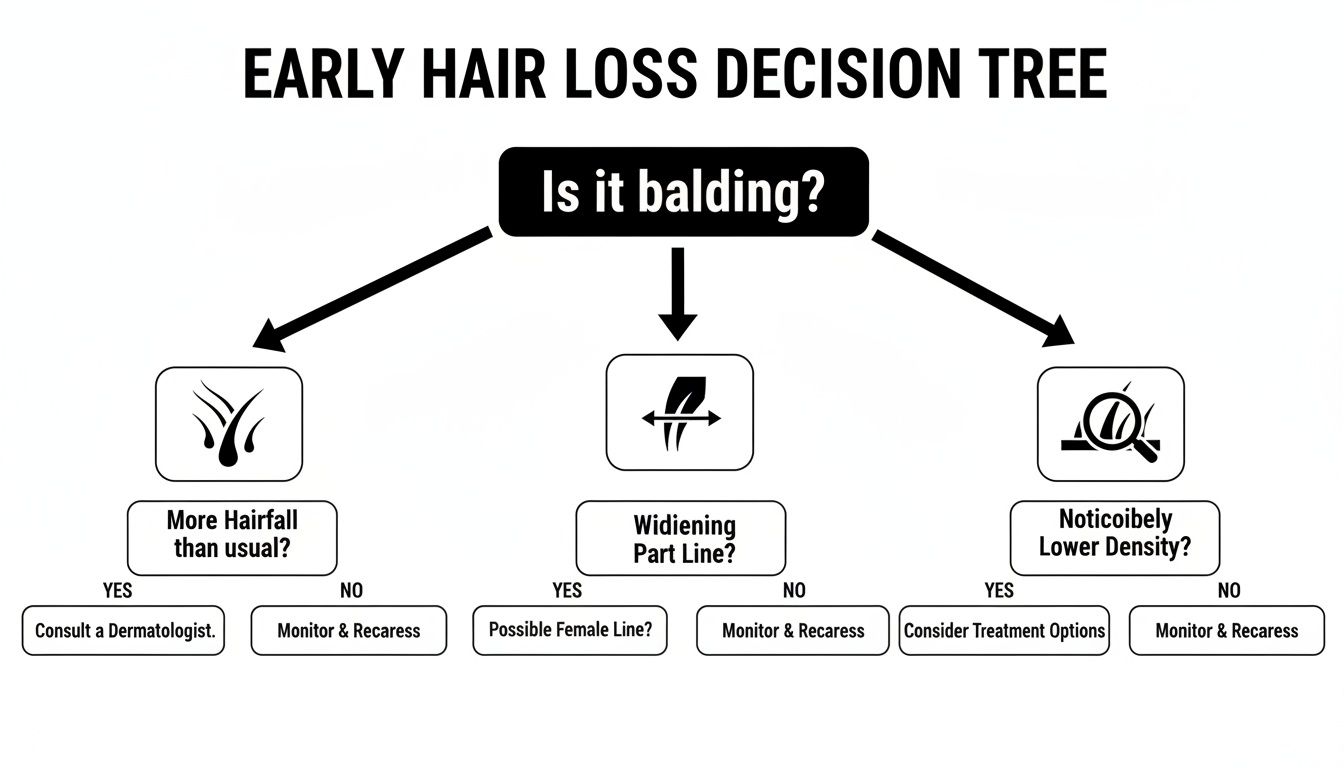
It helps you connect the dots between common symptoms like seeing more hair on your pillow, noticing a wider part, or just feeling less density overall.
Using Photos and Family History as Your Guide
One of the most powerful tools you have is your camera roll. Seriously. Find some photos from a couple of years back and compare them to a picture you take today. Just make sure the lighting is similar. Can you see a clear retreat at the temples, or is it just a subtle, overall shift? The photographic evidence doesn't lie.
Of course, you can’t ignore genetics. A whopping 95% of hair loss in men is hereditary. And while it's a bit of an old wives' tale that it only comes from your mom's side, your maternal grandfather's hair is a strong indicator.
The numbers are pretty staggering: a receding hairline at the temples shows up in 96% of mature Caucasian men, and by the time they hit 50, roughly half of all men are dealing with it to some degree.
To get an objective handle on this, it's worth looking up the Norwood Scale. This is the classification system doctors use to map out the stages of hair loss. A Norwood 1 is a baseline, youthful hairline. By Norwood 2, that M-shape at the temples starts to become noticeable. Figuring out where you land on that scale can give you a much clearer picture of what's happening and how it might progress.
Checking Your Crown for Hidden Thinning
Most guys obsess over their hairline, but the crown? That's the ultimate blind spot. You just don't see the top of your own head in the mirror every day, which means significant thinning can happen back there for months—or even years—before you have a clue. It's a critical spot to check if you're trying to figure out what's really going on with your hair.
Getting a good look is way easier than it sounds. You just need your phone and a bathroom mirror.
Stand with your back to the mirror, hold your phone up, and use the front-facing (selfie) camera to see the reflection of your crown. Snap a few clear, well-lit photos from a couple of different angles.
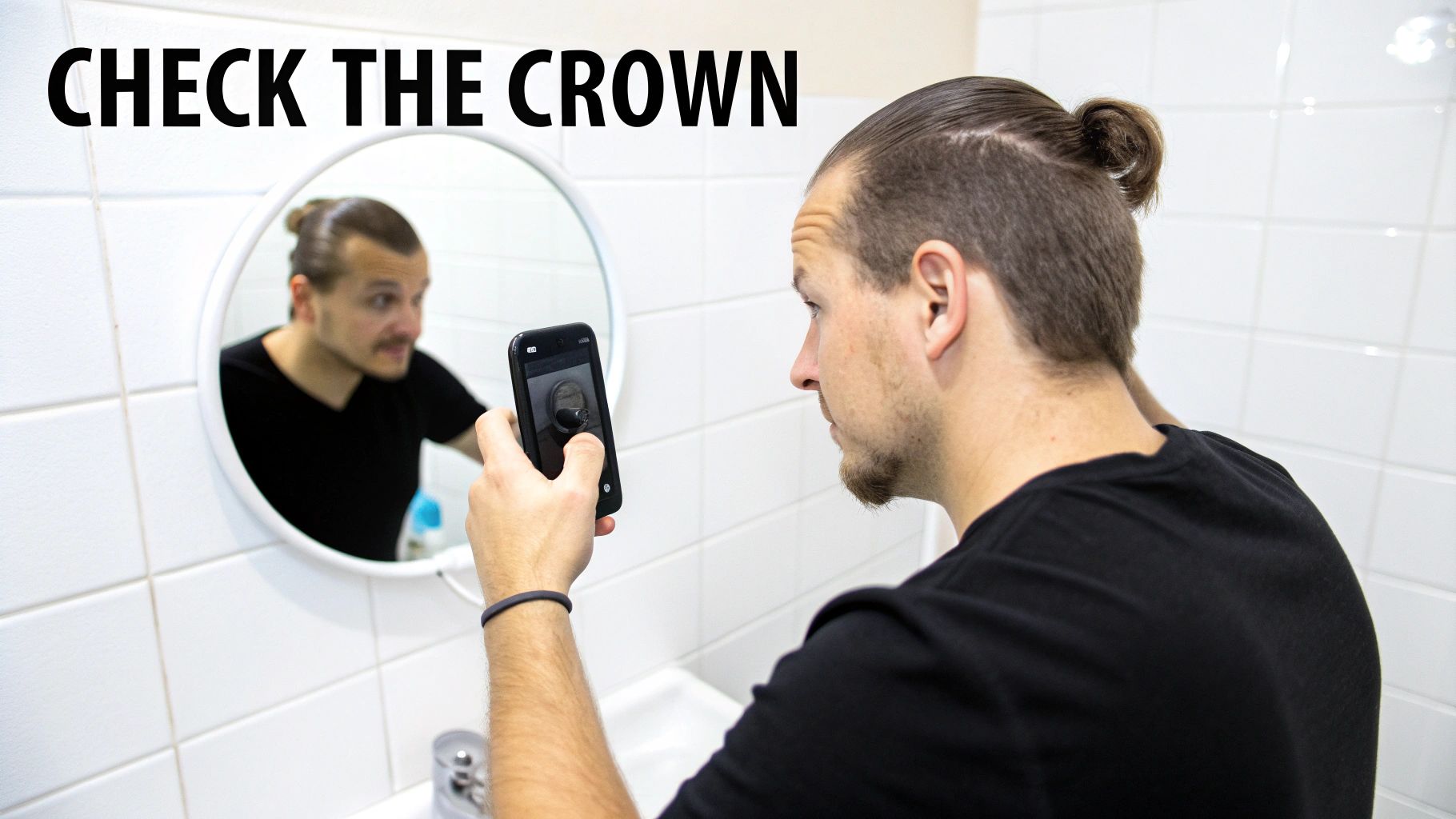
This simple trick finally gives you an objective view of an area you can’t normally see. It’s the best way to catch those early warning signs long before they become obvious to everyone else.
What to Look For in Your Photos
Once you have the pictures, don't just scan for a giant bald spot. The first signs of trouble are way more subtle than that. You need to look closely at your hair whorl—that natural spiral pattern of hair right at the crown.
Here are the tell-tale signs of early thinning:
- A Widening Whorl: Does the natural part at your crown seem wider or less defined than it used to?
- More Scalp Showing: Can you see more of your scalp peeking through the hair, especially when you’re under a bright light?
- Lower Hair Density: Does the hair around the whorl just look finer or less "full" compared to the hair on the sides and back of your head?
This specific type of loss is a classic sign of male pattern baldness, often called the Norwood vertex pattern.
Pro Tip: Spotting crown thinning early is a massive advantage. This area often responds incredibly well to treatments because the hair follicles are usually just miniaturized, not gone for good. If you wait until it's a smooth, shiny spot, it's a much bigger uphill battle to regain that density.
The Norwood vertex pattern is a dead giveaway, slowly forming that familiar "bald spot" as hair density drops. And it's incredibly common. Research shows that a staggering 53% of men in the US between the ages of 40 and 49 have moderate to severe hair loss. This pattern is a clear signal that the hormone DHT is actively shrinking follicles in that specific zone. You can dive deeper into the science behind it by checking out the findings on androgenetic alopecia.
Knowing how to spot this is half the battle. If you're starting to see these signs, learning more about the progression of crown thinning hair can help you figure out what to do next. My advice? Take these photos every three months. It creates a visual timeline that gives you undeniable proof of what's happening, so you can stop guessing and start taking action.
Simple At-Home Tests to Track Hair Health
If you're operating on more than just a gut feeling, a few simple at-home tests can give you some real data to work with. This isn't about self-diagnosis; it's about gathering concrete information to see if things are actually changing over time. Think of yourself as a detective building a case file on your own hair.
The Hair Pull Test
One of the most straightforward methods is what’s known as the Hair Pull Test. It sounds a bit dramatic, but it’s a gentle way to get a snapshot of your shedding rate. The trick is to do it when your hair is both clean and completely dry.
Just pinch a small section of hair—around 60 strands, or what feels like a small pinch between your thumb and forefinger. Then, run your fingers through it, pulling gently but firmly from the scalp all the way to the ends.

What Do the Results Mean?
So, what are you looking for? Don't freak out if a few hairs come loose. Seeing one to three strands is perfectly normal. It's when you consistently pull out more than six hairs that it might point to active shedding that’s a bit beyond the norm.
The key here is consistency. A single test doesn’t mean much. To spot a real trend, try performing the test once a week for a month or two. That’s how you’ll know if you have a pattern of increased shedding.
This simple check helps you establish a baseline. It's not the definitive answer for "how to tell if you are balding," but it's a solid piece of evidence. When you combine this with what you notice in the shower drain or on your pillow, the picture of your hair’s current state becomes a lot clearer.
Create a Photographic Record
Honestly, the most powerful tool for tracking hair loss is probably already in your pocket: your phone's camera. Our memories can be fuzzy and unreliable, but photos don't lie. Building a consistent photographic record is the single best way to monitor subtle shifts in your hairline and crown.
To get photos you can actually rely on, you need a system.
- Consistent Lighting: Always take your pictures in the same spot with the same lighting. Natural daylight near a window is ideal. Avoid harsh overhead lights, which can cast shadows that make your hair look thinner than it is.
- Consistent Angles: Every time you document, take a standard set of shots. Get one from the front (hairline), one from the top looking down (crown), and one from each side (temples).
- Consistent Styling: Take the photos when your hair is dry and styled more or less the same way. Wet hair clumps together and always makes things look worse than they are.
Do this every two to three months, and you’ll create a visual timeline. When you put those images side-by-side, any real changes to your hairline's shape or your crown's density will be obvious. This kind of evidence is invaluable if you ever decide to talk to a specialist.
For those who want to get even more technical, you can learn more about how to measure hair density for a deeper dive.
Understanding Why Hair Loss Happens
Before you can figure out if you're going bald, it helps to know why it happens. For the vast majority of men—we're talking 95% of cases—the story comes down to a one-two punch of genetics and a powerful hormone called dihydrotestosterone (DHT).
It's a common misconception that balding men have "too much" testosterone. The reality is more nuanced. It’s all about a genetic sensitivity in your hair follicles to DHT, which is just a natural byproduct of testosterone.
Think of it like this: DHT is a key, and certain hair follicles have a perfectly shaped lock for it. When the key fits, it triggers a process called miniaturization. This is the slow-motion culprit behind thinning hair. Over time, DHT shrinks the follicle, forcing it to produce hairs that are shorter, finer, and weaker with each cycle. Eventually, the follicle just gives up and stops producing hair at all.
The Real Triggers vs. Common Myths
It’s incredibly easy to get lost in a sea of myths about hair loss. You’ve probably heard them all. Wearing hats will suffocate your follicles. Washing your hair too much makes it fall out. Stress is the sole reason you're losing your hair.
When it comes to male pattern baldness, these are mostly distractions.
The core issue isn't what you're doing to your hair on the outside; it’s what’s happening on the inside. Your genetic blueprint dictates which follicles are sensitive to DHT and when that sensitivity will start to kick in. This is why hair loss almost always follows those predictable patterns, starting at the temples or the crown.
While trying to get a handle on potential thinning, a lot of guys also start looking at products that support a healthier scalp and hair. Some explore options like Rice Water Shampoo and Conditioner for Hair Growth to build a better hair care routine.
How This Knowledge Helps You
Getting a solid grasp on this DHT and genetics concept is actually pretty empowering. It cuts through the noise and demystifies what’s really going on, which helps you understand why the proven treatments actually work.
Most modern treatments aim to tackle the problem in one of two ways:
- Block DHT: Medications like finasteride go after the root cause by lowering DHT levels in your system, effectively shielding your follicles from its damaging effects.
- Stimulate Follicles: Treatments like minoxidil work differently, helping to increase blood flow and nudge follicles to stay in their growth phase longer, directly fighting back against that shrinking process.
Understanding the "why" is the first real step. It lets you move past the myths and focus on the biological factors at play, giving you a clear-headed foundation for deciding what to do next.
When It's Time to Talk to a Pro About Your Hair
Tracking your hair at home with photos and simple tests gives you a great starting point, but it's not the final word. There's a limit to what you can diagnose in your own bathroom mirror.
If your self-checks are consistently showing more thinning, or if the whole "am I or aren't I?" question is just stressing you out, that's your cue. It's time to get a definitive answer from someone who looks at scalps for a living.
Making that appointment is a huge, proactive step. You're moving from worrying to getting real answers. The two experts you'll want to look for are dermatologists (medical doctors who specialize in all things skin, hair, and nails) and trichologists (certified specialists who focus exclusively on hair and scalp science).
What to Expect at That First Appointment
It’s totally normal to feel a bit nervous walking in, but knowing what's on the agenda can really help. Think of it as part fact-finding mission, part physical exam. Be ready to share what you’ve noticed, when the changes started, and anything you’ve tried so far.
The specialist is going to dig a little deeper, too. They'll likely ask about:
- Your Family Tree: They'll be curious about hair loss patterns in your parents, grandparents, and even uncles. Genetics plays a huge role.
- Your Lifestyle and Health: Expect questions about your diet, recent stress, medications you're on, and any other health conditions. It all connects.
- A Close-Up Scalp Exam: This is where the real diagnostic work happens. They'll use a specialized magnifying tool (a dermatoscope) to get an up-close look at your scalp and hair follicles. This helps them spot tell-tale signs like follicle miniaturization and assess your overall hair density.
Your specialist isn’t just looking at the hair on your head; they're putting together a complete puzzle of your health, habits, and genetic blueprint. This is how they can confidently diagnose male pattern baldness and rule out other issues.
Getting that professional diagnosis is, without a doubt, the most critical step you can take. It replaces guesswork with certainty and gives you a solid foundation for deciding what to do next. Honestly, most guys find that just having a clear diagnosis and a plan makes all the difference.
If you want to get a head start, you can learn more about when to see a dermatologist for hair loss and find tips on how to make that first visit as productive as possible.
Frequently Asked Questions About Balding
Figuring out if you're starting to lose your hair can bring up a ton of questions. Let's tackle some of the most common ones guys ask when they first think, "Am I going bald?"
Is It Balding or Just Thin Hair?
This is the big one, and it's a great question. Naturally fine or thin hair is a texture—it's something you've probably had your whole life. Balding, however, is a process of change.
The real difference comes down to a noticeable reduction in hair density in very specific places, usually at the temples or the crown of your head. If your hair has always been fine but you're now seeing more scalp in those classic male pattern baldness zones, that's a huge clue you're dealing with active hair loss, not just your natural hair type.
How Long Does It Take to Go Bald?
Honestly, there's no single timeline. It's wildly different for every person. For some guys, the process is incredibly slow and plays out over decades. For others, a high genetic sensitivity to DHT can trigger much faster thinning in just a few years.
Ultimately, the speed of your hair loss is baked into your DNA. The most important thing to remember is that regardless of the pace, taking action sooner gives you a much better shot at keeping the hair you have.
Catching hair loss early, around a Norwood 2 or 3, is the sweet spot. It opens up the most options for slowing things down or even stopping progression. Waiting until the later stages really limits what you can accomplish without surgery.
Can Stress Cause Permanent Balding?
While intense stress can definitely cause temporary hair shedding (a condition called telogen effluvium), it's not what drives male pattern baldness. With telogen effluvium, the hair usually grows back once the stressful period is over.
Male pattern baldness, on the other hand, is a genetic and hormonal condition. Stress might accelerate it a bit, but it’s not the underlying cause. If your hair loss is creating that classic M-shaped hairline or a bald spot on the crown, your genetics are almost certainly in the driver's seat.
As you look into hair loss, you'll naturally come across different remedies, and might even be curious about things like Batana Oil for hair growth. But the first, most critical step is figuring out whether you're dealing with genetic loss or something else, as that determines the right path forward.
At PRP For HairLoss, we believe knowledge is power. Getting clear, accurate information is the first step toward taking control of your hair's future. To learn more about proven, evidence-based treatments and find out what could work for you, visit us at https://prpforhairloss.com.
 PRP For Hairloss
Leave a comment