It's a story many men know all too well. You're looking at a photo or catch an unexpected reflection, and you notice it—the hair on the crown of your head is looking a little thinner than you remember. This isn't your imagination. For a huge number of guys, losing hair on the crown of the head is the classic opening act for male pattern baldness.
Picture a dense forest. A small clearing doesn't appear overnight; it starts with a few trees thinning out, then a few more, until a noticeable patch forms. That's pretty much what's happening on your scalp, and it’s driven by some very specific biology.
Understanding Why Hair Loss Often Starts at the Crown
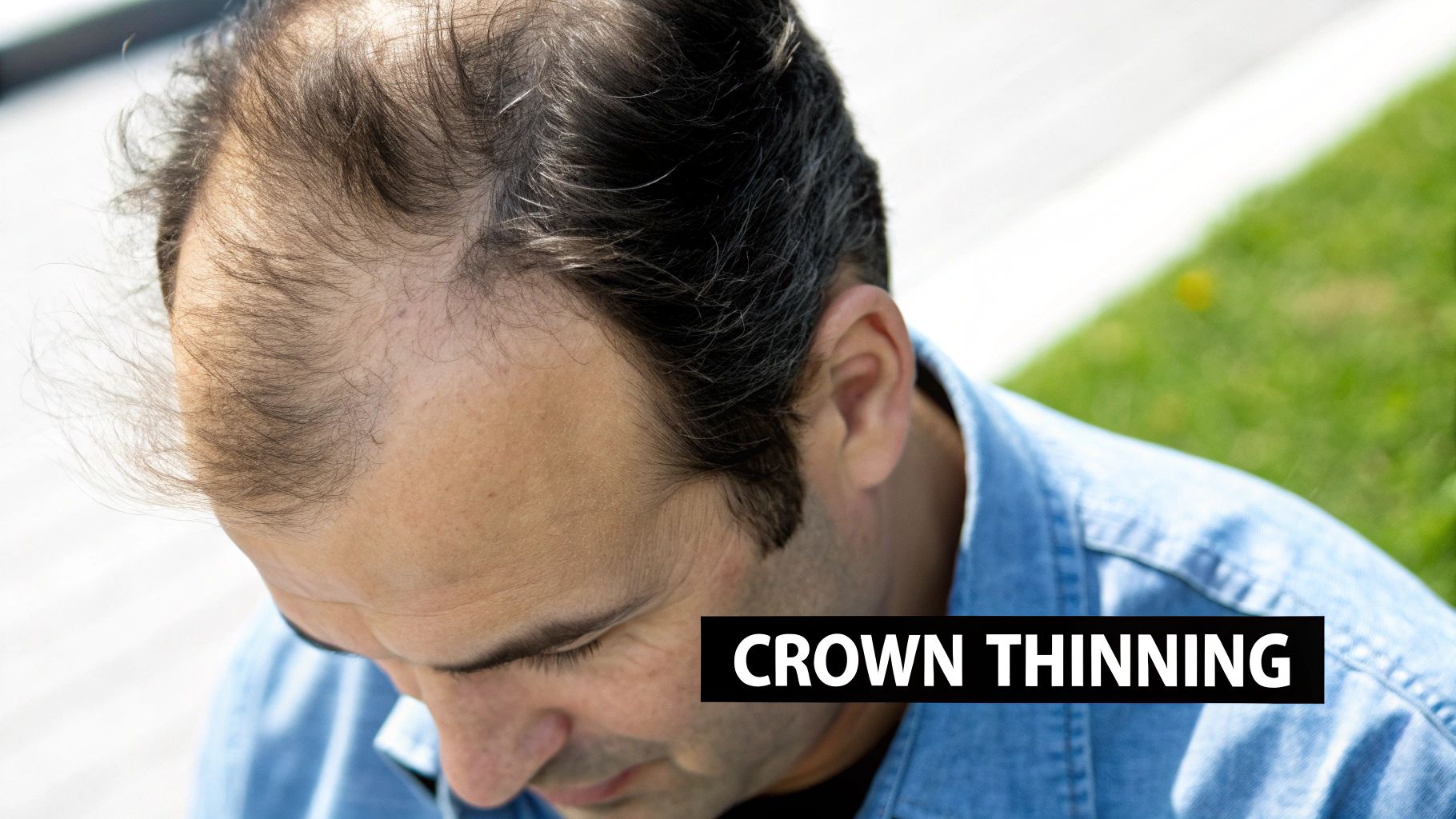
If you're seeing that familiar thinning spot at the back of your head (the vertex), you are definitely not alone. It's one of the most common experiences for men across the globe.
This condition, known in medical terms as androgenetic alopecia, follows a very predictable script. It's so common that in the United States, an estimated 42.68% of men are dealing with it. That translates to over 50 million men facing the same journey.
So why the crown? Why not the back or sides? It all comes down to a potent mix of your genes and a specific hormone: dihydrotestosterone (DHT). Your genetic makeup essentially dictates how sensitive your hair follicles are to this powerful hormone.
The Role of DHT in Crown Thinning
Think of your hair follicles as tiny, hair-producing factories. For men with a genetic predisposition to hair loss, DHT is the culprit that slowly shuts down production. It just so happens that the follicles on the crown and at the temples are usually the most vulnerable to its effects.
When DHT latches onto these sensitive follicles, it kicks off a process called miniaturization. This isn't a sudden event. It’s a slow, gradual strangulation of the hair growth cycle.
Here's how it plays out, step by step:
- The Growth Phase Gets Shorter: Every hair on your head goes through a natural cycle of growing, resting, and shedding. DHT systematically shortens the active growth (anagen) phase.
- Hairs Grow Back Weaker: With each new cycle, the hair that emerges is finer, shorter, and lighter in color. It's a shadow of its former self.
- Follicles Eventually Give Up: After enough cycles of this abuse, the follicle shrinks to the point where it can no longer produce a visible hair. It goes dormant, and that's when the bald spot becomes apparent.
This slow-motion process is why you don't just wake up bald one morning. It’s a fade-out, where strong, healthy terminal hairs are methodically replaced by weaker, wispy "vellus" hairs until nothing is left.
If you want to get into the nitty-gritty, you can learn more about what DHT is and how it causes hair loss in our detailed guide.
The key takeaway is this: crown balding isn't a random fluke. It’s a targeted attack where DHT weakens genetically susceptible follicles in a specific pattern, creating that classic bald spot.
Understanding this is the absolute first step toward figuring out what you can do about it.
How Crown Balding Typically Progresses Over Time

Losing hair on the crown of your head is rarely a sudden event. It’s more of a slow burn—a gradual process that often starts so subtly you might not even register it at first. Knowing what this progression looks like can help you identify where you are in the journey and decide when it’s time to take action.
Think of it like watching a clearing form in a dense forest over several years. Initially, you might just see a few sparse patches. Over time, those spots connect and widen, eventually becoming a distinct, open area. For most men, crown balding follows a very similar, predictable pattern.
The Earliest Signs You Might Miss
In the very beginning, thinning at the crown is incredibly easy to overlook. A big reason for this is the natural hair whorl—that spiral pattern of hair growth at the top of your head. This swirl is a master of camouflage, creating an illusion of fullness that can effectively hide the first stages of hair loss.
You might only catch it under the unforgiving glare of bathroom lighting or when your hair is wet. Sometimes, the first clue comes from a friend's offhand comment or a photo taken from an unflattering angle. This is often the very first sign: the hair at the center of that whorl just isn't as dense as it used to be.
From Small Spot to Noticeable Thinning
As months and years pass, that subtle thinning starts to become more defined. What was once a slightly sparse area begins to widen into a distinct spot. This is the stage where you can clearly say, "I am losing hair on the crown of my head."
- The Initial Spot: It usually starts as a small circle, maybe the size of a coin, right at the vertex of your scalp.
- The Widening Circle: The diameter of this spot slowly expands. The hairs inside this zone also become finer and shorter because of that miniaturization process we talked about earlier.
- Increased Scalp Visibility: You’ll begin to see more of your scalp peeking through, even when your hair is dry and perfectly styled.
This progression is what hair loss specialists classify using the Norwood Scale, which is the standard system for measuring the extent of male pattern baldness. While you don't need to memorize it, understanding how the Norwood Scale tracks hair loss can give you a better grasp of the clinical stages.
For most men, the journey from a tiny thin spot to a noticeable bald patch can take several years, sometimes even a decade or more. The rate of progression is almost entirely down to your genetics.
When the Crown Meets the Front
For many guys, hair loss isn't just happening in one spot. It’s often a two-front battle. While that clearing at the crown is expanding, the hairline at the front is frequently in retreat.
In the more advanced stages, these two areas start heading toward each other. The bald patch on the crown grows forward, while the receding hairline creeps backward. Eventually, that "bridge" of hair separating them thins out completely, creating one large bald area across the top of the scalp.
Of course, this process can look different for everyone. Some men might only ever thin at the crown, while others will only see their hairline recede. But for many, the combination of the two is the classic signature of male pattern baldness. Your timeline is unique, but the pattern is a well-trodden path. Recognizing these stages is your first, most important step toward getting back in control.
Getting a Clear Diagnosis for Your Hair Loss
Moving from suspicion to certainty is a huge step in tackling hair loss. If you've been monitoring the situation at home, scheduling a consultation with a specialist is the most proactive, empowering move you can make. It takes the guesswork out of the equation and puts you on a clear path forward.
A lot of guys feel some anxiety about this appointment, but it’s usually much more straightforward than you might think. A professional can quickly determine if you're dealing with male pattern baldness or something else entirely. This is the essential first step before you can confidently choose the right treatment.
What to Expect During Your Consultation
The whole point of this first visit is to get to the "why" behind your hair loss. A dermatologist or hair loss specialist has a few reliable methods to get a clear picture of what’s happening on your scalp.
The process almost always starts with a detailed chat about your history. The specialist will likely ask about:
- Family History: Does hair loss run in your family?
- Timeline: When did you first notice the thinning, and how quickly has it progressed?
- Lifestyle Factors: They might ask about your diet, recent stress, and any medications you're taking.
This initial conversation helps them rule out less common culprits that can sometimes look like male pattern baldness. For example, sudden and widespread shedding could point to a stress-related event (telogen effluvium), while distinct patches of loss might suggest an autoimmune condition like alopecia areata.
A proper diagnosis isn't just about confirming what you already suspect. It's about eliminating other potential causes to ensure your treatment plan is perfectly targeted to the actual problem.
After the chat, the specialist will perform a physical examination of your scalp and hair.
The Diagnostic Tools of the Trade
This isn't just a quick glance. Specialists use specific, non-invasive techniques to assess the health of your follicles and the degree of thinning.
One common method is the "pull test." It sounds simple because it is: the doctor gently tugs on a small bundle of about 50-60 hairs. If more than a few hairs come out, it could signal active shedding that’s happening faster than the normal hair cycle.
The real game-changer, though, is the dermatoscope. Think of it as a powerful, handheld microscope for your skin. This device gives the specialist a highly magnified view of your scalp, revealing details completely invisible to the naked eye.
With a dermatoscope, they can see:
- Follicle Miniaturization: This is the tell-tale sign of androgenetic alopecia. They can literally see if your hair follicles are shrinking and producing thinner, weaker hairs.
- Scalp Health: The device can easily spot signs of inflammation, scaling, or other scalp conditions that could be contributing to the problem.
- Hair Density: They can accurately assess hair density in different zones, confirming that thinning is concentrated at the crown.
In the vast majority of cases, a visual exam and dermoscopy are all it takes to get a definitive answer. For the rare instances where the picture is still fuzzy, you can learn about when a scalp biopsy for hair loss might be necessary. But for most men with a thinning crown, this first appointment provides all the clarity needed to start planning your next steps.
Exploring Your Treatment Options for Crown Thinning
Once you have a clear diagnosis, the next logical step is figuring out what you can actually do about it. The good news? When it comes to that thinning spot on your crown, you have a solid toolkit of effective, evidence-based options to fight back. The real key is finding the right strategy that fits your specific stage of hair loss and, just as importantly, your lifestyle.
Let's walk through the most proven treatments out there, breaking down how each one works to protect and potentially regrow the hair on your crown.
FDA-Approved Medications: Your First Line of Defense
For most guys, the journey to stop crown thinning starts with two well-known, FDA-approved medications. Think of these as the foundational pillars of any serious hair retention strategy.
Finasteride: The DHT Shield
Finasteride is a daily pill that gets to the hormonal root of male pattern baldness. It acts like a powerful shield, blocking the enzyme (5-alpha reductase) that turns testosterone into DHT—the hormone responsible for shrinking your hair follicles.
By seriously knocking down the DHT levels in your system, Finasteride helps to:
- Stop the Clock: Its main job is to halt the miniaturization process cold, preventing your hair from getting any thinner.
- Encourage a Comeback: For follicles that are weakened but not totally gone, easing off the DHT pressure can give them a chance to recover, eventually producing thicker, healthier hair.
Minoxidil: The Growth Stimulant
Minoxidil is a topical treatment, usually a foam or liquid, that you apply directly to your scalp. It works completely differently from Finasteride; it doesn’t block any hormones. Instead, it’s a vasodilator, which is just a technical way of saying it helps widen the blood vessels.
This action boosts blood flow right to the hair follicles, delivering a rush of oxygen and nutrients. It also gives the anagen (growth) phase of your hair cycle a helpful nudge, keeping hairs growing for longer. You can think of Minoxidil as a high-octane fertilizer for your scalp, creating a much better environment for hair to thrive.
Platelet-Rich Plasma (PRP): Your Body's Own Growth Engine
Beyond the daily meds, Platelet-Rich Plasma (PRP) therapy has become a go-to, non-surgical option that uses your body's own natural healing powers. If medications are your defense, think of PRP as a targeted offensive strike to wake up dormant follicles.
The process itself is surprisingly simple. We draw a small amount of your blood—no different than a routine lab test—and spin it in a centrifuge. This separates out the platelet-rich plasma, a golden-colored liquid absolutely packed with powerful growth factors.
This concentrated "liquid gold" is then carefully injected into the thinning areas of your scalp, like the crown. Those growth factors get to work immediately, signaling the stem cells in your hair follicles to get back into the active growth phase. It’s like delivering a super-dose of nourishment directly where you need it most.
The crown of the head is ground zero for male pattern baldness, where hair loss often manifests first as a circular thinning patch that expands relentlessly. Globally, this hits hardest in Western countries: Spain tops the charts with 44.5% of men affected, followed by Italy's 44.37%, France's 44.25%, and the US at 42.68%. Over 95% of male hair loss cases are pattern baldness targeting the crown via genetic DHT sensitivity. But here's the hope: Platelet-Rich Plasma (PRP) therapy, drawn from your blood, delivers growth factors directly to crown follicles, with studies showing regrowth in early stages.
Comparing Top Treatments for Crown Hair Loss
A side-by-side comparison of the most common and effective treatments for crown thinning, helping you understand the pros, cons, and ideal candidate for each option.
| Treatment | How It Works | Best For | Typical Timeline |
|---|---|---|---|
| Finasteride | An oral pill that blocks the DHT hormone responsible for shrinking follicles. | Men in the early to moderate stages of crown thinning who want to stop further loss. | Initial results in 3-6 months; full effect seen around 12 months. |
| Minoxidil | A topical solution/foam that increases blood flow to the scalp and extends the hair growth phase. | Those with general thinning who want to stimulate growth. Works well with Finasteride. | Noticeable improvements can take 4-6 months of consistent, twice-daily use. |
| PRP Therapy | Injects concentrated growth factors from your own blood into the scalp to stimulate dormant follicles. | Individuals with thinning hair but still viable follicles; excellent for boosting density. | A series of 3-4 initial treatments; maintenance sessions every 6-12 months. |
| Hair Transplant | Surgically moves DHT-resistant hair follicles from the back/sides of the head to the crown. | Men with significant, advanced hair loss on the crown where follicles are no longer active. | A permanent solution, with new hair growth visible in 3-4 months and full results in 12-18 months. |
Choosing the right approach often means combining therapies for the best possible outcome. A specialist can help build a plan tailored to your specific situation.
Other Effective Treatment Avenues
While medications and PRP are the heavy hitters, a few other approaches can play a strong supporting role.
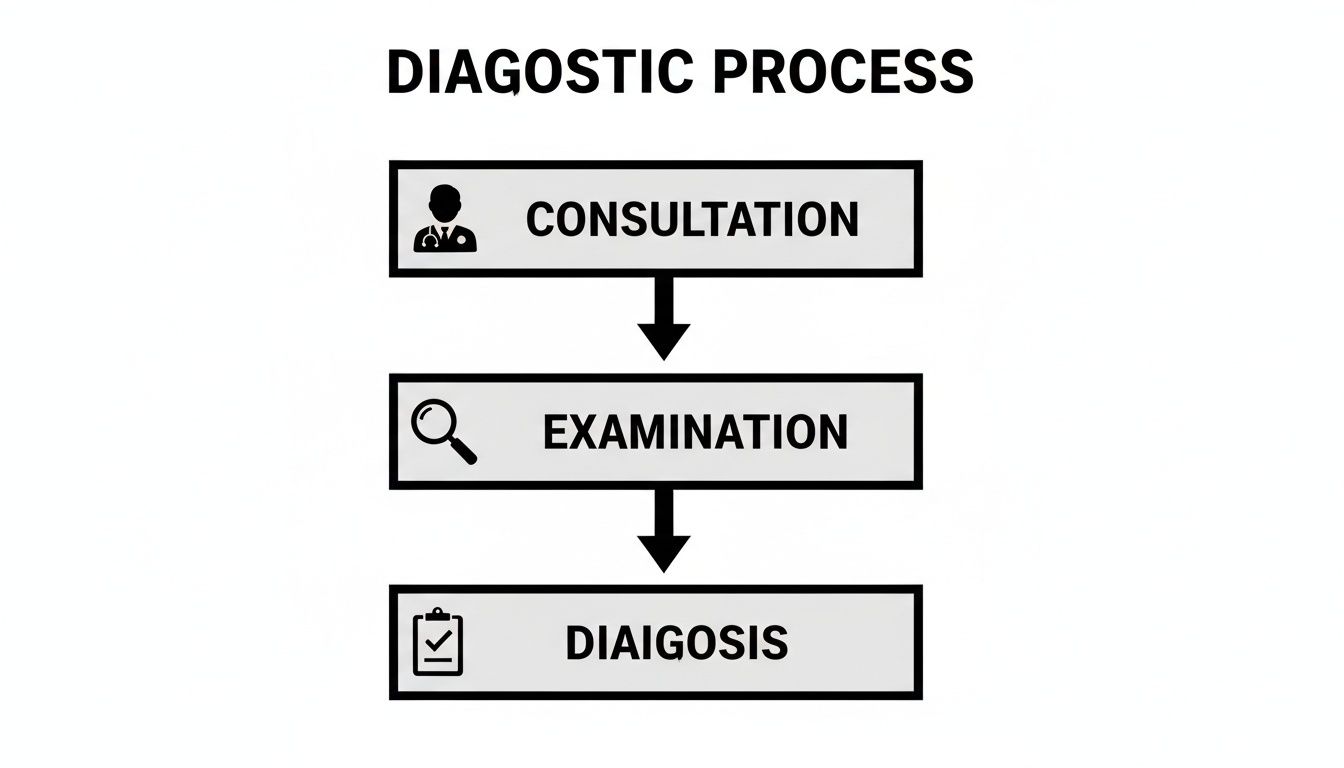
This chart highlights an essential truth: a proper diagnosis is the foundation you need before building any effective treatment plan.
Low-Level Laser Therapy (LLLT)
LLLT uses devices like caps or combs that shine red light at a very specific wavelength onto your scalp. The idea is that this light energy gets absorbed by the follicle cells, kickstarting their metabolism and promoting growth. It's a completely non-invasive option you can use at home, and it pairs well with other treatments.
Hair Transplant Surgery
For more advanced cases where the crown has significant balding and the follicles are long gone, a hair transplant is really the only way to restore density. This surgical procedure carefully moves DHT-resistant hair from the back and sides of your head to the balding areas on top. It’s a permanent fix that can deliver some incredibly natural-looking and dramatic results. You can see how all these options stack up in our complete guide to the best hair loss treatments for men.
Finally, don't overlook the simple stuff. Addressing potential nutritional gaps is always a smart move. Some research points to a link between hair loss and low vitamin levels, so it’s worth looking into things like vitamin D supplements. Working with a specialist to find the right combination of treatments gives you the best possible shot at winning the fight against crown hair loss.
What to Realistically Expect from Hair Loss Treatments
Starting treatment for a thinning crown is a big step, but it’s really important to set the right expectations from the get-go. Patience isn’t just a good idea here; it’s a non-negotiable part of the process. I often tell my patients to think of it like turning a massive ship around—it doesn't happen instantly. It takes slow, consistent effort before you finally see it heading in a new direction.
The journey to restoring hair on your crown happens in phases, and seeing new hair isn't even the first goal. The first thing any good treatment—whether it's medication or PRP—aims to do is stop the bleeding, so to speak. The immediate objective is to halt any further hair loss by putting the brakes on that DHT-driven miniaturization process.
The Slow Road to Results
Once you've managed to stabilize the hair loss, then the focus can finally shift to regrowth. This is where a lot of guys get antsy, but you have to remember that your hair follicles are on their own biological clock, and it moves a lot slower than we'd like.
For instance, if you're using medications like Finasteride and Minoxidil, you probably won't see much of anything for the first few months.
- Months 3-6: This is when you might start to notice the very first signs of change. It usually begins with less shedding, followed by some fine, baby-like vellus hairs (think "peach fuzz") popping up in the thinning spot.
- Months 6-12: This is the window where more significant results tend to show up. Those initial fine hairs can start to mature—becoming thicker, darker, and actually contributing to the feeling of more density.
The timeline for PRP therapy is pretty similar. It takes a series of treatments spread out over several months to really wake up those dormant follicles and give them the growth factors they need to produce stronger hair. It’s a gradual thickening, not an overnight transformation. You can check out a detailed Finasteride results timeline to get a better sense of this step-by-step journey.
Success looks different for everyone. For some guys, just holding onto the hair they still have is a huge win. For others, it's all about noticeable regrowth. Both outcomes are valid victories in the fight against hair loss.
Consistency is Everything
Treatments for crown thinning are not a one-and-done deal. They demand a serious commitment. Skipping your Finasteride doses or pushing back PRP sessions is like trying to fill a leaky bucket—you’re actively working against your own progress.
You have to be consistent because you're fighting a persistent genetic and hormonal process. The moment you stop treatment, the root cause—DHT's assault on your follicles—gets right back to work. Before long, any ground you gained will likely be lost.
This is also why combination therapy so often yields the best results. Imagine using Finasteride to block DHT at the source, Minoxidil to boost blood flow and follicle function, and PRP to inject a powerful cocktail of growth factors directly where they're needed. You're creating a multi-front attack—building a strong defense while simultaneously launching an offense to reclaim lost territory on your crown.
Taking Control: Your Action Plan for Crown Hair Loss
Alright, you've done the research. You now understand the why behind that thinning spot on your crown and the options on the table. But knowing is only half the battle—the real change happens when you act.
Let's break down the next steps into a simple, no-nonsense plan. The goal here isn't to add more to your plate, but to give you a clear, manageable starting point so you can tackle this head-on and feel in control.
Step 1: Take a Baseline Photo. Right Now.
This is your first, easiest, and most important move. Seriously, grab your phone right now. Find a spot with good, consistent lighting (like your bathroom) and take a few clear pictures of the top of your head from different angles.
These photos aren’t for anyone else; they're your personal benchmark. It’s the honest starting line from which you and your doctor can measure real progress. Without this visual record, you're just guessing whether a treatment is actually working months down the road.
Step 2: Book an Appointment with a Pro
Googling your symptoms will only get you so far. The single most effective thing you can do is book a consultation with a dermatologist or a dedicated hair loss specialist. A professional eye is the only way to get a firm diagnosis and build a treatment plan that’s right for you.
Walk into that appointment prepared. Jot down a list of questions about the treatments we’ve covered. Ask about their experience with them, what the side effects are, and what a realistic outcome looks like for someone with your specific level of hair loss.
Hair loss at the crown isn't a rare problem—it's a global one. By age 50, anywhere from 30% to 50% of men will have some degree of DHT-driven hair loss, and a staggering 95% of all male hair loss is just good old-fashioned male pattern baldness. This is where treatments like PRP for hair loss come in, using your own concentrated platelets to kickstart dormant follicles and build density where medications might not be enough. You can see more detailed numbers on global hair loss trends at Chemist-4-U.com.
Step 3: Make Small Changes That Support Big Results
While medical treatments do the heavy lifting, your daily habits have a huge impact on your overall scalp health. You can start making these positive adjustments today.
Dial in Your Diet: Think of food as fuel for your follicles. A balanced diet packed with protein, iron, zinc, and biotin gives your hair the raw materials it needs to grow strong.
Keep Stress in Check: Chronic stress can throw your hair's growth cycle completely out of whack. Find something that works for you—whether it's hitting the gym, meditation, or just carving out time for a hobby—and stick with it.
Following these steps moves you from being a spectator to being the key player in your own story. You’ve got a clear path forward. Now, it's time to take that first step.
Your Top Questions About Crown Hair Loss, Answered
When you're dealing with hair loss, especially at the crown, questions are bound to pop up. You want straightforward, honest answers from someone who knows the ropes. Let's tackle some of the most common questions we get from guys just like you.
Can I Get Hair Back on a Completely Bald Crown?
This is the big one, and the honest answer is: it’s tough. If the crown has been smooth and shiny for several years, it usually means the hair follicles have miniaturized to the point of no return. They've essentially gone dormant for good.
Hair loss treatments are all about reviving follicles that are weak or struggling, but not gone completely. That's why catching it early makes such a massive difference in your results. A specialist can use a tool called a dermatoscope to get a magnified look at your scalp and see if there's any life left in those follicles.
Is a Thinning Crown a Sign of a Bigger Health Issue?
For the overwhelming majority of men—we’re talking over 95% of cases—a thinning crown is simply male pattern baldness. It’s a genetic hand-me-down, not a reflection of your overall health.
That said, in some rare instances, sudden and patchy hair loss can be a red flag for other things. We sometimes see links to nutritional gaps (like low iron), thyroid problems, or even severe stress. A proper diagnosis from a doctor is the only way to be sure, ruling out any underlying issues and confirming the real cause.
While pattern baldness is almost always the answer, getting a professional diagnosis gives you certainty and peace of mind. It ensures you're starting your treatment journey on the right foot.
How Is PRP Different from Finasteride for Crown Loss?
Great question. Both are heavy hitters in the fight against crown loss, but they come at the problem from completely different angles.
Finasteride (The Guardian): Think of this as your internal defense system. It’s a daily pill that works throughout your body to block the formation of DHT, the hormone that’s actively shrinking your hair follicles. Finasteride is all about playing defense and protecting your hair from more damage.
PRP Therapy (The Stimulator): This is a direct, localized approach. We take the powerful growth factors from your own blood and inject them right where you need them—at the crown. PRP is an offensive strategy, actively stimulating and nourishing weakened follicles to help them get back in the game.
The best part? You don't have to choose. They work incredibly well as a team. Using Finasteride to halt the hormonal assault while PRP directly feeds and revitalizes the follicles is a potent one-two punch against crown hair loss.
At PRP For HairLoss, our goal is to give you clear, science-backed information so you can make confident decisions. If you're ready to see how PRP therapy can be targeted to restore your crown, check out all our resources at https://prpforhairloss.com.


Leave a Reply