Losing your hair can be a tough experience, and sifting through all the "solutions" out there can feel just as overwhelming. One option that's been getting a lot of attention is Platelet-Rich Plasma (PRP) therapy. It’s a non-surgical approach that taps into your body's own healing power to give your hair growth a much-needed boost.
Think of it as giving your scalp a concentrated dose of everything it needs to get back to work.
Understanding PRP for Hair Loss
When you start digging into treatments for male pattern baldness, you'll find a lot of different paths you can take. Platelet-Rich Plasma (PRP) therapy really stands out because it's a key player in the exciting field of regenerative medicine. The whole idea behind it is beautifully simple: instead of relying on drugs or surgery, we concentrate the natural healing elements from your own blood and put them right where you need them most—your scalp.
The goal isn't to introduce something foreign to your system. It's all about amplifying your body's natural capacity for repair to wake up tired hair follicles and nourish the hair you still have.
The Science Behind the Treatment
So, what’s the secret sauce here? It all comes down to the platelets in your blood. These tiny cell fragments are biological powerhouses, absolutely loaded with proteins called growth factors. Normally, they rush to an injury to kickstart the healing process. In PRP, we essentially gather an entire army of them.
When this super-concentrated plasma is injected into the scalp, those growth factors send a powerful signal to the hair follicles, encouraging them to get back into their growth phase.
This isn't some brand-new, untested idea. PRP has been used in medicine since the 1970s for things like healing surgical wounds. Its application for hair loss, however, has really taken off in the last decade, with research picking up steam after 2010. By 2022, it was being seriously evaluated in clinical trials for male pattern baldness, a sure sign of its growing credibility in the medical community. You can find more about these clinical evaluations on eternaldermatology.com.
The core principle is straightforward: use your body's own biological toolkit to address the problem at its source. Instead of just masking the issue, PRP aims to improve the underlying health and function of the hair follicles.
What This Guide Covers
My goal here is to give you a straight-up, no-hype look at PRP. We'll walk through the entire journey, from the science behind it to the kind of results you can realistically hope for. This is your practical roadmap to figuring out if this treatment actually makes sense for you.
Here's what we'll get into:
- How PRP actually works on a biological level.
- A step-by-step look at what happens during the procedure.
- What kind of results to expect and a timeline for seeing them.
- A head-to-head comparison with other treatments like minoxidil and finasteride.
To kick things off, you can get a more detailed breakdown by reading our article on what PRP therapy is in our detailed article.
How PRP Uses Your Body's Own Power to Regrow Hair
You don't need a medical degree to get how platelet-rich plasma (PRP) therapy works for hair loss. The idea is quite simple: we take your body's natural healing power, concentrate it, and put it right where it's needed—your scalp—to wake up those tired hair follicles.
Think of the platelets in your blood as your own personal emergency response team. Whenever you get a cut, they're the first on the scene. They rush in to stop the bleeding and kickstart the repair process, armed with a powerful toolkit of proteins called growth factors. These growth factors are basically the foremen on the job site, giving instructions for cellular repair and regeneration.
With PRP therapy, we're essentially gathering this elite repair crew, beefing up their numbers, and sending them on a special mission to revitalize your hair.
The Three-Step Biological Process
The entire treatment boils down to a straightforward process that isolates these healing components from your blood.
First, we draw a small amount of your blood, no different than a routine lab test. That sample then goes into a centrifuge—a machine that spins at incredibly high speeds to separate the blood into its different parts.
This spinning is the secret sauce. It allows us to isolate the platelet-rich plasma, a golden-hued liquid packed with a concentration of platelets 5 to 10 times greater than what’s normally circulating in your blood. This supercharged plasma is the core of the treatment, loaded with all the growth factors your hair follicles have been craving.
Finally, we carefully inject this concentrated PRP into the areas of your scalp where your hair is thinning. By delivering it directly to the source, we make sure those growth factors get exactly where they need to go to start working their magic.
This visual guide breaks down the core concepts, from your body's natural healing abilities to the scientific process behind the treatment.
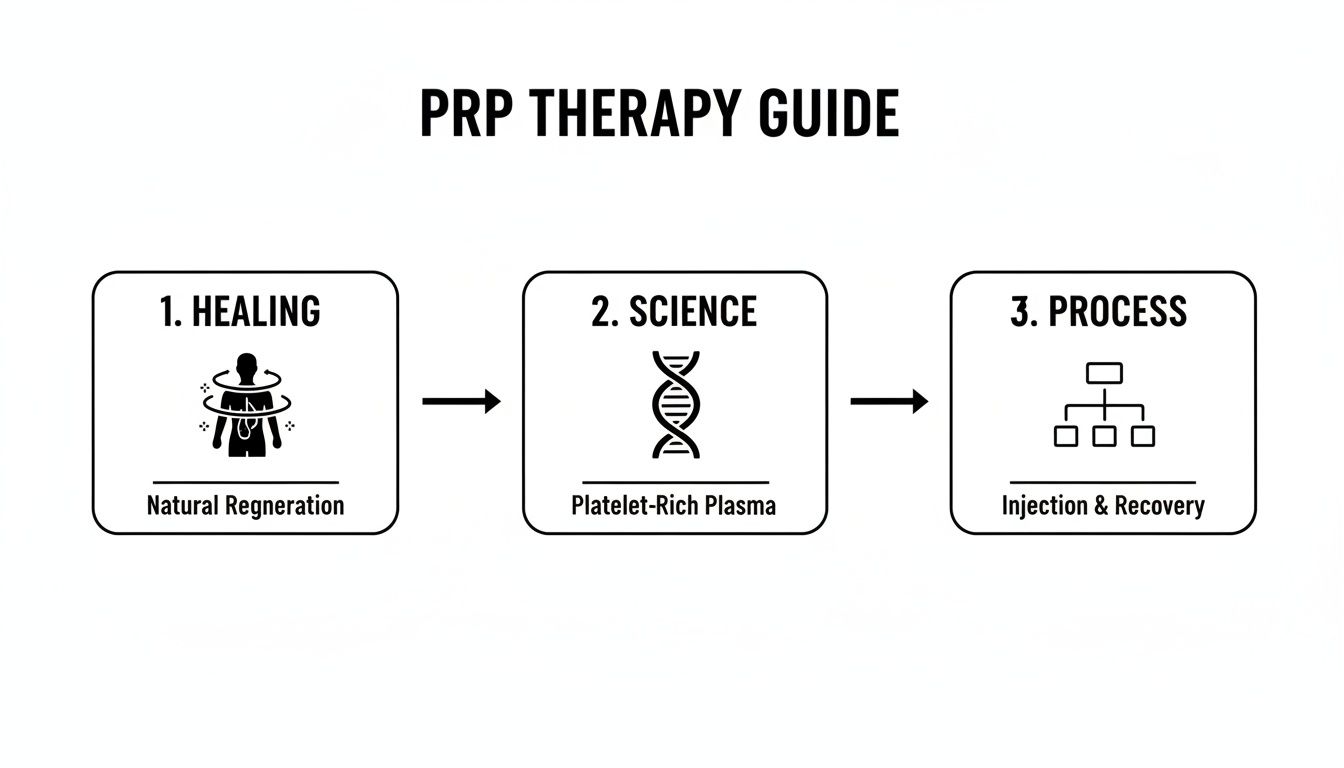
As you can see, the therapy is a logical step, taking what your body does naturally and applying it scientifically to help restore your hair.
Waking Up Dormant Hair Follicles
So what actually happens once the PRP is in your scalp? It’s all about communication. The growth factors released by the platelets act as a powerful wake-up call to underperforming or sleeping hair follicles.
In many cases of hair thinning, the follicles aren't dead—they're just dormant or have shrunk (a process called miniaturization), causing them to produce much finer, weaker hairs. PRP therapy aims to hit the reset button on this whole process.
The growth factors in PRP get to work on several fronts. They signal the stem cells in your hair follicles to get active, encourage the formation of new blood vessels to improve circulation (a process called angiogenesis), and help extend the growing phase of the hair cycle.
Better circulation is a game-changer. It means more oxygen and nutrients can finally reach the hair follicles, creating a much healthier environment for strong, robust hair to grow. Over a series of treatments, this can lead to visibly thicker hair shafts and better overall hair density.
The Key Growth Factors at Play
While you don't need to know all the science, it helps to understand a few of the key players involved. Your platelets release a whole cocktail of powerful growth factors, and each one has a specific job:
- Platelet-Derived Growth Factor (PDGF): Helps build new blood vessels and gets cells to multiply.
- Transforming Growth Factor (TGF-beta): Plays a big part in cell growth and forming new tissue.
- Vascular Endothelial Growth Factor (VEGF): A critical signal that stimulates the creation of new blood vessels.
- Epidermal Growth Factor (EGF): Encourages cell growth and is vital for healthy skin and follicles.
- Fibroblast Growth Factor-2 (FGF-2): Gets specialized cells to ramp up their activity.
Working together, this team creates a revitalized environment on the scalp. And because the entire process uses your body's own biological material, the risk of an allergic reaction or rejection is practically zero.
To take a deeper dive into the science, you can check out our detailed guide on how PRP works for hair regrowth. It's a truly natural approach designed to help your body heal itself from the inside out.
What to Expect on Your PRP Treatment Day
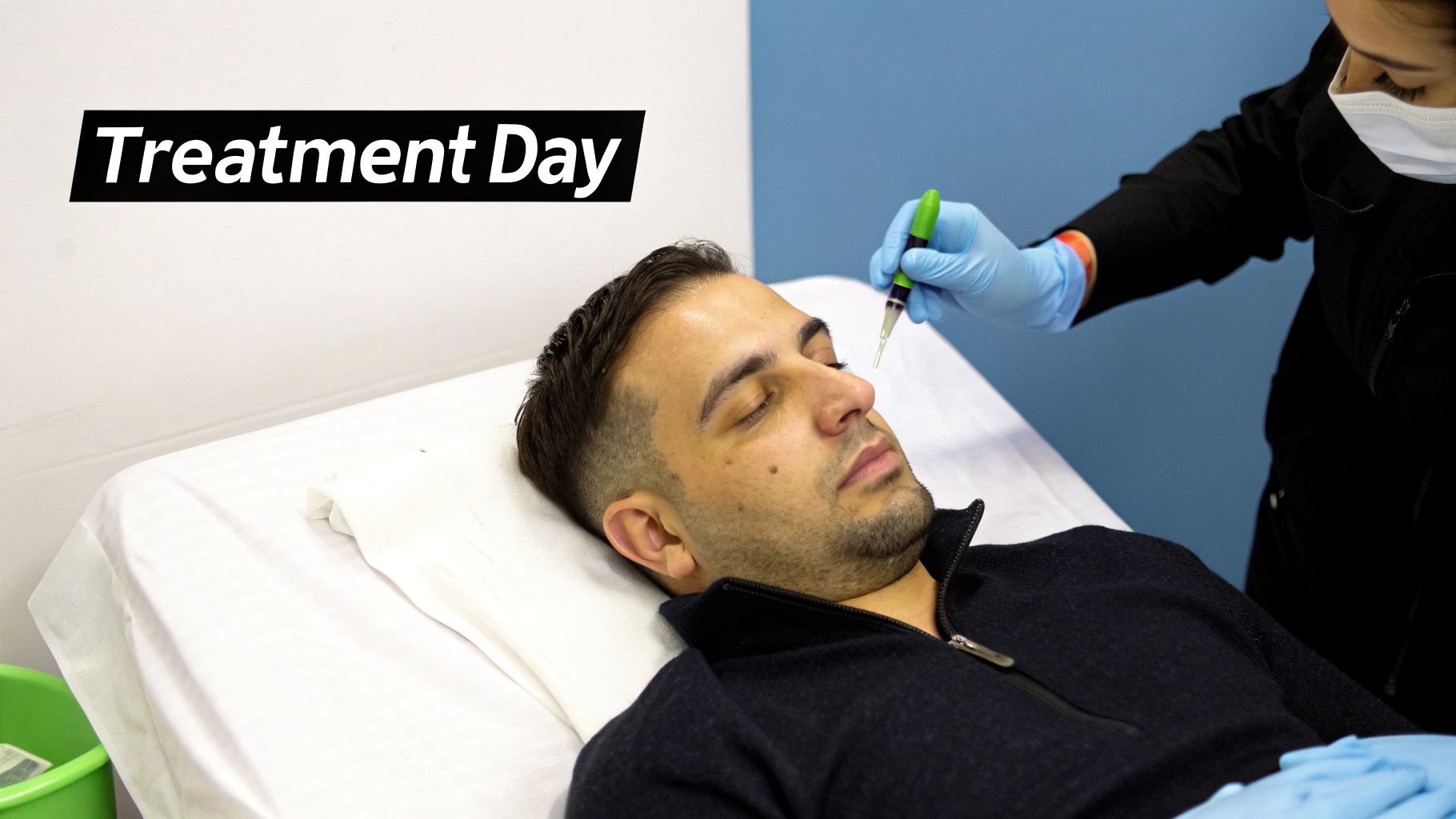
Walking into a clinic for the first time can be a bit nerve-wracking, especially when you don't know what's coming. The good news is that a PRP session for hair loss is remarkably straightforward and quick. Most guys are in and out in under an hour.
The whole process is designed to be as efficient and comfortable as possible. Let's break down exactly what happens from the moment you sit in the chair.
Step 1: The Blood Draw
It all starts with a simple blood draw from your arm, no different than what you'd get at a regular check-up. A small amount of blood, typically between 30 to 60 milliliters, is collected in a special vial.
This is the raw material for your treatment. It contains everything needed to create the concentrated plasma that will ultimately be used to stimulate your hair follicles. The whole thing takes just a minute or two.
Step 2: Creating the "Liquid Gold"
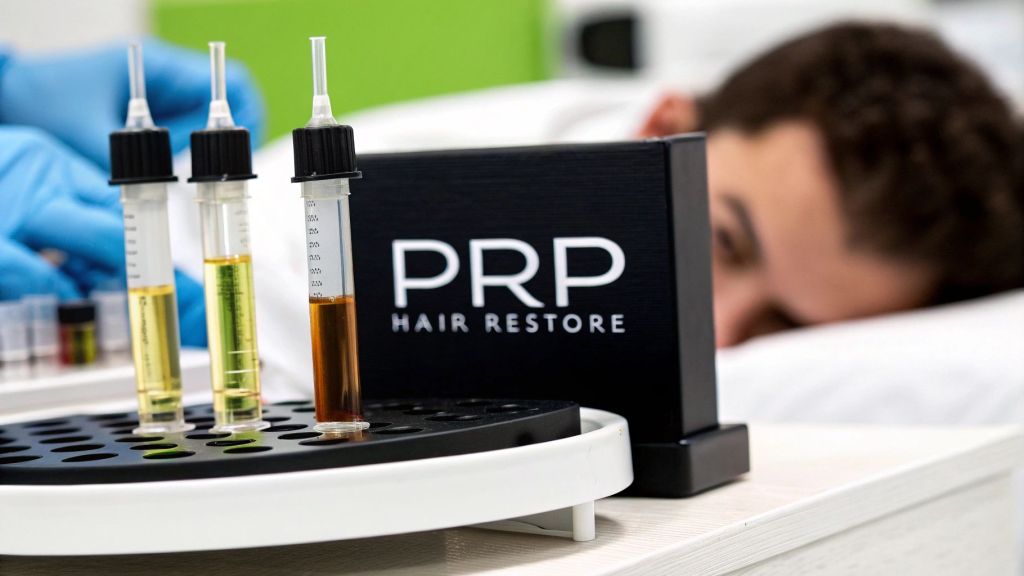
Next, that vial of blood is placed into a centrifuge. Think of it as a high-tech spinner that whirls your blood around at an incredibly high speed for about 10 to 15 minutes. This process uses centrifugal force to separate the blood into three distinct layers:
- Red Blood Cells: The heaviest parts, which settle at the bottom.
- Platelet-Poor Plasma: The lightest liquid that floats to the top.
- Platelet-Rich Plasma (PRP): The "buffy coat" in the middle, a golden-hued liquid packed with growth factors. This is the good stuff.
Once separated, the clinician carefully draws out this concentrated PRP, which is now ready to be put to work on your scalp.
Step 3: Numbing and Injections
While the centrifuge is doing its thing, your scalp gets prepped. A topical numbing cream is usually applied to the treatment areas to make the experience as comfortable as possible. This typically needs about 20-30 minutes to kick in, so you'll have a little time to relax.
With your scalp numbed, the clinician will use a very fine needle to inject small amounts of your PRP directly into the scalp where the hair is thinning. The injections are administered in a grid-like pattern to ensure even coverage across all the target zones.
How does it feel? Most men report a feeling of mild pressure or a series of quick, tiny pinpricks. The anesthetic does a great job of minimizing any real discomfort, and the injections themselves are over in about 15 minutes.
And that’s it. From start to finish, the entire appointment usually takes just 45 to 60 minutes. You can get right back to your day afterward, armed with a few simple aftercare tips from your doctor.
If you want a more granular breakdown of the process, our detailed guide on the PRP procedure for hair restoration covers every detail. Knowing what's happening step-by-step really helps take the mystery out of it, turning treatment day into just another productive appointment.
What Kind of Results Can You Realistically Expect from PRP?
It's crucial to go into any hair loss treatment with your eyes wide open, and PRP is no exception. Let's cut through the hype: this is not an overnight miracle. Think of it less like a magic wand and more like a personal trainer for your scalp, gradually coaxing your hair follicles back into a healthier, more productive state.
The results from PRP therapy build up slowly over time because the treatment works in sync with your body’s natural hair growth cycle. You won’t walk out of your first session with a full head of hair, so patience is absolutely key. This is a marathon, not a sprint, and the most noticeable improvements show up after a consistent series of treatments.
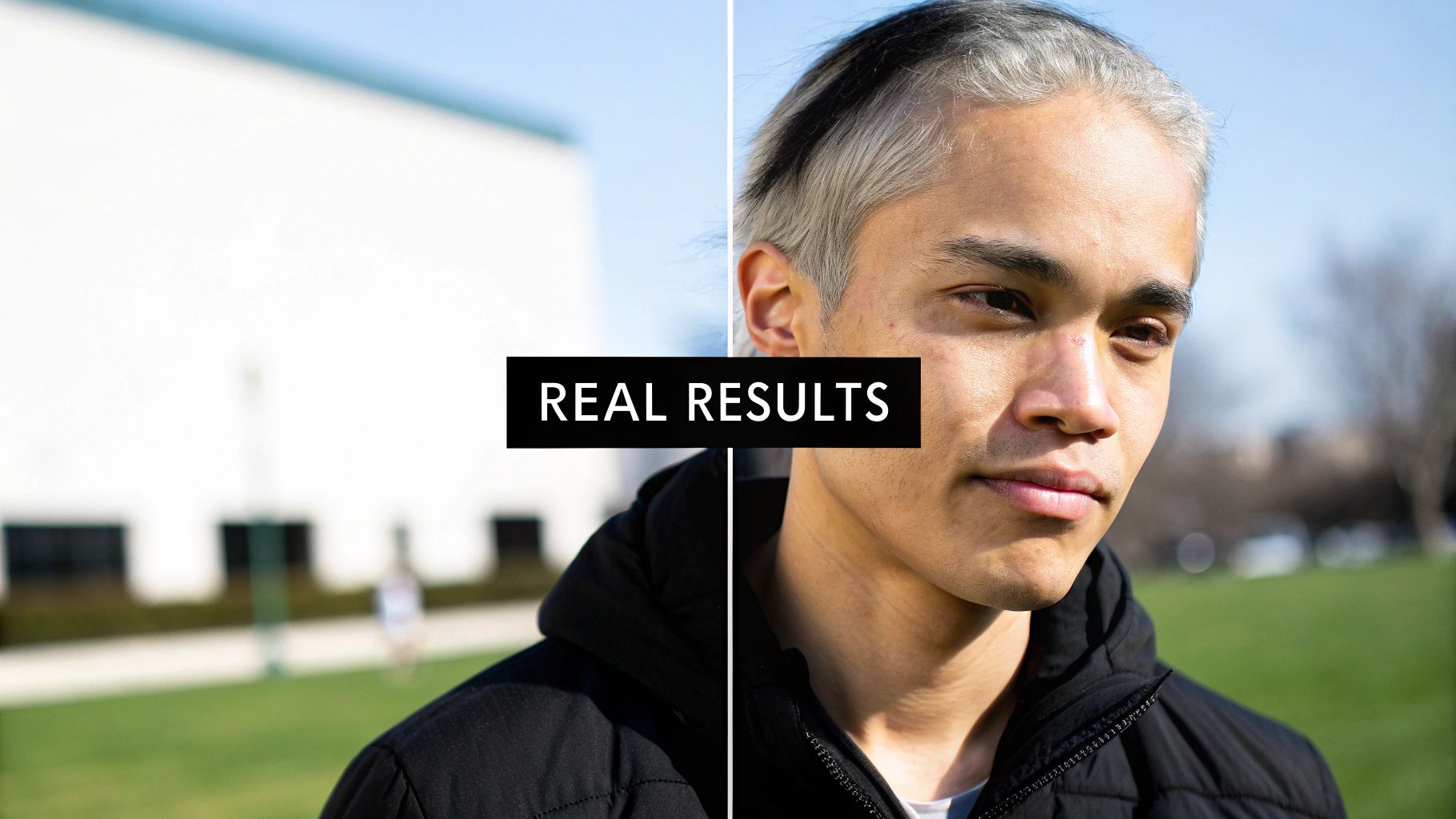
What Does Success Actually Look Like?
When we talk about "results," we're not talking about sprouting new hair on a completely bald patch—that’s not what PRP is designed for. Instead, success is measured in more subtle but significant changes that add up to a fuller, healthier-looking head of hair. The real goal is to beef up the hair you already have.
Here are the key markers of progress to watch for:
- Less Hair Shedding: Often, the very first sign that things are moving in the right direction is seeing less hair in your shower drain or on your brush. This indicates the treatment is helping to anchor your existing hairs more securely.
- Thicker Hair Shafts: The powerful growth factors in PRP get to work strengthening individual strands. This is a game-changer for appearance because thicker hairs provide much better scalp coverage, creating the illusion of more density.
- Better Hair Density: With ongoing treatment, many of those sleepy, dormant follicles can be nudged back into their growth phase. This leads to more active hairs growing in thinning areas, helping to fill in those spots that have been bothering you.
It's important to remember that PRP works best for men who are in the earlier stages of male pattern baldness. As long as your hair follicles are still alive—even if they're producing weak, miniaturized hairs—PRP has something to work with.
The Typical Results Timeline
Knowing when to expect changes can keep you motivated. The results unfold in stages, and everyone’s body responds a bit differently.
In my experience, most guys start to see visible improvements around the three-month mark. The really substantial, photo-worthy results tend to become clear after about six months of consistent therapy. It just takes time for the growth factors to do their job and for new, healthier hair to complete its growth cycle.
Here's a breakdown of how things generally play out:
| PRP Results Timeline: What to Expect and When |
| :— | :— |
| Timeframe | Expected Outcome |
| Months 1-2 | The main change you'll likely see is a reduction in hair shedding. Your scalp is stabilizing, and this is a critical first sign that the treatment is taking hold. |
| Months 3-4 | You might start to feel a difference in hair texture. Existing hairs can feel thicker and more robust. You may also notice the first signs of fine, new "peach fuzz" as dormant follicles awaken. |
| Months 6+ | By now, the cumulative effect of the treatments should be much more obvious. You should see a noticeable improvement in overall hair density and coverage. This is when before-and-after photos really start to tell the story. |
This timeline gives a great general overview, but for a more in-depth look, you can check out our complete guide on the PRP hair treatment timeline.
Is This Backed by Clinical Data?
Absolutely. This isn't just based on anecdotal success stories. Solid clinical data supports PRP's effectiveness for androgenetic alopecia (the scientific term for male pattern baldness).
Dozens of studies confirm that PRP can deliver measurable improvements in both hair density and thickness, typically within that crucial 3–6 month window. For example, a major 2022 review of 17 different clinical trials concluded that most reported statistically significant gains in hair count and hair shaft diameter.
In one particularly compelling study involving men who had failed to respond to other treatments, switching to PRP resulted in about 30% more hair in just three months. You can dive into the specifics by reading the full research in Frontiers in Medicine.
Is PRP the Right Hair Loss Solution for You?
Choosing a hair loss treatment is a big decision, and it’s definitely not a one-size-fits-all situation. Platelet-rich plasma therapy is a fantastic option for many men, but its success really hinges on treating the right person at the right time.
Think of it like trying to revive a struggling lawn. If you have patches of thin, weak grass, a good fertilizer can work wonders. But if the lawn is already paved over, no amount of fertilizer will bring it back. PRP is that powerful fertilizer for your hair—it needs existing, albeit dormant, follicles to work its magic. It can't sprout new ones from a completely bare scalp.
The Ideal Candidate for PRP Therapy
So, who sees the best results? Generally, it's men who are just starting to see the effects of male pattern baldness or are somewhere in the middle stages. If you've started noticing your hairline creeping back, your part widening, or that spot on your crown becoming more obvious—but you still have a good amount of hair left—you’re likely in the prime zone for PRP.
Here’s a quick rundown of who tends to benefit most:
- Men with Androgenetic Alopecia: This is the classic male pattern baldness, and it’s the condition where PRP has been studied the most and shown the most impressive results.
- Early to Moderate Hair Loss: Doctors often use the Norwood scale to classify hair loss. If you fall anywhere between stages 2 and 5, you're considered a great candidate.
- Those with Living Follicles: The whole point of PRP is to kickstart follicles that have become lazy or miniaturized, not to resurrect ones that are long gone. As long as the follicles are still there, PRP can give them a serious wake-up call.
- Individuals in Good Overall Health: It makes sense, right? A healthier body produces higher-quality plasma and has a stronger healing response, which can lead to better results from regenerative treatments like this.
The key thing to remember is that PRP is a restorative treatment, not a reconstructive one. It’s brilliant at thickening up the hair you have and nudging dormant follicles back into a growth phase. This is exactly why getting started earlier often leads to a better outcome.
Who Might Not Be a Good Fit for PRP
It's just as important to know when PRP isn't the right move. For some guys, it’s simply not the best tool for the job, either for safety reasons or because it’s unlikely to deliver the results they’re hoping for.
PRP is generally not recommended if you have:
- Extensive Baldness: If an area has been completely slick and bald for years, the follicles in that region have likely shut down for good. Unfortunately, PRP can’t bring them back from the dead.
- Active Scalp Infections: You’ll need to completely clear up any issues like folliculitis or severe dermatitis before even considering the procedure.
- Certain Blood Disorders: Conditions that mess with your platelets, like thrombocytopenia (a low platelet count), can make the treatment ineffective from the start.
- Chronic Liver Disease or Cancer: These serious health issues can impact your body’s ability to heal and the function of your platelets, making PRP a poor choice.
This isn’t about excluding people from treatment; it’s about making sure you’re safe and not wasting your time and money on something that won't work for you. The only way to know for sure is to sit down with a doctor who specializes in hair restoration. They can take a close look at your scalp, go over your health history, and give you an honest, professional opinion on whether PRP is the right call for you.
How PRP Stacks Up Against Other Hair Loss Treatments
When you're looking for answers to hair loss, PRP is one of several strong contenders. But it's rarely the only option on the table. To figure out what's right for you, it helps to see how PRP compares to the other major players in the hair restoration world.
Each treatment—from daily medications to surgery—has its own unique strengths, weaknesses, and ideal candidate. Let's walk through how PRP compares head-to-head with treatments like Minoxidil, Finasteride, and hair transplants so you can make a well-informed decision.
PRP vs. Other Hair Loss Treatments
Making sense of your options can be overwhelming. This table breaks down the most common treatments for male pattern baldness to give you a clear, at-a-glance comparison.
| Feature | PRP Therapy | Minoxidil (Rogaine) | Finasteride (Propecia) | Hair Transplant |
|---|---|---|---|---|
| How It Works | Injects your own concentrated platelets to stimulate follicle growth. | A topical solution that increases blood flow to the scalp. | An oral pill that blocks the DHT hormone responsible for hair loss. | Surgically moves follicles from a donor area to balding spots. |
| Best For | Early to moderate hair loss; revitalizing thinning hair. | Slowing hair loss and promoting some regrowth, especially at the crown. | Slowing or stopping hair loss; most effective for prevention. | Advanced hair loss with significant balding or receding hairline. |
| Procedure | A few office visits per year for injections. | Daily topical application to the scalp. | Daily oral pill. | A one-day surgical procedure with a longer recovery. |
| Invasiveness | Minimally invasive (injections). | Non-invasive. | Non-invasive. | Surgical and invasive. |
| Results Timeline | Visible results often seen in 3-6 months. | Can take 4-6 months to see initial results. | Results typically noticeable after 3-4 months. | Initial growth in 3-4 months, full results in 12-18 months. |
| Cost | $500-$1,500 per session; multiple sessions needed. | Relatively low-cost monthly expense. | Moderate monthly cost for a prescription. | High upfront cost ($5,000-$20,000+). |
Ultimately, the "best" treatment is the one that aligns with your specific pattern of hair loss, lifestyle, budget, and personal comfort level.
PRP vs. Topical Minoxidil
You probably know Minoxidil by its brand name, Rogaine. It's a liquid or foam you apply directly to your scalp, usually once or twice a day. Its primary function is as a vasodilator, meaning it widens the blood vessels. This little trick boosts blood flow to your hair follicles, which can help kick them into a longer, more active growth phase.
The fundamental difference here is a biological approach versus a chemical one. Minoxidil is a daily chemical stimulant, whereas PRP is a biological therapy that uses your body's own healing power, delivered in a handful of sessions throughout the year. For many guys, the daily chore of applying Minoxidil gets old fast, not to mention the potential for scalp irritation. PRP bypasses that daily grind completely.
PRP vs. Oral Finasteride
Finasteride, sold as Propecia, is a once-a-day pill. It works systemically by blocking the enzyme that turns testosterone into dihydrotestosterone (DHT)—the main culprit behind male pattern baldness. By lowering DHT levels in your body, Finasteride can significantly slow down hair loss and, in some cases, even help regrow some hair.
Here again, the methods couldn't be more different. Finasteride is a prescription medication that alters your hormones on a systemic level. PRP, on the other hand, is a targeted treatment that works only where it's applied: your scalp. Some men are wary of Finasteride due to the small but real risk of sexual side effects. For them, PRP presents a powerful alternative that avoids hormonal changes entirely.
PRP vs. Hair Transplant Surgery
A hair transplant is the most direct and permanent solution for restoring hair to areas that have gone completely bald. It’s a surgical procedure where a surgeon literally moves healthy hair follicles from a dense area (like the back of your head) to the thinning or bald spots up top. It's the only method that can truly rebuild a hairline from scratch.
This is the clearest distinction of all. A hair transplant is a surgical, reconstructive procedure, while PRP is a non-surgical, restorative one. Think of it this way: a transplant is for bringing hair back to a barren area, while PRP is for making the existing, thinning hair you still have thicker, stronger, and healthier.
The two treatments can also be fantastic partners. Many surgeons now recommend PRP sessions after a hair transplant. The growth factors can help speed up healing, reduce the initial "shock loss" of the newly transplanted grafts, and beef up the surrounding native hair for a more seamless result.
Choosing the right path is a big decision, and it pays to do your homework. To get a wider perspective, you can look into other effective hair loss treatments from trusted sources. And if you’re trying to decide between the surgical and non-surgical routes, our deep dive on PRP vs. hair transplants can provide more clarity.
Your PRP Questions Answered
We’ve covered a lot of ground, but you probably still have a few practical questions. Let's tackle some of the most common things guys want to know before committing to PRP.
Does PRP Hurt?
Honestly, most men find it very manageable. Your provider will apply a topical numbing cream to your scalp before anything starts, which takes the edge off significantly.
You might feel a slight pinch or some pressure during the injections, but "painful" isn't the word most people use. Any tenderness or mild soreness afterward is temporary and usually gone within 24 hours. It's nothing like the recovery from a surgical procedure.
How Many PRP Sessions Do I Really Need?
PRP is a process, not a quick fix. Think of it as building momentum for your hair follicles. The typical starting point is an initial round of 3 to 4 treatments, spaced about 4 to 6 weeks apart. This is the "loading phase" designed to really wake up those dormant follicles.
But androgenetic alopecia is a progressive condition, so you can't just stop there. To maintain your results and keep the progress you've made, you’ll need to come back for maintenance sessions. Most doctors suggest a follow-up treatment every 6 to 12 months.
What About Side Effects and Downtime?
This is where PRP really shines. Because it uses your own blood, the risk of an allergic reaction or major side effects is almost zero. It's an incredibly safe option.
The most you'll likely experience is some mild, temporary stuff right after the treatment:
- Minor swelling on your scalp
- A little bit of redness around the injection sites
- Tenderness that some guys compare to a light sunburn
And the best part? There’s virtually no downtime. You can walk out of the clinic and get right back to your day. The only common advice is to skip a heavy workout or hold off on washing your hair for the first 24 hours.
The safety of PRP is a huge plus for many men. It taps into your body's own natural healing mechanisms, which sidesteps the risks you might see with synthetic medications or surgery. That makes it a much more comfortable choice for managing hair loss long-term.
At PRP For HairLoss, our goal is to give you the clear, straightforward information you need to decide if this is the right path for you. To keep learning, explore more resources on our website.
 PRP For Hairloss
Leave a comment