Follicular Unit Extraction, or FUE, is a sophisticated hair transplant technique that involves moving individual hair follicles from a dense part of your scalp to an area where hair is thinning. Think of it like a master gardener carefully selecting and relocating the healthiest individual seedlings to a new patch of soil where they can flourish. That's the heart of FUE—a meticulous, one-by-one approach that gives you incredibly natural results without the linear scar left by older methods.
Understanding Follicular Unit Extraction

At its core, FUE is a detailed, artistic procedure designed to bring your hair back. It’s a huge leap forward from older techniques that required taking out an entire strip of the scalp. Instead, FUE hones in on the hair’s natural building blocks: the follicular units.
These are just naturally occurring little bundles of one to four hair follicles. Using a tiny, specialized tool often less than a millimeter wide, the surgeon carefully extracts each follicular unit directly from the donor area. This is usually the back and sides of your head, where hair is genetically hardwired to resist balding.
The Art And Science Of FUE
Once these tiny grafts are harvested, they’re meticulously placed into the thinning or balding spots, what we call the recipient sites. This is far from a random process. A skilled surgeon has to consider the precise angle, direction, and density of each implanted hair to perfectly mimic your natural growth pattern.
This is where the procedure becomes as much an art form as it is a medical science. The goal isn’t just to put hair where there wasn't any; it's to design a hairline and create density that looks completely natural—as if it was always there. The main culprit behind hair loss for most people is genetics, a condition known as male or female pattern baldness. To get the full story on what causes it, our guide on what is androgenetic alopecia is a great place to start.
The real beauty of FUE lies in its subtlety. Because individual follicles are moved, the process avoids the linear scar of older methods, leaving behind only tiny, pinprick-sized marks that become virtually invisible once healed.
This makes FUE a perfect choice for men who like to wear their hair short without worrying about a tell-tale scar. Recovery is also generally faster and more comfortable than with more invasive techniques. For a wider look at complementary procedures, you can explore the range of Dr. DeJesus MD's aesthetic services.
FUE At A Glance
To quickly break down the key aspects of FUE, here's a simple chart.
| Aspect | Description |
|---|---|
| Extraction Method | Individual follicular units are removed one by one using a micro-punch tool. |
| Scarring | No linear scar. Leaves behind tiny, dot-like scars that are easily concealed by short hair. |
| Recovery | Generally quicker and less painful, with most patients returning to normal activities within days. |
| Ideal Candidate | Those who prefer short hairstyles, need smaller-scale restoration, or want to avoid a linear scar. |
| Naturalness | Allows for precise placement, resulting in a highly natural-looking hairline and density. |
Ultimately, FUE is defined by its precision and ability to deliver subtle, seamless results that blend right in with your existing hair.
How FUE Became The Gold Standard In Hair Restoration
To really get why Follicular Unit Extraction is such a big deal, you have to look at where hair restoration came from. The procedures we have today—refined, artistic, and incredibly natural-looking—didn't just appear out of nowhere. They’re the result of decades of surgeons and patients searching for better results, less scarring, and an easier overall experience.
Not that long ago, the main way to transplant hair was a pretty invasive process. Surgeons would remove a whole strip of scalp from the back of the head, a technique we now call Follicular Unit Transplantation, or FUT. It worked, but it had one major downside: a long, linear scar that many men had to hide by keeping their hair long.
The Shift From Strips To Single Follicles
That very obvious scar was the main thing driving innovation. Patients wanted a solution without the tell-tale sign of surgery, and doctors were determined to find a better way. The big idea was simple in concept but tough in practice: instead of taking a whole strip of skin, what if you could just take the individual hair follicles, one by one?
This less invasive approach started gaining ground in the late '80s and early '90s. But the real breakthrough came in 2002, when Dr. William Rassman and Dr. Robert Bernstein published a paper called 'Follicular Unit Extraction: Minimally Invasive Surgery for Hair Transplantation.' They laid out a clear, effective method for harvesting individual hair follicles without a scalpel or stitches. If you're curious about the full timeline, you can explore the history of hair transplant surgery in more detail.
This one-by-one extraction method was the game-changer. It addressed the biggest patient concerns head-on, offering a path to hair restoration without the linear scar that announced to the world you’d had a procedure.
Why FUE Is The Modern Method Of Choice
The arrival and constant improvement of FUE started a new chapter for hair restoration. It solved the key problems of the older methods, which is why it has become the go-to choice for so many people and their doctors today.
Here are the advancements that really cemented FUE as the gold standard:
- No More Linear Scar: Because follicles are taken out individually, FUE leaves behind tiny, dot-like marks that fade and become practically invisible once healed. This gives you the freedom to wear your hair as short as you want.
- Faster, Easier Recovery: Without a large incision and stitches, patients feel much less discomfort and can get back to their normal routine in just a few days.
- More Donor Hair Options: FUE isn't limited to the back of the head. If the scalp's donor supply is low, surgeons can often harvest hair from other parts of the body, opening up possibilities for those with more advanced hair loss.
- Unmatched Precision and Artistry: The meticulous, graft-by-graft nature of FUE gives surgeons incredible control. They can place each hair with the exact angle and direction needed to build a completely natural-looking hairline.
This evolution from a "plug-and-play" approach to a truly artistic one has dramatically improved what patients can expect. We've seen a much higher hair transplant success rate because the goal is no longer just moving hair—it's about restoring it so flawlessly that no one can tell you had a procedure done.
A Walkthrough Of The FUE Hair Transplant Procedure
The thought of procedure day can be a bit nerve-wracking, but knowing exactly what to expect can turn that anxiety into excitement. Let's pull back the curtain and walk through the entire process, step-by-step, from the moment you arrive to the final graft placement.
It’s helpful to think of it less like a major surgery and more like a day dedicated to meticulous, artistic restoration. It’s a true partnership between you and your team, and choosing qualified surgical providers is the most critical decision you'll make. Their skill is what elevates this from a technical procedure to a life-changing result.
Setting The Stage For Your New Hairline
Your day kicks off with one of the most crucial parts: designing your new hairline. This isn't just about drawing a line; it's a creative and collaborative discussion with your surgeon.
You’ll talk about your goals, and they'll use their expert eye to sketch a proposed hairline directly onto your scalp with a marker. They're looking at your facial structure, your age, and even how your hair might recede further down the road. The goal is a look that fits you perfectly now and continues to look completely natural for decades.
Next up is prepping the donor area—usually the back and sides of your head. For a classic FUE procedure, this area is trimmed or shaved very short. This gives the surgeon a crystal-clear view and easy access to the healthiest follicular units.
The Extraction Phase: Precision In Action
Once the blueprint is set and the donor area is prepped, it's time for local anesthesia. This is a game-changer, making sure your scalp is completely numb so you remain comfortable and feel no pain. Most patients just report feeling a little pressure or some light vibrations, but that’s it.
With your scalp numb, the surgeon gets to work. Using a specialized micro-punch tool, often less than a millimeter wide, they meticulously extract one follicular unit at a time. Each tiny graft, containing one to four hairs, is carefully chosen for its health and robustness.
This follicle-by-follicle extraction is the very definition of FUE. It's a patient, precise process that can take several hours, but it’s exactly why FUE avoids the linear scar of older methods and makes the recovery so discreet.
The harvested grafts are immediately passed to skilled technicians. They inspect each one under a microscope, sorting them and placing them in a special holding solution that keeps the follicles alive and healthy until it's time for implantation.
This image shows just how far the technology has come.
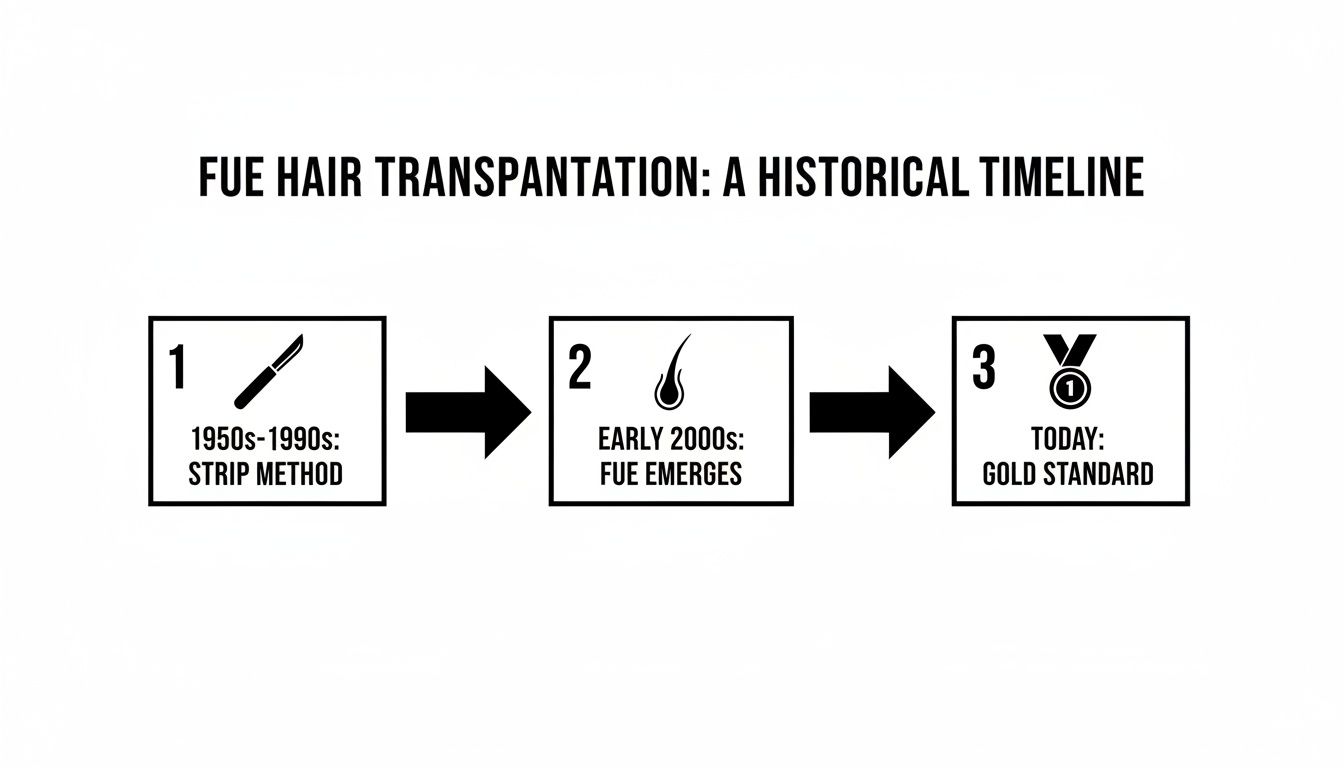
You can see the clear progression from the more invasive strip methods of the past to the refined, individual follicle technique used today.
The Art Of Implantation: Crafting Natural Density
After a break, the focus shifts to the recipient area—the part of your scalp where you’re looking to restore hair. Your surgeon will numb this area with local anesthesia as well, keeping you comfortable for the second half of the day.
This is where the real artistry shines. The surgeon creates tiny incisions, called recipient sites, where the new grafts will live. They have to nail several factors for every single incision to get a natural result:
- Angle: The precise direction the new hair will grow.
- Direction: The natural-looking way the hair will lay.
- Density: How closely the hairs are packed to create fullness.
By perfectly mimicking your natural growth patterns, the surgeon ensures the final result is totally indistinguishable from the hair you were born with. If you're curious about your own hair coverage, a hair density test can give you a good baseline before you even consult a doctor.
Finally, the team begins placing the preserved grafts into the sites they just created. They strategically use the finer one- and two-hair grafts to build a soft, feathered hairline, while the thicker three- and four-hair grafts are used further back to create that dense, full look.
Once the last graft is in place, your procedure is officially done. You're on your way home, and your journey to new hair growth has begun.
Choosing Your Path: FUE vs. FUT
When you start digging into hair restoration, you’ll quickly notice the conversation always comes back to two main procedures: Follicular Unit Extraction (FUE) and Follicular Unit Transplantation (FUT). Both are fantastic at delivering natural-looking results, but they get there in fundamentally different ways. The real difference is how the hair follicles are harvested from the donor area on the back of your head.
Here’s a simple way to think about it. FUE is like a gardener carefully picking individual cherries from a tree, one by one, leaving the tree looking almost untouched. On the other hand, FUT is more like snipping off a small, cherry-laden branch and then harvesting the fruit from that branch. Both methods get you the cherries, but the impact on the tree is completely different.
This core distinction in harvesting technique cascades down to affect everything else—from scarring and recovery time to the kinds of hairstyles you can wear down the road. It’s not about which one is "better" in a general sense, but which one is better for you.
The Defining Difference: Scarring
For many guys, the single biggest deciding factor between FUE and FUT comes down to the scar. This is a direct consequence of those different harvesting methods we just talked about.
The FUT method, often called the "strip method," involves a surgeon surgically removing a thin strip of scalp from your donor area. This incision is then closed up with sutures, leaving behind a fine, linear scar. While it’s usually easy to hide this scar under hair that's at least a half-inch long, it does mean a very short buzz cut is probably off the table.
This is where FUE completely changed the game. Before FUE became popular, the FUT linear scar was just a part of the deal. FUE introduced a way to get the hair without the line, creating only tiny, pinprick-like extraction sites that heal almost invisibly. This was a huge deal, especially for younger men who wanted the freedom to wear any hairstyle without showing any signs of a procedure. You can learn more about FUE's origins and how this key benefit made it so popular.
Because FUE removes follicles one by one with a tiny punch tool, there's no linear incision and no need for stitches. The result is a pattern of tiny, dot-like scars scattered across the donor area that are virtually impossible to spot, even with super short hair.
Recovery Time And Shaving Requirements
The harvesting method doesn't just affect scarring; it has a big impact on your recovery, too. Since FUT involves an incision and stitches, the healing process is naturally a bit longer and can come with more discomfort. Your doctor will likely recommend avoiding strenuous activity for a few weeks to make sure that incision heals up perfectly.
FUE, being much less invasive, usually offers a significantly quicker and more comfortable recovery. Most men are back to their regular routines within just a handful of days. Those tiny extraction sites heal up on their own, no stitches required, which dramatically cuts down on your downtime.
Another practical point to consider is shaving. For a standard FUE procedure, the surgeon needs to shave the donor area short to get a clear view of each individual follicle. FUT, however, is always a no-shave procedure for the patient. The surgeon works within that narrow strip, which is easily covered by the hair around it, making it more discreet right after surgery.
A Head-To-Head Comparison
To help you weigh your options, let's put the key differences side-by-side. Walking through these points can help you figure out if a hair transplant is worth it for your specific goals and lifestyle.
Comparing FUE And FUT Key Differences
This side-by-side comparison of the two leading hair transplant methods will help you understand the pros and cons of each approach.
| Feature | Follicular Unit Extraction (FUE) | Follicular Unit Transplantation (FUT) |
|---|---|---|
| Harvesting Method | Individual follicular units are extracted one by one with a micro-punch tool. | A thin strip of hair-bearing scalp is surgically removed from the donor area. |
| Scarring | Leaves tiny, dot-like scars that are virtually invisible, allowing for short hairstyles. | Leaves a fine, linear scar that must be concealed with longer hair. |
| Recovery | Quicker recovery with less discomfort, typically returning to normal activities in days. | Longer recovery period, with activity restrictions for a few weeks. Stitches required. |
| Shaving | The donor area usually needs to be shaved to perform the extraction. | No shaving is required, making the procedure more discreet initially. |
| Cost | Often costs more per graft due to the meticulous, time-intensive nature of the procedure. | Typically costs less per graft because the harvesting process is much faster. |
At the end of the day, both FUE and FUT are highly effective techniques that have helped millions. The right choice really boils down to your personal priorities—whether you place more value on minimal scarring and a fast recovery, or if you're looking for a more cost-effective option and don't mind the linear scar.
What To Expect After Your FUE Transplant
So, the Follicular Unit Extraction procedure is done. The journey to a fuller head of hair has officially begun, but it's important to remember that the transplant day is just the starting line. Knowing what to expect during recovery is the key to setting realistic expectations and navigating the next year with confidence.
If there's one piece of advice I can give every patient, it's this: be patient. The final results won't pop up overnight, but if you understand the key milestones, you'll feel reassured every step of the way.
The First Few Days: Healing And Aftercare
Right after your procedure, your scalp will feel tender and you'll likely see some redness and swelling. This is completely normal. Your clinic will arm you with a detailed aftercare plan, and following it to the letter is absolutely critical for getting the best possible outcome.
Most people feel well enough to get back to light activities within a day or two. Your main job is simple: keep the scalp clean exactly as instructed and protect those new grafts from any kind of friction or impact.
Here are a few essential aftercare tips for that initial healing phase:
- Sleeping Position: For the first few nights, you’ll need to sleep with your head propped up on pillows. This is a huge help for minimizing swelling and, more importantly, it keeps the recipient area from rubbing against your pillowcase.
- Washing Your Hair: You'll be given a special spray and shampoo to gently clean the area without bumping or dislodging those delicate new grafts. Your surgeon will tell you exactly when and how to start.
- Avoiding Strenuous Activity: For at least the first week, you’ll need to skip the gym and any heavy lifting. Sweating and spikes in blood pressure can interfere with healing, so take it easy.
The Shedding Phase: Explaining "Shock Loss"
About two to four weeks after your FUE procedure, something happens that can be pretty alarming if you're not ready for it: the transplanted hairs start to fall out. We call this "shock loss," and it's a completely normal—and necessary—part of the hair growth cycle.
Think of it this way: the transplant moves the follicle (the tiny hair factory), not the actual hair strand itself. The "shock" of being moved causes the follicle to hit the reset button, shedding the old hair shaft to make room for a new, stronger one to grow in its place.
Don't panic when you see shedding. It's actually a good sign that the follicles have successfully settled into their new home and are getting ready for a fresh growth phase. The roots themselves are safe and sound beneath the skin.
This shedding phase is temporary, but it’s a real test of patience. For a little while, your scalp might look a lot like it did before the transplant, but rest assured, big things are happening just under the surface.
Your Hair Growth Timeline: Milestones To Watch For
Once the shedding phase is over, the real magic starts. New, permanent hairs begin to emerge from the transplanted follicles. The growth is gradual, so you’ll see slow but steady progress over the next year.
Here’s a typical timeline of what to expect:
- Months 3-4: You should start spotting the very first signs of new growth. These initial hairs will be fine, thin, and maybe a bit sparse. It might not look like much yet, but this is a huge and exciting milestone.
- Months 6-9: This is when things really start to get interesting. You'll notice the most significant changes during this period as the new hairs grow longer and thicker, adding real, visible density. Your new hairline truly begins to take shape.
- Months 12-18: By the one-year mark, you can expect to see about 80-90% of your final result. Over the next several months, the hair will continue to mature, thicken, and settle into its final look, revealing the full, natural-looking result you’ve been waiting for.
Understanding these stages is crucial. For a deeper dive into what to look for, learning about the common signs hair is growing can give you that extra bit of reassurance during this exciting process.
FUE Hair Transplant: Your Questions Answered
Even with a solid understanding of the FUE procedure, you're bound to have more questions pop into your head. That's completely normal. Let's tackle some of the most common ones we hear from men who are considering this path.
Does the FUE Procedure Hurt?
Thankfully, no. Your scalp is numbed with a local anesthetic before anything begins, so you won't feel any pain during the actual procedure. Most men describe the sensation as a bit of light pressure or a slight vibration, but that’s it.
Afterward, you can expect some mild soreness for a few days, but it’s nothing major. Most guys find that regular over-the-counter pain medication is more than enough to keep them comfortable.
What's the Cost of an FUE Transplant?
This is one of the biggest questions, and the honest answer is: it varies. The final price tag really depends on your unique situation—how much hair you’ve lost, how many grafts are needed to get the density you want, and the surgeon's level of expertise.
Pricing is almost always done on a per-graft basis. Because of this, the only way to get a firm number is to sit down for a one-on-one consultation. It's best to think of it not just as a cost, but as a permanent investment in your confidence.
The hair follicles moved during FUE are taken from the back and sides of your head. This "donor area" is naturally resistant to the DHT hormone that causes male pattern baldness, which is the key to why the results last.
Are the Results from FUE Permanent?
Yes, the results from a follicular unit extraction are considered permanent. The hairs that are transplanted will continue to grow for the rest of your life, just as they would have in their original location.
What's important to remember, though, is that FUE doesn't stop your existing, non-transplanted hair from thinning over time. That’s why your doctor will likely put together a long-term plan to help you maintain your native hair, ensuring your overall look stays full and natural for years to come.
At PRP For HairLoss, we believe an informed patient is an empowered one. Our goal is to give you clear, straightforward information on hair loss solutions so you can make the right choice for your future. To learn more, explore our other articles and insights at https://prpforhairloss.com.

 PRP For Hairloss
Leave a comment