Hearing the term androgenetic alopecia might make you think of some complex medical diagnosis. But it’s really just the scientific name for the most common type of hair loss on the planet—what most of us simply call male or female pattern hair loss.
What Is Androgenetic Alopecia
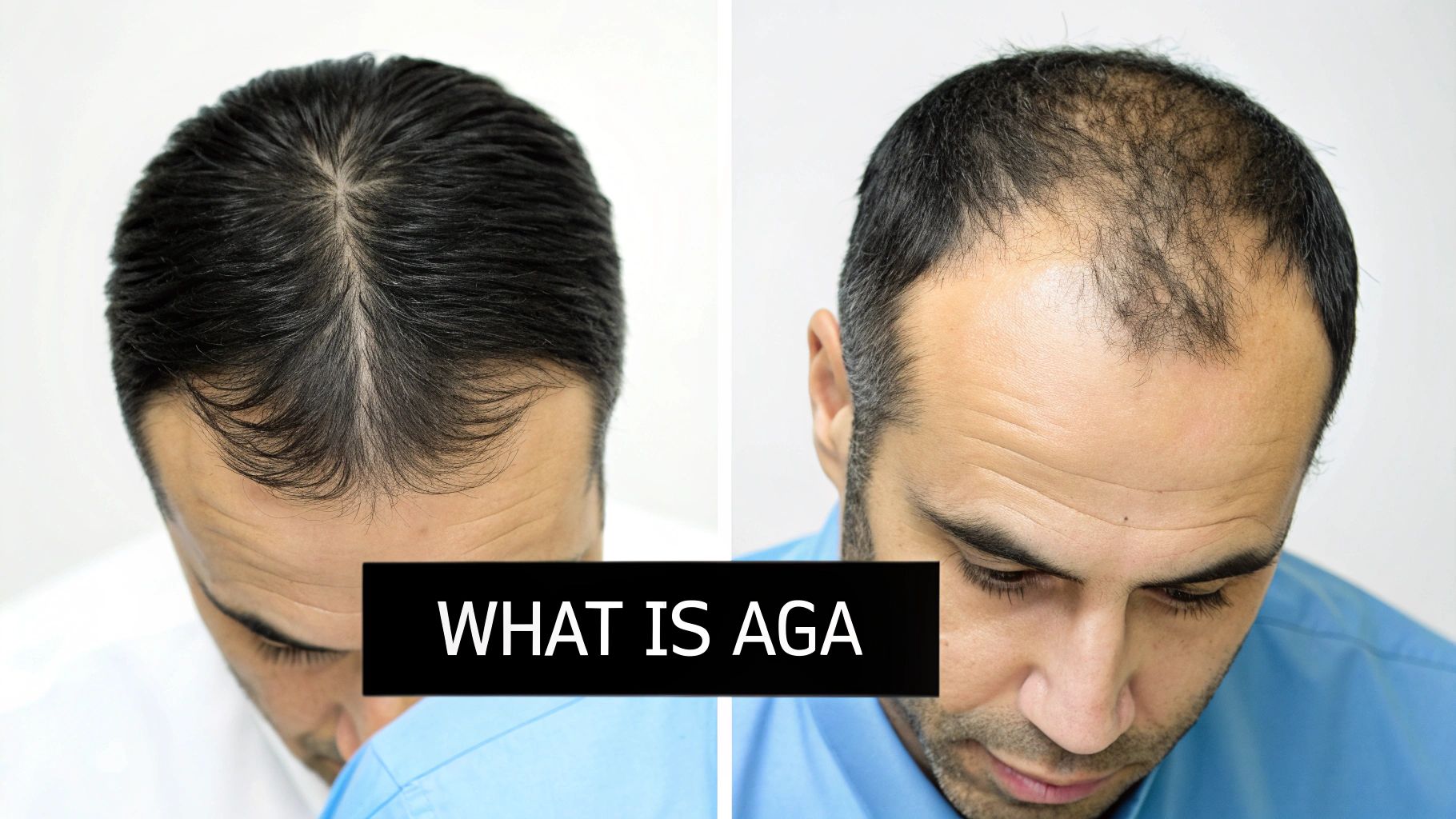
Let's unpack what's really going on. At its core, androgenetic alopecia is a genetic condition where your hair follicles just happen to be extra sensitive to certain hormones.
Imagine each hair follicle as a tiny factory on your scalp, with one job: to produce a single, healthy strand of hair. For people with this condition, specific hormones called androgens start sending signals to these little factories, telling them to shrink over time.
This gradual shrinking process has a name: follicular miniaturization. As the follicles get smaller, the hair they produce changes. It becomes finer, shorter, and often lighter in color, until, eventually, that follicle might just stop producing a visible hair altogether. So, it's not that your hair is suddenly falling out in clumps; it's more like a slow, steady weakening of the production line.
The key thing to remember is that the hair isn't just "falling out." Instead, the follicles are producing weaker and weaker hairs until they can't grow effectively anymore.
This is not a rare issue. Not by a long shot. Androgenetic alopecia affects an estimated 50 million men and 30 million women in the United States alone. It's a very common experience shared by a huge part of the population.
Getting a grip on how this all works is your first big step toward finding a solution that's right for you. If you're ready to get into the nitty-gritty of the language used, our guide on hair loss terminology is a great place to start.
Unpacking the Genetic and Hormonal Triggers
So, what really kicks off this whole process of hair thinning? It all boils down to a powerful combination of your genetics and certain hormones. You can think of it like a specific lock-and-key mechanism playing out right on your scalp.
The main hormone driving this is Dihydrotestosterone (DHT), a potent byproduct of testosterone. For those of us with a genetic tendency for hair loss, our hair follicles have special receptors—the “locks”—that DHT can bind to.
When DHT, the “key,” attaches to these receptors, it sends a signal for the hair follicle to start shrinking. This inherited sensitivity is the real reason some people lose their hair while others with the same hormone levels don't. To really dig into this, you can check out the primary causes of male pattern baldness.
Why the Patterns Look So Different
This very same dance between genes and hormones explains the classic hair loss patterns we’re all familiar with. For men, the follicles that are most sensitive to DHT are usually found along the hairline and at the crown. That's why we see that classic receding hairline and the balding spot on top.
Women, on the other hand, typically experience a more scattered, diffuse thinning across the entire scalp, while their frontal hairline often stays intact. It’s just a different expression of the same underlying issue.
This mix of genetic programming and hormonal activity is what causes androgenetic alopecia. The outcome is miniaturized hair follicles and progressively thinner hair. While it hits both men and women, the visual patterns are quite distinct; for more info, you can find insights on alopecia conditions from Pfizer.
While your genes write the script for hair loss, other factors can sometimes speed up the timeline. Chronic stress, for example, won’t cause pattern baldness on its own, but it can certainly accelerate the process if you’re already predisposed.
At the end of the day, your DNA loads the gun, and your hormones pull the trigger. Understanding this is crucial because it makes it clear that pattern hair loss isn't your fault—it’s just a biological process you've inherited.
Recognizing the Stages of Hair Thinning
Hair loss from androgenetic alopecia doesn't just happen overnight. It's more of a slow burn—a gradual thinning that can be surprisingly easy to miss until it’s pretty obvious. For most folks, the first hint is subtle: a few extra strands on the pillow, a bit more hair in the shower drain, or a brush that seems to fill up faster than it used to.
This is what that progression often looks like, moving from subtle shifts to more noticeable thinning.
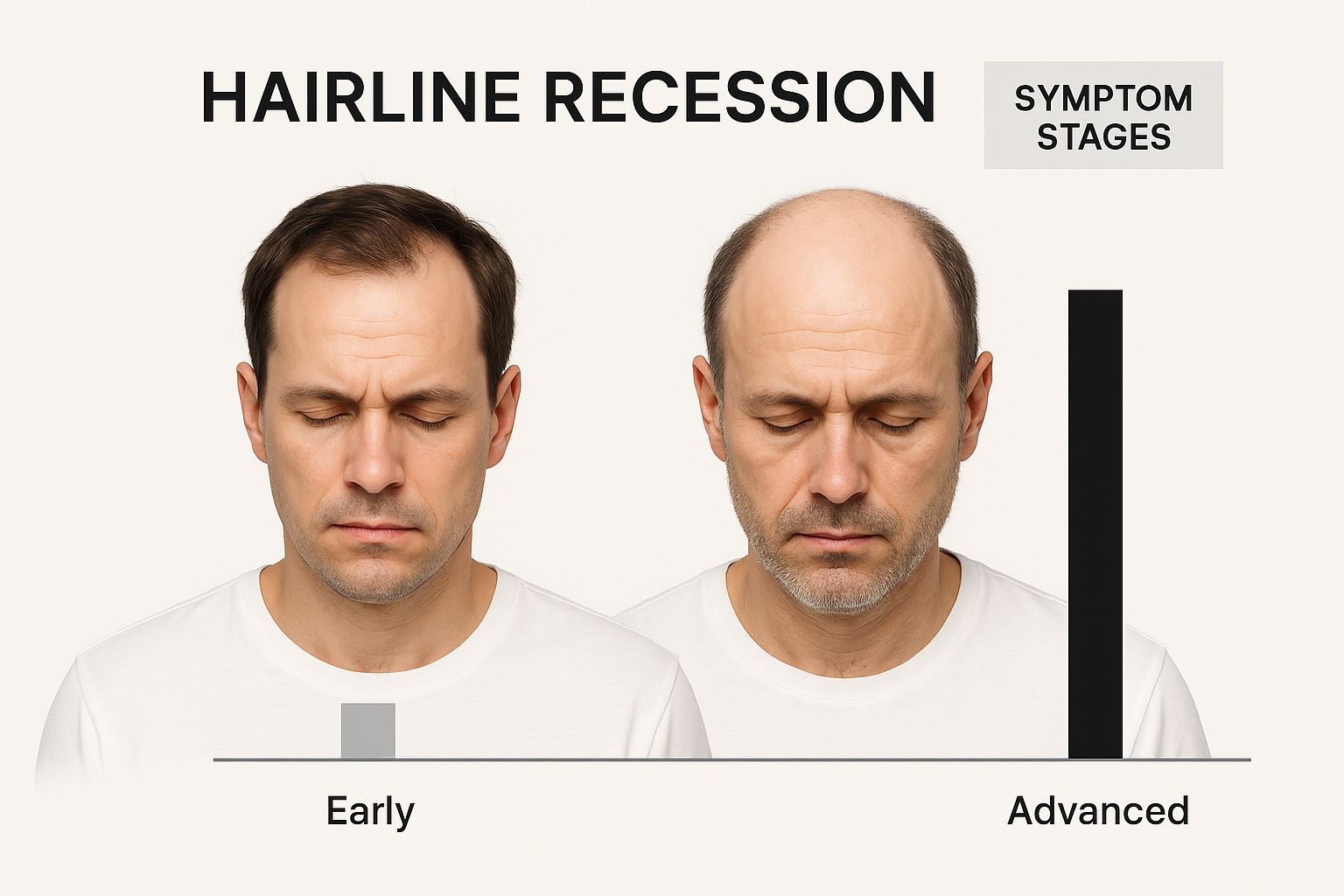
As you can see, what begins as a slight recession at the temples can slowly creep backward, eventually carving out that classic M-shaped hairline. Catching these early visual cues is the first step toward doing something about it.
The Typical Progression in Men and Women
Men and women tend to experience androgenetic alopecia in distinctly different ways. For men, the story almost always starts at the hairline. The temples begin to pull back, creating what’s known as a mature hairline, which then deepens into that signature "M" shape. These are some of the most common early male pattern baldness signs. At the same time, or maybe a bit later, a small bald spot might start to form at the crown.
Women's hair loss, however, usually follows a different script. Instead of a receding hairline, the first clue is often a widening part. The hair loss is more spread out, thinning over the top of the scalp while the front hairline typically stays in place.
To make things clearer, experts use standardized scales to map out these patterns. Here's a simple breakdown of how the progression compares.
Progression of Hair Loss in Men vs. Women
| Stage | Typical Signs in Men (Norwood Scale) | Typical Signs in Women (Ludwig Scale) |
|---|---|---|
| Early | Minor recession at the temples, often creating a slightly higher hairline (Stage 2). | A noticeable widening of the center part, but the front hairline is unaffected (Type I). |
| Mid | The "M" shape becomes more defined, and a bald spot may appear at the crown (Stage 3 Vertex). | The part continues to widen, and thinning becomes more apparent across the top of the scalp (Type II). |
| Advanced | The receding hairline and crown spot merge, leaving only a horseshoe-shaped ring of hair (Stage 5+). | Significant thinning on top reveals large areas of the scalp, though a thin frontal hairline remains (Type III). |
Understanding these different roadmaps is really important. The slow, creeping nature of this condition means you have a window of opportunity to step in. The sooner you spot the signs, the more options you'll have to manage it effectively.
What to Expect from a Professional Diagnosis
So you've done some research on your own, but now you need a definite answer. Getting a professional diagnosis is actually a pretty straightforward process, and it all begins with a visit to a dermatologist or a specialist in hair loss.
These experts have seen it all. They can often identify the classic signs of androgenetic alopecia just by looking at your scalp and recognizing the typical thinning patterns.
But they won't stop there. The next step is usually a much closer look using a dermatoscope. You can think of it as a high-powered magnifying glass for your scalp. This simple tool lets them spot a key sign of pattern hair loss: miniaturization, where some hair follicles are shrinking and producing finer, weaker strands right next to thicker, healthier ones.
Simple Diagnostic Tests
Beyond just a visual check, your doctor has a few quick in-office tests to get a clearer picture of what's happening.
- The Hair Pull Test: This might sound a bit intense, but it's really just a gentle tug on a small bunch of about 40-60 hairs. If more than a few hairs come loose, it could point to a different type of shedding issue that needs a closer look.
- Blood Work: It’s also very common for a doctor to order a blood test. This isn’t to diagnose the pattern baldness itself, but to play detective and rule out other common culprits.
By checking your thyroid function, iron levels, and other key vitamin markers, a doctor can confirm that an underlying medical issue isn't causing or contributing to your hair loss.
Ultimately, getting a professional diagnosis takes all the guesswork out of the equation. It gives you clarity, confirming whether you're dealing with androgenetic alopecia or something else, and gets you on the right track with a treatment plan that can actually help.
Exploring Modern and Effective Treatment Paths
Getting a diagnosis is step one. The next, and much more hopeful step, is figuring out what to do about it. The great news is that there's a solid playbook for managing androgenetic alopecia, with scientifically-proven treatments that can slow things down, stop the loss, or even encourage new growth.
Most of these solutions fall into two main camps: established, FDA-approved medications that have been the standard for years, and newer, advanced therapies that are really gaining momentum.
Established Medical Treatments
When it comes to the medical route, two names pop up time and time again, and for good reason—they work. They just tackle the problem from completely different angles.
- Minoxidil (Rogaine): You've probably seen this one on store shelves. It's a topical treatment, either a foam or a liquid, that you apply right where you need it. Think of Minoxidil as a direct stimulant for your hair follicles. It helps kickstart blood flow to the area, delivering a fresh supply of oxygen and nutrients that can reawaken dormant follicles and strengthen the ones that have started to shrink.
- Finasteride (Propecia): This one is a daily pill, which means it works from the inside out. Finasteride gets right to the hormonal cause of the issue by blocking the enzyme that turns testosterone into DHT—that follicle-damaging hormone. By lowering the DHT levels in your scalp, it acts like a shield, protecting your hair from more thinning.
Many guys find that the real magic happens when they combine both treatments. It’s a powerful one-two punch: Finasteride defends the fort by stopping more damage, while Minoxidil goes on the offense to help regrow what’s been lost.
Non-Surgical and Advanced Therapies
Beyond the daily medications, a whole new world of advanced therapies has opened up. These treatments often work by tapping into your body's own natural healing powers or using targeted energy to get the job done.
One of the most exciting options right now is Platelet-Rich Plasma (PRP) therapy. This is a non-surgical procedure where a small amount of your own blood is drawn, spun in a centrifuge to concentrate the platelets, and then injected back into your scalp. These platelets are packed with natural growth factors. It’s like applying a super-concentrated fertilizer directly to your hair roots, encouraging cell repair and stimulating thicker, stronger hair. You can learn more about platelet-rich plasma therapy for hair to see how it all works.
Other paths include Low-Level Laser Therapy (LLLT), using devices like caps or combs to bathe the scalp in red light, which stimulates energy production within the follicles. And of course, there's the surgical option of hair transplants, which involves physically moving healthy, DHT-resistant follicles from the back and sides of your head to the thinning spots on top. The best route for you really depends on where you are in your hair loss journey and what your goals are.
A Closer Look at PRP Therapy for Hair Regrowth
When you start looking into modern solutions for hair loss, Platelet-Rich Plasma (PRP) therapy is a name that comes up a lot. It’s one of the most talked-about options for androgenetic alopecia, and for a good reason: it uses your body's own healing ability to give tired hair follicles a serious boost.
The whole procedure is quite simple and starts with something we're all familiar with—a routine blood draw.
Next, that blood sample goes into a special machine called a centrifuge. This high-speed spinning process neatly separates the blood into its different components, isolating the platelets and plasma. What you're left with is a concentrated, golden liquid full of growth factors—that's the Platelet-Rich Plasma.
How PRP Wakes Up Hair Follicles
You can think of this concentrated PRP as a potent, all-natural fertilizer for your scalp. It's carefully injected directly into the areas where your hair is thinning.
Once it's in place, the growth factors in the PRP get to work right away. They send out signals that can:
- Reawaken dormant hair follicles that have stopped producing hair.
- Improve blood flow, bringing more vital nutrients to active follicles.
- Encourage the growth of thicker, stronger, and healthier hair strands.
This isn't just a surface-level treatment; it gets to the problem at the root by improving the health of the entire scalp environment. For a deeper look, you can learn more about how PRP for androgenetic alopecia gets to the core of the issue.
The real beauty of PRP is that it's an "autologous" treatment. That's just a technical way of saying it uses materials from your own body, which dramatically lowers the risk of allergic reactions or other side effects.
So, who is a good candidate for PRP? It’s often someone in the earlier stages of hair loss who still has a good number of hair follicles, even if they've started to shrink. A typical treatment plan starts with a few sessions, each about a month apart. After that, you'll usually need a maintenance session every six to twelve months to keep the results going strong.
While everyone's timeline is a little different, many people start to see a real difference in hair thickness and fullness within three to six months.
Your Questions About Androgenetic Alopecia, Answered
Let's tackle some of the most common questions people have about androgenetic alopecia. Getting straight answers is the best way to cut through the confusion and decide on your next steps.
Is There a Permanent Cure for Androgenetic Alopecia?
As of right now, there isn't a permanent "cure" for androgenetic alopecia, mainly because it's wired into your genetics. But don't let that discourage you—today's treatments are incredibly effective at managing it for the long run.
Think of it less like curing a cold and more like ongoing maintenance. Sticking with proven treatments like Minoxidil, Finasteride, or PRP therapy can significantly slow down hair loss, spark new growth, and help you hold onto the hair you have for years to come.
Do Natural Shampoos or Supplements Actually Work?
You’ll find tons of products on the market promising to stop hair loss, but their impact on true androgenetic alopecia is often minimal. While ingredients like biotin and saw palmetto can be good for your overall hair health, they don’t address the root cause—the genetic and hormonal drivers of this specific condition.
It’s best to see these products as part of a supporting cast. They can complement a healthy hair routine, but they aren't the main actors when it comes to a professionally guided treatment plan.
Can Wearing a Hat Make My Hair Loss Worse?
This is a classic myth, so let's clear it up once and for all. Wearing a hat, even every single day, does not cause or accelerate androgenetic alopecia.
This type of hair loss is triggered by internal factors—your genes and hormones—not by what you put on your head.
Unless your hat is so painfully tight that it's physically pulling your hair out (which is a different issue called traction alopecia), you've got nothing to worry about. Go ahead and wear it; it’s harmless and even provides great sun protection for your scalp.
Figuring out how to handle hair loss can feel overwhelming, but understanding what you're up against is the first real step toward taking back control. The team at PRP For HairLoss is here to provide clear, trustworthy information to guide you. If you want to learn more about advanced options like PRP therapy, we invite you to explore our resources.


Leave a comment