Let's be honest, the first question on just about everyone's mind when they start looking into hair restoration is: "So, what's this actually going to cost me?" It's a perfectly fair question, but the answer isn't a simple, one-size-fits-all number. Think of it more like a spectrum. You could be looking at anywhere from $1,500 for non-surgical treatments like PRP, all the way up to $15,000 or more for a full-scale hair transplant.
The final price tag really boils down to a few key things: the specific treatment you go with, how much hair you've lost, and believe it or not, even where you live.
Your Quick Guide to Hair Restoration Costs
When you first start exploring ways to tackle hair loss, trying to navigate the costs can feel a little overwhelming. It’s a real investment in yourself and your confidence, so getting a clear picture of the financial side of things right from the get-go is super important.
The price range is so wide because "hair restoration" isn't just one procedure. It's an entire category of treatments, from therapies designed to wake up dormant hair follicles to surgical procedures that physically move healthy hair to thinning areas. Each path has its own cost structure, which we'll unpack right here. To get a better handle on all the different procedures out there, it's worth taking a look at our complete guide to hair restoration treatment options.
At-a-Glance Look at Hair Restoration Prices
To give you a clearer idea of what you might expect, let's break down the typical price ranges for the most popular solutions for men. The table below offers a quick comparison to help you understand where different treatments land on the cost spectrum.
| Treatment Type | Average Cost Per Session | Typical Total Cost (Full Treatment) | Best For |
|---|---|---|---|
| PRP Therapy | $500 – $1,500 | $1,500 – $4,500 (initial series) | Men with thinning hair or early-stage hair loss looking for a non-surgical option. |
| FUT Hair Transplant | N/A (Priced per graft) | $6,000 – $12,000 | Men needing a large number of grafts who are okay with a linear scar. |
| FUE Hair Transplant | N/A (Priced per graft) | $8,000 – $20,000+ | Men wanting a minimally invasive surgical option with no linear scar. |
These numbers are a solid ballpark for what you might see in the United States, but always remember that a clinic's reputation and its location can definitely move the needle on price.
One of the biggest wild cards that affects your final bill is geography. It's a complete game-changer.
The average full hair transplant in the USA costs around $13,610. In a medical tourism destination like Turkey, you could find the same procedure for as little as $2,675, often with fantastic results.
That's a massive difference. When you break it down, the average cost per graft in the U.S. is $5.44, while in Turkey, it's just $1.07. This means patients willing to travel could see savings of up to 80%. This is just one of many strategies for reducing healthcare costs that people are using today. This global market gives you more options and control over your hair restoration journey than ever before.
Breaking Down the Cost of PRP Therapy
If you're starting to look into non-surgical ways to tackle hair loss, Platelet-Rich Plasma (PRP) therapy has probably popped up on your radar. It’s a go-to for many men because it uses your body's own healing power to wake up dormant hair follicles. But the big question on everyone's mind is: what’s this actually going to set me back?
The answer isn't a single, straightforward number. A single session of PRP therapy can run you anywhere from $500 to $1,500. That's a pretty wide gap, and it's not arbitrary. The price you're quoted is tied directly to a few key factors that are worth understanding before you commit to anything.
What Drives the Price of a PRP Session?
Think of it this way: the price of a PRP session reflects the quality, location, and technology you're getting. Not all treatments are created equal, and the cost usually tells you why.
- Geographic Location: It’s simple economics. A clinic in downtown Manhattan has way higher rent and operating costs than one in a smaller suburban town. That difference will absolutely show up in the price tag.
- Practitioner's Expertise: You're paying for skill. A board-certified dermatologist specializing in hair restoration has a level of training and experience that a general practitioner just doesn't. That expertise comes at a premium, but it can also mean better, safer results.
- Technology and Equipment: The gear really matters. Top-tier clinics invest in advanced centrifuges that can isolate a higher, purer concentration of platelets from your blood. This can lead to a more effective treatment, but the equipment itself is expensive, which bumps up the per-session cost.
A lower price isn't automatically a bad thing, but you should always ask what's behind it. You want to make sure you’re not sacrificing quality or safety just to get a bargain.
Beyond a Single Session: The Full Treatment Plan
Just looking at the cost of one PRP session is like pricing out a single brick instead of the whole wall. To get the kind of results you're hoping for, PRP requires a consistent, structured plan. This is definitely not a one-and-done kind of fix.
Most clinics follow a proven protocol that involves an initial "loading phase" to kickstart hair growth, followed by regular maintenance to keep it going.
A typical plan starts with an initial series of 3 to 4 treatments, usually spaced four to six weeks apart. After that, you’ll need to come back for maintenance sessions every 4 to 6 months to sustain the new growth.
This schedule is crucial for stimulating follicles and keeping them healthy long-term. So, when you're budgeting, you have to think about the entire journey, not just that first appointment.
Package Deals vs. Pay-As-You-Go Pricing
Because PRP is a commitment, most clinics offer pricing that reflects that. You'll generally see two main options: paying for each session as you go or buying a package upfront.
Pay-As-You-Go:
- You pay for one session at a time, which is great for flexibility.
- It's a solid option if you're not quite ready to commit to a full plan just yet.
- However, it almost always ends up costing you more in the long run.
Package Deals:
- You prepay for the initial series of treatments, like a bundle of three or four sessions.
- Clinics usually offer a nice discount for this, often 10-20% off the individual session price.
- It encourages you to stick with the full protocol, which is what actually gets you the results.
For most guys who are serious about seeing a change, a package deal is the smarter financial move. It locks you into the plan that has the best shot at success and can easily save you hundreds of dollars. For a more detailed look at the numbers, our complete guide on the PRP cost for hair breaks it down even further. Always make sure to ask any clinic you're considering for both their per-session and package pricing so you can make a fully informed decision.
Understanding Hair Transplant Pricing: FUE vs. FUT
When you start seriously exploring hair transplants, you’ll notice the conversation shifts away from session-based pricing to something new: the cost per graft. This is the core metric for calculating the total price of the two main surgical methods, Follicular Unit Extraction (FUE) and Follicular Unit Transplantation (FUT).
So, what exactly is a graft? It's not just a single hair. Think of it more like a tiny, natural cluster of hairs. On your scalp, hairs grow in small groupings of 1 to 4 follicles, and surgeons transplant these entire units—not individual strands. They harvest these "grafts" from a dense area, usually the back of your head, and meticulously place them where your hair is thinning.
The final bill for your procedure comes down to a simple formula: the price per graft multiplied by the total number of grafts you need. A guy with some minor thinning at the temples might only need 1,500 grafts. But for someone dealing with significant hair loss across the crown, that number could easily jump to 3,000 grafts or more. This is why a one-on-one consultation is absolutely non-negotiable; it's the only way to get a real graft count and an accurate quote.
The Global Price Tag Per Graft
Location is, without a doubt, the biggest factor influencing the cost per graft. And the price differences aren't minor—they're huge. A clinic in Beverly Hills has a completely different set of operating costs than one in Istanbul, and that reality is passed directly on to you, the patient.
The price tag on a single graft is what really separates the market. While the global average hovers around $2.98, that number doesn't tell the whole story. In the US, you can expect to pay an average of $6 per graft, with a wide range from $3 to $12.50. For a standard procedure, this can push the total cost into the $15,000 to $30,000 range.
Travel abroad, however, and the picture changes dramatically.
Global Hair Transplant Cost Per Graft Comparison
The decision to travel for a hair transplant, often called "medical tourism," has become a popular way to access high-quality care at a fraction of the domestic cost. Countries like Turkey and Mexico have built entire industries around offering all-inclusive packages that are far more affordable than what you'd find in the US, UK, or Australia. Here's a look at how the numbers stack up.
| Country | Average Cost Per Graft (USD) | Estimated Cost for 2,500 Grafts (USD) | Key Considerations |
|---|---|---|---|
| USA | $3.00 – $12.50 | $15,000 – $30,000+ | High-quality standards, but highest cost. |
| UK | $3.25 – $6.50 | $8,000 – $16,000 | Experienced surgeons, but still a premium price. |
| Australia | $4.00 – $11.00 | $10,000 – $27,500 | Similar quality and cost structure to the US. |
| Mexico | $1.25 – $3.00 | $3,000 – $7,500 | Popular near-shore option with competitive pricing. |
| Turkey | $1.00 – $2.50 | $2,500 – $6,000 | Global hub for hair transplants, often includes packages. |
| India | $0.80 – $1.50 | $2,000 – $3,750 | Among the most affordable options globally. |
Ultimately, choosing where to have your procedure can mean the difference between paying the price of a small car and the price of a budget-friendly vacation. It's a powerful illustration of just how much geography can impact your final hair restoration cost.
Real-World Scenarios: FUE vs. FUT Costs
Let's put this into practice with a couple of real-world examples. Imagine two men, both needing a transplant but with different degrees of hair loss. We'll use average US pricing to see how it all plays out.
-
Scenario 1: Moderate Hairline Recession
- Grafts Needed: 1,500
- Average FUE Cost: At $8 per graft, the total is $12,000.
- Average FUT Cost: At $6 per graft, the total is $9,000.
-
Scenario 2: Significant Thinning at Crown and Hairline
- Grafts Needed: 2,500
- Average FUE Cost: At $8 per graft, the total is $20,000.
- Average FUT Cost: At $6 per graft, the total is $15,000.
You'll notice that FUE is consistently more expensive per graft than FUT. That’s because FUE is a painstaking process where each follicular unit is removed one by one. FUT, which involves removing a small strip of scalp from the donor area, is simply a faster and less labor-intensive surgery.
This price difference is a huge part of the decision. Many guys end up weighing the higher cost of FUE against its major benefit: no long, linear scar. Asking yourself if that trade-off is worth the extra investment is a critical step, and you can dive deeper into that question by reading our article about whether a hair transplant is worth it.
The chart below shows the typical costs for PRP therapy, a treatment often paired with transplants to help grafts heal and thrive post-surgery.
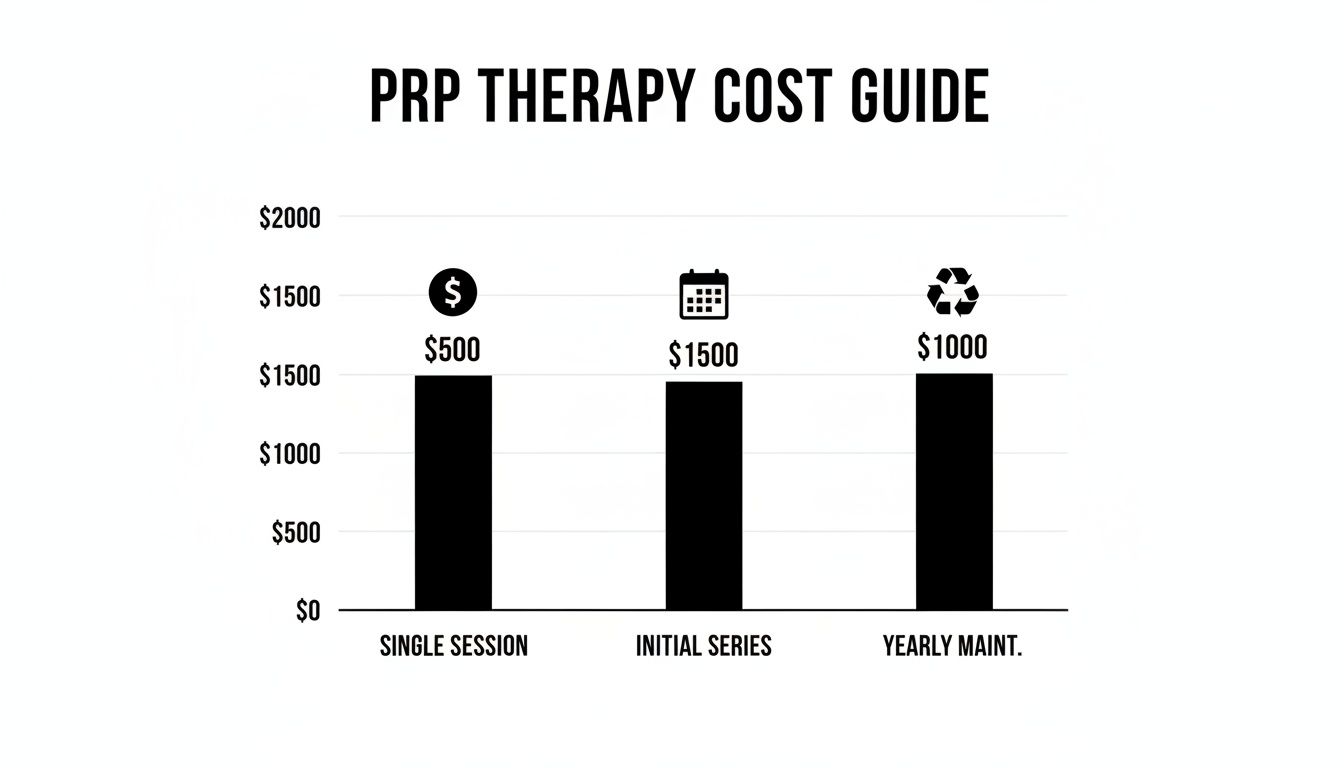
As you can see, a successful hair restoration journey isn't just a one-time payment. It's an ongoing investment with different financial stages to plan for.
What Really Drives the Final Price Tag?
That advertised price for a hair restoration procedure? It's best to think of that as a starting point. Like buying a car, the number on the sticker is rarely what you drive off the lot for. A handful of key factors can swing that final cost up or down, and knowing what they are ahead of time will save you from any budget-busting surprises.
The single biggest variable is almost always the person holding the tools. A surgeon with a decade of experience and a whole gallery of amazing results is going to charge more than a doctor who is relatively new to the game. You're not just paying for a few hours of their time; you're investing in their skill, their artistic eye, and the confidence that comes from a long track record of success.
The Surgeon and Technology Premiums
Let's be blunt: the experience of your surgeon is the most critical factor in what you'll pay. The best specialists often have a waiting list, and for good reason. Their ability to craft a natural-looking hairline and make sure the maximum number of grafts survive is what separates a good result from a great one.
Beyond the surgeon's hands, the technology they use also plays a huge part in the pricing.
- Robotic vs. Manual FUE: Clinics that have shelled out for robotic FUE systems like ARTAS will typically have a higher per-graft cost. The robot offers incredible precision, but that technology comes with a hefty price tag for the clinic, which gets passed on to you.
- Specialized Tools: The quality of the instruments themselves, from the punches that extract the grafts to the tools that place them, also matters. High-end equipment often means better outcomes and faster healing, but it adds to the bottom line.
Your Specific Hair Loss Situation
Your own head of hair—or what's left of it—is the next major cost driver. No two cases are exactly alike, so every procedure has to be customized. The further along you are on the Norwood scale, the more grafts you'll need to get the kind of density you're after. More grafts, of course, mean a higher total cost.
If you're not familiar with how hair loss is measured, our guide to the Norwood scale for hair loss breaks it all down.
Don't forget the condition of your donor area—that's the hair on the back and sides of your head. If that hair is fine or not very dense, the surgeon has to work much more carefully to harvest enough healthy grafts without thinning it out too much. That extra time and delicate work can add to the cost.
Location, Location, Location
It might sound strange, but where the clinic is located can have a massive impact on your final bill. A clinic in a major city with high rent and operating costs is going to be more expensive than one in a smaller town. This price difference gets even more extreme when you start looking at different countries.
So, why is a transplant in Turkey so much cheaper than one in the U.S. or the U.K.? It all comes down to economics. Western countries have high costs of living, expensive malpractice insurance, and mountains of regulations. Meanwhile, medical tourism hotbeds like Turkey and India have created incredibly efficient systems, performing over 500,000 transplants a year. That sheer volume creates an economy of scale that can slash their operational costs by 30-40%, letting them offer top-tier work for a fraction of the price. You can see more of these global transplant statistics on forhair.com.
Finally, you have to account for the little things that often get overlooked. They can add up quickly, so be sure to factor them into your budget from day one:
- Consultation Fees: Some top surgeons charge for the initial meeting, though they sometimes credit this fee toward your procedure if you decide to book with them.
- Post-Op Medications: You'll need to buy things like pain relievers, antibiotics, and special shampoos for aftercare.
- Follow-Up Visits: Always ask if your post-op check-ins are included in the price or if they're an extra charge.
Navigating Payment Options and Insurance
Figuring out the cost of hair restoration is one thing, but understanding how to actually pay for it is the next crucial step. Making this kind of investment in yourself means you really need a solid financial game plan.
Let’s tackle the most common question right away: will insurance cover any of it? The short answer is almost always no. Hair restoration treatments, from PRP therapy to FUE transplants, are pretty much universally considered elective cosmetic procedures. Insurance companies see them as treatments to enhance your appearance, not as a medical necessity.
Why Insurance Typically Says No
Insurance is built to cover treatments for illnesses and injuries. Because male pattern baldness doesn't threaten your physical health, it simply doesn't fall under what insurance plans are designed to pay for. This means you should plan on covering the cost out-of-pocket.
It can be frustrating, for sure, but this is standard across the entire industry. The good news? Clinics know this and have created different ways to make the treatments more affordable and manageable.
Even without insurance, you've got options. Don't let the initial sticker shock scare you off. Many men find a way to budget for their treatment using one of the strategies below. For a deeper dive into this topic, you can check out our guide on whether insurance covers hair loss treatment.
Exploring Your Financing and Payment Solutions
Once you’ve got your head around funding the procedure yourself, you can start looking at the tools that make it possible. Most good clinics are more than ready to walk you through this part of the journey.
Here are the most common ways people handle the cost:
- In-House Payment Plans: Some clinics offer their own financing, which lets you break up the total cost into smaller monthly payments. It never hurts to ask about this during your consultation.
- Third-Party Financing: This is a very popular route. Clinics often partner with healthcare financing companies like CareCredit. Think of it as a credit card specifically for health and wellness procedures, many of which come with low-interest or even no-interest promotional periods.
- Personal Loans: Getting a personal loan from your bank or a credit union is another solid option. You get the cash upfront to pay the clinic, then simply make regular payments back to the lender.
- Savings or HSA/FSA: Dipping into your savings is the most straightforward way to pay, as you won't have to worry about interest. You might also be able to use money from a Health Savings Account (HSA) or Flexible Spending Account (FSA), but double-check with your plan administrator first—rules around cosmetic procedures can be tricky.
To help men move forward, many practices provide flexible options; you can explore available payment plans to get an idea of how they're structured. The goal is to find a path that fits your budget so you can make your decision with confidence.
Making the Right Choice for Your Hair and Budget
So, you've seen the numbers and weighed the options. Now comes the hard part: figuring out what makes sense for you. It’s easy to get bogged down in price lists, but the best decision isn’t just about finding the cheapest deal. It's about balancing the cost with the real-world value you’ll get, what you hope to achieve, and the kind of confidence you're looking to get back.
Ultimately, the choice often boils down to this: do you prefer ongoing maintenance or a one-and-done surgical fix?
If you're just starting to see some thinning, a non-surgical treatment like PRP might be a great starting point. The upfront cost is lower, and it fits a more proactive, "let's stay ahead of this" kind of mindset. Think of it like a gym membership for your hair—you put in consistent effort and see gradual, but solid, results.
On the flip side, a hair transplant is more like a major home renovation. It’s a bigger investment from the get-go, but the change is permanent and pretty dramatic. This is often the better route for guys with more significant hair loss who want a definitive solution without regular trips back to the clinic.
Long-Term Value vs. Short-Term Price
When you're looking at quotes, that initial price tag can be tough to ignore. But the real value of any hair loss treatment isn't what you pay on day one—it's how you feel about it years down the line.
A cheaper transplant might sound great right now, but what happens if a good chunk of the grafts don't take? You could find yourself paying for a second procedure just to fix the first one. This is a classic case where paying more for a top-tier surgeon is actually the smarter financial move in the long run, because you get it right the first time. It’s about looking past the price and focusing on the skill and track record of the clinic.
Choosing a hair restoration path is an investment in your future self. The goal isn't just to find the cheapest price, but to find the solution that delivers the most confidence and satisfaction for years to come.
This long-term perspective is a big reason why medical tourism has absolutely exploded in popularity. Why? Because a man could get a full head of hair for $3,000 in a place like Turkey, while the same procedure might run him $30,000 at home. This has led to a boom in "haircations"—trips where guys get fixed-price packages abroad, avoiding the per-graft pricing surprises that are common in the U.S. As you can learn more about these hair transplant statistics, this trend is putting quality results within reach for more people than ever before.
Questions to Ask During Your Consultation
Your consultation is your chance to get all the facts and make sure there are no surprise fees later on. A good clinic will be totally transparent and happy to answer everything. Don't walk out of that room until you have solid answers to these questions:
- What, specifically, does this quote cover? (Surgeon's fee, anesthesia, clinic costs?)
- Are there any other costs I should expect, like for blood tests, meds, or aftercare supplies?
- How many follow-up appointments are included, and for how long after the procedure?
- What’s the plan if the results aren’t what we discussed? Are touch-ups included or do they cost extra?
Getting these answers down in writing is key. It protects you and lets you build a budget you can actually trust, so you can move forward feeling good about both the procedure and the price.
Common Questions About Hair Restoration Costs
When you start digging into the cost of hair restoration, a bunch of specific questions always seem to pop up. It's a big decision, and getting clear, direct answers is the only way to feel good about moving forward. Let's tackle some of the most common things men ask when they're trying to sort out their budget.
Are Cheaper Hair Transplants Overseas Actually Safe?
This is one of the first questions on everyone's mind, and for good reason. The short answer is yes, it's absolutely possible to get a fantastic, safe result abroad for a fraction of the price. Many clinics overseas, especially in popular spots like Turkey, have world-class standards, highly experienced surgeons, and all the latest tech.
The real issue isn't the country—it's the specific clinic. Thorough research is non-negotiable. You have to dive deep into real patient reviews, meticulously study their before-and-after photos, and confirm the surgeon's qualifications. While the lower cost is a huge plus, never let it overshadow quality and safety.
Will I Need More Than One Hair Transplant?
For many guys, one well-planned and skillfully executed transplant is all it takes to achieve a look they’ll be happy with for years. The whole point is to create a natural result that holds up and ages right along with you.
That said, male pattern baldness doesn't just stop. It can keep progressing over the years, meaning you might notice thinning in areas that weren't touched during your first procedure. If that happens, a second, smaller transplant to build up density or fill in new spots is a pretty common approach. A good surgeon will be upfront about this long-term possibility from day one.
What’s Included in a Hair Transplant Price Quote?
A transparent price quote should be an all-inclusive figure that covers the entire procedure from start to finish. You should expect it to cover:
- The surgeon’s fee for their expertise and time.
- The cost of the surgical facility and support staff.
- Anesthesia and all necessary medical supplies.
- The procedure itself, based on the number of grafts you agreed on.
Always ask for a detailed, itemized breakdown in writing. This is how you avoid any surprise fees later on. Get confirmation on whether the quote includes pre-op lab work, post-op medications (like antibiotics or pain relief), and all of your follow-up visits.
As more men seek out solutions, the demand for clear pricing has skyrocketed. The global hair transplant market was valued at an impressive $6.3 billion in 2023 and is projected to hit a massive $42.5 billion by 2033. This boom shows just how many men are investing in themselves, and it makes cost transparency more important than ever. As you can find out when you explore more insights about this growing market on hayatmed.com, patients rightfully expect to know exactly what they're paying for.
At PRP For HairLoss, we're committed to giving you the clear, honest information you need to make the right choice for your hair and your confidence. We cut through the noise to explain treatments, costs, and realistic results. Explore our resources and get the clarity you need at https://prpforhairloss.com.
 PRP For Hairloss
Leave a comment