It's a frustrating moment for any guy: looking in the mirror and realizing your hair is thinning. Millions of men go through it, but that doesn't make seeing a receding hairline any less of a gut punch. The good news is that science is finally catching up, and peptides for hair growth are getting a lot of attention as a serious strategy in this fight.
The Modern Approach to Reclaiming Your Hair

Let's get one thing straight: peptides aren't some miracle potion that will give you a full head of hair overnight. Think of them more like highly specific couriers delivering critical instructions directly to your hair follicles on a cellular level. They work by improving the very environment where your hair is struggling to grow.
If you're tired of feeling helpless against hair loss and are looking for a more sophisticated approach, this guide is for you. We'll dive into how these molecular tools can be a game-changer in your plan to get back thicker, healthier hair.
Why Peptides Are Gaining Momentum
At its core, male pattern baldness is often a problem of dormant follicles and an unhealthy scalp. While traditional treatments certainly have their merits, peptides step in with a different kind of support. Their mission is to:
- Wake Up Dormant Follicles: They signal follicles to shift out of the resting (telogen) phase and back into the active growth (anagen) phase.
- Improve Scalp Health: Peptides can help calm the low-level inflammation that often suffocates follicles and speeds up thinning.
- Support Hair Production: They supply the amino acid building blocks your body needs to create strong keratin—the very protein that makes up your hair.
This direct, targeted action is what makes peptides different from more generalized treatments. It's all about creating the optimal conditions for your hair to grow, right where it counts.
Of course, understanding what's causing the problem is key, and for most guys, it's a mix of genetics and hormones. You can get the full story in our guide explaining https://prpforhairloss.com/what-causes-hair-loss.
By working at a foundational level, peptides aim to restore the biological processes that support a full head of hair, rather than just treating the symptoms.
A New Tool in Your Toolkit
The field of hair restoration is moving fast. Treatments like PRP (Platelet-Rich Plasma) have made a huge impact, but peptides offer a strategy that can complement them or stand on its own. It's a sign of a broader trend, too, as professional peptide therapy services become more common for overall wellness.
Our goal is to give you a clear, no-nonsense look at how peptides for hair growth actually work, what the evidence shows, and how you can put them to use effectively.
How Peptides Actually Work to Fight Hair Loss
So, what exactly are these peptides everyone’s talking about? Let's skip the dense scientific jargon. Think of them as tiny, highly skilled messengers that carry specific instructions directly to your hair follicles. Their job is to wake up dormant follicles and get your scalp back in prime condition for growing hair.
At their core, peptides are just short chains of amino acids. You can think of amino acids as the essential building blocks for proteins, and the most critical protein for your hair is keratin. Without a steady supply of these building blocks, your body simply can't produce strong, healthy hair.
When you apply peptides to your scalp, they get to work on a cellular level. Their mission is to interrupt the signals that lead to thinning hair and kickstart the ones that lead to growth.
The Three Pillars of Peptide Action
Peptides don't just do one thing. They launch a coordinated, three-pronged attack to restore your hair's vitality. It's a bit like renovating a house: you have to clear out the junk, fix the foundation, and then turn the power back on.
These molecular powerhouses work by:
- Stimulating Follicles: Peptides send signals that nudge hair follicles out of their resting (telogen) phase and back into the active growth (anagen) phase. This is the single most important step in reversing the thinning process.
- Reducing Inflammation: Chronic, low-grade inflammation is a silent killer for hair follicles, slowly choking them out and causing them to shrink—a process called "miniaturization." Certain peptides have potent anti-inflammatory properties that calm this irritation, giving your follicles a chance to breathe and recover.
- Boosting Blood Flow: Your hair follicles are hungry. They need a constant supply of oxygen and nutrients to thrive. Peptides help improve microcirculation in the scalp, ensuring these vital resources get delivered right where they're needed most.
By tackling these core issues, peptides help create a much healthier, more robust environment for hair to grow. For a deeper dive into how this all works, check out our guide on the complete hair growth cycle.
Peptides act like a biological reset button for your scalp. They don't just mask the problem—they provide the specific signals needed to get your follicles back into the business of growing hair.
Unlocking Your Follicles' Potential
Here’s another way to look at it. Picture your hair follicle as a tiny factory. Over time, thanks to things like DHT and inflammation, this factory starts slowing down production and eventually shuts down parts of its assembly line.
Peptides are like a specialized maintenance crew arriving on-site. They don't just show up with raw materials (amino acids); they carry blueprints and instructions that tell the factory workers (your cells) exactly what to do. They tell them to fire up the production line, clear out the waste, and strengthen the factory walls.
This targeted approach is what makes peptides so interesting. They address the biological signaling that has gone haywire, essentially coaxing the follicle back to its prime.
This is especially promising for men dealing with pattern baldness. For example, peptide-based treatments like Alma TED are showing some serious potential for boosting growth in the exact areas guys tend to lose hair first. One study on a similar treatment showed an average 58% increase in total hair density across the frontal, crown, and vertex areas. These peptides work by penetrating the scalp to stimulate the follicles and promote thicker, healthier strands. To see the full scope of these findings, you can review the study data on hair density improvements.
The Key Peptides You Need to Know for Hair Regrowth
When you first dive into the world of peptides for hair growth, it can feel a little overwhelming. You're hit with a barrage of acronyms and scientific names, and it's tough to know which ones actually get the job done. Not all peptides are created equal when it comes to hair, but a few stand out as genuine powerhouses for reviving follicles and creating a healthy scalp.
Think of it like building a team for a specific mission. You need different specialists for different tasks. The same logic applies here; you want the right peptides for the job of regrowing your hair. Let's break down the key players you'll keep seeing and what each one actually does.
The Scalp Janitor: Copper Peptides (GHK-Cu)
If one peptide has become a household name in hair and skin health, it’s GHK-Cu, better known as a copper peptide. This isn't some new fad; it's a compound that our bodies produce naturally. The catch? Our levels of GHK-Cu drop as we age. Its main job is to act as the scalp's dedicated repair crew.
Imagine your scalp is a garden. Years of environmental stress and hormonal shifts can leave behind "debris" like inflammation, which clogs up the soil and stops new growth. GHK-Cu steps in to do two critical things:
- It cleans house: Copper peptides have powerful anti-inflammatory properties that calm the irritation choking your hair follicles.
- It rebuilds the foundation: GHK-Cu is also known to ramp up the production of collagen and elastin, the proteins that give your scalp the strong, supple structure follicles need to anchor themselves securely.
By creating a healthier, less inflamed environment, copper peptides give your hair a real fighting chance to thrive again.
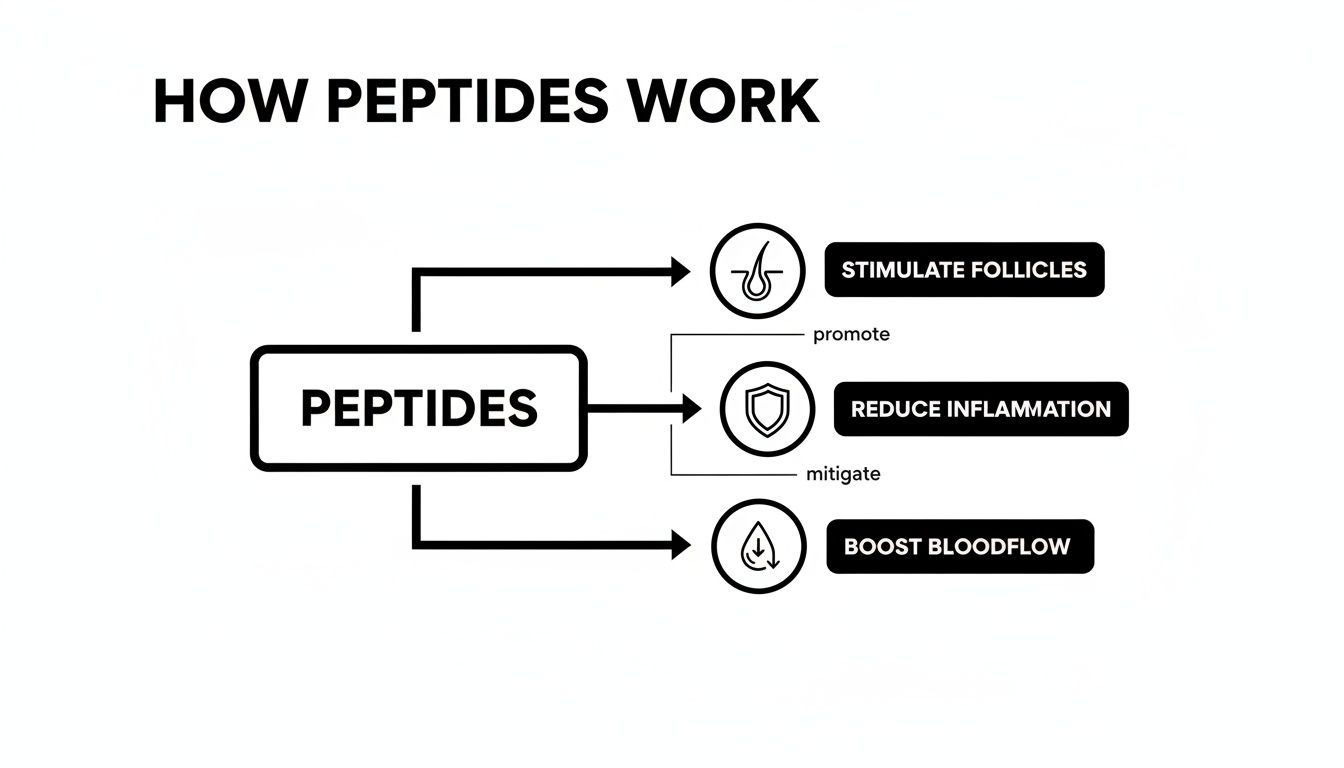
As you can see, peptides take a multi-faceted approach by stimulating follicles, calming inflammation, and boosting blood flow—all crucial for a healthy head of hair.
The Growth Signalers: PTD-DBM and Myristoyl Pentapeptide
While copper peptides are busy improving the overall scalp environment, other peptides are engineered to send direct signals to the hair follicles themselves. They're like a dispatcher sending a clear message: "Time to wake up and get back to work."
Two of the most well-known are PTD-DBM and Myristoyl Pentapeptide-17. These are designed to interact directly with the pathways controlling the hair growth cycle. PTD-DBM, for example, targets a specific protein that acts as a "brake" on hair growth. It essentially tells that protein to step aside, allowing the anagen (growth) phase to kick in.
Myristoyl Pentapeptide-17 is a staple in many eyelash and eyebrow serums for the same reason—it's believed to support keratin production, which is the very protein your hair is made of. Since peptides are made from amino acids for hair growth, providing these specific "signalers" is like giving your follicles direct instructions for rebuilding.
To make these differences clearer, let's compare some of the most common peptides you'll encounter.
Comparing Popular Hair Growth Peptides
| Peptide Type | Primary Mechanism | Common Application | Key Benefit for Hair |
|---|---|---|---|
| GHK-Cu (Copper Peptide) | Reduces inflammation, boosts collagen, and improves blood flow. | Topical serums, shampoos | Creates a healthier scalp environment for follicles to thrive. |
| PTD-DBM | Blocks proteins that inhibit the hair growth phase (anagen). | Topical serums | Directly signals dormant follicles to start growing again. |
| Myristoyl Pentapeptide-17 | Stimulates keratin production. | Topical serums | Provides the key building block for stronger, thicker hair strands. |
This table shows how different peptides tackle hair loss from various angles—some focus on the scalp's foundation while others directly target the hair follicle's growth machinery.
The Next Generation: A Look at the Evidence
The science here is always moving forward, with researchers developing new peptides aimed squarely at male pattern baldness. One that's getting a lot of attention is PP405, a topical peptide that targets the hormonal root cause of androgenetic alopecia.
Early clinical results have been quite promising. In one study, an impressive 31% of men with advanced hair loss saw their hair density jump by more than 20% in just eight weeks. By comparison, 0% of the men in the placebo group saw a similar improvement. Results like these highlight the potential of highly targeted peptide action.
The key takeaway is that different peptides have different jobs. Some are general contractors fixing the scalp, while others are specialists that flip the growth switch on individual follicles.
Understanding this distinction helps you know what you're looking for in a product. A formula with GHK-Cu is all about long-term scalp health, while one with PTD-DBM is focused on kick-starting dormant follicles. The most effective treatments often combine several types to hit hair loss from every possible angle.
How to Use Peptides for The Best Results
Knowing which peptides might help your hair is just the first step. Figuring out how to actually use them effectively is a whole different game. The right application method can be the difference between seeing real progress and feeling like you're just spinning your wheels.
When it comes to peptides, you're looking at two main delivery routes: topical solutions you apply yourself at home, and injectable treatments done by a professional.
Each path has its own rules, benefits, and trade-offs. Choosing the one that aligns with your lifestyle, budget, and hair goals is the key to building a strategy that you can actually stick with. Let's dig into the practical side of things so you can make a smart choice.
The Topical Approach: Serums and Foams
For most guys, topical peptides are the most accessible place to start. You’ll find them in serums, sprays, and foams designed for simple, at-home application. The whole idea is to get these peptides directly onto the scalp so they can be absorbed down into the hair follicles.
The absolute biggest key to success here is consistency. This isn't something you can just do when you remember and expect to see results. It has to become a non-negotiable part of your daily routine, like brushing your teeth. Most products call for application once or twice a day on a clean, dry scalp for several months before you’ll see a difference.
For the best absorption, make sure you're applying the product to your scalp, not just coating your hair. Use your fingertips to gently massage it in. This does two things: it helps stimulate blood flow and ensures the peptides actually penetrate the skin.
With topical peptides, patience and consistency are your two most important allies. Think of it as a long-term investment in your scalp’s health—results build up slowly over time, they don't appear overnight.
This slow-burn approach is one of the main drawbacks for some people. While topicals are non-invasive and easy to use, you might be waiting four to six months before the results become noticeable.
The Injectable Route: Professional Treatments
For men who want a more direct, and potentially faster-acting, solution, injectable peptides are a serious option. These treatments aren't a DIY project; they have to be administered by a qualified medical professional in a clinic. Instead of hoping for absorption through the skin, injections deliver a powerful, concentrated dose of peptides right where they need to go.
This targeted delivery bypasses the skin's barrier entirely, ensuring the active ingredients hit the hair follicles at full strength. As you can imagine, this can lead to more significant results in a shorter amount of time compared to topicals.
However, this method requires a different level of commitment.
- Professional Administration: You can’t do this at home. It means making and keeping appointments with a specialist.
- Higher Cost: Injectable treatments are significantly more expensive than over-the-counter serums.
- Increased Intensity: The procedure itself involves a series of small injections across the scalp.
It's also critical to know that peptides, especially those intended for injection, require careful preparation. Professionals need to know how to properly reconstitute peptides to ensure they're both safe and effective for use.
Choosing the Right Path for You
So, which way should you go? There's no single "best" answer here. It really boils down to your individual situation.
Topicals are an excellent choice for men who:
- Are in the earlier stages of hair thinning.
- Prefer a non-invasive routine they can do at home.
- Are looking for a more affordable way to get started.
Injectables might be a better fit for men who:
- Are dealing with more significant hair loss and want a stronger intervention.
- Are hoping for potentially faster, more dramatic results.
- Are comfortable with clinical procedures and have the budget for them.
A lot of guys also find success by combining different approaches. For example, using a daily topical peptide serum can be powerfully enhanced by pairing it with a treatment like microneedling, which creates tiny channels in the scalp to boost product absorption. You can get the full rundown on how that works in our guide on microneedling for hair growth.
At the end of the day, the best approach is the one you can stick with consistently.
Combining Peptides and PRP for a Powerful Hair Strategy

So far, we've seen how peptides are like tiny messengers, carrying very specific instructions to your hair follicles. But what if you could pair that precision signaling with another powerhouse of hair restoration? That's exactly the idea behind combining peptides with Platelet-Rich Plasma (PRP) therapy—a true one-two punch against hair loss.
Let’s use a gardening analogy. Think of PRP as the premium, nutrient-rich fertilizer. It uses the concentrated growth factors found in your own blood to supercharge the scalp, enriching the "soil" to create the perfect environment for growth. This step alone is a game-changer for waking up dormant follicles.
Then, you introduce the peptides. They act like specialized seeds and blueprints. With the scalp perfectly prepped and fertilized by PRP, peptides deliver the exact molecular signals needed to tell follicles how and when to grow. The result is a powerful synergistic effect.
A Perfect Partnership for Your Scalp
When you use both treatments together, you aren't just crossing your fingers and hoping for growth; you're actively creating the ideal biological conditions for it to flourish. PRP sets the stage by boosting blood flow and flooding the area with healing nutrients. The peptides then take full advantage of this primed environment, ensuring their growth signals are received loud and clear.
This dual-action strategy often produces far more impressive results than using either treatment alone. The combined benefits typically include:
- Accelerated Results: The nutrient-dense environment created by PRP can help follicles respond much faster to the signals from peptides.
- More Robust Growth: With both foundational support (PRP) and direct signaling (peptides), new hair often grows back thicker and stronger.
- Longer-Lasting Effects: By building a healthier overall scalp ecosystem, you're better able to sustain the results for the long haul.
The core idea is simple: PRP builds a better workshop, and peptides provide the high-tech machinery and instructions. Together, they get the hair production line running at peak efficiency.
What the Combined Approach Looks Like
A typical protocol often starts with a session of PRP injections to kickstart the whole regenerative process. This is then followed by a consistent regimen of topical or injectable peptides to maintain and amplify those growth signals over the coming weeks and months. It's a comprehensive strategy that tackles hair loss from multiple angles.
The PRP treatment addresses the bigger-picture environmental problems in the scalp, while the peptides provide the targeted, ongoing stimulation needed to keep follicles locked in their active growth phase.
To get a complete picture of how the foundational part of this duo works, you can explore the details of platelet-rich plasma therapy for hair. Understanding both sides of this strategy helps clarify why it’s become such a popular and effective option for men serious about fighting back against hair loss.
Real Evidence for Peptides: What Do the Clinical Studies Actually Show?
In the world of hair loss treatments, bold claims and marketing hype are a dime a dozen. But when you’re putting your time and money on the line, you need solid proof, not just promises. This is where we’ll cut through the noise and look at what the clinical research really says about peptides for hair growth.
I won't drown you in academic jargon. We’ll translate the key findings into what they actually mean for you and your hair. For instance, when a study mentions an increase in "anagen hairs," that’s just a scientific way of saying more of your follicles are actively growing hair instead of just sitting there dormant—which is exactly what you want.
Measuring What Matters Most
Serious scientific studies on hair growth don't rely on guesswork. Researchers look for objective, measurable outcomes that prove a treatment is working. These are the metrics that give real weight to the potential of peptides.
Key things they measure in these studies often include:
- Increased Hair Density: This is simply the number of individual hairs counted in a specific area, usually per square centimeter. A higher number means thicker-looking hair. It's that simple.
- Improved Hair Shaft Thickness: Stronger, thicker individual strands are less prone to breaking and add to your hair's overall volume.
- Reduced Hair Shedding: Tracking the number of hairs lost when you wash or comb gives a clear signal that a treatment is strengthening the follicle's grip.
These are the kind of tangible data points that separate scientifically backed solutions from wishful thinking. They ground the potential of peptides in real-world results, giving you confidence that this approach is based on credible evidence.
What the Numbers Say About Copper Peptides
Copper peptides, especially GHK-Cu, are some of the most studied peptides when it comes to scalp and hair health. Their main job is to reduce inflammation and get your scalp into a healthier state. The evidence suggests this foundational work really pays off.
For example, some research has shown that consistently using a copper peptide serum can lead to a significant increase in hair density over several months. While results can vary from person to person, these findings support the idea that creating a healthier scalp is a critical first step in fighting hair loss. A calm, well-nourished scalp is simply a better place for hair follicles to do their job.
The scientific consensus is building: peptides aren't a fleeting trend. They are a targeted tool that works on a biological level to address the root causes of hair thinning, from follicular signaling to scalp inflammation.
Evidence for Other Key Peptides
Beyond copper, other peptides have shown equally impressive results in clinical settings. These peptides often work by directly interacting with the hair follicle's growth cycle.
Take Acetyl Tetrapeptide-3, for example. This peptide is engineered to strengthen the structures that anchor the hair shaft into the follicle. Clinical trials have shown it can increase hair diameter and boost overall growth activity, leading to stronger, more resilient hair that's less likely to shed.
Another heavy hitter is Biotinoyl Tripeptide-1, which focuses on boosting keratin production—the very protein your hair is made of. Studies have demonstrated its ability to significantly reduce hair loss while increasing hair density among users. These results show that specific peptides can provide the direct signals and building blocks your follicles need to get back to work.
The Impact of Collagen Peptides
While many of the most effective peptides are applied topically, some are making waves as oral supplements. Collagen peptides are a great example, emerging as a simple way to help thicken thinning hair from the inside out. For men fighting pattern baldness, this offers another angle of attack.
A peer-reviewed study highlighted this potential with some very clear stats. After 16 weeks, the group taking collagen saw a 14.2% improvement in hair diameter, while the placebo group saw no change at all. Another study using fish collagen peptides boosted the proliferation of human dermal papilla cells—the very cells that regulate hair growth—by over 113%. This points directly to the ability of oral peptides to fuel thicker, stronger hair growth. You can explore the full details of the study on collagen peptides and hair thickness for a deeper dive.
Answering Your Top Questions About Peptides for Hair Growth
When you're looking into any new way to tackle hair loss, a healthy dose of skepticism is a good thing. It's smart to get all the facts straight before you dive in. Here, we'll cut through the noise and answer the most common questions guys have about using peptides, so you know exactly what to expect.
Are Peptides Safe to Use Long-Term?
For the most part, yes. When we're talking about topical peptides—like the GHK-Cu you’ll find in quality hair serums—they are generally very safe for daily, long-term use. Their molecules are typically too large to get into your bloodstream, meaning they stay right on the scalp where you want them.
Injectable peptides are a different ballgame. These should only ever be handled by a qualified medical professional who can monitor you properly. The biggest rule of thumb for any peptide is to get it from a reputable source. This ensures you're getting a pure product without any nasty contaminants. As always, running it by your doctor first is the best move you can make.
How Long Until I Actually See Results?
This is a marathon, not a sprint. Hair grows in slow, deliberate cycles, so you won't wake up with a new head of hair next week. With consistent daily use of a good topical peptide, most men start noticing the first positive signs—like less hair in the shower drain—within 2 to 3 months.
Real, visible changes in hair density and thickness? That usually takes about 4 to 6 months to become apparent. Keep in mind, this timeline can vary a bit depending on the specific peptide, the stage of your hair loss, and your own unique biology.
Think of it like hitting the gym. You don't see muscle growth after one session. It’s the consistent, daily effort over months that delivers real, lasting results for your hair.
Can I Combine Peptides With Minoxidil or Finasteride?
You bet. In fact, this is often where the magic happens. Many guys get their best results by adding peptides to a routine that already includes proven heavy-hitters like minoxidil or finasteride.
It’s all about attacking the problem from multiple angles. Each one works on a different biological pathway. For example, finasteride blocks the hormone DHT, while a copper peptide might be working to calm scalp inflammation and boost blood flow. It's a powerful, complementary approach.
A simple way to do this is to apply your peptide serum and your minoxidil at different times of the day to ensure each product gets fully absorbed. Of course, it's always a great idea to talk with a hair loss specialist to map out the perfect game plan for your situation.
Ready to build a powerful, science-backed strategy against hair loss? The team at PRP For HairLoss is dedicated to providing men with clear, actionable information on the most effective treatments available today. Explore our resources and take the next step in reclaiming your hair at https://prpforhairloss.com.
 PRP For Hairloss
Leave a comment