That first glance in the mirror where you think, "Hang on, does my hairline look different?"—it’s a moment most guys can relate to. It's rarely a sudden event, but more of a slow, creeping realization.
The earliest signs are often subtle. You might notice a few more hairs on your pillow or circling the shower drain. Or maybe you can see a bit more scalp through your hair at the crown than you used to. But for most guys, the most common starting point for male pattern baldness is a change in the hairline itself.
Is Your Hairline Changing? How to Read the First Clues
Let’s be honest, that initial worry can be stressful. But spotting the signs early is the key to getting ahead of the curve. Think of your hairline like a shoreline; male pattern baldness makes the tide go out, often so gradually you barely notice the day-to-day difference.
But over months or years, the change becomes undeniable. Recognizing what’s happening is the first step, giving you the power to explore your options instead of just worrying. It all starts with knowing what to look for.
The Telltale "M-Shape" Emerges
For most men, the journey begins right at the temples. The straight or gently rounded hairline of your youth starts to pull back at the corners, creating what's often called a V or M shape. This classic "M-shape" is one of the most reliable early indicators of male pattern baldness.
This isn't just your hairline "maturing." It's a distinct pattern of thinning driven by genetics and hormones. If you're not sure, you can learn more about the differences between a mature and a receding hairline. The best way to check for yourself is to pull up photos from a few years ago and do a side-by-side comparison.
Look for these specific changes:
- Deeper Corners: Are the angles at your temples looking much sharper or more recessed than they used to?
- Higher Hairline: Has the whole line shifted back, showing more of your forehead?
- Finer Hairs: Is the hair right at the edge of your new hairline noticeably thinner or less dense than the hair just behind it?
The timeline below gives you a good idea of how common this progression really is as men get older.
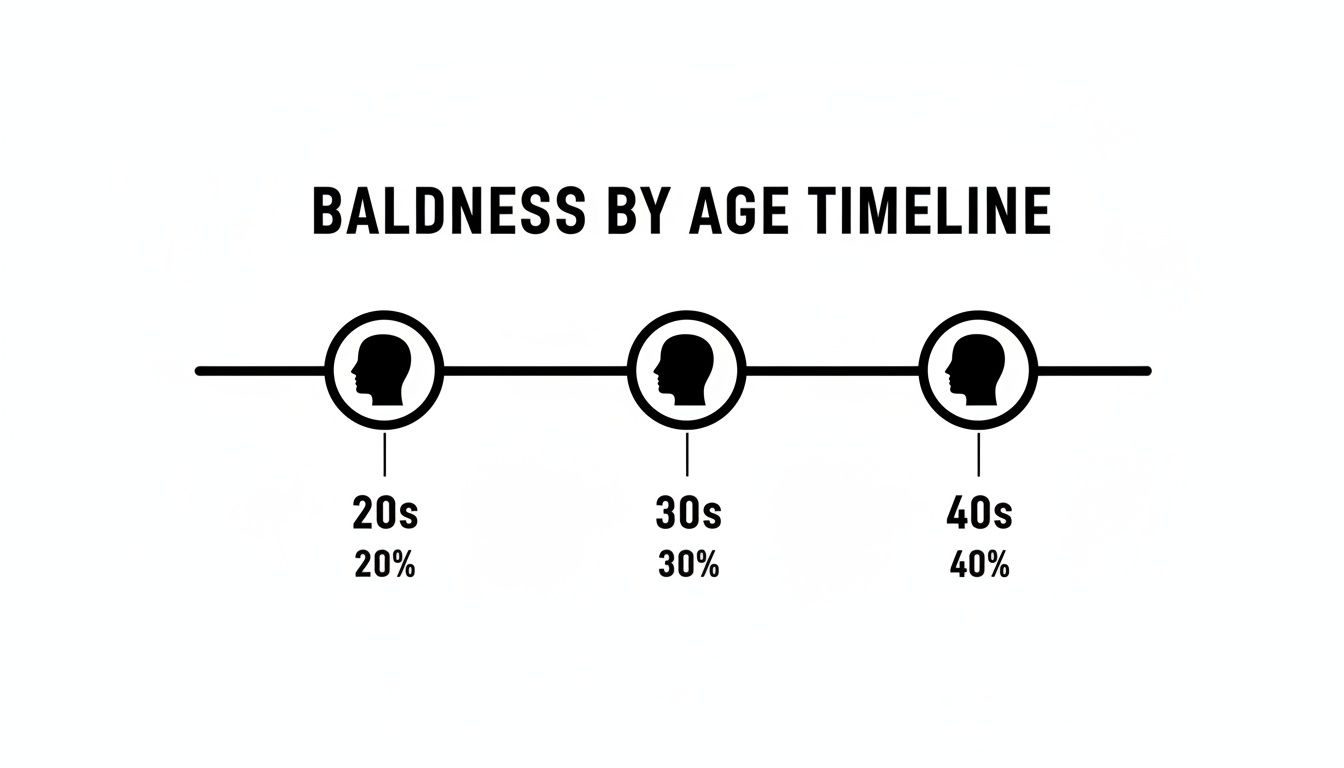
As you can see, the odds of experiencing hair loss steadily increase with each decade.
Male pattern baldness often starts much earlier than people think. By age 35, a staggering two-thirds of American men will experience some degree of noticeable hair loss, which really highlights why catching those first signs is so important.
This process doesn't just happen overnight. The numbers show a clear trend: about 20% of men see noticeable thinning in their 20s, that number jumps to 30% in their 30s, and then 40% by their 40s. For almost all of them, it starts right at the temples.
A Practical Checklist for Spotting Hair Loss Early
Endlessly wondering whether you're losing your hair can be a real source of anxiety. The best way to trade that uncertainty for clarity is to have a simple, practical plan. This guide is designed to help you stop guessing and start observing, so you can objectively track what's really happening on your scalp.
We'll walk through the five most common early signs of male pattern baldness, giving you specific visual cues to look for. This isn't about jumping to conclusions; it's about paying attention and gathering the facts.
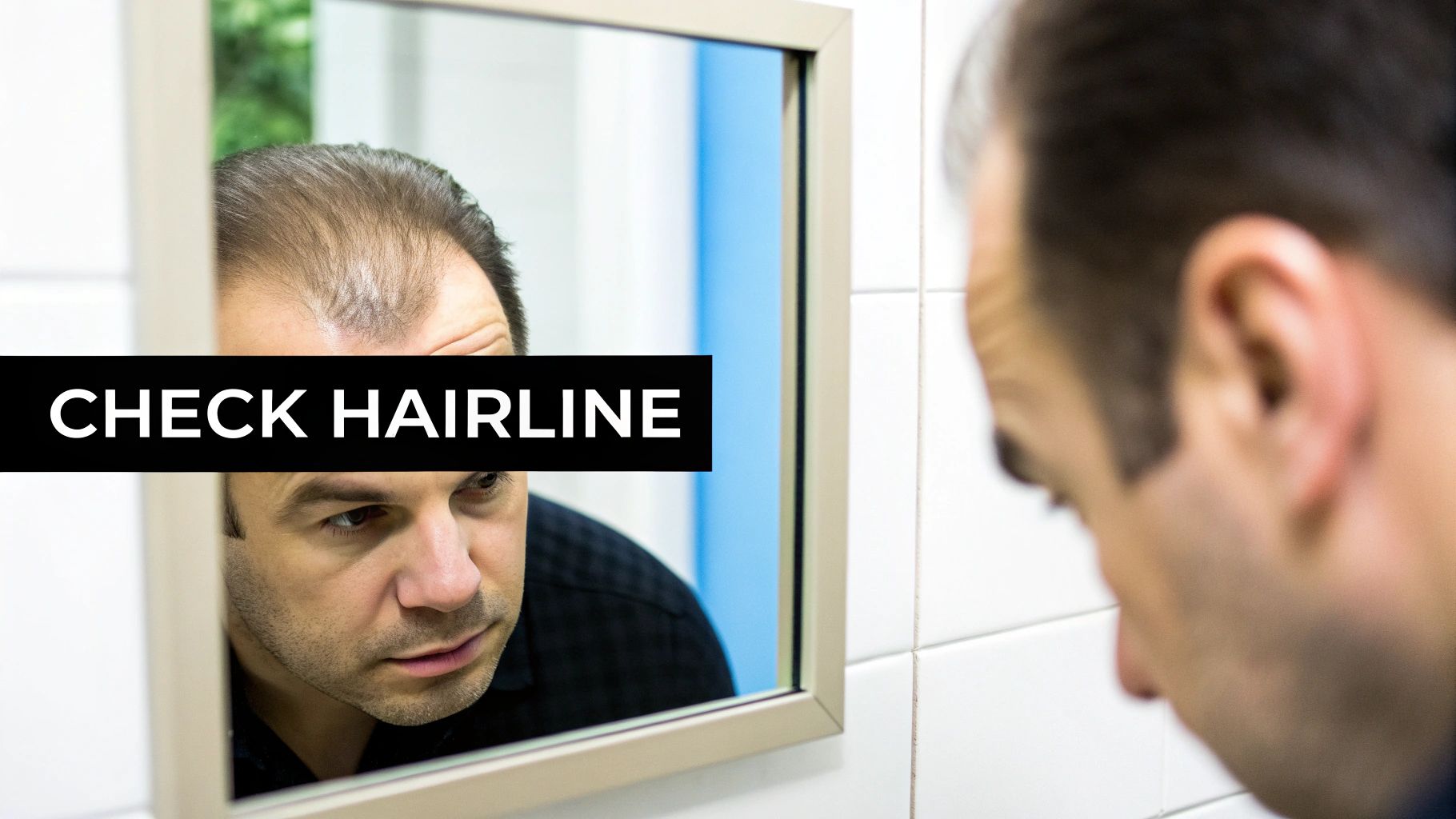
1. Increased Hair Shedding
Losing some hair every day is perfectly normal. In fact, most people shed between 50 and 100 hairs daily as part of a healthy hair growth cycle. You’ll find these on your pillowcase, in the shower drain, or tangled in your comb.
The red flag isn't the shedding itself, but a noticeable increase in the amount you're shedding. If you suddenly see much larger clumps of hair after a shower or find yourself constantly brushing stray hairs off your shirt, that's a signal worth paying attention to. This shift from your personal baseline is often the very first clue that something has changed.
2. Thinning at the Crown
The crown (or vertex) is that spot at the top-back of your head. Because you can't see it directly, it’s a classic blind spot for early hair loss. Thinning here often starts subtly, expanding outward in a circular pattern over time.
You might not even be the first to spot it. A friend, partner, or even your barber might point it out before you have any idea it's happening. The easiest way to check it yourself is to use a handheld mirror to get a good look at the back of your head in your bathroom mirror. Snapping a quick photo every few months is another great way to track its progression.
3. A Widening Hair Part
If you part your hair, this is one of the clearest signs you can look for. As the hair along your part line becomes less dense, more of your scalp starts to show through. Over time, that clean line can start to look more like a wide path.
Next time you comb your hair, take a close look at your part. Does it seem broader than it used to? When you use styling products, do you find it takes a bit more work to keep your scalp from peeking through? This is a direct indicator of reduced hair volume.
4. General Loss of Volume and Density
Sometimes, hair loss isn't confined to one specific spot. You might just get the feeling that your hair isn't as thick or full as it once was. This is known as diffuse thinning, where the loss happens more evenly across the top of the scalp instead of in a distinct pattern.
This one can be a bit harder to put your finger on, but there are definite clues:
- Your hair feels lighter. When you run your hands through it, it just doesn’t have the same weight or substance.
- Your scalp is more visible. You might notice more skin showing, especially under bright lights or right after you get out of the shower.
- Styling becomes a challenge. Your hair might not hold its shape as well or could fall flat much sooner than it used to.
Because these changes can be gradual, learning how to measure hair density can give you a more objective way to track your hair’s volume over time.
5. Slower Hair Growth
Does it feel like you can go longer and longer between haircuts? While a slower growth rate isn't a direct sign of balding, it's often related. As hair follicles are affected by DHT (the hormone responsible for male pattern baldness), their growth phase can shorten.
This means individual hairs may not grow as long as they once did before they shed. If your trips to the barber are getting further apart, it could be another piece of the puzzle pointing toward a change in your hair's overall health.
The Power of Comparison
To really understand what's happening, you need a way to track these signs over time. This simple checklist can help you do just that.
Early Male Baldness Self-Assessment Checklist
Use this checklist to track potential signs of male pattern baldness over several months. Note any changes you observe.
| Sign to Monitor | What to Look For | Your Observation (Note Date) |
|---|---|---|
| Increased Shedding | More hairs than usual on your pillow, in the shower drain, or on your clothes. | |
| Receding Hairline | Changes in the shape of your hairline, especially at the temples (M-shape). | |
| Thinning Crown | Scalp becoming more visible at the top-back of your head. Use a mirror or photos. | |
| Widening Part | Your hair part appears wider, with more scalp showing through. | |
| Loss of Density | Hair feels lighter or less full; styling is more difficult. | |
| Slower Growth | It takes longer for your hair to grow between haircuts. |
By systematically checking for these signs, you move from vague worry to informed observation. This puts you in the best possible position to decide on your next steps.
Why Is This Happening? Genetics and Other Key Factors
If you're noticing some of those first changes in the mirror, you're probably asking one simple question: why me? It can feel like you’ve been singled out, but male pattern baldness is far from a random event. It's actually a predictable process, driven mostly by a combination of your genes and hormones—a specific blueprint handed down through your family.
Getting a handle on the root cause is the first real step in taking the mystery out of hair loss. It’s not about something you did wrong; it's just about the biological script your body is following. Once you understand the "why," you're in a much better position to figure out the "what now."
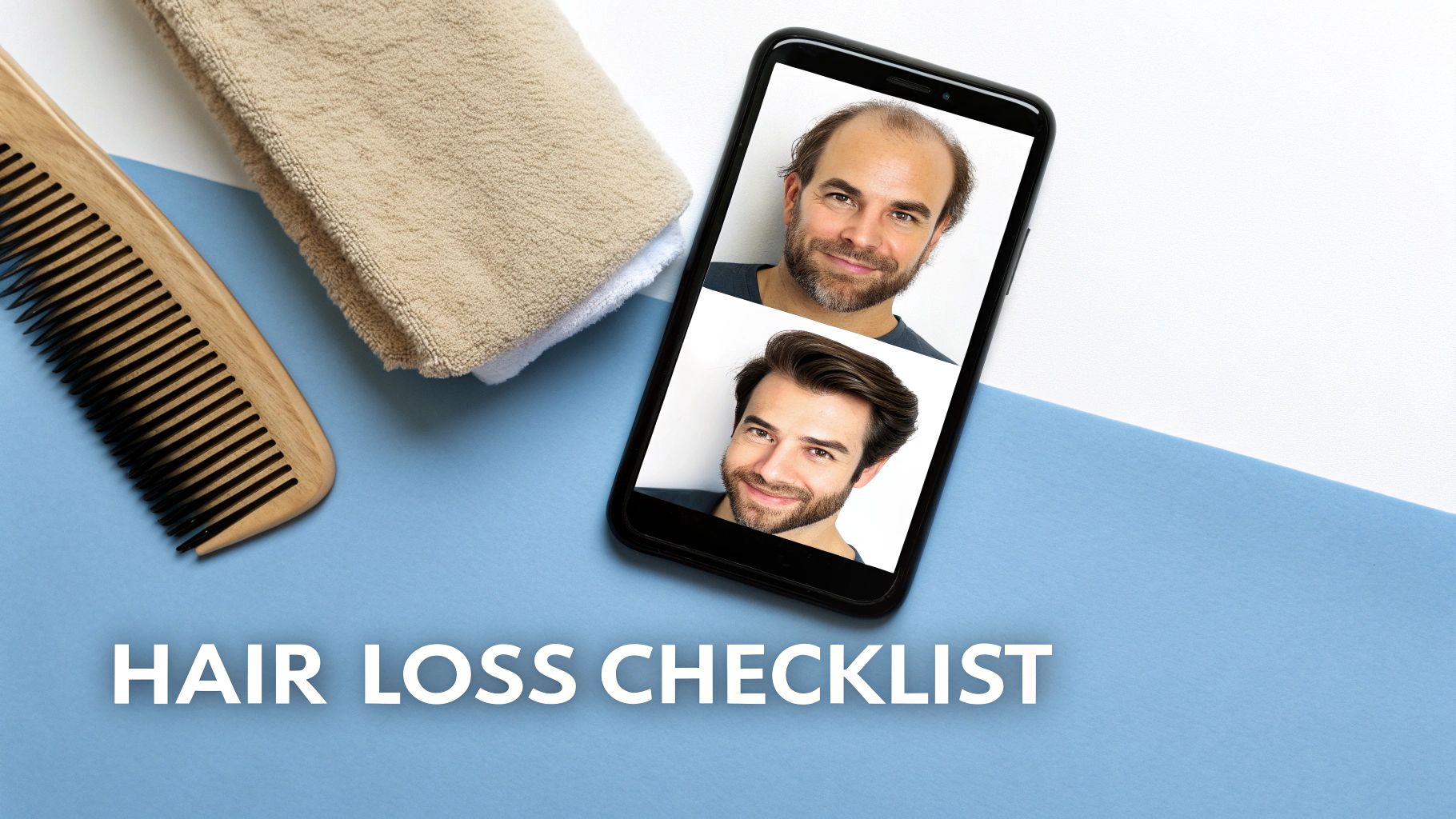
The Role of Genetics and DHT
The main culprit in this story is a hormone called dihydrotestosterone, or DHT for short. DHT is a natural, and necessary, byproduct of testosterone. The problem is, for men with a genetic predisposition to hair loss, the hair follicles on certain parts of the scalp are extremely sensitive to it.
Think of it this way: your genes decide which of your hair follicles have a specific "lock" on them. DHT is the "key." When that key finds the right lock, it kicks off a process called miniaturization.
This miniaturization process is the central mechanism behind male pattern baldness. An affected hair follicle doesn't just die off. Instead, it shrinks over time, producing thinner, shorter, and weaker hairs with each new growth cycle, until it eventually gives up producing visible hair at all.
This genetic sensitivity explains why hair loss follows such a classic pattern. It typically starts at the hairline and crown because the follicles there have the DHT "locks." Meanwhile, the hair on the back and sides of your head often remains dense and healthy—those follicles simply weren't programmed with the same sensitivity. You can get a deeper dive into how male pattern baldness genetics really work.
Debunking Common Genetic Myths
You've almost certainly heard the old wives' tale that you inherit baldness from your mother's father. While there's a grain of truth to the maternal link, it's definitely not the whole story. The genetic lottery for hair loss is way more complex, with contributions from both sides of your family.
- Myth: Just look at your maternal grandfather to see your hair's future.
- Fact: The most influential gene for baldness is on the X chromosome, which men inherit from their mothers. But that's just one piece of the puzzle; many other genes on other chromosomes also have a say.
- Conclusion: If you have a family history of baldness on either your mother's or your father's side, your risk is higher.
Essentially, your genetic risk isn't a straight line from one relative. It's a mosaic built from pieces handed down from many different family members.
Other Contributing Factors You Should Know
While genetics and DHT are in the driver's seat, they aren't the only things steering the ship. Several other factors can influence when hair loss starts and how quickly it progresses.
Age is easily the biggest secondary factor. Your odds of seeing noticeable hair loss go up with each passing decade. The longer those sensitive follicles are exposed to DHT, the more that miniaturization process takes hold.
Ethnicity also plays a significant role. Globally, Caucasian men have the highest rates of early-onset male pattern baldness. In fact, Western countries top the charts for baldness prevalence. Spain leads the world with 44.5 percent of men being either bald or actively balding, with Italy right behind at 44.37 percent and France at 44.25 percent. The United States comes in fourth, with 42.68 percent of men affected.
Hormones are obviously central to all of this, but the details can get technical. For those wanting to dig deeper into their own hormonal profile, understanding your Free Androgen Index (FAI) can offer more specific insights. By putting all these pieces together—genetics, hormones, age, and ethnicity—you get a much clearer picture of what's going on, which is the best place to start when exploring your options.
When to Talk to a Professional About Hair Loss
Let's be honest: trying to diagnose yourself with a search engine can send you down a rabbit hole of confusion and anxiety. While checking for the signs yourself is a great first step, there comes a time when closing the laptop and talking to a real expert is the smartest move you can make.
Getting a clear diagnosis from a professional takes the guesswork out of the equation. It's the first real step toward a plan that actually works.
Key Reasons to See a Doctor
Deciding to book that appointment can feel like a big deal, but some things are clear signals that it’s time. If you're noticing more than just the slow, predictable thinning at your temples or crown, it's a good idea to get it checked out.
Pay close attention if you're experiencing any of the following:
- Sudden or Rapid Hair Loss: Is your hair falling out in clumps? Or have you noticed a dramatic change in just a few weeks or months? This kind of accelerated loss can sometimes point to an underlying health issue that needs attention, so it's not something to ignore.
- Scalp Irritation or Pain: Typical male pattern baldness shouldn't hurt. If your scalp is itchy, red, burning, or painful, you could be dealing with an infection or an inflammatory condition. A dermatologist can figure out what's really going on.
- Patchy Hair Loss: Are you seeing distinct, round bald spots on your scalp instead of the classic M-shaped hairline? This pattern is a hallmark of alopecia areata, an autoimmune condition that requires a completely different approach to treatment.
- Significant Emotional Distress: It’s normal to be concerned about hair loss. But if that worry is causing serious anxiety, tanking your confidence, or getting in the way of your daily life, talking to a professional can provide both a clear action plan and much-needed peace of mind.
Not sure who to even call? Our guide on what doctor you see for hair loss can point you in the right direction.
A professional consultation isn't just about getting a prescription. It's about gaining clarity, understanding all your options, and creating a personalized strategy that works for you, putting you back in control of your journey.
What to Expect During a Consultation
Knowing what to expect can make the whole process feel less intimidating. A hair loss consultation is usually very straightforward and non-invasive. The doctor’s main goal is to get a complete picture of your situation and rule out any other potential causes.
First, you'll just have a conversation. Be ready to chat about:
- Your Family History: They’ll likely ask about hair loss patterns in your parents and grandparents.
- Your Timeline: When did you first notice things changing? Has it been a slow burn or a fast progression?
- Your Lifestyle: Expect questions about your diet, stress levels, and any medications or supplements you take.
After you talk, the doctor will do a physical exam of your hair and scalp. They might pull out a dermatoscope—basically a handheld magnifying glass—to get a close-up look at your hair follicles.
They may also perform a simple "hair pull test," where they gently tug on a small group of about 50-60 hairs to see how many come out. It’s a quick way to gauge the severity of the shedding. Based on all this, they can confirm whether it’s male pattern baldness and start discussing a game plan that’s right for you.
Your Guide to Early Intervention and Treatment Options
Catching male pattern baldness early isn’t a reason to panic. Think of it as a signal to start taking action. An early diagnosis gives you a crucial head start, opening the door to proactive strategies that can make a real difference.
The most important takeaway is this: the sooner you start a proven treatment plan, the more of your existing hair you can hold onto. It puts you back in the driver's seat.
Fortunately, you have several evidence-based options to slow things down. These aren't old wives' tales or miracle potions, but scientifically-backed treatments that work with your body's biology. Let's break down how they work.
Established and Effective Treatments
When it comes to fighting male pattern baldness, two treatments have long been the gold standard. They tackle the problem from different angles but can be incredibly effective.
- Minoxidil (Topical): You probably know this one as Rogaine®. As a topical solution, you apply it directly to your scalp. Think of Minoxidil as a support system for your hair follicles. It's a vasodilator, which means it helps widen blood vessels. This increases blood flow, delivering a fresh supply of oxygen and nutrients that can help wake up sluggish follicles.
- Finasteride (Oral): While Minoxidil works on the surface, Finasteride gets to the root of the problem from within. This is a prescription pill that targets the hormonal trigger of hair loss. It works by blocking the enzyme that converts testosterone into dihydrotestosterone (DHT)—the very hormone responsible for shrinking hair follicles. By lowering DHT levels, it helps put the brakes on that miniaturization process.
These two are often used together for a powerful one-two punch. To get the full picture, you can explore the complete landscape of FDA-approved hair loss treatments and see how they fit into a bigger strategy.
Introducing Platelet-Rich Plasma Therapy
Beyond the classic medications, modern medicine offers a more personalized approach called Platelet-Rich Plasma (PRP) therapy. This minimally invasive treatment is gaining serious traction because it uses your body's own natural healing power to rejuvenate thinning hair.
The concept is actually pretty straightforward. Your blood contains platelets, which are little powerhouses packed with growth factors—the same proteins your body uses to repair injuries and encourage cell growth. PRP therapy works by drawing a small amount of your blood, isolating these potent platelets in a centrifuge, and then reinjecting this concentrated "liquid gold" back into the areas of your scalp that need it most.
Think of PRP as a highly concentrated, organic fertilizer for your scalp. You're not introducing anything foreign. Instead, you're delivering a supercharged dose of your own natural growth messengers directly to the hair follicles that are struggling.
This targeted boost can help awaken dormant follicles, thicken existing hairs, and promote a healthier, more robust growth cycle. It's an excellent option for anyone looking for an effective solution without committing to daily pills or foams.
The Power of Proactive Management
No matter which path you explore, the core message is the same: acting early is your biggest advantage. Hair loss treatments work best when they're used to protect and revive follicles that are still hanging on, even if they've started to shrink. Once a follicle goes completely dormant and the pore closes, it’s much, much harder to bring it back.
Supporting your hair's health from the inside out can also be a valuable part of any routine. For a nutritional approach, supplements like Biotin Gummies For Hair Growth are a popular choice. While they won't stop genetic balding on their own, ensuring your body has the right building blocks can complement any other treatments you're using.
By identifying the signs early and talking to a professional, you can create a plan that’s right for you. Whether that involves Minoxidil, Finasteride, PRP, or a combination of strategies, taking decisive steps now gives you the best possible chance to manage your hair loss effectively and keep your confidence high for years to come.
Common Questions About Early Male Baldness
Noticing the first signs of hair loss is one thing, but dealing with the flood of questions that comes next can feel just as overwhelming. There's so much conflicting information out there, making it tough to separate myth from reality. This section is here to cut through the noise and give you straight answers to the questions most guys have when they start seeing changes in the mirror.

Let's tackle some of the biggest concerns head-on, so you can move forward with a clear head and a solid plan.
Can Stress Cause Permanent Male Pattern Baldness?
This is a big one, and the short answer is no, not directly. Intense stress can trigger a temporary shedding condition called telogen effluvium, which causes a startling amount of hair to fall out all at once. But this is a temporary shock to the system, not the permanent, genetic process of male pattern baldness.
However, don't write off stress just yet. Think of it like this: your genetics may have already paved the road toward hair loss. Chronic stress is like flooring the gas pedal, potentially speeding up the journey.
So, while chilling out won't magically regrow a receding hairline, managing your stress is a crucial piece of the puzzle. It supports your overall health and can help pump the brakes on thinning if you're already genetically predisposed.
Will Wearing a Hat Make My Hair Loss Worse?
Let's put this old myth to rest for good. Wearing a clean, properly fitting hat will not cause male pattern baldness. The idea that a hat "suffocates" your follicles is a complete fabrication. Your hair follicles get all the oxygen and nutrients they need from your bloodstream, not from the air.
There are only a couple of very specific, and frankly rare, scenarios where a hat could cause an issue:
- If it's way too tight: A hat that's so tight it's constantly pulling on your hair could lead to a type of mechanical hair loss called traction alopecia.
- If it's dirty: A filthy, sweat-soaked hat could foster bacteria or fungus, leading to scalp irritation that isn't great for healthy hair.
As long as your hat fits comfortably and you keep it reasonably clean, wear it with confidence. It has nothing to do with genetic hair loss.
Can Lifestyle Changes Help Slow Down Hair Loss?
Absolutely. While you can't change the genetic hand you were dealt, you can definitely control the environment your hair grows in. Think of a healthy lifestyle as creating the best possible foundation for your hair to thrive, and it's a powerful ally to any medical treatments you might consider.
These habits won't stop genetic hair loss cold, but they are a vital part of your support system.
Your lifestyle choices are like tending to the soil in a garden. You can't change the type of seed you've planted, but you can make sure the soil is rich with nutrients, giving that seed the best possible chance to flourish.
Here's where to focus your efforts:
- A Balanced Diet: Hair is primarily protein, so make sure you're getting enough. Also, load up on foods rich in iron, zinc, Biotin, and Vitamin D.
- Stress Management: We've already covered this, but it's worth repeating. Exercise, meditation, or just making time for hobbies can make a real difference.
- Quality Sleep: Your body does most of its repair work while you're asleep. Aiming for a consistent 7-9 hours a night supports everything, including your hair follicles.
- Quit Smoking: Smoking constricts blood vessels, which can choke off the vital flow of blood, oxygen, and nutrients to your scalp.
Making positive changes here isn't just good for your hair—it's good for your entire well-being.
Is There an Age When It Is Too Late to Start Treatment?
This is a common fear, but the good news is that it’s less about how old you are and more about how advanced your hair loss is. The golden rule in hair restoration is simple: the earlier, the better.
Treatments work best when they're helping hair follicles that are still active, even if they're "miniaturized" and producing thinner, weaker hairs. These follicles are struggling, but they're still alive and kicking.
Once a follicle goes completely dormant and the scalp in that area becomes smooth and shiny, it's almost impossible to bring it back. This is exactly why catching those early signs is so critical—it opens a window of opportunity where intervention can be incredibly effective.
Whether you're 25 or 55, a specialist can look at your scalp and see what's really going on. They can determine how many follicles are still viable and create a plan, perhaps involving treatments like PRP therapy, that gives you the best odds of holding onto the hair you have and even reviving some that has weakened.
At PRP For HairLoss, we believe that understanding your options is the first step toward taking control. Our resources are dedicated to providing clear, reliable information about male pattern baldness and innovative treatments like PRP therapy. Learn more at https://prpforhairloss.com.
 PRP For Hairloss
Leave a comment