Figuring out the best laser cap for your hair loss really boils down to three things: technology that's been proven to work, total scalp coverage, and a treatment schedule you can actually stick with. Everyone's journey is different, of course, but the top-shelf models like the CapillusPro and iRestore Laser Pro consistently get the nod for their medical-grade lasers and FDA clearance. The real trick is finding the cap that makes sense for your specific hair loss and, just as importantly, your daily routine.
Your Search for the Best Laser Cap Starts Here

Let's be honest, navigating the world of hair loss treatments can feel like a full-time job. You're constantly bombarded with products promising the moon, and it's tough to separate the marketing hype from what actually works. This guide is here to cut through all that noise. We're zeroing in on one thing: Low-Level Laser Therapy (LLLT) delivered through a simple, wearable cap.
I'm not here to sell you a miracle cure overnight. What I am here to do is lay out how LLLT is a scientifically-backed approach that gives people a real chance to get their hair confidence back. It works by sending low-level light energy directly to your hair follicles, essentially "waking them up" and nudging them back into a healthy growth phase.
Setting Realistic Expectations
Before we get into comparing different brands and models, let's get on the same page about what to expect. A laser cap isn't a magic wand; it's a long-term commitment that demands consistency and a healthy dose of patience.
- It’s a Marathon, Not a Sprint: You’ll likely start to see less shedding in the first 3 to 6 months. But for real, noticeable improvements in thickness and density, you're looking at closer to a year.
- Consistency is Crucial: This is the non-negotiable part. You have to stick to the schedule—usually just a few times a week for under 30 minutes. If you don't use it, it won't work. Plain and simple.
- Best for Early to Moderate Thinning: LLLT shines for those with androgenetic alopecia (your classic pattern baldness) who still have hair follicles that are weak but not completely dormant.
The market for these devices is exploding for a good reason. Projections show the laser hair loss hat market could jump from $250 million in 2025 to a massive $850 million by 2033. This boom is fueled by how common androgenetic alopecia is—affecting over half of all men by age 50—making non-invasive home treatments incredibly appealing. For a closer look at these numbers, you can check out the market analysis from Data Insights Market.
A Quick Look at Top-Rated Laser Caps
To give you a lay of the land, here’s a snapshot of some of the most popular and effective laser caps out there. This will help you see the key differences at a glance before we dig deeper into each one.
Top-Rated Laser Caps at a Glance
| Laser Cap Model | Key Feature | Best For | FDA Status |
|---|---|---|---|
| CapillusPro | High diode count (272 medical-grade lasers) | Maximum scalp coverage and dense, uniform treatment. | FDA-Cleared |
| iRestore Laser Pro | Combination of lasers and LEDs for broad stimulation. | Users seeking a balance of performance and value. | FDA-Cleared |
| HairMax LaserBand | Unique band design with shorter treatment times. | Targeted treatment for specific areas like the hairline. | FDA-Cleared |
Think of this table as just the starting point. My goal here is to arm you with a detailed, evidence-based guide so you can find the best laser cap for your hair loss journey and make a decision you feel good about.
Understanding How Laser Caps Actually Work
Before you even think about buying a laser cap, it’s worth understanding what’s really going on under the hood. It’s not some kind of snake oil—it's a well-studied biological process known as Low-Level Laser Therapy (LLLT). This technology uses targeted light to give your tired hair follicles a serious energy boost.
Imagine a struggling hair follicle like a phone battery that’s always hovering at 5%. It just doesn't have the juice to do its job, which is to grow strong, healthy hair. A laser cap acts like a specialized charger, delivering precise wavelengths of red light straight to the base of those follicles.
The Science of Light and Hair Growth
So, what happens when that light hits your scalp? The energy gets absorbed by your cells, particularly by the tiny powerhouses inside them called mitochondria. This kicks off a chain reaction of positive effects.
- More Cellular Fuel: The light ramps up the production of Adenosine Triphosphate (ATP), which is basically the high-octane fuel for all cellular activity. When your follicle cells have more ATP, they can get back to the business of growing hair.
- Better Blood Flow: LLLT also improves circulation in the scalp. Think of it as opening up the supply lines. This brings more oxygen and vital nutrients to the hair roots and helps clear out waste products like DHT, a major culprit in male pattern baldness.
This one-two punch effectively awakens sluggish follicles. It helps nudge them out of their dormant "resting" phase and back into the active "growing" phase. For a deeper dive into the science behind red light therapy, this guide from MedEq Fitness breaks it down nicely.
The Bottom Line: Laser caps don't magically create new follicles. They work by "recharging" your existing ones with targeted light, boosting their metabolism and improving scalp circulation. This creates a healthier environment for thicker, stronger hair to grow.
Why Wavelength is Everything
Now, you can't just shine any old red light on your head and expect results. The real magic of LLLT lies in its precision. The most effective devices use a very specific wavelength, typically right around 650 nanometers (nm).
This isn't some arbitrary number. Decades of research have shown that the 650 nm wavelength penetrates the scalp to the perfect depth to reach the base of your hair follicles. It does this without generating heat or damaging your skin.
This is also why medical-grade lasers are different from simple LEDs. True lasers produce a focused, powerful beam of light that stays strong as it travels through the skin, ensuring the maximum amount of energy gets where it needs to go.
Turning Science into Visible Results
What does all this science actually look like on your head? When you use a laser cap consistently, the first thing you'll likely notice is less shedding. That’s a great early sign.
Next, you might see some new, fine "peach fuzz" hairs starting to pop up. Over the next few months, many of these can mature into thicker, darker hairs, which is what builds that feeling of improved density and coverage. This isn't just anecdotal, either—clinical studies back it up, consistently showing significant hair count increases in men who use LLLT. Having a good grasp of the basics of red light therapy and hair growth is key to setting the right expectations from the start.
Comparing the Top Laser Caps on the Market
Once you know how the science works, the next step is diving into the actual products. It's incredibly easy to get lost in a sea of marketing claims and technical specs, so let's cut through the noise and compare the leading laser caps on the features that genuinely matter for results.
We're going to move beyond just listing features and get into the "why" behind them. For example, we'll explore how the quality of medical-grade lasers often trumps the sheer number of diodes, and how power density can make or break the efficiency of your treatment sessions. The goal here is to help you pick the right tool for the job, not just the one with the flashiest packaging.
Revitalizing hair follicles with a laser cap is a pretty straightforward process: the light stimulates your cells, boosts their energy, and encourages them to get back to the business of growing hair.
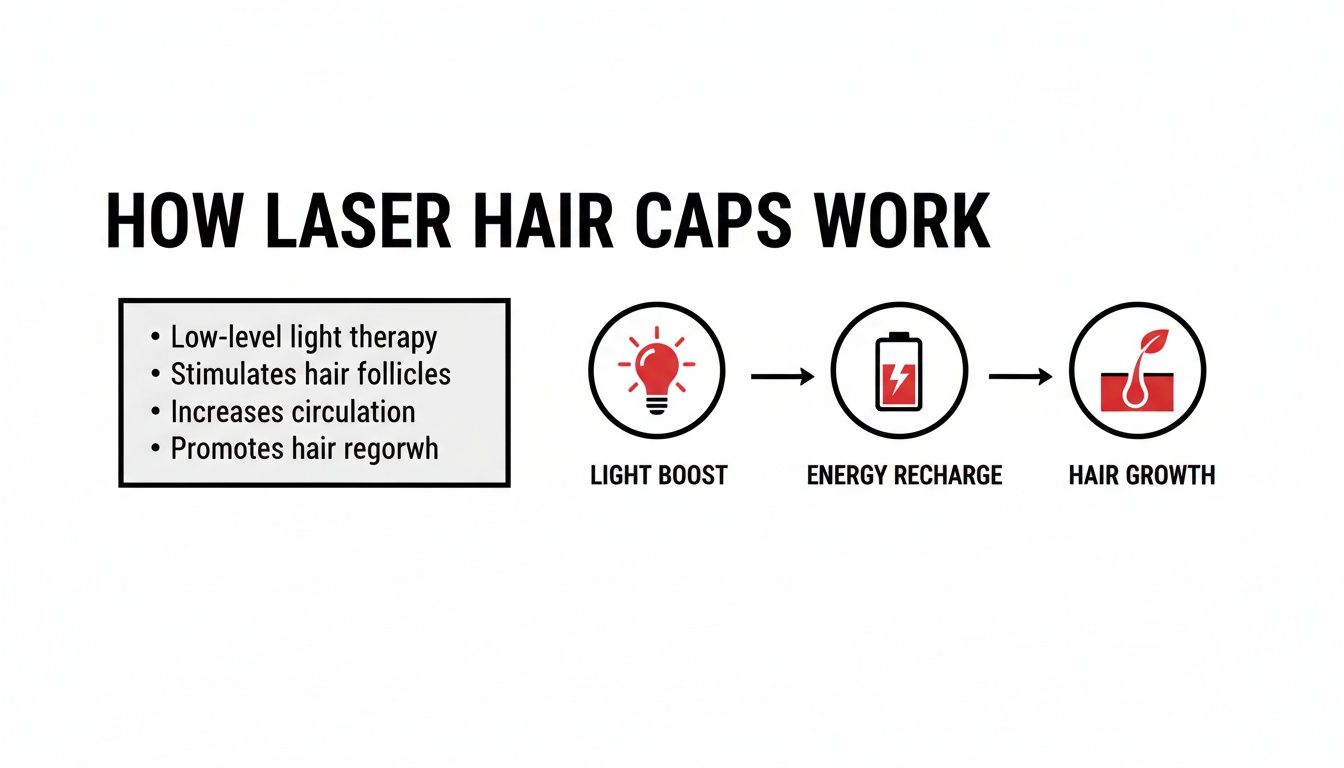
This diagram breaks it down nicely: light from the cap energizes the follicles, which in turn kickstarts the growth cycle.
Diode Count vs. Diode Quality
One of the first specs you'll see is the diode count—the number of tiny light sources packed inside the cap. It’s easy to assume that more is always better, but the reality is a bit more nuanced.
A cap with 272 diodes will naturally provide more comprehensive scalp coverage than one with just 82. If you're dealing with diffuse thinning all over your head, that wider coverage is a huge plus, ensuring every follicle gets consistent light energy.
However, the quality of those diodes is the real game-changer. You want a device that uses medical-grade lasers, not just basic LEDs. Lasers produce a focused, coherent beam of light that penetrates deep enough to energize the base of the hair follicle. LEDs, on the other hand, tend to disperse their light more superficially, making them far less effective for stimulating real growth.
A device with 100 high-quality, medical-grade lasers will likely deliver better results for hair regrowth than a cap packed with 300 low-power LEDs. Don't let a high diode count distract you from what truly matters: the quality and type of light being delivered.
Treatment Time and Lifestyle Fit
Another critical factor is the required treatment time. This is where you have to be honest with yourself about your daily routine. Will you actually stick with a quick 6-minute session every single day, or does a 30-minute session three times a week sound more manageable?
- Shorter, More Frequent Sessions: Devices like the HairMax LaserBand are built for speed, with sessions lasting just a few minutes. This is perfect if you want to quickly slot it into your morning or evening routine without a second thought.
- Longer, Less Frequent Sessions: Full-coverage caps like those from Capillus or iRestore usually demand longer sessions of around 25-30 minutes, but you only have to do it a few times a week. This "set it and forget it" approach is great if you can wear it while watching TV, reading, or working from your home office.
Remember, consistency is everything with LLLT. Picking a device that fits your life is one of the most important decisions you'll make.
Coverage Area and Design
Not all hair loss looks the same, and laser caps are designed differently to address that. The physical shape of the device dictates which parts of your scalp get treated.
Full caps give you the most extensive coverage, hitting the top, crown, and sides of your scalp all at once. This makes them the go-to choice for anyone experiencing widespread or diffuse thinning.
Laser bands, in contrast, deliver a more concentrated treatment to a smaller area. They're excellent for targeting specific trouble spots, like a receding hairline or a thinning patch on the crown. They're also usually lighter and more portable, which is a nice bonus for frequent travelers.
At-home LLLT devices have truly changed the game for treating alopecia. In fact, household use has skyrocketed, now claiming 65% of the market—a massive jump from 45% in 2020—as more men seek private and convenient solutions. The iRestore stands out with its mix of medical-grade lasers and LEDs, and for good reason. One study in Lasers in Surgery and Medicine found it boosted hair count by an average of 39% after just 16 weeks.
Detailed Laser Cap Feature Comparison
To make this all a bit clearer, let's put some of the top models head-to-head. This isn't about declaring a single "winner" but about helping you understand the trade-offs so you can make an informed choice.
| Feature | CapillusPro | iRestore Laser Pro | HairMax LaserBand 82 | What This Means for You |
|---|---|---|---|---|
| Diode Type | 272 Medical-Grade Lasers | 282 Lasers & LEDs | 82 Medical-Grade Lasers | Capillus offers pure, focused laser therapy. iRestore uses a combination approach. HairMax concentrates powerful laser energy in a smaller zone. |
| Treatment Time | 6 minutes, daily | 25 minutes, every other day | As little as 90 seconds, 3x a week | Your schedule is the deciding factor. HairMax is the fastest by far, while iRestore requires a longer but less frequent time commitment. |
| Coverage Area | Full Scalp | Full Scalp | Targeted Band | Capillus and iRestore are built for overall thinning. HairMax is better if you're targeting specific problem areas like the hairline or crown. |
| Portability | Excellent (fits under a hat) | Good (hands-free cap) | Excellent (lightweight band) | Capillus is the most discreet for wearing on the go. HairMax is the easiest to pack for travel. iRestore is best suited for home use. |
Ultimately, choosing the right laser cap comes down to weighing these factors against your specific pattern of hair loss, your budget, and your daily life. If you want to dive even deeper, our guide on the best low-level laser therapy devices offers a more extensive breakdown of the tech and other products on the market.
Are Laser Caps Safe? And What Results Can You Really Expect?
When you’re looking into any new hair loss treatment, safety is naturally the first question that comes to mind. Let's get right to it: Low-Level Laser Therapy is widely considered a very gentle and non-invasive technology, especially when you stick with FDA-cleared devices.
Unlike medications that can introduce a whole host of systemic side effects, LLLT works on the outside, focusing light energy directly onto your scalp. This targeted approach means the risk of side effects is incredibly low for most people. The most you'll likely feel is a mild warmth on your scalp during a session, or maybe some slight, temporary tenderness when you first start. These feelings usually go away right after you take the cap off.
What “FDA-Cleared” Actually Means for You
You’ll see the term "FDA-Cleared" on just about every laser cap worth its salt. This isn't just marketing fluff; it's a critical benchmark for both safety and whether the device actually works.
To earn that clearance for treating androgenetic alopecia, a company has to back up its claims with solid scientific evidence. They have to prove to the FDA that their device is safe for you to use at home and that it does what it promises—promote hair growth—without posing any unreasonable risks. It’s your best guarantee that the product has been properly vetted.
A Realistic Timeline for Seeing Results
With LLLT, patience is absolutely key. Laser caps work by nudging your hair's natural growth cycle back into action, so the changes happen gradually and in distinct stages. Here’s what that typically looks like:
- Months 1-3: The first thing you'll probably notice is less hair in the drain or on your brush. This is a great sign! It means your follicles are responding to the therapy and starting to stabilize.
- Months 3-6: You might begin to see some new, fine hairs sprouting. These are often called "vellus" hairs, and they're the first real visual proof that dormant follicles are waking up.
- Months 6-12: This is when the magic really starts to happen. Those fine hairs can mature into thicker, darker terminal hairs, leading to a noticeable improvement in density and scalp coverage.
The science behind LLLT has been building since its first FDA approval way back in 2007. A major meta-analysis pooling data from 11 different clinical trials found that people using LLLT saw their hair density increase by about 25%. The placebo group? Just 5%. That's a big difference, and for the 50 million people in the U.S. dealing with hair loss, that kind of data makes these devices a compelling option.
A Quick Word on That Initial Shed
Every once in a while, someone will report a slight increase in shedding right after they start using a laser cap. It sounds counterintuitive and can definitely be alarming, but it’s often a good thing.
This initial shed is sometimes called "shedding phase synchronization." It can be a sign that the laser therapy is successfully pushing your hair follicles into a new, active growth phase. In short, it’s clearing out the old, weak hairs to make room for stronger, healthier ones.
This process is a core part of reversing hair follicle miniaturization, the underlying cause of male pattern baldness. Of course, if the shedding continues for more than a few weeks, it's always a good idea to check in with your doctor.
Laser Caps vs. PRP Therapy: Which Is Right for You?
When you start looking into serious treatments for hair loss, two names pop up constantly: Low-Level Laser Therapy (LLLT), delivered through laser caps, and Platelet-Rich Plasma (PRP) therapy. Both are backed by science and known to stimulate hair growth, but they couldn't be more different in how they work and what they ask of you.
This isn't about which one is "better" in a universal sense. It’s about figuring out which one slots into your life, budget, and hair goals. A laser cap is a one-and-done purchase you use at home, while PRP is a series of treatments you get in a clinic. Grasping that fundamental difference is the first step toward making the right choice.
The Core Difference: Treatment Philosophy
At its heart, you're choosing between a long-term, low-and-slow approach versus a short-term, high-intensity boost.
-
Laser Caps (LLLT): Think of a laser cap as a daily workout for your hair follicles. It uses consistent, gentle light energy to kickstart cellular metabolism and improve blood flow over months and years. The whole point is to achieve sustained, gradual improvement from the comfort of your couch.
-
PRP Therapy: This is a direct medical intervention. A clinician draws your blood, spins it down to isolate the plasma packed with growth factors, and then injects it right into your scalp. The goal is to deliver a powerful, concentrated shot of your body's own healing agents to jolt dormant follicles back to life.
One method is passive and consistent; the other is active and requires appointments. Neither is superior, but one will almost certainly feel like a better fit for you.
A Head-to-Head Comparison
Let's break down the practical differences that will really shape your decision.
Convenience and Commitment
A laser cap is built for minimal life disruption. A typical session is just 6 to 30 minutes, done a few times a week while you’re reading, working, or watching TV. The real commitment is just remembering to do it consistently.
PRP, on the other hand, means scheduling appointments, driving to a clinic, and sitting for a procedure that involves needles. While the sessions themselves aren't terribly long, they require planning and a more hands-on level of participation.
For someone with a hectic travel schedule or who just prefers a non-invasive, private solution, the sheer ease of a laser cap is a huge win. But if you'd rather a professional handle everything in a few concentrated visits a year, PRP might feel more manageable.
Cost Structure and Long-Term Value
The financial commitment for these two treatments is completely different.
-
Laser Caps: You’re looking at a single upfront cost, usually between $800 and over $3,000. After that initial investment, the treatment costs you nothing for the life of the device, which is usually several years.
-
PRP Therapy: This is a pay-per-session model, with each treatment often costing $500 to $1,500. A standard starting plan includes three sessions spaced a month apart, then maintenance sessions every 4-6 months. Those recurring costs can really add up over the years.
From a pure value perspective, a quality laser cap often comes out ahead as a more predictable and lower long-term investment.
Mechanism and Ideal Candidate
Laser therapy is all about energizing the follicles you still have. It's an excellent option for men in the early to moderate stages of androgenetic alopecia who want to slow down the thinning process and add some density back.
PRP delivers a high concentration of growth factors directly to the source, which can be a much-needed jolt for follicles that have become sluggish or dormant. For a closer look at how this process works, this guide on PRP therapy for hair loss is a great resource.
Interestingly, the principle of using concentrated platelets to boost healing isn't unique to hair loss. It’s fascinating to see how similar biological concepts are applied in other medical fields, like using Platelet-Rich Fibrin (PRF) for dental implants to improve tissue regeneration.
Ultimately, the right choice comes down to a personal calculation of cost, convenience, and your own treatment philosophy. A laser cap offers a steady, non-invasive solution you control at home, while PRP provides a more intensive, periodic boost administered by a professional.
Picking the Right Laser Cap and Getting the Most Out of It
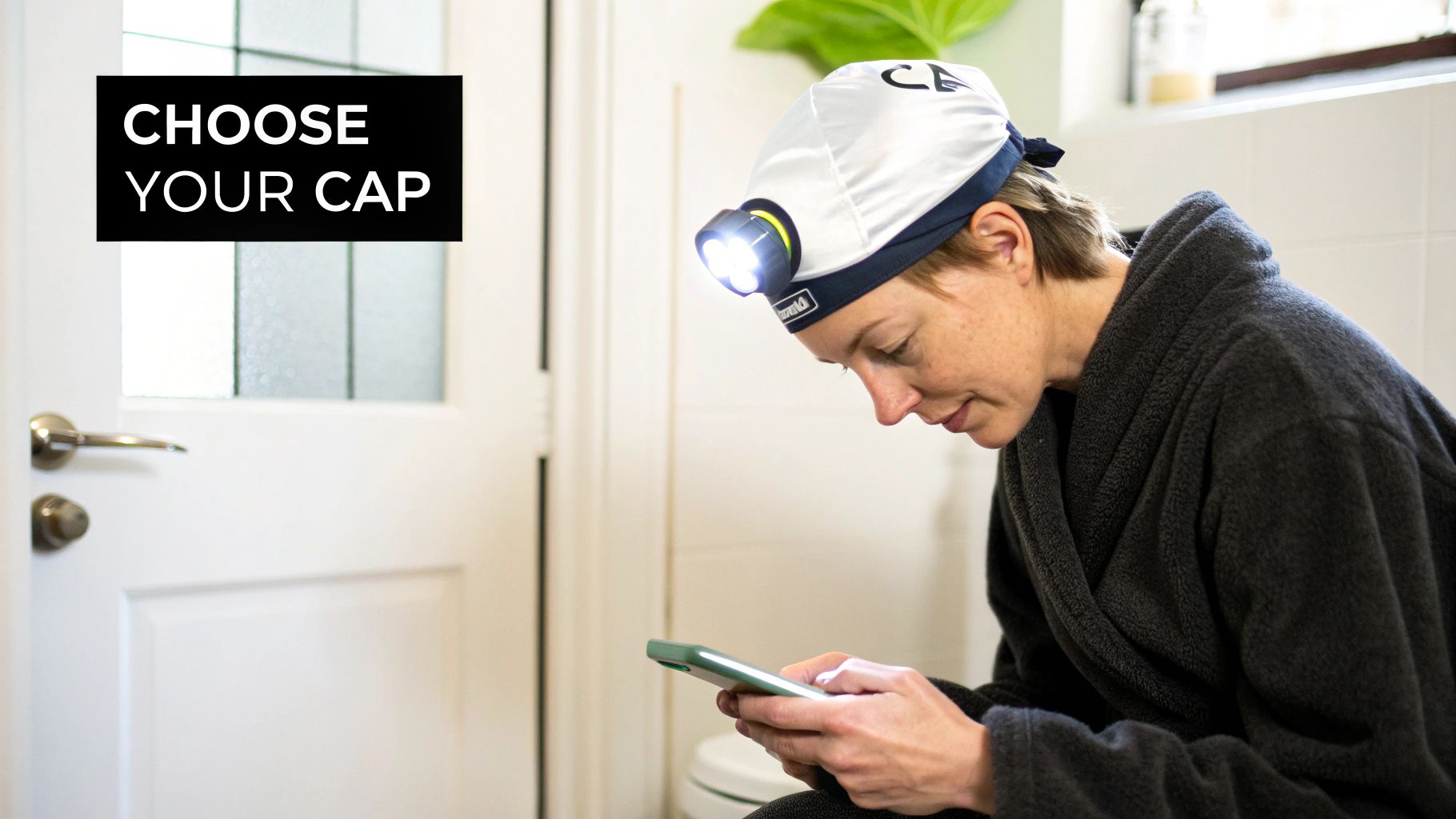
We've gone deep into the science behind LLLT and compared some of the top devices out there. Now comes the practical part: putting all that information to work for you. Choosing the right laser cap isn't just about grabbing the one with the most diodes. It’s about finding the device that genuinely fits your specific type of hair loss, your budget, and—most importantly—your daily life.
Think of it this way: you're creating a personalized plan for tackling hair loss. The best technology in the world won't do you any good if it doesn't align with your needs. Let's walk through a simple way to figure out which cap is your best match.
A Simple Framework for Your Decision
To cut through the noise and find the best laser cap, just ask yourself three key questions. Your answers will immediately help you zero in on the right device.
-
What's the Pattern of My Hair Loss?
- All-Over Thinning: If your hair is losing volume everywhere, you need uniform, widespread coverage. In this case, a full-head cap with a high diode count (200+) is the way to go. It ensures your entire scalp receives consistent light energy.
- Specific Trouble Spots: Are you dealing with a receding hairline or a thinning spot on your crown? A laser band might be a more practical choice. These devices focus their power on one area at a time, delivering a concentrated dose of LLLT right where you need it most.
-
What Does My Day-to-Day Look Like?
- Always on the Go: If your schedule is tight, you need something fast. A cap that requires only 6 minutes a day is easy to slip into a hectic morning routine without feeling like a burden.
- More Time at Home: If your days are a bit more flexible, a longer session of 25-30 minutes a few times a week could be a better fit. You can easily wear it while watching TV or scrolling through your phone, making the treatment time fly by.
-
What's My Budget?
- Your investment should be in quality, not just a brand name. Always look for devices that use medical-grade lasers and have FDA clearance. The upfront cost might be higher, but the peace of mind and better results from a proven, safe device are worth it in the long run.
I always tell my patients this: The best laser cap is the one you'll actually use. A top-tier device will do absolutely nothing for you if it's just collecting dust. Be honest with yourself about your lifestyle and pick a cap that slots into your life, not one that forces you to change it.
How to Maximize Your Long-Term Success
Once you've picked your device, success boils down to two things: consistency and tracking your progress.
- Make It a Habit: The easiest way to stay consistent is to "stack" the treatment with something you already do every day, like making your morning coffee or brushing your teeth. Tying it to an existing habit makes it automatic.
- Take Progress Photos: It's hard to notice slow, gradual changes when you look in the mirror every day. Take clear, well-lit pictures of your hair from the same angles once a month. This creates an objective record and is the best way to see how far you've come.
- Be Patient: LLLT is a marathon, not a sprint. You need to give it time. Stick with your routine for at least six months before you start looking for significant results.
Knowing where you started is key. To get a professional baseline, you can take a hair density test to measure your hair's thickness before you begin treatment. By following these simple steps, you're not just buying a device—you're committing to a process designed to deliver the best possible outcome.
Laser Cap FAQs: Your Questions, Answered
Alright, you've gone through the specs and comparisons, but a few practical questions are probably still rattling around in your head. Let's tackle those common "what ifs" so you can move forward with confidence.
How Long Until I See Results from a Laser Cap?
This is a long game, so patience is key. Most guys first notice a slowdown in shedding within the first 3 to 6 months of consistent use. You might even spot some new, fine vellus hairs starting to pop up.
For more noticeable changes in thickness and density, you’ll want to look at the 6 to 12-month mark. The real magic happens when you stick to the schedule. LLLT needs that consistency to work on your hair follicles through their entire growth cycle.
Can I Use a Laser Cap with Other Hair Loss Treatments?
Absolutely. In fact, many experts recommend it. Think of it as a combined-arms assault on hair loss—you’re hitting it from multiple angles, which often produces the best results.
Low-level laser therapy works differently on a cellular level than drugs like minoxidil or finasteride. Since they target different pathways, they can work together beautifully. This combination can create a synergistic effect, giving you a better outcome than you’d get from just one treatment alone. Just make sure to run it by your doctor before you start mixing and matching treatments.
Is a More Expensive Laser Cap Always Better?
Not always. It's easy to assume that a higher price tag or more diodes means a better device, but that’s not the whole story. The quality of the lasers matters far more than the sheer number of them.
The most crucial factors are medical-grade lasers (not just LEDs), FDA clearance that verifies safety and effectiveness, and sufficient power output to actually stimulate the hair follicles. A well-built cap with fewer high-quality lasers will consistently outperform a cheap one stuffed with hundreds of weak LEDs.
Instead of getting fixated on the diode count, focus on the verified specs and the clinical evidence behind the device. You're investing in proven technology, not just a flashy number on the box.
At PRP For HairLoss, our mission is to arm you with clear, evidence-based information for your hair restoration journey. To dive deeper into other treatments like PRP therapy, check out our extensive guides and resources at https://prpforhairloss.com.

 PRP For Hairloss
Leave a comment