If you're exploring ways to tackle hair loss, you’ve probably bumped into the term Platelet-Rich Plasma, or PRP, therapy. In a nutshell, it's a non-surgical treatment that harnesses the healing power of your own blood to wake up dormant hair follicles. It's all about using your body's natural growth factors to increase hair thickness and density, essentially creating a personalized "super serum" to encourage regrowth.
Unlocking Your Body's Potential to Fight Hair Loss

Seeing more hair on your brush or catching a glimpse of a thinner spot in the mirror can be a real blow to your confidence. The hair loss market is a minefield of products that promise the world but often fail to deliver. That’s where PRP therapy for hair loss stands out as a genuinely different option.
Instead of relying on synthetic chemicals or going under the knife, PRP taps into the incredible regenerative capabilities already built into your system. It’s a treatment that’s all about helping your body heal and restore itself from the inside out.
A Natural Approach to Hair Regrowth
The process itself is refreshingly straightforward. It all starts with a simple blood draw, no different than what you'd have at a routine doctor's appointment. That blood sample is then placed in a special machine called a centrifuge, which spins it at high speed to separate it into its different components.
This spinning process isolates the platelet-rich plasma, a concentrated, golden liquid teeming with powerful growth factors. This "liquid gold" is then meticulously injected into the areas of your scalp that need it most. The whole idea is to give those tired, underperforming hair follicles a direct boost, encouraging them to get back to the business of growing hair.
By concentrating these platelets, we're essentially delivering a powerful biological signal directly to the follicles, telling them to repair and grow. It's less of an intervention and more of a powerful nudge in the right direction.
To give you a clearer picture, here’s a quick summary of what the treatment involves.
PRP Therapy at a Glance Key Information
| Aspect | Summary |
|---|---|
| Treatment Goal | Stimulate dormant hair follicles to promote new growth and increase hair thickness. |
| Procedure | A three-step process: draw blood, process it to isolate PRP, then inject it into the scalp. |
| Source Material | Uses the patient's own blood, minimizing the risk of allergic reactions or side effects. |
| Session Duration | Typically takes about 30 to 60 minutes per session. |
| Treatment Plan | Usually involves an initial series of 3 to 4 treatments spaced 4 to 6 weeks apart. |
| Maintenance | Follow-up treatments are often recommended every 6 to 12 months to maintain results. |
| Recovery | Minimal downtime; most people can return to their daily activities immediately. |
This table provides a snapshot, but understanding the 'why' behind its growing popularity is just as important.
Why Is PRP Gaining Attention?
So, what's all the buzz about? A massive part of its appeal is how safe and natural it is. Since you're using your own biological material, the chances of your body rejecting it or having a bad reaction are incredibly low. It’s a treatment that works with your body, not against it.
In this guide, we'll walk you through the science, the process, and what you can realistically expect. We’ll dive into the evidence behind the question of does PRP really work for hair loss and arm you with the knowledge to decide if it's the right path for your hair restoration journey. Our goal is to cut through the noise and give you the clear, honest information you need.
How PRP Wakes Up Sleeping Hair Follicles
Think of your scalp like a garden where some flowerbeds have gone dormant. The plants aren't dead, they've just stopped growing. PRP therapy for hair loss is like a targeted, organic fertilizer made from your own body, designed to gently coax those "sleeping" hair follicles back to life.
This isn't some synthetic chemical concoction. It's a clever process that taps into the powerful healing and regenerative systems you already have. We're simply concentrating your body's natural repair crew and putting them to work right where you need them most: your scalp.
The Three-Step 'Liquid Gold' Process
The real elegance of PRP therapy lies in its simplicity. The entire treatment is based on your own biology and unfolds in three distinct stages, each one crucial for concentrating the growth factors that kickstart hair follicles.
First, a small amount of your blood is drawn, just like a routine lab test. This sample is the raw material, containing red blood cells, white blood cells, plasma, and, most critically, the platelets. The platelets are the real heroes of this story.
Next, that blood sample is placed in a centrifuge. This device spins at an incredibly high speed, separating the blood into its different parts by density. This process isolates the platelet-rich plasma (PRP)—a golden-colored liquid now packed with a much higher concentration of platelets than what's normally found in your blood. This is exactly why it's often called "liquid gold."
Finally, this concentrated PRP is carefully injected into the areas of your scalp where the thinning is happening. The entire goal is to deliver this potent serum directly to the base of those dormant hair follicles.
This visual breaks down the simple journey from a standard blood draw to the final scalp injection.
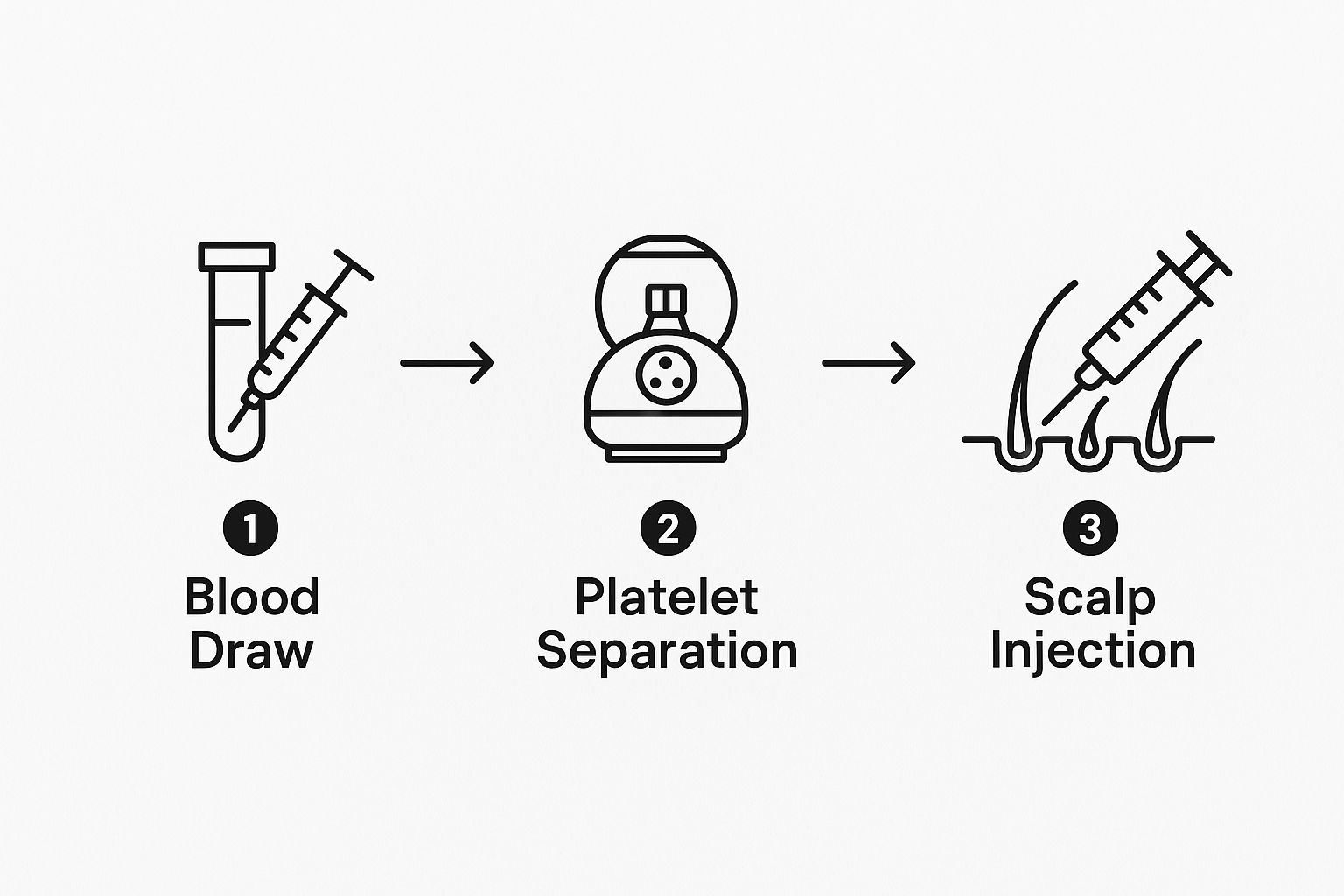
As you can see, the infographic neatly illustrates how your own blood is processed and turned into a powerful treatment to rejuvenate your hair.
The Science Behind Waking Up Follicles
So, what actually happens when this "liquid gold" gets into your scalp? The platelets spring into action almost immediately, releasing a cascade of powerful proteins called growth factors. These are the primary communicators in your body's natural healing and repair mechanisms.
Think of these growth factors as messengers arriving with urgent instructions for your hair follicles. They deliver signals that trigger several important things at once:
- Boost Cell Growth: They signal the cells at the base of your hair follicle to start dividing and multiplying, essentially telling them it's time to build a new hair.
- Improve Blood Supply: They help create new, tiny blood vessels around the follicles. This increased circulation means more oxygen and nutrients can get to the hair root, creating a much healthier environment for growth.
- Extend the Growth Phase: Hair follicles cycle through resting and growing phases. These growth factors help push follicles out of the resting phase (telogen) and into the active growth phase (anogen), and crucially, help them stay there longer.
In short, PRP therapy starts a natural conversation with your scalp. It's not introducing a foreign substance; it’s just amplifying your body's own repair signals in the specific areas that need a boost.
This targeted stimulation is what makes PRP therapy for hair loss so effective. It’s not some superficial treatment that just sits on the skin. Instead, it gets to the root of the problem by revitalizing the cellular processes that have slowed down over time, helping your follicles get back to a healthier, more productive state.
What to Expect: Your PRP Treatment Journey from Start to Finish
Knowing the science behind PRP is one thing, but what does the treatment actually feel like? Let's walk through what you can expect when you come in for your appointment, from the first conversation to the final follow-up.
It all starts with an initial consultation. This is more than just a formality; it’s where a specialist takes a close look at your hair loss, discusses what you're hoping to achieve, and figures out if PRP is the right move for you. This is the perfect time to ask all your questions and get a real, honest sense of the potential results.
A Typical Treatment Day
On the day of your appointment, the entire process is surprisingly quick—usually taking less than an hour from start to finish. Your comfort is a priority, so the first step is often applying a topical numbing cream to your scalp. This cream takes about 20-30 minutes to fully kick in, making sure the treatment area is nice and desensitized.
While you're waiting for the numbing cream to do its thing, a small amount of your blood will be drawn, just like a routine lab test. That blood sample is then spun in a centrifuge, a machine that separates the platelet-rich plasma—the "liquid gold"—from the other components.
Once your scalp is numb, the practitioner will carefully inject the concentrated PRP into the specific areas where your hair is thinning. These injections are very shallow and quick, designed to deliver the growth factors right to the base of the hair follicles. Most guys say it feels like mild pressure or a series of tiny pinches, but it’s generally not described as painful.
The whole in-office experience is designed to be as easy as possible. From the simple blood draw to the final injection, the focus is on keeping you comfortable while getting the PRP exactly where it needs to be.
After the injections are done, you’re pretty much good to go. There’s virtually no downtime. Your scalp might feel a little tender or look a bit red for a few hours, but you can get right back to your day.
Unpacking the Treatment Schedule
It’s important to understand that PRP therapy for hair loss isn’t a one-and-done solution. Think of it more like a workout plan for your hair follicles—consistency is what gets you the best, most lasting results.
A standard protocol typically looks something like this:
- Initial Phase: You'll start with a series of three treatments, usually scheduled about four to six weeks apart. This initial round really gets the ball rolling, flooding the scalp with growth factors to wake up dormant follicles.
- Maintenance Phase: After that initial series, you’ll switch to a maintenance schedule. Most experts recommend a follow-up treatment every 6 to 12 months to keep the results going strong and the follicles active.
This structured approach is backed by solid research. For instance, one study found that men who had three PRP sessions four weeks apart saw a significant boost in hair density. The average hair count jumped from about 41 hairs/cm² to 66 hairs/cm²—an improvement of roughly 62%.
Proper aftercare is also a crucial piece of the puzzle. Following your provider's instructions will help you recover smoothly and get the most out of every session. For a detailed rundown, check out our guide on after PRP hair treatment care. Understanding the full timeline from the get-go helps you set clear expectations and feel confident about the process.
Understanding the Benefits and Potential Risks
Whenever you’re looking into a treatment for hair loss, it’s just plain smart to look at both sides of the coin. Knowing the good, the bad, and the unlikely helps you make a decision you can feel good about. PRP therapy for hair loss has some really compelling upsides, but it’s just as important to be aware of the minor risks.
The Major Upsides of PRP Therapy
Perhaps the biggest draw for many people is that PRP is an incredibly natural and safe option. The entire treatment is built around a concentrate made from your own blood. Because of this, the chances of having an allergic reaction or your body rejecting the treatment are practically zero. It’s a therapy designed to work with your body, not against it.
This natural approach often leads to results you can actually see and feel. For most men who undergo a successful PRP plan, the goals are simple: more hair density and less shedding. And often, that's exactly what they get.
By injecting a powerful cocktail of your own natural growth factors right where they're needed—at the hair follicle—PRP gives them a serious wake-up call. The result is often thicker, stronger hair strands. Many of my patients don't just see more hair; they tell me it feels healthier and more substantial.
The numbers back this up, too. In my experience and in clinical studies, PRP hair therapy can have a success rate between 70% and 80%, especially for men in the earlier stages of hair loss. These are the guys who usually see the best boost in density and a real slowdown in the amount of hair they're losing.
Acknowledging the Potential Downsides
Let’s be realistic—no medical procedure comes with zero potential side effects. The good news with PRP is that the side effects are almost always minor and don't stick around for long. Remember, the procedure involves a series of small injections into your scalp, so a little bit of temporary discomfort is part of the process.
Most of these issues are confined to the scalp and clear up on their own within 24 to 48 hours. Knowing what to expect makes the whole experience much smoother.
Here's what you might encounter for a day or so:
- Mild Soreness: It's common for your scalp to feel a bit tender or sensitive after the injections.
- Minor Swelling: A little bit of puffiness right at the injection sites is perfectly normal and goes down quickly.
- Redness or Bruising: You might see some slight redness or tiny bruises, but these fade within a few days.
It's also worth mentioning that a very small percentage of people might get a temporary headache or feel a bit of pressure on their scalp right after the treatment. Think of these as signs that your body is responding to the injections and the powerful plasma is getting to work. For a complete rundown, you can check out our detailed guide on PRP hair treatment side effects.
When you weigh it all up, the risks tied to PRP therapy for hair loss are very low. This is especially true when you compare it to invasive surgeries or daily medications that can affect your whole body. It's a procedure done right in the clinic by trained professionals, making sure you’re safe and comfortable from start to finish.
Are You a Good Candidate for PRP Therapy?
While PRP therapy for hair loss is a fantastic option for stimulating new growth, it's not a silver bullet for every single person. Figuring out if it's the right fit for you is the most important first step, because the treatment works best when it's used for the right person at the right time.
The single biggest factor? The health of your hair follicles. Think of PRP as a powerful fertilizer. It can do wonders to revive a wilting garden, but it can’t bring plants back from the dead.
The Sooner, The Better: Why Early Hair Loss Responds Best
PRP therapy delivers its most impressive results for people in the earlier stages of androgenetic alopecia, what most of us just call male pattern baldness. In this phase, your follicles are still there—they're just shrinking, weakening, and going dormant. They're still alive, which means they can still be saved.
The growth factors packed into your platelet-rich plasma act like a wake-up call for these sleepy follicles. They send a flood of natural signals that boost blood supply, deliver critical nutrients, and nudge the follicles back into their active growth phase.
But here’s the crucial part: if hair loss has progressed to the point of smooth, shiny baldness, it means the follicles in that area are likely gone for good. PRP can't create brand new follicles out of thin air. This is why timing is so critical. Acting early gives you a much higher chance of success. You can learn more about how PRP helps male pattern baldness in our dedicated guide.
Here's the bottom line: PRP is a revitalization treatment, not a resurrection treatment. It works on follicles that are weak but still present, which is why it's so effective for men who are just starting to see their hair thin out.
Your Health Plays a Big Part
Your overall health is another piece of the puzzle. Since PRP therapy uses your own blood, the quality of your plasma is a direct reflection of your body's health. A healthier you means a more potent treatment.
Several factors can affect whether you're a good candidate and what kind of results you can expect:
- General Health: People who are in good overall health tend to respond better. Your body's ability to heal and regenerate is simply stronger.
- Smoking: This is a big one. Nicotine constricts your blood vessels, which can seriously reduce blood flow to the scalp and undermine the treatment's effectiveness.
- Medical History: Certain conditions, particularly blood disorders or autoimmune diseases, might mean PRP isn't the best option for you. It's vital to be completely upfront with your provider about your medical history.
Ultimately, the only way to know for sure is to book a consultation. A specialist can take a close look at your scalp, determine your specific stage of hair loss, and go over your health background. This process sets realistic expectations and confirms if PRP therapy for hair loss is a safe and promising choice for you.
Breaking Down the Cost of PRP Hair Treatments

When you're looking into PRP therapy for hair loss, one of the first things on your mind is, "What's this going to cost me?" It's a perfectly practical question, and understanding the investment is a crucial step in deciding if this is the right path for you. So, let’s get straight to it and break down what you can expect.
The price for PRP isn't a simple, flat fee. It’s an investment in yourself, and a few key things can shift the final number. Much like any specialized medical service, the price often reflects the provider’s expertise and where their clinic is located.
A session in a major city like New York or Los Angeles will almost certainly have a higher price tag than one in a smaller town. The clinician's reputation and years of experience also play a big role—you're paying for their skill and the quality of their results.
What Determines the Price Tag
So, what exactly goes into the final cost? When a clinic sets its pricing for PRP, a few variables are always at play. Knowing what they are can help you see the value behind the numbers.
Here’s a look at the main factors that shape the cost:
- Geographic Location: Clinics in big urban areas simply have higher operating costs, and that gets reflected in their pricing.
- Clinic and Provider Expertise: A board-certified dermatologist who specializes in hair restoration will understandably charge more than a general practitioner, and their track record often justifies it.
- Technology Used: Not all equipment is created equal. The quality of the centrifuge used to spin your blood directly impacts how concentrated the platelets are, which can affect both the results and the price.
It's also important to remember that PRP therapy for hair loss is almost always considered a cosmetic procedure. That means you should plan on it being an out-of-pocket expense, as health insurance is highly unlikely to cover it.
It helps to think of this as an investment rather than just a cost. When you stack it up against the much higher price of hair transplant surgery or the ongoing, lifelong expense of medications, PRP often presents a really compelling middle ground.
The demand for these treatments is climbing, and fast. The U.S. market for PRP and similar hair loss therapies was recently valued at USD 255.20 million and is projected to keep growing. This trend shows just how many people are looking for effective, minimally invasive ways to restore their hair. You can discover more insights about these market trends on grandviewresearch.com.
Getting a Realistic Price Range
Okay, let's talk numbers. What can you actually expect to pay? On average, a single PRP session will likely fall somewhere between $750 and $1,500.
Keep in mind that the initial treatment protocol almost always involves a series of sessions. Most clinics recommend starting with three treatments, which puts the total initial investment in the range of $2,250 to $4,500.
Of course, the only way to get a firm number is to book a consultation for a personalized quote. To help you plan your budget, we've put together a complete guide on the PRP hair treatment cost. It's the best way to set clear financial expectations as you start your hair restoration journey.
Got Questions About PRP? Let's Get Them Answered
Even after getting into the science and the costs, you probably still have a few questions floating around. That’s perfectly normal. Getting straight answers is the only way to feel confident about deciding if PRP therapy for hair loss is right for you.
Let's tackle some of the most common things men want to know.
When Will I Actually See a Difference?
This is the big one, and the key here is patience. PRP works with your body's own hair growth cycle, so it’s not an overnight fix. The first thing most guys notice is that they're shedding a lot less hair, which usually happens within two to three months after the first few sessions.
From there, you'll start to see more noticeable improvements. Between months three and six, you can expect to see and feel an increase in hair thickness and density. The most dramatic, final results often take up to a year to fully appear as those rejuvenated follicles produce stronger, healthier hair.
Okay, But Does It Hurt?
I get it, needles in the scalp sound intimidating. But honestly, most men find it much more manageable than they expect. Before anything starts, a strong topical numbing cream is applied to your scalp, which does a great job of dulling the sensation.
When the injections happen, you might feel a bit of pressure or a quick, mild pinch. It’s not uncommon to have some tenderness or even a dull headache for a day or so afterward, but that fades quickly.
The bottom line is this: while it's not completely sensation-free, the whole process is designed to be as comfortable as possible. A little bit of temporary discomfort is often a very small price to pay for the potential payoff.
Can I Use PRP with Other Hair Loss Treatments?
Absolutely. In fact, many doctors encourage it. Think of PRP as one tool in your toolbox—it often works best when combined with other proven treatments to attack hair loss from multiple angles.
Creating this kind of synergistic effect can really amplify your results. Some of the most effective combinations include:
- Topical Minoxidil (Rogaine): This works on the surface to help support the new growth that PRP kicks into gear from within.
- Oral Finasteride: This pill works internally to block DHT, the hormone behind male pattern baldness. Using it with PRP means you're fighting the problem from the inside out and the outside in.
Just make sure you talk everything over with your doctor. They can help you build a comprehensive plan that’s both safe and tailored to your specific hair loss situation.
How Long Will My Results Last?
The results from PRP therapy for hair loss are significant and long-lasting, but they aren't permanent. Why? Because the underlying genetic or hormonal factors causing your hair loss are still there. The initial round of treatments gives your follicles a powerful boost to wake them up and get them healthy again.
To keep that momentum going, you’ll need to schedule maintenance treatments. Most experts recommend a follow-up session every 6 to 12 months. These appointments act like a booster shot, keeping your hair follicles stimulated and preserving the thickness and health you’ve worked to achieve.
At PRP For HairLoss, we know that clear, honest information is your best weapon in the fight against hair loss. If you’re ready to see how this could work for you, visit us at https://prpforhairloss.com to learn more.


Leave a comment