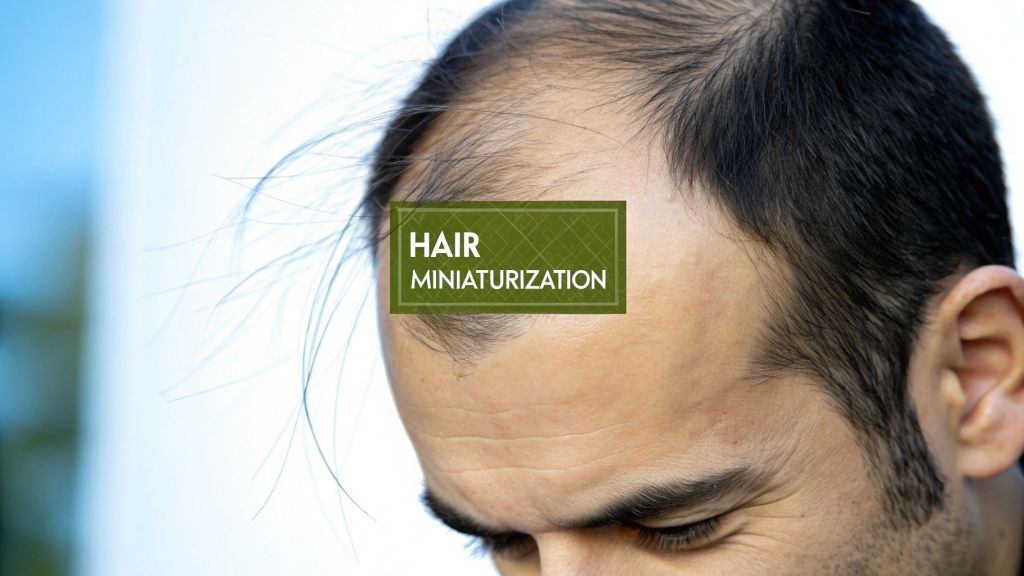
Ever run your hands through your hair and feel like it’s just not as thick as it used to be? You’re not imagining things. This isn't about sudden clumps of hair falling out; it’s a far more subtle process called hair miniaturization.
Essentially, your hair follicles—the tiny anchors in your scalp that grow hair—begin to gradually shrink. As they get smaller, the hair they produce becomes progressively thinner, shorter, and weaker. It’s a slow-motion transformation where your strong, healthy hair is quietly replaced by fine, wispy strands, often long before you notice any real bald spots.
The Unseen Shift: What Hair Miniaturization Really Means
Think of your scalp like a garden. In a thriving garden, each plant is robust, growing from a deep, well-nourished root. Your hair follicles are those roots. Hair miniaturization is like a slow-moving drought that only affects certain parts of the garden. The roots don’t just shrivel up and die overnight; they simply get smaller and weaker, producing a less impressive plant season after season.
This gradual decline is the core of what hair miniaturization is. It’s a shift in the quality of your hair that happens long before you see a major change in quantity. You might not find extra hair on your pillow, but you might notice your ponytail feels thinner or your part looks a little wider.
The Science Behind the Shrinking
Every single hair on your head follows a natural rhythm of growing, resting, and eventually shedding. Miniaturization throws a wrench in this well-oiled machine. With each new cycle, the affected follicle shrinks just a little bit more.
This has a few direct consequences:
- Thinner Strands: The actual diameter of the hair shaft gets smaller, making each hair feel finer and less substantial.
- Shorter Length: The hair's growth phase (known as the anagen phase) is cut short, meaning it simply can't grow as long as it used to.
- Lighter Color: As the follicle weakens, it also produces less pigment, which can make the hair appear lighter and less visible against the scalp.
This transition from thick, colored "terminal" hairs to fine, barely-there "vellus-like" hairs is the hallmark of androgenetic alopecia—what we commonly call male or female pattern baldness. When a specialist examines a scalp experiencing hair loss, one of the key things they look for is this mix of thick and thin hairs. It's a dead giveaway that miniaturization is in full swing.
A Quick Comparison
To really see the difference, it helps to put the two side-by-side. The changes might seem small at first, but they add up to a significant visual impact over time.
| Characteristic | Healthy (Terminal) Hair Follicle | Miniaturized (Vellus-Like) Hair Follicle |
|---|---|---|
| Follicle Size | Large and deep-seated in the scalp | Small and shallow |
| Hair Diameter | Thick and coarse | Thin and fine |
| Hair Length | Can grow long (long growth phase) | Remains short (short growth phase) |
| Pigmentation | Richly colored | Pale or colorless |
| Scalp Coverage | Provides dense coverage | Offers minimal coverage |
This table clearly shows how a once-mighty follicle becomes a shadow of its former self, producing hair that’s a fraction of its original size and strength.
From Forest to Field
Here’s one more way to think about it: imagine a lush, dense forest. Hair miniaturization is the slow-motion process of that forest turning into a sparse field. The towering trees (your healthy terminal hairs) are gradually replaced by smaller, weaker saplings (the miniaturized hairs). Eventually, the overall canopy thins out, letting a lot more sunlight reach the forest floor—or, in this case, your scalp.
Understanding this is the first real step toward doing something about it. Miniaturization isn’t an overnight disaster; it’s a long-term progression. And that means there are windows of opportunity to intervene. Catching the signs early is crucial because most treatments work best to protect and bolster the follicles you still have, not to bring back ones that have gone completely dormant. Getting familiar with the hair growth cycle provides a much deeper understanding of why timing really is everything.
Why Your Hair Follicles Are Shrinking
So we know hair miniaturization is about follicles shrinking, but what's actually kicking off this whole process? For the vast majority of people with pattern hair loss, it boils down to a one-two punch of your genes and your hormones.
This isn't your fault—it's a biological script that plays out under the surface. Think of it like this: your DNA hands certain hair follicles a blueprint that makes them extra sensitive to a particular hormone. When that hormone makes its presence known, it sets off a chain reaction that leads straight to thinning hair.
The Hormone Behind the Havoc: DHT
The main culprit in this story is a hormone called Dihydrotestosterone, or DHT for short. DHT is a potent offshoot of testosterone, made when an enzyme called 5-alpha reductase gets involved. While DHT is important for developing certain male characteristics, it becomes a real problem for those hair follicles that are genetically predisposed to be sensitive to it.
Imagine your hair follicle has a tiny receptor, like a keyhole. For most people, regular testosterone doesn't fit this specific lock, so it just passes by. DHT, however, is shaped in a way that allows it to bind perfectly to this receptor on sensitive follicles.
Once it's locked in, DHT sends a disruptive signal that essentially tells the follicle to shorten its growth phase and start shrinking. To really dig into this, you can learn more about the link between DHT and hair loss.
It's crucial to understand that DHT isn't inherently bad. The real issue is the genetic sensitivity of the follicles. This explains why one person can have high DHT levels and a full head of hair, while another starts to thin out with much lower levels. It's all about how your follicles are programmed to react.
The Cycle of Decline
Once DHT gets a foothold, a follicle doesn't just shrivel up overnight. It's a slow, gradual retreat that occurs over many hair growth cycles. Each time a hair sheds and a new one starts growing, the follicle is a little smaller and produces a weaker hair than the last time.
This gradual weakening is what the diagram below shows so well—the journey from a robust, healthy follicle to one that's barely there.
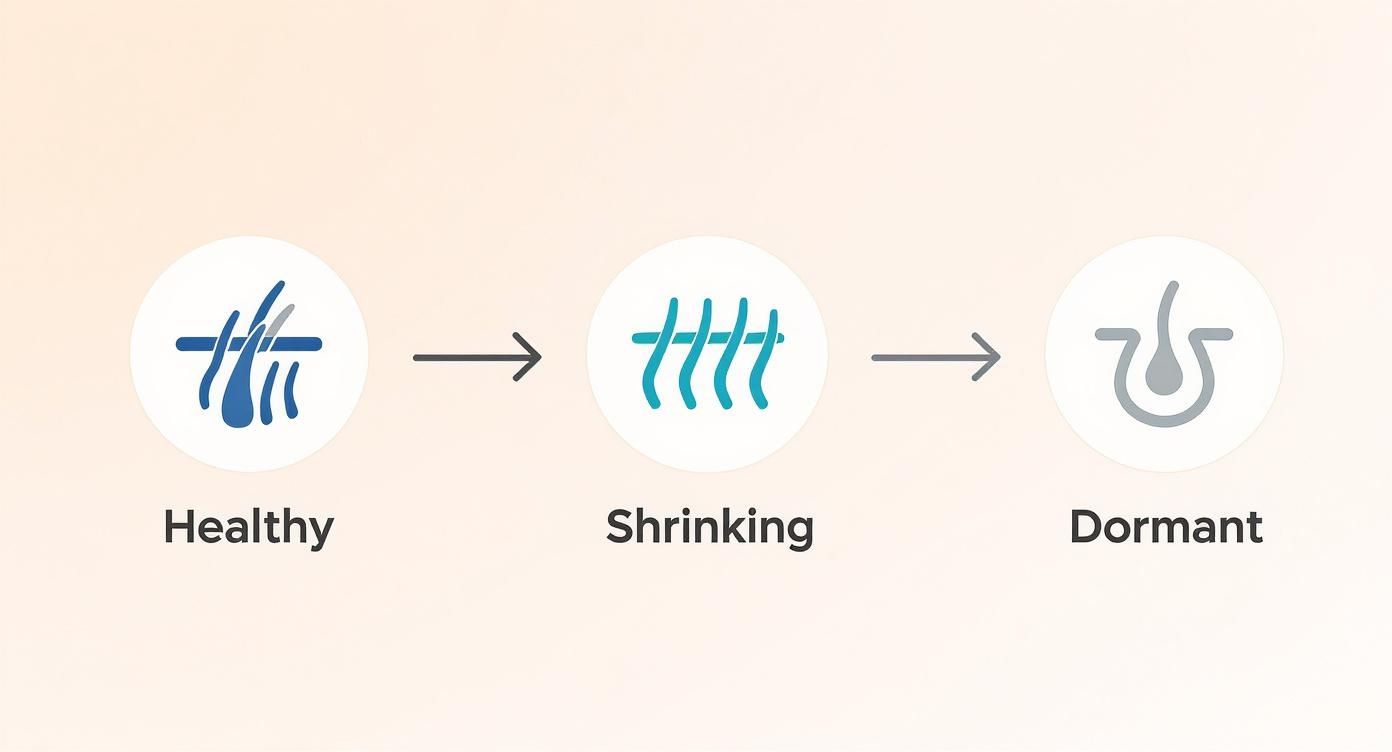
As you can see, it's a slow burn. This process can unfold over years, sometimes even decades. With every cycle, the anagen (growth) phase gets shorter while the telogen (resting) phase gets longer. In other words, your hair spends less time actively growing and more time just sitting there before it falls out.
Here’s a step-by-step look at that downward spiral:
- Healthy Stage: A large, healthy follicle produces a thick, pigmented terminal hair that grows for years.
- DHT Influence: DHT latches onto the follicle's receptors, triggering the miniaturization process.
- Shorter Growth Phase: In the next hair cycle, the hair that emerges is a bit thinner and doesn't grow for as long.
- Repeated Cycles: This pattern repeats. Each new hair is progressively finer, shorter, and lighter in color as the follicle continues to shrink.
- Dormancy: Finally, the follicle becomes so small it can only produce a tiny, invisible "peach fuzz" hair (a vellus hair), or it might just give up entirely and go dormant.
This slow, relentless cycle is precisely why hair loss often creeps up on you. You're not shedding massive clumps of hair at once. Instead, your strong, healthy hairs are gradually being replaced by weaker, thinner versions until the overall loss of density becomes obvious. Getting a handle on this mechanism is the first step toward figuring out how to interrupt the cycle.
Spotting the Early Warning Signs of Hair Miniaturization
Knowing the science behind shrinking follicles is one thing, but actually seeing it happen in the mirror is a completely different ballgame. The first clues are usually so subtle that we write them off as a "bad hair day" or just normal shedding. The real sign isn't a massive clump of hair in the shower drain; it's the quiet, almost sneaky, changes in your hair's overall character and density.
Often, the very first hint is a slow loss of volume. Maybe your hair just doesn't hold a style like it used to, or that ponytail feels a bit thinner than it did last year. These are the real-world signs that the underlying structure of your hair is shifting, long before you notice a significant drop in the actual number of hairs on your head.

How to Be Your Own Hair Detective
To catch miniaturization early, you have to know what to look for. Forget the dramatic scenes of hair falling out and tune into these far more telling signals.
- A Widening Part: This is one of the classic early signs, especially for women. If your part line seems to be getting wider, it's because the hairs along that line are getting finer and providing less scalp coverage.
- More Scalp Showing: Do you see your scalp more easily, particularly under bright lights or when your hair is wet? That's a direct result of individual hair shafts thinning out, which lets more light pass through to the skin.
- A Change in Texture: Pay close attention to how your hair feels. You might notice some areas—often the crown or temples—feel softer, finer, or almost "fluffy" compared to the rest. This happens when you have a growing number of miniaturized hairs mixed in with your healthy, terminal ones.
This process is incredibly common. In fact, 95% of male hair loss is driven by androgenetic alopecia, the very condition defined by miniaturization. By age 50, about half of all men show noticeable signs. That number jumps to roughly 80% by age 80, which just goes to show how widespread this biological process really is.
The Dead Giveaway: Hair Diameter Diversity
If there's one definitive sign you can spot yourself, it's something we call hair diameter diversity. It sounds technical, but the concept is simple. It just means that within one small patch of your scalp, you have a mix of thick, healthy hairs growing right next to thin, wispy, almost see-through ones.
Think of it like a lawn. A healthy, thriving lawn is uniform, with thick, green blades of grass. A lawn that's struggling will have a mix of those healthy blades alongside weak, thin, and yellowing ones. Your scalp works the same way. This visible variation is a clear signal that while some follicles are thriving, others are actively shrinking.
This is exactly what a dermatologist or trichologist is looking for when they examine your scalp. Using a specialized magnifying tool called a dermatoscope, they get an up-close view of the hair shafts. Seeing a significant mix of thick and thin hairs is one of the most reliable clinical signs to confirm a diagnosis of androgenetic alopecia.
Learning to spot these clues yourself gives you the power to act sooner. For anyone wanting to track these changes more formally, it helps to understand how the pros do it. Our guide on how to measure hair density breaks down how experts quantify these subtle shifts, giving you a baseline to monitor your hair over time.
The Path of Miniaturization: What to Expect Next
Realizing your hair follicles are shrinking brings up an immediate and critical question: where is this all heading? If you just let it run its course, hair miniaturization follows a predictable, though very slow, path. This is a journey that unfolds over years, not weeks, and the patterns are so consistent they've been mapped out by experts.
This progression isn’t random. For men, the journey almost always follows the Norwood Scale, a seven-stage visual guide that charts the typical routes of male pattern baldness. It often starts with a receding hairline at the temples (Stage II) and a thinning spot on the crown (Stage III Vertex). Over time, these areas expand and merge until only a wreath of hair around the back and sides remains (Stage VII).
Women experience this differently, in a pattern described by the Ludwig Scale. Instead of a receding hairline, women usually see diffuse thinning across the top of the scalp. It begins with a widening part (Stage I) which becomes progressively more obvious (Stages II and III), though the frontal hairline typically stays intact.
The Marathon of Hair Loss
It's crucial to think about this process in the right way. Hair miniaturization is a marathon, not a sprint. The full timeline, from a head of thick, healthy hair to noticeable thinning, can take anywhere from 15 to 25 years. Of course, the exact pace varies a lot from person to person.
This slow-motion process is actually a good thing. It gives you a huge window of opportunity to step in and do something about it.
Your follicles don't just give up overnight. They put up a real fight, trying to cycle back again and again, even as they get weaker. It's this built-in resilience that makes early treatment so effective. You aren’t trying to bring dead follicles back to life; you’re stepping in to support the ones that are still fighting.
The most important thing to understand is this: time is your greatest ally. The sooner you act, the more healthy—and semi-healthy—follicles you have to work with. Waiting until the thinning is advanced means you’re fighting a much tougher, uphill battle.
Setting Realistic Expectations
So, what can you actually hope to achieve? The prognosis for hair miniaturization depends almost entirely on when you start taking action. It's really a game of preservation and potential regrowth.
Here’s a practical look at what you can expect, based on where your follicles are in their journey:
- Healthy Follicles: The main goal here is protection. Treatment aims to shield these follicles from the damaging effects of DHT, keeping them strong and productive for as long as possible.
- Miniaturizing Follicles: These are the prime targets for any intervention. Treatments can slow or even stop the shrinking process. In many cases, they can even partially reverse it, helping the follicle produce a thicker, longer hair once again.
- Dormant Follicles: Once a follicle has shrunk so much that it no longer produces a visible hair and the pore has effectively scarred over, it's extremely difficult to revive. At this point, the follicle is gone for good, and regrowth is highly unlikely.
This is exactly why managing your expectations is key. The goal of treatment isn't to magically regrow a full head of hair on a bald scalp. The realistic—and achievable—goal is to stop further loss and thicken the hair you already have.
By supporting the follicles that are still in that shrinking phase, you can see a real improvement in overall density and scalp coverage. Acting early gives you the best possible shot at keeping a good head of hair for years to come.
Proven Strategies to Fight Hair Miniaturization
Understanding what hair miniaturization is and seeing the signs is the first step. The next, more important step is deciding what to do about it. Thankfully, you're not going into this fight empty-handed. Years of research have given us several effective, evidence-backed treatments that can interrupt the shrinking process and give your follicles a fighting chance.
This is your battle plan. We'll cut through the marketing fluff and focus on the strategies that actually work. The goal here isn't a magic cure; it's about using science to hold onto the hair you have and, in many cases, help it reclaim some of its former strength and thickness.

Finasteride and Minoxidil: The FDA-Approved Cornerstones
When it comes to clinically proven options, two names consistently lead the pack: Finasteride and Minoxidil. They’ve been rigorously tested and have earned FDA approval specifically for hair loss, but they work in completely different ways.
Finasteride gets right to the hormonal root of the problem. Its job is to block the 5-alpha reductase enzyme—the catalyst that turns testosterone into follicle-assaulting DHT. By drastically lowering DHT levels in the scalp, Finasteride essentially takes away the main trigger for miniaturization. It's like changing the locks so DHT's key no longer works.
Minoxidil, on the other hand, works directly on the follicle itself. First developed as a blood pressure medication, its ability to grow hair was a happy accident. As a vasodilator, it widens blood vessels to boost blood flow, bringing more oxygen and nutrients straight to the hair root. It’s also thought to open up potassium channels in the follicles, which helps stretch out the anagen (growth) phase, giving miniaturized hairs more time to grow thicker and stronger before they're shed.
A critical thing to remember is that these aren't "one and done" treatments. Consistency is everything. They protect your follicles day after day, and if you stop, the miniaturization process will unfortunately pick right back up where it left off.
Platelet-Rich Plasma (PRP): An Emerging Powerhouse
Beyond the daily medications, other therapies are showing real promise in giving follicles a direct jolt of energy. One of the most talked-about is Platelet-Rich Plasma (PRP) therapy. The process is straightforward: a specialist draws a small amount of your own blood, spins it in a centrifuge to isolate the platelets, and then injects this concentrated "liquid gold" back into the areas of your scalp that need it most.
So, why platelets? They are your body’s natural emergency response team, loaded with powerful growth factors that kickstart healing and tissue regeneration. The idea is that delivering a super-concentrated dose of these growth factors directly to your struggling follicles can help wake them up and encourage a healthier, more robust growth cycle. If you want to get into the nitty-gritty, our guide on how to stimulate hair follicles breaks down the entire process.
Many people use PRP as a powerful complement to Finasteride and Minoxidil to give their follicles an extra, targeted boost.
Comparing Top Treatments for Hair Miniaturization
Choosing the right treatment—or combination of treatments—really comes down to your specific situation, your lifestyle, and a frank discussion with a doctor or dermatologist. To help you get a clearer picture, here’s an at-a-glance guide to the most common treatments, breaking down how they work, who they're best for, and what kind of results you can realistically expect.
| Treatment | How It Works | Best For | Realistic Outcome |
|---|---|---|---|
| Finasteride | Reduces scalp DHT levels, addressing the hormonal cause of miniaturization. | Men with androgenetic alopecia, particularly for stopping progression and preserving hair. | Halting or significantly slowing hair loss; some users experience noticeable regrowth and thickening. |
| Minoxidil | Improves blood flow and extends the hair's growth phase by acting directly on the follicle. | Both men and women looking to stimulate growth and thicken existing hairs. | Slowing loss and promoting regrowth, which is often most visible on the crown. |
| PRP Therapy | Uses growth factors from your own blood to stimulate and rejuvenate struggling follicles. | Individuals seeking a non-daily treatment to complement other therapies and boost overall follicle health. | Improved hair thickness and density; results can vary quite a bit from person to person. |
Ultimately, the goal is to find the right tool for the job. Each of these options plays a unique role in the fight against miniaturization.
Building a Complete Strategy
A truly effective game plan often involves more than just one therapy; it's about creating a totally supportive environment for your hair. Once you understand the mechanics of miniaturization, layering in practical, at-home solutions is a smart next step. You can find some great proven tips on how to thicken thinning hair that can work alongside these medical treatments.
The best strategy is always a personalized one. The keys to success are starting early, staying consistent, and having realistic expectations. By taking decisive action with proven treatments, you can actively push back against hair miniaturization and give your hair the best possible chance to thrive.
When to See a Doctor for Your Hair Thinning
Trying to figure out what's happening on your head can feel like a guessing game, and let's be honest, self-diagnosis usually leads to more anxiety than answers. If you’ve started noticing your hair isn't as thick as it used to be, the single most important thing you can do is get a professional opinion. It’s the only way to know for sure if you're dealing with hair miniaturization or if something else is going on.
Not all hair loss is created equal. Things like a vitamin deficiency, a wonky thyroid, or even a period of intense stress can cause shedding that, at first glance, looks a lot like genetic hair loss. If you start treating the wrong problem, you'll just end up frustrated and no closer to a solution.
Key Signs It’s Time for a Consultation
So, when is it time to pick up the phone? While any hair thinning that bothers you is a good enough reason, a few specific signs should make booking an appointment a top priority.
- You See Sudden or Patchy Loss: If your hair is falling out in clumps or you’re seeing distinct bald patches, this could point to something other than miniaturization, like alopecia areata.
- Your Scalp is Red, Itchy, or Painful: Discomfort is a major red flag. These symptoms often signal an underlying inflammatory issue or infection that needs a doctor's attention.
- You Have Other Symptoms: When hair loss comes with fatigue, sudden weight changes, or new skin problems, it’s a strong hint that a bigger health issue might be the real culprit.
- You're Simply Worried: Honestly, peace of mind is invaluable. If your hair is causing you stress, getting a clear answer from an expert is the best first step you can take.
What to Expect at Your Appointment
Setting up a meeting with a dermatologist or a trichologist—a specialist who focuses entirely on hair and scalp health—is you taking control of the situation. These experts have the experience and the right tools to see what’s truly happening with your hair follicles.
A professional will likely start by using a dermatoscope. Think of it as a high-powered magnifying glass for your scalp. It lets them see the “hair diameter diversity”—that classic mix of thick, healthy hairs and wispy, miniaturized ones—which is the hallmark of androgenetic alopecia.
They’ll also review your full medical history and may run some blood tests to rule out any other potential causes. This comprehensive approach is all about creating a treatment plan that’s actually built for you. If you're not sure where to begin, you can find out more about what doctor you should see for hair loss to get pointed in the right direction. Taking this step is the most reliable way to get an accurate diagnosis and a plan that gives you the best shot at success.
Your Top Questions About Hair Miniaturization, Answered
When you first start researching hair loss, a lot of new terms and concepts come up. Let's clear the air and tackle some of the most common questions we hear about hair miniaturization.
Can Miniaturized Hair Grow Back Fully?
This is the big question, and the honest answer is: it's complicated. Complete reversal is highly unlikely, especially if the hair loss has been progressing for a while. The real goal of treatment isn't to bring back every lost hair, but to stop the shrinking process in its tracks and coax those weakened, miniaturized hairs back to health.
Think of it this way: a follicle in the early stages of miniaturization is like a struggling plant. With the right care, you can often nurse it back to a healthier state. But once a follicle goes completely dormant and the scalp tissue closes over it, it's essentially gone for good. That's why jumping on treatment early gives you the best possible shot at preserving your hair density.
Is Hair Miniaturization Just a Fancy Term for Shedding?
Not at all. They're two totally different things happening on your scalp, even though they can sometimes overlap.
- Hair Shedding: This is when you see whole, full-length hairs falling out. It’s often a temporary reaction to something like stress, a recent illness, or a big change in diet. The hair follicle itself is usually fine; it's just pushing out the old hair prematurely.
- Hair Miniaturization: This is a much sneakier, long-term process. The hair doesn't necessarily fall out in clumps. Instead, with each growth cycle, the hair that comes back is a little thinner, shorter, and weaker than the one before it.
The key difference is a change in hair quality, not just the quantity of hairs you see in the drain.
Knowing which one you're dealing with is crucial. Shedding might resolve on its own once you fix the trigger. Miniaturization, on the other hand, requires a dedicated, long-term plan to protect your follicles from shrinking further.
Do Stress and Diet Really Affect Miniaturization?
Absolutely. While your genes and hormones are the main culprits behind pattern hair loss, your lifestyle choices can pour fuel on the fire. If genetics loads the gun, chronic stress and a poor diet can certainly help pull the trigger.
To be clear, stress or a bad diet won't give you male or female pattern baldness if you don't already have the genetic tendency for it. But for those who are genetically susceptible, these factors can create an internal environment that speeds up the miniaturization process.
That’s why a holistic approach works best. A balanced diet and good stress management are foundational for healthy hair follicles. While they can't replace medical treatments that target the root hormonal cause, they are an essential part of giving your hair its best fighting chance.
At PRP For HairLoss, we're committed to giving you clear, straightforward information. We find that when people truly understand the science behind what's happening to their hair, they feel more empowered to choose the right path forward. Dive into our resources to see how treatments like Platelet-Rich Plasma work and find out if it’s the right fit for your hair restoration journey.
 PRP For Hairloss
Leave a comment