Here’s the simple truth about how PRP works: it’s a natural healing process, just supercharged. We're essentially taking a concentrated dose of your own blood’s most powerful healing agents—the platelets—and using them to kickstart dormant hair follicles. Think of it as a rescue mission for your hair, using your body's own elite repair crew to get things growing again.
Unpacking the Basics of PRP for Hair Loss
Imagine your blood has a specialized construction team on standby 24/7. This team is made up of tiny cells called platelets, and they're packed with powerful proteins known as growth factors. Normally, when you get a cut or injury, these platelets rush to the scene to stop the bleeding and begin repairs. Platelet-Rich Plasma (PRP) therapy simply gathers a massive crew of these "workers" and deploys them exactly where you need them most—your scalp.
It all kicks off with a simple blood draw, just like one you’d get at a routine physical. That blood then goes into a machine called a centrifuge, which spins at an incredibly high speed to separate the blood into its different components. One of those layers is a concentrated, golden-colored fluid we call PRP, or "liquid gold." This stuff is packed with 5 to 10 times the normal concentration of platelets. You can dive deeper into the science by reading our guide on what is Platelet-Rich Plasma.
Once prepared, this powerful solution is carefully injected into the specific areas of your scalp where hair is thinning.
PRP's Key Players and Their Roles in Hair Regrowth
To really get how PRP works, it helps to know who the main players are. Each component has a specific job to do when it comes to waking up your hair follicles.
"PRP therapy leverages the intrinsic healing power within your own blood. By concentrating platelets, we are essentially amplifying the natural signals that tell your body to repair and regenerate tissue, including dormant hair follicles."
This targeted approach gives your follicles the exact resources they need to shift from a resting state back into an active growth phase. To make it even clearer, this table breaks down the essential elements and what they do.
PRP's Key Players and Their Roles in Hair Regrowth
| Component | Primary Function | Goal for Hair Follicles |
|---|---|---|
| Platelets | The "delivery trucks" that carry growth factors. | To transport a powerful dose of healing proteins directly to the follicle. |
| Growth Factors | The "construction crew" that signals cells to repair and grow. | To "wake up" dormant follicles and encourage new cell production. |
| Plasma | The liquid medium that carries platelets and nutrients. | To provide a supportive environment for the platelets to do their work. |
Essentially, the plasma delivers the platelet-packed solution right to the follicle's doorstep, where the growth factors get to work signaling the follicle to start growing hair again. It's a beautifully simple and natural system.
The Science Behind Unlocking Your Body's Healing Power
To get a handle on how PRP actually works for hair loss, we need to peek at the powerful biology happening right under your skin. Think of your blood as a delivery system. Flowing within it are tiny, disc-shaped cells called platelets—they're basically your body's dedicated paramedics.
When you get a cut, these platelets are the first ones on the scene. They rush in, clump together to form a clot, and then release a potent cocktail of proteins known as growth factors. These growth factors are like foremen on a construction site, shouting out orders to start the healing and rebuilding process.
The Growth Factors: Engines of Regeneration
PRP therapy is all about gathering a high concentration of these "foremen" and putting them to work directly on your scalp. By spinning down your blood to isolate the platelets, we create a powerful serum packed with the exact growth factors hair follicles need to get back on track.
Two of the most critical players here are:
- Platelet-Derived Growth Factor (PDGF): This is a key signaling protein that helps build new blood vessels. More blood flow means more oxygen and nutrients reaching the hair follicles, which is essential for strengthening them.
- Vascular Endothelial Growth Factor (VEGF): This one is a master at creating new blood vessels, a process called angiogenesis. A healthy, dense network of tiny capillaries surrounding each follicle is non-negotiable for sustained hair growth.
When this concentrated blend of growth factors is injected into the scalp, it acts like a powerful wake-up call to hair follicles that have become lazy, dormant, or are starting to shrink. It’s a direct message telling them it’s time to get back to work.
This visual represents the core concept—using your own blood to spark new hair growth.

As you can see, the process is straightforward: we start with a blood sample, isolate the valuable platelets, and then use them to trigger regeneration right at the follicle level.
How PRP Signals Your Hair Follicles to Grow
At its heart, the science of PRP taps into your body's own natural healing cascade. We're simply concentrating this healing power and directing it with precision. While we’re focused on hair, this same fundamental principle shows incredible promise in other areas of medicine. For instance, in studies on bone injuries, the healing rate for patients treated with PRP was 85.8%, a massive jump compared to the 60.76% rate in the group that didn't receive it.
We're just applying that same regenerative logic to the scalp. The growth factors in PRP do more than just boost blood flow—they also help kick follicles out of their resting phase (telogen) and back into the active growth phase (anagen). To get a better feel for this, you can learn more about the different stages of the hair growth cycle in our detailed guide.
The real beauty of PRP is that we aren't introducing anything foreign into your system. It's just a way to amplify your body's own natural healing ability and point it exactly where you need it most: the roots of your hair.
PRP's effectiveness comes from its ability to orchestrate these complex cellular responses and even help manage inflammation. If you're curious about the broader biological systems involved in healing, you can learn more about how nitric oxide fights inflammation. It gives you a bigger picture of the amazing things your body can do.
Ultimately, by re-energizing the environment around the follicles, PRP helps strengthen the hair you have, cuts down on shedding, and nudges dormant follicles to start producing new, healthy strands again. It’s a targeted biological boost using the best tools nature gave you—your own.
What to Expect During Your PRP Treatment
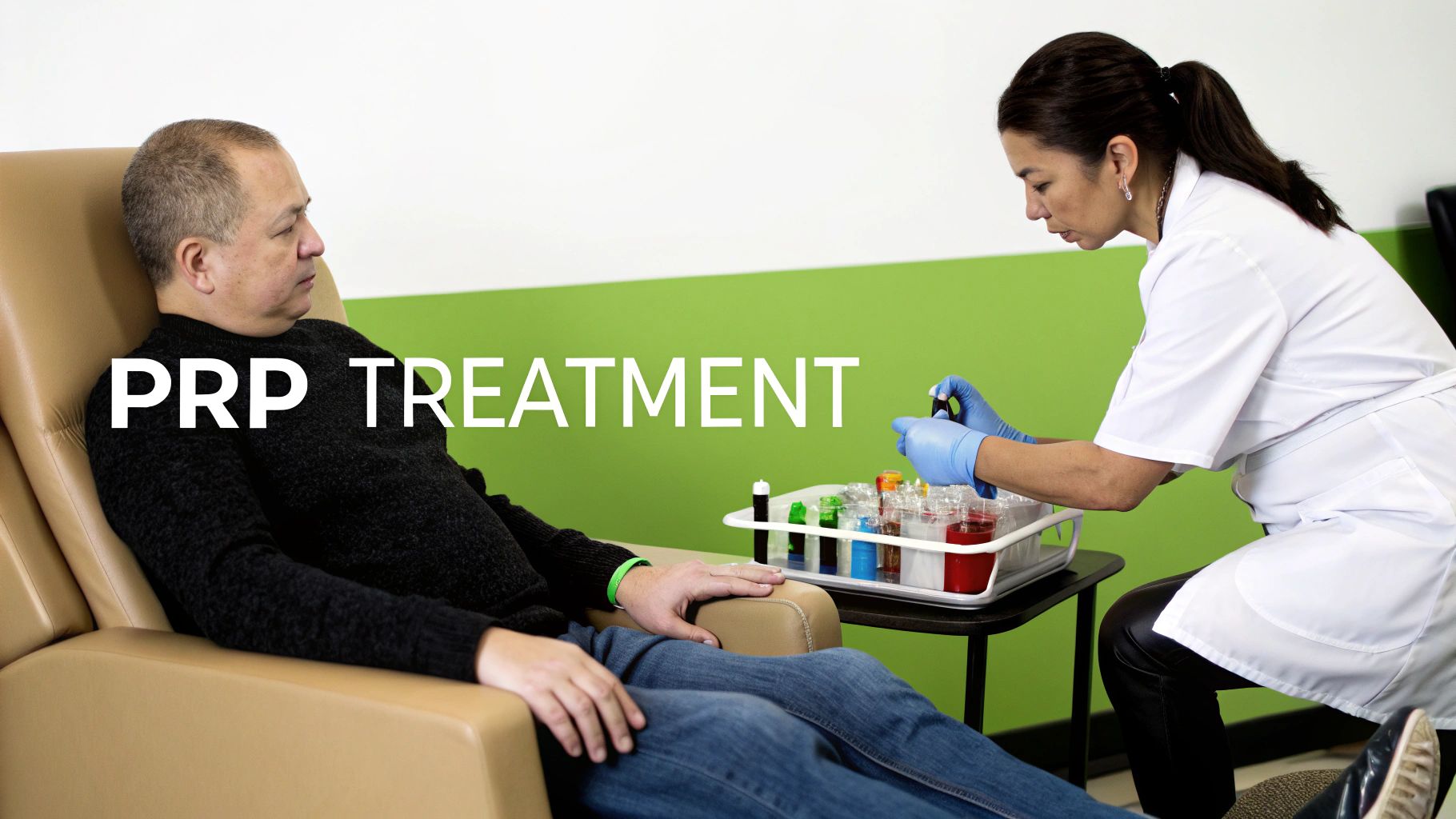
Walking into a clinic for the first time can feel a bit daunting, especially when you don’t know what’s involved. The good news is that a PRP session for hair loss is surprisingly straightforward—and probably quicker than you imagine.
It’s often called a "lunchtime procedure" for a reason. Most sessions wrap up in less than an hour, letting you get back to your day with minimal fuss. Let's break down exactly what happens from the moment you sit down in the chair.
Step 1: The Blood Draw
Your PRP journey starts with something you’ve likely done before: a simple blood draw. A clinician will take a small sample of blood from your arm, usually just one or two vials. It’s no different than the routine blood test you’d get at a check-up.
That’s it. This quick, familiar step provides all the raw material needed to create your personalized PRP treatment.
Step 2: Creating the “Liquid Gold”
Now for the interesting part. Your blood sample is placed into a machine called a centrifuge, which is basically a high-speed spinner. For the next 10 to 15 minutes, the centrifuge separates your blood into three distinct layers based on their density.
Here’s how it breaks down:
- Red Blood Cells: The heaviest cells settle at the very bottom.
- Platelet-Poor Plasma (PPP): The lightest part of the plasma floats to the top.
- Platelet-Rich Plasma (PRP): A thin, yellowish middle layer is isolated. This is the "liquid gold."
This concentrated PRP layer is packed with a powerful dose of platelets and growth factors—about 5 to 10 times more potent than what’s normally circulating in your bloodstream. The clinician carefully extracts this solution, getting it ready for the final step.
Step 3: The Injections
With the PRP prepared, it's time to deliver it where it's needed most. First, your practitioner will thoroughly clean your scalp. Comfort is key, so don't worry about this part being painful.
Most clinics will apply a topical numbing cream or use a cooling device on your scalp before starting. This helps ensure you feel little more than a few minor pinpricks during the process.
Using a very fine needle, the practitioner makes a series of shallow injections across the areas of thinning hair. These small, targeted injections place the growth-factor-rich PRP directly at the base of your dormant or weakened hair follicles. The whole injection process itself usually only takes a few minutes.
For an even more granular view of the clinical side, you can explore a full overview of the PRP procedure for hair.
Once the last injection is done, you’re finished. There’s typically no downtime, meaning you can walk right out and get back to your life. It’s that convenient.
Your PRP Results Timeline
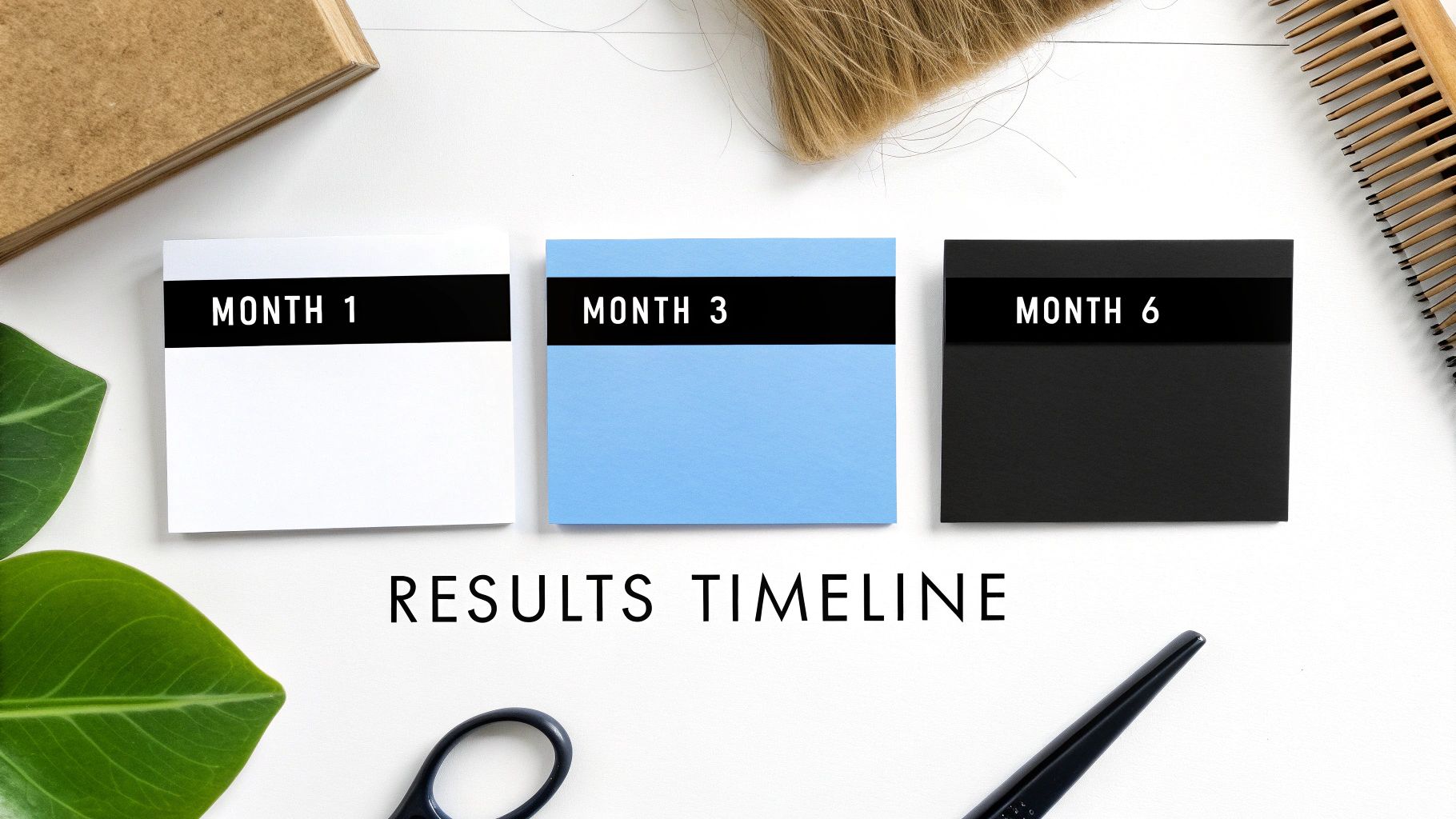
Let's cut to the chase. The biggest question on everyone's mind is, "When will I actually see a difference?" With PRP, it's crucial to understand that you're playing the long game. This isn't a quick fix; it's a biological process that taps into your body's own hair growth cycle.
Think of it this way: you're not just patching a problem, you're nurturing a garden. It takes time for the seeds to sprout. Patience and consistency are going to be your best friends here. The changes happen slowly, steadily, and underneath the surface long before you see them in the mirror.
The First Month: Laying The Foundation
Right after your first session, don't expect to see new hair. It's just not going to happen. The real work is taking place invisibly, deep in your scalp. The injected growth factors are busy waking up sluggish follicles, boosting blood supply, and calming the inflammation that often chokes out hair growth.
Your scalp might feel a little tender for a day or two, but that’s about it. The main focus here is on healing and preparation. This is the "tilling the soil" phase—it’s absolutely essential, but you won't see any sprouts just yet.
Months Two To Four: The First Green Shoots
This is where things start to get interesting. Somewhere around the three-month mark, most people start to see the first real signs that things are moving in the right direction. But it's probably not what you'd expect.
The first victory is usually a major decrease in hair shedding. You'll notice fewer hairs on your pillow, in the shower drain, or in your comb. That’s a massive win! It means your existing hair follicles are getting stronger. Shortly after, you might start to spot some fine, baby-like hairs (we call them vellus hairs) popping up.
Months Five To Six: Seeing Real Density
By the time you hit the six-month point, the results should be much more obvious. Those little vellus hairs have had time to grow up—becoming thicker, darker, and longer. This is when you'll look in the mirror and notice a genuine improvement in density and less visible scalp.
Each treatment builds on the last. It's the cumulative effect of the sessions that creates a healthy environment for your hair to thrive. It’s a lot like hitting the gym; one workout does very little, but consistent effort over several months delivers results you can see and feel. You can dive deeper into this journey with our complete PRP hair treatment timeline.
Your PRP Journey Month by Month
To help you visualize the road ahead, here’s a straightforward breakdown of what to expect and when. This timeline tracks the typical progress following a full series of treatments.
| Timeframe | What to Expect | Key Milestones |
|---|---|---|
| Month 1 | Minimal visible change. Scalp is in the "repair and prepare" phase. | Reduced inflammation and improved blood flow at the follicular level. |
| Months 2-3 | Noticeable decrease in daily hair shedding. | The first sign that follicles are strengthening. Less hair in the shower drain. |
| Months 3-4 | Emergence of fine, new "vellus" hairs in treated areas. | Visible, albeit subtle, new growth begins. |
| Months 5-6 | Existing hair feels thicker. New hairs begin to mature and darken. | Noticeable improvement in hair density and scalp coverage. |
| Months 6-12 | Continued improvement in thickness, density, and overall hair quality. | Peak results from the initial series of treatments become apparent. |
Remember, this is a typical progression, and individual results can vary based on your specific pattern of hair loss and how your body responds.
Why A Full Series Of Treatments Is Non-Negotiable
One PRP session is just an introduction; a full series is what actually creates meaningful change. Most specialists recommend starting with 3 to 4 sessions, spaced about a month apart. This repeated stimulation is what it takes to truly kick dormant follicles back into gear.
Consistency is what turns potential into progress. Each PRP session reinforces the healing signals sent to your follicles, building momentum that leads to more noticeable and sustainable hair growth over time.
This principle holds true across medicine. Studies on PRP for other conditions, like joint pain, consistently show a dose-response relationship. The more treatments patients receive (up to a certain point), the better their results. That’s why sticking to the recommended schedule isn't just a suggestion—it's the key to getting the outcome you're hoping for.
Are You a Good Candidate for PRP Therapy?
While the science behind PRP is solid, it's not a silver bullet for everyone dealing with hair loss. The success of the treatment really comes down to choosing the right candidates—people whose specific type of hair loss is primed for this kind of biological jumpstart. Figuring out if that’s you is the first step to setting realistic expectations.
The best results are almost always seen in people who are in the earlier stages of male pattern baldness (androgenetic alopecia). The key is that your hair follicles need to be dormant, not dead. Think of it like this: PRP is an alarm clock for sleeping follicles, not a miracle worker for follicles that are gone for good. It needs something there to work with.
The Profile of an Ideal Candidate
So, who gets the most out of this treatment? Typically, it's men who've noticed their hair thinning or their hairline receding in the last few years. If you look closely and can still see very fine, vellus-like hairs in those thinning spots, that's a fantastic sign. It means the follicles are still alive and have a real shot at being revived.
You're probably a strong candidate if you tick these boxes:
- You have noticeable thinning, but not complete baldness. The goal is to thicken existing hair and wake up weak follicles, not to grow hair on a completely smooth scalp.
- Your hair loss is fairly recent. The sooner you tackle the problem, the more viable follicles you have to work with, which almost always leads to a better outcome.
- You're in good overall health. Your body's healing ability is what powers this treatment, so being healthy gives the PRP a much better foundation to work from.
When PRP Might Not Be the Best Option
It’s just as important to know who PRP isn't for. This isn't a one-size-fits-all solution, and certain things can seriously lower the odds of seeing the results you want.
If you have extensive, long-term baldness where the follicles have been gone for many years, you're unlikely to see much regrowth. At that stage, the follicles have likely miniaturized to the point of no return. Certain underlying health conditions can also get in the way of the treatment's effectiveness.
Candidacy is about matching the right tool to the right problem. For PRP, the problem it solves best is thinning hair and dormant follicles, not areas where follicles have been gone for a long, long time.
It's also worth remembering that results can vary, even among perfect candidates. The effectiveness of PRP isn't a guarantee, and we see this across medicine. For example, when used for chronic tendon injuries, one major meta-analysis found that the success rate was around 54.8%, defined as relieving over half the symptoms. While that's a different part of the body, it shows that how one person responds can be very different from the next. You can get more details from the full study on PRP's success rates.
Ultimately, there’s only one way to know for sure if PRP is the right move for you: sitting down with a specialist for a proper consultation.
Common Questions About PRP for Hair Loss
Even after getting into the science, it's natural to have some practical questions bubble up. When you're looking at a treatment like PRP, you want to feel sure about everything—from what it feels like in the chair to what the long-term plan looks like. We've put together the questions we hear most often.
Our goal here is to clear up those practical, real-world concerns. Let's get these questions answered so you can feel confident making a decision.
Is the PRP Injection Process Painful?
Let's be direct: needles are involved, so you're going to feel something. But "painful" isn't the word most people end up using. It’s more of a quick, manageable stinging or a series of pinpricks.
Any good clinic makes your comfort a top priority. They’ve got a few tricks up their sleeve to take the edge off. Before anything starts, they’ll usually apply a strong topical numbing cream to your scalp and let it sit for a while.
Beyond the cream, they might also use:
- Cooling Devices: A stream of cold air aimed at the treatment area works wonders to numb the skin and distract you from the needle.
- Vibrating Tools: A small handheld device that vibrates near the injection site can actually confuse the nerve signals, making the pricks feel a lot less intense.
- Nerve Blocks: This is less common, but for very sensitive patients, a local anesthetic can be injected to numb a larger section of the scalp.
With these techniques, any discomfort is over quickly. Most people leave the clinic feeling just fine, maybe with a little bit of scalp tenderness that fades by the next day.
How Much Does PRP for Hair Loss Typically Cost?
This is the big one, and the answer has a pretty wide range. In the U.S., a single PRP session for hair loss generally costs anywhere from $500 to $2,500. Where a clinic falls in that range depends on a few key things.
The final price tag is influenced by:
- Geographic Location: A clinic in downtown Manhattan will naturally have higher overhead and prices than one in a smaller city.
- Clinic Reputation and Expertise: You're paying for experience. A top specialist with a proven track record is going to command a higher fee.
- Technology Used: The quality of the equipment, especially the centrifuge that separates your blood, plays a role in the cost.
Remember, this isn't a one-shot deal. You’ll need an initial series of treatments—usually three to four sessions spaced about a month apart—to really get the ball rolling. So, when you're budgeting, think about the total cost of that initial package.
It's really important to know that PRP for hair loss is almost always seen as a cosmetic procedure. That means your health insurance won't cover it. You should plan on this being an out-of-pocket expense.
Are the Results from PRP Permanent?
That's a great question because it gets right to managing expectations. The results from PRP can be fantastic and last a long time, but they aren't technically "permanent." It’s much healthier to think of PRP as a powerful, ongoing management strategy, not a one-and-done cure.
The reason is simple: PRP stimulates your existing hair follicles, but it doesn't switch off the genetic or hormonal signals causing male pattern baldness in the first place. That underlying process will continue if you don't do anything to maintain your results.
To protect your investment and keep your hair looking good, you'll need tune-up sessions after the initial round. Most doctors recommend a maintenance treatment every 6 to 12 months. Think of it like getting the oil changed in your car—it’s just what you do to keep things running smoothly and prevent problems down the road.
Can I Combine PRP with Other Hair Loss Treatments?
Not only can you, but you probably should! For many people, the most powerful strategy is a multi-pronged attack. Combining PRP with other proven treatments lets you fight hair loss from several different angles, often leading to a much better outcome.
PRP works by providing a direct biological boost of growth factors to your follicles. Other treatments work in completely different ways, and when you put them together, they can create a powerful synergy.
Some of the most effective combinations include:
- PRP and Minoxidil (Rogaine): Minoxidil is a topical that works by increasing blood flow to the scalp. More blood flow means more nutrients for the follicles, which perfectly complements the growth-factor-rich environment PRP creates.
- PRP and Finasteride (Propecia): Finasteride is a pill that tackles the root hormonal cause of hair loss by blocking DHT. By stopping the hormonal assault while PRP stimulates repair, you're hitting the problem from both sides.
- PRP and Laser Therapy (LLLT): Low-level laser therapy (think laser caps) uses specific wavelengths of red light to energize the cells in your follicles. Adding this into a PRP routine is like giving your hair a third source of stimulation.
While PRP is incredibly safe since it's derived from your own body, it’s always smart to be fully informed. To get a complete overview, you can read our detailed guide on potential PRP hair treatment side effects.
At PRP For HairLoss, we believe that clear, honest information is the best tool for fighting hair loss. We're dedicated to helping you understand all your options so you can choose the path that's right for you. Explore our resources to learn more about how to reclaim your confidence.

 PRP For Hairloss
Leave a comment