Catching a glimpse of your changing hairline in the mirror can feel like a shock, especially when you're only 20. It's easy to feel like you're the only one this is happening to, but a receding hairline at 20 is actually far more common than you'd believe. This isn't a sign you're unhealthy or did something wrong—it's usually the first sign of a predictable, genetic process known as male pattern baldness.
You Are Not Alone With a Receding Hairline At 20
That moment of realization can be jarring. You might feel like you're the only guy your age dealing with this, but trust me, you're in very good company. The feeling of being singled out is totally normal, yet the statistics paint a much different picture.
In reality, around 20-25% of men who have male pattern baldness start seeing thinning hair or a receding hairline before they even hit 21. This early start is almost always due to androgenetic alopecia, a hereditary condition you can thank your family tree for.
Understanding What's Happening
So, what’s actually going on up there? Think of your DNA as a set of instructions. For some men, those instructions tell the hair follicles at the temples and crown to become overly sensitive to a hormone called dihydrotestosterone (DHT). Over time, DHT causes these follicles to shrink, producing shorter, finer hairs until they eventually stop growing altogether. That's why the shape of your hairline starts to change.
It’s crucial to understand this isn't a personal failure—it's just biology. This is an important distinction to make as you figure out how to handle it. Many guys immediately wonder if this is the beginning of the end for their hair. To learn more, check out our guide on what age baldness starts.
To help track this progression, experts created a simple visual guide.
The Norwood scale is a classification system doctors use to measure the different stages of male pattern baldness. It runs from Stage 1 (no significant hair loss) to Stage 7 (the most advanced stage), giving you a clear roadmap of where you are on your journey.
Figuring out your stage on the Norwood scale can actually be empowering. It takes a vague worry and turns it into a measurable starting point. From there, you can track changes and make informed decisions about what to do next. Realizing you're on a well-documented path—one that millions of men have walked before—is the first real step toward taking back control.
The Science Behind Early Male Pattern Baldness
Seeing your hairline start to creep back at 20 can feel completely random and unfair. But what’s happening on your scalp is actually a very specific biological process. It’s not about stress or wearing hats too often; it’s a story written in your genetics and hormones. Once you understand the science, it takes the mystery out of it and puts you in a much better position to act.
Think of your DNA as the master blueprint for your body, and that includes your hair. For some of us, that blueprint contains a specific instruction: a high sensitivity to a powerful hormone called dihydrotestosterone, or DHT.
DHT is a natural byproduct of testosterone. While testosterone is busy building muscle and deepening your voice, DHT plays a different role. In men who are genetically prone to hair loss, DHT essentially becomes the villain for hair follicles at the temples and crown.
The Role of DHT Explained
Picture each hair follicle as a tiny factory that produces a single strand of hair. DHT acts like a key that fits into a lock on the outside of this factory. When it connects, it sends a signal to slow down production.
Over time, this constant signaling causes the hair follicle to shrink. This process, called miniaturization, is the absolute core of male pattern baldness. It doesn't happen overnight, but it’s a slow, steady cycle.
Miniaturization is the gradual shrinking of hair follicles. Each new hair that grows from a miniaturized follicle is thinner, shorter, and weaker than the one before it. Eventually, the follicle just goes dormant and stops producing hair altogether.
This shrinking process is why you might notice your hair feels finer or "wispier" in certain spots long before you see any major recession. Those weaker hairs are a direct result of the follicle losing its strength. Understanding this hormonal and genetic link is crucial, and you can dive deeper into what causes androgenetic alopecia in our detailed guide.
Why Does It Happen So Early?
So, why does this whole process kick into high gear for some guys at 20? It really just comes down to when your genetic "on" switch gets flipped. If early hair loss runs in your family, your follicles are likely programmed to have a more aggressive and much earlier reaction to DHT.
Your body produces DHT your entire adult life, but the sensitivity of your follicles is the real deciding factor. It's not that you suddenly have more testosterone or DHT than your friends who have full heads of hair; it's simply that your hair follicles are far more susceptible to its effects.
This also explains why hair loss follows such a predictable "pattern." The follicles at the back and sides of your head are typically not sensitive to DHT, which is why they usually remain full and healthy even in advanced stages of baldness.
The key takeaway here is that a receding hairline at 20 isn't a sign that you're unhealthy. It's just the visible result of a specific genetic trait interacting with your natural hormones. Once you grasp this fundamental science, the different treatment options start to make a lot more sense, because they are all designed to interfere with this miniaturization process one way or another.
Medical Treatments That Actually Work For Young Men

Alright, understanding the "why" behind your hair loss is one thing, but now it’s time for action. When you're dealing with a receding hairline at 20, the internet feels like a minefield of "miracle" cures and outright scams. Let's cut through that noise and focus on the proven, FDA-approved medical treatments that are the bedrock of any real strategy.
These aren't overnight fixes. Think of them as the most reliable tools in the toolbox for fighting back against male pattern baldness. We're seeing more and more men in their 20s and 30s seeking help, and that’s a good thing—being proactive is the smartest move you can make. You can read more about the trends in young men seeking hair loss treatment on belgraviacentre.com.
The two heavy hitters here are Finasteride and Minoxidil. It's best to think of them as a one-two punch against hair loss, each one tackling the problem from a completely different angle.
Finasteride: The DHT Blocker
Remember how we talked about DHT being the main villain that shrinks your hair follicles? Finasteride goes straight to the source. It’s a daily pill that works as a DHT blocker, specifically by stopping the enzyme (5-alpha reductase) that turns testosterone into DHT in the first place.
By lowering the DHT levels in your scalp, Finasteride basically takes the pressure off your hair follicles. This gives them a fighting chance to recover from the shrinking process, stop further hair loss, and in many cases, even regrow thicker, healthier hair.
Finasteride is like putting up a shield around your hair follicles. It doesn’t create new ones, but it protects the ones you still have from the hormonal attack that’s trying to wipe them out.
Because it works from the inside out, consistency is everything. You have to make it a daily habit, and results take time to show up as your hair growth cycle slowly resets. Most guys notice their hair loss stops within 3-6 months, with real regrowth often taking up to a year. For a deeper dive, check out our guide on if Finasteride can stop hair loss for good.
Minoxidil: The Growth Stimulant
While Finasteride is working internally, Minoxidil gets to work directly on your scalp. It's a topical treatment—usually a liquid or foam—that you apply to your thinning areas every day. We don't know the exact mechanism, but we know it acts as a vasodilator, which is just a fancy way of saying it widens blood vessels.
This boost in blood flow delivers more oxygen and nutrients to your follicles, which can help kickstart them out of a dormant state. It also seems to keep your hair in the anagen (growth) phase for longer.
Think of Minoxidil as fertilizer for your scalp. It creates a richer, more supportive environment for hair to grow, but it doesn't actually stop DHT from causing damage. That’s precisely why it’s so often paired with Finasteride for a more comprehensive, powerful attack.
Comparing Finasteride And Minoxidil
To make it even clearer, here's a simple side-by-side comparison of the two leading FDA-approved treatments. This should help you grasp their key differences and see how they can work together.
| Feature | Finasteride | Minoxidil |
|---|---|---|
| Type | Oral pill (prescription) | Topical liquid or foam (over-the-counter) |
| How it Works | Blocks the conversion of testosterone to DHT | Increases blood flow to the scalp, stimulates follicles |
| Primary Goal | Stops the root cause of hair loss, prevents more loss | Promotes and stimulates new hair growth |
| Best For | Halting hair loss and maintaining existing hair | Regrowing hair in thinning areas, especially the crown |
| Time to See Results | 3-6 months to see hair loss slow, up to a year for regrowth | 4-6 months for visible new growth |
As you can see, they aren't competing against each other; they're playing for the same team. Using both gives you the best of both worlds: a defensive shield (Finasteride) and an offensive growth boost (Minoxidil).
Realistic Expectations And Side Effects
Starting medical treatment requires two things: patience and a realistic mindset. These treatments are incredibly effective, but they aren't magic.
- Consistency is Key: You have to use them as directed, every single day. If you stop, you'll unfortunately lose any ground you've gained within a few months.
- Results Take Time: You will not see a difference overnight. The hair growth cycle is a slow process, so you need to give the medications at least six months to a year before you can judge their full effect.
- Potential Side Effects: Both are generally well-tolerated. Minoxidil can sometimes cause an itchy or dry scalp. A very small percentage of men experience side effects from Finasteride, which is something you should always discuss with your doctor before starting.
The bottom line is that these medical treatments are your scientifically-backed foundation for taking on male pattern baldness. They offer a real, tangible way to get control of the situation, especially when you start early.
Lifestyle Changes That Support Healthy Hair

While you can't fight your genetics head-on with lifestyle tweaks alone, you can absolutely control the environment your hair grows in. Think of it this way: your DNA might have dealt you a certain hand, but your daily habits determine how you play those cards.
Let’s be realistic—these changes won't reverse a genetically driven receding hairline. What they can do is create the best possible conditions for your hair to thrive, supporting any medical treatments you're using and keeping every strand as healthy as possible.
Dial in Your Nutrition for Stronger Hair
Your hair follicles are like tiny factories that need the right raw materials to produce strong hair. If your diet is off, your body will always prioritize vital organs over hair growth, and your follicles get short-changed.
Making sure you get enough of these key nutrients is a simple but powerful first step:
- Iron: This is non-negotiable for producing hemoglobin, which carries oxygen to your cells. The cells that stimulate hair growth need that oxygen to do their job properly.
- Zinc: Zinc is a workhorse for hair. It plays a huge role in tissue growth and repair, and it helps keep the oil glands around the follicles functioning as they should.
- Biotin: Famous for a reason, this B-vitamin helps your body produce keratin—the very protein your hair is made of.
Focus on whole foods first. You'll find these nutrients in things like spinach, lentils, eggs, nuts, and lean meats. While supplements have their place, nothing beats getting your vitamins and minerals from a well-rounded diet. You can find more practical tips right here: how to boost hair growth naturally.
Manage Stress to Protect Your Growth Cycle
Chronic stress can absolutely wreck your hair. When you're constantly stressed out, your body pumps out the hormone cortisol, which can prematurely shove a huge number of your hair follicles into the "resting" phase of their growth cycle.
This condition is called telogen effluvium, and it leads to a sudden, noticeable shed a few months after a majorly stressful event. While it’s usually temporary, it can make existing male pattern thinning look much worse.
Finding a way to de-stress is crucial. That could mean hitting the gym, trying meditation, or just making time for a hobby you love. And don't underestimate sleep—exploring the health benefits of a good night's sleep shows just how important it is for hormone regulation and cell repair.
Adopt Gentle Hair Care Habits
How you handle your hair day-to-day really matters. Being too rough can cause physical breakage and put unnecessary strain on your follicles, which you can't afford when you're already concerned about thinning.
Common Myths vs. Gentle Realities
- Myth: Wearing a hat causes baldness.
- Reality: Nope. Unless your hat is so tight that it's cutting off circulation (which is nearly impossible), it has zero impact on genetic hair loss.
- Myth: Washing your hair every day makes it fall out.
- Reality: The hairs you see in the shower drain were already in the shedding phase. In fact, keeping your scalp clean is essential for healthy hair growth.
The goal here is simple: preserve the hair you have. Use a sulfate-free shampoo, avoid blasting your hair with high-heat styling tools, and gently pat it dry instead of rubbing it like crazy with a towel. This isn't about stopping genetics, but about creating the best possible environment for your hair.
Looking at Your Long-Term Hair Loss Options
Beyond daily routines, there's a whole world of advanced procedures for guys looking for a more powerful approach to a receding hairline at 20. These options are a bigger commitment, both in time and money, but they can deliver some serious results when the time is right.
Let's break down the most common procedures. Each one tackles hair loss from a completely different angle, so they all come with their own unique pros and cons.
Platelet-Rich Plasma (PRP) Therapy
You’ve probably heard the buzz around Platelet-Rich Plasma (PRP) therapy. The best way to think about it is using your body's own healing machinery to give your hair follicles a major kickstart. The process itself is surprisingly straightforward.
First, a small amount of blood is drawn—no different than a routine blood test. That blood is then spun in a special machine called a centrifuge, which separates out the platelets. These are the tiny powerhouses in your blood that are packed with growth factors for healing and repair. This golden, platelet-rich liquid is then carefully injected back into the areas of your scalp where the thinning is happening.
The goal is to wake up sleeping follicles, boost blood flow, and signal the hair to grow thicker and stronger. It's not a one-and-done deal, though. PRP requires an initial round of treatments, usually followed by maintenance sessions every few months to keep the results going.
Low-Level Laser Therapy (LLLT)
Another route, and one you can do from your couch, is Low-Level Laser Therapy (LLLT). This tech uses safe, medical-grade red light to gently stimulate the cells inside your hair follicles. The light energy is thought to improve circulation and metabolism at the root, helping follicles stay in their active growth phase for longer.
You can find LLLT built into all sorts of at-home devices now, from caps and headbands to combs. It’s super convenient, but the key is consistency. You have to be willing to use it for 15-30 minutes several times a week, every week. It can take many months before you notice any real difference.
LLLT is a long game. It's less about a dramatic reversal and more about slowing down the thinning process and beefing up the hair you already have.
Hair Transplants: The Gold Standard
Finally, we get to the most permanent solution on the table: a hair transplant. This is a surgical procedure where a surgeon literally moves healthy, DHT-resistant hair follicles from the back and sides of your head to the areas that are balding.
There are two primary methods used today:
- Follicular Unit Transplantation (FUT): Often called the "strip method," where a small strip of scalp is removed from the donor area. Technicians then dissect the individual hair follicles from that strip before they're implanted into the thinning spots.
- Follicular Unit Excision (FUE): This is the more modern and popular technique. The surgeon extracts individual follicular units one by one directly from the scalp, which leaves behind tiny dot scars instead of a linear one.
A transplant can give you a completely natural and lasting result, but there’s a huge catch for men in their early 20s. Your hair loss pattern is still a moving target. If you get a transplant too early, you could end up with a strange-looking "island" of transplanted hair as your original hairline continues to recede behind it. It's a look nobody wants.
This is why most reputable surgeons will insist you stabilize your hair loss for a few years first, usually with medication. This lets them see where your hair loss is really going to end up, making you a much better candidate for surgery in your late 20s or 30s. Digging into the specifics of PRP vs. hair transplants is a great way to understand which path might be right for you down the line.
Part of this journey is also about perspective. Working to learn to love yourself regardless of your hair can be incredibly powerful. Whether you ultimately choose medication, a procedure, or simply owning your look, making a choice you feel good about is what matters most.
Building Your Action Plan and Taking Control
https://www.youtube.com/embed/PuRJfY5dVVw
Knowing the "why" behind hair loss is one thing, but taking action is what really makes a difference. You now have a solid understanding of the science, the treatments, and the lifestyle factors that play into a receding hairline at 20. It's time to translate that knowledge into a practical game plan that puts you in control.
The whole process kicks off with one crucial, non-negotiable step: getting a proper diagnosis.
Step 1: Confirm What's Actually Happening
Before you spend a cent or change a single routine, you have to be sure about what you’re up against. Trying to self-diagnose by comparing your hairline to pictures on the internet is a recipe for frustration and wasted effort.
Your first call to action is booking an appointment with a dermatologist or a hair loss specialist. These experts have the right tools—like a dermatoscope—and the experience to properly examine your scalp, confirm if it's male pattern baldness, and rule out any other sneaky causes. This professional green light is the foundation for everything that comes next.
Step 2: Create Your Strategy
With a clear diagnosis in hand, you can start building a strategy that fits you. This isn't just about picking a treatment off a list; it’s about crafting a well-rounded approach that pairs medical science with supportive daily habits.
Your personal plan should cover a few key areas:
- Talk Through Medical Options: Have an open conversation with your doctor about the proven workhorses we’ve discussed, like Finasteride and Minoxidil. Get a real sense of the benefits, potential downsides, and what a realistic timeline looks like for someone your age.
- Lock in Lifestyle Support: Commit to the small, consistent changes that add up over time. This means zeroing in on a nutrient-dense diet, finding healthy ways to blow off steam and manage stress, and switching to a gentler hair care routine.
- Think About the Future: It's smart to keep more advanced options on your long-term radar. Procedures like hair transplants become a much more reliable option once your hair loss pattern has stabilized over several years.
This decision tree gives you a great visual for how to approach those bigger decisions down the road, once you know where your hair loss is headed.
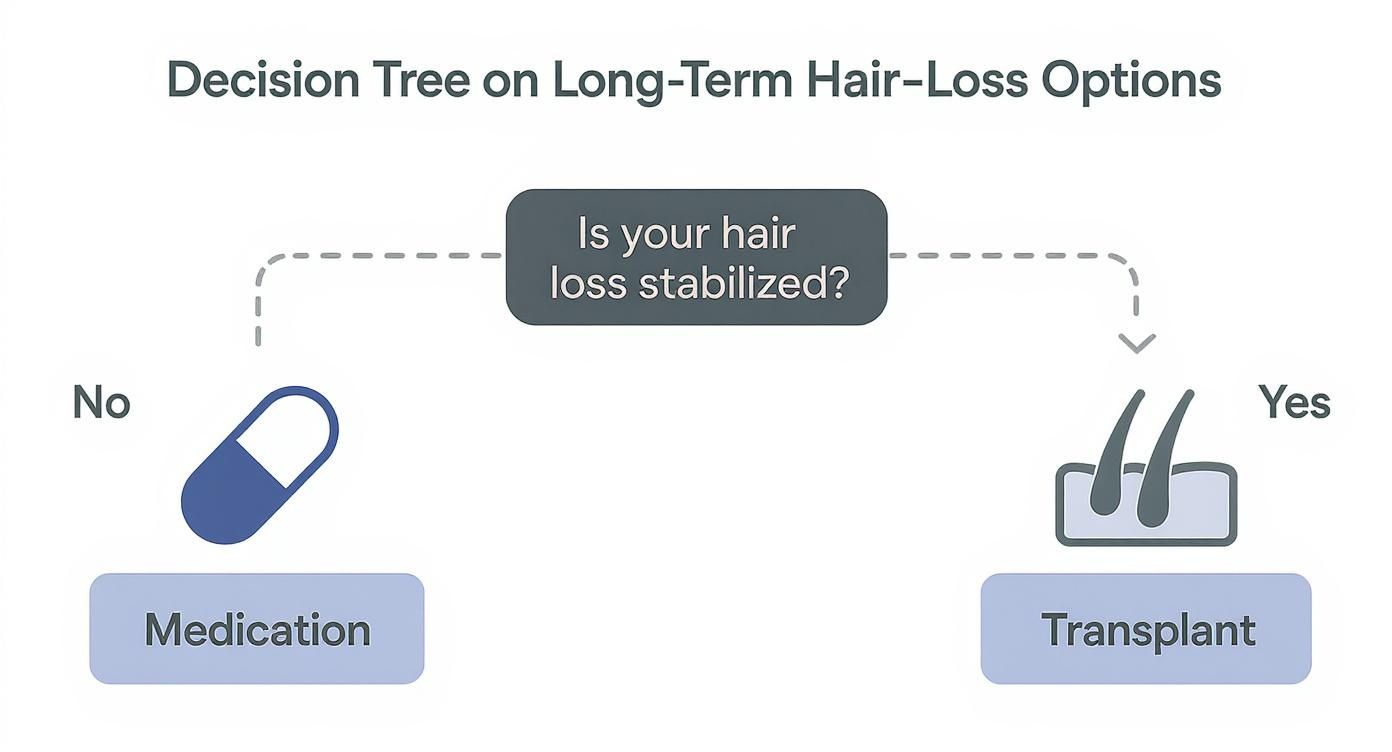
As you can see, getting things under control with medication is often the critical first phase before you can even begin to think about a permanent surgical fix like a transplant.
Finally, don’t forget to manage the mental side of things. True confidence doesn't come from having a perfect hairline; it comes from owning your look and being comfortable with your decisions. Whether you decide to fight for every last strand or rock a shorter style, the goal is to land on a choice that makes you feel good. You have the roadmap—now it’s time to take that first step.
Your Questions, Answered
If you're dealing with a receding hairline at 20, you probably have a lot of questions running through your head. Let's tackle some of the most common ones with straight, no-nonsense answers.
Can a receding hairline at 20 stop on its own?
In short, no. If your receding hairline is caused by male pattern baldness, it's a progressive condition hardwired into your genetics. It won't just stop by itself.
The rate of loss might seem to speed up or slow down over the years, but the underlying process keeps going. This is exactly why medical treatments exist—to intervene and disrupt that genetic timeline.
Does shaving my head help with hair loss?
This is a classic myth, but it's just that—a myth. Shaving your head does absolutely nothing to the hair follicle, which is the tiny factory producing hair deep under your skin.
Your hair might feel thicker for a little while as it grows back because the tips are blunt, but shaving doesn't change your hair's actual thickness, the number of follicles you have, or the progression of your hairline. It’s a great stylistic choice for many guys, but it's not a treatment.
Think of your hair like a lawn. Mowing the grass doesn't change what the roots are doing underground. Shaving your head is the same; it doesn’t affect the follicle.
Are natural remedies or supplements actually effective?
While supplements like biotin or saw palmetto can support overall hair health, there’s no strong scientific evidence that any natural remedy can truly stop or reverse a receding hairline caused by male pattern baldness.
The only options that have been through rigorous clinical trials and are proven to work are FDA-approved medical treatments like Finasteride and Minoxidil. They are the heavy hitters when it comes to fighting hair loss.
Is 20 too young for a hair transplant?
For the vast majority of guys, yes. Reputable hair transplant surgeons will almost always advise waiting, and for a very important reason: your hair loss pattern hasn't stabilized yet.
Jumping into surgery too early can backfire spectacularly. Imagine getting a new hairline, only for the native hair behind it to continue receding over the next few years. You could end up with an isolated island of transplanted hair—a look that's far more unnatural than where you started. The standard advice is to stabilize the loss with medication for several years first.
At PRP For HairLoss, we believe that understanding your options is the most powerful step you can take. To learn more about advanced, science-backed treatments that work with your body, explore our PRP treatments.
 PRP For Hairloss
Leave a comment