Let's cut right to the chase. If you're wondering what’s really behind male pattern baldness, the answer boils down to two main culprits: your genes and a hormone called Dihydrotestosterone (DHT).
It helps to think of it like a lock and key. Your DNA essentially places a unique ‘lock’ on your hair follicles. DHT is the ‘key’ that fits it perfectly. When that key turns, it sends a signal to the follicle, telling it to shrink over time.
Why You Are Really Losing Your Hair

Seeing more hair in the shower drain or noticing a widening part is a classic sign of androgenetic alopecia, the official name for male pattern baldness. It's by far the most common reason guys lose their hair.
At its heart, this is a story of inherited sensitivity. It has nothing to do with being unhealthy or having too much testosterone. It's simply that your hair follicles are genetically wired to overreact to a specific hormone that's naturally circulating in your body.
The Role of Genes and Hormones
This whole process kicks into gear after puberty, when your body starts producing more hormones. An enzyme in your hair follicles, known as 5-alpha reductase, takes testosterone and converts it into a much more powerful androgen: DHT.
For men with the genetic predisposition, DHT binds to special receptors in their hair follicles. This kicks off a gradual shrinking process called follicular miniaturization, which is what we see as thinning hair and, eventually, baldness.
So, if you have that genetic sensitivity, DHT is the main villain in your hair loss story. This one-two punch of genetics and hormones is responsible for an estimated 95% of all male hair loss cases. You can read the full research about these contributing factors to get a more technical breakdown.
To make this even clearer, here's a quick summary of the primary drivers.
The Main Causes of Androgenetic Alopecia
This table breaks down the key players in male pattern baldness.
| Factor | Role in Hair Loss | Analogy |
|---|---|---|
| Genetics | You inherit genes that make certain hair follicles sensitive to androgens (hormones like DHT). | Your genes hand out the "blueprints" for how your follicles should react to hormones. |
| DHT | This potent hormone binds to sensitive follicles and signals them to shrink and stop growing hair. | DHT is the "messenger" that reads the genetic blueprints and tells the follicles to shut down. |
| 5-alpha reductase | This enzyme is the "factory" that converts regular testosterone into the more powerful DHT. | Think of it as the catalyst that turns a relatively harmless substance into a potent one. |
As you can see, it's the combination of these factors, not just one, that leads to the visible signs of hair loss.
What Happens to the Follicle
So what does this "shrinking" actually look like? When DHT latches onto a susceptible follicle, it doesn't just kill it off instantly. The process is gradual and happens over many hair growth cycles. We call it miniaturization.
As the follicle shrinks, a few things start to happen:
- The hair it produces becomes progressively thinner and finer, almost like baby hair.
- The hair's active growth phase (the anagen phase) gets shorter and shorter.
- Because the growth phase is cut short, the hair can't grow as long as it used to.
Eventually, the follicle can become so small and damaged that it stops producing any visible hair at all. This is what creates the distinct receding hairlines and bald spots we associate with male pattern baldness.
Exploring the Genetic Blueprint for Hair Loss
When you're trying to figure out what causes male pattern baldness, the first place to look is your family tree. For years, the common wisdom was that you only had to look at your mother’s father to see your future hairline. While there's a grain of truth there, the real story is that you can inherit the genes for hair loss from both of your parents.
Think of your DNA as the instruction manual for your hair follicles. Some people get a manual that codes for follicles that are tough and resilient, able to withstand hormonal shifts for decades. Others inherit a set of instructions that makes their follicles much more sensitive to the factors that cause them to shrink and stop producing hair.
This genetic lottery explains why you and a sibling might have completely different experiences with hair loss, even though you grew up in the same house. One of you might have inherited that high-sensitivity gene set, while the other didn't.
It's More Than Just One Gene
It would be simple if we could point to a single "baldness gene," but our genetics are far more intricate than that. Scientists have now pinpointed a whole collection of genes that contribute to androgenetic alopecia. Each one adds a small piece to the puzzle, influencing things like:
- The age you first notice thinning.
- How quickly your hair loss progresses.
- The classic pattern your baldness follows.
This is why male pattern baldness looks so different for everyone. One guy gets a receding hairline in his 20s, while another might not see any changes until he notices thinning at the crown in his 40s. Your unique genetic cocktail dictates the specific story of your hair loss.
The most well-known player in this genetic story is the Androgen Receptor (AR) gene. This gene is found on the X chromosome and is responsible for building the receptors—think of them as docking stations—on your hair follicles that DHT binds to. A specific variation of this gene can create hyper-sensitive receptors, which makes the follicle-shrinking message from DHT come through loud and clear.
Since men inherit their X chromosome from their mothers, this is where the old myth about looking at your mom's side of the family comes from. But it’s only one piece of a much larger puzzle. Many other contributing genes are on different chromosomes, passed down from either parent. If you're interested in what your own DNA might say, learning more about genetic hair loss testing can offer some fascinating clues.
Your Genes Set the Stage
At the end of the day, your genetics don't seal your fate—they just set the stage. Think of it this way: your genes load the gun, but it's hormones and aging that eventually pull the trigger.
Understanding this takes away a lot of the mystery and blame. Losing your hair isn't a result of something you did or didn't do; it's simply a reflection of the biological blueprint you were handed at birth. This genetic predisposition is the core reason some people are more vulnerable to the hormonal triggers of hair loss than others.
Understanding How DHT Shrinks Hair Follicles
While your genes might load the gun for hair loss, it's a hormone called Dihydrotestosterone (DHT) that actually pulls the trigger. DHT is a potent androgen, or male sex hormone, derived directly from testosterone. It’s essential for many bodily functions, but for those with a genetic predisposition to balding, it’s the primary culprit.
So, where does DHT come from? It's a surprisingly simple chemical reaction. An enzyme living in the oil glands of your hair follicles, known as 5-alpha reductase, takes a bit of your circulating testosterone and converts it into DHT. Once this potent hormone is created, it begins to interact with your hair follicles, kickstarting the process of androgenetic alopecia. If you're curious to learn more, our detailed article explains exactly what DHT is and how it relates to hair loss.
The Process of Follicle Miniaturization
When DHT latches onto the androgen receptors in a genetically sensitive hair follicle, it triggers a destructive chain reaction called follicular miniaturization. It’s a slow, methodical process.
Imagine a healthy hair follicle as a deep, wide pot capable of growing a thick, vibrant plant. DHT's influence is like swapping that pot for a slightly smaller one every time a new growth cycle begins.
This constant shrinking has a few distinct effects on your hair:
- Thinner Hairs: Each new strand that emerges from the shrinking follicle is noticeably finer and weaker than the last.
- Shorter Growth Phase: DHT cuts the anagen (growth) phase of the hair cycle short, so hairs fall out sooner and can’t reach their previous length.
- Lighter Pigment: The miniaturized hairs often lose their color and become finer, eventually resembling the "peach fuzz" you see on other parts of your body.
This infographic gives a great visual breakdown of how testosterone becomes DHT and what it does to the hair follicle.
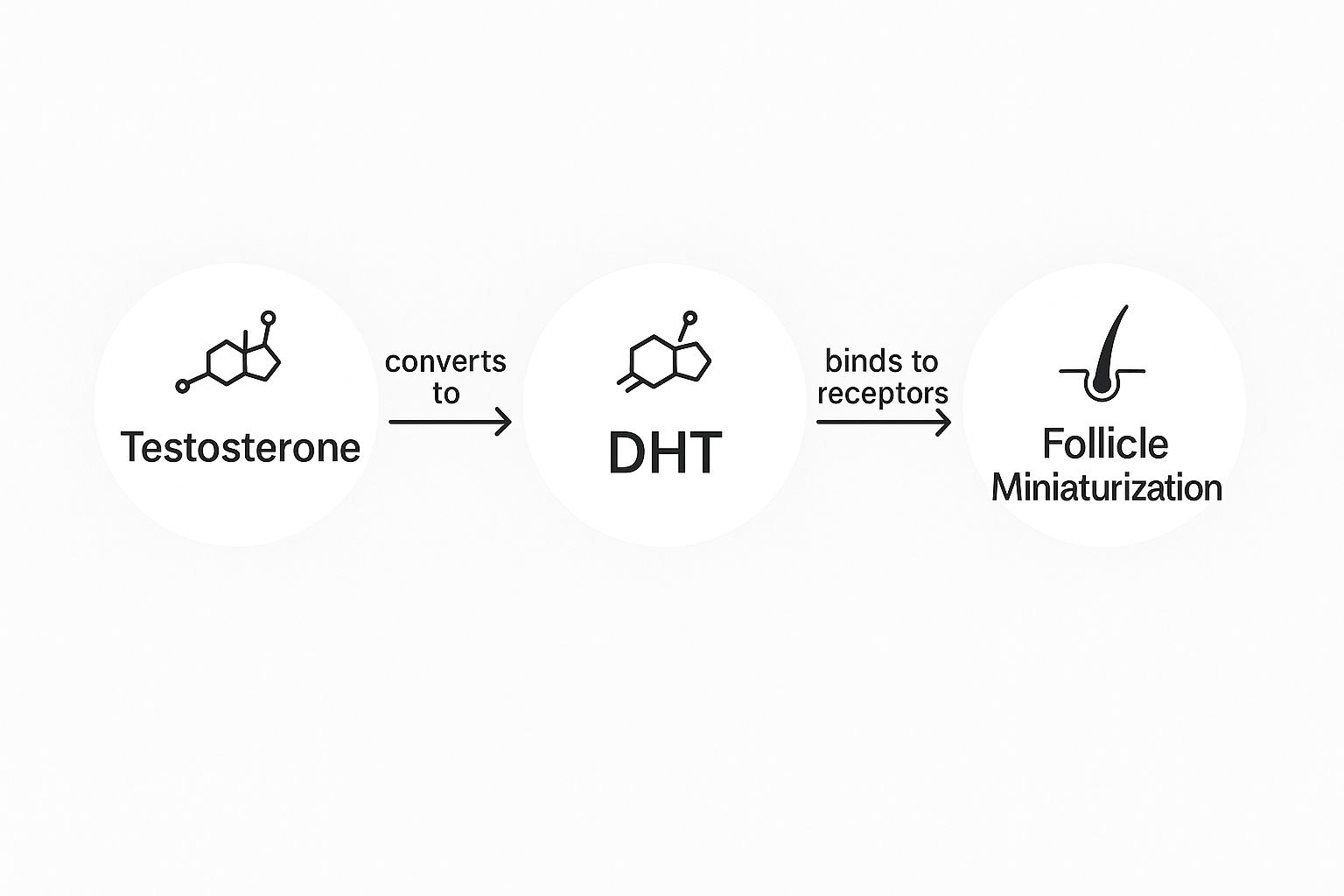
As the visual shows, testosterone is just the precursor. DHT is the active hormone that directly causes the follicle to shrink. Repeated over countless hair cycles and many years, the follicle eventually becomes so tiny that it can no longer produce a visible hair. That’s when baldness becomes apparent.
This progressive thinning is incredibly common, affecting up to 50% of males and females worldwide at some point. The process usually kicks off after puberty when androgen levels rise, causing susceptible follicles to miniaturize until they eventually stop producing hair altogether.
The numbers show just how widespread this is. Research indicates that about 20% of men are already dealing with some degree of hair loss in their 20s. That figure skyrockets to roughly 50% by age 50. This relentless, systematic weakening of the hair follicles is what creates the distinct patterns we recognize as male pattern baldness.
How Ethnicity Shapes Hair Loss Patterns
While the biological blueprint for male pattern baldness—genes and DHT—is the same for everyone, the way it actually plays out can look surprisingly different from one person to the next. A huge piece of that puzzle is your ethnic background. It’s a major factor in determining not just if you’ll lose your hair, but when it starts and the specific pattern it follows.
Think of it this way: our ancestral DNA is like a set of instructions passed down through generations. Over thousands of years, different populations developed unique genetic traits, including subtle variations in the genes that control how sensitive hair follicles are to hormones. Because of this, some ethnic groups are simply more likely to experience hair loss, and often at an earlier age.
A Global Look at Hair Loss Prevalence
The statistics on hair loss from around the world really highlight these differences. For Caucasian men, hair loss often starts earlier and progresses further. In fact, the incidence rate for Caucasian men can hit 50% by the age of 50, and it keeps climbing to upwards of 80% by age 70. You can discover more insights about these global hair loss rates and see just how much the numbers vary between countries.
On the other hand, men of East Asian descent—such as Japanese, Korean, and Chinese—tend to see hair loss start later in life. It's still common, but the pattern is often different, with less likelihood of developing that classic bald spot on the crown.
This global variance underscores a key point: your personal experience with hair loss is part of a much larger human story. Understanding where your ancestry fits into this picture can provide valuable context for your own journey.
Understanding the Differences
So, what’s happening at the genetic level to cause these different outcomes? Researchers point to a few key factors that vary among populations.
- Androgen Receptor Sensitivity: The specific version of the androgen receptor gene you inherit matters a lot. Some ethnic groups have a higher frequency of gene variants that make follicles hypersensitive to DHT.
- Enzyme Activity: The levels of 5-alpha reductase, the enzyme that turns testosterone into the more potent DHT, can also differ from one population to another.
- Hair Characteristics: Even the physical makeup of the hair itself plays a role. The natural thickness, density, and shape of hair strands can make thinning look more or less obvious.
At the end of the day, understanding what causes androgenetic alopecia means looking at the whole picture. It’s a complex dance between your hormones, your individual genes, and the ancestral story written in your DNA.
Lifestyle Choices That Can Accelerate Thinning
While your genes and hormones are steering the ship when it comes to male pattern baldness, your daily habits can definitely put the wind in its sails. Think of it this way: your genetic predisposition is like a pile of dry kindling. Your lifestyle can either keep it from catching fire or toss a lit match right on it.
This isn't about placing blame. It's about giving you control. You can't rewrite your DNA, but you absolutely can change the environment your hair follicles live in.
How Stress Worsens Hair Loss
Chronic stress is a major player here. When you're constantly under pressure, your body pumps out the stress hormone cortisol. This hormonal flood can seriously mess with your hair's growth cycle.
It can shove a large number of your hair follicles prematurely into the resting phase, known as the telogen phase. After a few months in this phase, those hairs fall out. For someone already genetically wired for baldness, this extra shedding can make thinning look much faster and more dramatic.
The Impact of Diet and Smoking
Just like the rest of your body, your hair follicles need the right fuel to do their job. A diet that's short on essential nutrients literally starves your hair of the building blocks it needs to grow strong.
It's not all about genetics. Simple nutritional gaps, like not getting enough protein, can also lead to thinner hair. Figuring out and understanding your daily protein requirements is a great first step toward better hair health.
Smoking is another direct hit on your hair. It constricts the tiny blood vessels in your scalp, choking off the supply of oxygen and nutrients your follicles are desperate for. The toxic chemicals in smoke also create oxidative stress, which can damage the follicle cells themselves.
We dive deeper into this connection in our guide on smoking and hair loss. Taking charge of these lifestyle factors can make a real difference in building a healthier foundation for your hair.
How the Hair Growth Cycle Gets Disrupted
Before we can pinpoint why hair loss happens, we need to look at how hair is supposed to grow. Think of each hair on your head as having its own internal clock, ticking through a predictable cycle of growing, resting, and shedding.
Because every follicle is on its own independent schedule, you don't lose all your hair at once. It’s a beautifully designed system of continuous renewal. For a more detailed look at this process, you can explore the stages of the hair growth cycle and see how it all fits together.
The Three Phases of Normal Hair Growth
Your hair's entire life plays out across three distinct stages. When your scalp is healthy, this cycle hums along perfectly, keeping your head full of hair.
- Anagen (The Growth Phase): This is the main event. It’s the long, active period where hair cells are rapidly dividing and your hair is actively growing. This phase is surprisingly long, lasting anywhere from two to six years.
- Catagen (The Transition Phase): After its long growth spurt, the hair gets a signal to wind down. This is a brief transitional stage, usually just a couple of weeks, where the hair follicle shrinks and detaches from the blood supply. Growth officially stops.
- Telogen (The Resting Phase): Now the hair just sits there, dormant, for about three months. At the end of this resting period, the follicle wakes up, a new hair begins to form, and the old one is naturally pushed out.
This is why shedding a certain number of hairs each day is completely normal. For every hair you find in the shower drain, a new one should be starting its own growth journey.
The core problem in male pattern baldness isn't just that hair is falling out. It's that the cycle itself has been hijacked, and the new hairs growing back are weaker, thinner, and have a much shorter lifespan.
How DHT Throws the Cycle Off Balance
Remember DHT, that potent hormone that shrinks hair follicles? Its primary method of attack is to sabotage the anagen, or growth, phase.
In follicles that are genetically sensitive, DHT systematically cuts this crucial growth window short. A hair that should have grown for several years might now only last for a few months or, in advanced cases, just a few weeks. This is the root cause of miniaturization—the hairs simply don't get enough time to grow into the strong, pigmented strands they once were.
To make matters worse, DHT can also extend the telogen, or resting, phase. This means the follicle stays dormant for longer periods between cycles. So, not only are the new hairs weaker, but there's a longer delay before they even start to appear.
Think of it like a production line. DHT comes in and reprograms the machinery to work for shorter shifts and take longer breaks. The result? Each new product that comes off the line is smaller and lower quality than the last. Repeat that process over years, and you get the visible thinning and hair loss we recognize as male pattern baldness.
Common Questions About Androgenetic Alopecia
After digging into the genetics, hormones, and lifestyle factors behind hair loss, it's natural to have a few more questions pop up. Let's tackle some of the most common ones to clear up any lingering confusion about androgenetic alopecia.
Can You Stop Androgenetic Alopecia Completely?
Since this type of hair loss is hardwired into your DNA, there's no magic bullet or "cure" that can switch it off for good. But that absolutely doesn't mean you're powerless.
The goal of modern treatments isn't to find a cure, but to manage the condition. We focus on slowing the thinning process way down, protecting the hair you still have, and sometimes even waking up dormant follicles to spur new growth. It’s less like curing a cold and more like managing a chronic condition to keep your hair as healthy and full as possible for years to come.
Is My Hair Loss Permanent?
This is the big question, and the answer isn't a simple yes or no. The hair loss from androgenetic alopecia is progressive—it gets worse over time without intervention. Once a hair follicle shrinks down and goes dormant, getting it to produce hair again becomes a real challenge.
The most important thing to remember is this: the sooner you take action, the more hair you can save. A dormant follicle isn't necessarily dead, but the clock is ticking on the opportunity to revive it. To get a better sense of what's possible, our guide on whether dead follicles can be revived is a great resource.
Does Wearing a Hat Cause Baldness?
Let's put this one to bed for good. This is one of the oldest and most stubborn myths about hair loss. The simple answer is no, wearing a hat has nothing to do with male pattern baldness. That process is all internal, driven by your genes and hormones.
For a hat to cause any hair loss, it would need to be painfully tight—so tight that it literally cuts off blood flow to the scalp. That condition is called traction alopecia, and it's a completely different issue. Your everyday ball cap or beanie is not the culprit.
Can Certain Shampoos or Products Reverse Hair Loss?
The shelves are full of products making bold claims, so it's smart to be skeptical. A high-quality shampoo can definitely improve the health of your scalp by clearing out buildup and reducing inflammation, creating a better environment for hair to grow.
But a shampoo by itself can't stop DHT or change your genetic programming. Think of these products as the supporting cast in your hair care routine. They help, but they aren’t the star of the show. Focus on clinically proven treatments as your primary strategy, and use good shampoos to back them up.
At PRP For HairLoss, we believe that understanding the "why" behind your hair loss is the first step toward finding a solution that works. We're here to give you the clear, science-backed information you need to make confident decisions. Learn more at https://prpforhairloss.com.


Leave a comment