It’s a moment most of us dread. You're looking in the mirror, and suddenly you notice it—your part seems wider, your hairline is creeping back, or you can just see a bit more scalp than you used to. It's frustrating, and it's easy to feel like you're fighting a losing battle.
But here’s the thing: figuring out how to get thicker hair isn’t about some magic potion. It's about a smart, methodical approach that starts with one simple question: why is this happening?
First, Let's Figure Out Why Your Hair Is Thinning
Before you throw money at every "miracle cure" you see online, you need a game plan. And any good game plan starts with understanding the opponent. Hair thinning isn't just about strands falling out; it's often a process called "miniaturization." This is where your individual hair strands become progressively thinner, shorter, and weaker over time, until they’re practically invisible.
If this sounds familiar, you’re far from alone. This is an incredibly common part of being a man. Research confirms that around 85% of men will deal with noticeable hair thinning by the time they're 50, and for 95% of them, the culprit is good old male pattern baldness.
The Usual Suspects Behind Thinning Hair
For the vast majority of us, the reason our hair thins comes down to genetics. If your dad or grandad had thinning hair, chances are you've inherited the same predisposition. This is clinically known as androgenetic alopecia, or what we all call male pattern baldness.
But your DNA isn't telling the whole story. Other factors can absolutely kick things into high gear or even be the primary cause.
-
Hormonal Havoc: The main hormone to know here is dihydrotestosterone (DHT). It’s a byproduct of testosterone, and in genetically susceptible men, it can latch onto hair follicles and shrink them until they stop producing hair altogether.
-
Life's Stressors: Ever notice more hair in the shower drain after a really tough few months? That’s not your imagination. Chronic stress can literally shove hair follicles into a "resting" phase, causing a sudden shed a couple of months down the line. A demanding job and poor sleep can take a real toll.
-
Dietary Gaps: Your hair is built from the nutrients you eat. If your diet is lacking in essentials like iron, zinc, protein, and B vitamins, you're basically starving your follicles of the raw materials they need to build strong, healthy hair.
-
Underlying Health Issues: Sometimes, thinning hair is your body's way of signaling that something else is going on. It can be a red flag for issues like thyroid problems or certain autoimmune conditions.
Knowing what you're up against is half the battle. It moves you from a place of frustration to a position of power, where you can make informed decisions about what will actually work for you.
Take an Honest Look in the Mirror
It's time for a quick self-assessment. Where is the thinning happening? Is it a slow, diffuse thinning all over your head? Or is it concentrated at the temples and the crown, creating that classic 'M' shape?
The pattern tells a story. Gradual thinning at the hairline and crown almost always points to genetic male pattern baldness. On the other hand, sudden, patchy loss might suggest a stress-related event or a medical issue.
By getting a clear picture of what's happening on your own head, you'll be much better equipped to explore the solutions that follow. You can't effectively treat a symptom without knowing what causes hair loss in men in the first place.
Here’s a quick-start guide to the foundational steps you can take today, categorized by approach and when you might start seeing changes.
Your Initial Action Plan for Thicker Hair
| Action Area | Specific Steps | Why It Helps | Time to See Changes |
|---|---|---|---|
| Diet & Nutrition | Add more lean protein (chicken, fish), iron-rich foods (spinach, red meat), and healthy fats (avocado, nuts). | Provides the essential building blocks for strong hair follicle and strand health. | 3-6 months |
| Lifestyle Adjustments | Prioritize 7-8 hours of sleep per night. Incorporate stress-management techniques like exercise or meditation. | Reduces cortisol levels, which can prematurely push hair into its shedding phase. | 2-4 months |
| Scalp Care | Use a gentle, sulfate-free shampoo. Avoid overly hot water. Massage your scalp daily for 2-3 minutes. | Improves blood flow to the follicles and creates a healthier environment for growth. | 1-3 months |
| Initial Assessment | Take clear photos of your hairline and crown from multiple angles to establish a baseline. | Allows you to objectively track progress or worsening of thinning over time. | Immediate |
This table isn't a cure-all, but it represents the fundamental lifestyle and habit changes that support every other treatment you might consider. Think of it as preparing fertile ground before you plant the seeds.
Your Daily Routine for Thicker-Looking Hair
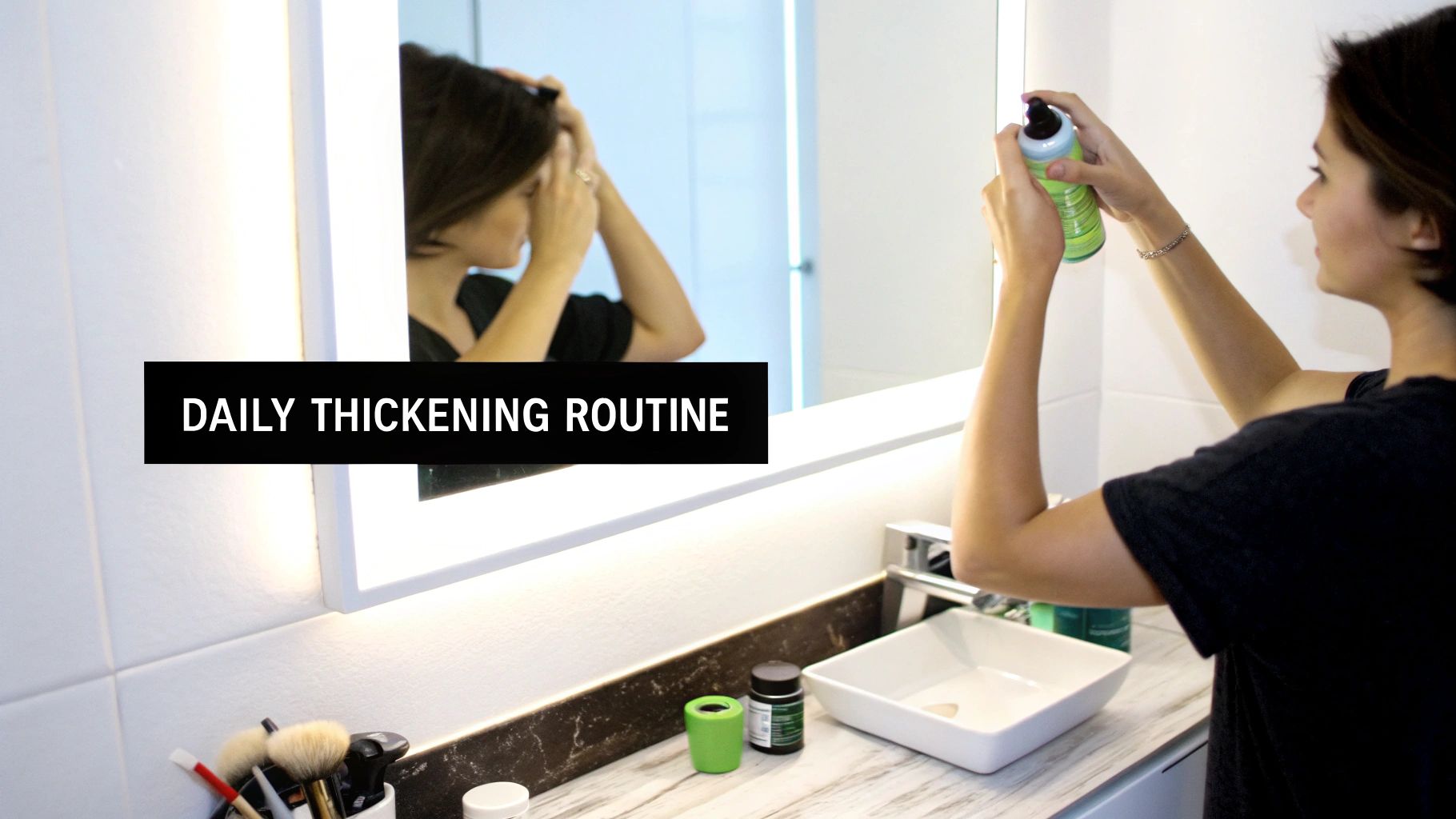
The battle for thicker hair is often won or lost in the bathroom mirror every morning. While you’re working on the long game with treatments and lifestyle changes, your daily grooming habits can either highlight thinning spots or create a convincing illusion of fullness right now. It's all about making a few smart swaps that work with your hair, not against it.
Let's turn that daily routine into your strategic advantage. It starts the moment you step in the shower.
Master the Wash and Dry
The foundation of any good hair day is the wash. For thinning hair, the goal is lift and body without weighing anything down. Heavy conditioners are often the enemy here, making fine hair look flat and greasy before you've even had your coffee.
Instead, switch to a lightweight, volumizing shampoo. These are specifically formulated to clear out the scalp oils and product residue that kill volume at the root. When it comes to conditioner, apply it only to the mid-lengths and ends of your hair—keep it away from your scalp.
How you dry your hair is just as critical. Vigorously rubbing your head with a towel is a recipe for disaster. Wet hair is incredibly fragile and prone to snapping, and that breakage will only make thin hair look thinner.
- Blot, don't rub: Use a soft microfiber towel to gently squeeze and pat the excess water out. This simple change minimizes friction and protects those delicate strands.
- Use a pre-styler: Before the blow dryer comes out, work in a volumizing mist or a light mousse. This gives your hair some guts and makes your styling efforts far more effective.
- Dry it upside down: When you do blow-dry, flip your head over and aim the airflow at the roots. It’s an old trick for a reason—it lifts the hair directly off the scalp, creating natural, lasting volume.
A healthy scalp is the bedrock of healthy hair. Getting the wash and dry right doesn't just make your hair look better today; it creates a better environment for your follicles to thrive. For a deeper dive, check out our guide on essential scalp care for men.
Choose Your Styling Weapons Wisely
The right product is a game-changer, but the wrong one is a definite setback. You need to steer clear of anything heavy, greasy, or shiny. That means saying goodbye to heavy waxes, oily pomades, and wet-look gels that clump hair together. When hair sticks together, it exposes more scalp—the exact opposite of what we're going for.
Your new best friends are products that create texture and separation without the weight.
Product Swaps for a Thicker Look
| Instead of This… | Try This… | Why It Works |
|---|---|---|
| Heavy Wax or Pomade | Lightweight Mousse or Fiber Spray | Adds texture and fullness without clumping hair or weighing it down. |
| Wet-Look Gels | Matte Finish Clay or Paste | Absorbs light and reduces scalp shine, making hair appear denser. |
| Oily Serums | Dry Shampoo or Texturizing Powder | Lifts roots, soaks up excess oil, and provides a gritty texture for volume. |
A little goes a long way. Always start with a pea-sized amount, warm it up in your hands, and apply it evenly. I always tell clients to start from the back and work forward so you don't overload the finer hair around your hairline.
The Power of a Good Haircut
You can have the best products on the planet, but they won't do much without the right canvas. Honestly, a good haircut is probably the single most powerful tool you have for making thinning hair look thicker.
Forget the instinct to grow it long to "cover things up." This almost always backfires by making fine hair look stringy and drawing even more attention to thin areas. Shorter, textured styles are your best bet.
- Keep the sides short: Taking the sides and back down tight creates a clean, strong shape. By contrast, the hair on top immediately looks fuller and denser.
- Ask for texture on top: A skilled barber can use techniques like point-cutting to add texture. This breaks up the hair, making it look more voluminous and less like a solid block.
- Consider a defined part: A messy part can look sparse. A clean, classic side part, on the other hand, creates structure and gives the impression of deliberate fullness.
Don't be afraid to talk to your barber. Tell them your goal is to maximize fullness. A good one will know exactly how to work with your hair type and thinning pattern to give you a cut that looks sharp and gives you a serious confidence boost.
Fueling Hair Growth from the Inside Out

While the right shampoo and styling products can give you an immediate visual boost, they’re not getting to the root of the problem. Real, lasting hair strength is built from within. I like to think of each hair follicle as a tiny factory; it needs the right raw materials and a calm working environment to do its best work.
What you eat and how you live your life directly fuel those factories. Running on processed junk food is like trying to run an assembly line with shoddy parts and a stressed-out crew—the output is going to be weak. Getting your internal environment right is honestly the most powerful long-term strategy for thicker hair.
The Building Blocks of Stronger Hair
Your hair is made almost entirely of a protein called keratin. So, it should come as no surprise that getting enough high-quality protein in your diet is absolutely non-negotiable for hair health.
But it’s not just about protein. A whole team of vitamins and minerals is critical for supporting the hair growth cycle. If you're deficient in any of them, you can slow down production or end up with weaker, brittle strands that just snap off. It’s all about giving your body the complete toolkit it needs.
-
Iron: This is a big one. Iron helps produce hemoglobin, which is like the oxygen-delivery truck for your entire body, including the cells that kickstart hair growth. You’ll find it in red meat, spinach, and lentils.
-
Zinc: Zinc is crucial for hair tissue growth and repair. It also helps keep the oil glands around the follicles working properly, which is key for a healthy scalp. Beef, pumpkin seeds, and chickpeas are great sources.
-
Biotin (Vitamin B7): This is probably the most famous "hair vitamin," and for good reason. Biotin is essential for producing that keratin we talked about. Look for it in eggs, salmon, and sweet potatoes.
Making an effort to get these on your grocery list is a simple first step. If you want to dive deeper into a hair-focused diet, this guide on the best foods for hair growth has some fantastic, specific ideas for your next meal plan.
Beyond the Plate: Stress and Sleep
Here’s the hard truth: you can eat all the salmon and spinach in the world, but if you're chronically stressed and sleep-deprived, you're constantly fighting an uphill battle. High stress levels flood your body with a hormone called cortisol.
Chronically elevated cortisol can seriously mess with your natural hair growth cycle. It can actually push more of your follicles into the "shedding" phase prematurely. If you've ever heard someone say their hair fell out from stress, they weren't exaggerating—it’s a real biological phenomenon.
Managing stress isn't just a mental health platitude; it's a core component of a hair thickening strategy. Your follicles are highly sensitive to your body's hormonal environment.
The same goes for sleep. Skimping on sleep robs your body of its primetime for cellular repair and regeneration. Your body does its best work while you're in a deep sleep, producing growth hormones essential for everything from muscle repair to, you guessed it, hair production.
Making 7-8 hours of quality sleep a priority isn't an indulgence. It's a foundational practice that directly supports the hair you're working so hard to thicken. To take it a step further, you can explore some of the best supplements for cellular health and longevity to understand how to build that robust internal foundation. Getting this right gives every other effort you make a much better chance of succeeding.
Navigating Over-the-Counter Hair Treatments
Walking down the hair care aisle can feel like a high-stakes guessing game. You're faced with dozens of bottles all promising miracles, but in my experience, only a few key players have the science to actually back up their claims. When you're figuring out how to thicken thinning hair, understanding these over-the-counter (OTC) options is your first real step into taking control.
The Heavy Hitter: Minoxidil
Let's cut to the chase. The undisputed champion in the topical treatment world is minoxidil. It's the only FDA-approved drug for treating female pattern baldness and is the go-to recommendation from dermatologists for men as a first line of defense. You've probably heard of it by its most famous brand name, Rogaine.
Funnily enough, it started out as a blood pressure medication. Doctors noticed a very interesting side effect: patients were growing more hair. So, researchers smartly reformulated it into a topical solution. It’s a vasodilator, which means it widens blood vessels. But the real magic for your hair is its ability to wake up sleeping follicles—shortening their resting phase and kicking them back into their active growing phase.
Think of it as flicking the lights back on in a dormant factory and getting the assembly line running at full tilt again.
Making Minoxidil Work for You
Success with minoxidil comes down to two non-negotiables: consistency and patience. This isn't a quick fix. You have to apply it directly to your scalp twice a day, every single day. If you stop, you can expect any hair you've managed to regrow or hold onto to disappear within a few months.
-
Application is everything. Whether you grab the foam or the liquid, the goal is to get it on your scalp, not just all over your hair. I tell guys to part their hair in a few spots and apply it right to the skin where the thinning is worst.
-
Don't expect overnight results. You'll need at least three to six months of dedicated use before you see a real difference. Some men even get a bit of a shock when they experience more shedding in the first few weeks. Don't panic! This is actually a good sign. It means the minoxidil is pushing out the old, weak hairs to make room for new, stronger ones to grow in.
-
Pick the right formula for you. A lot of guys I've talked to prefer the foam because it's less greasy and doesn't mess with their hairstyle as much as the liquid drops can. For an even easier application, you can now find a minoxidil spray for male hair loss that makes targeting specific areas a lot faster.
We naturally lose about 50 to 100 hairs a day, but sticking with a medically-proven product like minoxidil, usually at a 5% concentration, can genuinely help increase hair thickness by re-energizing those follicles.
Minoxidil doesn’t work for everyone, but clinical studies show that a significant portion of men experience some degree of hair regrowth, with many more successfully slowing or stopping their rate of loss. It's one of the most reliable tools available without a prescription.
Beyond Minoxidil: Other Promising Ingredients
While minoxidil is definitely the star of the show, a few other ingredients are fantastic supporting actors in an OTC hair-thickening strategy. They work a bit differently, which makes them great additions to your routine.
Ketoconazole Shampoos
Originally an anti-dandruff ingredient, ketoconazole has some mild anti-androgenic properties. In simple terms, it helps interfere with DHT—the hormone that shrinks follicles and causes male pattern baldness. Using a 1% ketoconazole shampoo (like Nizoral) two or three times a week is an easy way to improve your scalp health and add another layer of defense against thinning.
Caffeine-Infused Products
Topical caffeine is another popular ingredient you'll see in specialty shampoos and serums. Early research suggests it can help boost blood flow to the scalp and may even counteract some of DHT's damaging effects right at the follicle. It’s not as powerful as minoxidil, but it’s a low-risk addition that can certainly support your main treatment.
People are also getting interested in devices that stimulate follicles with new tech. For example, there's growing buzz around the potential benefits of red light therapy, which is thought to improve cellular activity in the scalp. When you combine these strategies—daily minoxidil, a ketoconazole wash a few times a week, and a healthy lifestyle—you create a powerful, multi-pronged approach you can start today.
When To See A Doctor About Hair Loss
You’ve tried the at-home treatments, you’ve perfected your styling routine, and you’ve cleaned up your diet. That’s great, and it can make a real difference. But sometimes, you hit a wall.
If over-the-counter options aren't giving you the results you hoped for after a few solid months, it's not a failure. It’s simply a sign that it's time to bring in a specialist. This is where you get access to powerful, medical-grade solutions that work on a biological level that store-bought products just can't touch.
Prescription Power: Finasteride
When you talk to a doctor about male pattern baldness, the conversation will almost certainly turn to finasteride, often known by its brand name, Propecia. This is a daily prescription pill designed to tackle the root hormonal cause of thinning hair from the inside out.
Unlike minoxidil, which acts as a growth stimulant on the surface, finasteride is a DHT blocker. It works by inhibiting the specific enzyme that converts testosterone into dihydrotestosterone (DHT)—the hormone notorious for shrinking hair follicles. By dramatically lowering DHT levels in your scalp, finasteride not only protects your follicles from further damage but can even allow some of them to recover.
Think of it this way: minoxidil is like fertilizing your garden, while finasteride is pulling out the invasive weeds that are strangling your plants. This is exactly why many dermatologists recommend them together for a powerful one-two punch.
The success rates are impressive. Studies show that a huge majority of men—upwards of 80%—either stop losing more hair or see some regrowth. But it’s a prescription for a reason, so a thorough chat with your doctor about potential side effects is a must.
Cutting-Edge Therapies: Platelet-Rich Plasma (PRP)
Beyond daily meds, there are in-office procedures that have gained serious ground for their ability to kickstart hair growth. One of the most talked-about is Platelet-Rich Plasma (PRP) therapy.
PRP uses your body's own healing power to rejuvenate your hair follicles. Here’s how it works:
- Draw Blood: A small amount of your blood is drawn, just like a routine blood test.
- Separate Plasma: The blood is spun in a centrifuge, a machine that separates the platelet-rich plasma—the "liquid gold"—from everything else.
- Inject Growth Factors: This concentrated plasma, loaded with natural growth factors, is then carefully injected back into the areas of your scalp where you're thinning.
The whole idea is that these growth factors act as a wake-up call for your follicles, stimulating cell growth and encouraging thicker, healthier hair. It’s a compelling option because it's so natural. If you're looking into this, it’s worth understanding what doctor you should see for hair loss to make sure you’re in the hands of a qualified expert.
This decision tree can help you map out your next steps.
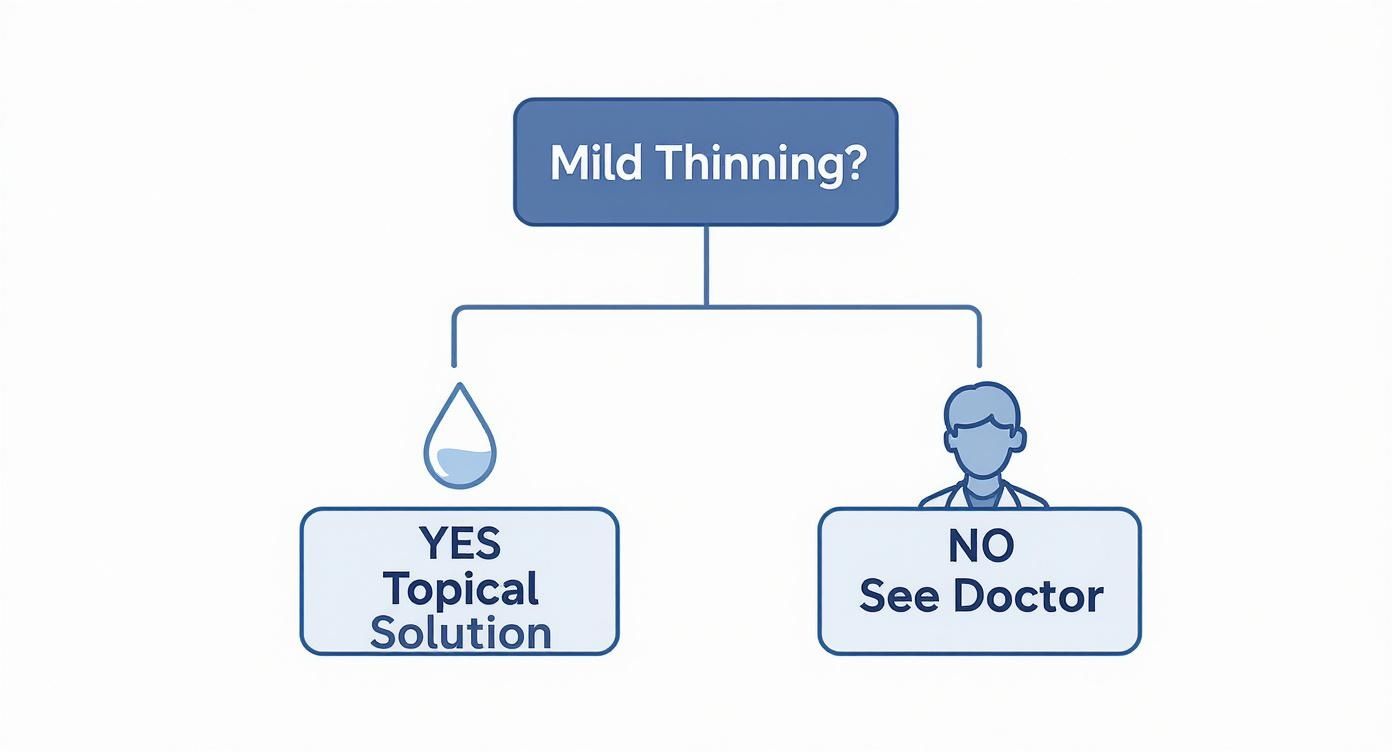
As the chart shows, mild thinning can often be managed at home, but more advanced loss usually benefits from professional guidance. This growing need for effective solutions is reflected in the market itself.
The global industry for hair loss solutions was valued at around USD 1.51 billion in 2024 and is only expected to grow. This boom is driven by more and more men turning to clinical treatments and advanced products that actually work.
Comparing Medical Hair Thickening Treatments
With several powerful options available, it's helpful to see how they stack up. This table gives you a side-by-side look at the most common professional treatments to help you understand what might be right for you.
| Treatment | Type | How It Works | Average Cost | Effectiveness |
|---|---|---|---|---|
| Finasteride | Prescription Pill | Blocks the conversion of testosterone to DHT, protecting follicles from miniaturization. | $30 – $90 / month | High (stops loss/regrows hair in ~80% of men). Requires ongoing use. |
| Dutasteride | Prescription Pill | A more potent DHT blocker than finasteride, often used off-label for hair loss. | $40 – $100 / month | Very high, potentially more effective than finasteride. |
| PRP Therapy | In-Office Injections | Uses growth factors from your own blood to stimulate dormant hair follicles. | $500 – $1,500 / session | Varies by individual. Best results with multiple initial sessions. |
| Hair Transplant | Surgical Procedure | Moves healthy, DHT-resistant hair follicles from a donor area to thinning areas. | $4,000 – $15,000+ | Very high (permanent results). Most invasive and expensive option. |
Ultimately, the best path forward will depend on your specific type of hair loss, your budget, and what you're comfortable with. A consultation with a dermatologist is the best way to get a personalized recommendation.
Common Questions About Thickening Thinning Hair
When you first start looking into ways to thicken up your hair, it’s completely normal to have a ton of questions. It can feel like a pretty complex topic, but getting clear, honest answers is the first step toward building a routine that actually gets you results. Let's tackle some of the most common questions I hear from guys trying to figure this all out.
How Long Does It Really Take to See Results?
This is the big one, isn't it? Everyone wants to know when they'll see a change. The most truthful answer is this: you have to be patient. Real, lasting change happens at the follicular level, and that just takes time. Think of it as a marathon, not a sprint.
For over-the-counter topicals like minoxidil, you need to be incredibly consistent for at least three to six months before you can expect to see a noticeable difference. One of the first signs things are working might just be less hair in the shower drain—and trust me, that's a huge win in itself!
If you go the medical route with a prescription like finasteride, the timeline is often a bit longer, usually taking six to twelve months for the results to become really visible. The key with any effective treatment is consistency. If you stop, you'll likely lose whatever progress you've made within a few months.
The biggest takeaway here is that hair grows in cycles. You're waiting for new, stronger hairs to push through, and that process simply can't be rushed. Sticking with your chosen routine is the only way to see it through.
Is It Okay to Combine Different Hair Treatments?
Absolutely. In fact, for many guys, it's the most effective way to go. Think of it as a multi-pronged attack on hair loss. Many dermatologists recommend a dual-action plan because different treatments tackle the problem from completely different angles.
For example, a common and powerful combination is:
- Topical Minoxidil: This works on the surface of your scalp to stimulate and essentially wake up dormant hair follicles.
- Oral Finasteride: This works from the inside out, blocking the DHT hormone that causes follicles to shrink and eventually stop producing hair.
You can also support these medical treatments with the other things we've talked about—a better diet, stress management, and the right hair care products. Using a ketoconazole shampoo a few times a week, for instance, can complement your daily minoxidil by creating a healthier scalp environment. Just make sure you talk to a doctor before you start mixing and matching any prescription-level options.
Do Natural Remedies Like Oils or Scalp Massages Actually Work?
There's a lot of chatter online about natural solutions. While many are popular, their scientific backing can be a mixed bag. It's really important to separate what feels good from what's clinically proven to fight male pattern baldness.
A good scalp massage, for instance, feels great and can boost circulation to the follicles. That’s always a plus for general hair health, since better blood flow brings more oxygen and nutrients to the area.
Some studies on rosemary oil have even suggested it can be as effective as 2% minoxidil for some people, but a lot more research is needed before we can call that conclusive.
It's best to think of these natural options as supportive players, not the main event for treating androgenetic alopecia. They probably won't give you the same level of results as FDA-approved treatments, but they can be a fantastic, low-risk part of a holistic routine that makes your scalp a healthier place for hair to grow.
Will Wearing a Hat All the Time Make My Hair Thinner?
This is a classic myth that just refuses to die. Let's set the record straight: wearing a normal, clean hat will not cause hair loss.
Your hair follicles get their oxygen and all the nutrients they need from your bloodstream, not from the air. You simply cannot "suffocate" them by wearing a hat.
The only time a hat could possibly cause an issue is under two very specific circumstances:
- If it's incredibly tight: Constant, severe pulling on your hair could lead to a condition called traction alopecia. This is far more common with tight hairstyles like braids or man buns than with hats.
- If it's dirty and sweaty: An unwashed, sweat-soaked hat can create a less-than-ideal environment on your scalp, potentially leading to irritation or fungal issues that aren't good for hair growth.
As long as your hat fits well and you keep it clean, you're totally in the clear. So go ahead and wear your favorite cap with confidence—it's not the culprit behind your thinning hair.
At PRP For HairLoss, we believe that understanding your options is the most powerful tool you have. Whether you're just starting with lifestyle changes or considering advanced medical treatments like PRP, our goal is to provide you with clear, reliable information to help you on your journey. Explore our resources to learn more about the science behind hair loss and the treatments that can make a real difference. https://prpforhairloss.com
 PRP For Hairloss
Leave a comment