If you're looking into saw palmetto for hair loss and wondering if it’s a real contender, the short answer is yes. It shows some genuine promise, especially for guys dealing with male pattern baldness. It works by getting to the hormonal root of the problem, offering a more natural route for those who might be hesitant about prescription drugs.
Does Saw Palmetto Actually Work for Hair Loss?

Watching your hair get thinner is a tough, often private, battle. It can feel like you're fighting a losing game against your own genetics, which sends a lot of men searching for a solution that’s both effective and safe. This is exactly where the discussion about saw palmetto for hair loss picks up.
This natural supplement comes from the berries of a small palm tree native to the southeastern U.S. and has been used in traditional medicine for ages. Lately, though, it's been getting a lot of attention for its potential to slow down androgenic alopecia—the official name for male pattern baldness.
The DHT Connection to Hair Loss
The main villain in this story is a hormone called dihydrotestosterone, or DHT. Your body naturally produces DHT by converting a small amount of testosterone, using an enzyme called 5-alpha reductase to do the job. While DHT has its purposes, it's pretty harsh on your hair follicles.
DHT latches onto receptors in the hair follicles on your scalp, kicking off a damaging process known as miniaturization. This process makes the follicles shrink, cuts their growth cycle short, and, eventually, they just stop producing hair altogether. It’s what’s behind the classic receding hairline and thinning crown we all recognize.
This is where saw palmetto comes in. It acts as a natural DHT blocker. The plant's active compounds are thought to interfere with the 5-alpha reductase enzyme, which means less testosterone gets converted into follicle-harming DHT. With less DHT around, the damage to your follicles slows down, which can help put the brakes on hair loss and sometimes even encourage healthier growth. The debate over which is better, a drug or a supplement, is a big one, and you can dive deeper into a direct comparison between Finasteride vs Saw Palmetto to see how they stack up.
At its core, saw palmetto offers a way to address the hormonal imbalance at the root of male pattern baldness, rather than just treating the symptoms on the surface.
To give you a clearer picture, I've put together a quick summary of what to keep in mind if you're thinking about adding saw palmetto to your routine.
Saw Palmetto for Hair Loss at a Glance
| Aspect | Key Information |
|---|---|
| Primary Goal | To reduce the levels of DHT on the scalp, thereby slowing hair loss. |
| Best For | Men with mild to moderate androgenic alopecia (male pattern baldness). |
| Typical Dosage | 320 mg per day is the most commonly studied dosage. |
| Expected Timeline | Results are not immediate; it often takes 3-6 months of consistent use. |
This table gives you the essential details, but remember that individual results will always vary. Consistency is really the key here.
How Saw Palmetto Fights Hair Thinning
To really get how saw palmetto works for hair loss, we need to talk about a specific enzyme in your body called 5-alpha reductase. Think of this enzyme as a factory worker that’s constantly converting a little bit of your testosterone into a much more powerful, hair-unfriendly hormone: dihydrotestosterone, better known as DHT.
This DHT is the main culprit in the story of male pattern baldness. It latches onto receptors on your hair follicles, and once it does, it starts a process called miniaturization. This slowly shrinks the follicles until they can no longer grow healthy, visible hair.
This is where saw palmetto comes into play. It acts like a natural brake on that DHT production factory.
Blocking the DHT Production Line
The active compounds in saw palmetto berries get in the way of the 5-alpha reductase enzyme. By partially blocking this enzyme, saw palmetto slows down the conversion of testosterone into DHT. It doesn’t stop it entirely, but it can lower the overall amount of DHT circulating in your scalp.
With less DHT available to attack your follicles, the shrinking process can slow down significantly. For many guys, this translates into real-world results:
- Slowing the rate of hair thinning: The most common benefit is simply losing hair less quickly.
- Stabilizing hair loss: For some, it’s enough to maintain the hair they currently have.
- Healthier hair growth: By easing the DHT-induced stress, follicles get a chance to recover and thrive.
This strategy gets to the hormonal root of the problem, rather than just masking the symptoms. If you want to dive deeper into the science, our guide explains in more detail what DHT is and its connection to hair loss.
Saw palmetto works by limiting the enzyme responsible for creating DHT. This reduction in DHT levels gives your hair follicles a fighting chance against the shrinking process that leads to baldness.
Saw Palmetto's Role in Follicle Health
Beyond just tackling DHT, there’s also some evidence that saw palmetto has anti-inflammatory properties. Chronic inflammation around the hair follicles can make hair loss worse, so calming things down creates a healthier environment for hair to grow.
Think of your scalp as a garden. DHT is like a persistent weed that slowly chokes the life out of your plants—the follicles. Saw palmetto helps pull some of those weeds, giving your hair a better shot at growing strong.
It’s crucial to understand that this isn’t a quick fix. Just as it took years for DHT to weaken your hair, it takes time to see the benefits of reducing it. Consistency is everything when using saw palmetto for hair loss.
Most men need to stick with it for at least a few months before they notice any real difference in shedding or hair thickness. The goal here is a long-term management plan for the hormonal side of androgenic alopecia, not an overnight miracle.
What the Research Says About Its Effectiveness
The theory behind how saw palmetto works makes a lot of sense. But the real question for any guy dealing with thinning hair is simple: does it actually work in the real world?
To answer that, we have to move past anecdotes and look at the clinical studies. The research paints a pretty clear picture—saw palmetto is a promising natural option for managing male pattern baldness, though it's important to have realistic expectations.
The scientific community has been digging into saw palmetto for hair loss for a while now, and the findings are generally positive, especially for men who are just starting to notice thinning.
Head-to-Head with a Prescription Drug
One of the most telling pieces of research is a 2012 clinical study that put saw palmetto directly up against finasteride, the well-known prescription DHT blocker. The study followed 100 men with mild-to-moderate hair loss over a two-year period.
The results were fascinating. While finasteride was definitely more powerful—68% of users saw improvement—saw palmetto really held its own. A solid 38% of the men taking a daily 320 mg dose of saw palmetto also experienced a noticeable improvement in their hair loss.
This study was a big deal because it showed that saw palmetto could be a legitimate alternative, even if it doesn't pack the same punch as the pharmaceutical option. You can dig into the specifics of that study in this Medical News Today article.
This infographic breaks down exactly how saw palmetto gets the job done.
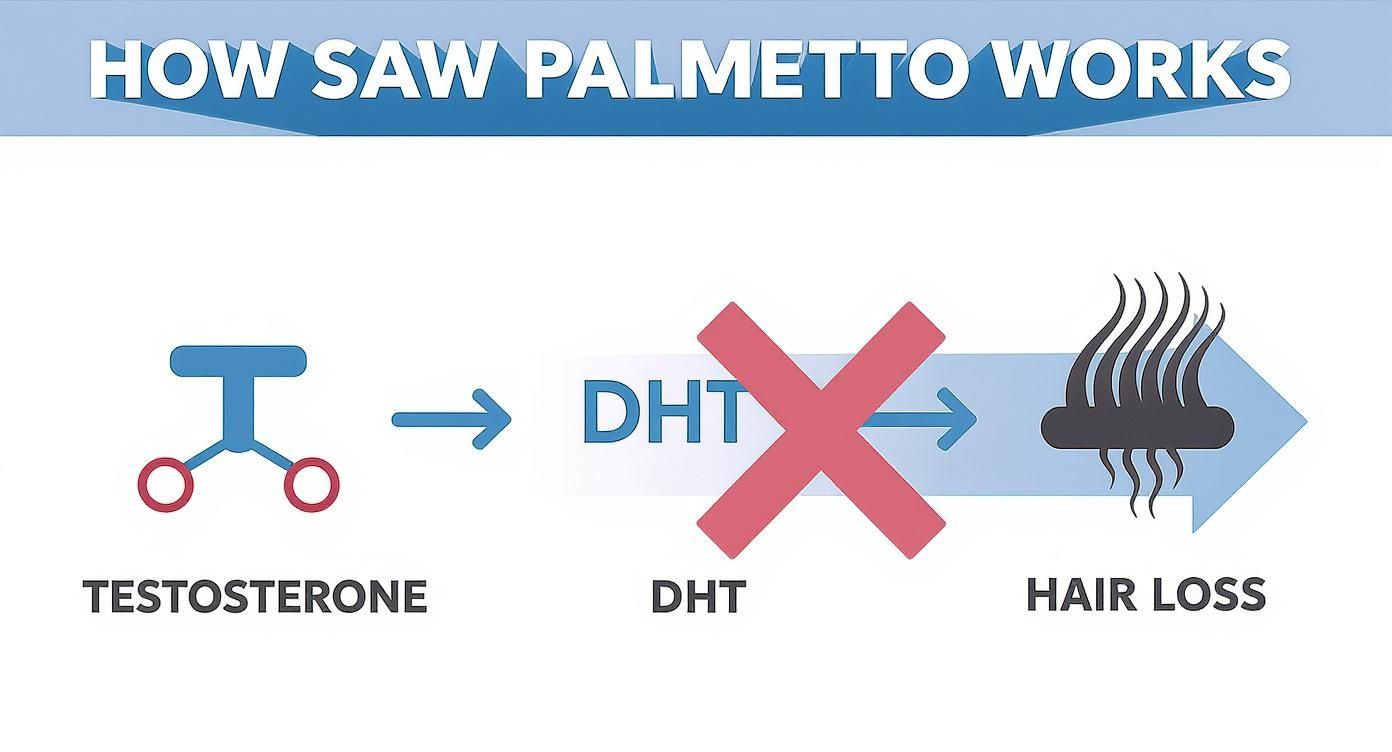
As you can see, the main event is blocking that conversion of testosterone into DHT. By stopping that process, it helps protect your hair follicles from shrinking.
Measuring Real-World Improvements
Beyond just comparing it to other treatments, researchers have also zeroed in on the specific, measurable benefits of taking saw palmetto. They've looked at hard data like hair count, density, and overall hair quality.
Several analyses that pulled together data from multiple studies have shown some really encouraging outcomes. Men using saw palmetto reported improvements in a few key areas:
- Overall Hair Quality: A significant number of guys said their hair just felt and looked healthier.
- Total Hair Count: Some participants saw a real, measurable increase in the number of hairs on their scalp.
- Stabilization: For many men, the biggest win was simply stopping the hair loss from getting any worse.
This data shows that saw palmetto isn't just working in a lab—it's producing tangible results you can actually see and feel. That's a crucial piece of the puzzle when you're trying to decide if it’s the right move for you.
The general consensus from the research is that saw palmetto can be an effective tool against hair loss, particularly for stopping thinning in its tracks and improving hair health in men with mild to moderate cases.
Of course, it's critical to keep expectations in check. Saw palmetto isn't a miracle cure, and results can vary from one person to the next. The 2012 study, for instance, found it was less effective for men who already had advanced hair loss. This really drives home the point that it works best as an early intervention strategy.
To get the full picture, it helps to understand the science behind DHT. Our detailed guide answers the question, "Do DHT blockers work?" and is a great place to start.
Ultimately, the body of research positions saw palmetto as a credible, natural first line of defense. It's also a great complementary piece to a larger hair care strategy. It offers a way to get to the hormonal root of hair loss with a pretty good safety profile, making it a very appealing option for a lot of men.
How to Choose a Quality Saw Palmetto Supplement

Stepping into the supplement aisle can feel overwhelming. With so many brands flashing different claims, how do you know which bottle of saw palmetto for hair loss is actually worth your money?
It’s a crucial decision. The effectiveness of this natural DHT blocker hinges entirely on its quality and concentration. A cheap, poorly made supplement might be packed with useless fillers, meaning you won't get the active compounds needed to see any real benefits for your hair. Let’s cut through the noise and figure out how to pick a high-quality product that actually works.
Forms and Formulations
Saw palmetto comes in a few different forms, and it's good to know the pros and cons of each. You'll mostly see capsules, oils, and even topical solutions.
- Capsules and Softgels: This is the most common way to take saw palmetto. They typically contain either a powdered extract or, even better, a concentrated oil from the berry. Oil-based softgels are often preferred because the active compounds are fat-soluble, which helps with absorption.
- Topical Solutions: Some hair growth shampoos and serums now include saw palmetto. The idea is to target the hair follicles directly, but the jury is still out on whether this is as effective as taking it orally.
No matter which form you choose, one thing is non-negotiable: the extract must be standardized. This ensures you’re getting a consistent and potent dose every single time.
What to Look For on the Label
The supplement label is your best friend here. Forget the flashy marketing on the front of the bottle and flip it over to the "Supplement Facts" panel—that's where the truth lies.
The single most important detail to look for is a standardized extract. You want to see that it’s standardized to contain 85–95% fatty acids and sterols. This specific concentration is the one used in the clinical trials that showed positive results for both prostate health and hair loss.
If the label doesn't mention this standardization, put it back on the shelf. You have no idea if you’re getting an effective dose or just ground-up plant matter.
Key Takeaway: A quality saw palmetto supplement will always specify that it is a standardized extract containing 85-95% fatty acids. Without this, you're essentially flying blind.
Dosage and Third-Party Testing
The most common dosage used in saw palmetto for hair loss studies is 320 mg per day. This is typically split into two 160 mg capsules or taken as a single 320 mg softgel. Of course, it’s always a good idea to run this by your doctor before starting any new supplement.
But how do you know what’s on the label is actually in the bottle? That's where third-party certifications come in. These are seals from independent organizations that verify a product’s purity and potency.
Look for seals like:
- USP (United States Pharmacopeia): This seal confirms the product contains the ingredients listed on the label, in the declared potency and amounts.
- NSF International: This certification ensures the supplement was made in a facility that’s regularly audited for quality and safety.
- GMP (Good Manufacturing Practices): This indicates the manufacturer adheres to strict quality standards. Taking a moment for understanding GMP Certified supplements can give you much more confidence in your purchase.
These certifications are an extra layer of assurance that you’re not wasting your money. For more vetted options, check out our guide to the best DHT blocking supplements, where we feature high-quality saw palmetto.
A broad review of multiple studies found that saw palmetto supplements led to a 60% improvement in overall hair quality and a 27% increase in total hair count for people with androgenetic alopecia. Impressively, hair density improved in over 83% of patients, and the supplement was well-tolerated. Discover more about the research on saw palmetto's impact on hair growth.
Using Saw Palmetto with Other Hair Loss Treatments
Fighting hair loss often feels like you're trying to solve a puzzle, and it's rare that a single piece gives you the whole picture. The smartest approach is building a strategy with multiple moving parts, and this is where saw palmetto for hair loss can really shine as a team player. It’s less about finding one magic bullet and more about creating a powerful combination that works for you.
Let's break down how saw palmetto fits in with other popular treatments so you can build a more effective, personalized routine.
Saw Palmetto and Finasteride: A Natural Starting Point
When you start talking about DHT blockers, finasteride is the prescription-strength heavyweight in the room. Both finasteride and saw palmetto are aiming for the same target: they both mess with the 5-alpha reductase enzyme to bring down DHT levels. The key difference, though, is their potency.
Finasteride is a potent, targeted drug designed specifically for this job and is, frankly, more effective. Saw palmetto is a much milder, natural alternative.
This difference usually leads men to one of a few common scenarios:
- The First Step: A lot of guys are hesitant to jump straight to a prescription medication. Saw palmetto gives you a way to tackle the hormonal root of hair loss without the commitment or potential side effects of a pharmaceutical.
- The Alternative: For men who've tried finasteride and ran into side effects they couldn't tolerate, saw palmetto can be a solid plan B to keep fighting DHT.
Generally, you wouldn't use both at the same time without talking to your doctor, since they’re targeting the exact same mechanism. Think of it like this: one is a precision power tool, and the other is a reliable hand tool. You choose the one that's right for the job and your comfort level.
Combining Forces for Better Results
Where saw palmetto really comes into its own is when you pair it with treatments that work through entirely different channels. While it’s busy managing the internal, hormonal side of things, other therapies can work on the outside to directly stimulate the follicles. This gives you a comprehensive, two-pronged attack on hair loss.
By pairing saw palmetto with a growth stimulant, you're tackling the problem from two angles: reducing the DHT that causes follicle damage while also encouraging the follicles you have to grow stronger and healthier.
Here are a couple of powerful combinations to consider:
Saw Palmetto and Minoxidil
Minoxidil is a growth stimulant. It works by improving blood flow to the scalp and essentially kicking follicles into the growth phase. The important thing to know is that it does absolutely nothing about DHT. This is what makes the combination so perfect. Saw palmetto works from the inside to lower DHT, protecting your hair from getting thinner. At the same time, Minoxidil works on the surface to push for new growth. There are different ways to use it, and you can explore the pros and cons of oral vs topical minoxidil to see what fits your lifestyle.
Saw Palmetto and PRP Therapy
Platelet-Rich Plasma (PRP) therapy uses the growth factors from your own blood to wake up dormant or struggling hair follicles. Just like minoxidil, PRP is all about stimulating growth directly. Adding a daily saw palmetto supplement to your routine can help create the ideal environment for the PRP to do its job, protecting those newly energized follicles from the ongoing threat of DHT.
At the end of the day, making saw palmetto part of a bigger plan is a strategic move. It lets you cover your bases by addressing the root hormonal cause while using other tools to actively promote new growth, giving you a much stronger defense against thinning hair.
Understanding Potential Side Effects and Safety

Any time you add a new supplement to your routine, the first question should always be, "Is it safe?" When we're talking about saw palmetto for hair loss, the answer is overwhelmingly positive. Decades of use and clinical research paint a clear picture: it's generally safe and most men handle it just fine. Serious side effects are very uncommon.
That said, it’s not completely free of potential issues. Anything that can influence your body's chemistry has the potential to cause a few ripples. The good news is that the problems people report are typically minor and often fade as your body gets used to the supplement. Knowing what to look for helps you stay in control.
Common and Mild Side Effects
Most of the side effects tied to saw palmetto are digestive—think minor annoyances rather than major problems.
Some men might notice:
- Stomach Upset: This is the big one. It can show up as a bit of nausea or a stomachache.
- Headaches: A few guys report mild headaches, particularly when they first start taking it.
- Dizziness: It’s less common, but some people can feel a little lightheaded.
Here’s a simple trick that works for most people: take your saw palmetto supplement with food. A meal acts as a buffer and can often head off any stomach-related complaints before they start. If the symptoms don't go away, that’s your cue to talk to your doctor.
While saw palmetto is known for its strong safety record, listening to your body is key. Mild digestive issues are the most common hurdle, and taking the supplement with a meal is the easiest fix.
Important Drug Interactions to Know
Now, this is where you need to pay close attention. Because saw palmetto can have a mild effect on hormones and blood, it can potentially clash with certain prescription medications.
You need to be especially careful if you're taking:
- Blood Thinners: Saw palmetto might have a subtle blood-thinning property. If you combine it with anticoagulants or antiplatelet drugs (like warfarin or even daily aspirin), you could increase your risk of bleeding.
- Hormone-Related Medications: Since saw palmetto works by influencing DHT levels, it could theoretically interact with any hormone-based treatments. This includes testosterone replacement therapy or even medications like oral contraceptives.
This isn't a complete list, which is why having an open conversation with your doctor is non-negotiable. Before you even think about starting saw palmetto, you must go over your entire list of medications and supplements with your healthcare provider. It’s a simple step, but it’s the most important one you can take to use saw palmetto for hair loss safely.
Answering Your Questions About Saw Palmetto for Hair Loss
Alright, let's wrap up by tackling some of the most common questions that pop up when guys are thinking about trying saw palmetto for hair loss. Getting solid answers to these can help you figure out if it's the right move for you and what to expect along the way.
How Long Until I See Any Results?
When it comes to saw palmetto, patience is your best friend. This isn't a magic bullet; it works by slowly dialing back DHT's attack on your hair follicles. Think of it less as a quick fix and more as a long-term play to manage hair thinning.
Most guys need to stick with it for at least three to six months before they start to see any meaningful changes. The first clues are usually subtle—maybe you notice a little less hair shedding in the shower drain or on your pillow. Real, visible improvements in hair thickness or density can take even longer, sometimes closer to a year.
Can Women Use Saw Palmetto for Hair Loss?
This one is a bit more complex. While women also experience androgenetic alopecia, saw palmetto's effect on hormones makes it a tricky option. Since it messes with androgen levels, it has the potential to throw a woman's natural hormonal balance out of whack.
Because of this, it's absolutely critical for women to speak with a doctor before even thinking about it. A healthcare provider needs to diagnose the root cause of the hair loss and determine if a supplement that influences hormones is safe or even appropriate. Saw palmetto should never be used by women who are pregnant, breastfeeding, or planning to become pregnant.
Is Topical Saw Palmetto as Good as Taking the Pills?
The idea of putting saw palmetto directly on the scalp is definitely catching on, and it makes a lot of sense. Topical versions, like serums and shampoos, are designed to get the active ingredients right to the source—the hair follicle—which might lower the risk of side effects throughout the body.
The latest research looks pretty good, too. One controlled study found that taking saw palmetto orally reduced hair shedding by up to 29%, but a topical application also delivered an impressive 22% reduction. What's really interesting is that the same study showed the topical version produced a slightly better increase in hair density (7.61%) compared to the oral supplement (5.17%). These results suggest that a topical approach can be a powerful alternative. You can dive into the details of this hair loss study on saw palmetto.
The bottom line is that both oral and topical saw palmetto have been shown to work. The choice really boils down to your personal preference and how you want to balance effectiveness with the potential for side effects.
Here at PRP For HairLoss, our mission is to give you clear, science-backed information to help you navigate the world of hair loss treatments. Feel free to explore our site to learn more about advanced options like PRP therapy.
 PRP For Hairloss
Leave a comment