Yes, low ferritin can absolutely cause hair loss. It's one of the most common—and often overlooked—reasons for excessive shedding, but it's rarely the only thing going on. This makes it a particularly frustrating piece of the hair loss puzzle. If you've been noticing more hair in your brush or circling the shower drain, checking your iron stores is a crucial first step.
The Hidden Connection Between Iron And Your Hair
Ever feel like you’re doing everything right for your hair—using the best products, eating well—but still shedding more than seems normal? The problem might not be what you’re putting on your head, but what’s happening inside your body. Specifically, it could all come down to a protein you’ve probably never even heard of: ferritin.
Think of ferritin as your body's iron savings account. Iron is the cash you use for essential daily tasks, like carrying oxygen in your blood. Ferritin is the vault where you store all your iron reserves for a rainy day.
When your iron intake drops, or your body starts using more than you're getting, it begins dipping into that ferritin vault. You won't notice it at first. But as those iron stores get lower and lower, your body is forced to make some tough choices about where to spend its energy.
Your Body's Priority System
Your body is incredibly efficient and hardwired for survival. Essential functions—like keeping your heart beating and your brain firing—always get first dibs on resources like iron.
So, what gets the chop when supplies run low? Unfortunately, hair growth is high on the non-essential list. Growing hair is an energy-demanding process, and when your body detects a drop in its iron reserves (low ferritin), it cuts the power to "luxury" functions like hair production to support your vital organs instead.
The result? Your hair follicles are starved of the iron they need to maintain a healthy growth cycle. This can prematurely push a large number of hairs from their growing phase (anagen) straight into the shedding phase (telogen), triggering a type of diffuse thinning known as telogen effluvium.
To put it all into perspective, here's a quick rundown of how these pieces fit together.
Low Ferritin and Hair Loss at a Glance
| Concept | What It Means for Your Hair |
|---|---|
| Iron | This is the raw material needed to produce hemoglobin, which carries oxygen to your cells, including the ones that build your hair strands. |
| Ferritin | This is the protein that stores your body's iron. It’s the best indicator of your long-term iron reserves, not just what's circulating today. |
| The Body’s Triage | When iron stores (ferritin) are low, your body redirects iron to vital organs first. Hair growth is considered non-essential and gets put on the back burner. |
| Telogen Effluvium | This is the medical term for stress-induced shedding. Low ferritin is a major metabolic stressor that can push more hair into the shedding phase. |
Ultimately, a lack of stored iron tells your body it's time to conserve resources, and one of the first things to go is robust hair growth.
Is Low Ferritin The Only Cause?
It's really important to understand that low ferritin rarely acts alone. It often works in tandem with other factors to trigger or worsen hair loss. While it's a significant piece of the puzzle, it's just one piece. Other culprits like genetics, hormonal shifts, and stress play huge roles. On top of that, other nutritional gaps can make matters worse, which is why it helps to know how vitamin deficiency can cause hair loss too.
This guide will cut through the noise and give you a clear, evidence-based look at the ferritin-hair loss link. We'll break down the science without the jargon, helping you figure out if low iron could be the missing link in your hair health journey—and what you can do about it.
What Ferritin Is and Why Your Hair Needs It
To really get to the bottom of the low ferritin and hair loss connection, we first need to clear up two terms that often get tangled up: iron and ferritin. They're related, but they do very different jobs inside your body.
Iron is the actual mineral. It's a key building block for hemoglobin, the protein in your red blood cells that's responsible for a crucial task: carrying oxygen from your lungs to every single cell in your body. That includes the tiny, hard-working cells that build each strand of hair.
Ferritin, on the other hand, isn't the iron itself—it's the protein that stores the iron. Think of it as your body's dedicated iron bank vault. When you eat iron-rich foods, your body takes what it needs for immediate tasks and squirrels the rest away inside ferritin molecules. This stored supply is incredibly important, acting as a buffer that can be tapped into whenever your daily iron intake doesn't quite cut it.
The Savings Account Analogy
Let's run with that bank analogy for a moment. Think of the iron you eat every day as your paycheck. The iron actively circulating in your blood is like the cash in your wallet—ready for immediate, everyday spending. Ferritin is your savings account, holding your reserves for bigger projects or unexpected shortfalls.
When your body needs to build new cells, create energy, or keep your organs running smoothly, it makes a withdrawal. As long as your "paychecks" (your diet) keep coming in steadily, your "savings account" (ferritin) stays topped up. But if you start spending more than you're bringing in, your body has no choice but to start dipping into those savings.
And that's exactly where the trouble starts for your hair.
How Your Hair Follicles Get Shortchanged
Your hair follicles are some of the most rapidly dividing cells in your entire body. The process of building a single strand of hair is incredibly energy-demanding, requiring a steady, reliable stream of oxygen and nutrients to get the job done.
When your body senses that its ferritin savings account is running low, it immediately kicks into survival mode. It starts rationing its resources, deciding what's essential and what's not. Vital functions—your heart, your brain, your major organs—are always at the top of the list. They get all the iron they need, no questions asked.
Unfortunately, in this biological pecking order, hair growth is considered a luxury.
Your body essentially says, "We've got a resource shortage on our hands. We can't afford to waste precious iron on growing hair right now." It then diverts iron away from the hair follicles to make sure the systems critical for survival stay fully supplied. This sudden budget cut throws the hair growth cycle out of whack, pushing more follicles than usual into the resting and shedding phase.
While that sounds pretty direct, the medical community has found the relationship isn't always so clear-cut. Research has produced conflicting results over the years. For example, one study found that 61.9% of women experiencing hair loss actually had ferritin levels considered normal (above 30 µg/l), which complicates the idea that low ferritin is always the culprit. Yet, other studies show that younger women with hair loss often have much lower ferritin than their peers without hair issues, hinting that it plays a bigger role in certain groups. You can see the debate for yourself in these hair loss and ferritin studies on Karger.com.
Ultimately, while ferritin is a major piece of the puzzle, it's just one piece. You have to look at the whole picture of your nutritional health. To get a better handle on that, check out our guide on what vitamins prevent hair loss to make sure all your bases are covered. This bigger context helps explain why asking "can low ferritin cause hair loss" is a question with a surprisingly complex answer, one that often goes beyond a single number on a lab report.
So, What Does All This Conflicting Research Mean for You?
If you've spent any time online trying to figure out if low ferritin can cause hair loss, you've probably walked away confused. It’s a real head-scratcher. One study seems to scream "yes!" while the next one says "not so much." So, what's the deal?
Let's break down the two sides of the argument.
The Case for a Connection
Many studies draw a pretty clear line between low ferritin and hair loss, especially when they compare people experiencing shedding to those with healthy hair. The evidence often points to significantly lower iron stores in the hair loss group.
For example, a study looking at both serum ferritin and vitamin D found that people complaining of hair loss had noticeably lower iron reserves.
- In that research, only 9.1% of healthy participants had low ferritin, while a whopping 90.9% were in the normal range. That's a statistically significant difference compared to the group with alopecia.
- The average ferritin levels were way lower in the hair loss group, making a strong case that for many people, this connection is very real.
You can dive deeper into these specific numbers in the full research findings.
The Case Against a Strong Link
On the flip side, you'll find plenty of research that questions just how important iron really is. These studies often compare people with different types of hair loss (like diffuse thinning or pattern baldness) to a control group and find… well, not much. They just don't see a significant difference in iron levels between the groups.
Some major studies have even concluded that the role of iron in female hair loss might be overblown. They found that most women experiencing hair loss actually had normal ferritin levels. This perspective suggests that while iron deficiency might be a factor for some, it's rarely the sole cause.
Finding the Middle Ground
So how do we make sense of this? It's not about one side being right and the other wrong. It's about looking at the nuances. The truth is, a one-size-fits-all answer just doesn't exist here. The connection between iron and hair often depends on the individual. For instance, younger women, those with heavy menstrual cycles, or people with a specific type of shedding called telogen effluvium often show a much stronger link.
It's also crucial to look at how these studies are conducted:
- Different Cutoff Points: One study might consider a ferritin level of 15 ng/mL as "low," while another uses 40 ng/mL. This alone can completely change the results.
- Who Is Being Studied: The sample size, age, and gender of the participants can make a huge difference.
- Selection Bias: Often, only people who are already worried about their hair get their ferritin tested, which can skew the data.
Understanding these details helps explain why iron might be a huge deal for one person but completely irrelevant for another.
Your Practical Takeaway
While low ferritin isn't a smoking gun for hair loss, it’s absolutely a clue worth investigating. A "normal" lab result from your doctor might not be what's optimal for healthy hair. Many hair loss specialists and trichologists now consider a ferritin level below 30 ng/mL to be a potential red flag, even if it's technically within the standard reference range.
Here’s what you can do:
- Ask your doctor specifically for a serum ferritin test. Don't just assume it's part of a standard blood panel.
- Have a conversation about optimal levels for hair health, not just general health.
- While you're at it, consider checking other key nutrients like vitamin D, zinc, and B12.
By arming yourself with this information, you can have a much more productive conversation with your doctor. Your test result isn't a diagnosis on its own—it's a starting point.
Remember, hair loss is almost always multifactorial. Low ferritin might be a contributing piece of the puzzle, but it often works in tandem with genetics, hormones, stress, or other factors. Seeing both sides of the research helps you ask the right questions and move forward with clarity.
Next Steps With Your Doctor
When you go for a hair loss consultation, bring your ferritin results with you. Explain your symptoms and ask your doctor if they think your iron status could be tipping the scales toward more shedding.
- Point out the numbers: Compare your result to the 30 ng/mL benchmark often cited for hair health.
- Ask for the full picture: Inquire about a full iron panel, which includes tests like TIBC and transferrin saturation, to get a better sense of how your body is using iron.
- Create a plan: Discuss a timeline for retesting to monitor your progress once you start any treatment.
Combining this data with a proper scalp examination gives you and your doctor a much clearer roadmap. By working together, you can make low ferritin a manageable part of your hair restoration journey, not a lingering mystery.
How to Understand Your Ferritin Lab Results
Getting your blood tested is the first step, but the real challenge often starts when the report lands in your hands. A list of numbers and medical jargon can be more confusing than helpful, especially when you're trying to figure out what it all means for your hair. Let’s break down how to decode these results so you can have a more productive chat with your doctor.
When your doctor wants to check your iron status, they'll order a serum ferritin test. This isn't a measure of the iron actively floating around in your blood; think of it more like checking the balance of your body's iron savings account. It's the single best indicator of your long-term iron reserves, which makes it far more insightful than a simple iron or hemoglobin test alone.
The Problem with "Normal" Lab Ranges
This is where things get tricky, and frankly, where a lot of people get confused. You get your results, and your doctor might say, "Everything looks normal." While that's great news for your overall health, it might not tell the whole story for your hair. Standard lab ranges are set wide to catch outright medical problems like anemia, not to pinpoint the optimal levels needed for non-essential, energy-hungry processes like growing a full head of hair.
For those wanting to dig deeper into their body's biomarkers beyond what a standard physical offers, exploring comprehensive blood testing services like Function Health can be an insightful next step, as they often provide a much more granular view of your health markers.
Optimal vs. Normal: What Your Hair Actually Needs
A typical lab might flag a "normal" ferritin range for an adult woman as anything from 15 to 150 ng/mL (nanograms per milliliter). So, if your result comes back at 25 ng/mL, you are technically within the normal window. No red flags for your doctor.
But here’s the thing: many dermatologists and trichologists (the real hair specialists) would tell you that a level of 25 ng/mL is nowhere near enough to support healthy, thriving hair growth.
To help clear this up, here’s a breakdown of what the numbers mean from a hair health perspective.
Interpreting Ferritin Lab Results for Hair Health
| Ferritin Level (ng/mL) | Standard Lab Interpretation | Hair Health Interpretation |
|---|---|---|
| Below 15 | Iron-Deficient Anemia | Severe depletion. Hair loss is highly likely. |
| 15-40 | "Low Normal" / Acceptable | Insufficient for hair. The body prioritizes iron for essential functions, leaving little for follicles. |
| 40-70 | "Normal" / Healthy | A good starting point. Many specialists aim for at least 50 ng/mL to see hair improvements. |
| 70-100 | "Optimal" / Healthy | The ideal range for robust hair growth and minimizing shedding. |
As you can see, what's considered "normal" for general health and what's optimal for your hair are two very different things.
For truly healthy hair growth, many experts believe your ferritin level needs to be at least 50 ng/mL, with some pushing for a target closer to 70 ng/mL. At those lower-but-technically-normal levels, your body has just enough iron to keep vital functions running, but there's simply nothing left in the tank to power your hair follicles.
This infographic captures the ongoing debate in the research community, showing why some studies find a clear link while others don't.
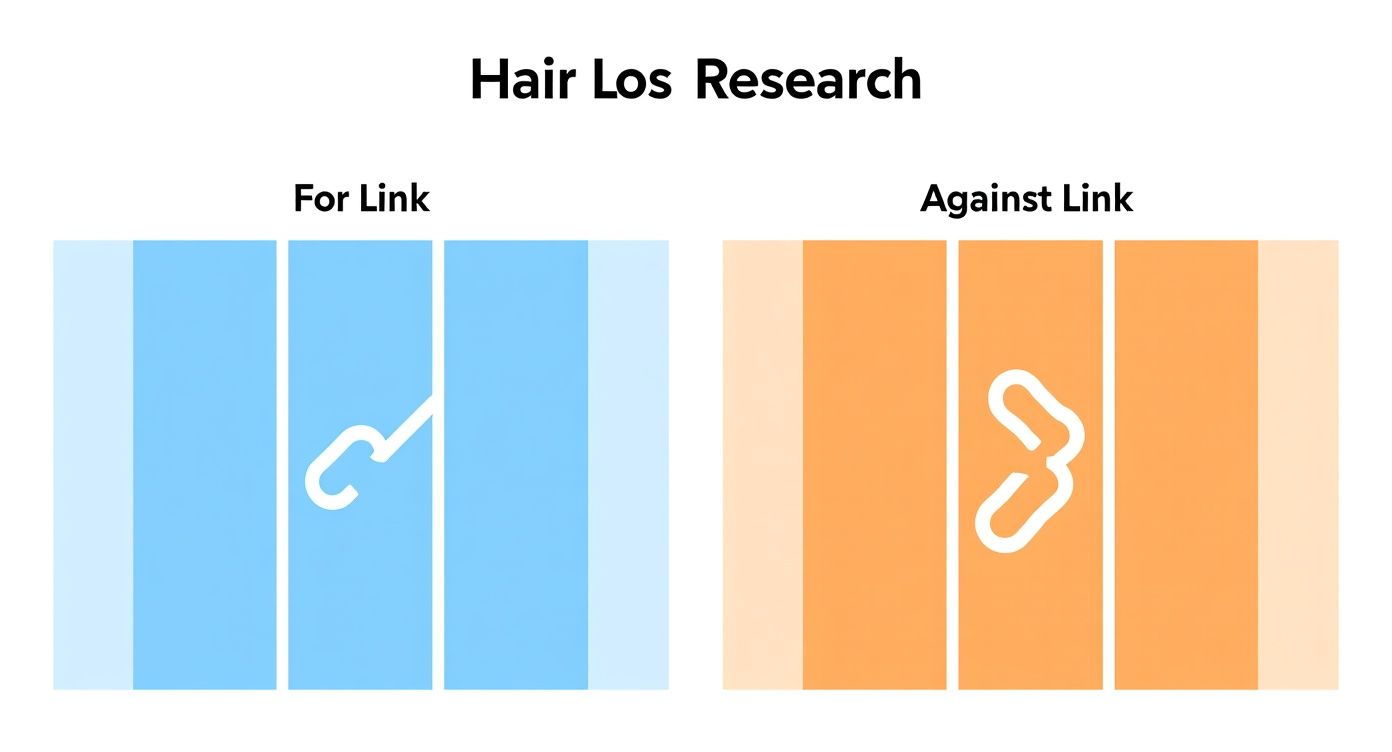
This scientific debate is exactly why understanding your numbers in the context of hair health is so critical.
Other Important Iron Tests
While ferritin is the star of the show, a few other tests can paint a more complete picture. If you're serious about figuring out if low iron is behind your hair loss, it's a good idea to ask your doctor for a full iron panel.
This panel usually includes:
- Serum Iron: Measures the amount of iron currently circulating in your blood.
- Total Iron-Binding Capacity (TIBC): This test checks how well a specific protein (transferrin) can carry iron through your blood. A high TIBC often points to an iron deficiency.
- Transferrin Saturation: This calculates the percentage of your transferrin that's actually busy carrying iron. Low saturation is another strong sign of depleted iron stores.
Having these extra data points can really strengthen your case, especially if your ferritin is stuck in that gray area—not low enough to be diagnosed with anemia, but still too low for healthy hair. For a deeper dive, you can learn more about how to read blood test results in our guide. Knowing what these terms mean empowers you to become an informed partner with your doctor on your hair restoration journey.
A Realistic Plan to Restore Your Ferritin Levels
So, the lab results are in, and they confirm your iron stores are scraping the bottom of the barrel. The big question is, what now? Getting your ferritin back to a healthy, hair-supporting level is a marathon, not a sprint. It takes a smart, patient approach, but with a solid plan, you can absolutely rebuild those reserves.
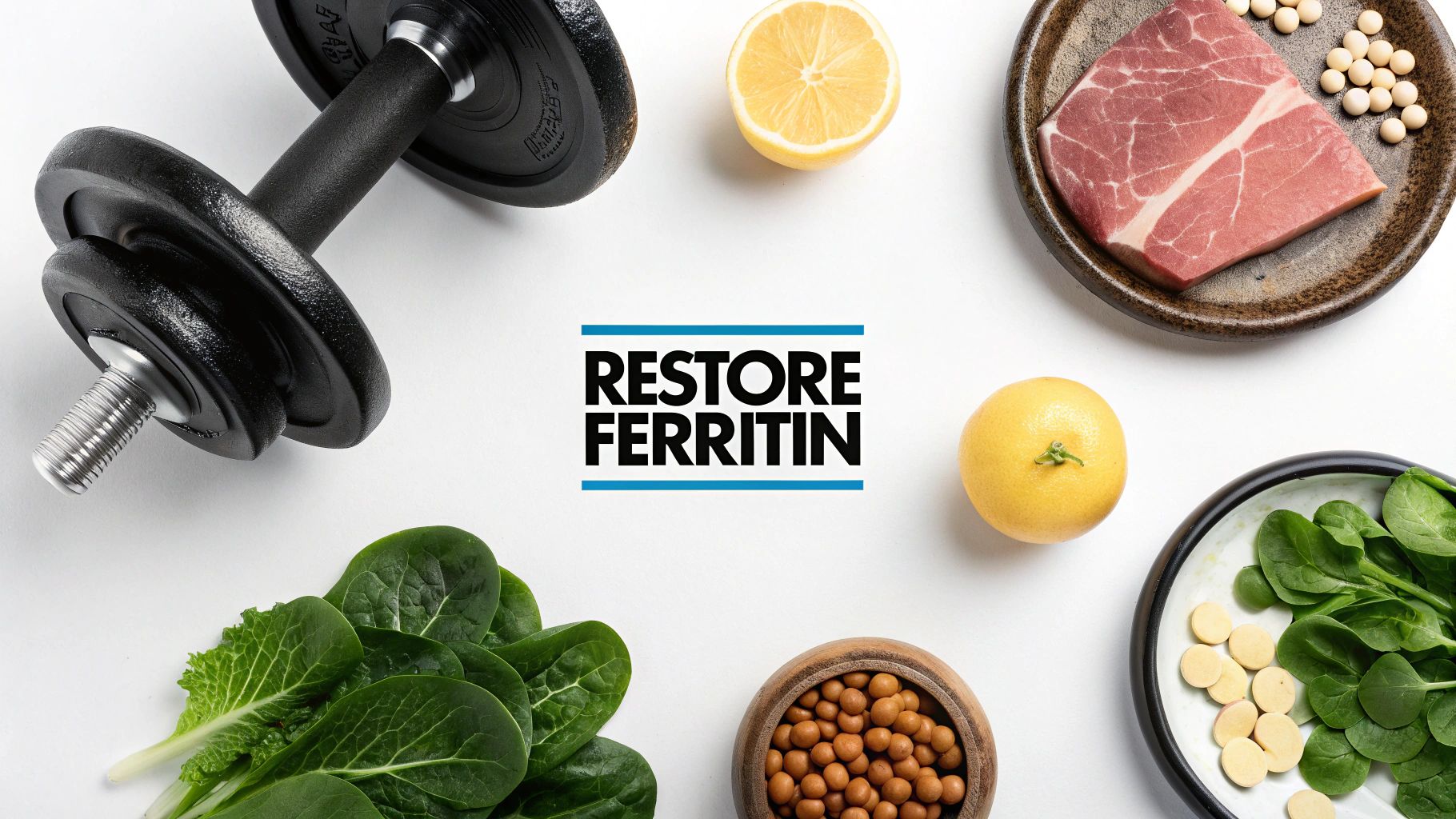
The journey back to healthy ferritin levels really boils down to a two-pronged attack: targeted supplements (with a doctor's guidance, of course) and intelligent food choices. Let's dig into what that actually looks like.
The Role of Iron Supplements
For most people with truly low ferritin, just changing your diet isn't going to cut it—at least not quickly. This is where iron supplements become your heavy lifters, but you absolutely have to approach them correctly.
This part is critical: taking iron when you don't need it can be dangerous. Your body doesn't have an easy way to get rid of excess iron, and a buildup can lead to a nasty condition called iron overload, which can damage your organs. That's why you should never self-prescribe iron supplements. Always work with your doctor, who can pinpoint the right type and dosage for you.
Your doctor will likely recommend one of a few common forms of iron:
- Ferrous Sulfate: The old standby. It’s effective and inexpensive, but it’s also notorious for being rough on the digestive system.
- Ferrous Gluconate: Generally considered a gentler option on the stomach compared to ferrous sulfate.
- Iron Bisglycinate: This is a chelated form, which is just a fancy way of saying it's bound to an amino acid. It's known for being absorbed very well with far fewer gastrointestinal side effects.
Pro Tip: To get the most out of every dose, take your iron with a little Vitamin C. A small glass of orange juice or a simple Vitamin C tablet can dramatically increase how much iron your body actually absorbs and uses.
Fueling Your Body with Iron-Rich Foods
While supplements are doing the initial heavy lifting, your daily diet is what will maintain your iron levels for the long haul. Think of it as building a sustainable foundation for healthy ferritin stores.
There are two kinds of iron you'll find in food, and they behave very differently in the body:
- Heme Iron: This is the VIP of iron, found in animal products like red meat, poultry, and fish. Your body absorbs it very easily.
- Non-Heme Iron: Found in all the good plant-based stuff like lentils, spinach, beans, and fortified cereals. Your body has to work a bit harder to absorb this type.
You can get smarter with your meals to boost absorption. For example, pairing a non-heme source with a heme source—like adding lentils to your chicken soup—gives the non-heme iron a little boost. Better yet, always add Vitamin C to any iron-rich meal. A squeeze of lemon over your spinach or some bell peppers with your beans makes a huge difference. For more inspiration, check out this guide on the best foods for hair growth.
If you follow a vegetarian diet, it's even more important to be strategic. Exploring well-designed vegetarian meal plans can help ensure you’re hitting your iron targets consistently.
Patience is a Virtue: The Hair Growth Cycle
Okay, here’s where you need to take a deep breath and settle in for the long haul. Restoring your iron stores takes time, and seeing the results in your hair takes even longer. It can easily take a few months of consistent supplementation to get your ferritin back into that sweet spot above 50-70 ng/mL.
Once your ferritin is back up, your hair follicles can finally breathe a sigh of relief and get the fuel they need to kick back into their growth phase. But remember, hair only grows about half an inch per month. You're looking at 3-6 months after your levels have normalized before you'll notice a real drop in shedding and the first signs of new growth.
Stick with your plan, get your levels re-checked by your doctor, and keep your expectations realistic. That’s the key. Fixing low ferritin absolutely makes a difference in hair loss, but it's a process that rewards patience.
Why Your Ferritin Level Can Make or Break Hair Growth Treatments
If you're thinking about investing in PRP or other regenerative therapies for hair loss, your iron stores are a critical piece of the puzzle. The success of these treatments often hinges on something as simple as your ferritin level.
Think of it this way: regenerative treatments work by kickstarting your body's own repair mechanisms. Processes like cell division and building new tissue are incredibly energy-intensive, and they absolutely depend on iron to happen.
If your ferritin is low, your body just doesn't have the raw materials it needs to build and repair. It's like trying to build a house without enough bricks. For this reason, any reputable clinic will insist on checking your ferritin levels before starting treatment. The goal is to create the perfect environment for growth before a single needle ever touches your scalp.
- PRP Needs Iron to Work: The platelets in PRP send powerful signals to wake up your hair follicles, but the follicles need a steady supply of iron to respond to those signals and actually grow hair.
- The Threshold for Success: Research and clinical experience suggest that ferritin levels below 50 ng/mL can seriously hinder how well these treatments work.
- Test Before You Treat: Getting a simple ferritin test before your first session is the smartest move you can make. It allows you and your doctor to get your iron levels right where they need to be, ensuring you get the most out of your investment.
"Iron is a fundamental building block for DNA synthesis in the hair follicle matrix," a leading trichologist often explains. This underscores why checking ferritin isn't just a suggestion—it's non-negotiable for achieving the best results.
The Synergy Between Healthy Ferritin and PRP
When your ferritin levels are in that sweet spot, PRP treatments can deliver faster, more noticeable, and more consistent results. It's a powerful synergy.
One clinic, for instance, reported that patients with ferritin levels above 70 ng/mL saw a 30% higher increase in hair count after just three PRP sessions compared to those with lower levels.
This happens because iron helps your cells effectively use the potent growth factors that are released from the platelets during a PRP injection. Without enough iron in the tank, those growth signals can fizzle out before they have a chance to truly rejuvenate the follicle.
How to Get Your Iron Levels Ready for Treatment
Getting ahead of the game is simple.
- Ask your doctor for a serum ferritin test, explaining it's to assess your readiness for hair loss treatment.
- Talk to them about an ideal target range. For hair health, this is often between 50–70 ng/mL.
- If your number comes back low, work with your doctor on a plan to raise it through iron therapy, dietary changes, or both.
You can dive deeper into how iron optimization fits into a broader treatment strategy in our guide on Is PRP Effective for Hair Loss.
Key Takeaways on Ferritin and Hair Growth
- Low ferritin doesn't just cause shedding; it can actively sabotage hair restoration treatments.
- Top-tier clinics test ferritin because they are committed to delivering effective outcomes for their patients.
- Getting your ferritin up can completely transform the success you see from PRP or similar therapies.
Understanding that the question "can low ferritin cause hair loss?" is only half the story is crucial. The other half is realizing why healthy ferritin levels are the foundation for any successful hair restoration journey.
Gearing Up for Your First PRP Session
Once you have your ferritin test results, share them with your practitioner well before your first appointment. This gives them time to tailor your treatment plan. They might suggest pushing back your start date or recommend a personalized iron-boosting protocol.
Here’s a simple checklist to prepare:
- Schedule a re-test about 4–6 weeks before your planned first PRP session to confirm your levels are in the optimal range.
- Start an iron-rich plan right away, combining supplements (if recommended by your doctor) with iron-packed foods.
- Always take your iron with vitamin C to dramatically improve how well your body absorbs it.
Just as a house needs a strong foundation before the walls go up, your scalp needs a solid iron reserve before regenerative therapies can do their magic.
By making your ferritin level a priority, you're setting the stage for PRP to deliver on its promise of thicker, healthier, and more vibrant hair. Don't wait—start optimizing your ferritin today.
Common Questions About Ferritin and Hair Loss
As we've unpacked the connection between ferritin and hair health, a few key questions tend to pop up again and again. Let's tackle some of the most common ones that people have on their hair restoration journey.
Will Raising My Ferritin Stop Hair Loss Immediately?
This is the big one, and the honest answer involves a bit of patience. Raising your ferritin levels won't stop hair loss in its tracks overnight. Think of it like refilling a reservoir after a long drought—it takes time.
First, you have to consistently build your body's iron stores back up to a healthy level, which can take several months. Only then can your hair follicles get the message and start responding. Since hair has its own growth cycle, you're likely looking at another 3 to 6 months before you see a noticeable difference in shedding and new growth.
Is Iron Deficiency a Common Cause of Alopecia?
It’s a major player, but it's not the only cause. A landmark study revealed something fascinating: while only 5% of alopecia patients were anemic, a much larger group—around 25%—had low iron stores without being anemic.
What's really interesting is that the study found this issue was almost exclusively a problem for women, pointing to a clear demographic risk. You can dig into the specifics in the research published by the NCBI.
This tells us that for about one in four people struggling with hair loss, low ferritin is a huge piece of the puzzle. It’s a critical checkpoint, but not a one-size-fits-all diagnosis.
Can I Have Low Ferritin Without Being Anemic?
Yes, and this is where a lot of confusion comes from. Anemia is what happens when your iron deficiency becomes so severe that it affects your red blood cells and hemoglobin. That's the final stage.
Your ferritin—your body's "iron savings account"—can hit rock bottom long before you ever become officially anemic. This is exactly why low ferritin can cause hair loss even when your primary doctor says your standard blood work looks normal. Your body is smart; it's already diverting iron away from non-essential functions like hair growth to protect your vital organs, long before it shows up as anemia.
At PRP For Hairloss, we believe that getting to the root cause of your hair loss is the only way to find a truly effective solution. We're here to give you the knowledge you need to make the best decisions for your hair. To learn more, check out our blog at https://prpforhairloss.com.

 PRP For Hairloss
Leave a comment